
Physics Spring 2016 Semester Exam Study Guide Answers
- Slides: 34
Physics Spring 2016 Semester Exam Study Guide Answers
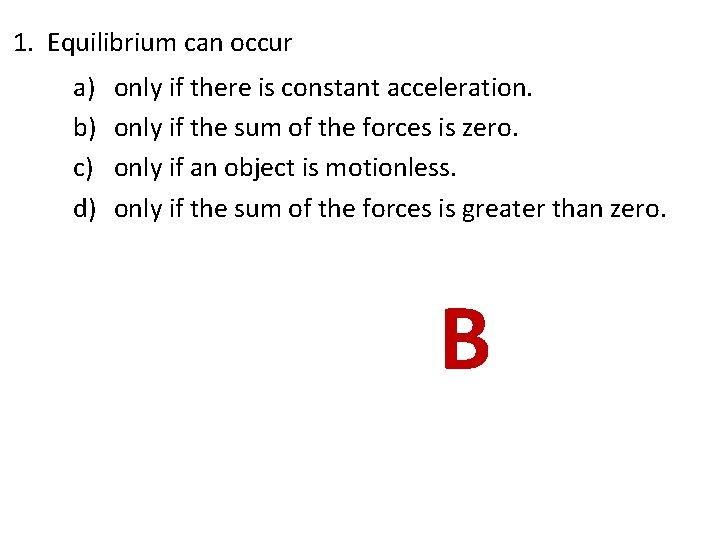
1. Equilibrium can occur a) b) c) d) only if there is constant acceleration. only if the sum of the forces is zero. only if an object is motionless. only if the sum of the forces is greater than zero. B
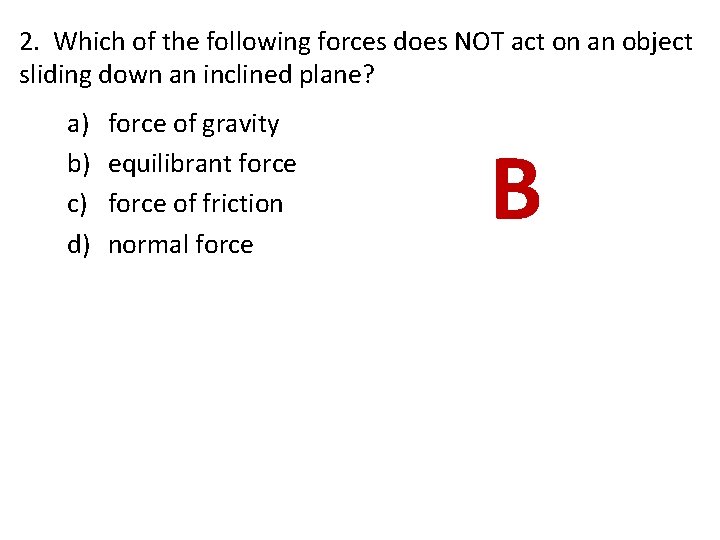
2. Which of the following forces does NOT act on an object sliding down an inclined plane? a) b) c) d) force of gravity equilibrant force of friction normal force B
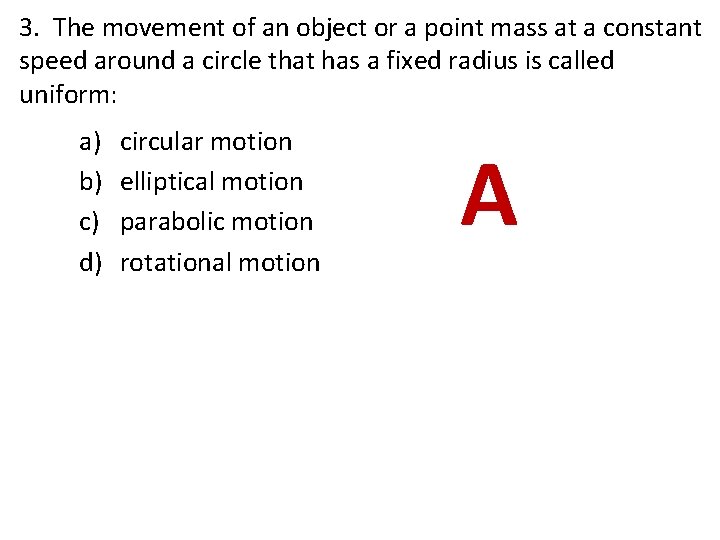
3. The movement of an object or a point mass at a constant speed around a circle that has a fixed radius is called uniform: a) b) c) d) circular motion elliptical motion parabolic motion rotational motion A
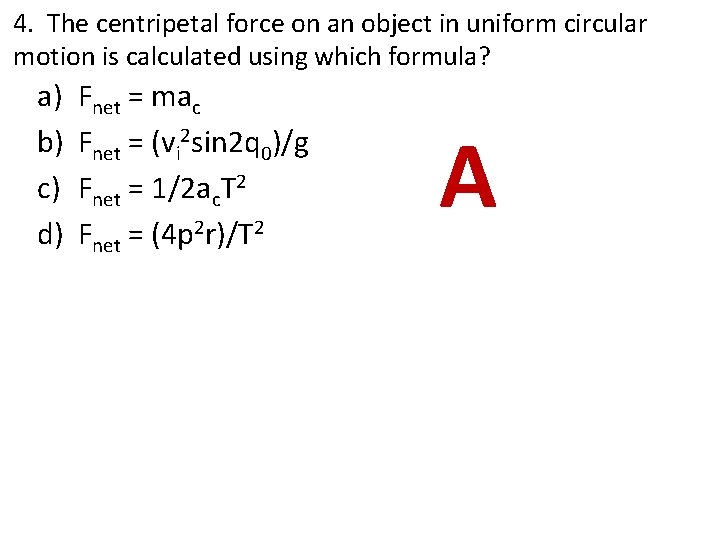
4. The centripetal force on an object in uniform circular motion is calculated using which formula? a) b) c) d) Fnet = mac Fnet = (vi 2 sin 2 q 0)/g Fnet = 1/2 ac. T 2 Fnet = (4 p 2 r)/T 2 A
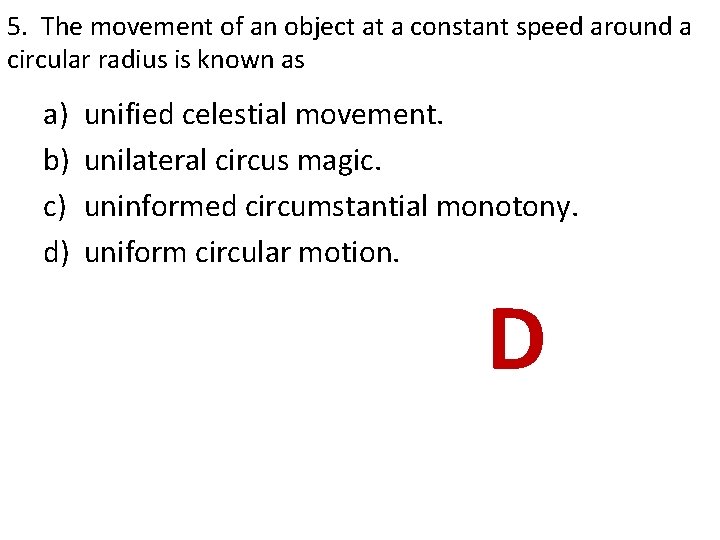
5. The movement of an object at a constant speed around a circular radius is known as a) b) c) d) unified celestial movement. unilateral circus magic. uninformed circumstantial monotony. uniform circular motion. D
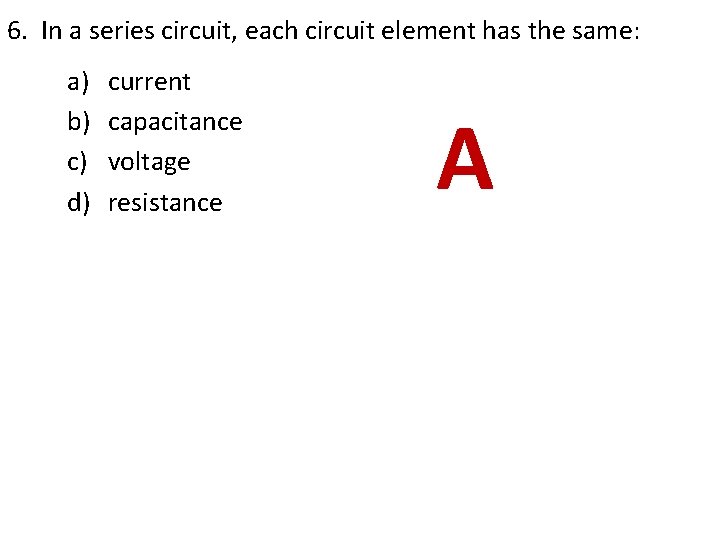
6. In a series circuit, each circuit element has the same: a) b) c) d) current capacitance voltage resistance A
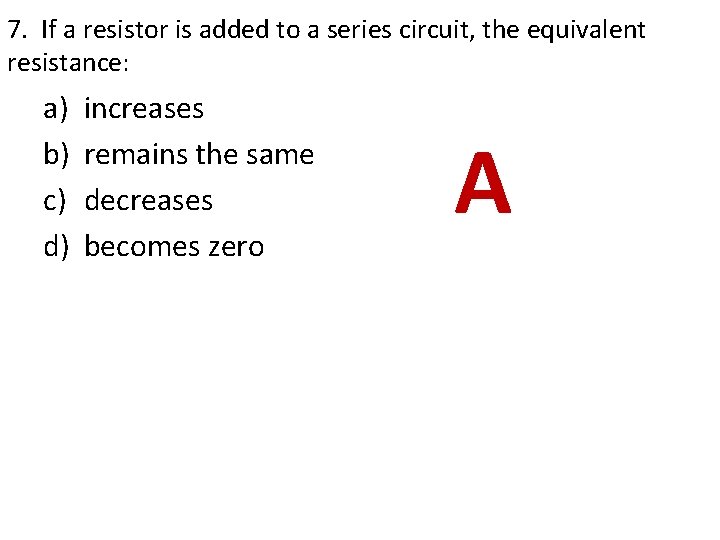
7. If a resistor is added to a series circuit, the equivalent resistance: a) b) c) d) increases remains the same decreases becomes zero A
8. If a resistor is added to a parallel circuit, the equivalent resistance: a) b) c) d) increases remains the same decreases becomes zero C
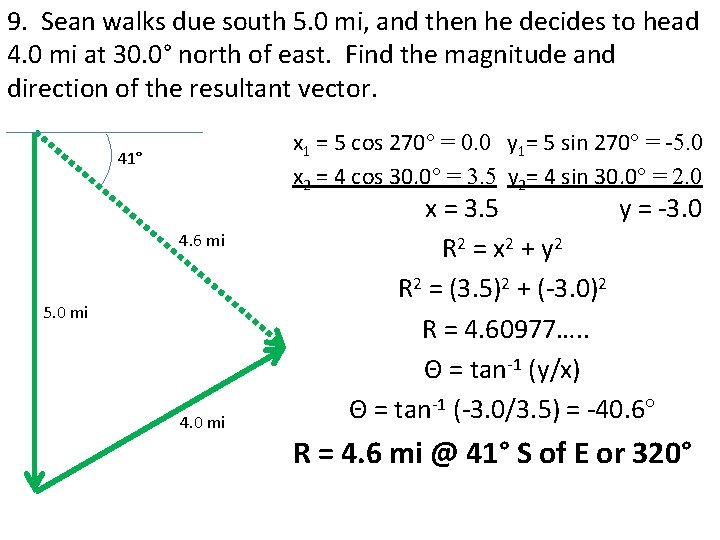
9. Sean walks due south 5. 0 mi, and then he decides to head 4. 0 mi at 30. 0° north of east. Find the magnitude and direction of the resultant vector. x 1 = 5 cos 270° = 0. 0 y 1= 5 sin 270° = -5. 0 x 2 = 4 cos 30. 0° = 3. 5 y 2= 4 sin 30. 0° = 2. 0 41° 4. 6 mi 5. 0 mi 4. 0 mi x = 3. 5 y = -3. 0 R 2 = x 2 + y 2 R 2 = (3. 5)2 + (-3. 0)2 R = 4. 60977…. . Θ = tan-1 (y/x) Θ = tan-1 (-3. 0/3. 5) = -40. 6° R = 4. 6 mi @ 41° S of E or 320°
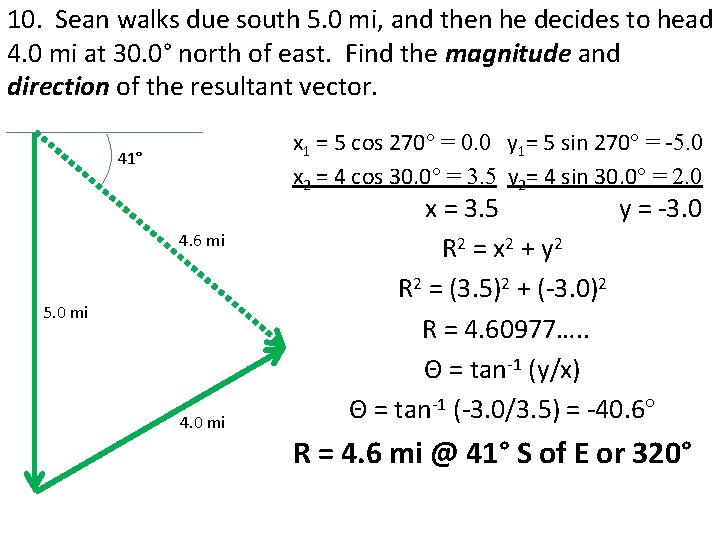
10. Sean walks due south 5. 0 mi, and then he decides to head 4. 0 mi at 30. 0° north of east. Find the magnitude and direction of the resultant vector. x 1 = 5 cos 270° = 0. 0 y 1= 5 sin 270° = -5. 0 x 2 = 4 cos 30. 0° = 3. 5 y 2= 4 sin 30. 0° = 2. 0 41° 4. 6 mi 5. 0 mi 4. 0 mi x = 3. 5 y = -3. 0 R 2 = x 2 + y 2 R 2 = (3. 5)2 + (-3. 0)2 R = 4. 60977…. . Θ = tan-1 (y/x) Θ = tan-1 (-3. 0/3. 5) = -40. 6° R = 4. 6 mi @ 41° S of E or 320°
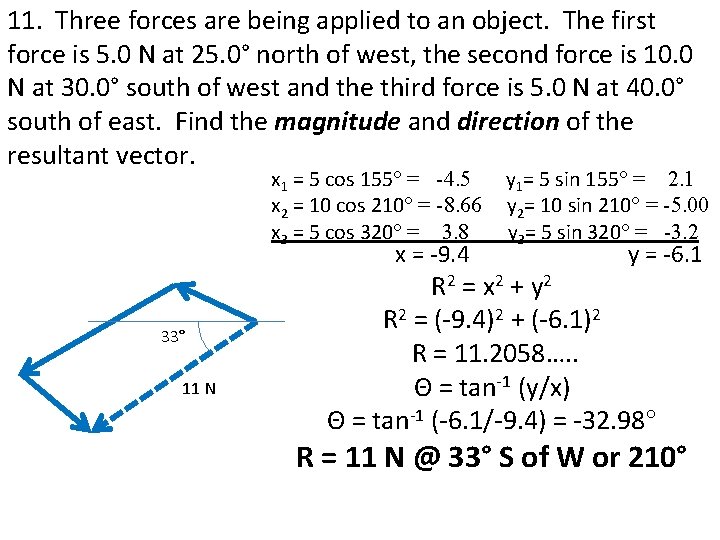
11. Three forces are being applied to an object. The first force is 5. 0 N at 25. 0° north of west, the second force is 10. 0 N at 30. 0° south of west and the third force is 5. 0 N at 40. 0° south of east. Find the magnitude and direction of the resultant vector. x 1 = 5 cos 155° = -4. 5 x 2 = 10 cos 210° = -8. 66 x 3 = 5 cos 320° = 3. 8 x = -9. 4 33° 11 N y 1= 5 sin 155° = 2. 1 y 2= 10 sin 210° = -5. 00 y 3= 5 sin 320° = -3. 2 y = -6. 1 R 2 = x 2 + y 2 R 2 = (-9. 4)2 + (-6. 1)2 R = 11. 2058…. . Θ = tan-1 (y/x) Θ = tan-1 (-6. 1/-9. 4) = -32. 98° R = 11 N @ 33° S of W or 210°
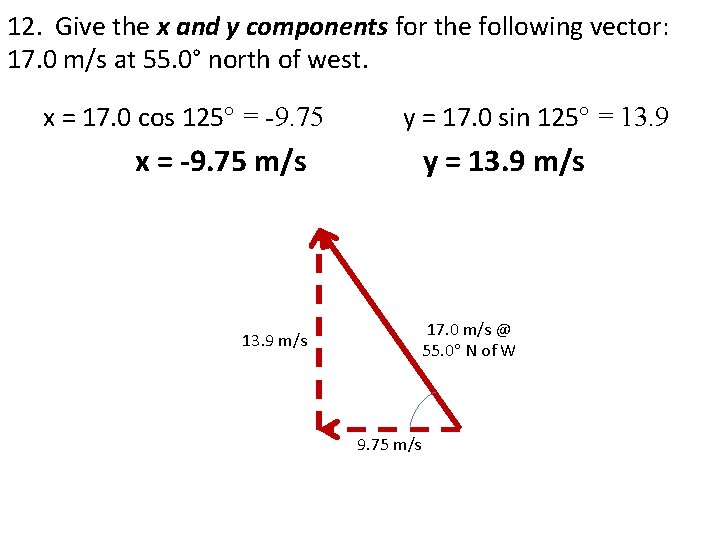
12. Give the x and y components for the following vector: 17. 0 m/s at 55. 0° north of west. x = 17. 0 cos 125° = -9. 75 y = 17. 0 sin 125° = 13. 9 x = -9. 75 m/s y = 13. 9 m/s 17. 0 m/s @ 55. 0° N of W 13. 9 m/s 9. 75 m/s
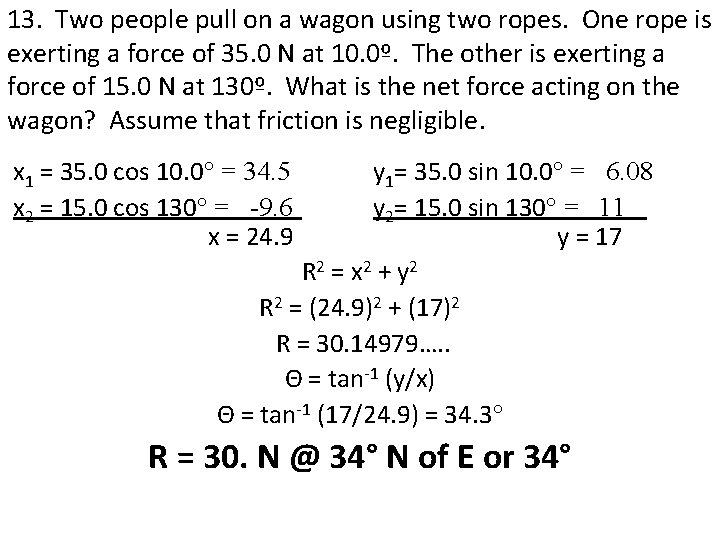
13. Two people pull on a wagon using two ropes. One rope is exerting a force of 35. 0 N at 10. 0º. The other is exerting a force of 15. 0 N at 130º. What is the net force acting on the wagon? Assume that friction is negligible. x 1 = 35. 0 cos 10. 0° = 34. 5 x 2 = 15. 0 cos 130° = -9. 6 x = 24. 9 y 1= 35. 0 sin 10. 0° = 6. 08 y 2= 15. 0 sin 130° = 11 y = 17 R 2 = x 2 + y 2 R 2 = (24. 9)2 + (17)2 R = 30. 14979…. . Θ = tan-1 (y/x) Θ = tan-1 (17/24. 9) = 34. 3° R = 30. N @ 34° N of E or 34°
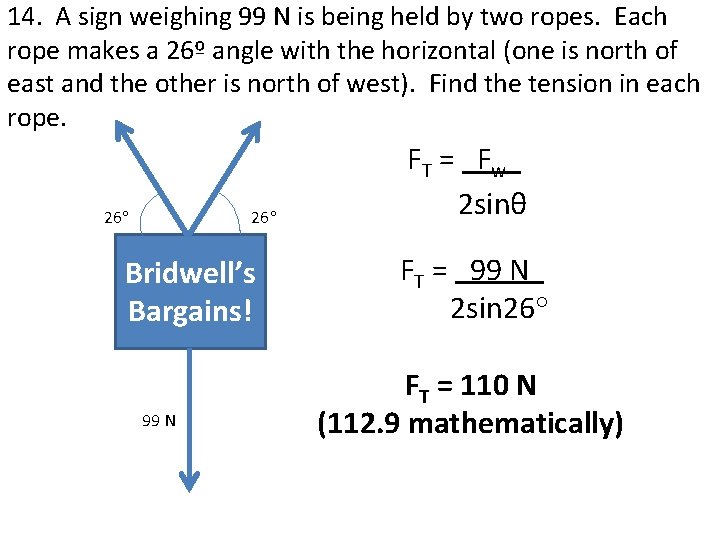
14. A sign weighing 99 N is being held by two ropes. Each rope makes a 26º angle with the horizontal (one is north of east and the other is north of west). Find the tension in each rope. 26° Bridwell’s Bargains! 99 N FT = Fw. 2 sinθ FT = 99 N. 2 sin 26° FT = 110 N (112. 9 mathematically)
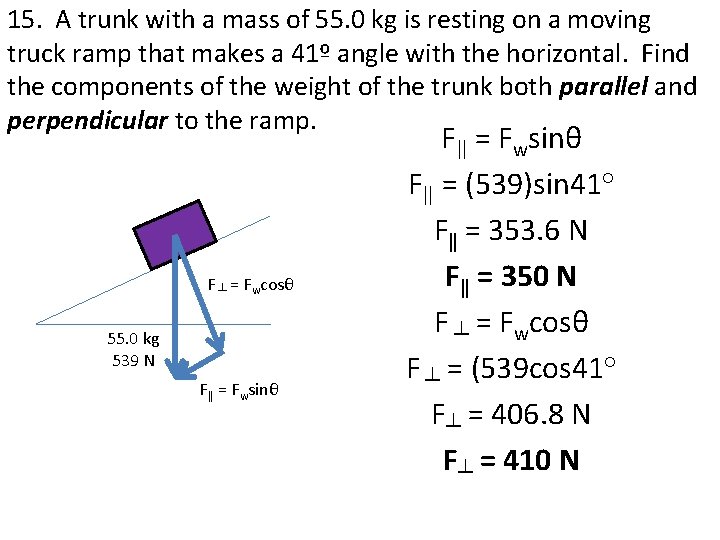
15. A trunk with a mass of 55. 0 kg is resting on a moving truck ramp that makes a 41º angle with the horizontal. Find the components of the weight of the trunk both parallel and perpendicular to the ramp. F ┴ = Fwcosθ 55. 0 kg 539 N F‖ = Fwsinθ F‖ = (539)sin 41° F‖ = 353. 6 N F‖ = 350 N F ┴ = Fwcosθ F ┴ = (539 cos 41° F┴ = 406. 8 N F┴ = 410 N
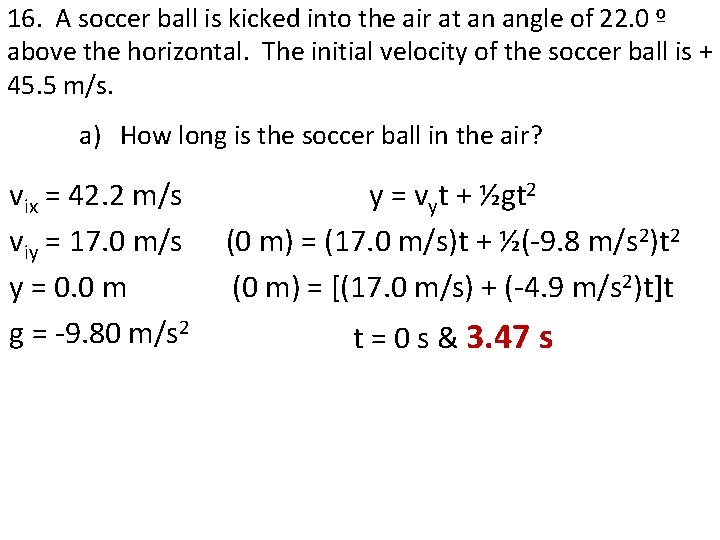
16. A soccer ball is kicked into the air at an angle of 22. 0 º above the horizontal. The initial velocity of the soccer ball is + 45. 5 m/s. a) How long is the soccer ball in the air? vix = 42. 2 m/s viy = 17. 0 m/s y = 0. 0 m g = -9. 80 m/s 2 y = vyt + ½gt 2 (0 m) = (17. 0 m/s)t + ½(-9. 8 m/s 2)t 2 (0 m) = [(17. 0 m/s) + (-4. 9 m/s 2)t]t t = 0 s & 3. 47 s
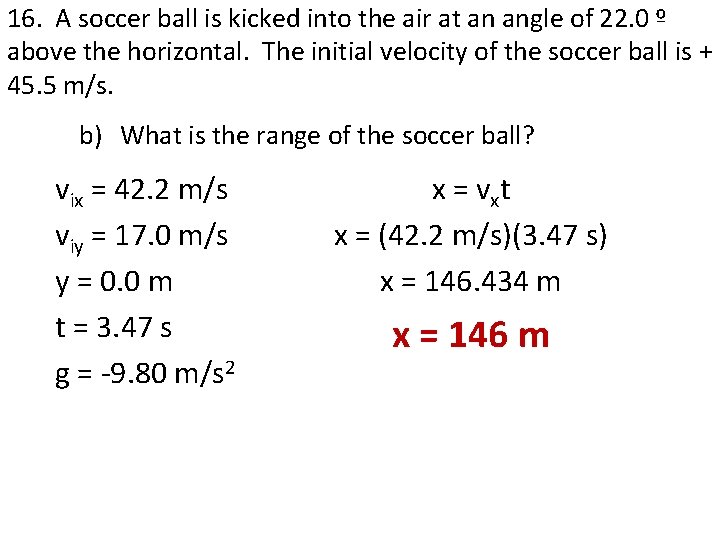
16. A soccer ball is kicked into the air at an angle of 22. 0 º above the horizontal. The initial velocity of the soccer ball is + 45. 5 m/s. b) What is the range of the soccer ball? vix = 42. 2 m/s viy = 17. 0 m/s y = 0. 0 m t = 3. 47 s g = -9. 80 m/s 2 x = v xt x = (42. 2 m/s)(3. 47 s) x = 146. 434 m x = 146 m
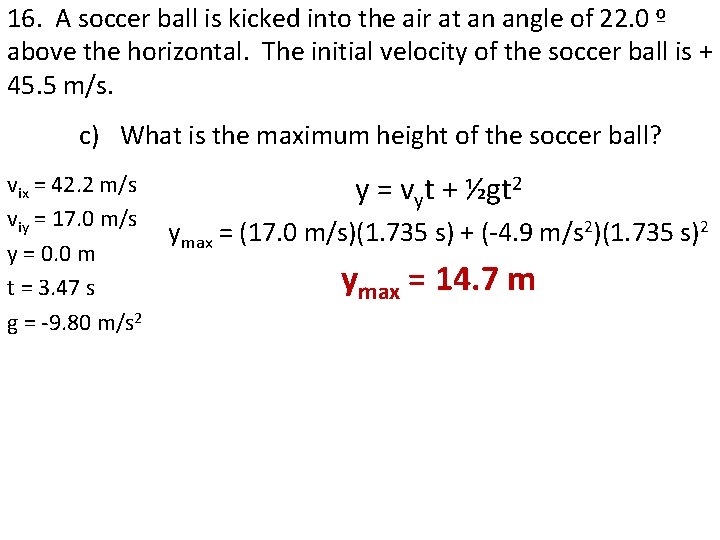
16. A soccer ball is kicked into the air at an angle of 22. 0 º above the horizontal. The initial velocity of the soccer ball is + 45. 5 m/s. c) What is the maximum height of the soccer ball? vix = 42. 2 m/s viy = 17. 0 m/s y = 0. 0 m t = 3. 47 s g = -9. 80 m/s 2 y = vyt + ½gt 2 ymax = (17. 0 m/s)(1. 735 s) + (-4. 9 m/s 2)(1. 735 s)2 ymax = 14. 7 m
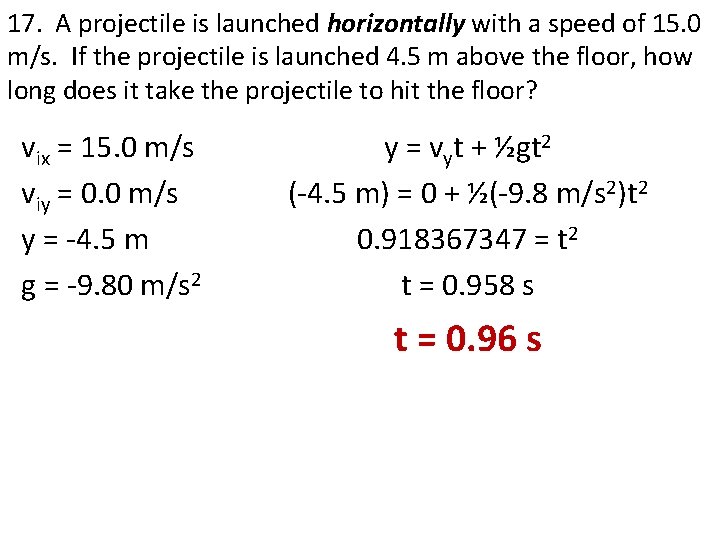
17. A projectile is launched horizontally with a speed of 15. 0 m/s. If the projectile is launched 4. 5 m above the floor, how long does it take the projectile to hit the floor? vix = 15. 0 m/s viy = 0. 0 m/s y = -4. 5 m g = -9. 80 m/s 2 y = vyt + ½gt 2 (-4. 5 m) = 0 + ½(-9. 8 m/s 2)t 2 0. 918367347 = t 2 t = 0. 958 s t = 0. 96 s
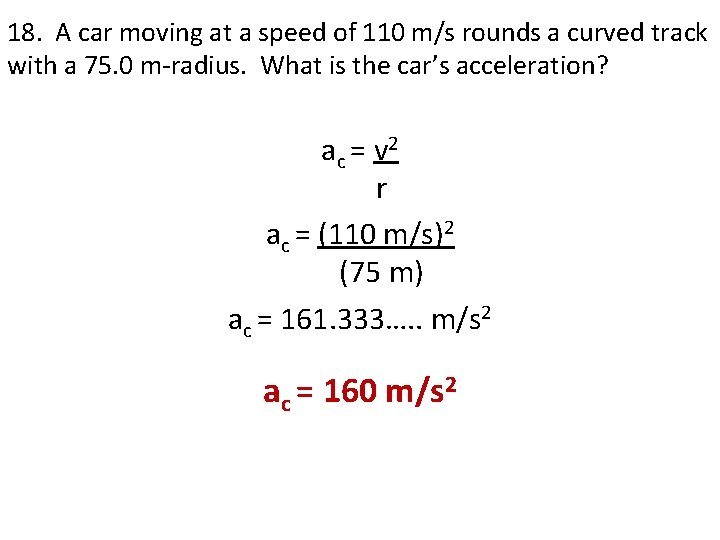
18. A car moving at a speed of 110 m/s rounds a curved track with a 75. 0 m-radius. What is the car’s acceleration? ac = v 2 r ac = (110 m/s)2 (75 m) ac = 161. 333…. . m/s 2 ac = 160 m/s 2
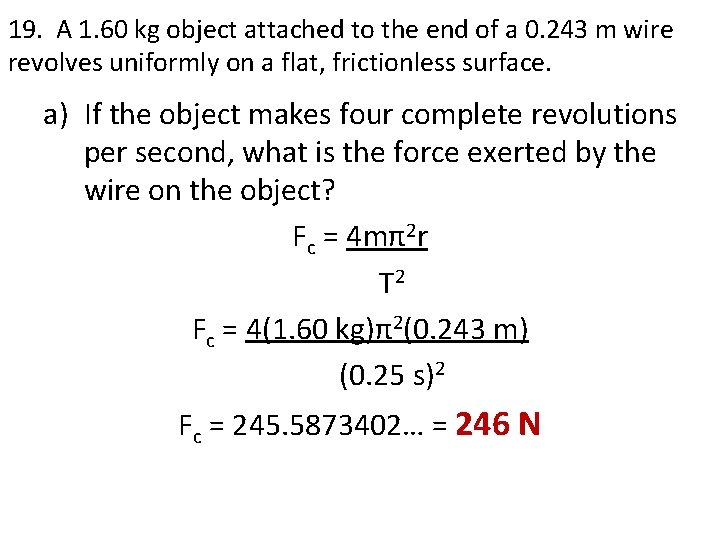
19. A 1. 60 kg object attached to the end of a 0. 243 m wire revolves uniformly on a flat, frictionless surface. a) If the object makes four complete revolutions per second, what is the force exerted by the wire on the object? Fc = 4 mπ2 r T 2 Fc = 4(1. 60 kg)π2(0. 243 m) (0. 25 s)2 Fc = 245. 5873402… = 246 N
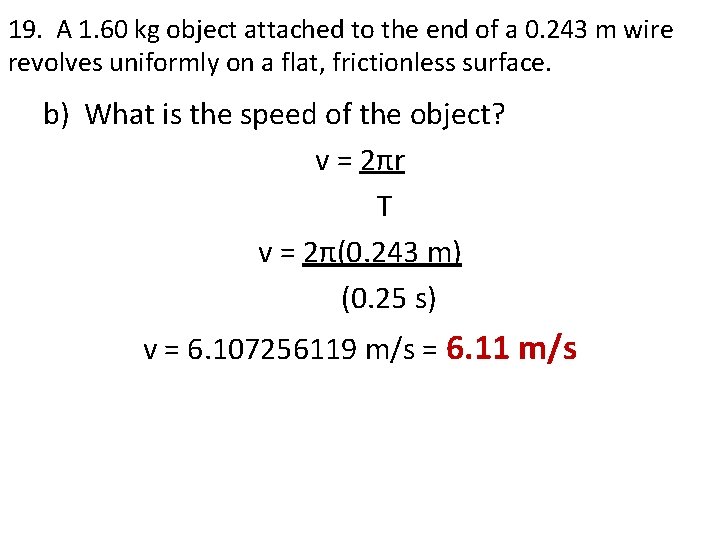
19. A 1. 60 kg object attached to the end of a 0. 243 m wire revolves uniformly on a flat, frictionless surface. b) What is the speed of the object? v = 2πr T v = 2π(0. 243 m) (0. 25 s) v = 6. 107256119 m/s = 6. 11 m/s
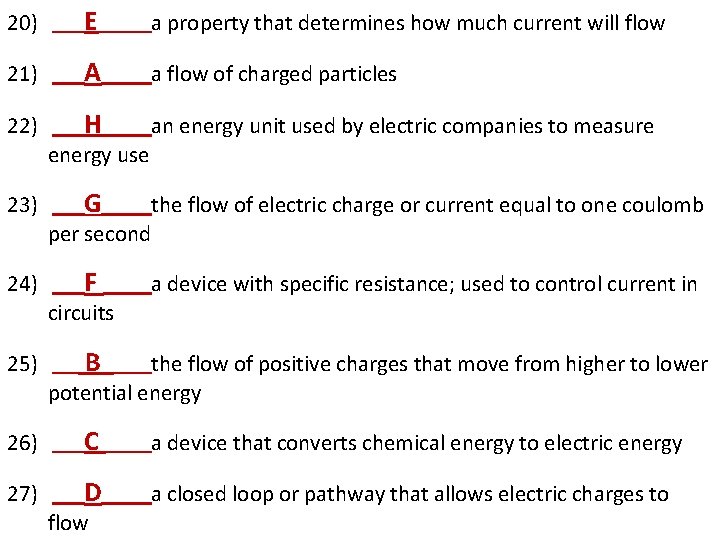
20) E a property that determines how much current will flow 21) A a flow of charged particles 22) H an energy unit used by electric companies to measure G the flow of electric charge or current equal to one coulomb F a device with specific resistance; used to control current in energy use 23) per second 24) circuits 25) B the flow of positive charges that move from higher to lower potential energy 26) C a device that converts chemical energy to electric energy 27) D a closed loop or pathway that allows electric charges to flow
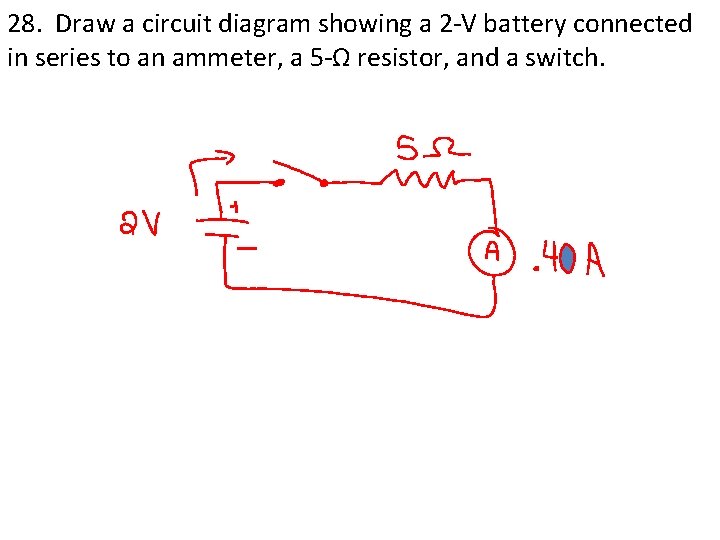
28. Draw a circuit diagram showing a 2 -V battery connected in series to an ammeter, a 5 -Ω resistor, and a switch.
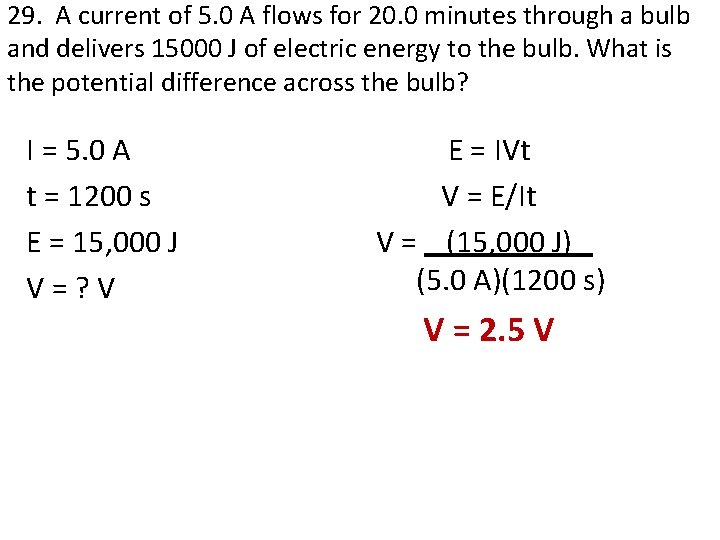
29. A current of 5. 0 A flows for 20. 0 minutes through a bulb and delivers 15000 J of electric energy to the bulb. What is the potential difference across the bulb? I = 5. 0 A t = 1200 s E = 15, 000 J V=? V E = IVt V = E/It V = (15, 000 J). (5. 0 A)(1200 s) V = 2. 5 V
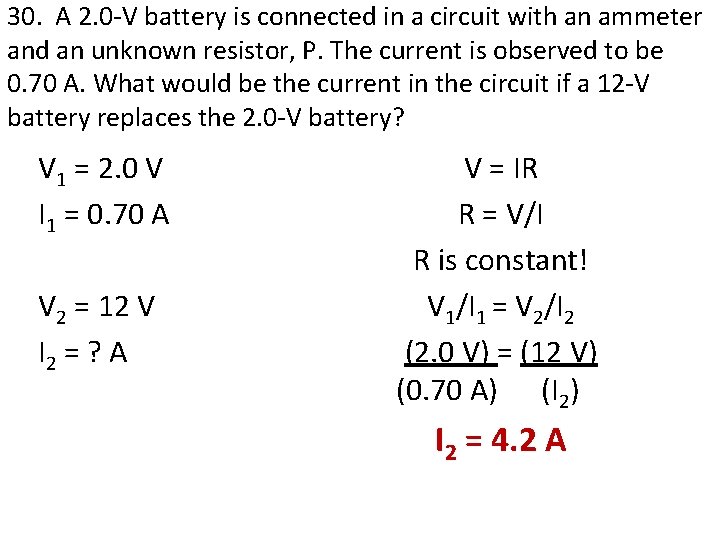
30. A 2. 0 -V battery is connected in a circuit with an ammeter and an unknown resistor, P. The current is observed to be 0. 70 A. What would be the current in the circuit if a 12 -V battery replaces the 2. 0 -V battery? V 1 = 2. 0 V I 1 = 0. 70 A V 2 = 12 V I 2 = ? A V = IR R = V/I R is constant! V 1/I 1 = V 2/I 2 (2. 0 V) = (12 V) (0. 70 A) (I 2) I 2 = 4. 2 A
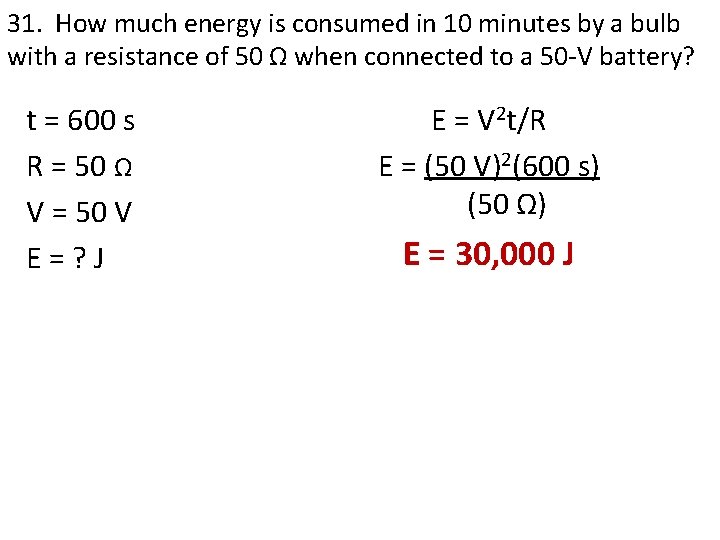
31. How much energy is consumed in 10 minutes by a bulb with a resistance of 50 Ω when connected to a 50 -V battery? t = 600 s R = 50 Ω V = 50 V E=? J E = V 2 t/R E = (50 V)2(600 s) (50 Ω) E = 30, 000 J
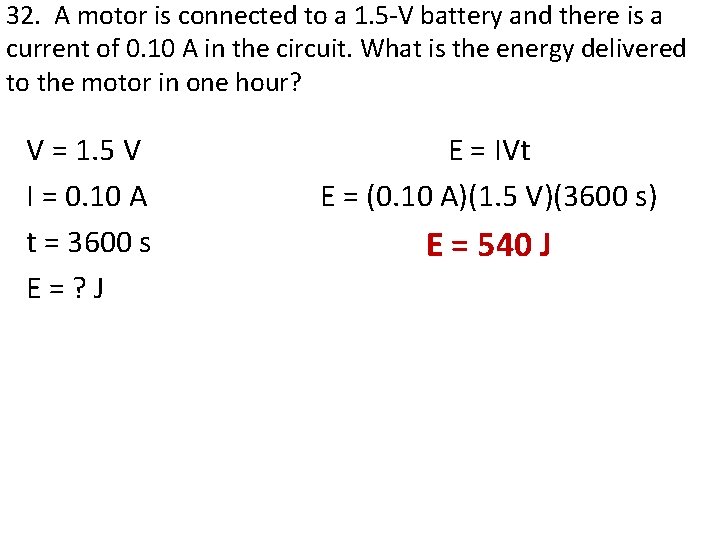
32. A motor is connected to a 1. 5 -V battery and there is a current of 0. 10 A in the circuit. What is the energy delivered to the motor in one hour? V = 1. 5 V I = 0. 10 A t = 3600 s E=? J E = IVt E = (0. 10 A)(1. 5 V)(3600 s) E = 540 J
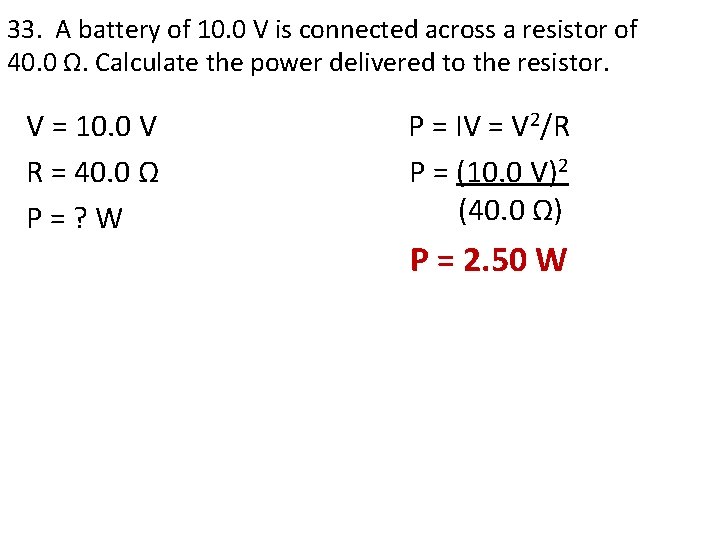
33. A battery of 10. 0 V is connected across a resistor of 40. 0 Ω. Calculate the power delivered to the resistor. V = 10. 0 V R = 40. 0 Ω P=? W P = IV = V 2/R P = (10. 0 V)2 (40. 0 Ω) P = 2. 50 W
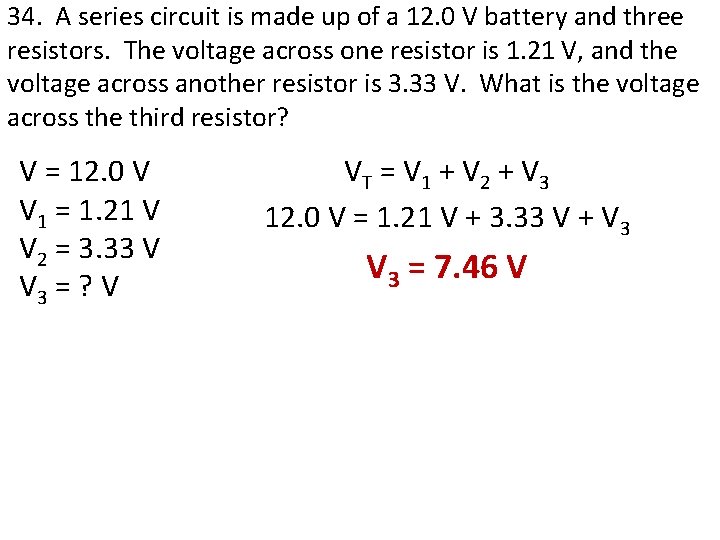
34. A series circuit is made up of a 12. 0 V battery and three resistors. The voltage across one resistor is 1. 21 V, and the voltage across another resistor is 3. 33 V. What is the voltage across the third resistor? V = 12. 0 V V 1 = 1. 21 V V 2 = 3. 33 V V 3 = ? V VT = V 1 + V 2 + V 3 12. 0 V = 1. 21 V + 3. 33 V + V 3 = 7. 46 V
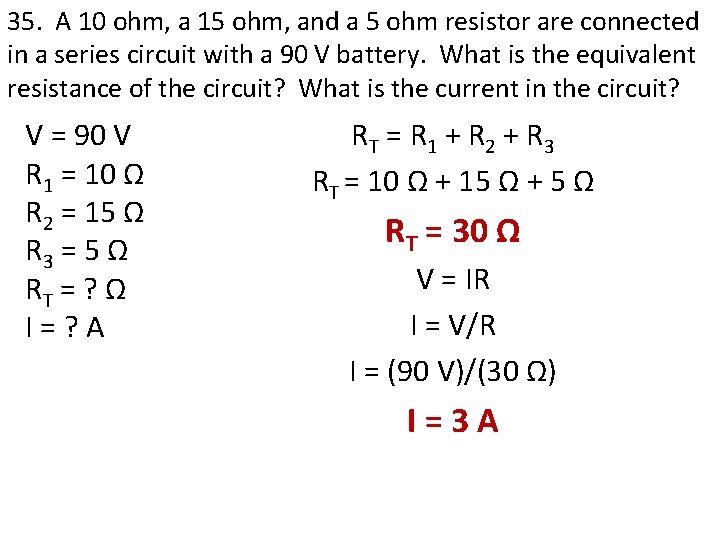
35. A 10 ohm, a 15 ohm, and a 5 ohm resistor are connected in a series circuit with a 90 V battery. What is the equivalent resistance of the circuit? What is the current in the circuit? V = 90 V R 1 = 10 Ω R 2 = 15 Ω R 3 = 5 Ω RT = ? Ω I=? A RT = R 1 + R 2 + R 3 RT = 10 Ω + 15 Ω + 5 Ω RT = 30 Ω V = IR I = V/R I = (90 V)/(30 Ω) I=3 A
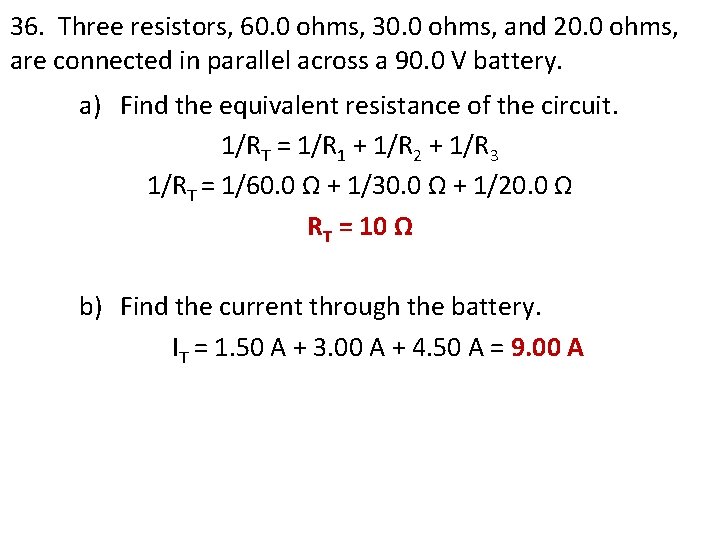
36. Three resistors, 60. 0 ohms, 30. 0 ohms, and 20. 0 ohms, are connected in parallel across a 90. 0 V battery. a) Find the equivalent resistance of the circuit. 1/RT = 1/R 1 + 1/R 2 + 1/R 3 1/RT = 1/60. 0 Ω + 1/30. 0 Ω + 1/20. 0 Ω RT = 10 Ω b) Find the current through the battery. IT = 1. 50 A + 3. 00 A + 4. 50 A = 9. 00 A
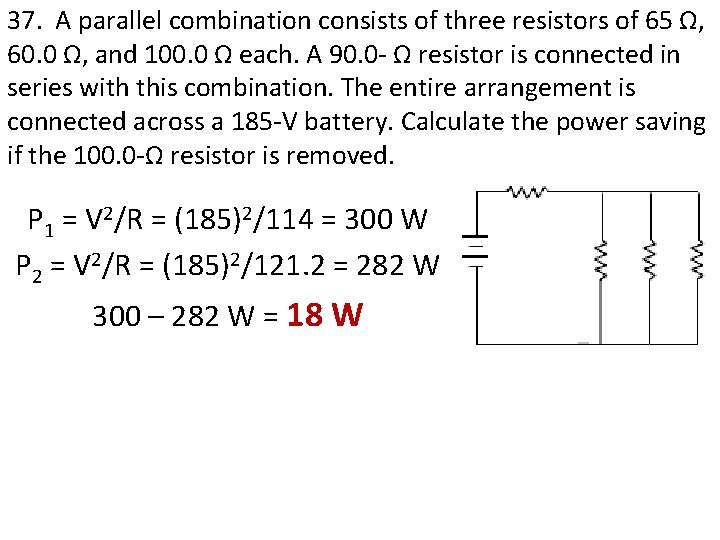
37. A parallel combination consists of three resistors of 65 Ω, 60. 0 Ω, and 100. 0 Ω each. A 90. 0 - Ω resistor is connected in series with this combination. The entire arrangement is connected across a 185 -V battery. Calculate the power saving if the 100. 0 -Ω resistor is removed. P 1 = V 2/R = (185)2/114 = 300 W P 2 = V 2/R = (185)2/121. 2 = 282 W 300 – 282 W = 18 W