
Physics Simple Machines Notes I Forces A Definition
- Slides: 9
Physics Simple Machines Notes I. Forces A. Definition- push or a pull B. Contact forces and Long Range forces 1. examples- tension in a rope & gravity
C. Forces at angles 1. Mowing or pulling a sled D. Measurement of Forces 1. Metric- Newtons 2. English- foot-pounds
II. Work A. Definition- force acting through a distance B. Mathematical equation- W = F x dcos. Q C. Measurement of Work- Newton-meter (Joule) D. Work-Energy Theorem- energy acquired by an object is equal to the work done on it.
III. Power A. Definition- work done per unit of time B. Mathematical equation- P = W/t C. Measurement of Power- horsepower, ( Joules / sec) = watts
IV. Machines A. Definition- device used to multiply force, multiply speed, or change directio B. Functions of Machines 1. Transfers forces to different locations 2. Transforms energy from one form to another 3. Can change direction of a force 4. Can multiply speed or distance 5. Can multiply force
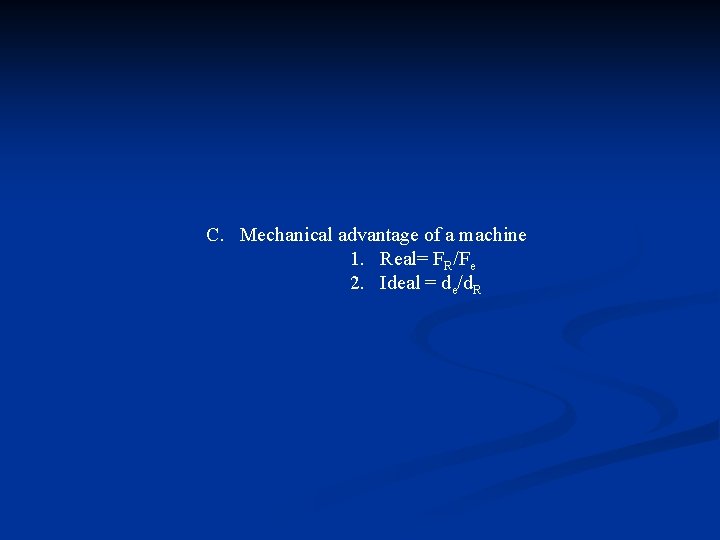
C. Mechanical advantage of a machine 1. Real= FR/Fe 2. Ideal = de/d. R
D. Types of Simple Machines 1. Levers a. wheel and axle b. pulleys- continuous levers 2. Inclined Planes a. screw b. wedge – double incline
E. Types of Levers 1. First Class 2. Second Class 3. Third Class F. Types of Pulleys 1. First Class 2. Second Class 3. Third Class
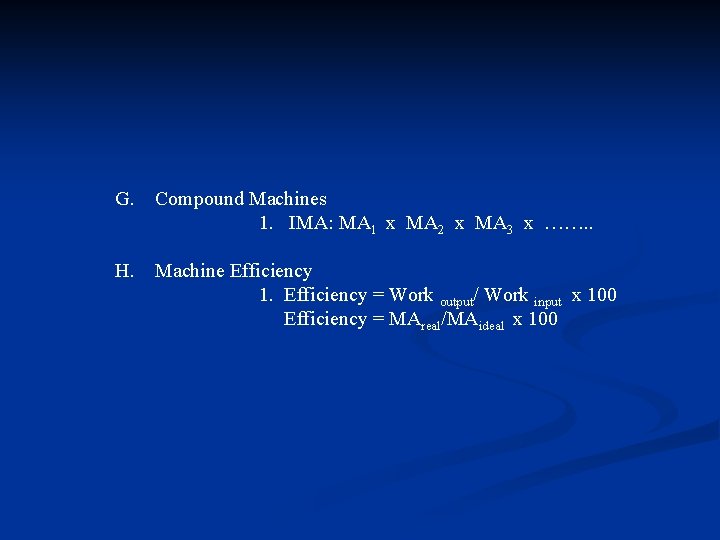
G. Compound Machines 1. IMA: MA 1 x MA 2 x MA 3 x ……. . H. Machine Efficiency 1. Efficiency = Work output/ Work input x 100 Efficiency = MAreal/MAideal x 100