
Physics Results from the National Spherical Torus Experiment

- Slides: 48
Physics Results from the National Spherical Torus Experiment College W&M Columbia U Comp-X General Atomics INEL Johns Hopkins U LANL LLNL Lodestar MIT Nova Photonics New York U Old Dominion U ORNL PSI Princeton U SNL Think Tank, Inc. UC Davis UC Irvine UC Los Angeles UC San Diego U Colorado U Maryland U Rochester U Washington U Wisconsin Bell / IFS / 070306 M. G. Bell for the NSTX Group Princeton Plasma Physics Laboratory Princeton University, Princeton, NJ Supported by Office of Science Culham Sci Ctr U St. Andrews York U Chubu U Fukui U Hiroshima U Hyogo U Kyoto U Kyushu Tokai U NIFS Niigata U U Tokyo JAERI Ioffe Inst RRC Kurchatov Inst TRINITI KBSI KAIST ENEA, Frascati CEA, Cadarache IPP, Jülich IPP, Garching ASCR, Czech Rep U Quebec 1
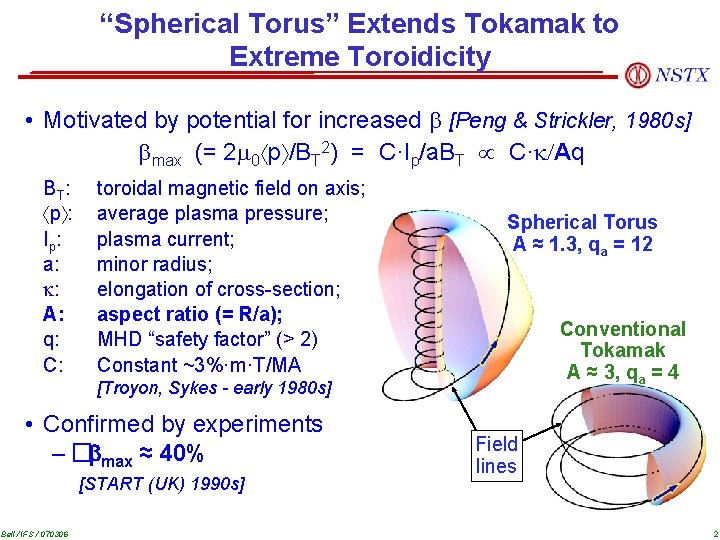
“Spherical Torus” Extends Tokamak to Extreme Toroidicity • Motivated by potential for increased [Peng & Strickler, 1980 s] max (= 2 0 p /BT 2) = C·Ip/a. BT C· /Aq BT : p : Ip : a: : A: q: C: toroidal magnetic field on axis; average plasma pressure; plasma current; minor radius; elongation of cross-section; aspect ratio (= R/a); MHD “safety factor” (> 2) Constant ~3%·m·T/MA Spherical Torus A ≈ 1. 3, qa = 12 Conventional Tokamak A ≈ 3, qa = 4 [Troyon, Sykes - early 1980 s] • Confirmed by experiments – � max ≈ 40% [START (UK) 1990 s] Bell / IFS / 070306 Field lines 2
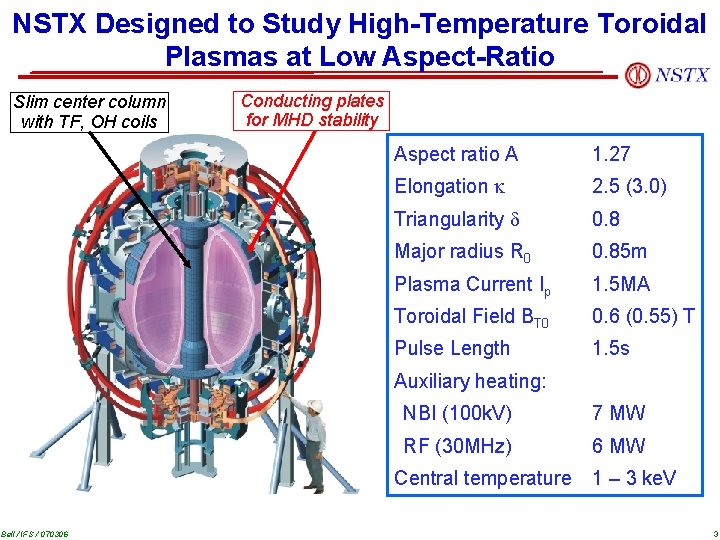
NSTX Designed to Study High-Temperature Toroidal Plasmas at Low Aspect-Ratio Slim center column with TF, OH coils Conducting plates for MHD stability Aspect ratio A 1. 27 Elongation 2. 5 (3. 0) Triangularity 0. 8 Major radius R 0 0. 85 m Plasma Current Ip 1. 5 MA Toroidal Field BT 0 0. 6 (0. 55) T Pulse Length 1. 5 s Auxiliary heating: NBI (100 k. V) 7 MW RF (30 MHz) 6 MW Central temperature Bell / IFS / 070306 1 – 3 ke. V 3
NSTX Research Contributes to Fusion Energy Development, ITER Physics and Plasma Science • Determine the physics principles of ST confinement – Limits, scaling, control, heating schemes, integration • Complement and extend conventional aspect-ratio tokamaks – Utilize low aspect ratio and high- T to address basic physics of toroidal confinement • Support preparation for burning plasma research in ITER – Participate in the ITPA and USBPO • Complement ITER by exploring possibilities for an attractive Component Test Facility and Demonstration Power Plant Bell / IFS / 070306 4
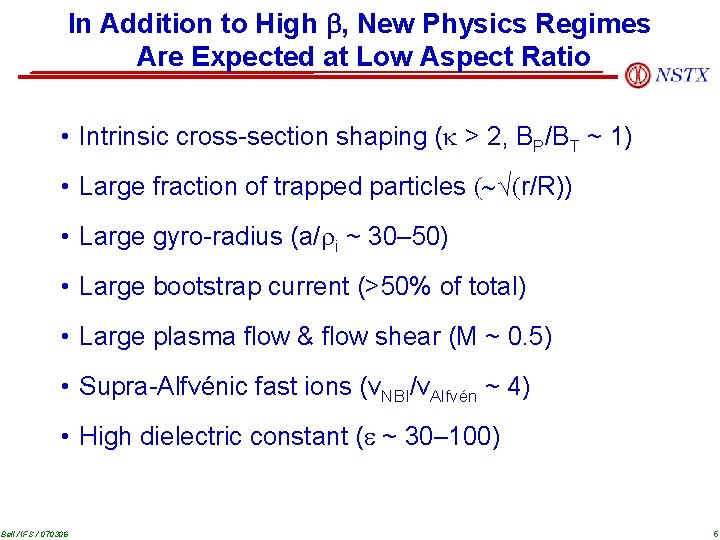
In Addition to High , New Physics Regimes Are Expected at Low Aspect Ratio • Intrinsic cross-section shaping ( > 2, BP/BT ~ 1) • Large fraction of trapped particles √ r/R)) • Large gyro-radius (a/ri ~ 30– 50) • Large bootstrap current (>50% of total) • Large plasma flow & flow shear (M ~ 0. 5) • Supra-Alfvénic fast ions (v. NBI/v. Alfvén ~ 4) • High dielectric constant ( ~ 30– 100) Bell / IFS / 070306 5
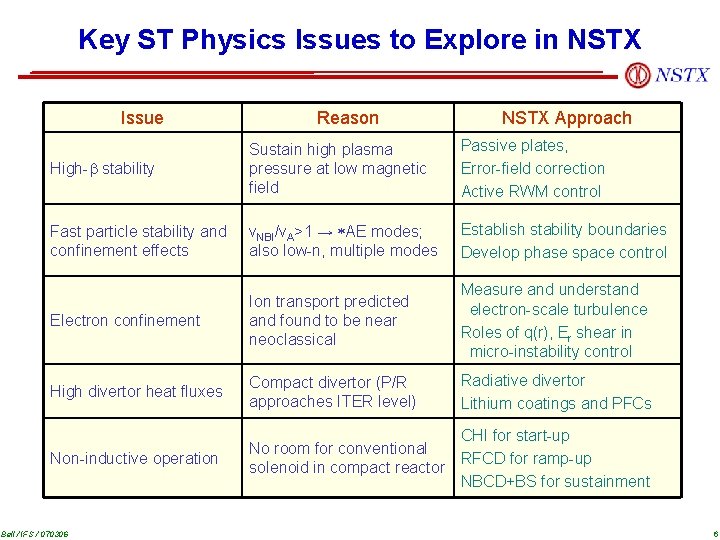
Key ST Physics Issues to Explore in NSTX Issue Reason NSTX Approach High- stability Sustain high plasma pressure at low magnetic field Passive plates, Error-field correction Active RWM control Fast particle stability and confinement effects v. NBI/v. A>1 → *AE modes; also low-n, multiple modes Establish stability boundaries Develop phase space control Electron confinement Ion transport predicted and found to be near neoclassical Measure and understand electron-scale turbulence Roles of q(r), Er shear in micro-instability control High divertor heat fluxes Compact divertor (P/R approaches ITER level) Radiative divertor Lithium coatings and PFCs Non-inductive operation CHI for start-up No room for conventional RFCD for ramp-up solenoid in compact reactor NBCD+BS for sustainment Bell / IFS / 070306 6
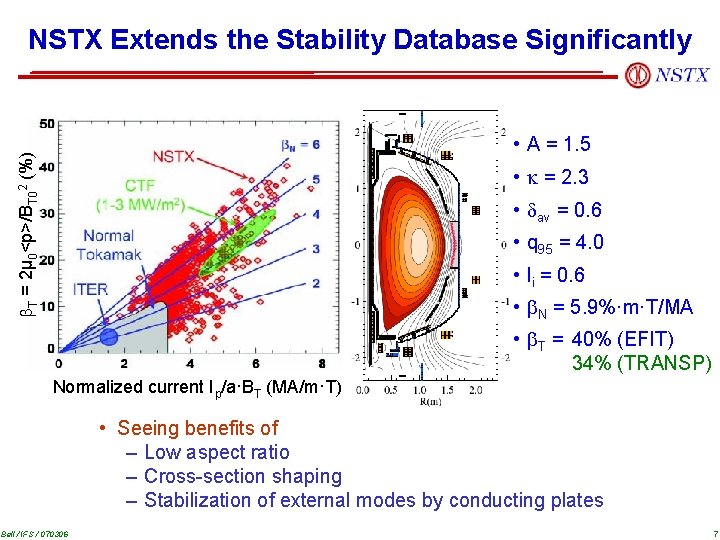
NSTX Extends the Stability Database Significantly T = 2µ 0<p>/BT 02 (%) • A = 1. 5 • = 2. 3 • av = 0. 6 • q 95 = 4. 0 • li = 0. 6 • N = 5. 9%·m·T/MA • T = 40% (EFIT) 34% (TRANSP) Normalized current Ip/a·BT (MA/m·T) • Seeing benefits of – Low aspect ratio – Cross-section shaping – Stabilization of external modes by conducting plates Bell / IFS / 070306 7
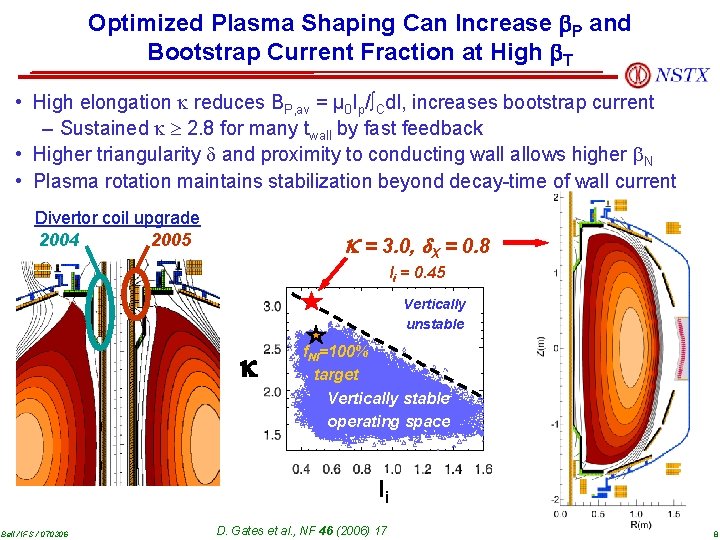
Optimized Plasma Shaping Can Increase P and Bootstrap Current Fraction at High T • High elongation reduces BP, av = µ 0 Ip/∫Cdl, increases bootstrap current – Sustained 2. 8 for many twall by fast feedback • Higher triangularity and proximity to conducting wall allows higher N • Plasma rotation maintains stabilization beyond decay-time of wall current Divertor coil upgrade 2004 2005 k = 3. 0, d. X = 0. 8 li = 0. 45 Vertically unstable f. NI=100% target Vertically stable operating space li Bell / IFS / 070306 D. Gates et al. , NF 46 (2006) 17 8
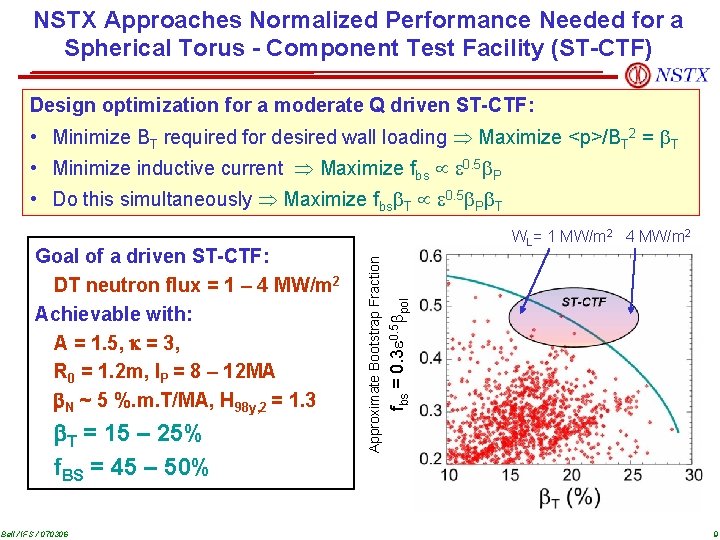
NSTX Approaches Normalized Performance Needed for a Spherical Torus - Component Test Facility (ST-CTF) Design optimization for a moderate Q driven ST-CTF: • Minimize BT required for desired wall loading Maximize <p>/BT 2 = T • Minimize inductive current Maximize fbs 0. 5 P • Do this simultaneously Maximize fbs T 0. 5 P T T = 15 – 25% f. BS = 45 – 50% Bell / IFS / 070306 fbs = 0. 3 0. 5 pol Approximate Bootstrap Fraction Goal of a driven ST-CTF: DT neutron flux = 1 – 4 MW/m 2 Achievable with: A = 1. 5, = 3, R 0 = 1. 2 m, IP = 8 – 12 MA N ~ 5 %. m. T/MA, H 98 y, 2 = 1. 3 WL= 1 MW/m 2 4 MW/m 2 9
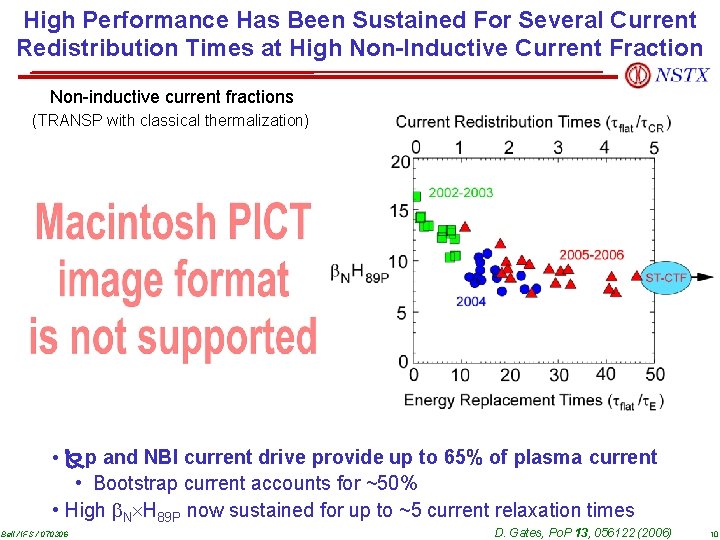
High Performance Has Been Sustained For Several Current Redistribution Times at High Non-Inductive Current Fraction Non-inductive current fractions (TRANSP with classical thermalization) • p and NBI current drive provide up to 65% of plasma current • Bootstrap current accounts for ~50% • High N H 89 P now sustained for up to ~5 current relaxation times Bell / IFS / 070306 D. Gates, Po. P 13, 056122 (2006) 10
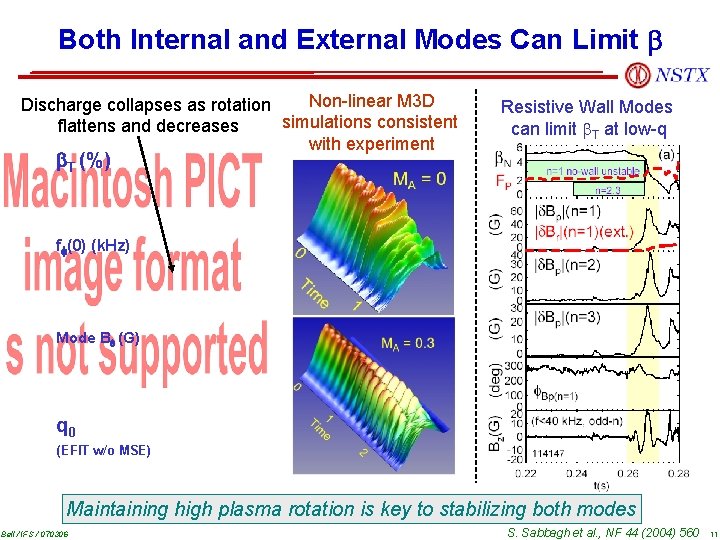
Both Internal and External Modes Can Limit Non-linear M 3 D Discharge collapses as rotation simulations consistent flattens and decreases with experiment Resistive Wall Modes can limit T at low-q T (%) ff(0) (k. Hz) Mode Bq (G) q 0 (EFIT w/o MSE) Maintaining high plasma rotation is key to stabilizing both modes Bell / IFS / 070306 S. Sabbagh et al. , NF 44 (2004) 560 11
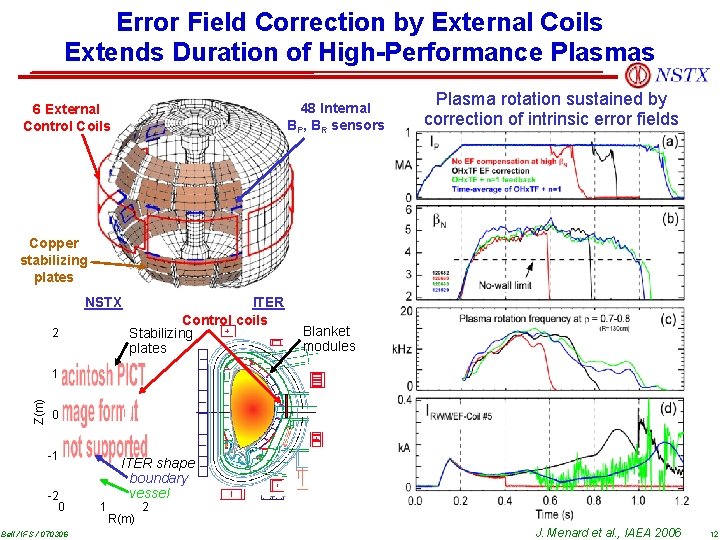
Error Field Correction by External Coils Extends Duration of High-Performance Plasmas 48 Internal BP, BR sensors 6 External Control Coils Plasma rotation sustained by correction of intrinsic error fields Copper stabilizing plates NSTX 2 ITER Control coils Stabilizing plates Blanket modules Z(m) 1 0 -1 -2 0 Bell / IFS / 070306 1 ITER shape boundary vessel R(m) 2 J. Menard et al. , IAEA 2006 12
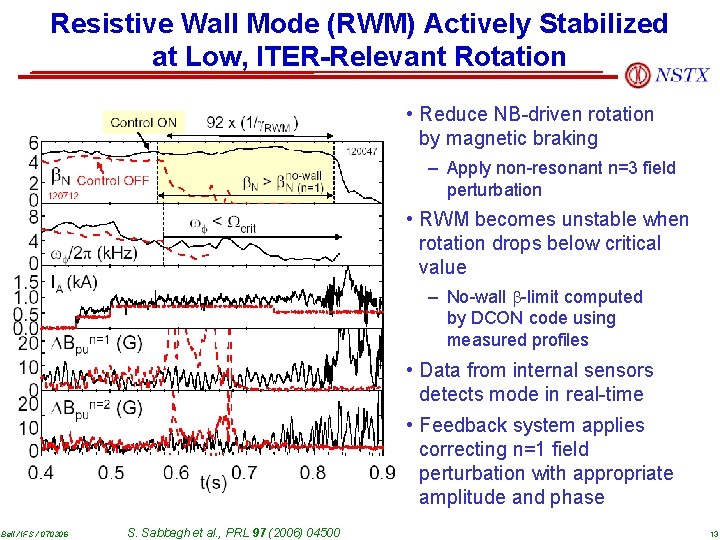
Resistive Wall Mode (RWM) Actively Stabilized at Low, ITER-Relevant Rotation • Reduce NB-driven rotation by magnetic braking – Apply non-resonant n=3 field perturbation • RWM becomes unstable when rotation drops below critical value – No-wall -limit computed by DCON code using measured profiles • Data from internal sensors detects mode in real-time • Feedback system applies correcting n=1 field perturbation with appropriate amplitude and phase Bell / IFS / 070306 S. Sabbagh et al. , PRL 97 (2006) 04500 13
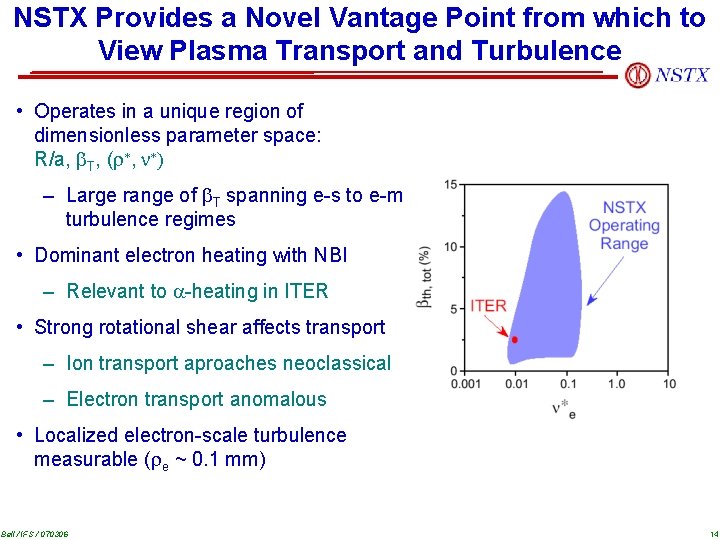
NSTX Provides a Novel Vantage Point from which to View Plasma Transport and Turbulence • Operates in a unique region of dimensionless parameter space: R/a, T, (r*, n*) – Large range of T spanning e-s to e-m turbulence regimes • Dominant electron heating with NBI – Relevant to -heating in ITER • Strong rotational shear affects transport – Ion transport aproaches neoclassical – Electron transport anomalous • Localized electron-scale turbulence measurable (re ~ 0. 1 mm) Bell / IFS / 070306 14
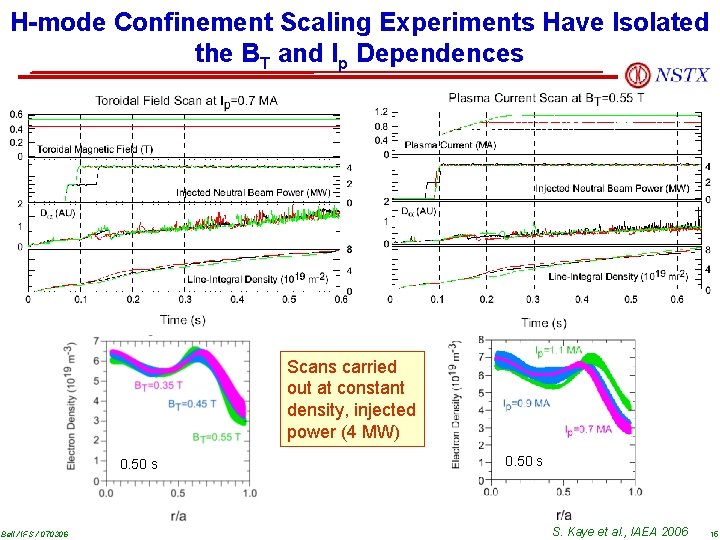
H-mode Confinement Scaling Experiments Have Isolated the BT and Ip Dependences Scans carried out at constant density, injected power (4 MW) 0. 50 s Bell / IFS / 070306 0. 50 s S. Kaye et al. , IAEA 2006 15
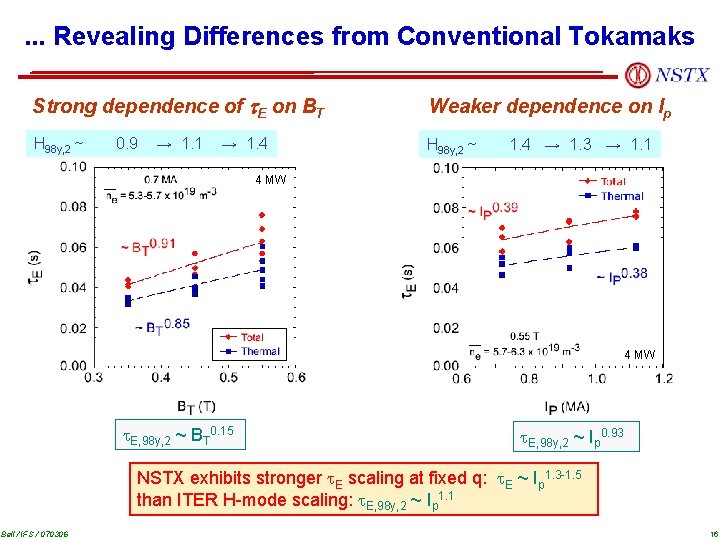
. . . Revealing Differences from Conventional Tokamaks Strong dependence of t. E on BT Weaker dependence on Ip H 98 y, 2 ~ 0. 9 → 1. 1 → 1. 4 → 1. 3 → 1. 1 4 MW E, 98 y, 2 ~ BT 0. 15 E, 98 y, 2 ~ Ip 0. 93 NSTX exhibits stronger E scaling at fixed q: E ~ Ip 1. 3 -1. 5 than ITER H-mode scaling: E, 98 y, 2 ~ Ip 1. 1 Bell / IFS / 070306 16
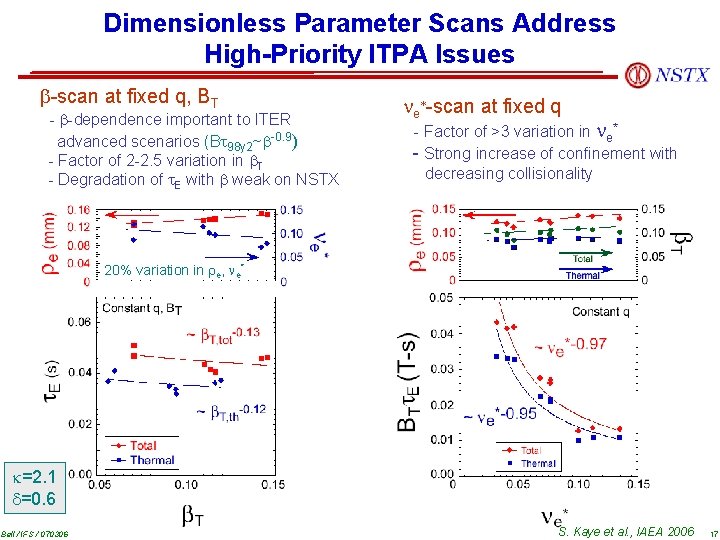
Dimensionless Parameter Scans Address High-Priority ITPA Issues -scan at fixed q, BT - -dependence important to ITER advanced scenarios (B 98 y 2~ -0. 9) - Factor of 2 -2. 5 variation in T - Degradation of E with weak on NSTX ne*-scan at fixed q - Factor of >3 variation in ne* - Strong increase of confinement with decreasing collisionality 20% variation in re, ne* =2. 1 =0. 6 Bell / IFS / 070306 S. Kaye et al. , IAEA 2006 17
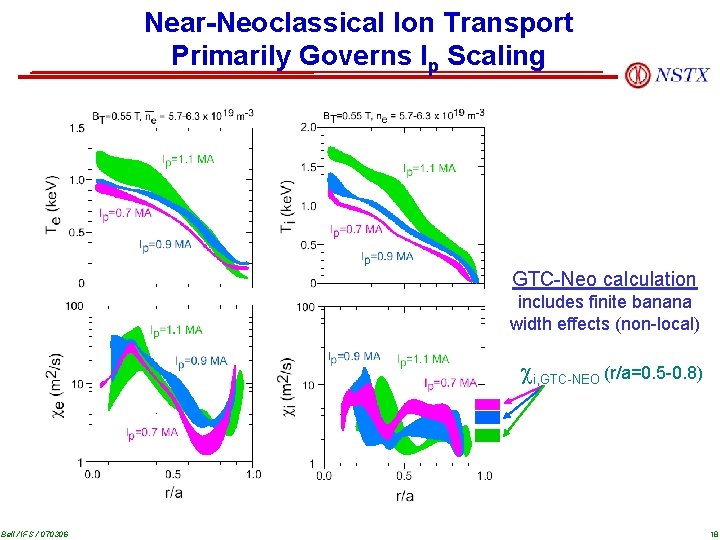
Near-Neoclassical Ion Transport Primarily Governs Ip Scaling GTC-Neo calculation includes finite banana width effects (non-local) ci, GTC-NEO (r/a=0. 5 -0. 8) Bell / IFS / 070306 18
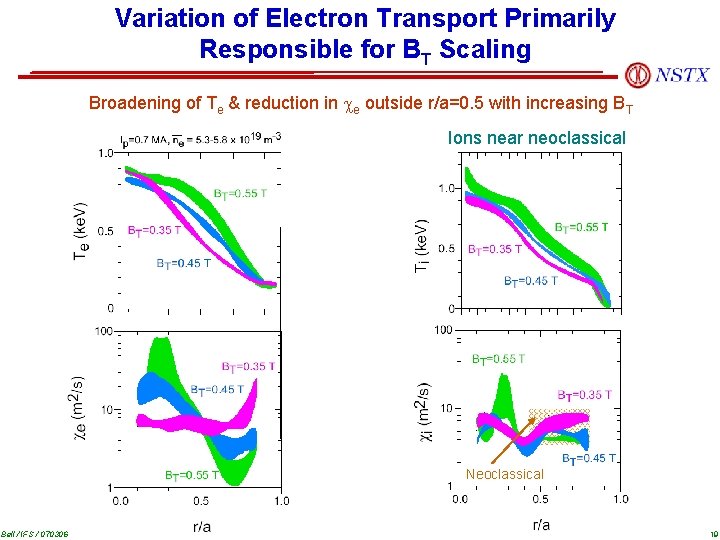
Variation of Electron Transport Primarily Responsible for BT Scaling Broadening of Te & reduction in ce outside r/a=0. 5 with increasing BT Ions near neoclassical Neoclassical Bell / IFS / 070306 19
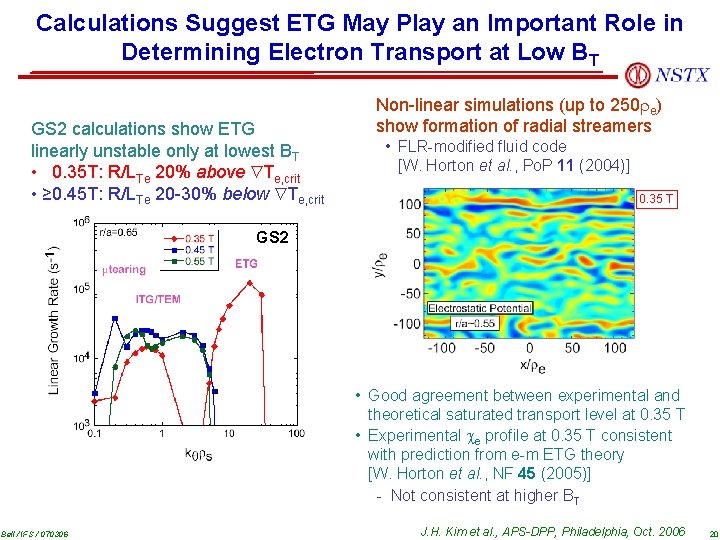
Calculations Suggest ETG May Play an Important Role in Determining Electron Transport at Low BT GS 2 calculations show ETG linearly unstable only at lowest BT • 0. 35 T: R/LTe 20% above Te, crit • ≥ 0. 45 T: R/LTe 20 -30% below Te, crit Non-linear simulations (up to 250 re) show formation of radial streamers • FLR-modified fluid code [W. Horton et al. , Po. P 11 (2004)] 0. 35 T GS 2 • Good agreement between experimental and theoretical saturated transport level at 0. 35 T • Experimental ce profile at 0. 35 T consistent with prediction from e-m ETG theory [W. Horton et al. , NF 45 (2005)] - Not consistent at higher BT Bell / IFS / 070306 J. H. Kim et al. , APS-DPP, Philadelphia, Oct. 2006 20
Now Beginning to Make Measurements of Turbulence Extending to Electron Gyro-radius Scale 1 mm microwave forward scattering system shows fluctuations (ñ/n) reduced in upper ITG/TEM and ETG k-ranges during H-mode Both ion and electron transport decrease at transition from L- to H- mode ELMs ~ Electron transport remains anomalous Ion transport close to neoclassical during H-phase - Localized measurement ( r ≈ 6 cm) - Adjustable from axis to outer edge Bell / IFS / 070306 r/a H. Park et al. , APS-DPP, Philadelphia, Oct. 2006 21
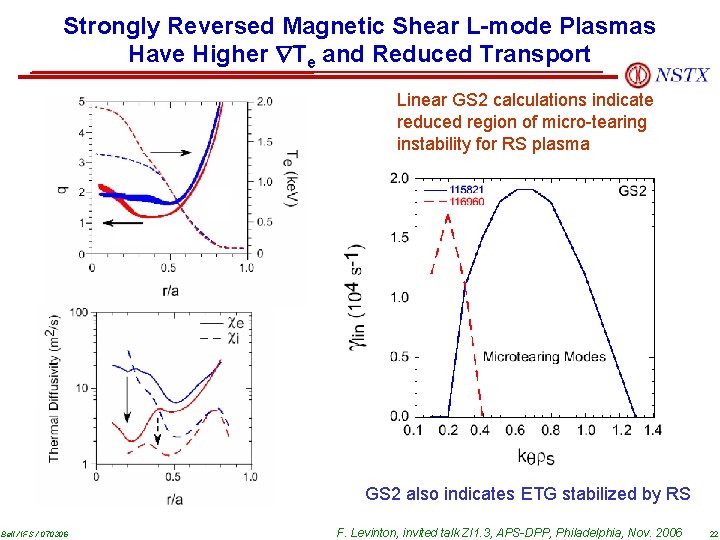
Strongly Reversed Magnetic Shear L-mode Plasmas Have Higher Te and Reduced Transport Linear GS 2 calculations indicate reduced region of micro-tearing instability for RS plasma GS 2 also indicates ETG stabilized by RS Bell / IFS / 070306 F. Levinton, invited talk ZI 1. 3, APS-DPP, Philadelphia, Nov. 2006 22
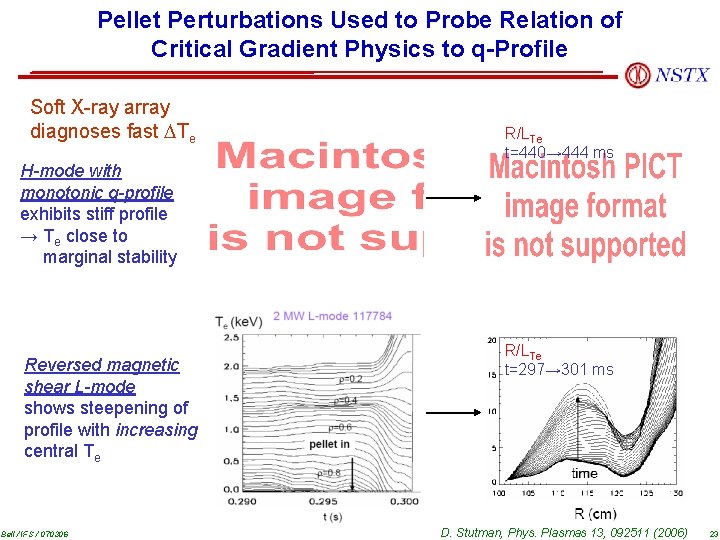
Pellet Perturbations Used to Probe Relation of Critical Gradient Physics to q-Profile Soft X-ray array diagnoses fast Te H-mode with monotonic q-profile exhibits stiff profile → Te close to marginal stability Reversed magnetic shear L-mode shows steepening of profile with increasing central Te Bell / IFS / 070306 R/LTe t=440→ 444 ms R/LTe t=297→ 301 ms D. Stutman, Phys. Plasmas 13, 092511 (2006) 23
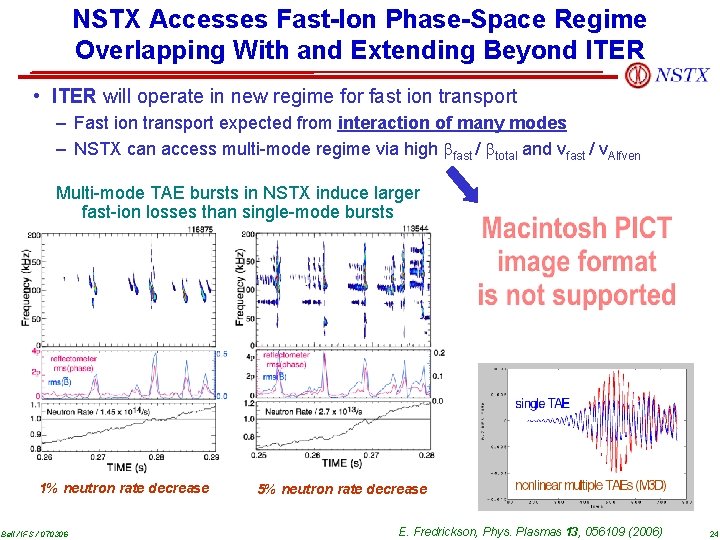
NSTX Accesses Fast-Ion Phase-Space Regime Overlapping With and Extending Beyond ITER • ITER will operate in new regime for fast ion transport – Fast ion transport expected from interaction of many modes – NSTX can access multi-mode regime via high fast / total and vfast / v. Alfven Multi-mode TAE bursts in NSTX induce larger fast-ion losses than single-mode bursts 1% neutron rate decrease Bell / IFS / 070306 5% neutron rate decrease E. Fredrickson, Phys. Plasmas 13, 056109 (2006) 24
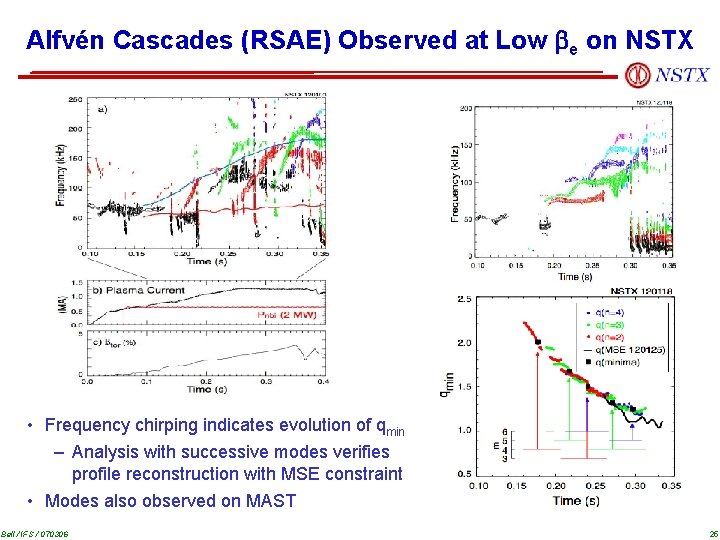
Alfvén Cascades (RSAE) Observed at Low e on NSTX • Frequency chirping indicates evolution of qmin – Analysis with successive modes verifies profile reconstruction with MSE constraint • Modes also observed on MAST Bell / IFS / 070306 25
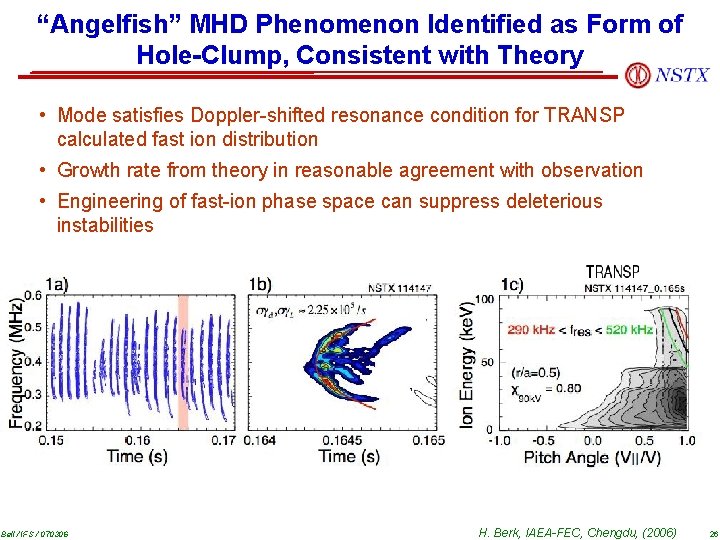
“Angelfish” MHD Phenomenon Identified as Form of Hole-Clump, Consistent with Theory • Mode satisfies Doppler-shifted resonance condition for TRANSP calculated fast ion distribution • Growth rate from theory in reasonable agreement with observation • Engineering of fast-ion phase space can suppress deleterious instabilities Bell / IFS / 070306 H. Berk, IAEA-FEC, Chengdu, (2006) 26
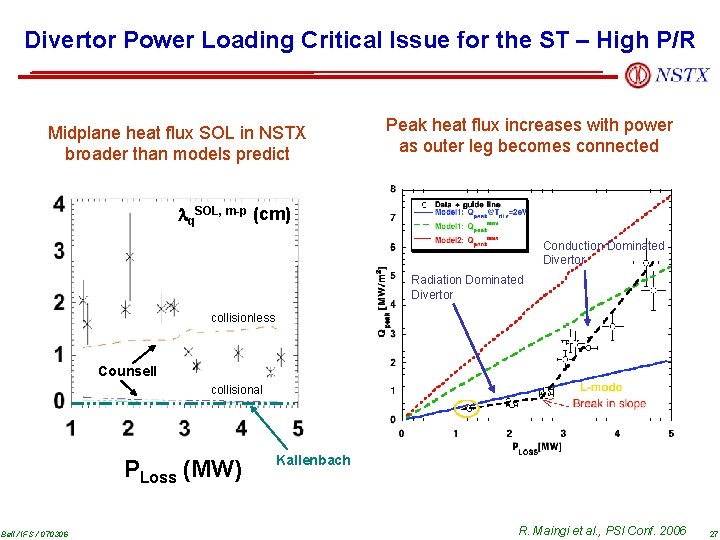
Divertor Power Loading Critical Issue for the ST – High P/R Midplane heat flux SOL in NSTX broader than models predict Peak heat flux increases with power as outer leg becomes connected lq. SOL, m-p (cm) Conduction Dominated Divertor Radiation Dominated Divertor collisionless Counsell collisional PLoss (MW) Bell / IFS / 070306 Kallenbach R. Maingi et al. , PSI Conf. 2006 27
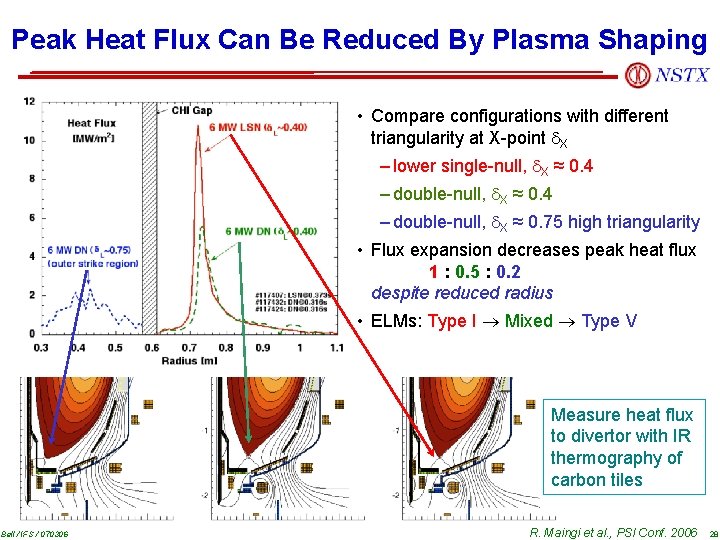
Peak Heat Flux Can Be Reduced By Plasma Shaping • Compare configurations with different triangularity at X-point X – lower single-null, X ≈ 0. 4 – double-null, X ≈ 0. 75 high triangularity • Flux expansion decreases peak heat flux 1 : 0. 5 : 0. 2 despite reduced radius • ELMs: Type I Mixed Type V Measure heat flux to divertor with IR thermography of carbon tiles Bell / IFS / 070306 R. Maingi et al. , PSI Conf. 2006 28
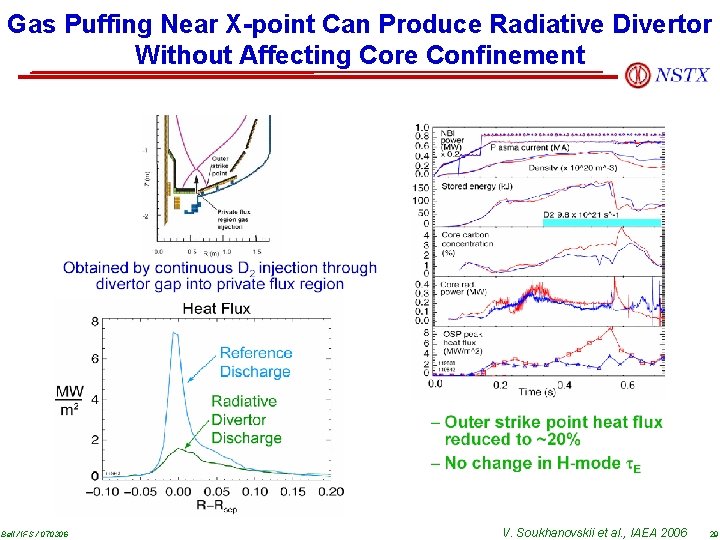
Gas Puffing Near X-point Can Produce Radiative Divertor Without Affecting Core Confinement Bell / IFS / 070306 V. Soukhanovskii et al. , IAEA 2006 29
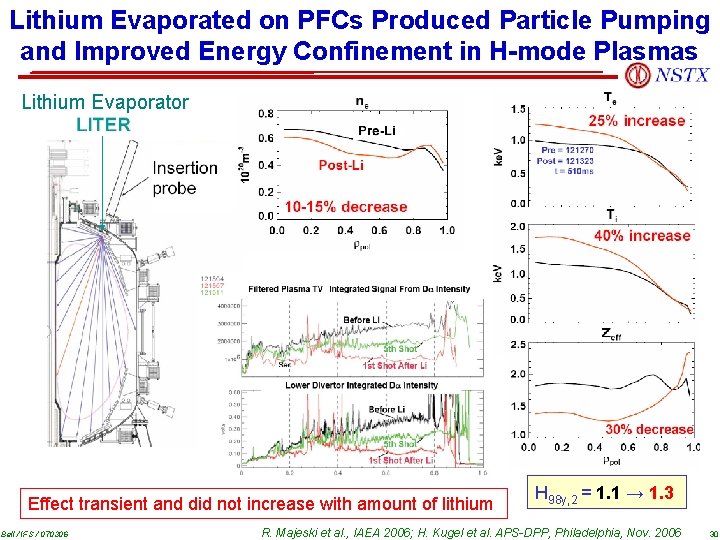
Lithium Evaporated on PFCs Produced Particle Pumping and Improved Energy Confinement in H-mode Plasmas Lithium Evaporator Effect transient and did not increase with amount of lithium Bell / IFS / 070306 H 98 y, 2 = 1. 1 → 1. 3 R. Majeski et al. , IAEA 2006; H. Kugel et al. APS-DPP, Philadelphia, Nov. 2006 30
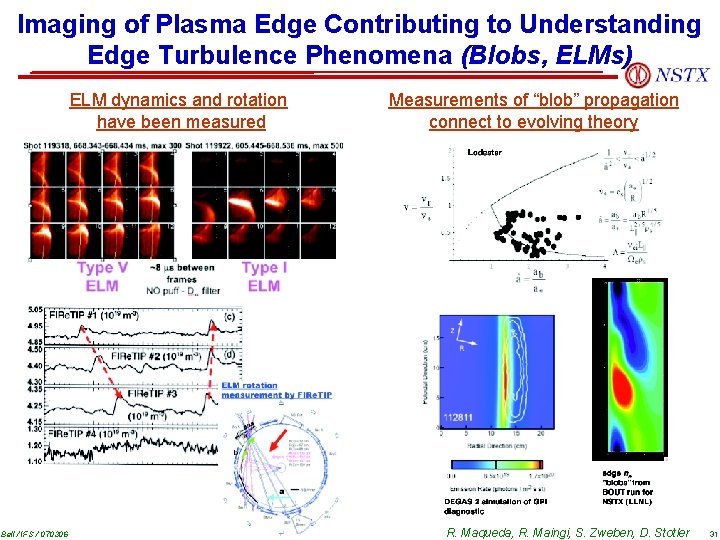
Imaging of Plasma Edge Contributing to Understanding Edge Turbulence Phenomena (Blobs, ELMs) ELM dynamics and rotation have been measured Bell / IFS / 070306 Measurements of “blob” propagation connect to evolving theory R. Maqueda, R. Maingi, S. Zweben, D. Stotler 31
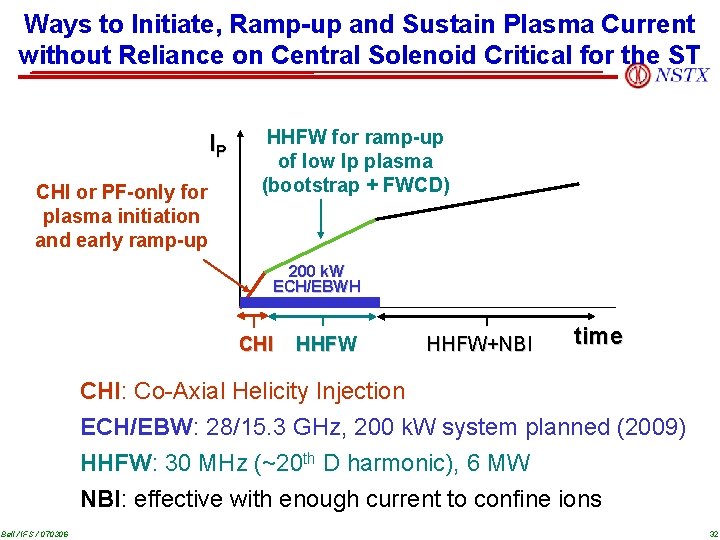
Ways to Initiate, Ramp-up and Sustain Plasma Current without Reliance on Central Solenoid Critical for the ST IP CHI or PF-only for plasma initiation and early ramp-up HHFW for ramp-up of low Ip plasma (bootstrap + FWCD) 200 k. W ECH/EBWH CHI HHFW+NBI time CHI: Co-Axial Helicity Injection ECH/EBW: 28/15. 3 GHz, 200 k. W system planned (2009) HHFW: 30 MHz (~20 th D harmonic), 6 MW NBI: effective with enough current to confine ions Bell / IFS / 070306 32
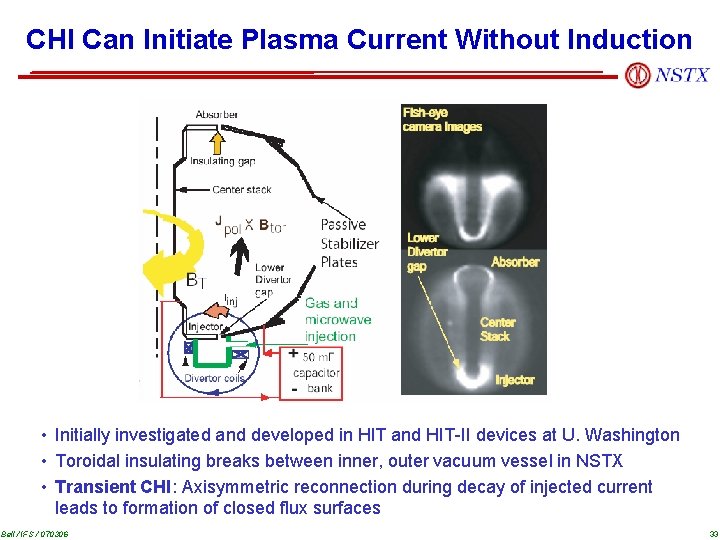
CHI Can Initiate Plasma Current Without Induction • Initially investigated and developed in HIT and HIT-II devices at U. Washington • Toroidal insulating breaks between inner, outer vacuum vessel in NSTX • Transient CHI: Axisymmetric reconnection during decay of injected current leads to formation of closed flux surfaces Bell / IFS / 070306 33
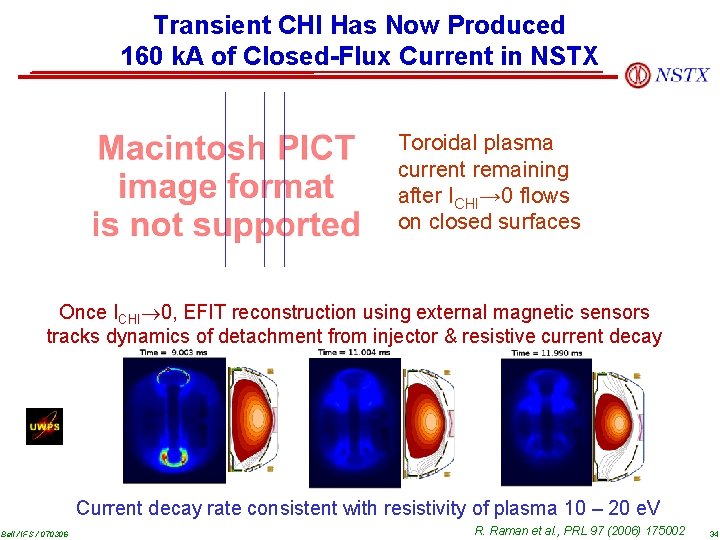
Transient CHI Has Now Produced 160 k. A of Closed-Flux Current in NSTX Toroidal plasma current remaining after ICHI→ 0 flows on closed surfaces Once ICHI 0, EFIT reconstruction using external magnetic sensors tracks dynamics of detachment from injector & resistive current decay Current decay rate consistent with resistivity of plasma 10 – 20 e. V Bell / IFS / 070306 R. Raman et al. , PRL 97 (2006) 175002 34
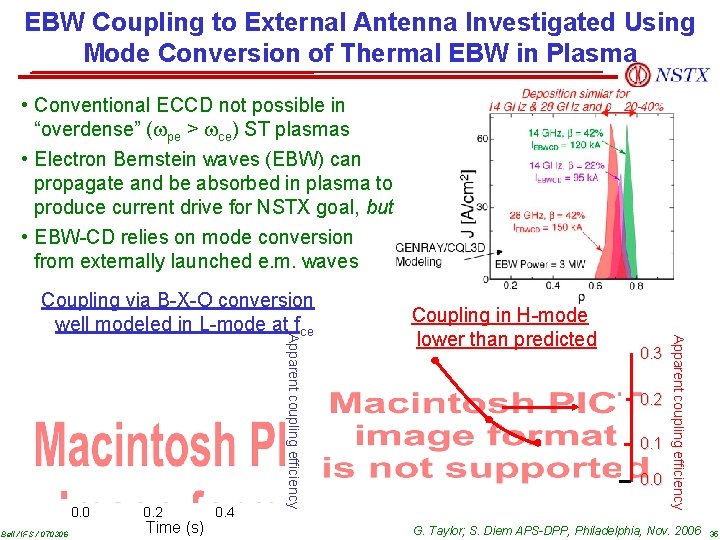
EBW Coupling to External Antenna Investigated Using Mode Conversion of Thermal EBW in Plasma • Conventional ECCD not possible in “overdense” ( pe > ce) ST plasmas • Electron Bernstein waves (EBW) can propagate and be absorbed in plasma to produce current drive for NSTX goal, but • EBW-CD relies on mode conversion from externally launched e. m. waves Bell / IFS / 070306 0. 2 Time (s) 0. 4 Coupling in H-mode lower than predicted 0. 3 0. 2 0. 1 0. 0 Apparent coupling efficiency Coupling via B-X-O conversion well modeled in L-mode at fce G. Taylor; S. Diem APS-DPP, Philadelphia, Nov. 2006 35
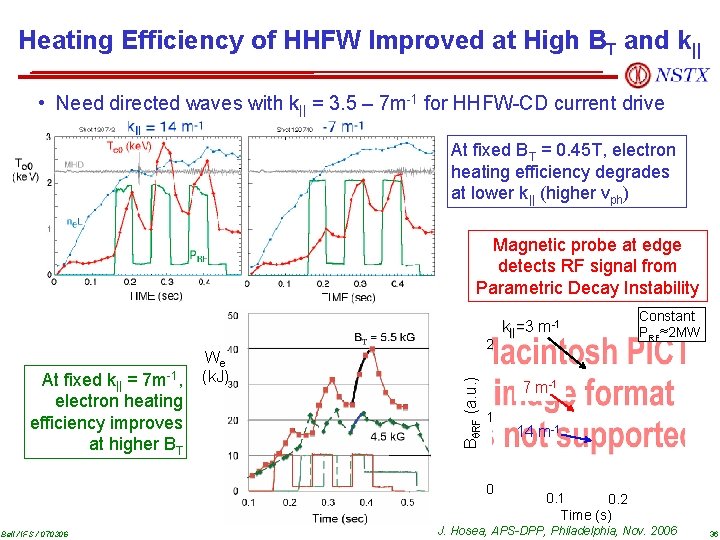
Heating Efficiency of HHFW Improved at High BT and k|| • Need directed waves with k|| = 3. 5 – 7 m-1 for HHFW-CD current drive At fixed BT = 0. 45 T, electron heating efficiency degrades at lower k|| (higher vph) Magnetic probe at edge detects RF signal from Parametric Decay Instability 2 B RF (a. u. ) At fixed k|| = 7 m-1, electron heating efficiency improves at higher BT We (k. J) Constant PRF≈2 MW 7 m-1 1 0 Bell / IFS / 070306 k||=3 m-1 14 m-1 0. 2 Time (s) J. Hosea, APS-DPP, Philadelphia, Nov. 2006 36
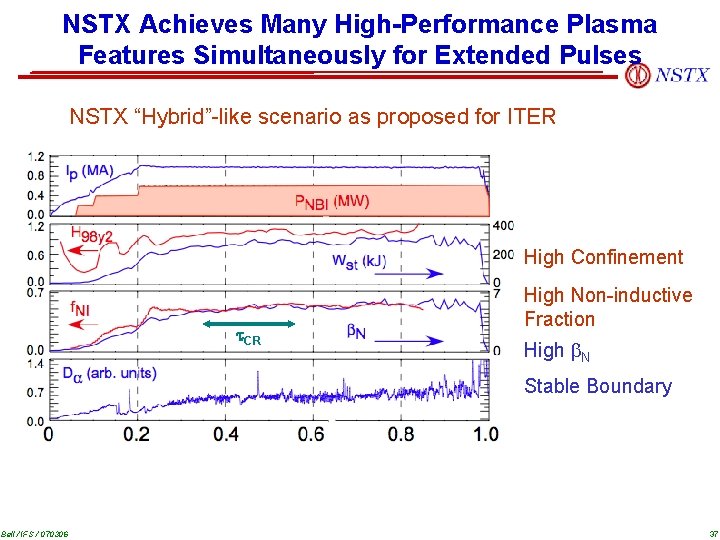
NSTX Achieves Many High-Performance Plasma Features Simultaneously for Extended Pulses NSTX “Hybrid”-like scenario as proposed for ITER High Confinement t. CR High Non-inductive Fraction High N Stable Boundary Bell / IFS / 070306 37
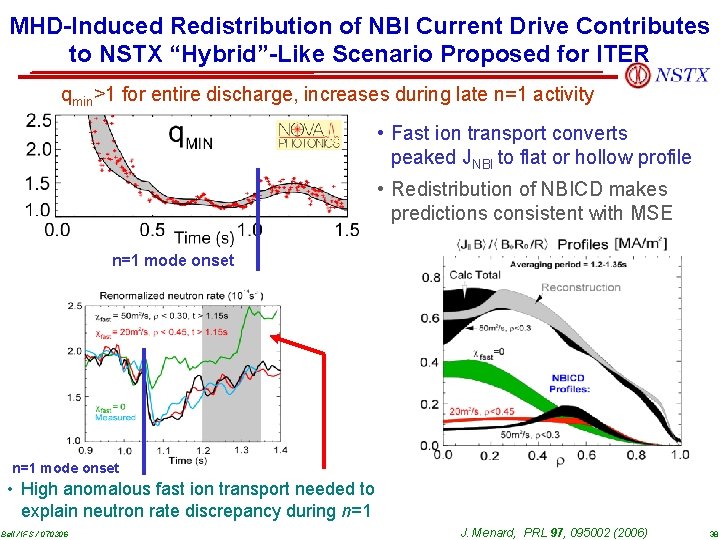
MHD-Induced Redistribution of NBI Current Drive Contributes to NSTX “Hybrid”-Like Scenario Proposed for ITER qmin>1 for entire discharge, increases during late n=1 activity • Fast ion transport converts peaked JNBI to flat or hollow profile • Redistribution of NBICD makes predictions consistent with MSE n=1 mode onset • High anomalous fast ion transport needed to explain neutron rate discrepancy during n=1 Bell / IFS / 070306 J. Menard, PRL 97, 095002 (2006) 38
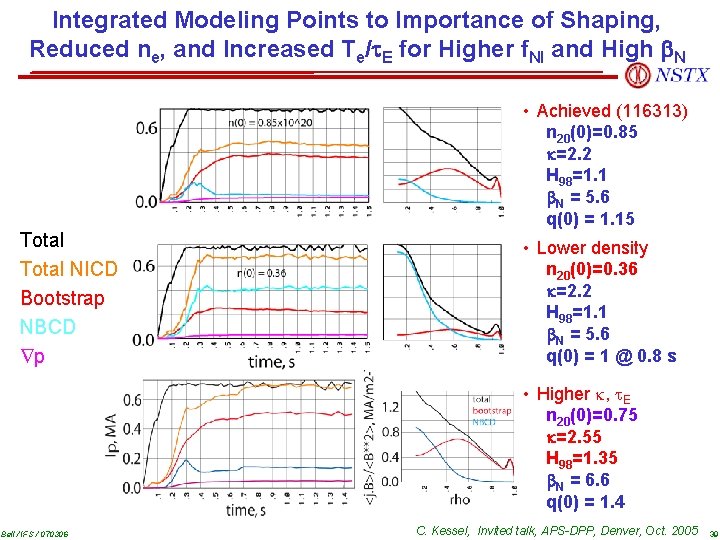
Integrated Modeling Points to Importance of Shaping, Reduced ne, and Increased Te/t. E for Higher f. NI and High N • Achieved (116313) n 20(0)=0. 85 =2. 2 H 98=1. 1 N = 5. 6 q(0) = 1. 15 Total NICD Bootstrap NBCD p • Lower density n 20(0)=0. 36 =2. 2 H 98=1. 1 N = 5. 6 q(0) = 1 @ 0. 8 s n(0)=0. 75 e 20 Bell / IFS / 070306 • Higher , E n 20(0)=0. 75 =2. 55 H 98=1. 35 N = 6. 6 q(0) = 1. 4 C. Kessel, Invited talk, APS-DPP, Denver, Oct. 2005 39
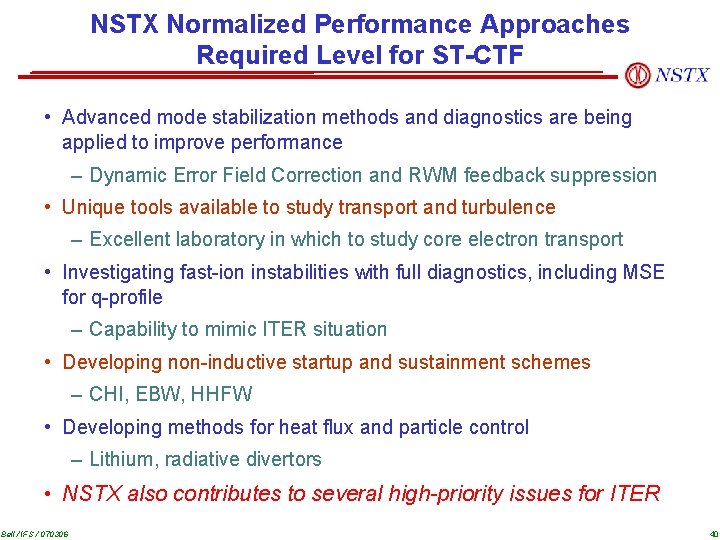
NSTX Normalized Performance Approaches Required Level for ST-CTF • Advanced mode stabilization methods and diagnostics are being applied to improve performance – Dynamic Error Field Correction and RWM feedback suppression • Unique tools available to study transport and turbulence – Excellent laboratory in which to study core electron transport • Investigating fast-ion instabilities with full diagnostics, including MSE for q-profile – Capability to mimic ITER situation • Developing non-inductive startup and sustainment schemes – CHI, EBW, HHFW • Developing methods for heat flux and particle control – Lithium, radiative divertors • NSTX also contributes to several high-priority issues for ITER Bell / IFS / 070306 40
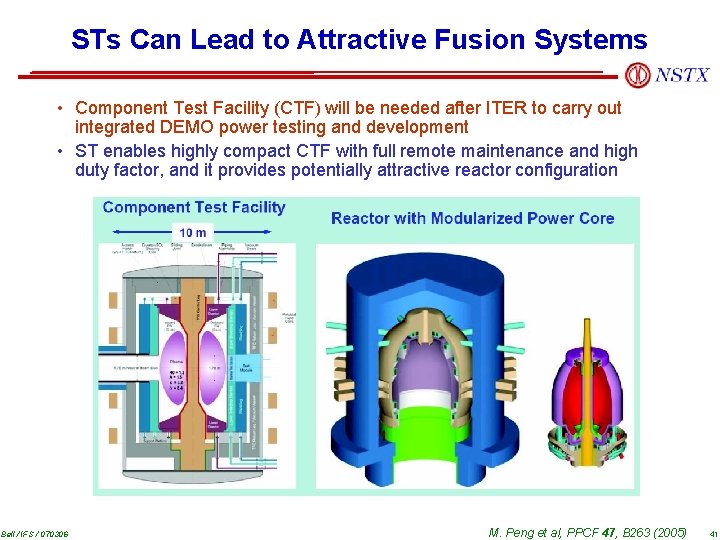
STs Can Lead to Attractive Fusion Systems • Component Test Facility (CTF) will be needed after ITER to carry out integrated DEMO power testing and development • ST enables highly compact CTF with full remote maintenance and high duty factor, and it provides potentially attractive reactor configuration Bell / IFS / 070306 M. Peng et al, PPCF 47, B 263 (2005) 41
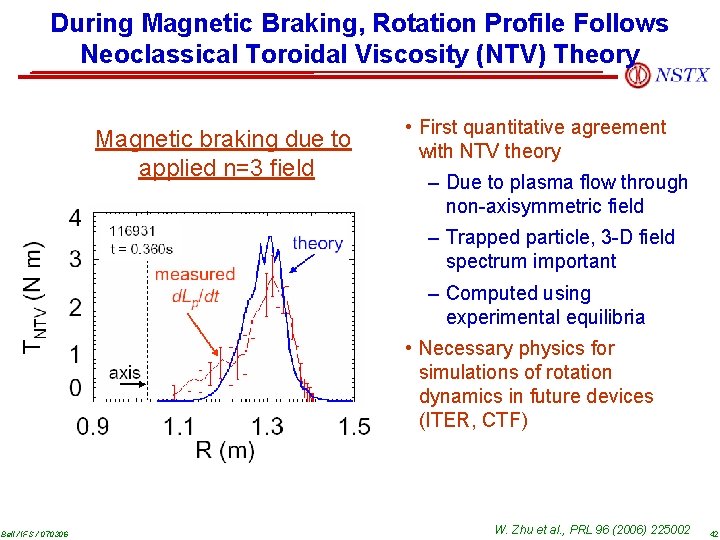
During Magnetic Braking, Rotation Profile Follows Neoclassical Toroidal Viscosity (NTV) Theory Magnetic braking due to applied n=3 field • First quantitative agreement with NTV theory – Due to plasma flow through non-axisymmetric field – Trapped particle, 3 -D field spectrum important – Computed using experimental equilibria • Necessary physics for simulations of rotation dynamics in future devices (ITER, CTF) Bell / IFS / 070306 W. Zhu et al. , PRL 96 (2006) 225002 42
Increased Ion Collisionality Decreases Critical Rotation Frequency Wcrit • Plasmas with similar v. A • Consistent with neoclassical viscous dissipation model – at low g, increased ni leads to lower Wcrit 121071 121083 (K. C. Shaing, Phys. Plasmas 11 (2004) 5525. ) • ITER plasmas with lower ni may require higher degree of RWM active stabilization Further analysis aims to uncover RWM stabilization physics Bell / IFS / 070306 Sontag, et al. , IAEA 2006 43
Low A, High Favorable for Study of NTM Seeding / Stabilization • Several types of event can initiate low frequency MHD modes in NSTX Sawtooth excitation of n = 2 – e. g. sawteeth*, RWMs** – Can led to soft beta limit, or rotation reduction resulting in disruption – Large q = 1 radius, high b, mode coupling at low-A facilitate seeding n=1 – NTM stabilization amplified at low-A (GGJ e 3/2) – NTM less deleterious • NTM study planned 2007 - 2009 – Characterize modes: NTMs, or internal kinks? – Exploit 12 channel MSE, reflectometer, fast USXR capabilities – Mitigate deleterious effects of modes Bell / IFS / 070306 • Sawtooth excites n = 2, but n = 2 can decrease post-crash *Fredrickson, et al. , APS-DPP 2004; **Sabbagh, et al. , NF 44 (2004) 560 44
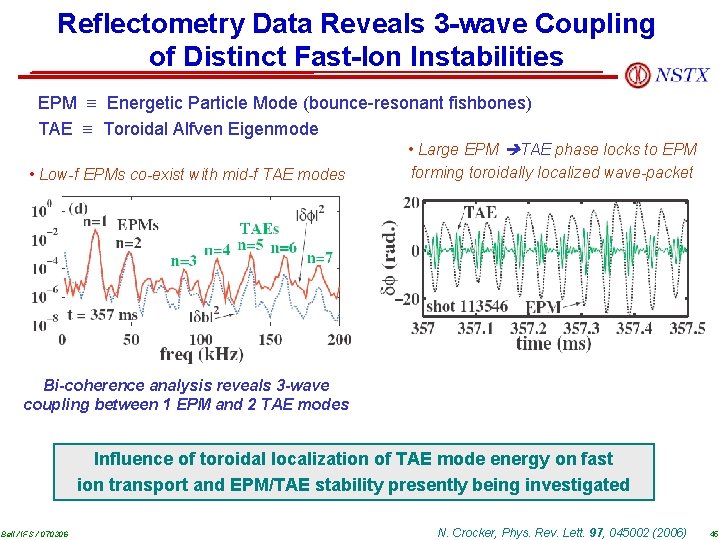
Reflectometry Data Reveals 3 -wave Coupling of Distinct Fast-Ion Instabilities EPM Energetic Particle Mode (bounce-resonant fishbones) TAE Toroidal Alfven Eigenmode • Low-f EPMs co-exist with mid-f TAE modes • Large EPM TAE phase locks to EPM forming toroidally localized wave-packet Bi-coherence analysis reveals 3 -wave coupling between 1 EPM and 2 TAE modes Influence of toroidal localization of TAE mode energy on fast ion transport and EPM/TAE stability presently being investigated Bell / IFS / 070306 N. Crocker, Phys. Rev. Lett. 97, 045002 (2006) 45
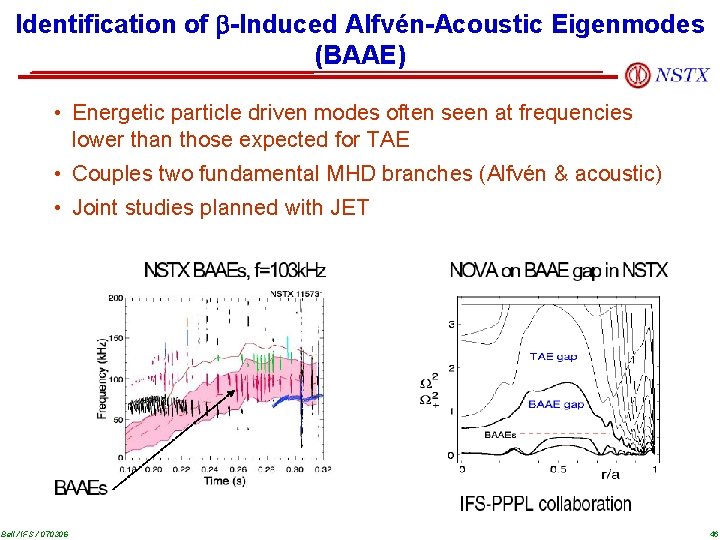
Identification of -Induced Alfvén-Acoustic Eigenmodes (BAAE) • Energetic particle driven modes often seen at frequencies lower than those expected for TAE • Couples two fundamental MHD branches (Alfvén & acoustic) • Joint studies planned with JET Bell / IFS / 070306 46
FY 07 Facility Enhancements • Higher temperature bakeout of divertor tile to improve plasma performance and to prepare for lithium – Lower divertor tiles to 350°C and upper tiles to 240°C • Faster lithium evaporation – x 10 deposition rate to lower divertor plates – Evaporation between/during shots in normal cycles • Higher Mach number for supersonic gas injector to improve fueling for H-mode (LLNL) • Higher voltage for higher current CHI (U Washington) – Improved monitoring of voltage transients • Faster processors for real-time plasma control system (GA) – Aiming to operate in parallel by end of FY 07 run Bell / IFS / 070306 47
FY 07 Diagnostic Enhancements • Poloidal CHERS (27 ch) for transport physics • MSE 12 16 channels for improved j(r) resolution (Nova) • Transmission grating x-ray spectrometer viewing across NBI for impurity transport (JHU) • FIDA (Fast Ion D measurement) - fast, band-pass-filtered channels for the local fast-ion density (prototype channels late in ‘ 07 run) (UC Irvine) • FIRe. TIP 4 6 channels (500 k. Hz) for improved spatial resolution (UC Davis) • New collection mirror for high-k scattering system • Correlation reflectometer, fixed freq. reflectometer (3 6 ch), profile reflectometer (25 10 s) and high-k backscattering (late in the run) (UCLA) • Improved high-frequency Mirnov coil system for energetic particle modes and segmented Rogowski coil for disruption study • Wider-angle view and local gas-puffing for EBW radiometers for H-mode coupling • 3 RF probes to measure surface waves during HHFW heating Bell / IFS / 070306 48