
Physics Performance Ulrich Uwer University of Heidelberg On
Physics Performance • Ulrich Uwer • University of Heidelberg • On behalf of the LHCb collaboration Beauty 2003, Carnegie Mellon University, Pittsburgh, PA, USA
Physics Goals At 2 x 1032 cm-2 s-1 1012 bb pairs produced / yr Ø CPV measurements in many decay channels: • pure hadronic and multi-body final states. • new decay channels in particular Bs decays Ø precise determination of CKM elements: measurement of b u+W (tree) phase 2 B 0 →J/ ( )K 2 + B 0 →D*_ + B 0 →D 0 K*0 and B 0 + Bs K + K Bs → DS K Bs→ J/ ( ) = B 0→ + , Ø overconstraining the Unitarity Triangles: disentangle the tree phases from phases of oscillations (loops) and penguins W Ø Study rare and loop-suppressed decays Search and filter-out effects of New Physics W New Physics
Example: New Physics in B mixing B(s) mixing phase: W New Physics Φd = 2 + Φd. NP Φs = 2 + Φs. NP Observation of new phase: CPV in B 0 J/ Ks sin(2 +Φd. NP) B 0 D * sin(2 +Φd. NP+ ) Bs J/ sin(2 + Φs. NP) B s Ds K sin(2 + Φs. NP+ ) Rate of B 0 D 0 K*0, D 0 CP K*0 Redundant measurements necessary to disentangle CKM phases from New Physics
Discovery Potential In 1 year: e. g. (B D K* ): 70 sin d(B 0 J/ Ks): 0. 022 “reference channel” ó 2007 BABAR+BELLE
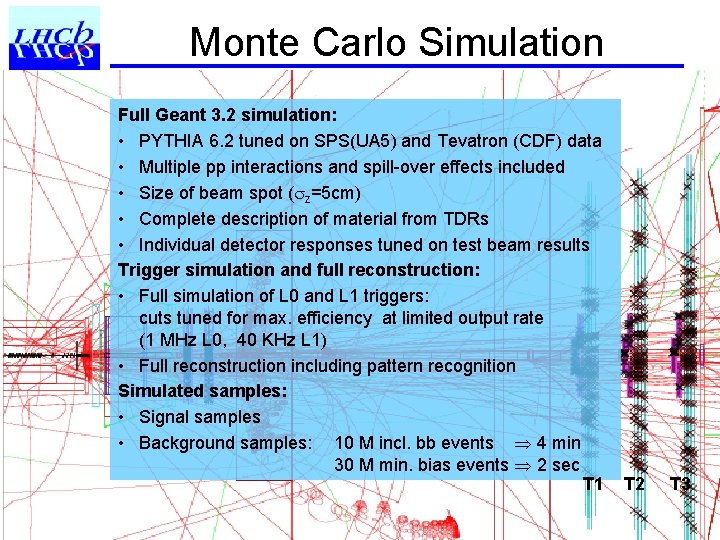
Monte Carlo Simulation Full Geant 3. 2 simulation: • PYTHIA 6. 2 tuned on SPS(UA 5) and Tevatron (CDF) data • Multiple pp interactions and spill-over effects included • Size of beam spot ( z=5 cm) • Complete description of material from TDRs • Individual detector responses tuned on test beam results Trigger simulation and full reconstruction: • Full simulation of L 0 and L 1 triggers: cuts tuned for max. efficiency at limited output rate (1 MHz L 0, 40 KHz L 1) • Full reconstruction including pattern recognition Simulated samples: • Signal samples • Background samples: 10 M incl. bb events 4 min 30 M min. bias events 2 sec T 1 T 2 T 3
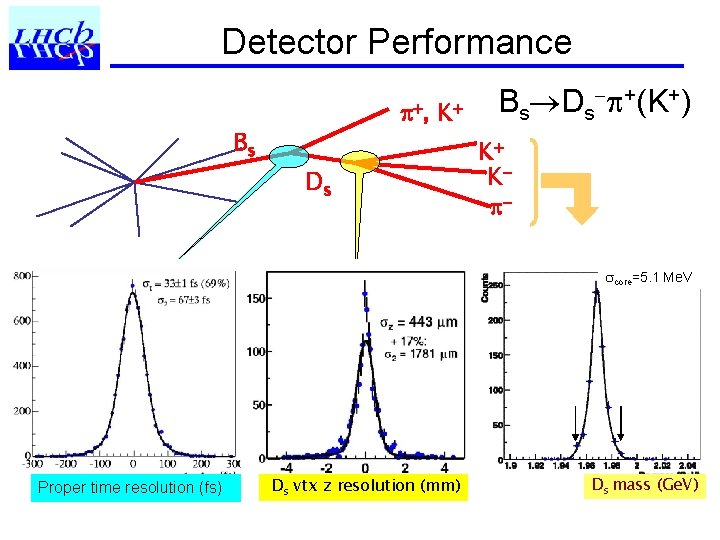
Detector Performance , Bs K Ds Bs Ds +(K+) K K core=5. 1 Me. V Bs vtx time z resolution Proper resolution(mm) (fs) Ds vtx z resolution (mm) Ds mass (Ge. V)
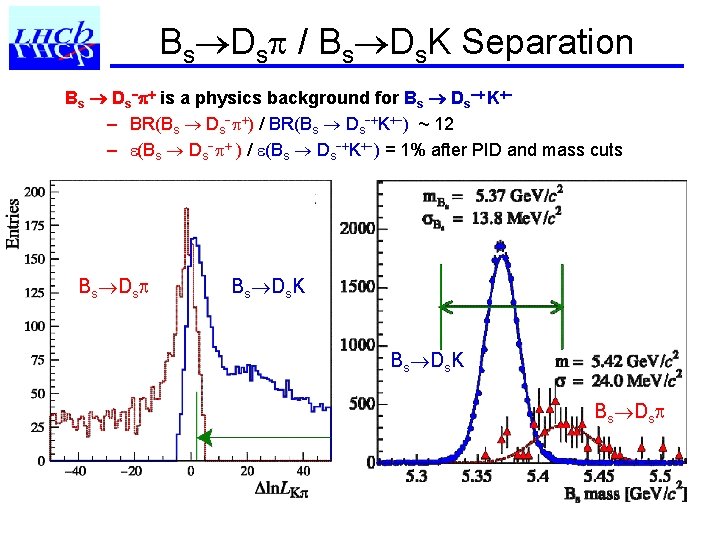
Bs Ds / Bs Ds. K Separation Bs Ds is a physics background for Bs Ds K – BR(Bs Ds ) / BR(Bs Ds K ) ~ 12 – (Bs Ds ) / (Bs Ds K ) = 1% after PID and mass cuts Bs Ds. K Bs Ds
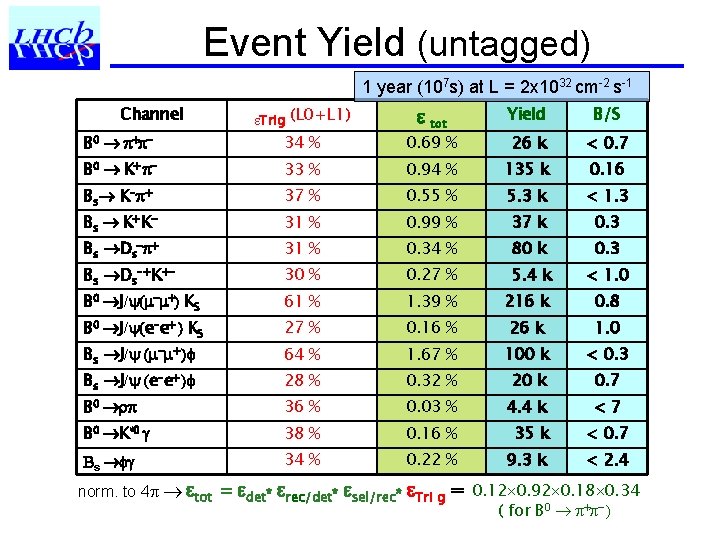
Event Yield (untagged) 1 year (107 s) at L = 2 x 1032 cm-2 s-1 Channel Trig (L 0+L 1) tot Yield B/S B 0 34 % 0. 69 % 26 k < 0. 7 B 0 K 33 % 0. 94 % 135 k 0. 16 Bs K- + 37 % 0. 55 % 5. 3 k < 1. 3 Bs K K 31 % 0. 99 % 37 k 0. 3 Bs Ds 31 % 0. 34 % 80 k 0. 3 Bs Ds-+K+- 30 % 0. 27 % 5. 4 k < 1. 0 B 0 J/y(m m ) KS 61 % 1. 39 % 216 k 0. 8 B 0 J/y(e-e ) KS 27 % 0. 16 % 26 k 1. 0 Bs J/y (m m ) 64 % 1. 67 % 100 k < 0. 3 Bs J/y (e-e ) 28 % 0. 32 % 20 k 0. 7 B 0 36 % 0. 03 % 4. 4 k <7 B 0 K*0 38 % 0. 16 % 35 k < 0. 7 Bs 34 % 0. 22 % 9. 3 k < 2. 4 norm. to 4 tot = det* rec/det* sel/rec* Tri g = 0. 12 0. 92 0. 18 0. 34 ( for B 0 )
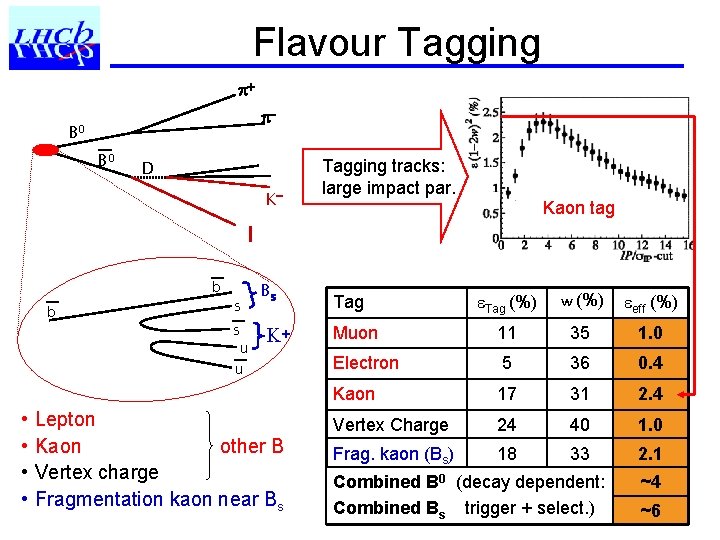
Flavour Tagging B 0 D K- Tagging tracks: large impact par. Kaon tag l b b s s u Bs K+ u • • Lepton Kaon other B Vertex charge Fragmentation kaon near Bs Tag (%) w (%) eff (%) Muon 11 35 1. 0 Electron 5 36 0. 4 Kaon 17 31 2. 4 Vertex Charge 24 40 1. 0 Frag. kaon (Bs) 18 33 2. 1 Tag Combined B 0 (decay dependent: Combined Bs trigger + select. ) ~4 ~6
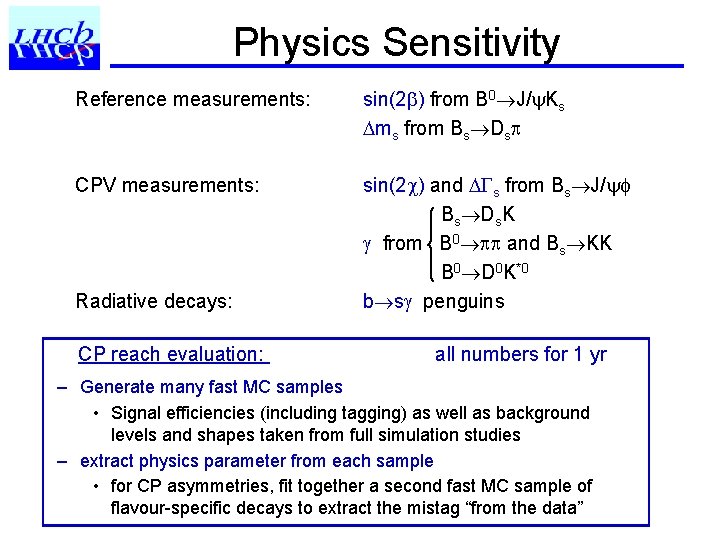
Physics Sensitivity Reference measurements: sin(2 ) from B 0 J/ Ks ms from Bs Ds CPV measurements: sin(2 ) and s from Bs J/ Bs Ds. K from B 0 and Bs KK B 0 D 0 K*0 b s penguins Radiative decays: CP reach evaluation: all numbers for 1 yr – Generate many fast MC samples • Signal efficiencies (including tagging) as well as background levels and shapes taken from full simulation studies – extract physics parameter from each sample • for CP asymmetries, fit together a second fast MC sample of flavour-specific decays to extract the mistag “from the data”
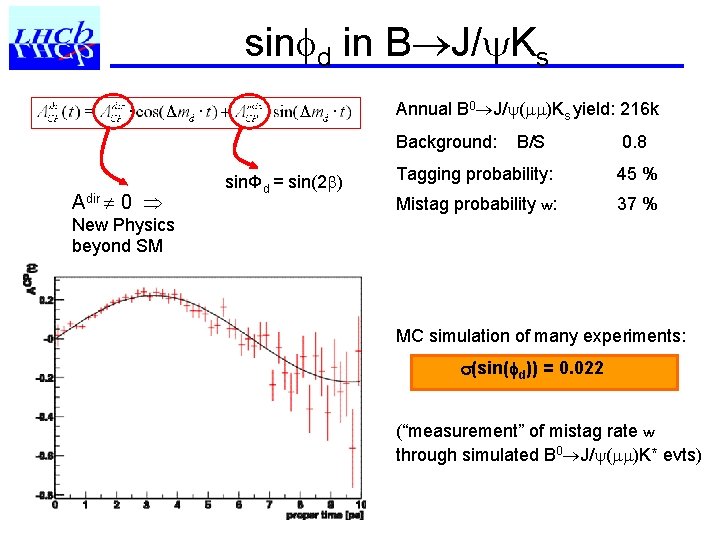
sin d in B J/ Ks Annual B 0 J/ ( )Ks yield: 216 k Background: Adir 0 New Physics beyond SM sinΦd = sin(2 ) B/S 0. 8 Tagging probability: 45 % Mistag probability w: 37 % MC simulation of many experiments: (sin( d)) = 0. 022 (“measurement” of mistag rate w through simulated B 0 J/ ( )K* evts)
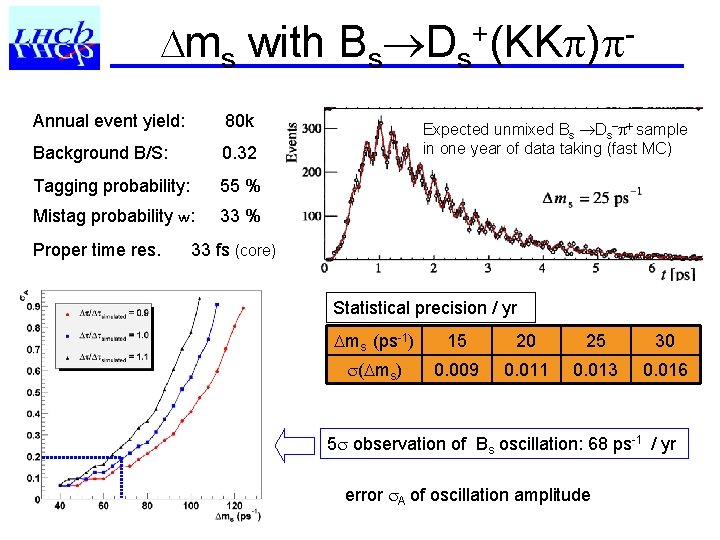
ms with Bs Ds+(KK ) Annual event yield: 80 k Background B/S: 0. 32 Tagging probability: 55 % Mistag probability w: 33 % Proper time res. Expected unmixed Bs Ds sample in one year of data taking (fast MC) 33 fs (core) Statistical precision / yr ms (ps-1) 15 20 25 30 ( ms) 0. 009 0. 011 0. 013 0. 016 5 observation of Bs oscillation: 68 ps-1 / yr error A of oscillation amplitude
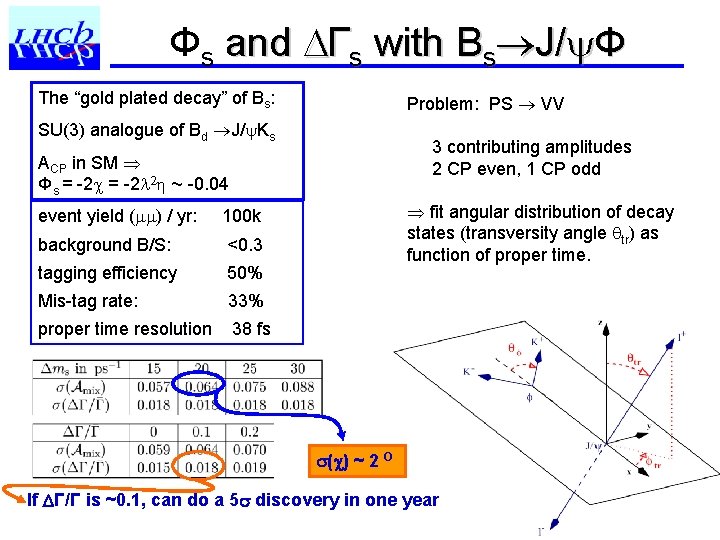
Φs and Γs with Bs J/ Φ The “gold plated decay” of Bs: Problem: PS VV SU(3) analogue of Bd J/ Ks 3 contributing amplitudes 2 CP even, 1 CP odd ACP in SM Φs = -2 2 ~ -0. 04 event yield ( ) / yr: 100 k background B/S: <0. 3 tagging efficiency 50% Mis-tag rate: 33% proper time resolution 38 fs fit angular distribution of decay states (transversity angle tr) as function of proper time. ( ) ~ 2 O If Γ/Γ is ~0. 1, can do a 5 discovery in one year
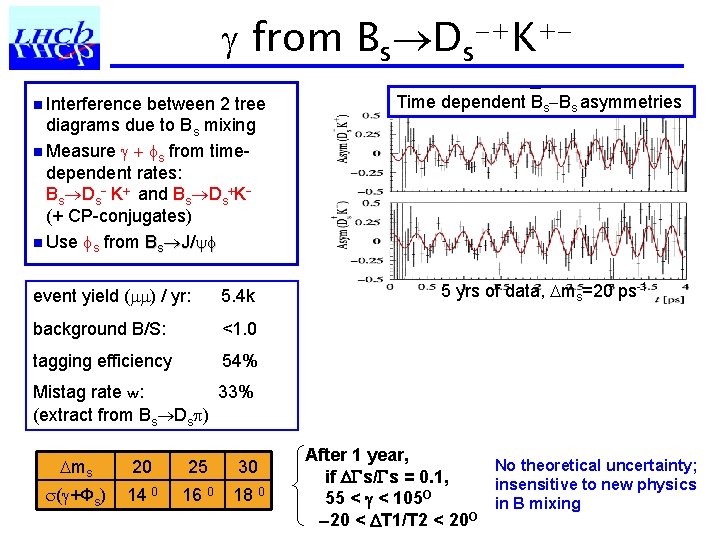
from Bs Ds +K+ Interference between 2 tree diagrams due to Bs mixing n Measure s from timedependent rates: Bs Ds K and Bs Ds K (+ CP-conjugates) n Use s from Bs J/ n event yield ( ) / yr: 5. 4 k background B/S: <1. 0 tagging efficiency 54% Time dependent Bs Bs asymmetries 5 yrs of data, ms=20 ps-1 Mistag rate w: 33% (extract from Bs Ds ) ms 20 25 30 ( +Φs) 14 0 16 0 18 0 After 1 year, No theoretical uncertainty; if s/ s = 0. 1, insensitive to new physics O 55 < < 105 in B mixing O 20 < T 1/T 2 < 20
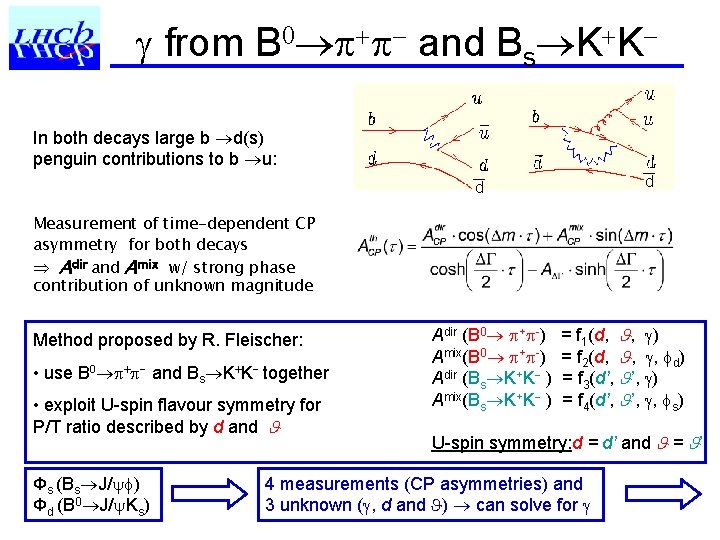
from B and Bs K K In both decays large b d(s) penguin contributions to b u: d d Measurement of time-dependent CP asymmetry for both decays Adir and Amix w/ strong phase contribution of unknown magnitude Method proposed by R. Fleischer: • use B and Bs K K together • exploit U-spin flavour symmetry for P/T ratio described by d and Φs (Bs J/ ) Φd (B 0 J/ Ks) Adir (B 0 + -) Amix(B 0 + -) Adir (Bs K+K ) Amix(Bs K+K ) = f 1(d, , ) = f 2(d, , , d) = f 3(d’, ) = f 4(d’, , s) U-spin symmetry: d = d’ and = ’ 4 measurements (CP asymmetries) and 3 unknown ( , d and ) can solve for
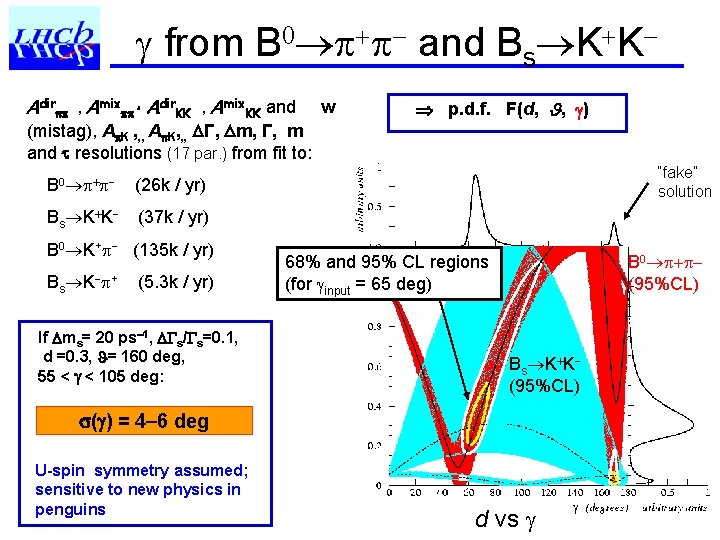
from B and Bs K K Adir , Amix , Adir. KK , Amix. KK and (mistag), A K , , , A K, , , Γ, m, Γ, m and resolutions (17 par. ) from fit to: B (26 k / yr) Bs K K (37 k / yr) B K+ (135 k / yr) Bs K + (5. 3 k / yr) If ms= 20 ps 1, s/ s=0. 1, d =0. 3, = 160 deg, 55 < < 105 deg: w p. d. f. F(d, , ) “fake” solution B (95%CL) 68% and 95% CL regions (for input = 65 deg) Bs K K (95%CL) ( ) = 4 6 deg U-spin symmetry assumed; sensitive to new physics in penguins d vs
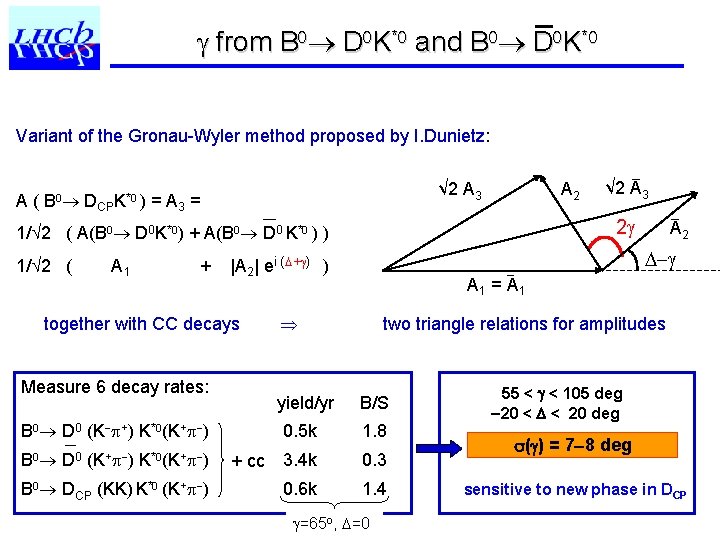
from B D K* and B D K* Variant of the Gronau-Wyler method proposed by I. Dunietz: √ 2 A 3 A ( B DCPK* ) = A 3 = A 2 2 1/ 2 ( A(B D 0 K* ) + A(B D 0 K* ) ) 1/ 2 ( A 1 + Measure 6 decay rates: B D 0 (K +) K* (K+ ) B D 0 (K+ ) K* (K+ ) B DCP (KK) K* (K+ ) + cc A 2 |A 2| ei ( + ) ) together with CC decays √ 2 A 3 A 1 = A 1 two triangle relations for amplitudes yield/yr B/S 0. 5 k 1. 8 3. 4 k 0. 3 0. 6 k 1. 4 =65 o, =0 55 < < 105 deg 20 < < 20 deg ( ) = 7 8 deg sensitive to new phase in DCP
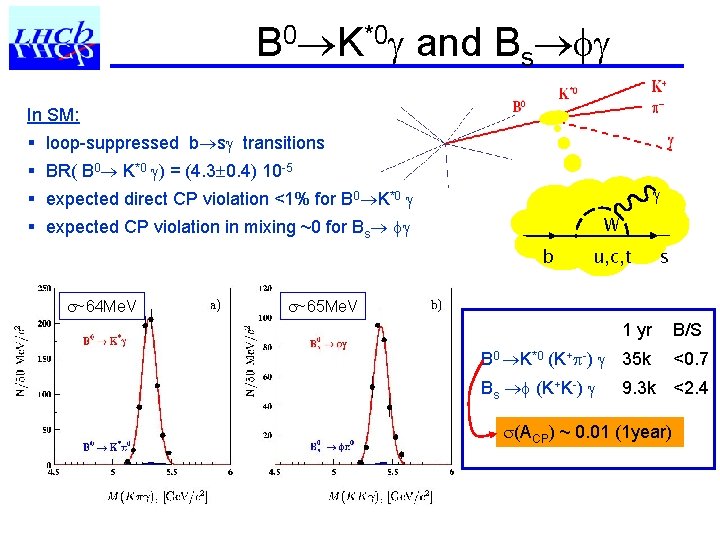
B 0 K*0 and Bs In SM: § loop-suppressed b s transitions § BR( B 0 K*0 ) = (4. 3 0. 4) 10 -5 § expected direct CP violation <1% for B 0 K*0 W § expected CP violation in mixing ~0 for Bs b ~64 Me. V u, c, t s ~65 Me. V 1 yr B 0 K*0 (K+ -) 35 k Bs (K+K-) B/S <0. 7 9. 3 k <2. 4 (ACP) ~ 0. 01 (1 year)
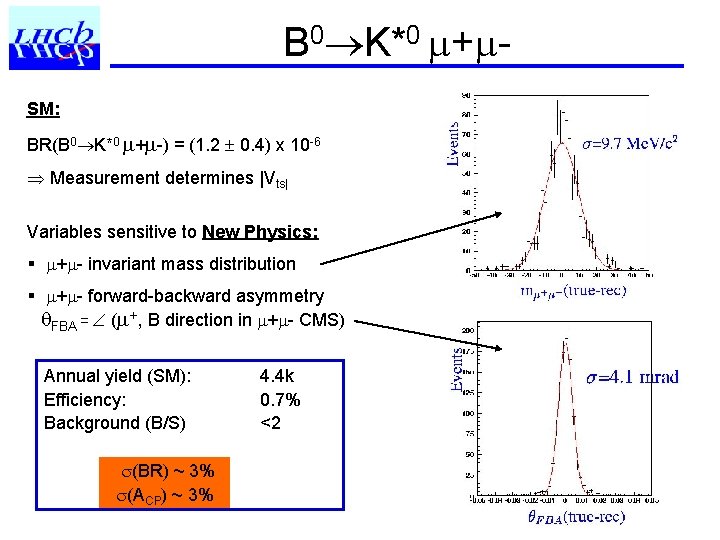
B 0 K*0 + SM: BR(B 0 K*0 + -) = (1. 2 0. 4) x 10 -6 Measurement determines |Vts| Variables sensitive to New Physics: § + - invariant mass distribution § + - forward-backward asymmetry FBA = ( +, B direction in + - CMS) Annual yield (SM): Efficiency: Background (B/S) (BR) ~ 3% (ACP) ~ 3% 4. 4 k 0. 7% <2
Conclusion LHCb can study many different B-meson decay modes with high precision § excellent particle identification capability § excellent mass and decay-time resolution LHCb can fully exploit the large B-meson yields at LHC from the start-up § flexible, robust and efficient trigger § design luminosity of 2 x 1032 is lower than typical LHC luminosity LHCb detector will be ready for data taking in 2007 at LHC start-up § detector production is on schedule § installation of detectors will start end of next year LHCb will offer soon an excellent opportunity to § determine precisely the CKM parameters through phase meas. § spot New Physics by overconstraining the Unitarity Triangles
- Slides: 20