
Physics opportunities with tagged deep inelastic scattering on
- Slides: 19
Physics opportunities with tagged deep inelastic scattering on polarized light nuclei at EIC Ch. Weiss Jefferson Lab, USA P. Nadel-Turonski Jefferson Lab, USA V. Guzey Petersburg Nuclear Physics Institute (PNPI) NRC“Kurchatov Institute”, Gatchina, Russia On behalf of JLab LDRD project “Physics potential of polarized light ions with EIC@JLab”: Ch. Weiss, D. Higinbotham, W. Melnitchouk, P. Nadel-Turonski, Kijun Park, Ch. Hyde, M. Sargsian, V. Guzey. With collaborators: W. Cosin, S. Kuhn, M. Strikman, Zh. Zhao https: //eic. jlab. org/forward_tagging/index. php/Main_Page XXII International Workshop on Deep-Inelastic Scattering and related subjects (DIS 2014) Warsaw, Poland, April 28 - May 2, 2014 1
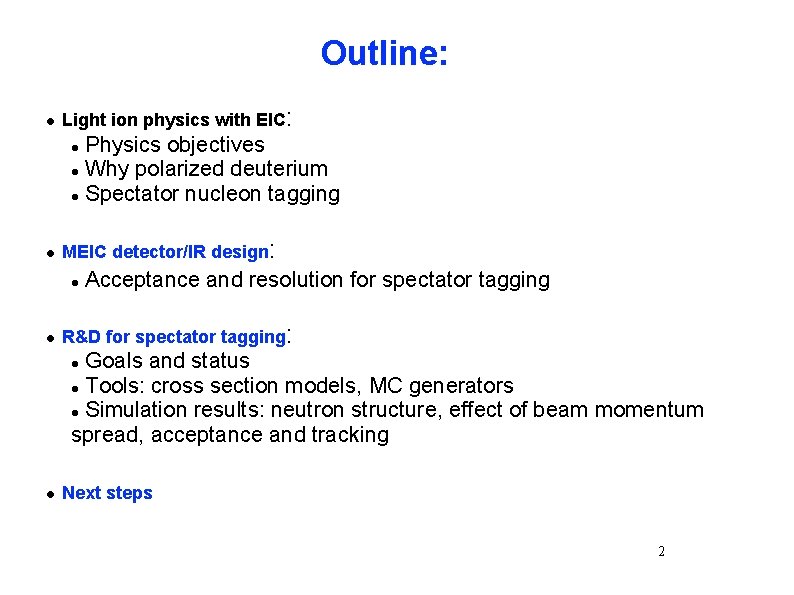
Outline: Light ion physics with EIC: Physics objectives Why polarized deuterium Spectator nucleon tagging MEIC detector/IR design: Acceptance and resolution for spectator tagging R&D for spectator tagging: Goals and status Tools: cross section models, MC generators Simulation results: neutron structure, effect of beam momentum spread, acceptance and tracking Next steps 2
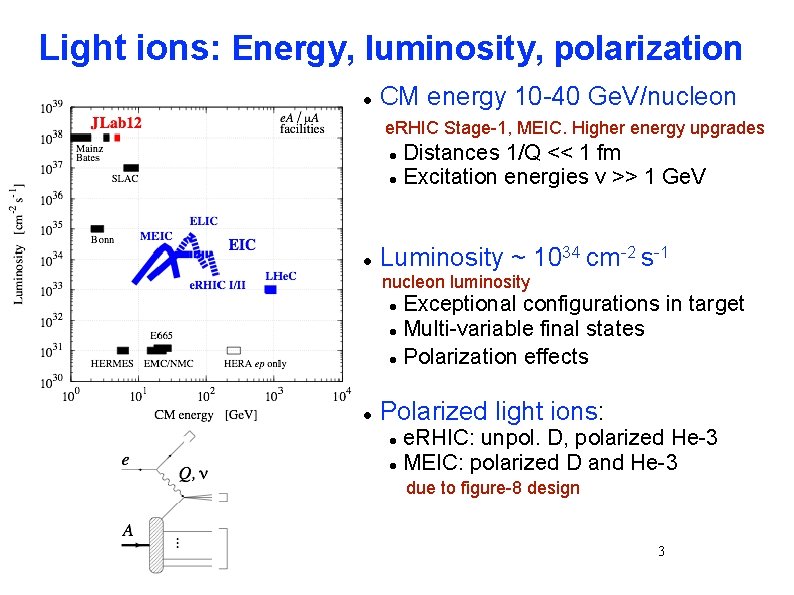
Light ions: Energy, luminosity, polarization CM energy 10 -40 Ge. V/nucleon e. RHIC Stage-1, MEIC. Higher energy upgrades Distances 1/Q << 1 fm Excitation energies ν >> 1 Ge. V Luminosity ~ 1034 cm-2 s-1 nucleon luminosity Exceptional configurations in target Multi-variable final states Polarization effects Polarized light ions: e. RHIC: unpol. D, polarized He-3 MEIC: polarized D and He-3 due to figure-8 design 3
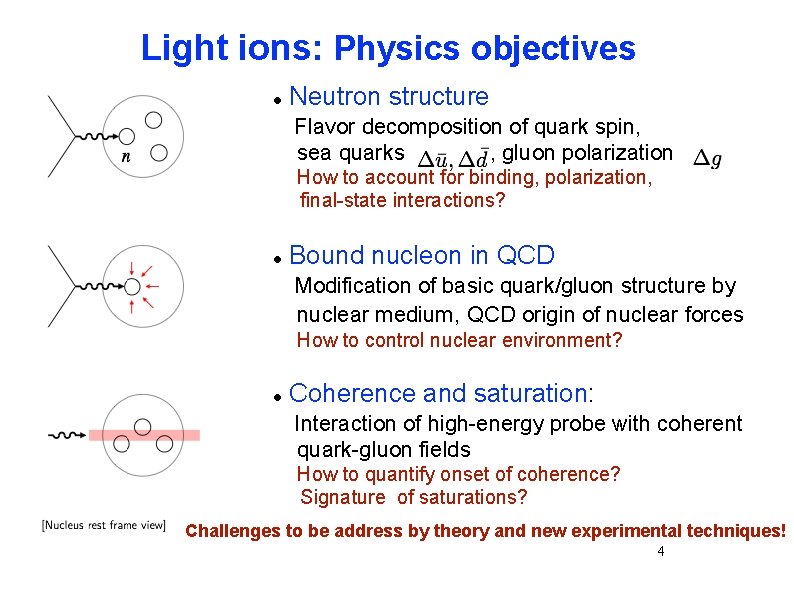
Light ions: Physics objectives Neutron structure Flavor decomposition of quark spin, sea quarks , gluon polarization How to account for binding, polarization, final-state interactions? Bound nucleon in QCD Modification of basic quark/gluon structure by nuclear medium, QCD origin of nuclear forces How to control nuclear environment? Coherence and saturation: Interaction of high-energy probe with coherent quark-gluon fields How to quantify onset of coherence? Signature of saturations? Challenges to be address by theory and new experimental techniques! 4
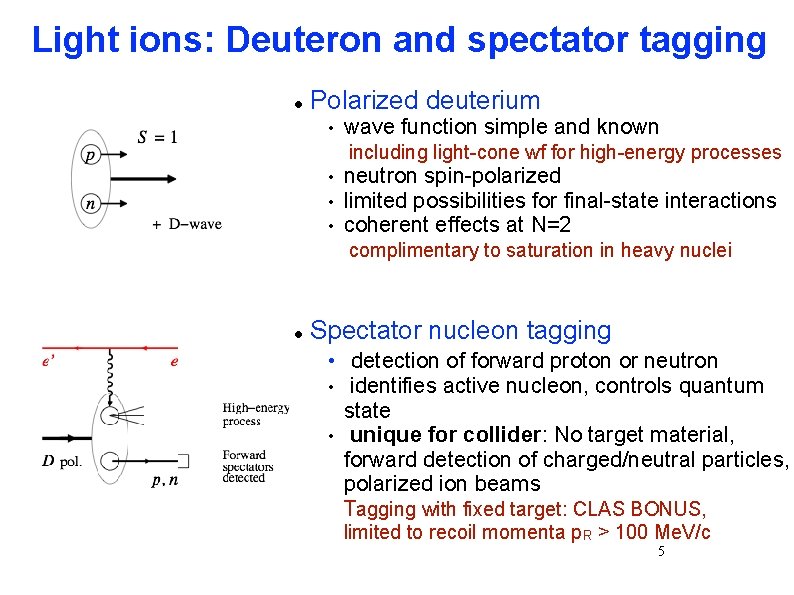
Light ions: Deuteron and spectator tagging Polarized deuterium • wave function simple and known including light-cone wf for high-energy processes • • • neutron spin-polarized limited possibilities for final-state interactions coherent effects at N=2 complimentary to saturation in heavy nuclei Spectator nucleon tagging • detection of forward proton or neutron • • identifies active nucleon, controls quantum state unique for collider: No target material, forward detection of charged/neutral particles, polarized ion beams Tagging with fixed target: CLAS BONUS, limited to recoil momenta p. R > 100 Me. V/c 5
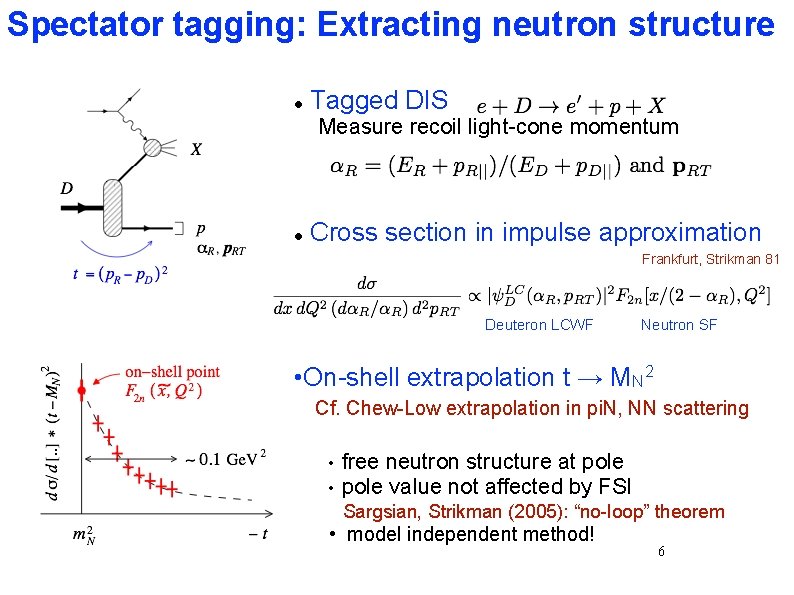
Spectator tagging: Extracting neutron structure Tagged DIS Measure recoil light-cone momentum Cross section in impulse approximation Frankfurt, Strikman 81 Deuteron LCWF Neutron SF • On-shell extrapolation t → MN 2 Cf. Chew-Low extrapolation in pi. N, NN scattering • • free neutron structure at pole value not affected by FSI Sargsian, Strikman (2005): “no-loop” theorem • model independent method! 6
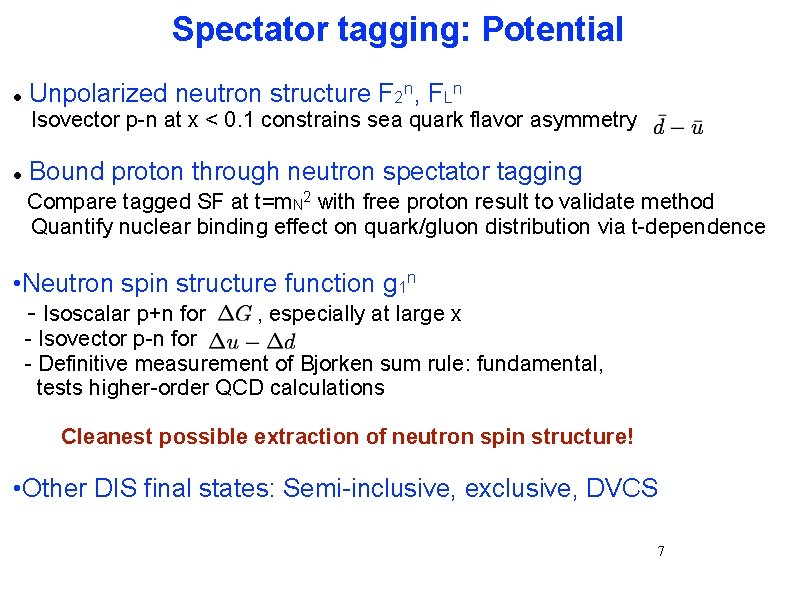
Spectator tagging: Potential Unpolarized neutron structure F 2 n, FLn Isovector p-n at x < 0. 1 constrains sea quark flavor asymmetry Bound proton through neutron spectator tagging Compare tagged SF at t=m. N 2 with free proton result to validate method Quantify nuclear binding effect on quark/gluon distribution via t-dependence • Neutron spin structure function g 1 n - Isoscalar p+n for , especially at large x - Isovector p-n for - Definitive measurement of Bjorken sum rule: fundamental, tests higher-order QCD calculations Cleanest possible extraction of neutron spin structure! • Other DIS final states: Semi-inclusive, exclusive, DVCS 7
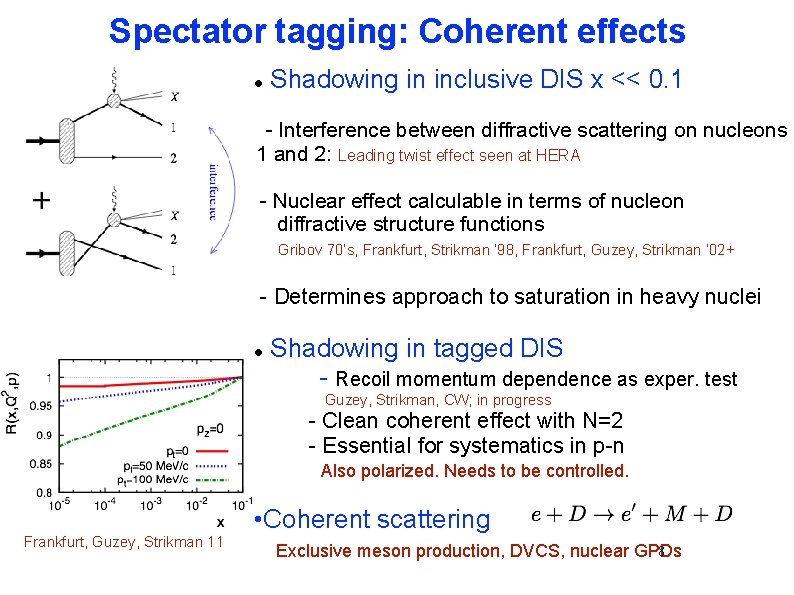
Spectator tagging: Coherent effects Shadowing in inclusive DIS x << 0. 1 - Interference between diffractive scattering on nucleons 1 and 2: Leading twist effect seen at HERA - Nuclear effect calculable in terms of nucleon diffractive structure functions Gribov 70’s, Frankfurt, Strikman ’ 98, Frankfurt, Guzey, Strikman ‘ 02+ - Determines approach to saturation in heavy nuclei Shadowing in tagged DIS - Recoil momentum dependence as exper. test Guzey, Strikman, CW; in progress - Clean coherent effect with N=2 - Essential for systematics in p-n Also polarized. Needs to be controlled. Frankfurt, Guzey, Strikman 11 • Coherent scattering 8 Exclusive meson production, DVCS, nuclear GPDs
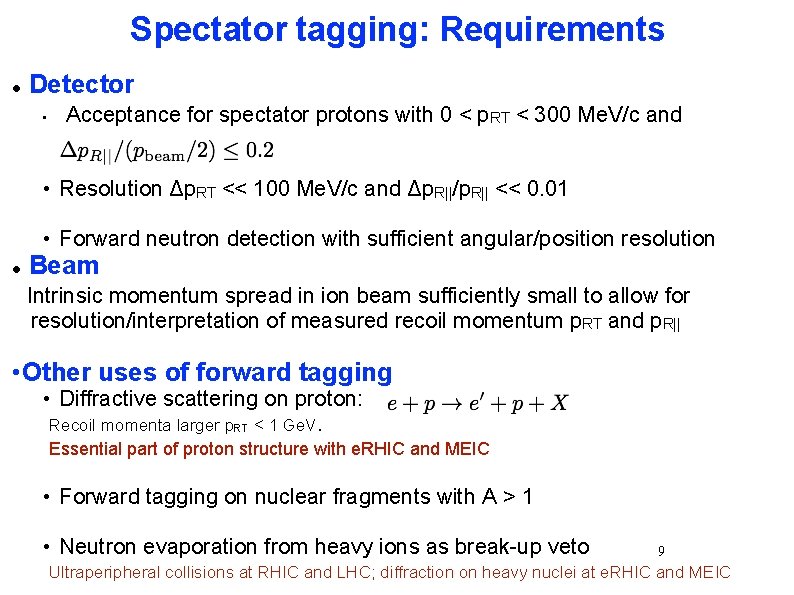
Spectator tagging: Requirements Detector • Acceptance for spectator protons with 0 < p. RT < 300 Me. V/c and • Resolution Δp. RT << 100 Me. V/c and Δp. R||/p. R|| << 0. 01 • Forward neutron detection with sufficient angular/position resolution Beam Intrinsic momentum spread in ion beam sufficiently small to allow for resolution/interpretation of measured recoil momentum p. RT and p. R|| • Other uses of forward tagging • Diffractive scattering on proton: Recoil momenta larger p. RT < 1 Ge. V. Essential part of proton structure with e. RHIC and MEIC • Forward tagging on nuclear fragments with A > 1 • Neutron evaporation from heavy ions as break-up veto 9 Ultraperipheral collisions at RHIC and LHC; diffraction on heavy nuclei at e. RHIC and MEIC
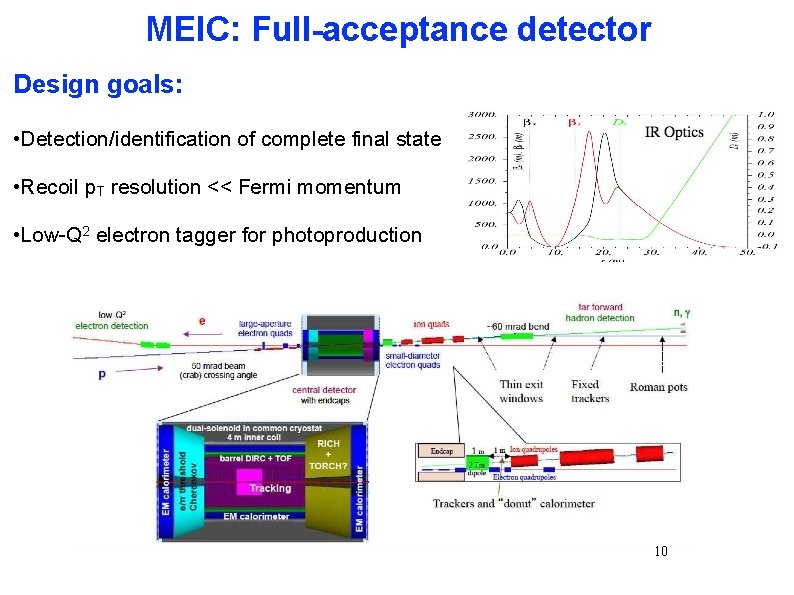
MEIC: Full-acceptance detector Design goals: • Detection/identification of complete final state • Recoil p. T resolution << Fermi momentum • Low-Q 2 electron tagger for photoproduction 10
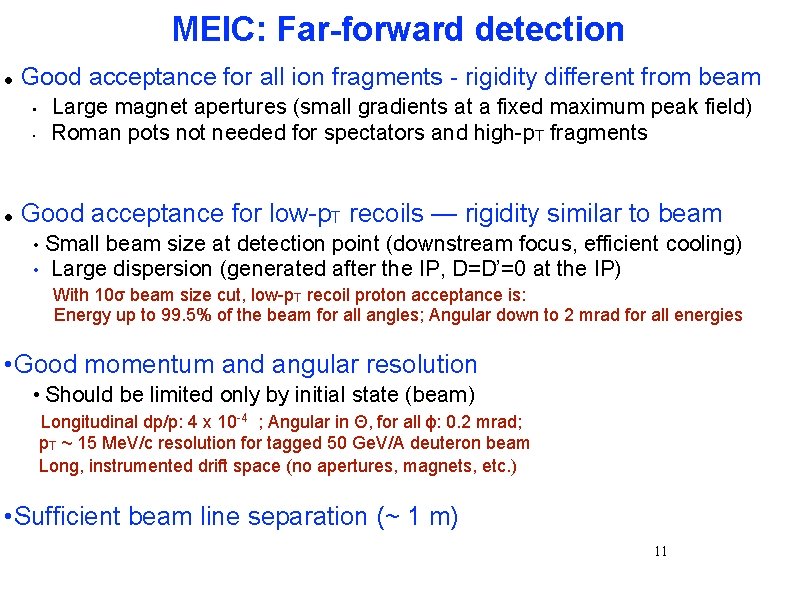
MEIC: Far-forward detection Good acceptance for all ion fragments - rigidity different from beam • • Large magnet apertures (small gradients at a fixed maximum peak field) Roman pots not needed for spectators and high-p. T fragments Good acceptance for low-p. T recoils — rigidity similar to beam • • Small beam size at detection point (downstream focus, efficient cooling) Large dispersion (generated after the IP, D=D’=0 at the IP) With 10σ beam size cut, low-p. T recoil proton acceptance is: Energy up to 99. 5% of the beam for all angles; Angular down to 2 mrad for all energies • Good momentum and angular resolution • Should be limited only by initial state (beam) Longitudinal dp/p: 4 x 10 -4 ; Angular in Θ, for all ɸ: 0. 2 mrad; p. T ~ 15 Me. V/c resolution for tagged 50 Ge. V/A deuteron beam Long, instrumented drift space (no apertures, magnets, etc. ) • Sufficient beam line separation (~ 1 m) 11
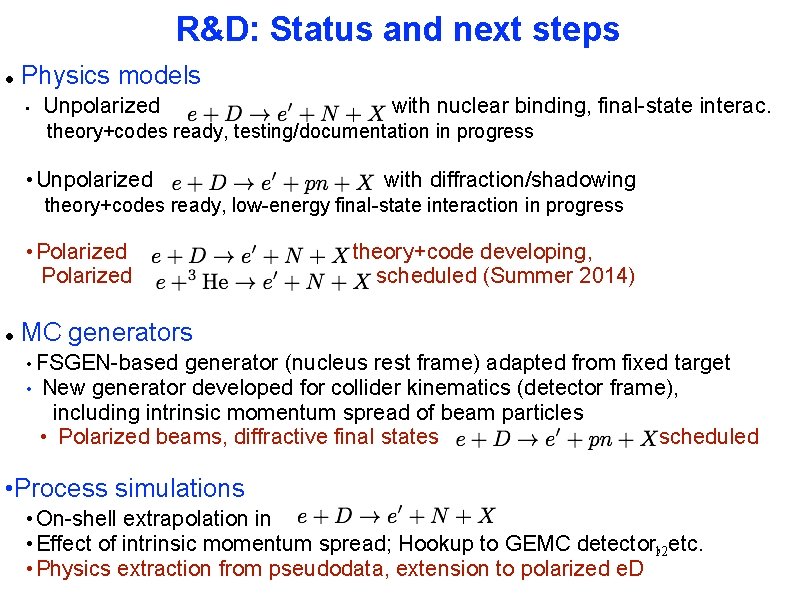
R&D: Status and next steps Physics models • Unpolarized with nuclear binding, final-state interac. theory+codes ready, testing/documentation in progress • Unpolarized with diffraction/shadowing theory+codes ready, low-energy final-state interaction in progress • Polarized theory+code developing, scheduled (Summer 2014) MC generators • FSGEN-based generator (nucleus rest frame) adapted from fixed target • New generator developed for collider kinematics (detector frame), including intrinsic momentum spread of beam particles • Polarized beams, diffractive final states scheduled • Process simulations • On-shell extrapolation in • Effect of intrinsic momentum spread; Hookup to GEMC detector, 12 etc. • Physics extraction from pseudodata, extension to polarized e. D
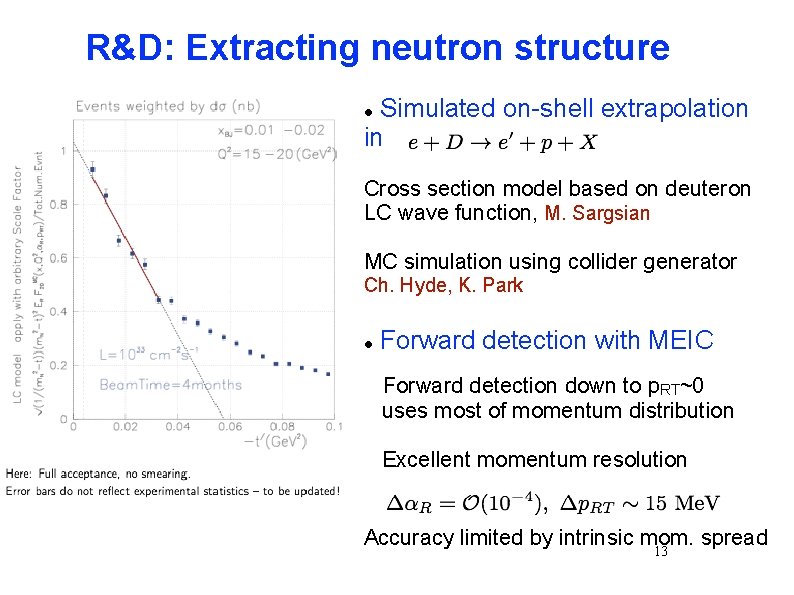
R&D: Extracting neutron structure Simulated on-shell extrapolation in Cross section model based on deuteron LC wave function, M. Sargsian MC simulation using collider generator Ch. Hyde, K. Park Forward detection with MEIC Forward detection down to p. RT~0 uses most of momentum distribution Excellent momentum resolution Accuracy limited by intrinsic mom. spread 13
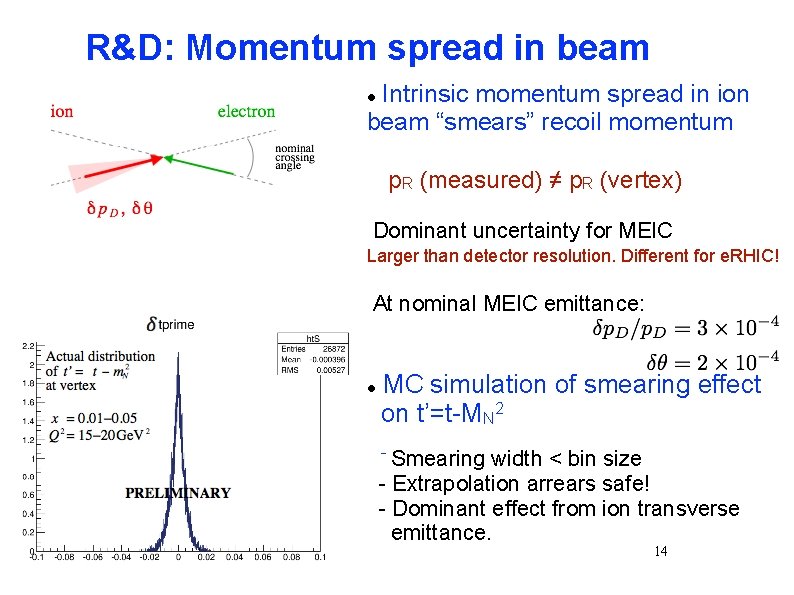
R&D: Momentum spread in beam Intrinsic momentum spread in ion beam “smears” recoil momentum p. R (measured) ≠ p. R (vertex) Dominant uncertainty for MEIC Larger than detector resolution. Different for e. RHIC! At nominal MEIC emittance: MC simulation of smearing effect on t’=t-MN 2 - Smearing width < bin size - Extrapolation arrears safe! - Dominant effect from ion transverse emittance. 14
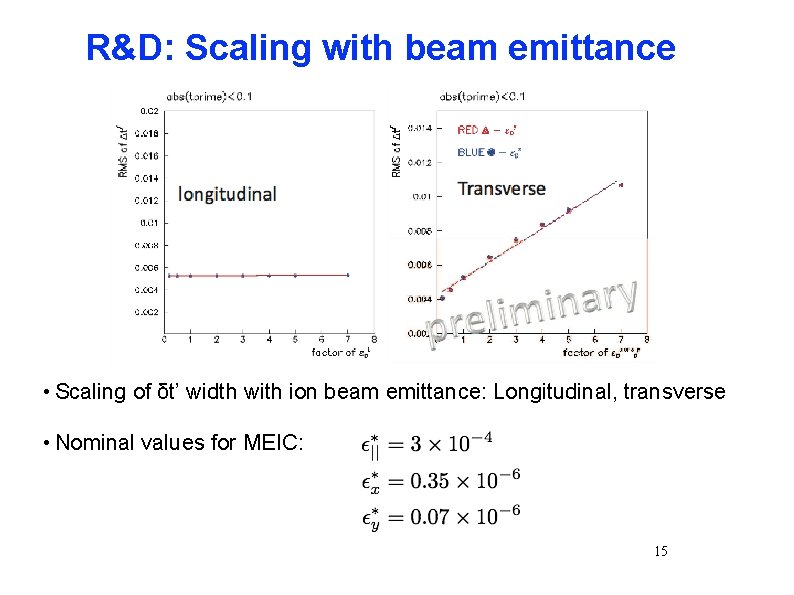
R&D: Scaling with beam emittance • Scaling of δt’ width with ion beam emittance: Longitudinal, transverse • Nominal values for MEIC: 15
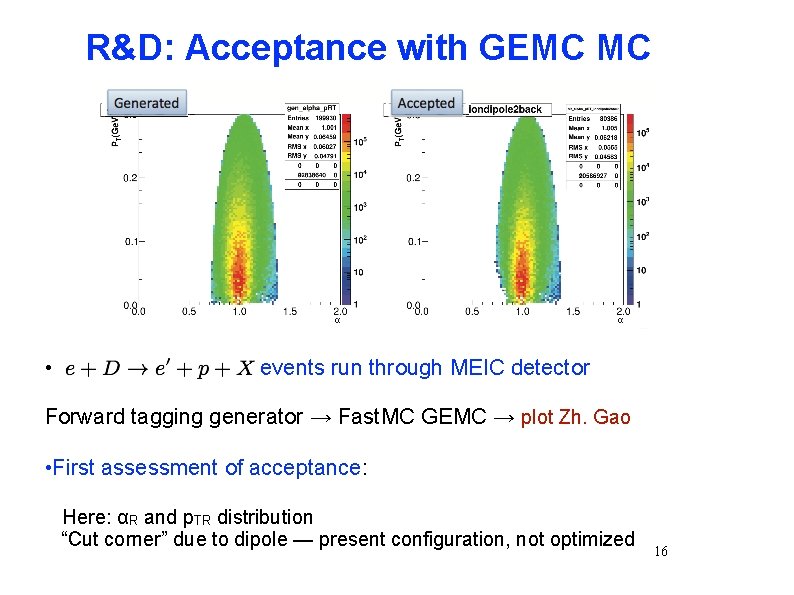
R&D: Acceptance with GEMC MC • events run through MEIC detector Forward tagging generator → Fast. MC GEMC → plot Zh. Gao • First assessment of acceptance: Here: αR and p. TR distribution “Cut corner” due to dipole — present configuration, not optimized 16
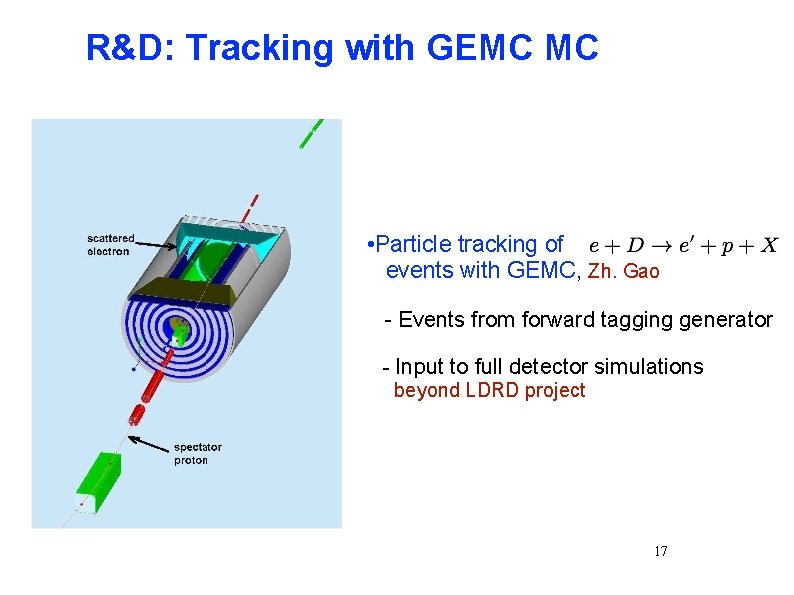
R&D: Tracking with GEMC MC • Particle tracking of events with GEMC, Zh. Gao - Events from forward tagging generator - Input to full detector simulations beyond LDRD project 17
Summary Precise nuclear physics measurements enabled by • • • Polarized deuterium beam Forward p, n detection EIC kinematic reach Excellent coverage and resolution forward p, n fragments with MEIC detector design • Main limitations likely to come from intrinsic momentum spread in ion beam • R&D project aims to establish forward tagging as standard method • Theory: Polarization, final-state interactions • Simulations: Acceptance, tracking, systematic errors 18
19