
Physics of UltraSound US Important 1 There are
- Slides: 28
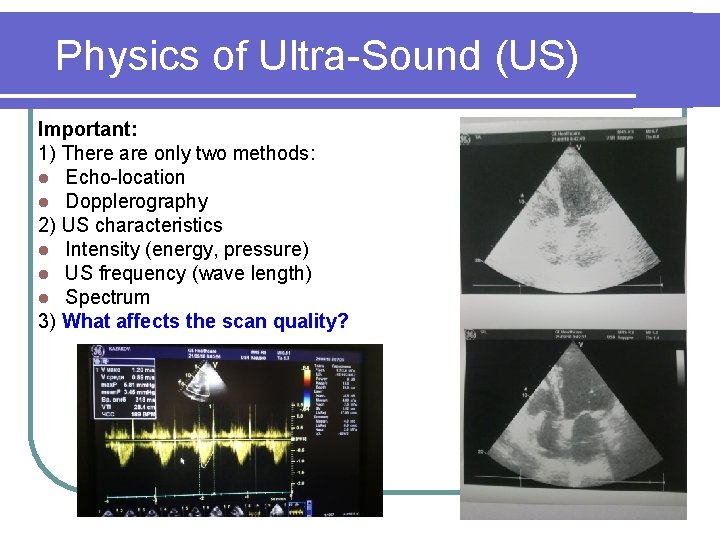
Physics of Ultra-Sound (US) Important: 1) There are only two methods: l Echo-location l Dopplerography 2) US characteristics l Intensity (energy, pressure) l US frequency (wave length) l Spectrum 3) What affects the scan quality?
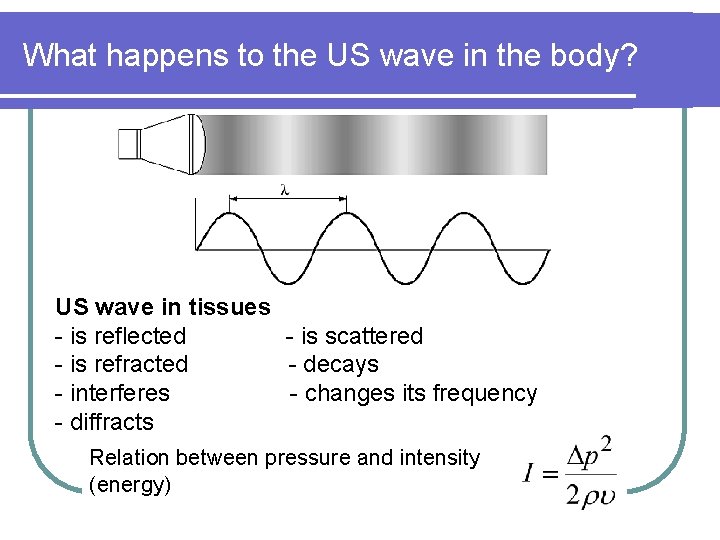
What happens to the US wave in the body? US wave in tissues - is reflected - is scattered - is refracted - decays - interferes - changes its frequency - diffracts Relation between pressure and intensity (energy)
Ultrasound in medicine Therapy frequencies f = 800 -3000 k. Hz Q. : What are the wavelengths of the US used in therapy? Intensity low (0, 05 -0, 4 W/cm² - 1 atm) - stimulating action medium (0, 5 -0, 8 W/cm²) - anaesthetic, antiphlogistic high (0, 9 -1, 2 W/cm²) - dissecting action Cells are under the influence of alternating pressure
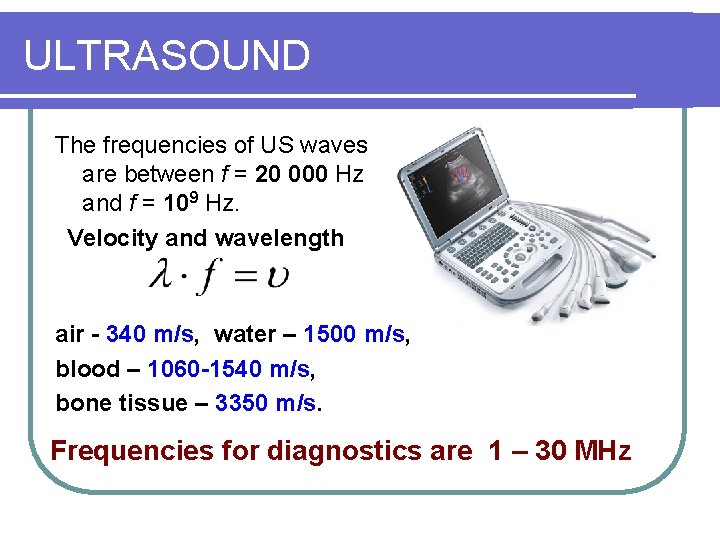
ULTRASOUND The frequencies of US waves are between f = 20 000 Hz and f = 109 Hz. Velocity and wavelength air - 340 m/s, water – 1500 m/s, blood – 1060 -1540 m/s, bone tissue – 3350 m/s. Frequencies for diagnostics are 1 – 30 MHz
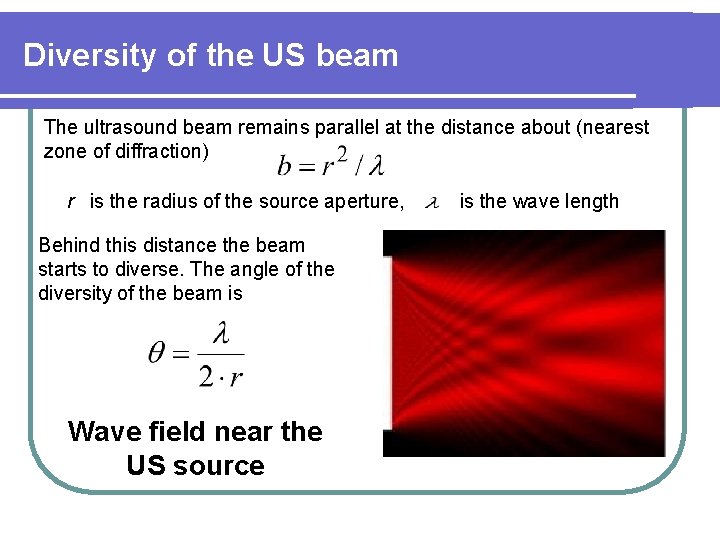
Diversity of the US beam The ultrasound beam remains parallel at the distance about (nearest zone of diffraction) r is the radius of the source aperture, Behind this distance the beam starts to diverse. The angle of the diversity of the beam is Wave field near the US source is the wave length
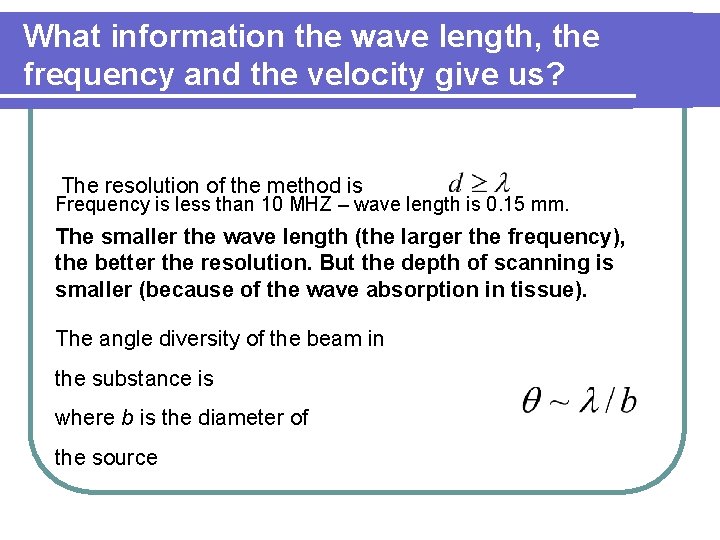
What information the wave length, the frequency and the velocity give us? The resolution of the method is Frequency is less than 10 MHZ – wave length is 0. 15 mm. The smaller the wave length (the larger the frequency), the better the resolution. But the depth of scanning is smaller (because of the wave absorption in tissue). The angle diversity of the beam in the substance is where b is the diameter of the source
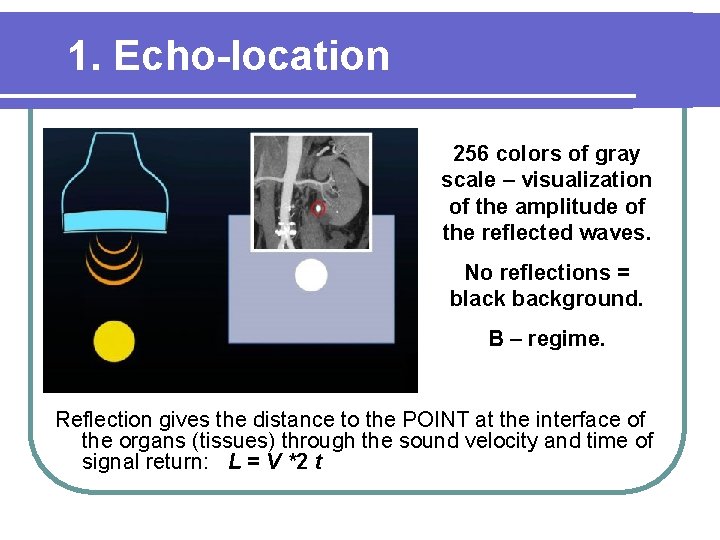
1. Echo-location 256 colors of gray scale – visualization of the amplitude of the reflected waves. No reflections = black background. B – regime. Reflection gives the distance to the POINT at the interface of the organs (tissues) through the sound velocity and time of signal return: L = V *2 t
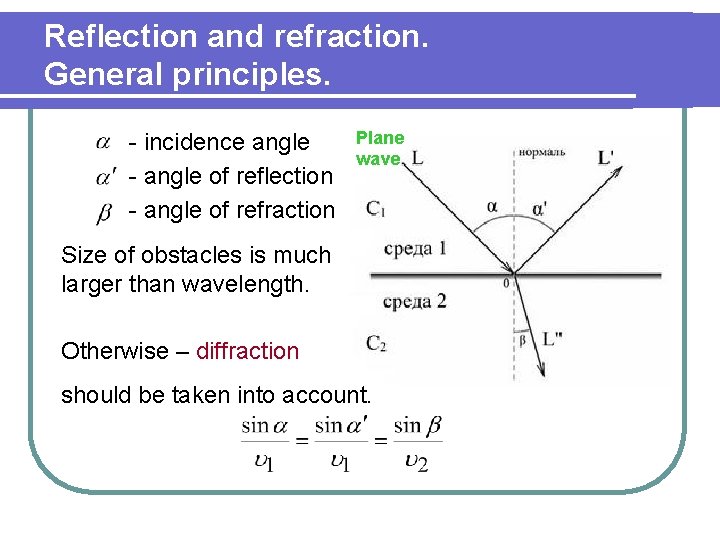
Reflection and refraction. General principles. - incidence angle - angle of reflection - angle of refraction Plane wave Size of obstacles is much larger than wavelength. Otherwise – diffraction should be taken into account.
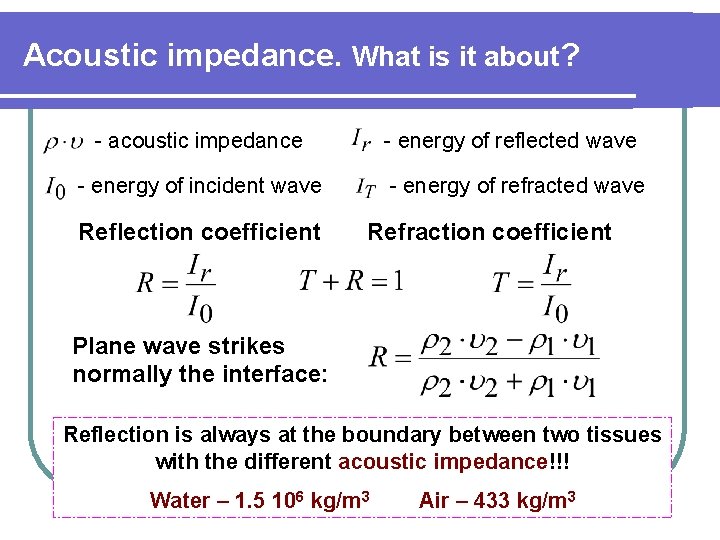
Acoustic impedance. What is it about? - energy of reflected wave - acoustic impedance - energy of incident wave Reflection coefficient - energy of refracted wave Refraction coefficient Plane wave strikes normally the interface: Reflection is always at the boundary between two tissues with the different acoustic impedance!!! Water – 1. 5 106 kg/m 3 Air – 433 kg/m 3
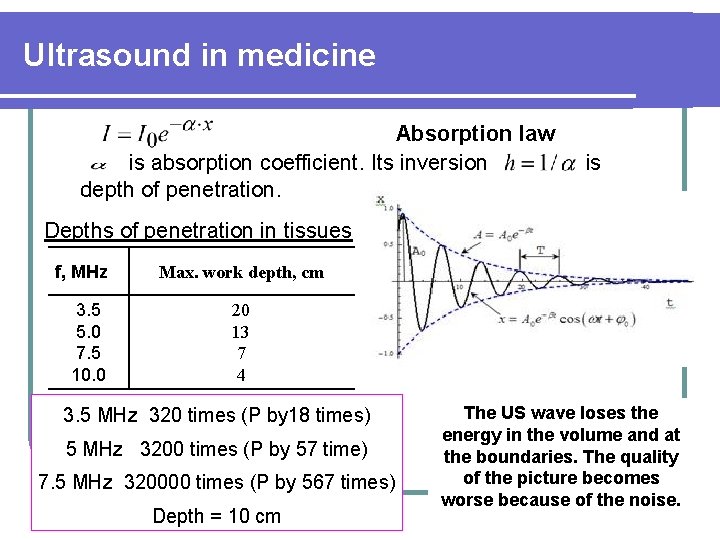
Ultrasound in medicine Absorption law is absorption coefficient. Its inversion depth of penetration. is Depths of penetration in tissues f, MHz 3. 5 5. 0 7. 5 10. 0 Max. work depth, cm 20 13 7 4 3. 5 MHz 320 times (P by 18 times) 5 MHz 3200 times (P by 57 time) 7. 5 MHz 320000 times (P by 567 times) Depth = 10 cm The US wave loses the energy in the volume and at the boundaries. The quality of the picture becomes worse because of the noise.
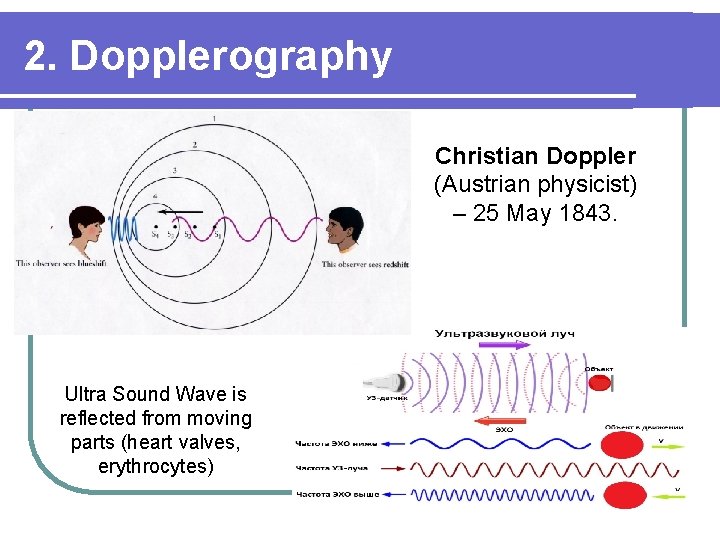
2. Dopplerography Christian Doppler (Austrian physicist) – 25 May 1843. Ultra Sound Wave is reflected from moving parts (heart valves, erythrocytes)
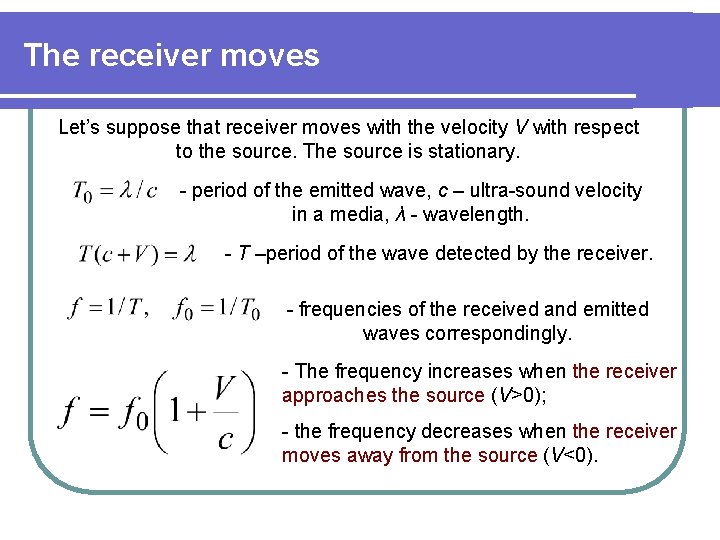
The receiver moves Let’s suppose that receiver moves with the velocity V with respect to the source. The source is stationary. - period of the emitted wave, c – ultra-sound velocity in a media, λ - wavelength. - T –period of the wave detected by the receiver. - frequencies of the received and emitted waves correspondingly. - The frequency increases when the receiver approaches the source (V>0); - the frequency decreases when the receiver moves away from the source (V<0).
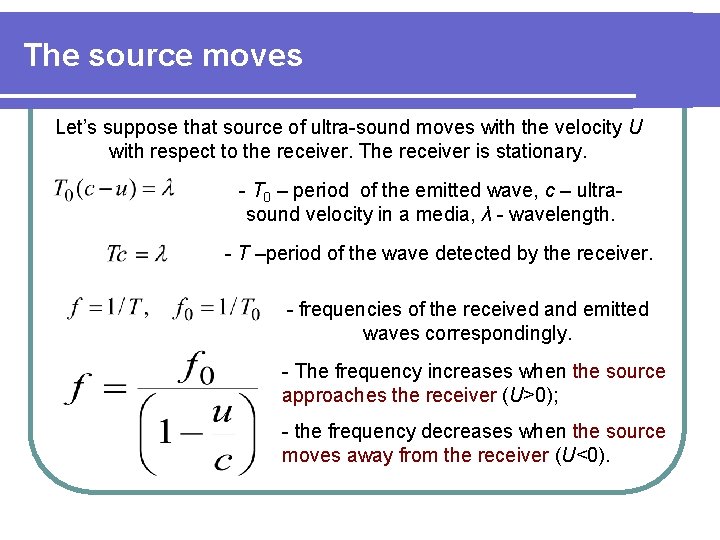
The source moves Let’s suppose that source of ultra-sound moves with the velocity U with respect to the receiver. The receiver is stationary. - T 0 – period of the emitted wave, c – ultrasound velocity in a media, λ - wavelength. - T –period of the wave detected by the receiver. - frequencies of the received and emitted waves correspondingly. - The frequency increases when the source approaches the receiver (U>0); - the frequency decreases when the source moves away from the receiver (U<0).
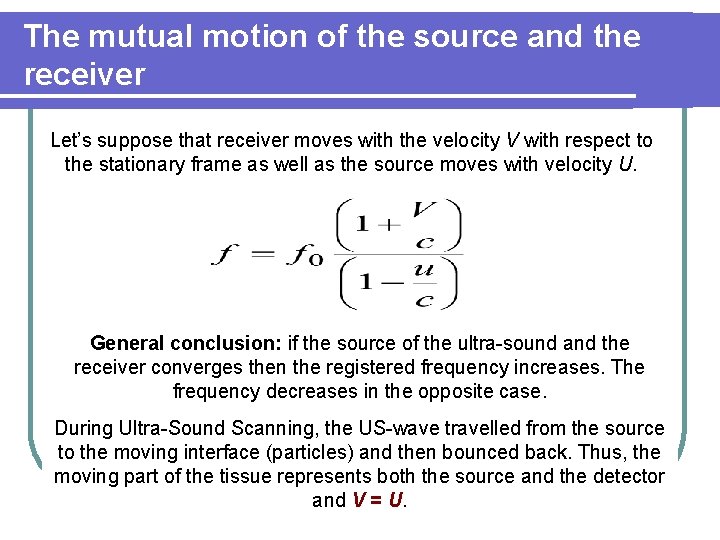
The mutual motion of the source and the receiver Let’s suppose that receiver moves with the velocity V with respect to the stationary frame as well as the source moves with velocity U. General conclusion: if the source of the ultra-sound and the receiver converges then the registered frequency increases. The frequency decreases in the opposite case. During Ultra-Sound Scanning, the US-wave travelled from the source to the moving interface (particles) and then bounced back. Thus, the moving part of the tissue represents both the source and the detector and V = U.
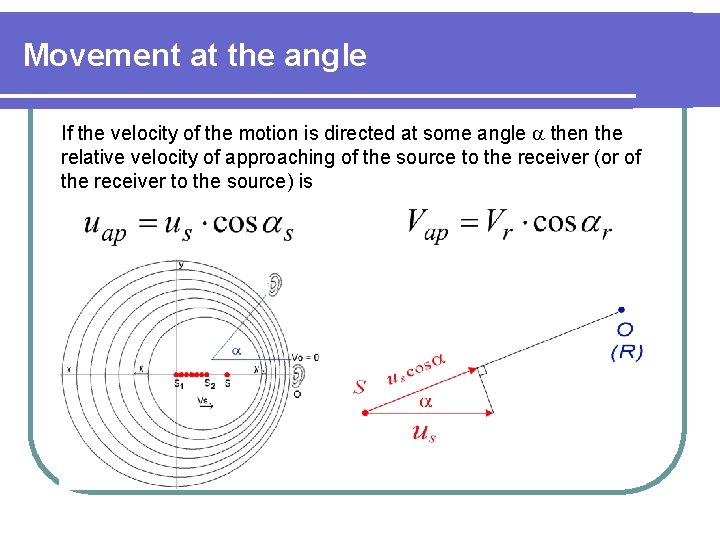
Movement at the angle If the velocity of the motion is directed at some angle then the relative velocity of approaching of the source to the receiver (or of the receiver to the source) is
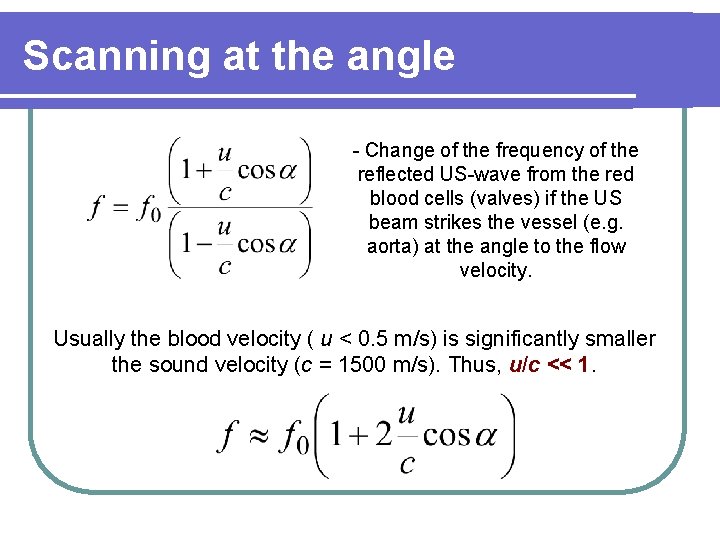
Scanning at the angle - Change of the frequency of the reflected US-wave from the red blood cells (valves) if the US beam strikes the vessel (e. g. aorta) at the angle to the flow velocity. Usually the blood velocity ( u < 0. 5 m/s) is significantly smaller the sound velocity (c = 1500 m/s). Thus, u/c << 1.
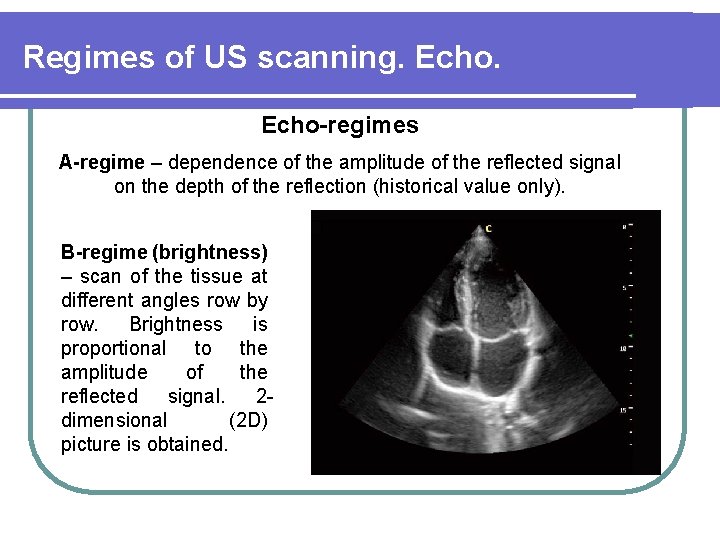
Regimes of US scanning. Echo-regimes A-regime – dependence of the amplitude of the reflected signal on the depth of the reflection (historical value only). B-regime (brightness) – scan of the tissue at different angles row by row. Brightness is proportional to the amplitude of the reflected signal. 2 dimensional (2 D) picture is obtained.
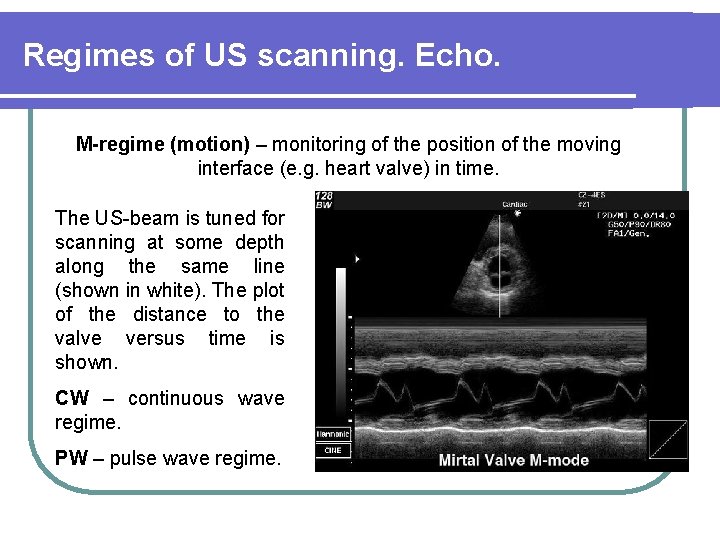
Regimes of US scanning. Echo. M-regime (motion) – monitoring of the position of the moving interface (e. g. heart valve) in time. The US-beam is tuned for scanning at some depth along the same line (shown in white). The plot of the distance to the valve versus time is shown. CW – continuous wave regime. PW – pulse wave regime.
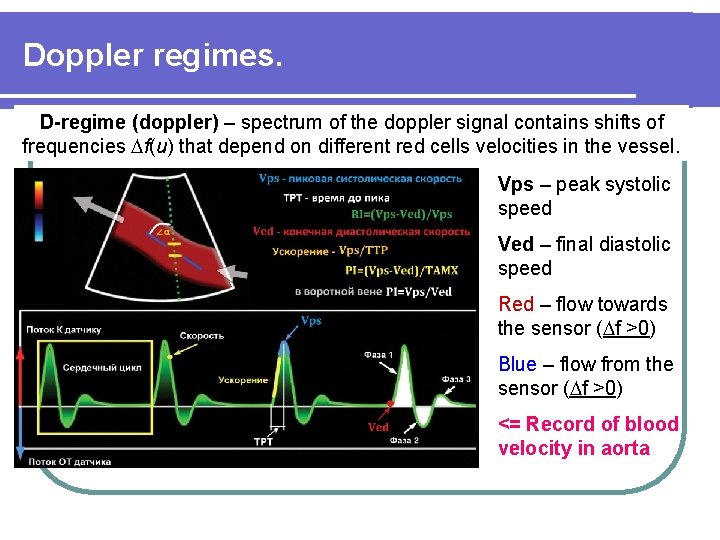
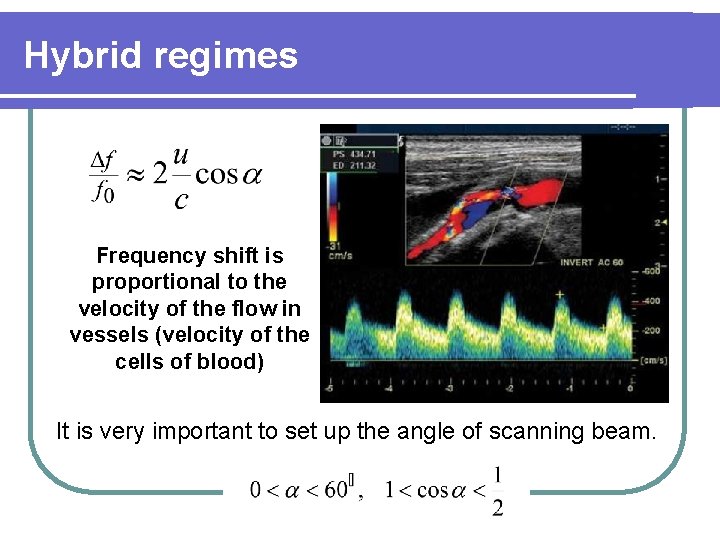
Doppler regimes. D-regime (doppler) – spectrum of the doppler signal contains shifts of frequencies f(u) that depend on different red cells velocities in the vessel. Vps – peak systolic speed Ved – final diastolic speed Red – flow towards the sensor ( f >0) Blue – flow from the sensor ( f >0) <= Record of blood velocity in aorta
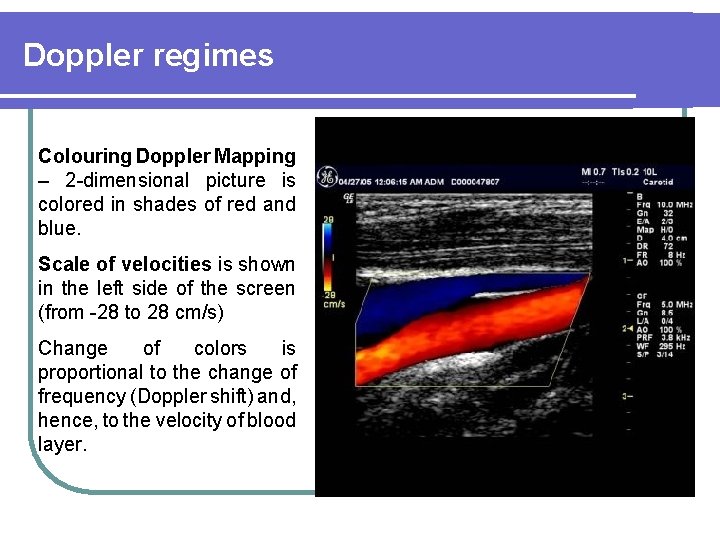
Doppler regimes Colouring Doppler Mapping – 2 -dimensional picture is colored in shades of red and blue. Scale of velocities is shown in the left side of the screen (from -28 to 28 cm/s) Change of colors is proportional to the change of frequency (Doppler shift) and, hence, to the velocity of blood layer.
Hybrid regimes Frequency shift is proportional to the velocity of the flow in vessels (velocity of the cells of blood) It is very important to set up the angle of scanning beam.
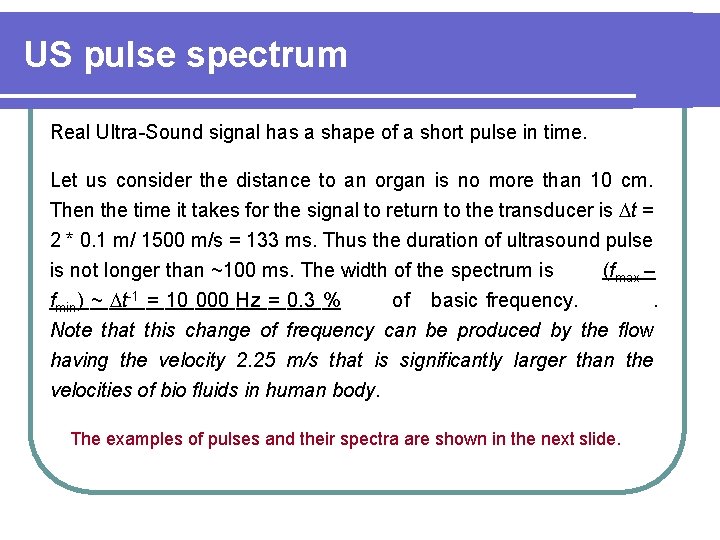
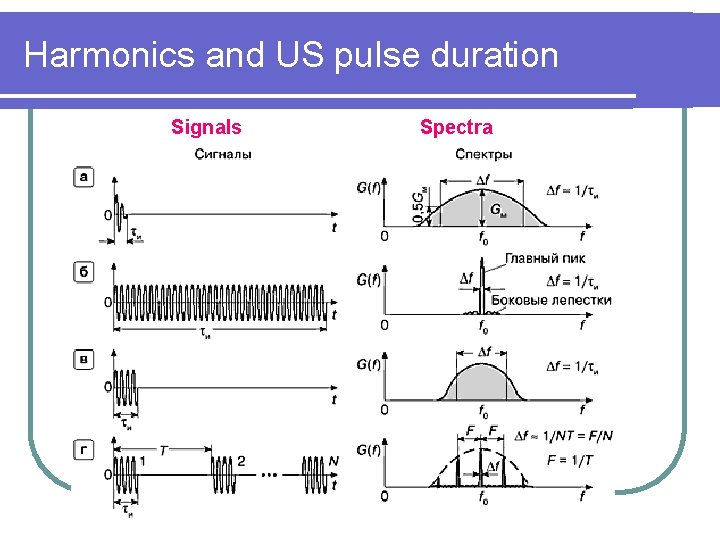
US pulse spectrum Real Ultra-Sound signal has a shape of a short pulse in time. Let us consider the distance to an organ is no more than 10 cm. Then the time it takes for the signal to return to the transducer is t = 2 * 0. 1 m/ 1500 m/s = 133 ms. Thus the duration of ultrasound pulse is not longer than ~100 ms. The width of the spectrum is (fmax – fmin) ~ t-1 = 10 000 Hz = 0. 3 % of basic frequency. . Note that this change of frequency can be produced by the flow having the velocity 2. 25 m/s that is significantly larger than the velocities of bio fluids in human body. The examples of pulses and their spectra are shown in the next slide.
Harmonics and US pulse duration Signals Spectra
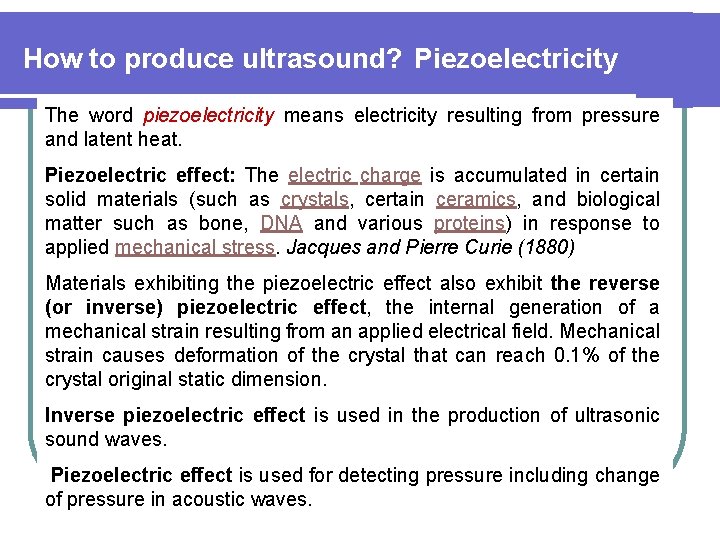
How to produce ultrasound? Piezoelectricity The word piezoelectricity means electricity resulting from pressure and latent heat. Piezoelectric effect: The electric charge is accumulated in certain solid materials (such as crystals, certain ceramics, and biological matter such as bone, DNA and various proteins) in response to applied mechanical stress. Jacques and Pierre Curie (1880) Materials exhibiting the piezoelectric effect also exhibit the reverse (or inverse) piezoelectric effect, the internal generation of a mechanical strain resulting from an applied electrical field. Mechanical strain causes deformation of the crystal that can reach 0. 1% of the crystal original static dimension. Inverse piezoelectric effect is used in the production of ultrasonic sound waves. Piezoelectric effect is used for detecting pressure including change of pressure in acoustic waves.
Piezoelectric effect. Some physical details. The change of electrical polarization P of piezoelecrtric material when applying a mechanical stress is of decisive importance for the piezoelectric effect. This might either be caused by a reconfiguration of the dipole-inducing surrounding or by re-orientation of molecular dipole moments under the influence of the external stress. The change in P appears as a variation of surface charge density upon the crystal faces, i. e. as a variation of the electric field extending between the faces caused by a change in dipole density in the bulk. Many material exhibit piezoelectric properties and can be classified as crystalline, ceramic and polymeric piezoelectric materials.
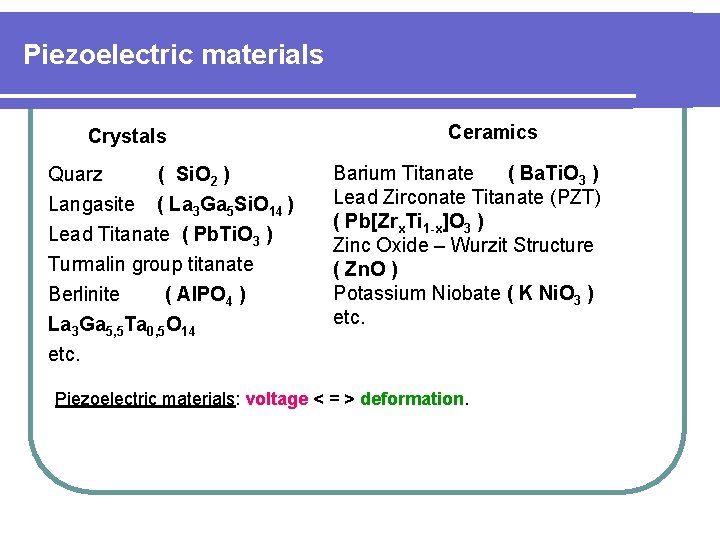
Piezoelectric materials Crystals Quarz ( Si. O 2 ) Langasite ( La 3 Ga 5 Si. O 14 ) Lead Titanate ( Pb. Ti. O 3 ) Turmalin group titanate Berlinite ( Al. PO 4 ) La 3 Ga 5, 5 Ta 0, 5 O 14 etc. Ceramics Barium Titanate ( Ba. Ti. O 3 ) Lead Zirconate Titanate (PZT) ( Pb[Zrx. Ti 1 -x]O 3 ) Zinc Oxide – Wurzit Structure ( Zn. O ) Potassium Niobate ( K Ni. O 3 ) etc. Piezoelectric materials: voltage < = > deformation.
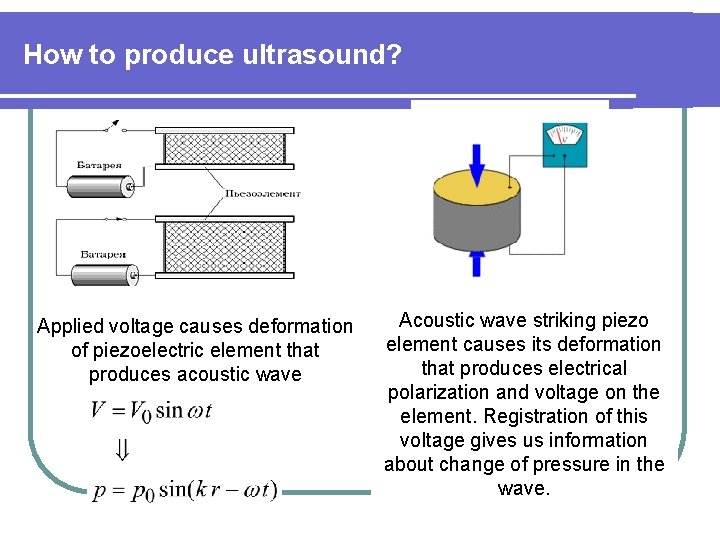
How to produce ultrasound? Applied voltage causes deformation of piezoelectric element that produces acoustic wave Acoustic wave striking piezo element causes its deformation that produces electrical polarization and voltage on the element. Registration of this voltage gives us information about change of pressure in the wave.
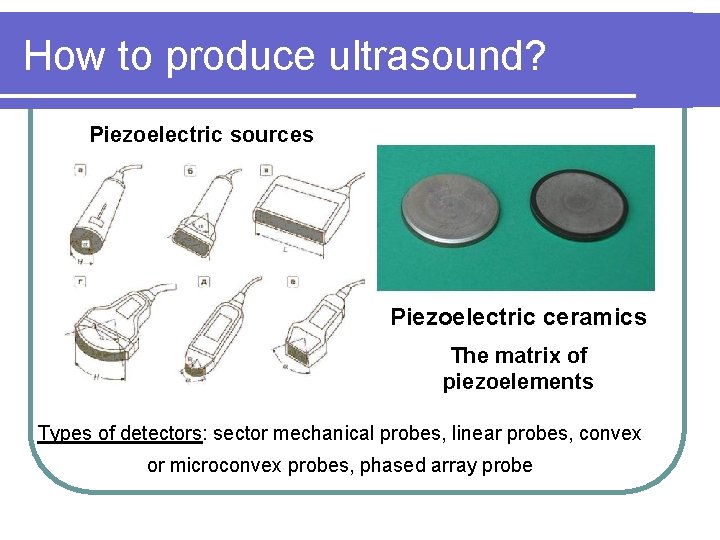
How to produce ultrasound? Piezoelectric sources Piezoelectric ceramics The matrix of piezoelements Types of detectors: sector mechanical probes, linear probes, convex or microconvex probes, phased array probe