
Physics of Motion Displacement speed velocity acceleration and
- Slides: 8
Physics of Motion: Displacement, speed, velocity, acceleration and momentum
Displacement-time graphs • Y axis is displacement/distance (position) • X axis is time • Slope of a line at any point is the speed (velocity). • Slope = (y 2 – y 1)/(x 2 – x 1) • Positive slope of straight line indicates constant, positive speed • Negative slope indicates movement in opposite direction • Slope of zero (flat line) indicates object at rest • An increasing slope (curve upward) indicates positive acceleration (speeding up) • A decreasing slope indicates negative acceleration (slowing down)
Distance-time graph summary
Velocity-time graphs • Y axis is speed or velocity • X axis is time • Y value of zero means object is at rest. • Slope of a line at any point is the acceleration. • Positive slope of straight line indicates constant, positive acceleration • Negative slope indicates negative acceleration (slowing down) • Slope of zero (flat line) no acceleration, so constant velocity
Speed-time graph summary
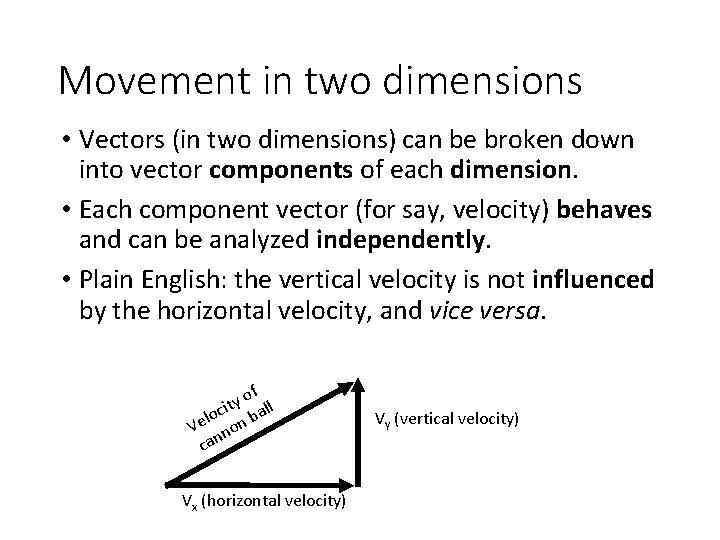
Movement in two dimensions • Vectors (in two dimensions) can be broken down into vector components of each dimension. • Each component vector (for say, velocity) behaves and can be analyzed independently. • Plain English: the vertical velocity is not influenced by the horizontal velocity, and vice versa. of y t ci ball o l Ve non can Vx (horizontal velocity) Vy (vertical velocity)
To break a vector down into its dimensional components… • Draw a horizontal vector pointing in the same direction of the original vector • Draw a vertical vector pointing in the same direction • Make a right triangle. The original vector is the hypotenuse
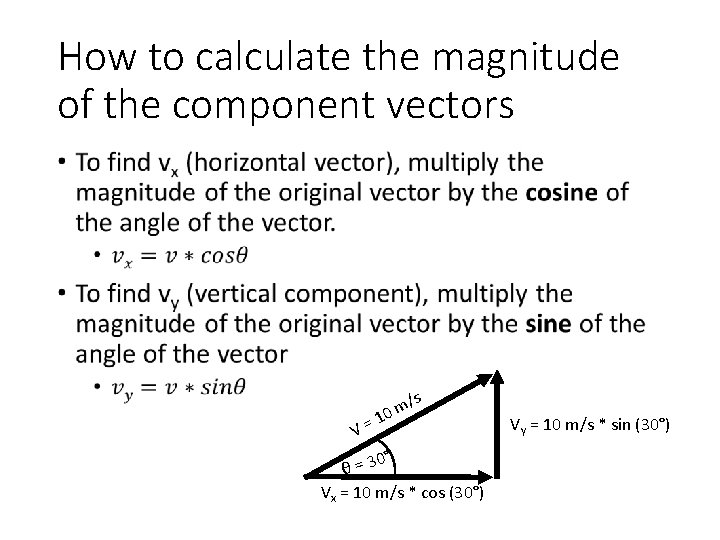
How to calculate the magnitude of the component vectors • V m/ 0 =1 s 0° θ=3 Vx = 10 m/s * cos (30°) Vy = 10 m/s * sin (30°)