
Physics of Light Slide Set 8 02 Introduction
- Slides: 13
Physics of Light Slide Set 8. 02
Introduction • This section discusses the physical basis for introducing light sources and how surfaces interact with light. • Later sections will discuss how simplified versions of this model can be used and then we will discuss how to get around the limitations of the simplified models. • Unfortunately, the physical model is too complex to implement directly, at least at this point 2
Light, Reflection, Transmission • Light is electromagnetic energy in a certain range of wavelengths. • Light is produced by some objects which we will call light sources • Surfaces of objects reflect light • We are not concerned with the physics of reflection in detail, just certain characteristics • The material that a surface is made of determines how light will reflect • Surfaces can also let light through, transmission • We will usually speak of transparency and translucence • The material of a surface and the object volume will determine the transmission characteristics 3
Basic Model • Light is emitted by one or more light sources, is reflected by surfaces and, eventually, reaches the camera or eye where the light is detected. • Some light will reflect off several surfaces before reaching the eye • Some light will never reach the eye 4
Light of Interest • We are only interested in light that eventually reaches the eye • The eye is at the center of perspective, so we look at light rays that reach there • The rays pass through the projection plane (usually in front of the center of projection) • Divide up the projection plane into rectangles matching the pixels on the canvas • The rays that pass through each small rectangle determine the color that will be displayed by that pixel. 5
Ray Tracing • A geometric path starts at the center of projection, • continues through one of the small rectangles in the projection plane • bounces around in the scene, perhaps splitting into multiple paths. • When a path reaches a light source, a contribution is computed for the pixel in the projection plane • This is slower than the direct lighting methods we will use 6
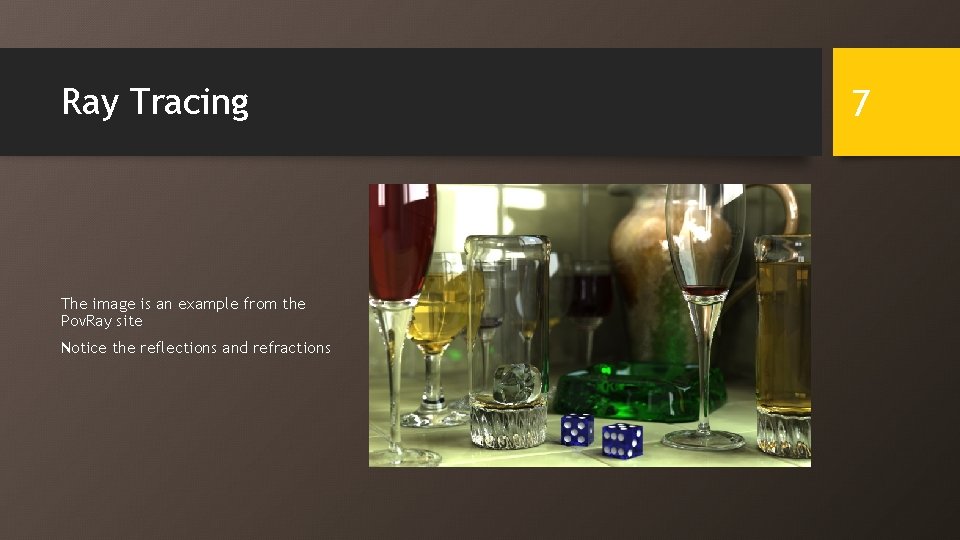
Ray Tracing The image is an example from the Pov. Ray site Notice the reflections and refractions 7
Our Lighting Model • We will not be able to model exactly the physical effects of reflection. • We can approximate the physical effects of lighting by simulating some lighting effects. • Three kinds of lighting • Diffuse • Ambient • Specular 8
Diffuse Lighting • Used to get shading effects that will provide a feeling of three dimensions • Shading is a basic technique for visual artists • For a perfectly diffuse surface, the amount of light reflected towards a viewer does not depend on which direction the viewer is standing relative to the light source • Lambertian surface 9
Ambient Lighting • Approximates light reflected among surfaces • We will not try to compute such reflected light directly • Ambient lighting ‘softens’ shadows, some light shines even in the darkest corners • We will approximate ambient lighting as a source of light that is constant throughout a scene 10
Specular Reflection • Light reflected from a shiny surface • Mostly reflected in the opposite direction from the direction in which the light first hits the surface 11
Lighting Computation • We will compute the light at a point as a sum of three components: diffuse, ambient, and specular • A general model for light would include a color for each component • A general model of the reflectance of a surface would include measures of how each component would reflect • We will simplify that for our examples 12
Light Sources • Directional source • Light comes from a certain direction • Distance the light travels does not matter • Point source • Light comes from a particular point • We may or may not model the light becoming less strong the farther away from the source • Area source • Light comes from an area • Often approximated with a set of point sources 13