
Physics of Atomic Nuclei The Joint Institute for
- Slides: 1
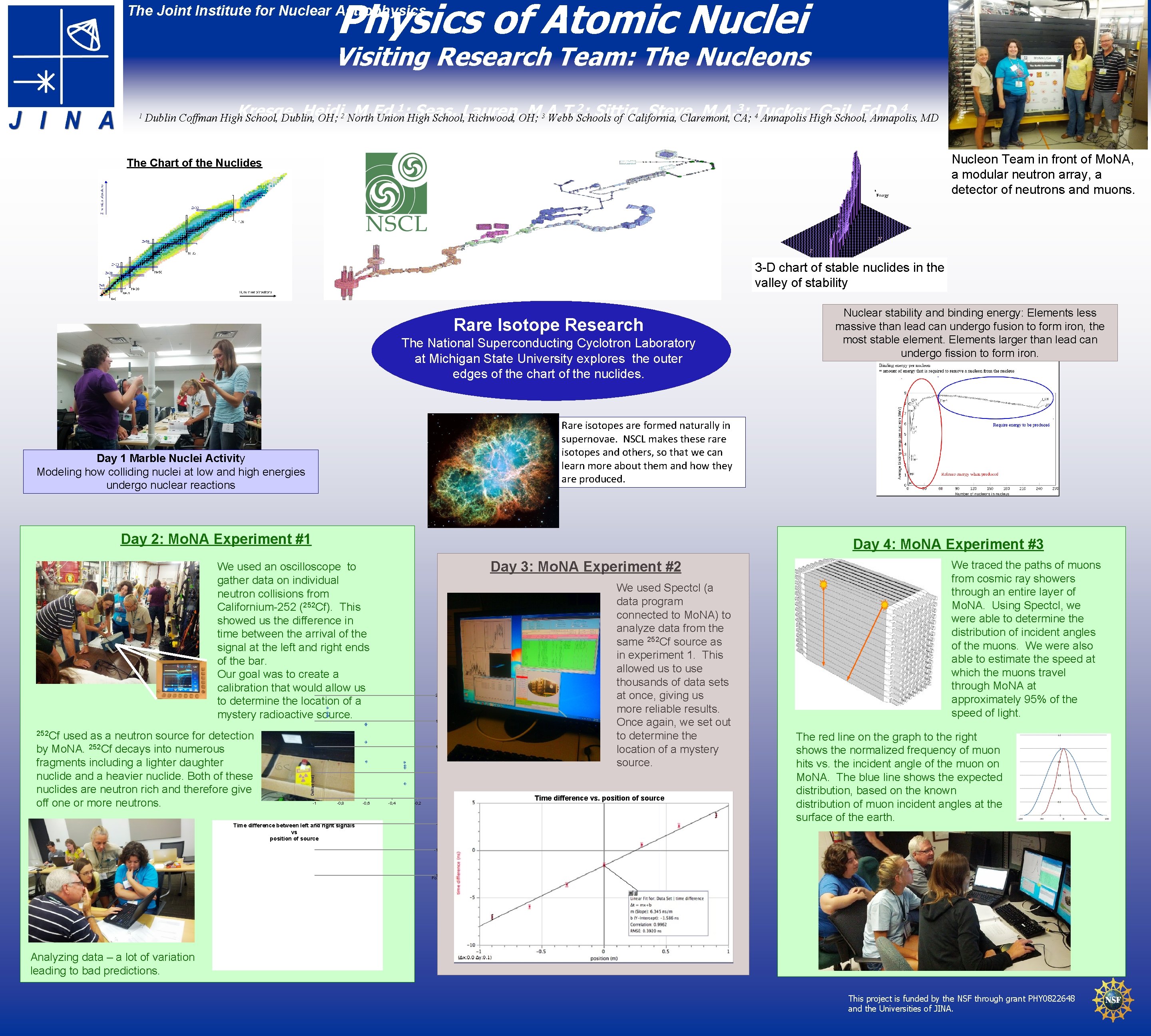
Physics of Atomic Nuclei The Joint Institute for Nuclear Astrophysics Visiting Research Team: The Nucleons 1; Seas, Lauren, M. A. T. 2; Sittig, Steve, M. A. 3; Tucker, Gail, Ed. D. 4 Kresge, Heidi, M. Ed. 1 Dublin Coffman High School, Dublin, OH; 2 North Union High School, Richwood, OH; 3 Webb Schools of California, Claremont, CA; 4 Annapolis High School, Annapolis, MD Nucleon Team in front of Mo. NA, a modular neutron array, a detector of neutrons and muons. The Chart of the Nuclides 3 -D chart of stable nuclides in the valley of stability Rare Isotope Research The National Superconducting Cyclotron Laboratory at Michigan State University explores the outer edges of the chart of the nuclides. Rare isotopes are formed naturally in supernovae. NSCL makes these rare isotopes and others, so that we can learn more about them and how they are produced. Day 1 Marble Nuclei Activity Modeling how colliding nuclei at low and high energies undergo nuclear reactions Day 2: Mo. NA Experiment #1 Day 4: Mo. NA Experiment #3 Day 3: Mo. NA Experiment #2 We used an oscilloscope to gather data on individual neutron collisions from Californium-252 (252 Cf). This showed us the difference in time between the arrival of the signal at the left and right ends of the bar. Our goal was to create a calibration that would allow us to determine the location of a mystery radioactive source. We used Spectcl (a data program connected to Mo. NA) to analyze data from the same 252 Cf source as in experiment 1. This allowed us to use thousands of data sets at once, giving us more reliable results. Once again, we set out to determine the location of a mystery source. 20 15 252 Cf 10 R 2 = 0, 9385 5 Delta t (ns) used as a neutron source for detection by Mo. NA. 252 Cf decays into numerous fragments including a lighter daughter nuclide and a heavier nuclide. Both of these nuclides are neutron rich and therefore give off one or more neutrons. Nuclear stability and binding energy: Elements less massive than lead can undergo fusion to form iron, the most stable element. Elements larger than lead can undergo fission to form iron. 0 -1 -0, 8 Time difference between left and right signals vs position of source -0, 6 -0, 4 -0, 2 0 -5 0, 2 0, 4 0, 6 Time difference vs. position of source 0, 8 1 We traced the paths of muons from cosmic ray showers through an entire layer of Mo. NA. Using Spectcl, we were able to determine the distribution of incident angles of the muons. We were also able to estimate the speed at which the muons travel through Mo. NA at approximately 95% of the speed of light. The red line on the graph to the right shows the normalized frequency of muon hits vs. the incident angle of the muon on Mo. NA. The blue line shows the expected distribution, based on the known distribution of muon incident angles at the surface of the earth. -10 -15 Position (m) Analyzing data – a lot of variation leading to bad predictions. This project is funded by the NSF through grant PHY 0822648 and the Universities of JINA.