
Physics of Animation Alej Garcia Dept Physics SJSU




















- Slides: 58
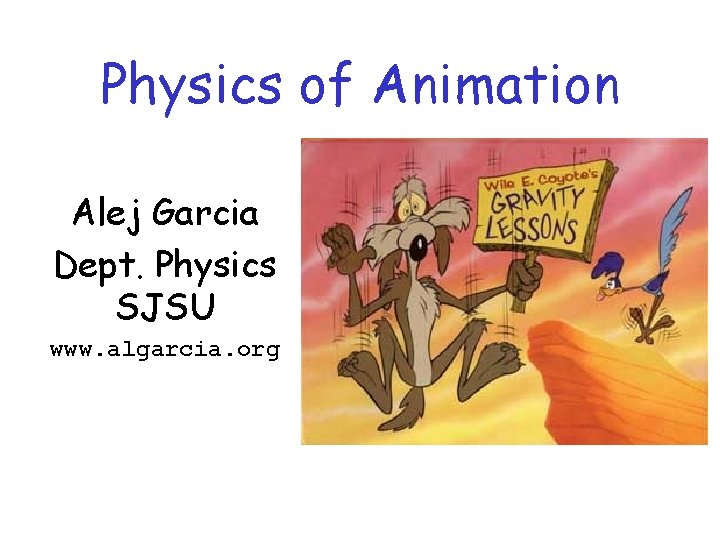
Physics of Animation Alej Garcia Dept. Physics SJSU www. algarcia. org
Anatomy for Artists Surgeons and artists learn anatomy, but for very different purposes. Thomas Eakins Leonardo da Vinci Life drawing is difficult but it’s not brain surgery
Physics for Animators An engineer’s calculation of motion needs to be highly accurate, with precise measurements. Animators, on the other hand, usually don’t need such mathematical precision. It just has to look right. It’s not rocket science.
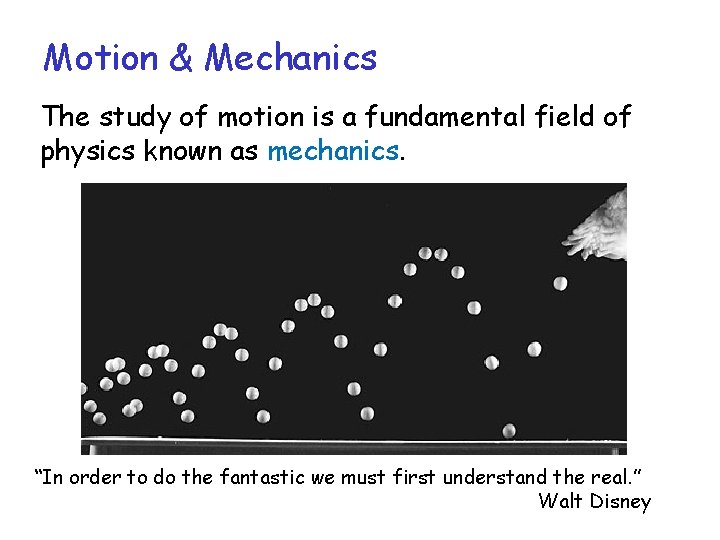
Motion & Mechanics The study of motion is a fundamental field of physics known as mechanics. “In order to do the fantastic we must first understand the real. ” Walt Disney
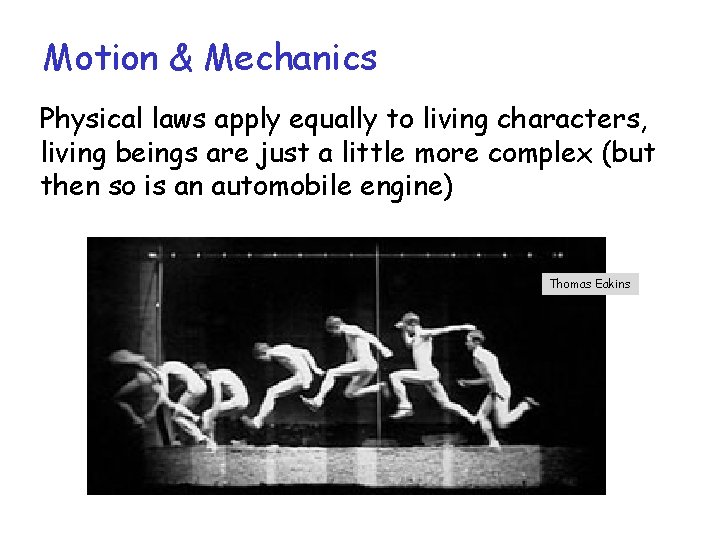
Motion & Mechanics Physical laws apply equally to living characters, living beings are just a little more complex (but then so is an automobile engine) Thomas Eakins
Physics in Maya Animation software, such as Maya, have sophisticated physics “engines” that use the laws of physics to compute motion. Easier to use these tools knowing physics.
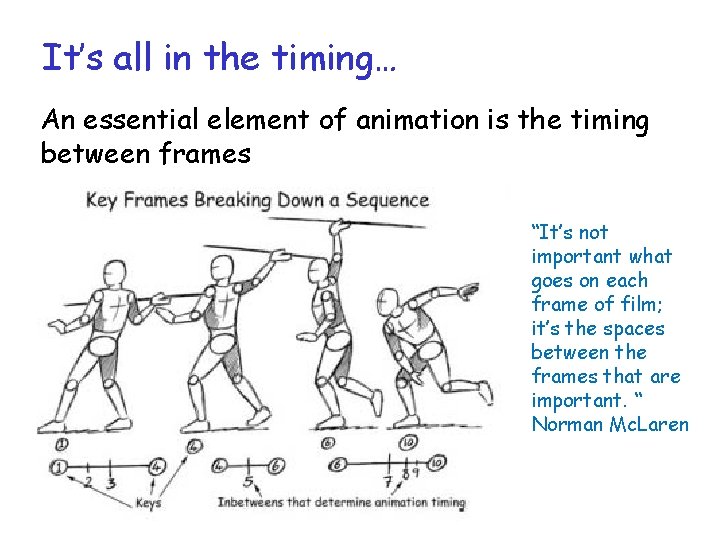
It’s all in the timing… An essential element of animation is the timing between frames “It’s not important what goes on each frame of film; it’s the spaces between the frames that are important. “ Norman Mc. Laren
Timing: Frames, Keys, & Clocks We’ll use three different ways of measuring time: • Frames (intervals of 1/24 th of a second) • Keys (given number of frames between poses) • Clocks (actual seconds as measured by a clock) IMPORTANT: We’ll select the keys such that there always the same number of frames between each key.
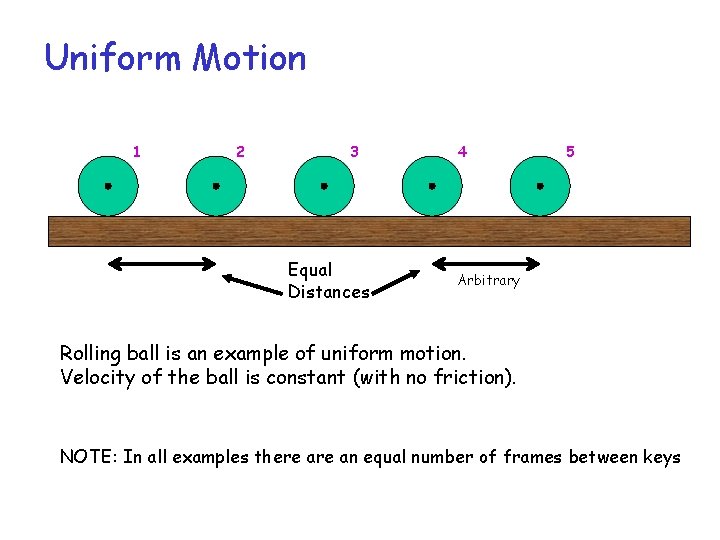
Uniform Motion 1 2 3 Equal Distances 4 5 Arbitrary Rolling ball is an example of uniform motion. Velocity of the ball is constant (with no friction). NOTE: In all examples there an equal number of frames between keys
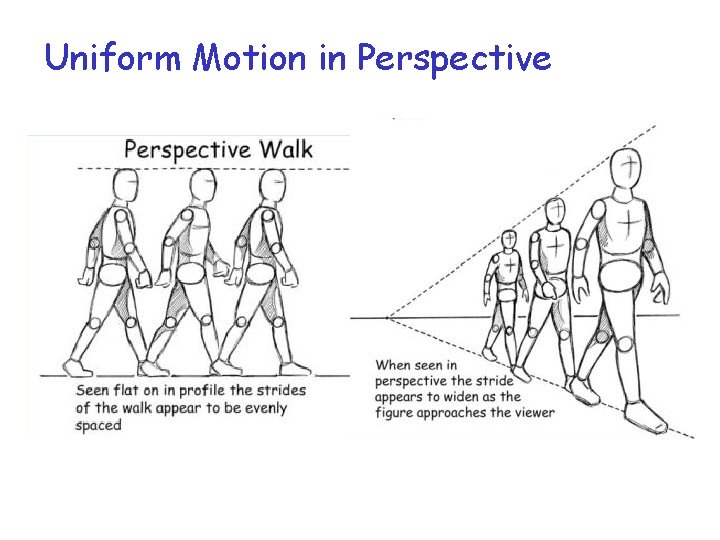
Uniform Motion in Perspective
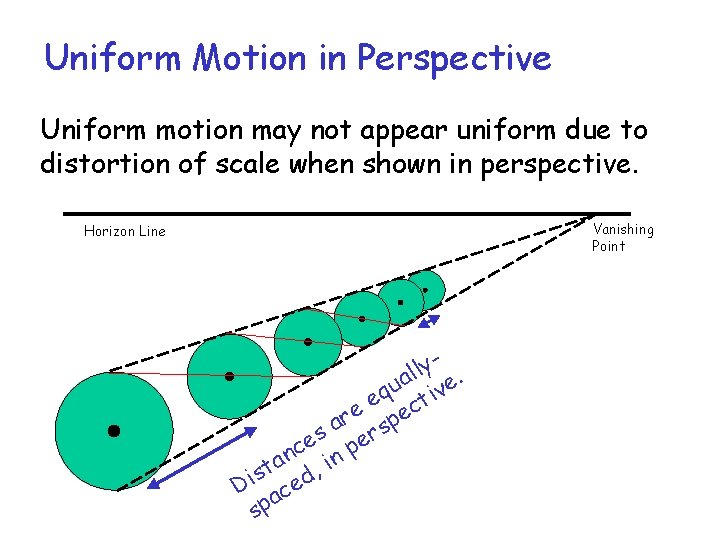
Uniform Motion in Perspective Uniform motion may not appear uniform due to distortion of scale when shown in perspective. Vanishing Point Horizon Line y l al ve. u q ti e e pec r a rs s ce n pe n a , i t s Di aced sp
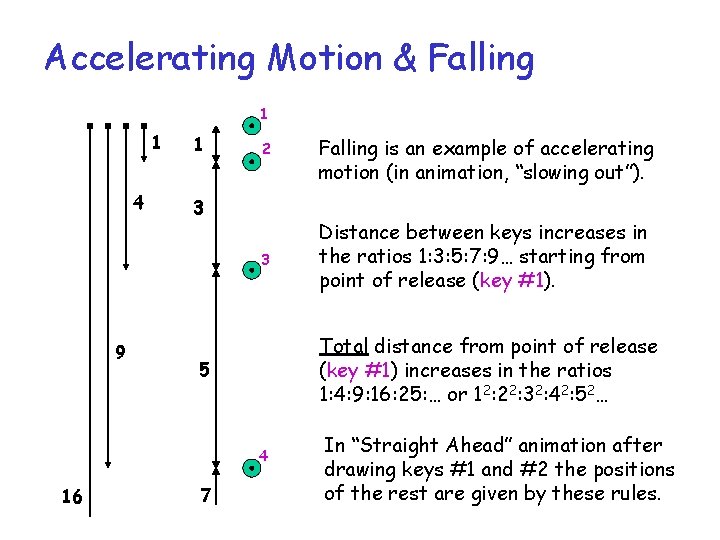
Accelerating Motion & Falling 1 1 4 1 2 3 3 9 5 7 Distance between keys increases in the ratios 1: 3: 5: 7: 9… starting from point of release (key #1). Total distance from point of release (key #1) increases in the ratios 1: 4: 9: 16: 25: … or 12: 22: 32: 42: 52… 4 16 Falling is an example of accelerating motion (in animation, “slowing out”). In “Straight Ahead” animation after drawing keys #1 and #2 the positions of the rest are given by these rules.
Distance Fallen Distance fallen from key #1 (release point) to key #2 depends on the number of frames between keys. Distance fallen from key #2 to #3 is three times further; from #3 to #4 is five times, from #4 to #5 is seven times, etc. Note: These distance do not depend on the object’s weight. Time (seconds) Frames Distance fallen (key #1 to #2) 1/ 24 1 1/ 1/ 12 2 1 1/3 inches 1/ 8 3 3 inches 1/ 6 4 5 1/3 inches 6 1 foot 8 1 ¾ feet 12 4 feet 16 7 feet ¾ 18 9 feet 1 24 16 feet ¼ 1/ 3 ½ 2/ 3 3 inch
Falling Bowling Ball 1 (Release) 2 (6 1 (Release) es) m fra Same times 2 3 Bowling ball is one foot in diameter. 4 Balls falls by one diameter in the first six frames. 4 (1 2 fr am es ) 3 5 5 3 frames per key (and dolly in) 6 frames per key Falls ¼ of diameter in the first three frames.
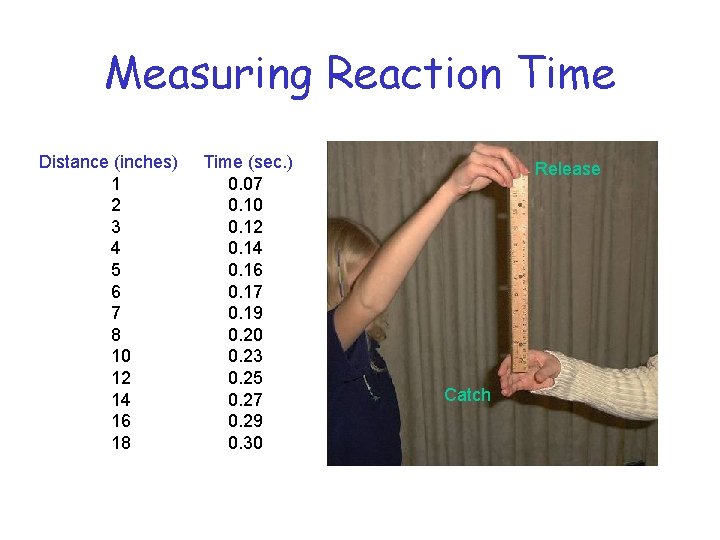
Demo: Catch a Buck Put thumb and index fingers near Washington’s head. Can you react fast enough to catch the money? Half length of dollar bill is 3 inch so it takes about 1/8 of a second (0. 125 seconds) to fall this distance. Typical reaction time is 0. 20 to 0. 25 seconds.
Measuring Reaction Time Distance (inches) 1 2 3 4 5 6 7 8 10 12 14 16 18 Time (sec. ) 0. 07 0. 10 0. 12 0. 14 0. 16 0. 17 0. 19 0. 20 0. 23 0. 25 0. 27 0. 29 0. 30 Release Catch
Rolling Downhill 1 1 Key #1 is point of release 3 2 3 5 4 Rolling downhill is also accelerating motion Very similar to falling except distances are smaller and depend on the slope of the incline. 7
Demo: Galileo’s Clicking Ramps Roll balls down notched, inclined ramps and listen for the clicks. 8 16 24 32 40 48 56 64 Start 1 4 4=2 x 2 9 16 9=3 x 3 16=4 x 4 25 25=5 x 5 36 49 36=6 x 6 49=7 x 7 64 64=8 x 8
Sliding with Friction Block stops here Sliding this way 3 5 1 2 1 3 Sliding with friction is another example of accelerating motion but in this case the object “slows in. ” Draw last key (where object stops) first and draw keys leading up to it in the ratios 1: 3: 5: 7: 9: … 4
In-betweens of Accelerated Motion Shooting on Twos (2 frames per key) 1 3 5 Accelerating this way 1 2 1/4 3 4 5/4 1 frame per key 5 7/4 7 6 9/4 11/4 5/4+7/4 = 12/4 = 3 To draw in-betweens of accelerating motion, divide first distance by 4, then keep the same ratios of 1: 3: 5: 7.
Falling a la Chai 1 3 1 2 3 1 1 2 3 3 4 5 4 4 An approximation to real falling that’s easy to use for pose-to-pose animation Recipe for “Falling a la Chai”: • Draw interval from first & last keys. • Divide interval in half. Mark a key. • Divide top part in half. Mark a key. 8 7 5 Real Falling 5 Falling a la Chai Key #4 is a bit too high but who’ll notice?
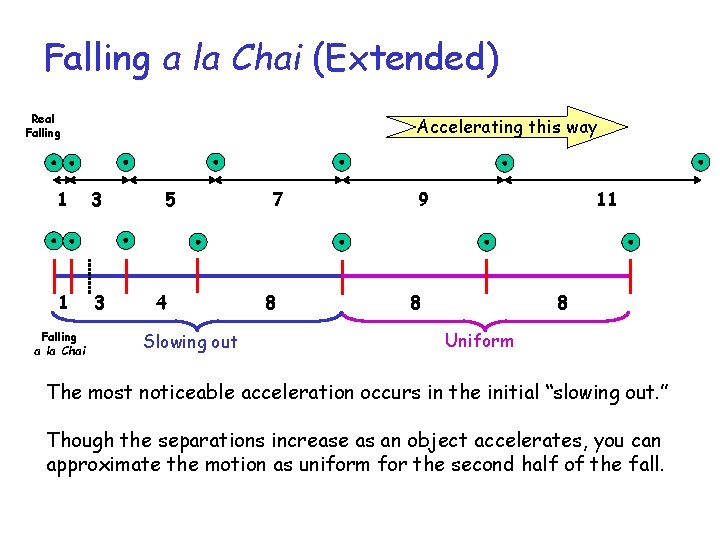
Falling a la Chai (Extended) Real Falling Accelerating this way 1 3 Falling a la Chai 5 4 Slowing out 7 8 9 11 8 8 Uniform The most noticeable acceleration occurs in the initial “slowing out. ” Though the separations increase as an object accelerates, you can approximate the motion as uniform for the second half of the fall.
Falling and Floating 1 3 5 5 Accelerating Motion Uniform Motion Light objects, such as a beach ball, initially fall with accelerating motion. Due to air resistance, the motion transitions to uniform motion after falling a certain distance. For very light objects, such as a leaf, this transition is almost immediate. Squirrels cannot die from a fall.
Hyper-acceleration Release 1 1 Constant acceleration 3 2 5 3 1 Release 7 4 2 3 Hyper-acceleration 4 If the slope of an incline increases, the acceleration itself accelerates.
Tipping Over At At ½Rsel 1 e 4 saº 1 in 5º ecoesce in ndon d in At 57º ond 1½ sec A good example of hyperacceleration is an object tipping over when offbalance. Brick tipped 2º offbalance then released. No simple way to compute hyper-acceleration.
Acceleration “Stretch” Objects visually stretch as they gain speed due to motion blur. Objects do not physically stretch as they fall (not even raindrops). High-speed camera Human eye Motion blur does not depend on the object’s material, however, it will look more natural for rigid objects to stretch less than elastic objects.
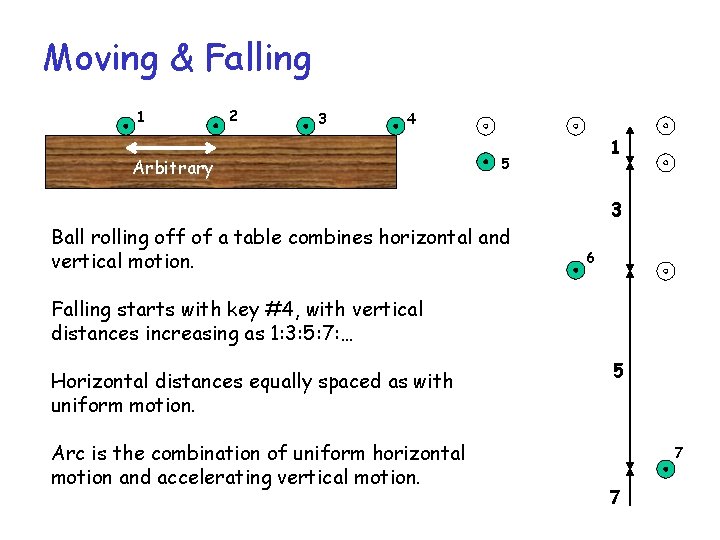
Moving & Falling 1 2 3 4 Arbitrary 1 5 3 Ball rolling off of a table combines horizontal and vertical motion. 6 Falling starts with key #4, with vertical distances increasing as 1: 3: 5: 7: … Horizontal distances equally spaced as with uniform motion. Arc is the combination of uniform horizontal motion and accelerating vertical motion. 5 7 7
Demo: Fall and Fire FALL 1 One ball is released and falls straight down. Other ball is fired horizontally. At all times the balls are at the same height. Hit the ground at the same time. 1 2 1 FIRE 2 3 3 3 5 4 4
Parabolic Arc of Motion 4 1 3 Arbitrary 3 5 Apex 2 Up and down motion is symmetric, as shown. Key #4 is highest point of the arc of motion. 5 1 7 6 7
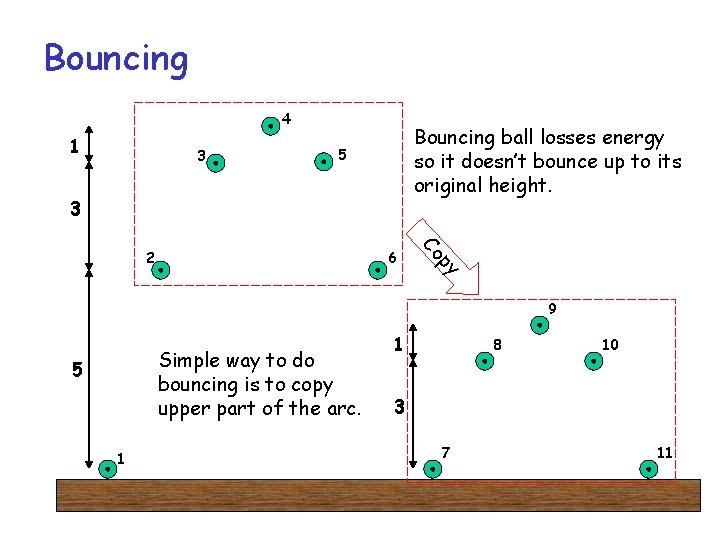
Bouncing 4 1 3 Bouncing ball losses energy so it doesn’t bounce up to its original height. 5 3 py 6 Co 2 9 Simple way to do bouncing is to copy upper part of the arc. 5 1 1 8 10 3 7 11
Bouncing with Squash & Stretch is added where motion is the fastest. Squash is used to emphasize impact on bounce.
Parabolic Arc in Perspective Maximum height (ball at midpoint) VP HL Ball starts and ends on the ground.
Parabolic Arc in Perspective (cont. ) 1 VP HL 3 Add points to the curve by ‘tweening’ from the point of maximum height.
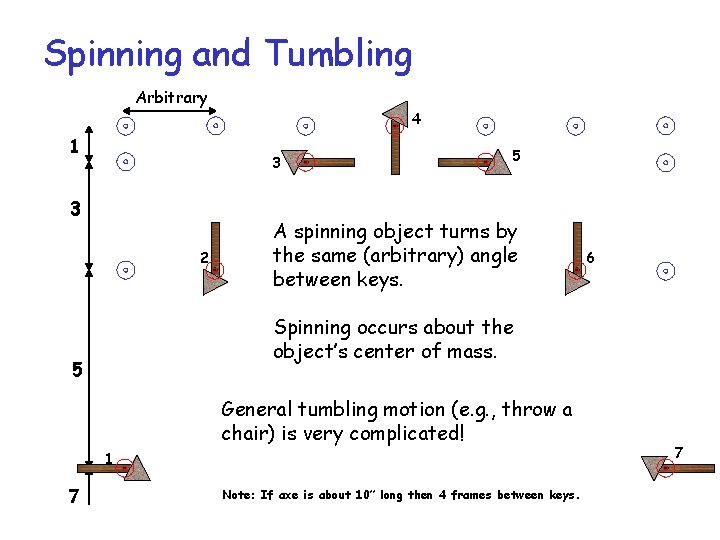
Spinning and Tumbling Arbitrary 4 1 3 3 2 5 A spinning object turns by the same (arbitrary) angle between keys. Spinning occurs about the object’s center of mass. 5 General tumbling motion (e. g. , throw a chair) is very complicated! 1 7 6 Note: If axe is about 10” long then 4 frames between keys. 7
Brick Drop A brick tipping off of a table combines all the elements described above: • Hyper acceleration as the brick tips over. • Constant acceleration in the vertical falling. • Uniform velocity in the horizontal motion. • Constant rotation as the brick falls. 1 2 3 1 4 3 5 5 6
What creates action? Various types of physical motion are: • Uniform motion (no acceleration) • Constant acceleration • Hyper-acceleration (non-constant) But why do objects accelerate? Answer: Forces!
Newton’s First Law of Motion An object moves with constant, uniform motion until acted on by a force. No force FORCE
First Law (Full Version) An object at rest remains at rest & an object in motion remains in uniform motion*, unless a force acts on the object. *Moving in a straight line with constant speed. First Law is also known as principle of inertia.
Demo: Tablecloth Pull Flower Vase Tablecloth Yank quickly Due to the vase’s inertia it remains at rest since almost no force acts on the vase if one pulls quickly & straight.
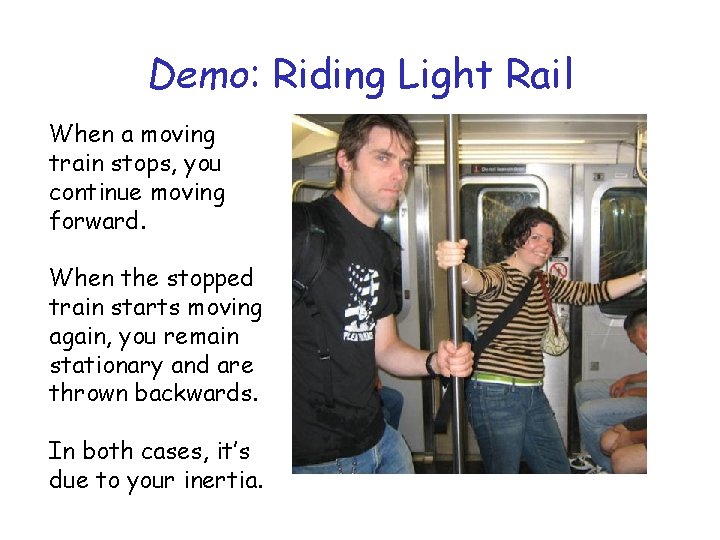
Demo: Riding Light Rail When a moving train stops, you continue moving forward. When the stopped train starts moving again, you remain stationary and are thrown backwards. In both cases, it’s due to your inertia.
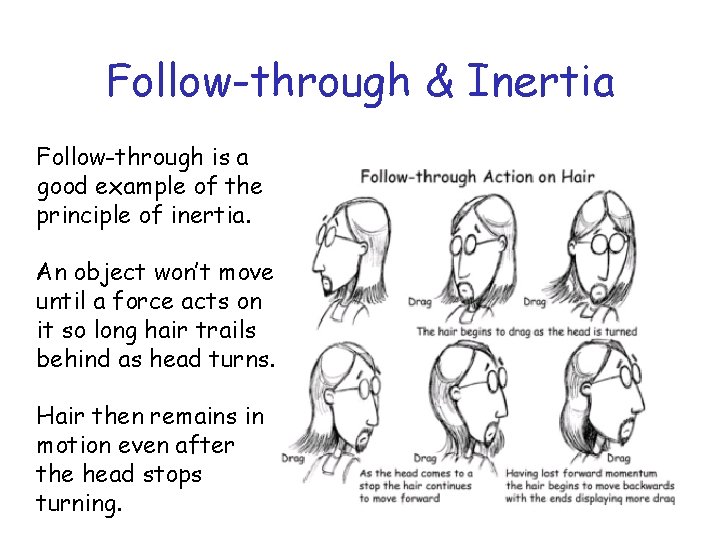
Follow-through & Inertia Follow-through is a good example of the principle of inertia. An object won’t move until a force acts on it so long hair trails behind as head turns. Hair then remains in motion even after the head stops turning.
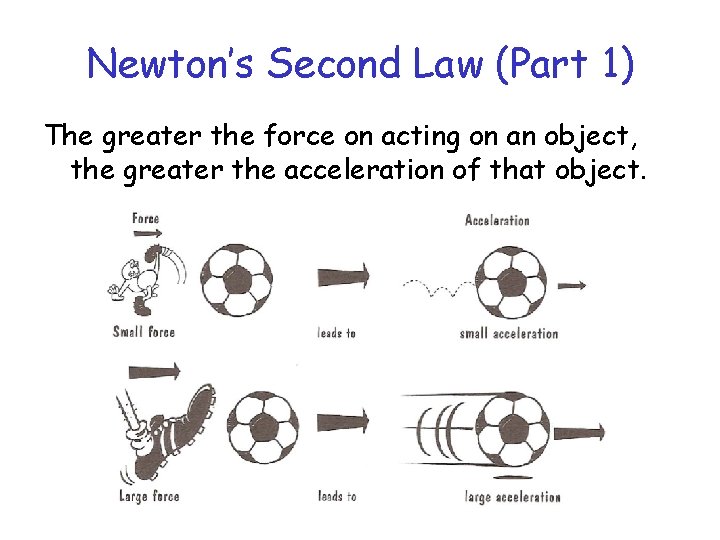
Newton’s Second Law (Part 1) The greater the force on acting on an object, the greater the acceleration of that object.
Newton’s Second Law (Part 2) The greater the mass of an object, the less it accelerates when acted on by the same force.
Free Fall Acceleration Newton’s Second Law explains why heavy and light objects fall with same acceleration. Ratio of weight to mass always the same since weight depends on mass.
Demo: Drop the Sheet A flat sheet of paper falls slowly because of air resistance. What happens if we place it on top of a book, blocking the air from reaching it? Air Resistance Weight Book and sheet fall together
Settle, Squash & Force of Impact The shorter the “settle” the greater the force of impact (since the deceleration is large if an object stops suddenly). Similarly, less “squash”, means a greater force of impact.
Demo: Bed of Nails One may safely lay or sit on a bed of nails, as long as there are enough nails since the force per nail is small. Weight of 150 pounds is distributed over 300 nails. Force per nail is ½ lb. Need 5 lb per nail to pierce skin. The one thing you never want to do with a bed of nails is jump into bed! Big deceleration means big force. Ouch!
Demo: Vampire Stake Safest when slowly moving stake placed on a soft, fleshy spot on the chest. Slow settle, small force Quick stop, BIG FORCE X X Ouch! Not safe if stake strikes hard skull
Newton’s Third Law of Motion For every action force there is an equal reaction force in the opposite direction.
Walking, Running & Jumping What forces accelerate us into motion when we walk, run, or jump?
Forces when Walking or Jumping For a person walking, running, or jumping, the three main forces on the person are: • Gravity (Downward) • Support of the floor (Upward) • Frictional force of the floor (Horizontal) Only these forces can accelerate the person. Gravity is constant but the force exerted by the floor can increase in reaction to the person exerting a force on the floor.
Walking Forward Back foot pushing back on the floor. Reaction is the friction of the floor, which pushes your body forward. If floor is frictionless then it is impossible to move forward. Action Reaction
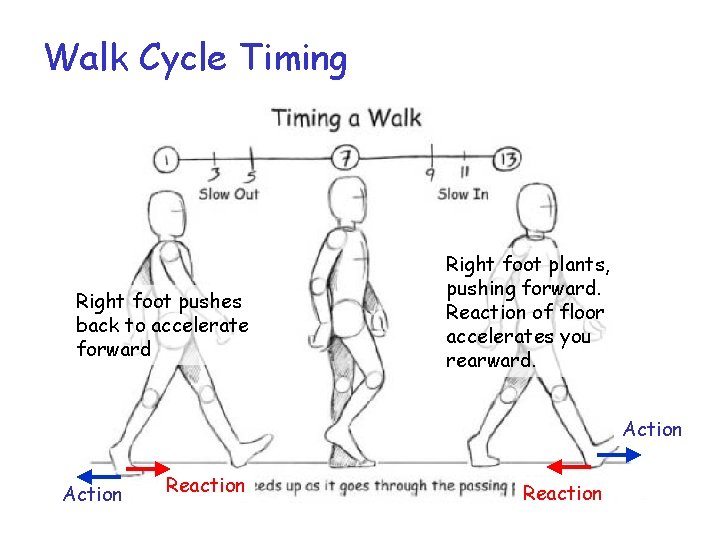
Walk Cycle Timing Right foot pushes back to accelerate forward Right foot plants, pushing forward. Reaction of floor accelerates you rearward. Action Reaction
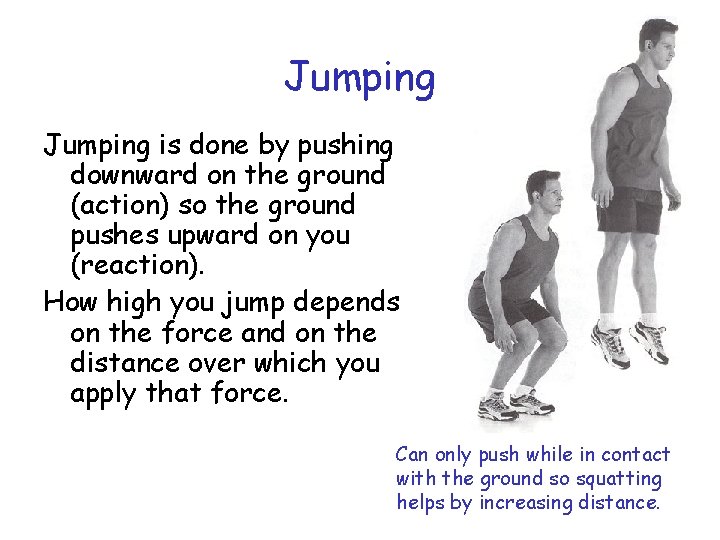
Jumping is done by pushing downward on the ground (action) so the ground pushes upward on you (reaction). How high you jump depends on the force and on the distance over which you apply that force. Can only push while in contact with the ground so squatting helps by increasing distance.
Swinging Arms and Jumping You swing your arms upward as you jump to increase the force pushing down on the ground. Try jumping and swinging your arms upward after you leave the ground; you won’t jump as high.
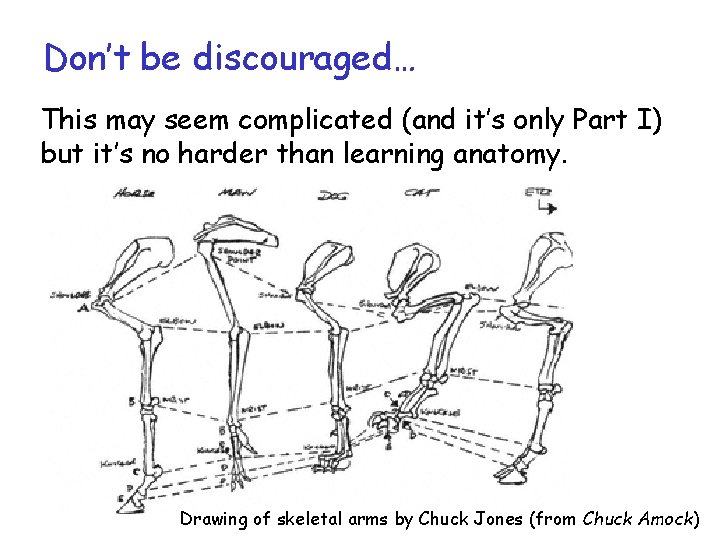
Don’t be discouraged… This may seem complicated (and it’s only Part I) but it’s no harder than learning anatomy. Drawing of skeletal arms by Chuck Jones (from Chuck Amock)
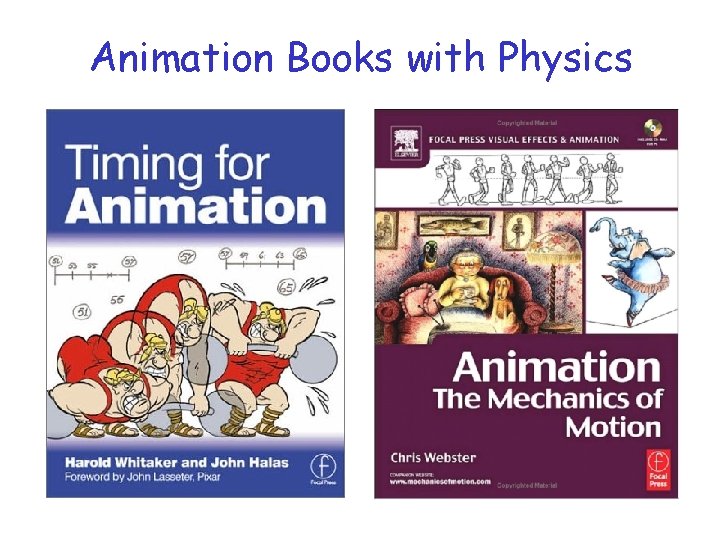
Animation Books with Physics
The Most Important Law of Motion The art director is always right.