
PHYSICS NOTES Review of Good Methodology WHO IS

- Slides: 18
PHYSICS NOTES Review of Good Methodology
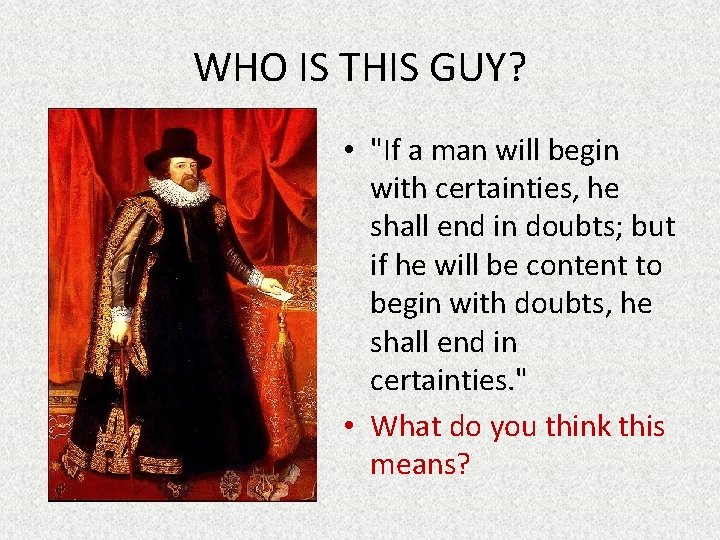
WHO IS THIS GUY? • "If a man will begin with certainties, he shall end in doubts; but if he will be content to begin with doubts, he shall end in certainties. " • What do you think this means?
WHO IS THIS GUY? • Bacon (pictured) and Descartes formalized Science into a Methodology. • However, many people have contributed to the SM over time. Karl Gauss David Hume John Locke Ernst Mach John Dewey Humphry Davy Isaac Newton Robert Boyle Abraham Wolf Morris Cohen Karl Pearson William James Gregor Mendel John Herschel Immanuel Kant William Wells Charles Darwin Claude Bernard William Jevons Charles Pierce William Jevons William Harvey Michael Faraday William Whewell Johannes Kepler Albert Einstein Henry Armstrong John Stuart Mill Joseph Priestley Bertrand Russell Benjamin Franklin Antoine Lavoisier Joseph Gay-Lussac Ernest Rutherford James Clerk Maxwell Albert North Whitehead
Objectives I can… • Recall the general steps of the SM • describe the criteria for good questions, hypotheses, tests, results, and conclusions. • describe the different types of testing methods • apply ST to the Scientific Method.
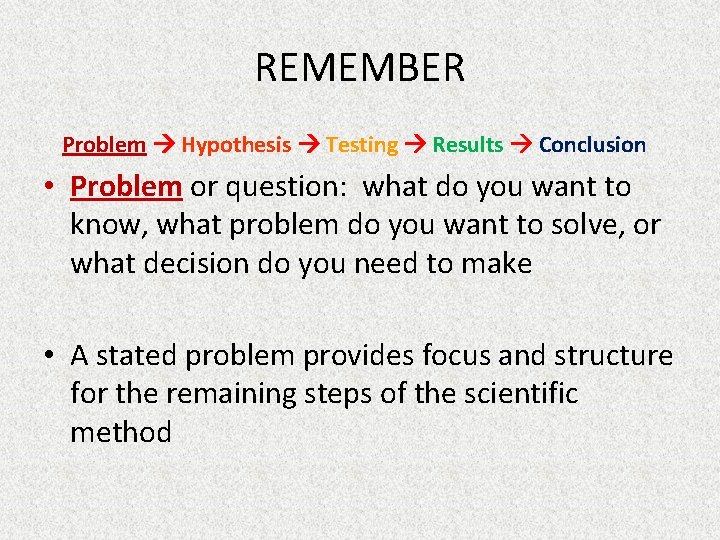
REMEMBER Problem Hypothesis Testing Results Conclusion • Problem or question: what do you want to know, what problem do you want to solve, or what decision do you need to make • A stated problem provides focus and structure for the remaining steps of the scientific method
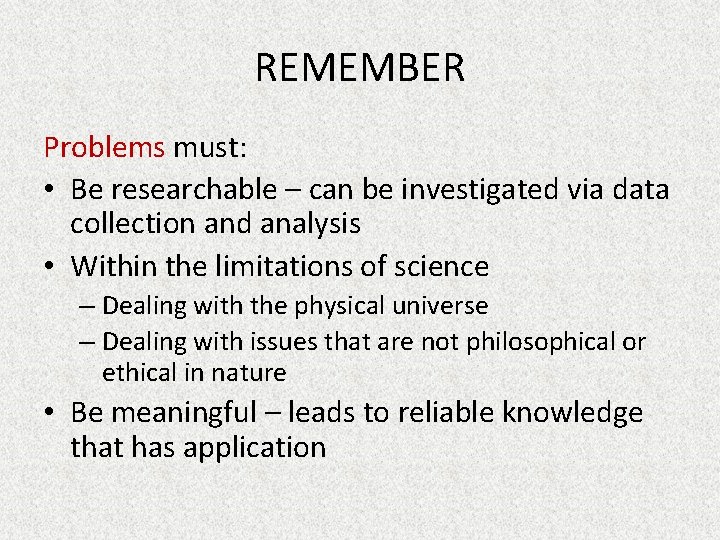
REMEMBER Problems must: • Be researchable – can be investigated via data collection and analysis • Within the limitations of science – Dealing with the physical universe – Dealing with issues that are not philosophical or ethical in nature • Be meaningful – leads to reliable knowledge that has application
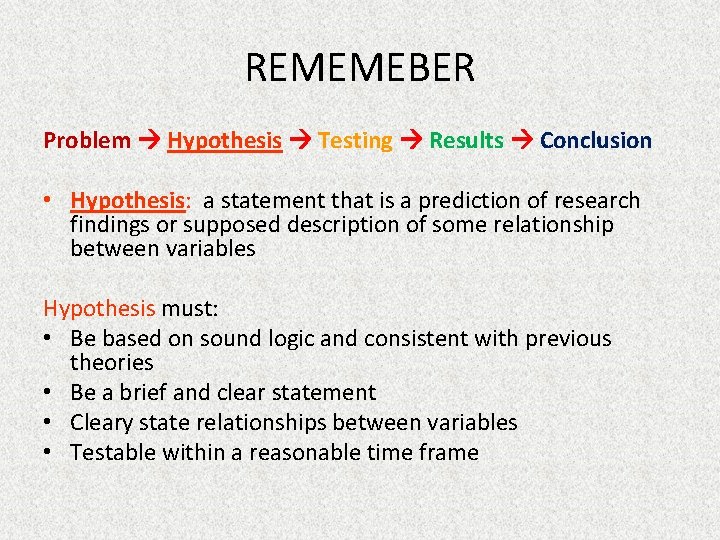
REMEMEBER Problem Hypothesis Testing Results Conclusion • Hypothesis: a statement that is a prediction of research findings or supposed description of some relationship between variables Hypothesis must: • Be based on sound logic and consistent with previous theories • Be a brief and clear statement • Cleary state relationships between variables • Testable within a reasonable time frame
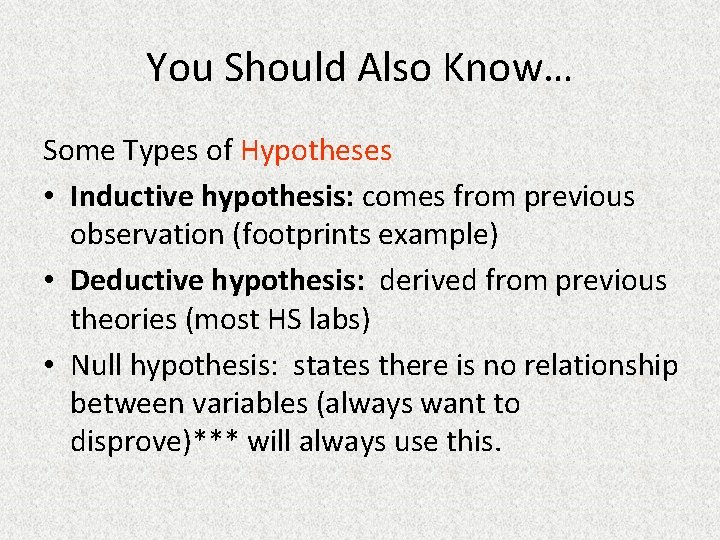
You Should Also Know… Some Types of Hypotheses • Inductive hypothesis: comes from previous observation (footprints example) • Deductive hypothesis: derived from previous theories (most HS labs) • Null hypothesis: states there is no relationship between variables (always want to disprove)*** will always use this.
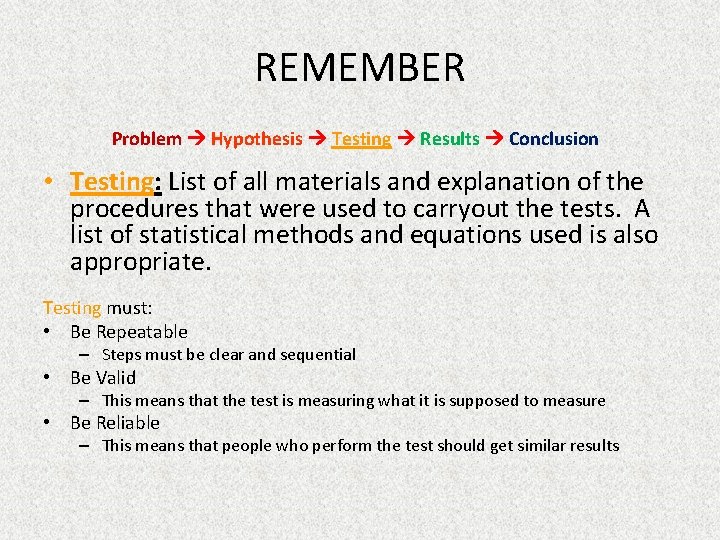
REMEMBER Problem Hypothesis Testing Results Conclusion • Testing: List of all materials and explanation of the procedures that were used to carryout the tests. A list of statistical methods and equations used is also appropriate. Testing must: • Be Repeatable – Steps must be clear and sequential • Be Valid – This means that the test is measuring what it is supposed to measure • Be Reliable – This means that people who perform the test should get similar results
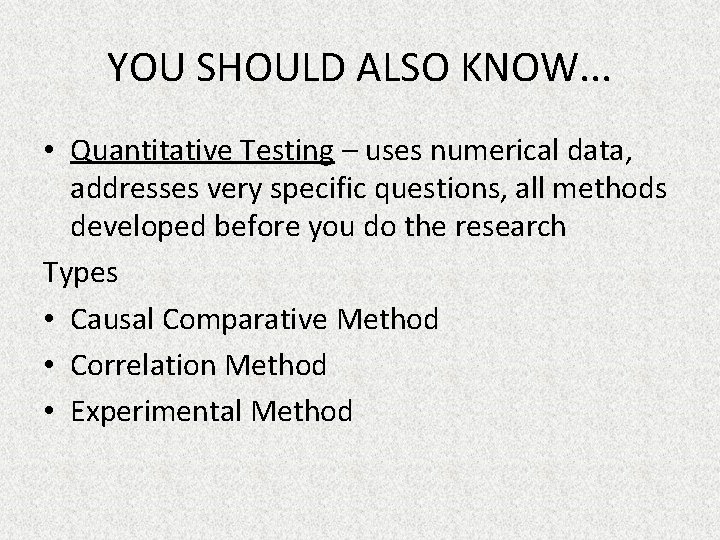
YOU SHOULD ALSO KNOW. . . • Quantitative Testing – uses numerical data, addresses very specific questions, all methods developed before you do the research Types • Causal Comparative Method • Correlation Method • Experimental Method
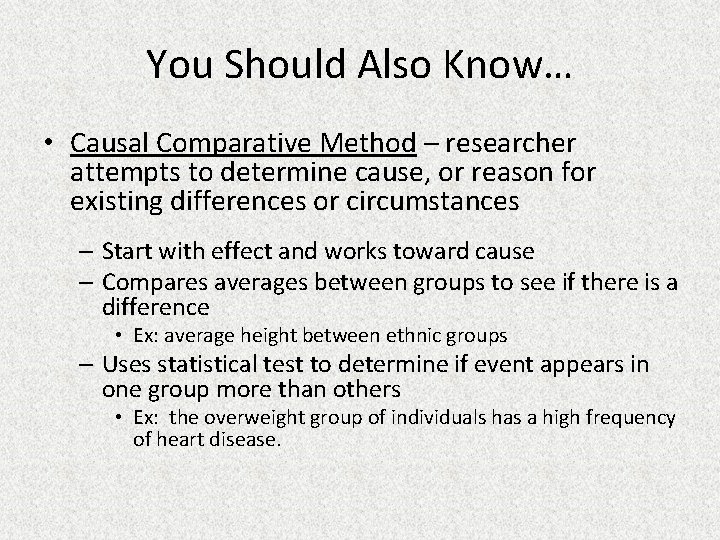
You Should Also Know… • Causal Comparative Method – researcher attempts to determine cause, or reason for existing differences or circumstances – Start with effect and works toward cause – Compares averages between groups to see if there is a difference • Ex: average height between ethnic groups – Uses statistical test to determine if event appears in one group more than others • Ex: the overweight group of individuals has a high frequency of heart disease.
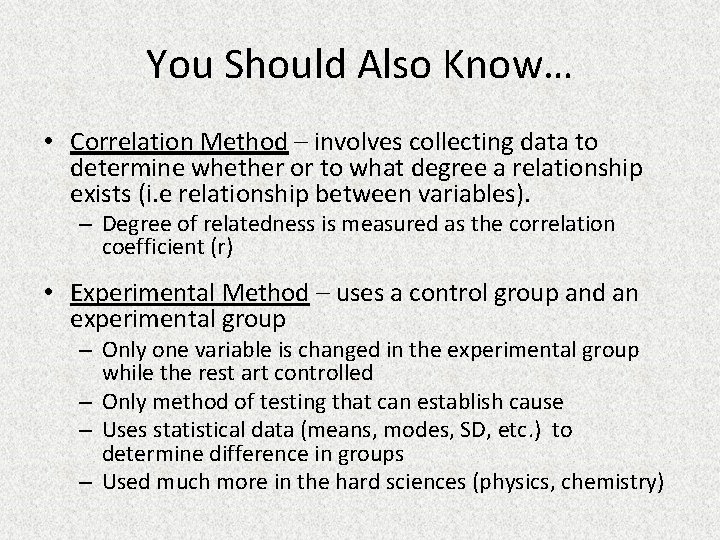
You Should Also Know… • Correlation Method – involves collecting data to determine whether or to what degree a relationship exists (i. e relationship between variables). – Degree of relatedness is measured as the correlation coefficient (r) • Experimental Method – uses a control group and an experimental group – Only one variable is changed in the experimental group while the rest art controlled – Only method of testing that can establish cause – Uses statistical data (means, modes, SD, etc. ) to determine difference in groups – Used much more in the hard sciences (physics, chemistry)
YOU SHOULD ALSO KNOW… • Qualitative Methods – uses data collected from observation and personal narratives and analyzes it, usually takes a long time, methods developed during or even after research. Types • Narrative Research Methods • Ethnographic Research Methods
YOU SHOULD ALSO KNOW… • Narrative Research Methods – studies how different human beings experience the world around them – Ex: Sociologists, Physiologist, etc. • Ethnographic Research Methods – looks at cultural patterns and participants in a natural setting – Ex: Anthropologists, etc.
REMEMBER Problem Hypothesis Testing Results Conclusion • Results: An organized representation and description of what the data says. Results must: • Be clearly described! • Must consider both accuracy and precision of measurements • Have clearly labeled and easy to read charts, tables, graphs, etc.
REMEMBER Problem Hypothesis Testing Results Conclusion • Conclusion: An explanation of what the data means. Conclusions must: • Tell whether the hypotheses were retained (tentatively accepted) or rejected. • Explain the evidence used to retain or reject the hypotheses (be empirical and Rational) • Identify and possibly justify any influencing factors and Suggest improvements and be open to other explanations (be skeptical) • Make possible generalizations or applications
Assessment Can I… • Recall the general steps of the SM • I can describe the criteria for good questions, hypotheses, tests, results, and conclusions. • I can describe the different types of testing methods • I apply ST to the Scientific Method • I can start thinking about my independent lab.
REMEMBER