
Physics Lecture 09 Chapter 8 Halliday Conservative forces
- Slides: 82
Physics : Lecture 09 (Chapter 8 Halliday) Conservative forces & potential energy Conservation of “total mechanical energy” Example: pendulum Non-conservative forces friction General work/energy theorem Example problem
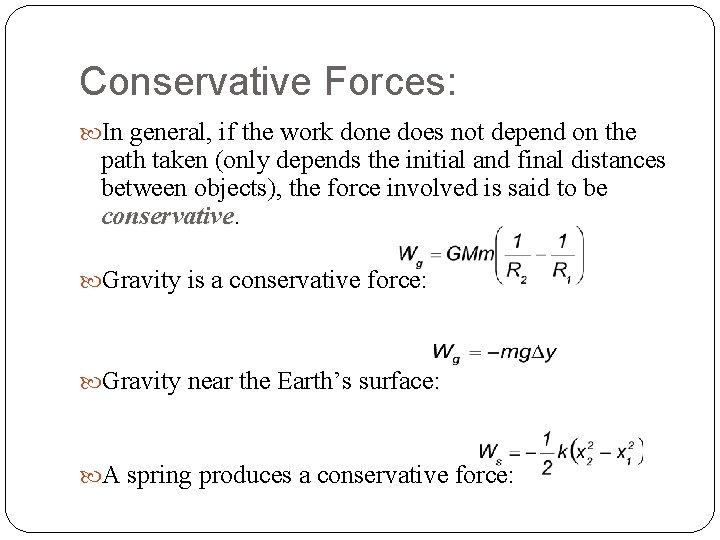
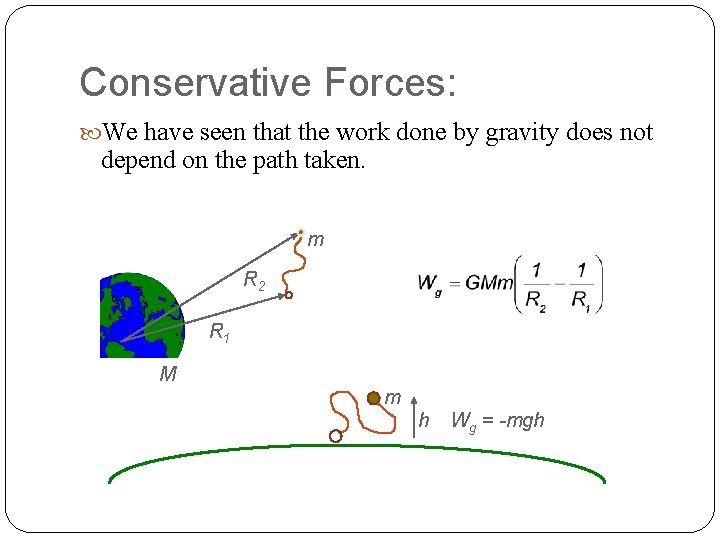
Conservative Forces: In general, if the work done does not depend on the path taken (only depends the initial and final distances between objects), the force involved is said to be conservative Gravity is a conservative force: Gravity near the Earth’s surface: A spring produces a conservative force:
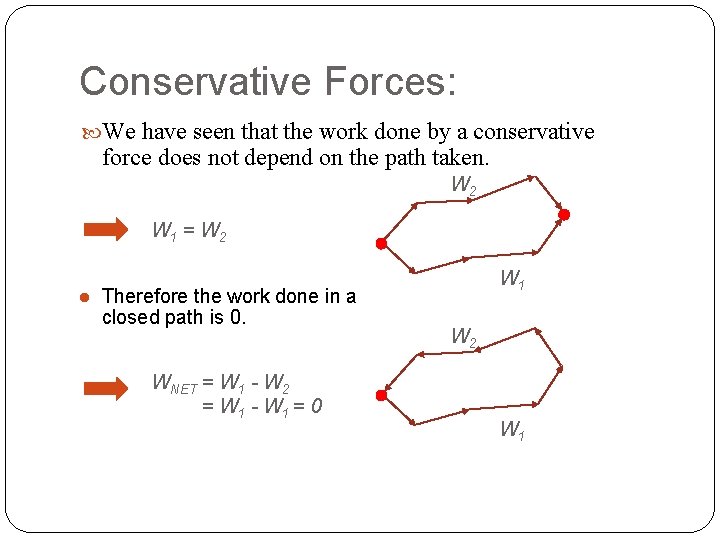
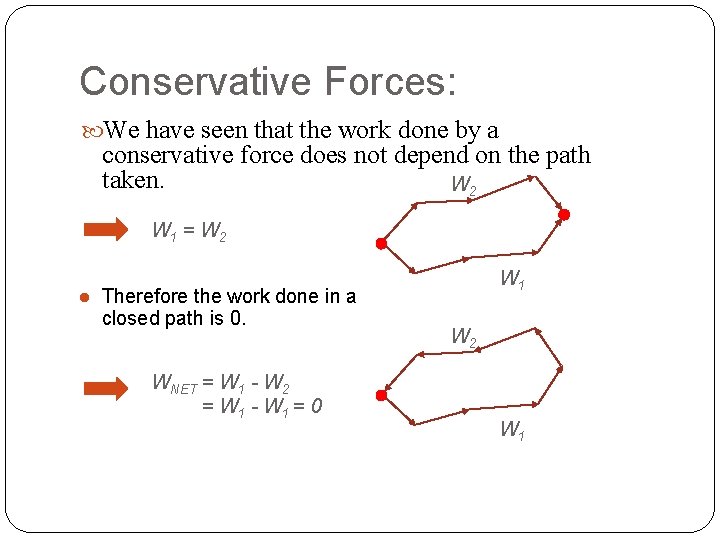
Conservative Forces: We have seen that the work done by a conservative force does not depend on the path taken. W 2 W 1 = W 2 l Therefore the work done in a closed path is 0. WNET = W 1 - W 2 = W 1 - W 1 = 0 W 1 W 2 W 1
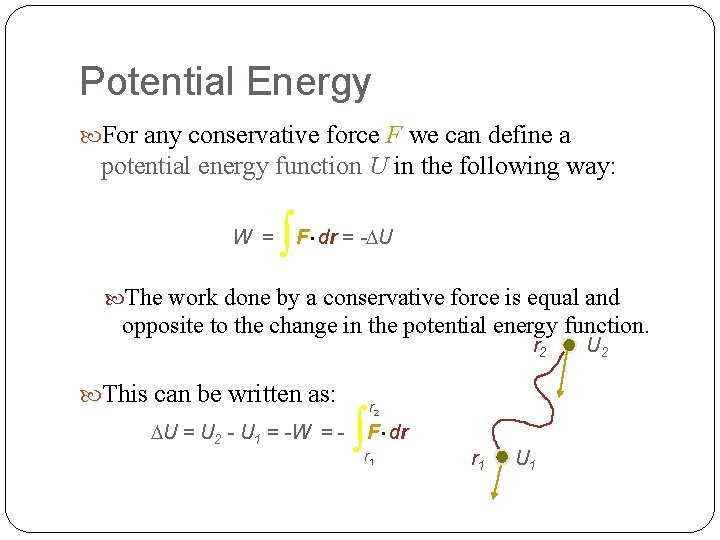
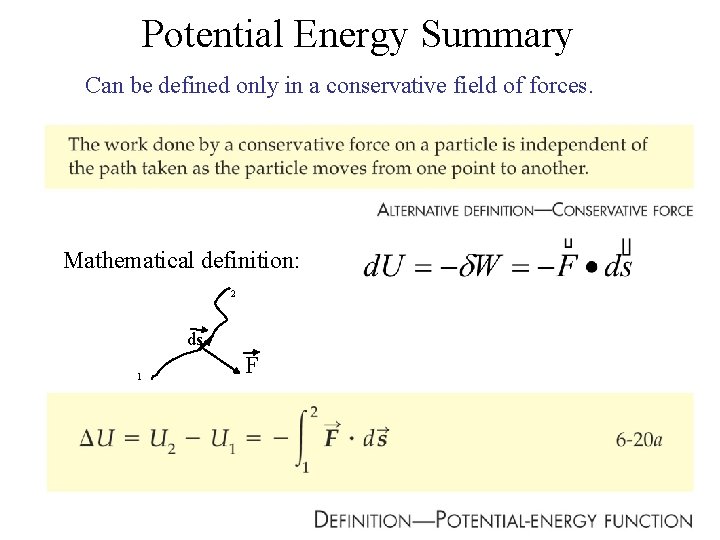
Potential Energy For any conservative force F we can define a potential energy function U in the following way: W = ò . F dr = - U The work done by a conservative force is equal and opposite to the change in the potential energy function. r 2 This can be written as: U = U 2 - U 1 = -W = - r 2 ò F. dr r 1 U 1 U 2
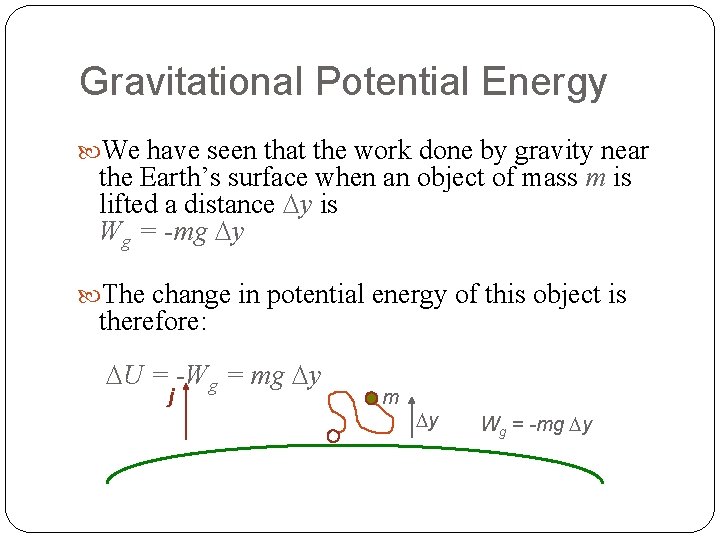
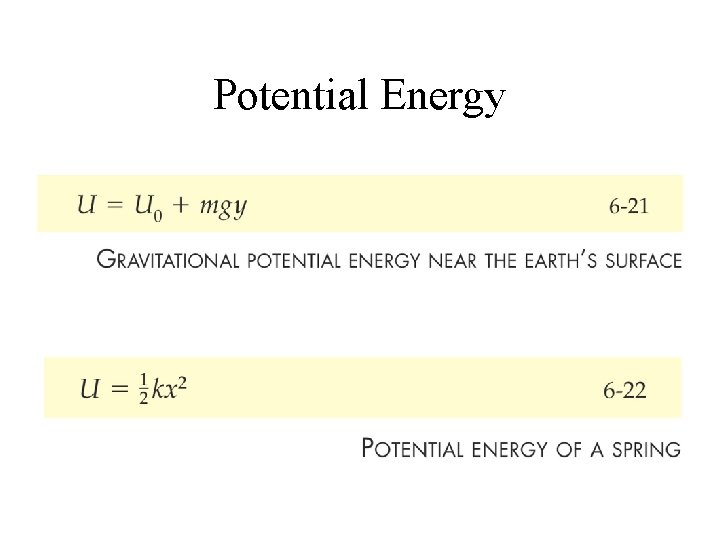
Gravitational Potential Energy We have seen that the work done by gravity near the Earth’s surface when an object of mass m is lifted a distance y is Wg = -mg y The change in potential energy of this object is therefore: U = -Wg = mg y j m y Wg = -mg y
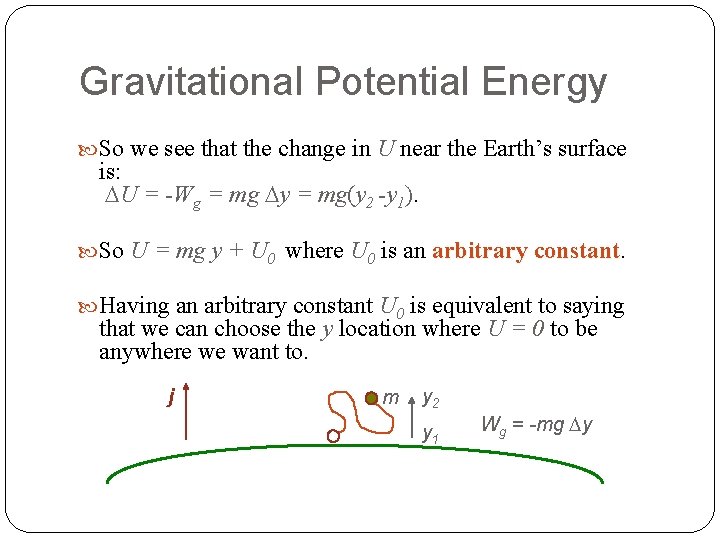
Gravitational Potential Energy So we see that the change in U near the Earth’s surface is: U = -Wg = mg y = mg(y 2 -y 1). So U = mg y + U 0 where U 0 is an arbitrary constant Having an arbitrary constant U 0 is equivalent to saying that we can choose the y location where U = 0 to be anywhere we want to. j m y 2 y 1 Wg = -mg y
Conservative Forces: We have seen that the work done by gravity does not depend on the path taken. m R 2 R 1 M m h Wg = -mgh
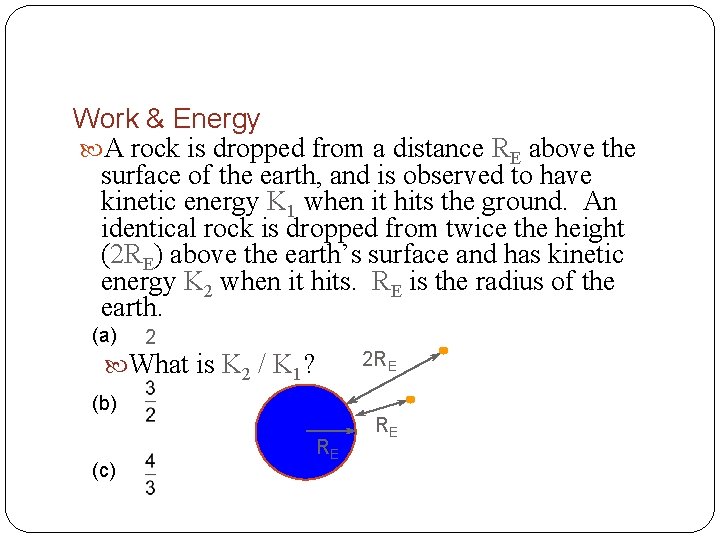
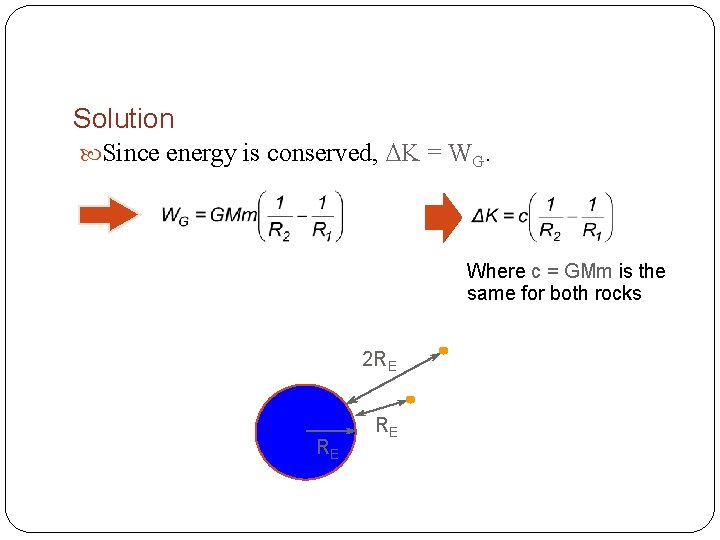
Work & Energy A rock is dropped from a distance RE above the surface of the earth, and is observed to have kinetic energy K 1 when it hits the ground. An identical rock is dropped from twice the height (2 RE) above the earth’s surface and has kinetic energy K 2 when it hits. RE is the radius of the earth. (a) 2 What is K 2 / K 1? 2 RE (b) (c) RE RE
Solution Since energy is conserved, K = WG. Where c = GMm is the same for both rocks 2 RE RE RE
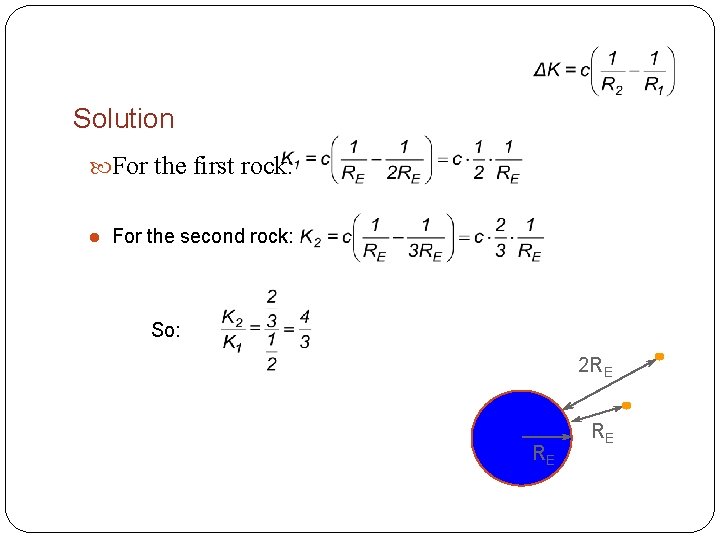
Solution For the first rock: l For the second rock: So: 2 RE RE RE
Conservative Forces: We have seen that the work done by a conservative force does not depend on the path taken. W 2 W 1 = W 2 l Therefore the work done in a closed path is 0. WNET = W 1 - W 2 = W 1 - W 1 = 0 W 1 W 2 W 1
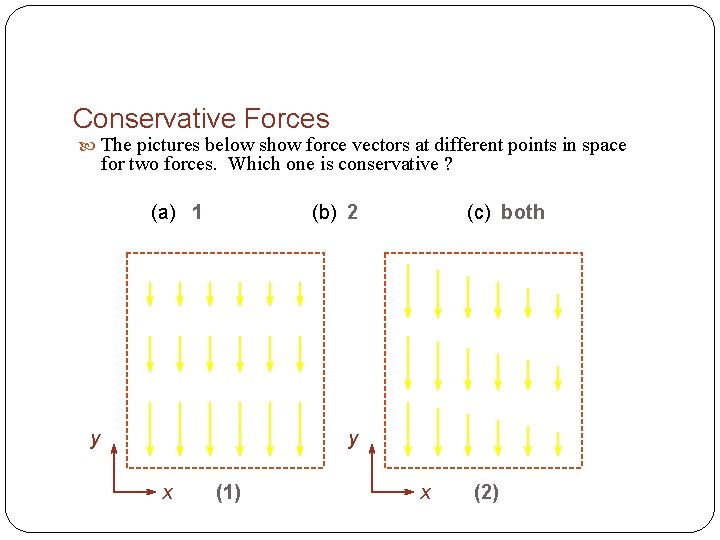
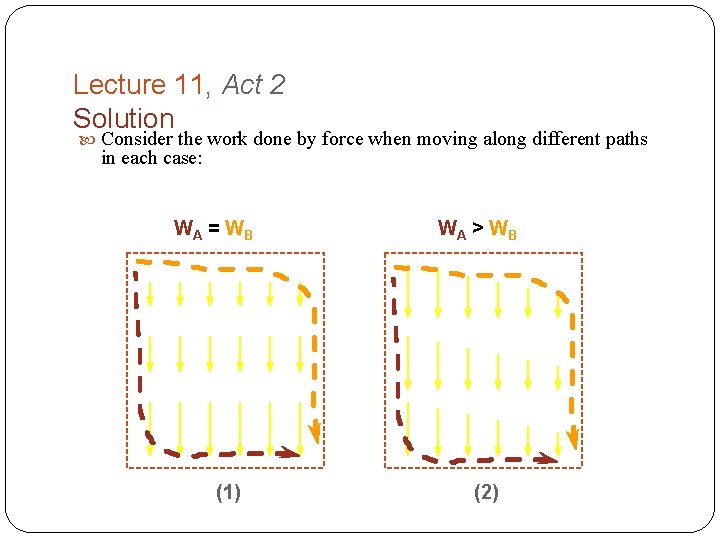
Conservative Forces The pictures below show force vectors at different points in space for two forces. Which one is conservative ? (a) 1 (b) 2 y (c) both y x (1) x (2)
Lecture 11, Act 2 Solution Consider the work done by force when moving along different paths in each case: WA = WB (1) WA > WB (2)
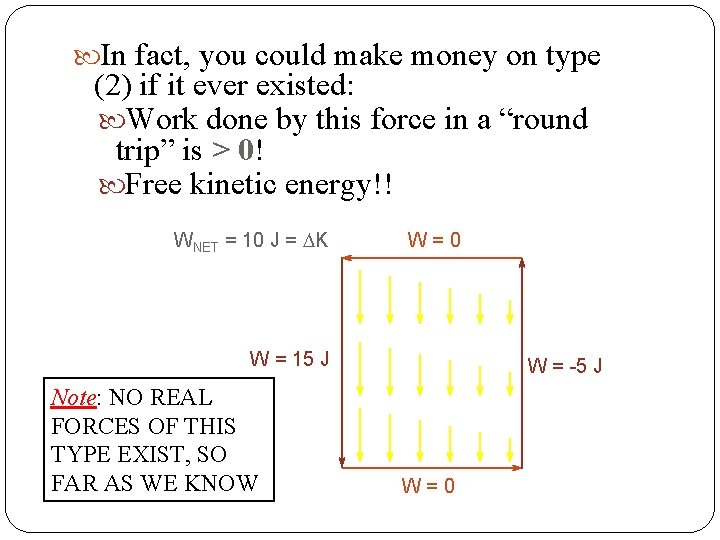
In fact, you could make money on type (2) if it ever existed: Work done by this force in a “round trip” is > 0! Free kinetic energy!! WNET = 10 J = K W=0 W = 15 J Note: NO REAL FORCES OF THIS TYPE EXIST, SO FAR AS WE KNOW W = -5 J W=0
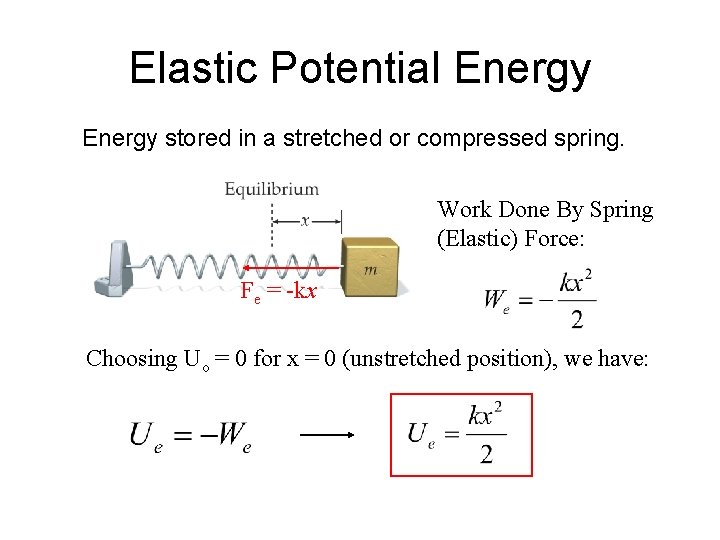
Elastic Potential Energy stored in a stretched or compressed spring. Work Done By Spring (Elastic) Force: Fe = -kx Choosing Uo = 0 for x = 0 (unstretched position), we have:
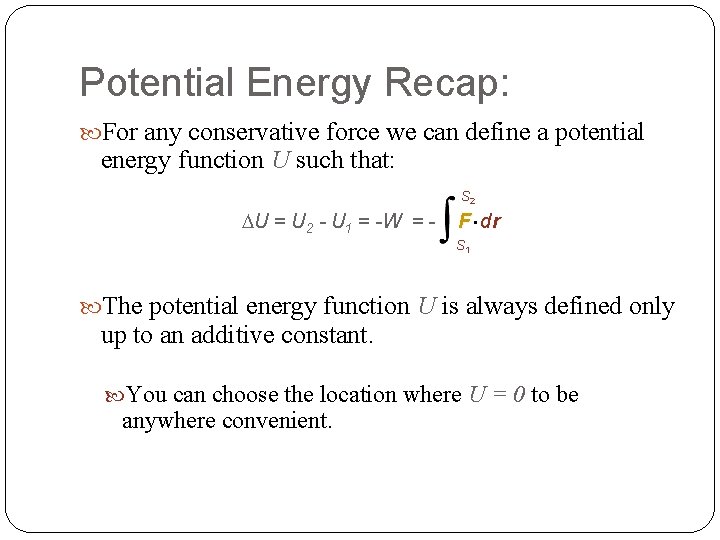
Potential Energy Recap: For any conservative force we can define a potential energy function U such that: S 2 U = U 2 - U 1 = -W = - . F dr S 1 The potential energy function U is always defined only up to an additive constant. You can choose the location where U = 0 to be anywhere convenient.
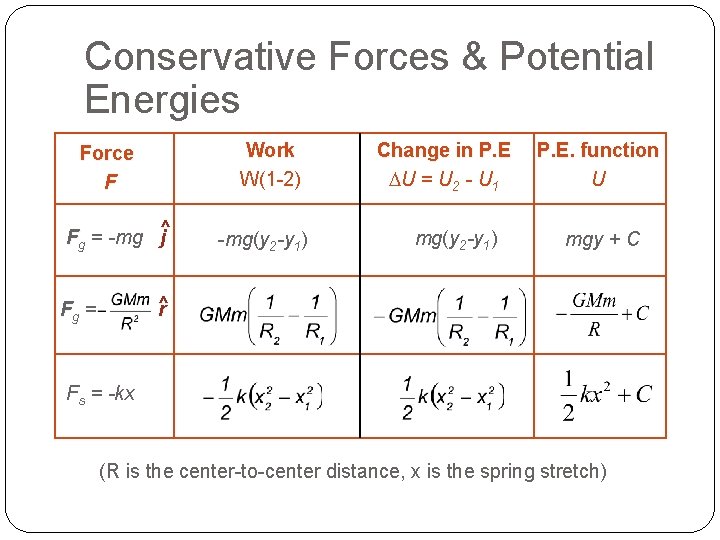
Conservative Forces & Potential Energies Work W(1 -2) Force F ^ Fg = -mg j -mg(y 2 -y 1) Change in P. E U = U 2 - U 1 mg(y 2 -y 1) P. E. function U mgy + C r^ Fg = Fs = -kx (R is the center-to-center distance, x is the spring stretch)
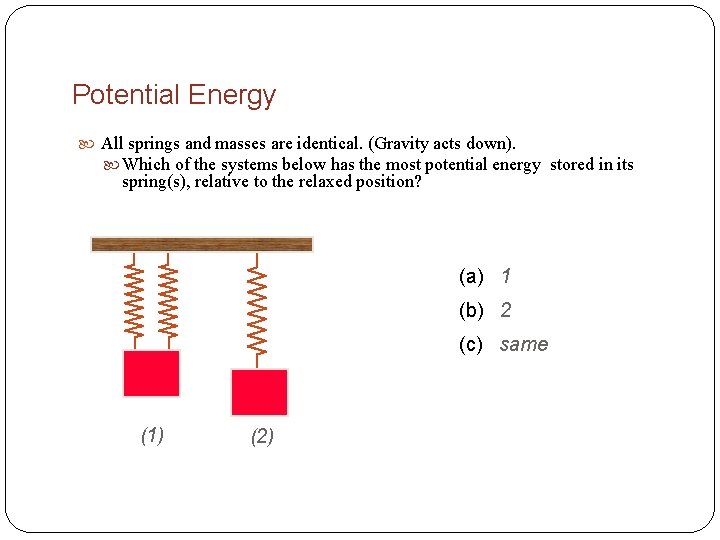
Potential Energy All springs and masses are identical. (Gravity acts down). Which of the systems below has the most potential energy stored in its spring(s), relative to the relaxed position? (a) 1 (b) 2 (c) same (1) (2)
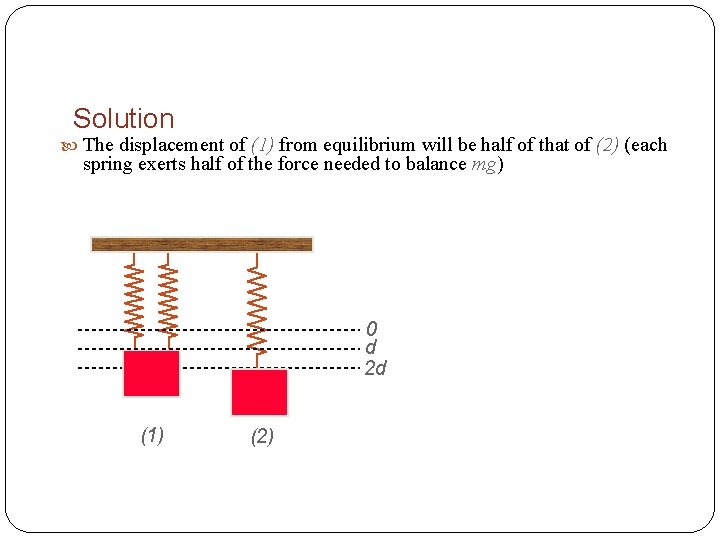
Solution The displacement of (1) from equilibrium will be half of that of (2) (each spring exerts half of the force needed to balance mg) 0 d 2 d (1) (2)
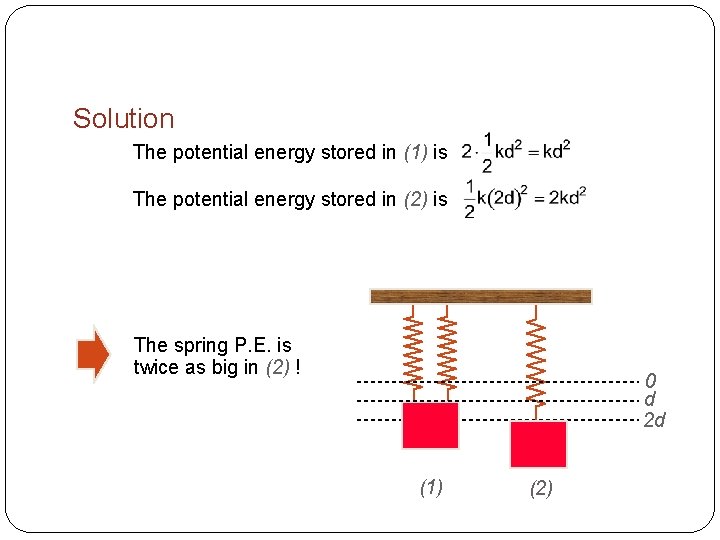
Solution The potential energy stored in (1) is The potential energy stored in (2) is The spring P. E. is twice as big in (2) ! 0 d 2 d (1) (2)
Potential Energy Summary Can be defined only in a conservative field of forces. Mathematical definition: 2 ds 1 F
Potential Energy
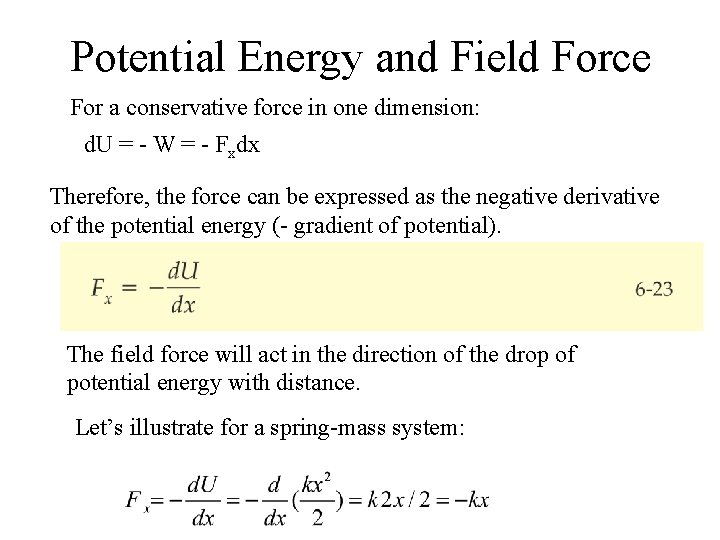
Potential Energy and Field Force For a conservative force in one dimension: d. U = - W = - Fxdx Therefore, the force can be expressed as the negative derivative of the potential energy (- gradient of potential). The field force will act in the direction of the drop of potential energy with distance. Let’s illustrate for a spring-mass system:
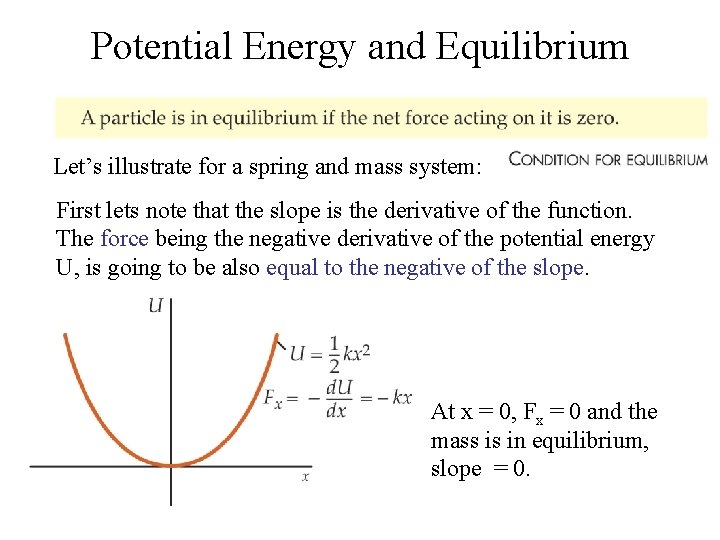
Potential Energy and Equilibrium Let’s illustrate for a spring and mass system: First lets note that the slope is the derivative of the function. The force being the negative derivative of the potential energy U, is going to be also equal to the negative of the slope. At x = 0, Fx = 0 and the mass is in equilibrium, slope = 0.
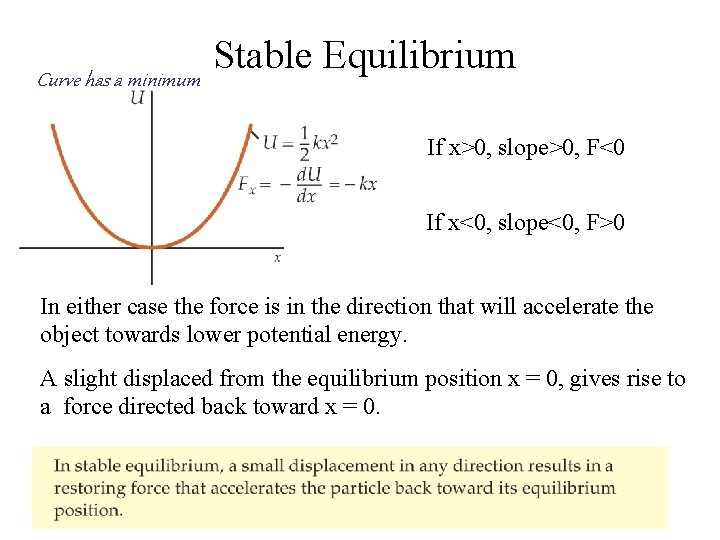
Curve has a minimum Stable Equilibrium If x>0, slope>0, F<0 If x<0, slope<0, F>0 In either case the force is in the direction that will accelerate the object towards lower potential energy. A slight displaced from the equilibrium position x = 0, gives rise to a force directed back toward x = 0.
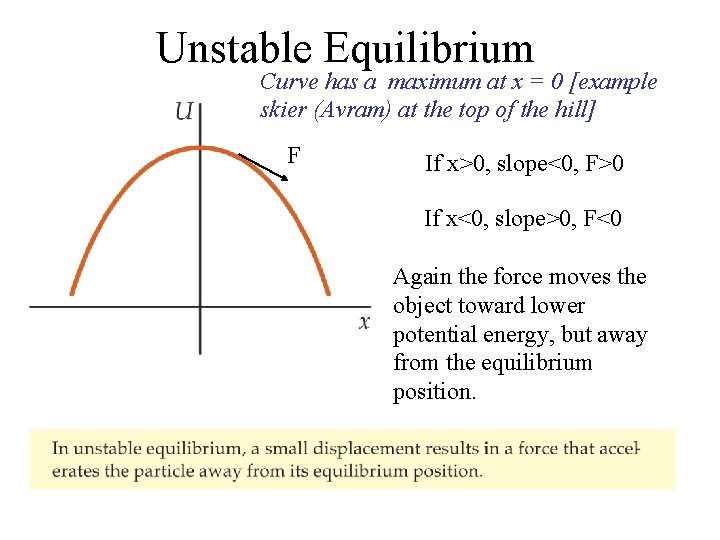
Unstable Equilibrium Curve has a maximum at x = 0 [example skier (Avram) at the top of the hill] F If x>0, slope<0, F>0 If x<0, slope>0, F<0 Again the force moves the object toward lower potential energy, but away from the equilibrium position.
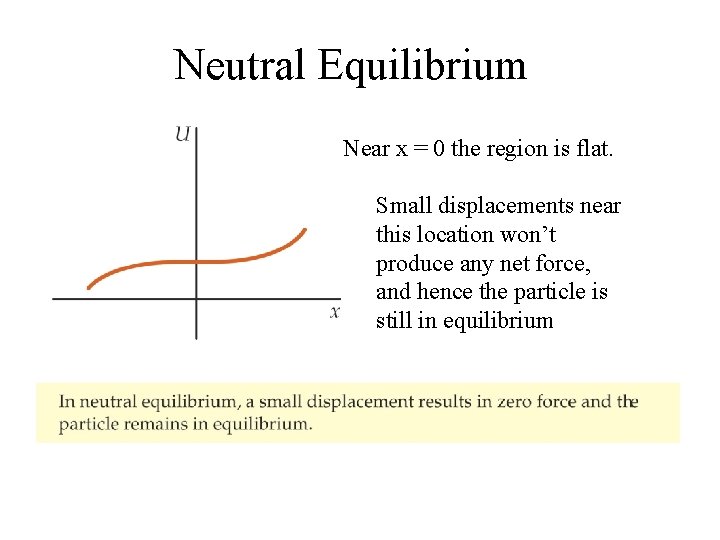
Neutral Equilibrium Near x = 0 the region is flat. Small displacements near this location won’t produce any net force, and hence the particle is still in equilibrium
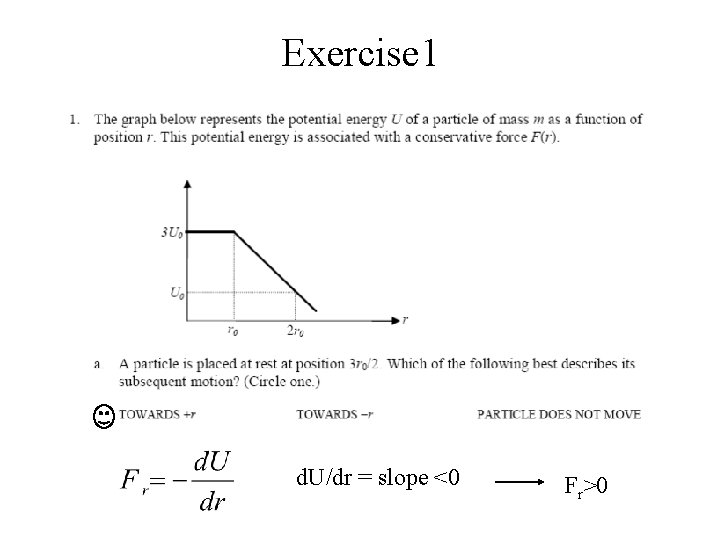
Exercise 1 d. U/dr = slope <0 Fr>0
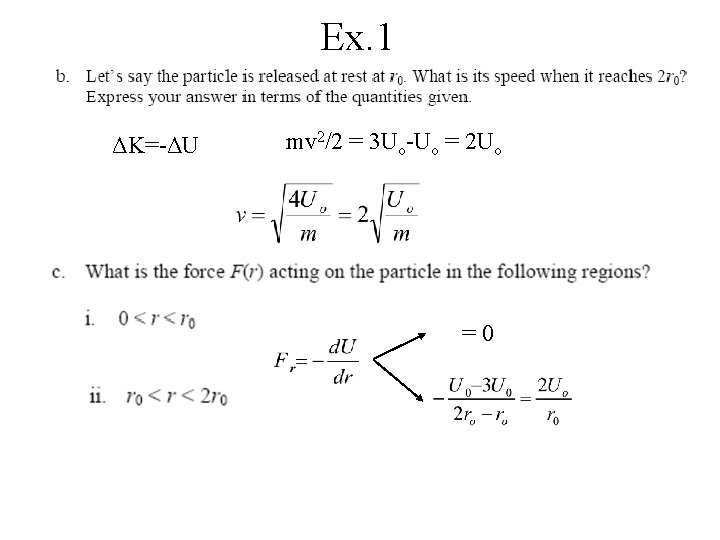
Ex. 1 ΔK=-ΔU mv 2/2 = 3 Uo-Uo = 2 Uo =0
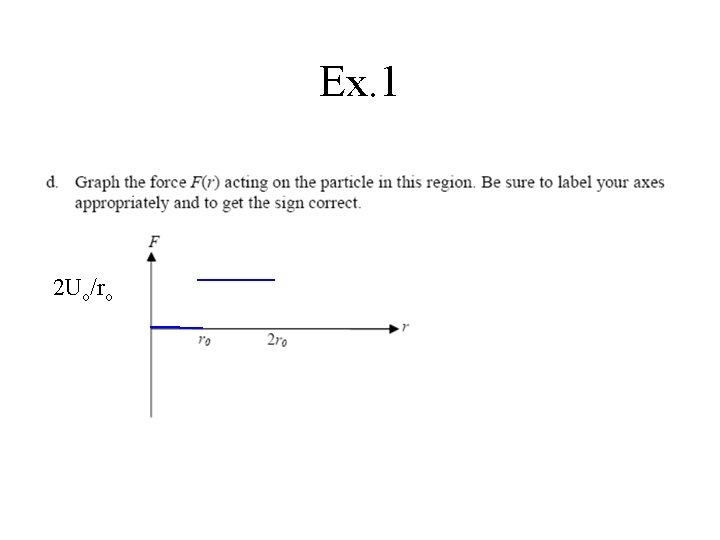
Ex. 1 2 Uo/ro
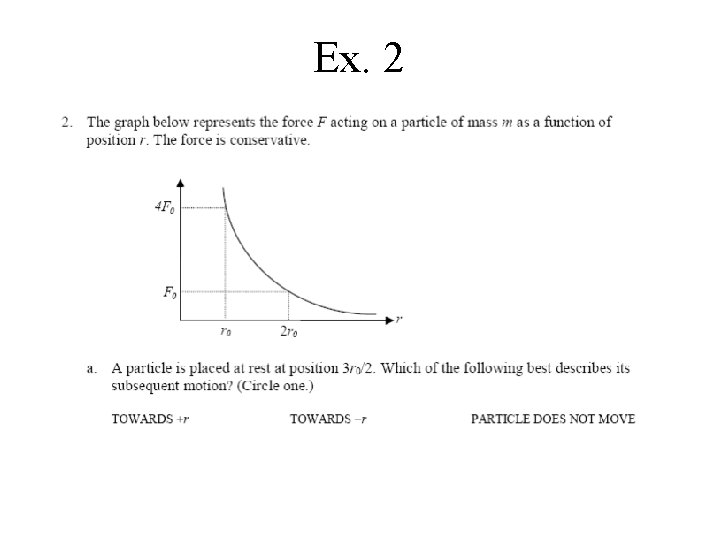
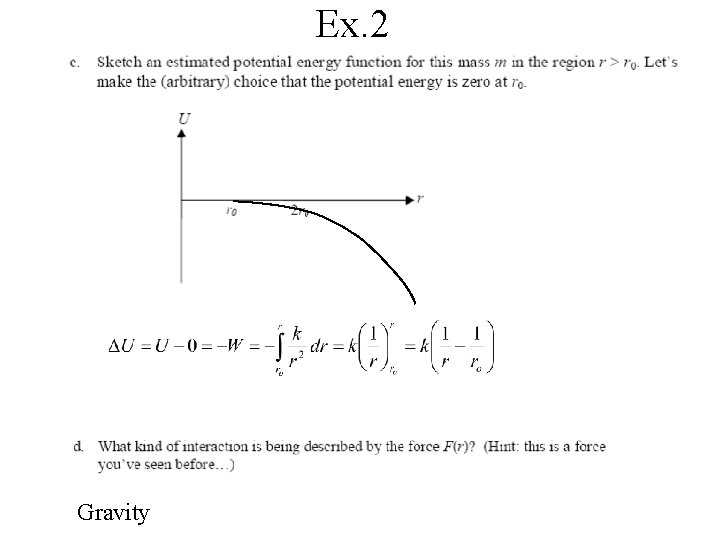
Ex. 2
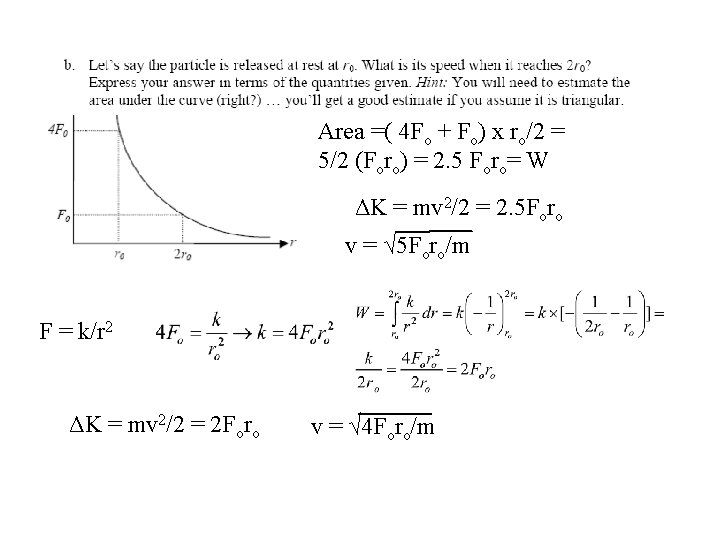
Ex. 2 Area =( 4 Fo + Fo) x ro/2 = 5/2 (Foro) = 2. 5 Foro= W ΔK = mv 2/2 = 2. 5 Foro v = √ 5 Foro/m F = k/r 2 ΔK = mv 2/2 = 2 Foro v = √ 4 Foro/m
Ex. 2 Gravity
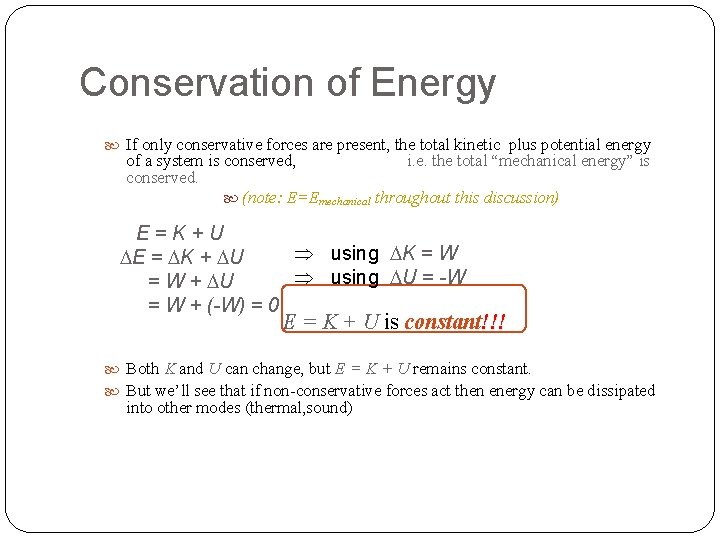
Conservation of Energy If only conservative forces are present, the total kinetic plus potential energy of a system is conserved, i. e. the total “mechanical energy” is conserved. (note: E=Emechanical throughout this discussion) E=K+U Þ using K = W E = K + U Þ using U = -W = W + U = W + (-W) = 0 E = K + U is constant!!! Both K and U can change, but E = K + U remains constant. But we’ll see that if non-conservative forces act then energy can be dissipated into other modes (thermal, sound)
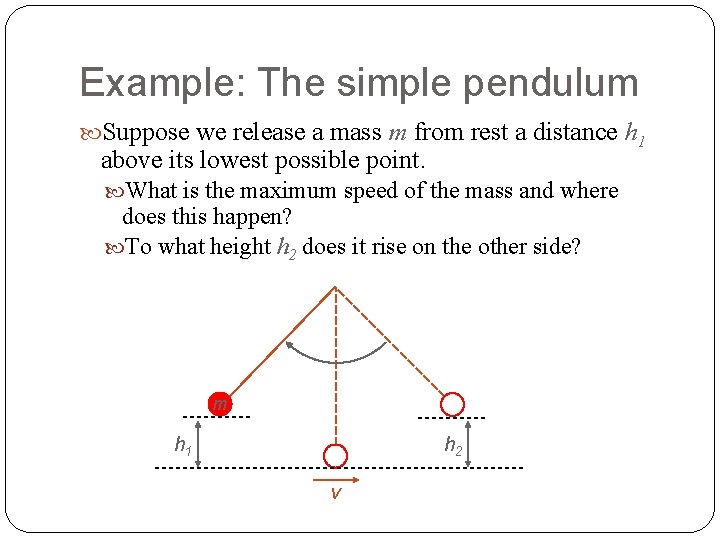
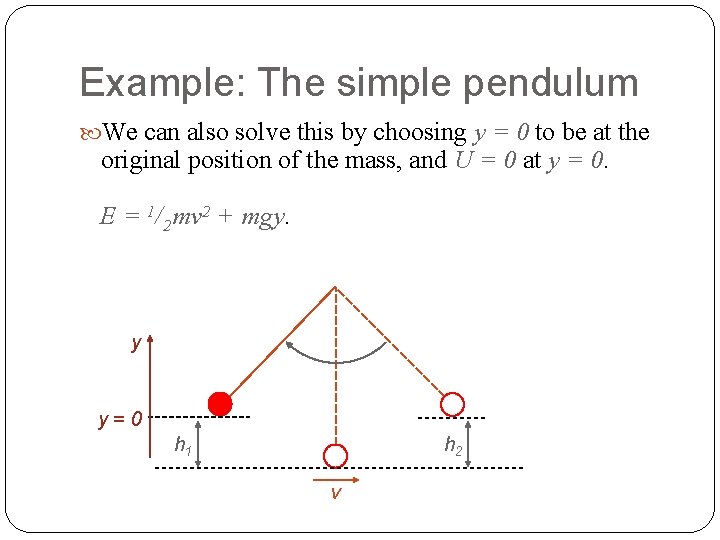
Example: The simple pendulum Suppose we release a mass m from rest a distance h 1 above its lowest possible point. What is the maximum speed of the mass and where does this happen? To what height h 2 does it rise on the other side? m h 1 h 2 v
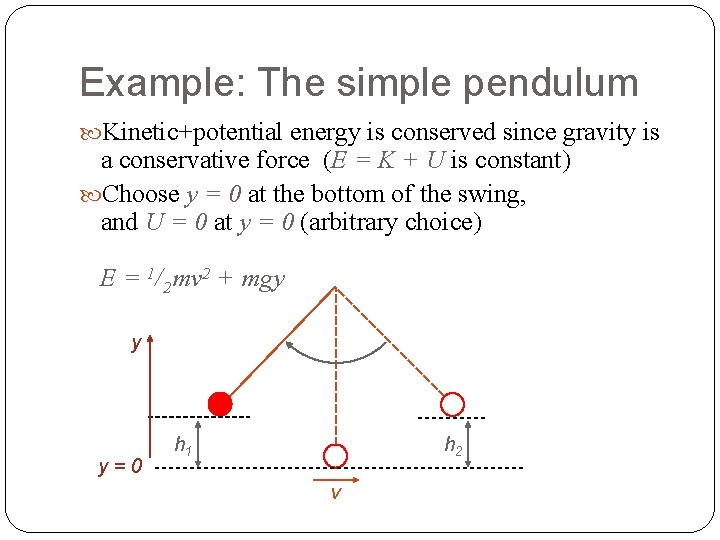
Example: The simple pendulum Kinetic+potential energy is conserved since gravity is a conservative force (E = K + U is constant) Choose y = 0 at the bottom of the swing, and U = 0 at y = 0 (arbitrary choice) E = 1/2 mv 2 + mgy y y=0 h 1 h 2 v
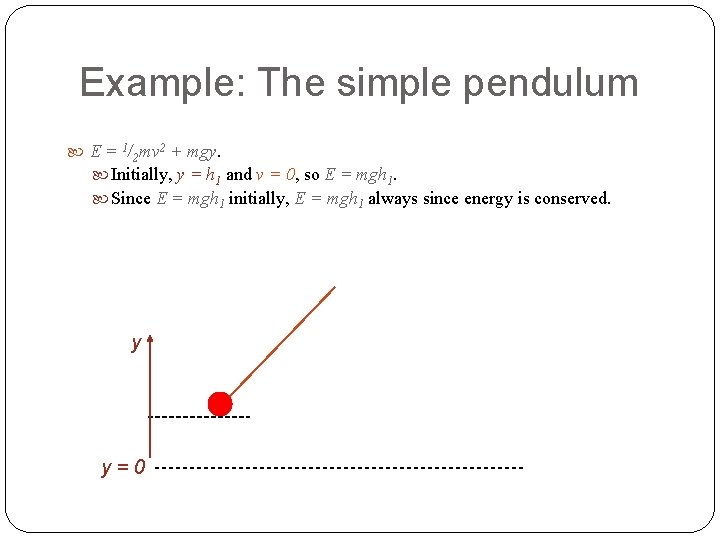
Example: The simple pendulum E = 1/2 mv 2 + mgy. Initially, y = h 1 and v = 0, so E = mgh 1. Since E = mgh 1 initially, E = mgh 1 always since energy is conserved. y y=0
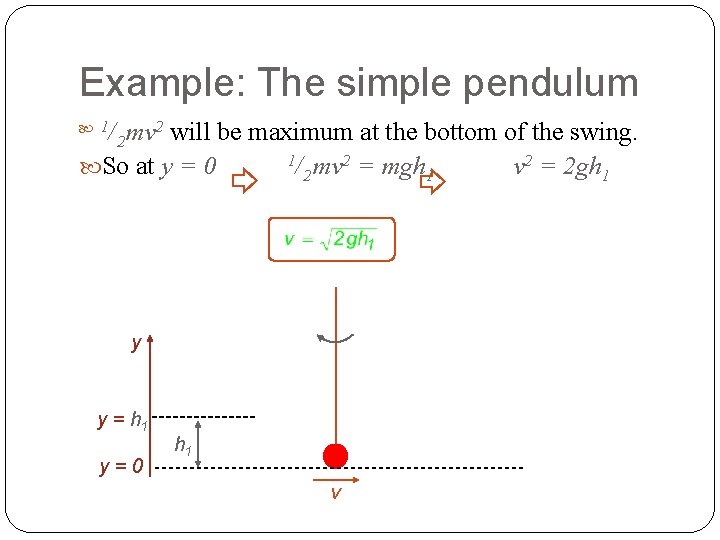
Example: The simple pendulum /2 mv 2 will be maximum at the bottom of the swing. 1/ mv 2 = mgh 2 = 2 gh So at y = 0 v 2 1 1 1 y y = h 1 y=0 h 1 v
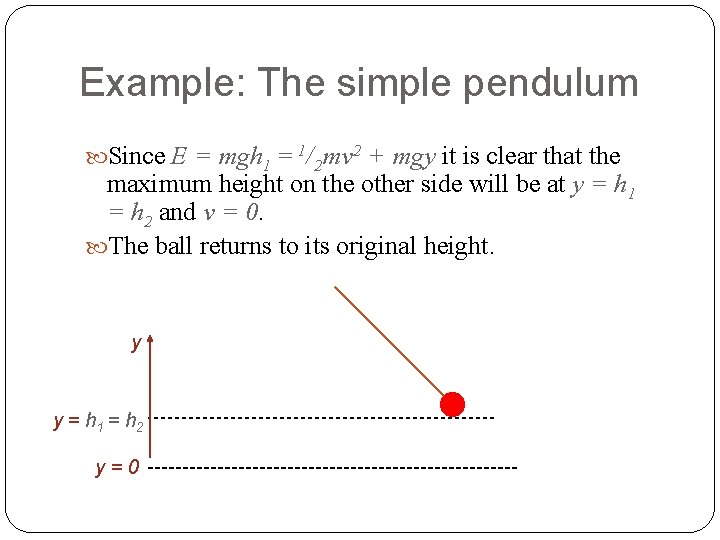
Example: The simple pendulum Since E = mgh 1 = 1/2 mv 2 + mgy it is clear that the maximum height on the other side will be at y = h 1 = h 2 and v = 0. The ball returns to its original height. y y = h 1 = h 2 y=0
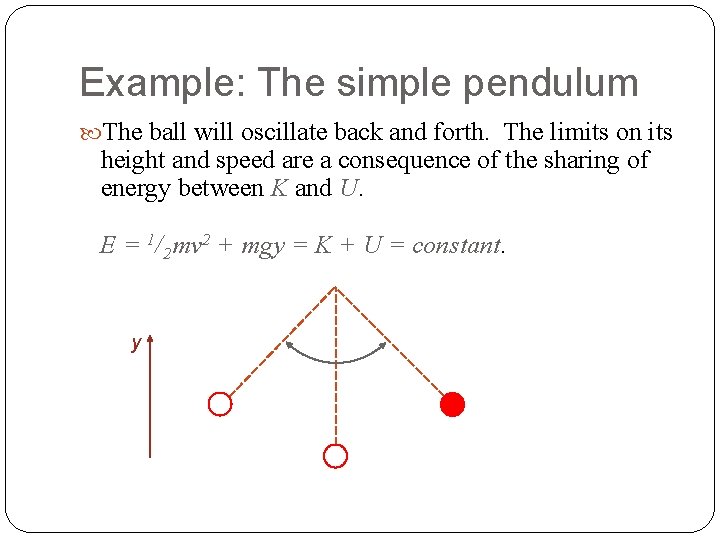
Example: The simple pendulum The ball will oscillate back and forth. The limits on its height and speed are a consequence of the sharing of energy between K and U. E = 1/2 mv 2 + mgy = K + U = constant. y
Example: The simple pendulum We can also solve this by choosing y = 0 to be at the original position of the mass, and U = 0 at y = 0. E = 1/2 mv 2 + mgy. y y=0 h 1 h 2 v
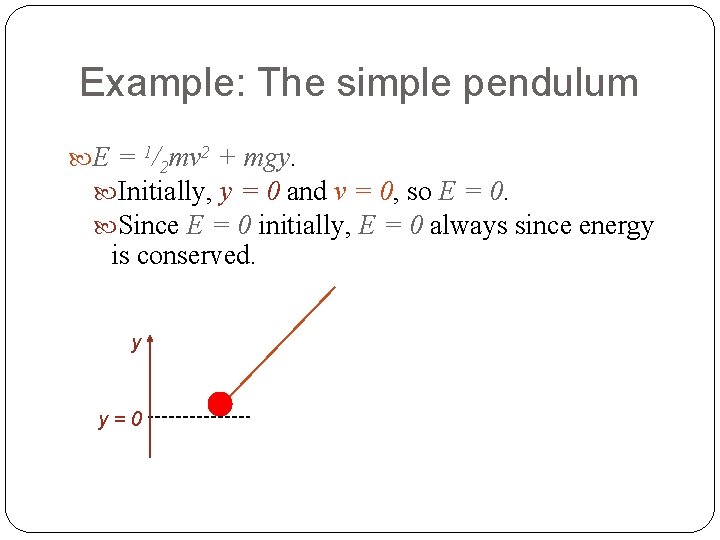
Example: The simple pendulum E = 1/2 mv 2 + mgy. Initially, y = 0 and v = 0, so E = 0. Since E = 0 initially, E = 0 always since energy is conserved. y y=0
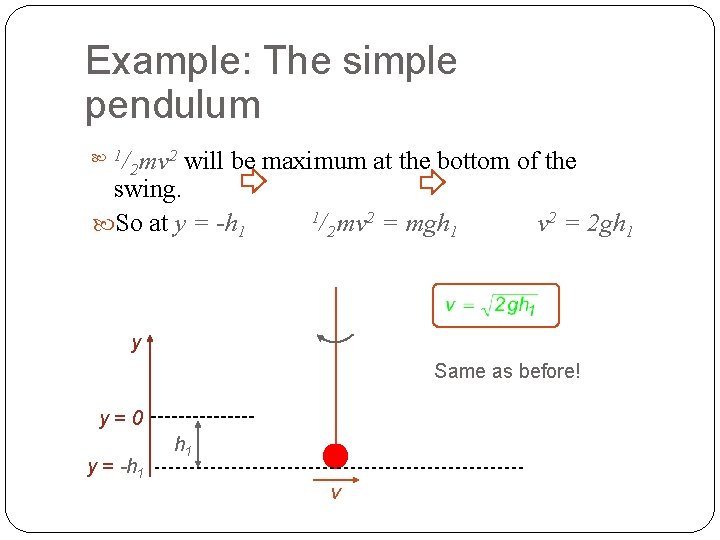
Example: The simple pendulum /2 mv 2 will be maximum at the bottom of the swing. 1/ mv 2 = mgh 2 = 2 gh So at y = -h 1 v 2 1 1 1 y Same as before! y=0 y = -h 1 v
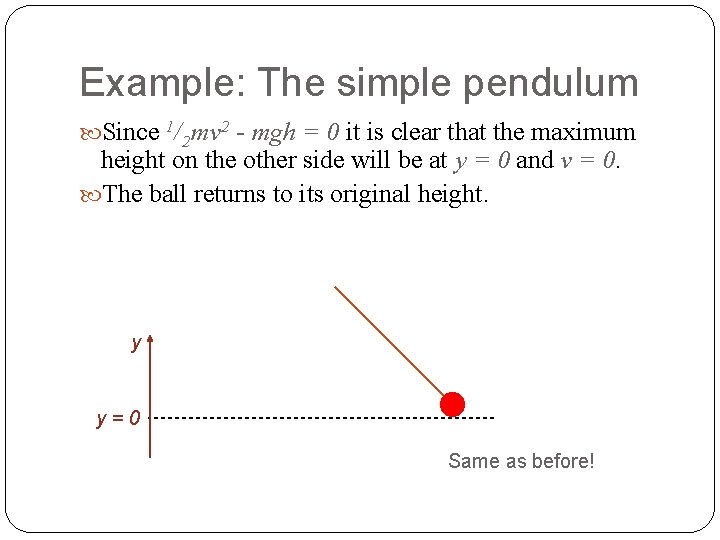
Example: The simple pendulum Since 1/2 mv 2 - mgh = 0 it is clear that the maximum height on the other side will be at y = 0 and v = 0. The ball returns to its original height. y y=0 Same as before!
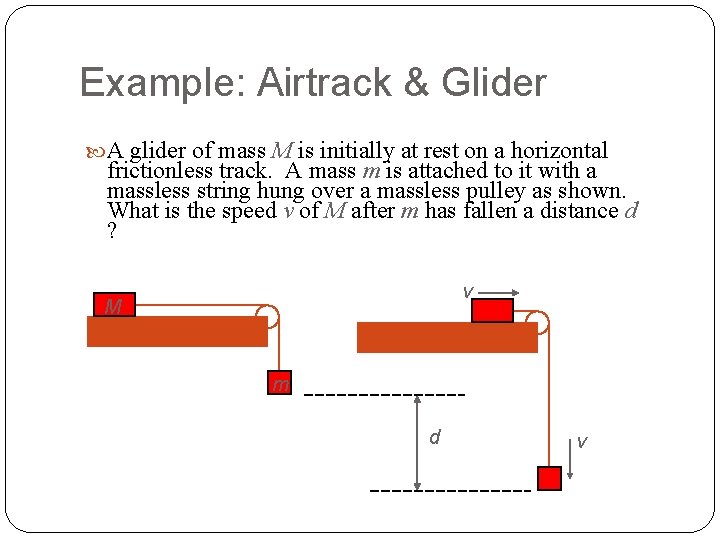
Example: Airtrack & Glider A glider of mass M is initially at rest on a horizontal frictionless track. A mass m is attached to it with a massless string hung over a massless pulley as shown. What is the speed v of M after m has fallen a distance d ? v M m d v
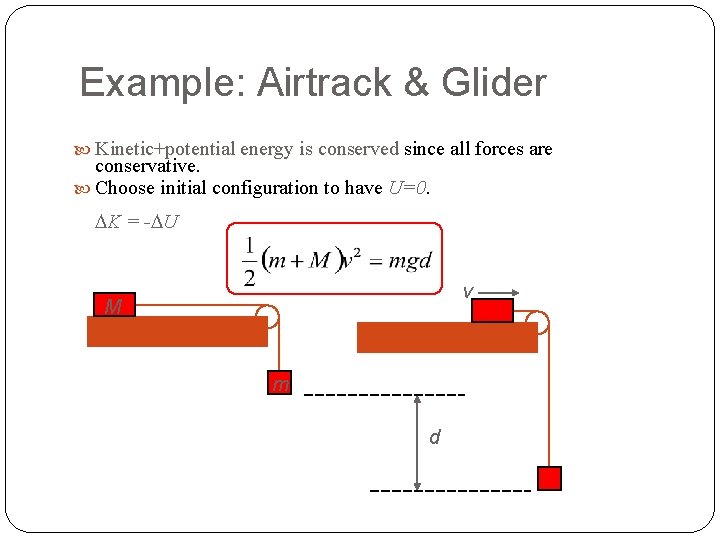
Example: Airtrack & Glider Kinetic+potential energy is conserved since all forces are conservative. Choose initial configuration to have U=0. K = - U v M m d
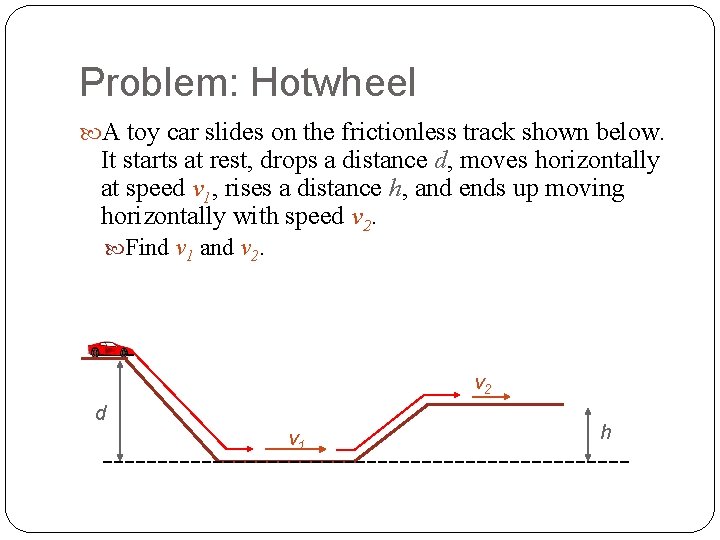
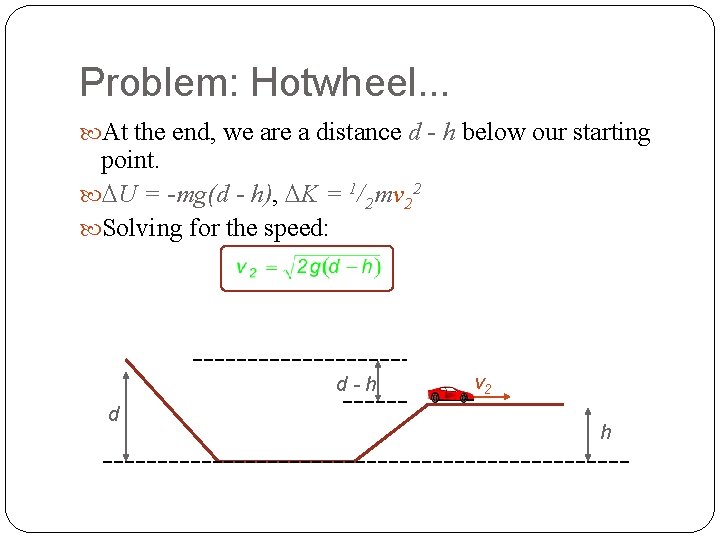
Problem: Hotwheel A toy car slides on the frictionless track shown below. It starts at rest, drops a distance d, moves horizontally at speed v 1, rises a distance h, and ends up moving horizontally with speed v 2. Find v 1 and v 2 d v 1 h
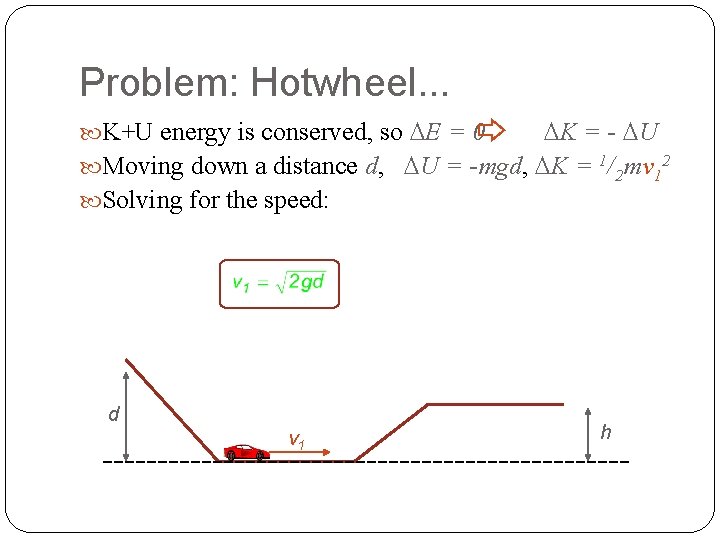
Problem: Hotwheel. . . K+U energy is conserved, so E = 0 K = - U Moving down a distance d, U = -mgd, K = 1/2 mv 12 Solving for the speed: d v 1 h
Problem: Hotwheel. . . At the end, we are a distance d - h below our starting point. U = -mg(d - h), K = 1/2 mv 22 Solving for the speed: d-h d v 2 h
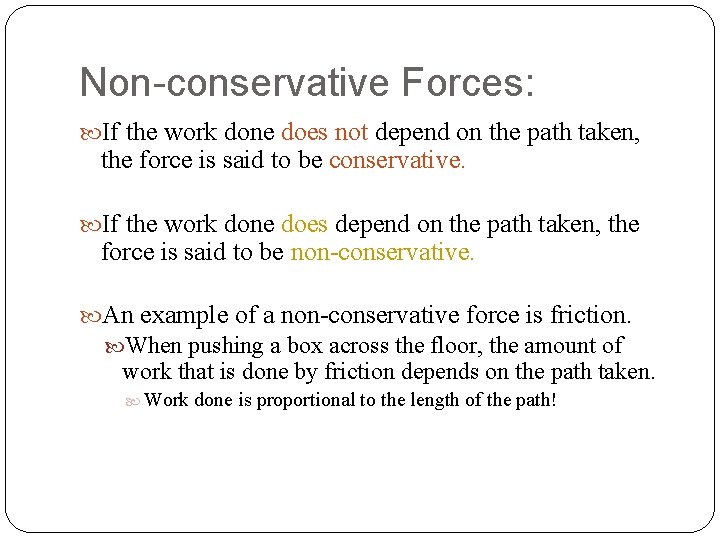
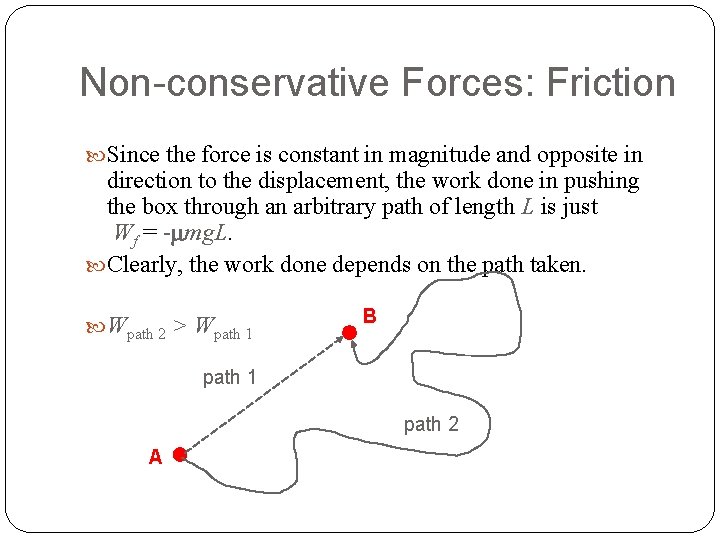
Non-conservative Forces: If the work done does not depend on the path taken, the force is said to be conservative. If the work done does depend on the path taken, the force is said to be non-conservative. An example of a non-conservative force is friction. When pushing a box across the floor, the amount of work that is done by friction depends on the path taken. Work done is proportional to the length of the path!
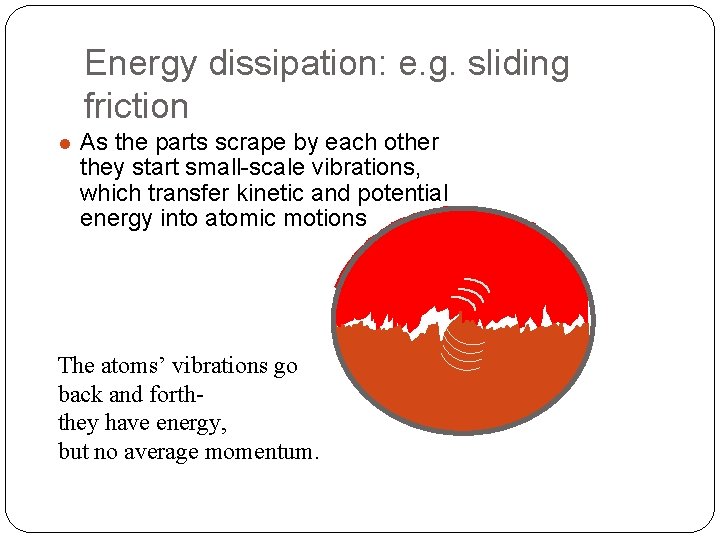
Energy dissipation: e. g. sliding friction l As the parts scrape by each other they start small-scale vibrations, which transfer kinetic and potential energy into atomic motions The atoms’ vibrations go back and forththey have energy, but no average momentum.
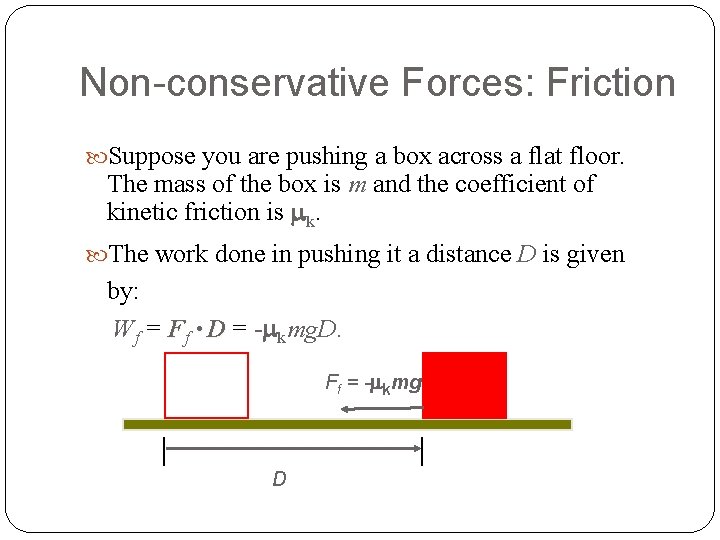
Non-conservative Forces: Friction Suppose you are pushing a box across a flat floor. The mass of the box is m and the coefficient of kinetic friction is k. The work done in pushing it a distance D is given by: Wf = Ff • D = - kmg. D. Ff = - kmg D
Non-conservative Forces: Friction Since the force is constant in magnitude and opposite in direction to the displacement, the work done in pushing the box through an arbitrary path of length L is just Wf = - mg. L. Clearly, the work done depends on the path taken. Wpath 2 > Wpath 1 B path 1 path 2 A
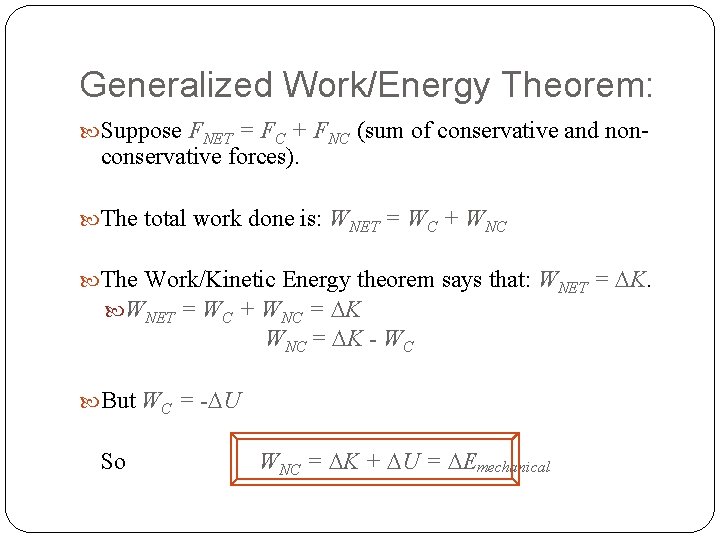
Generalized Work/Energy Theorem: Suppose FNET = FC + FNC (sum of conservative and non- conservative forces). The total work done is: WNET = WC + WNC The Work/Kinetic Energy theorem says that: WNET = K. WNET = WC + WNC = K - WC But WC = - U So WNC = K + U = Emechanical
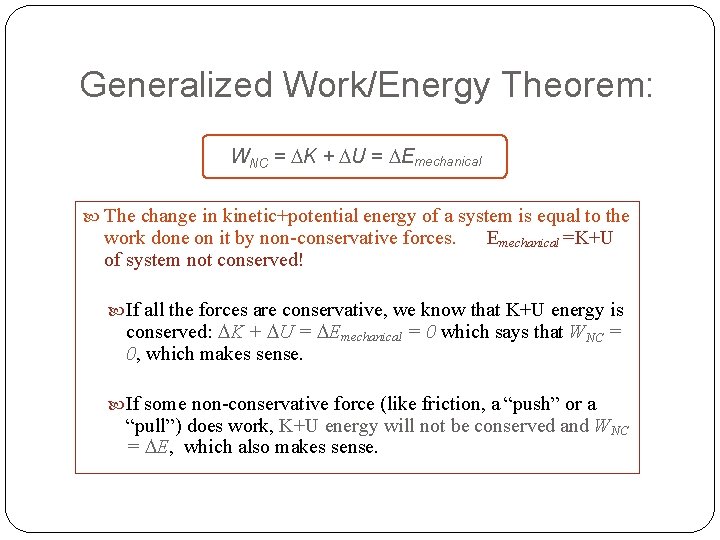
Generalized Work/Energy Theorem: WNC = K + U = Emechanical The change in kinetic+potential energy of a system is equal to the work done on it by non-conservative forces. of system not conserved! Emechanical =K+U If all the forces are conservative, we know that K+U energy is conserved: K + U = Emechanical = 0 which says that WNC = 0, which makes sense. If some non-conservative force (like friction, a “push” or a “pull”) does work, K+U energy will not be conserved and WNC = E, which also makes sense.
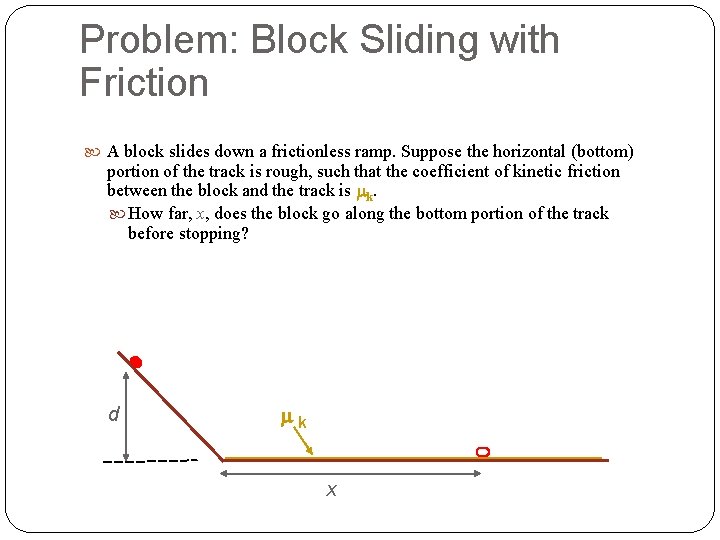
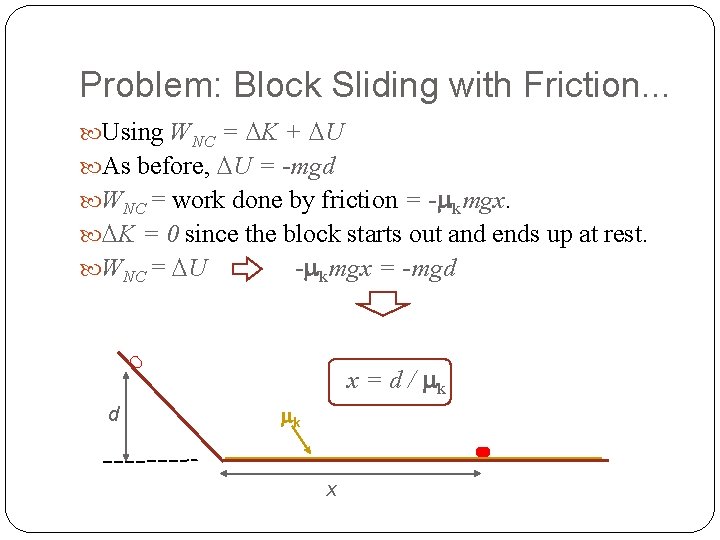
Problem: Block Sliding with Friction A block slides down a frictionless ramp. Suppose the horizontal (bottom) portion of the track is rough, such that the coefficient of kinetic friction between the block and the track is k. How far, x, does the block go along the bottom portion of the track before stopping? d k x
Problem: Block Sliding with Friction. . . Using WNC = K + U As before, U = -mgd WNC = work done by friction = - kmgx. K = 0 since the block starts out and ends up at rest. WNC = U - kmgx = -mgd x = d / k d k x
Recap of today’s lecture Conservative forces & potential energy - review Conservation of “Total Mechanical Energy” Examples: pendulum, airtrack, Hotwheel car Non-conservative forces friction General work/energy theorem Example problem Look at Textbook problems
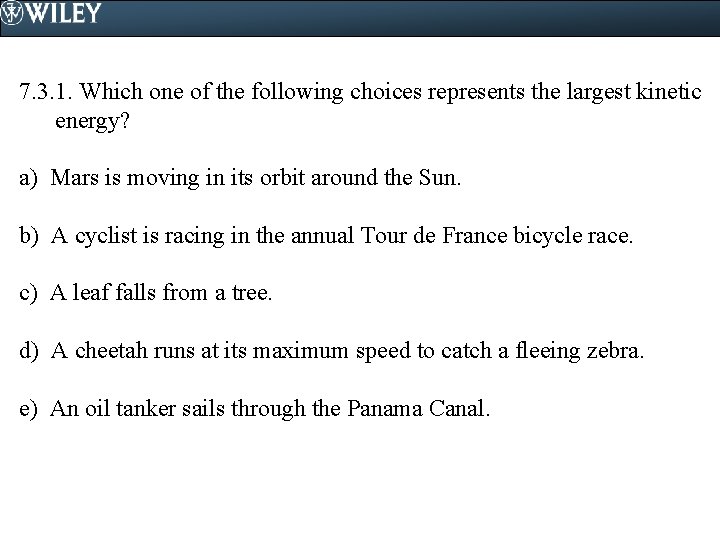
7. 3. 1. Which one of the following choices represents the largest kinetic energy? a) Mars is moving in its orbit around the Sun. b) A cyclist is racing in the annual Tour de France bicycle race. c) A leaf falls from a tree. d) A cheetah runs at its maximum speed to catch a fleeing zebra. e) An oil tanker sails through the Panama Canal.
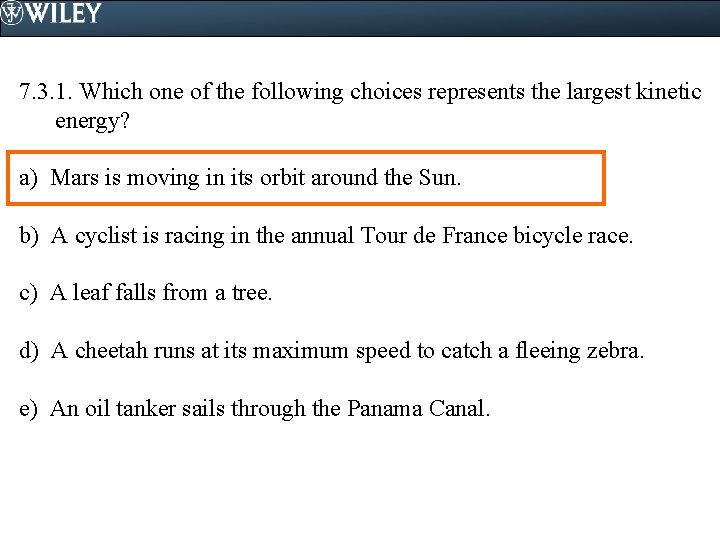
7. 3. 1. Which one of the following choices represents the largest kinetic energy? a) Mars is moving in its orbit around the Sun. b) A cyclist is racing in the annual Tour de France bicycle race. c) A leaf falls from a tree. d) A cheetah runs at its maximum speed to catch a fleeing zebra. e) An oil tanker sails through the Panama Canal.
7. 3. 3. Ignoring friction effects, the amount of energy required to accelerate a car from rest to a speed v is E. The energy is delivered to the car by burning gasoline. What additional amount of energy is required to accelerate the car to a speed 2 v? a) 0. 5 E b) E c) 2 E d) 3 E e) 4 E
7. 3. 3. Ignoring friction effects, the amount of energy required to accelerate a car from rest to a speed v is E. The energy is delivered to the car by burning gasoline. What additional amount of energy is required to accelerate the car to a speed 2 v? a) 0. 5 E b) E c) 2 E d) 3 E e) 4 E
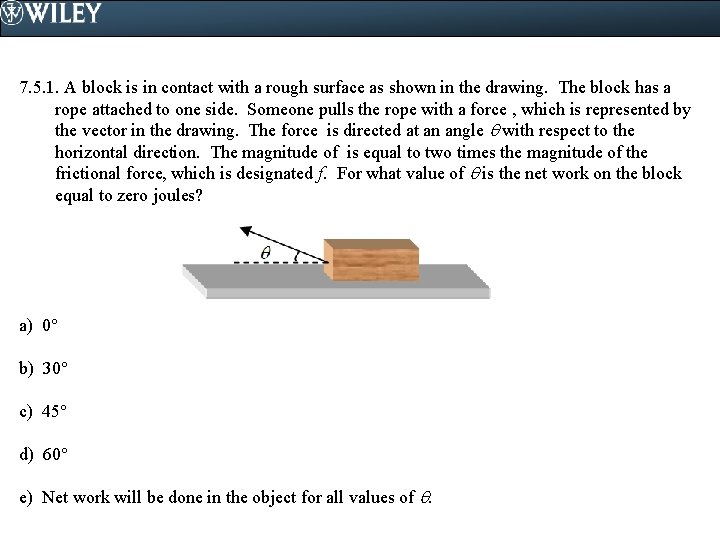
7. 5. 1. A block is in contact with a rough surface as shown in the drawing. The block has a rope attached to one side. Someone pulls the rope with a force , which is represented by the vector in the drawing. The force is directed at an angle with respect to the horizontal direction. The magnitude of is equal to two times the magnitude of the frictional force, which is designated f. For what value of is the net work on the block equal to zero joules? a) 0 b) 30 c) 45 d) 60 e) Net work will be done in the object for all values of .
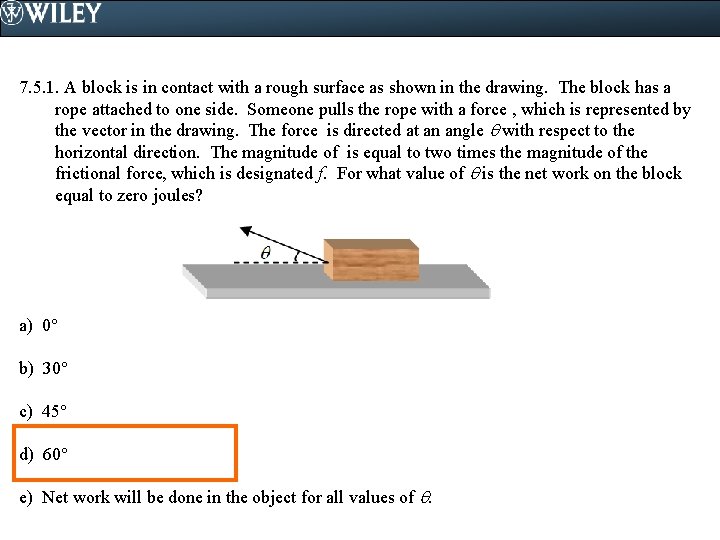
7. 5. 1. A block is in contact with a rough surface as shown in the drawing. The block has a rope attached to one side. Someone pulls the rope with a force , which is represented by the vector in the drawing. The force is directed at an angle with respect to the horizontal direction. The magnitude of is equal to two times the magnitude of the frictional force, which is designated f. For what value of is the net work on the block equal to zero joules? a) 0 b) 30 c) 45 d) 60 e) Net work will be done in the object for all values of .
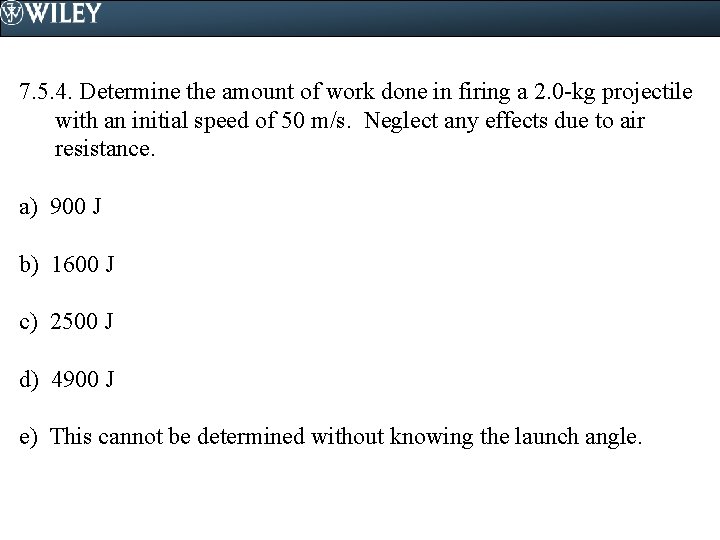
7. 5. 4. Determine the amount of work done in firing a 2. 0 -kg projectile with an initial speed of 50 m/s. Neglect any effects due to air resistance. a) 900 J b) 1600 J c) 2500 J d) 4900 J e) This cannot be determined without knowing the launch angle.
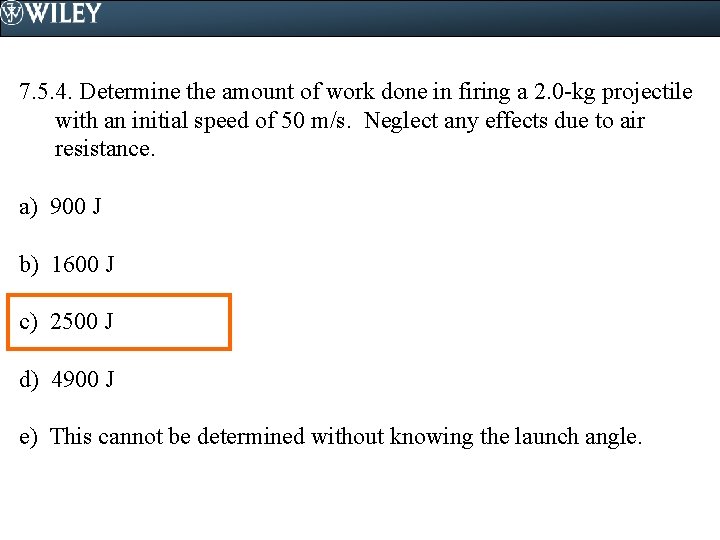
7. 5. 4. Determine the amount of work done in firing a 2. 0 -kg projectile with an initial speed of 50 m/s. Neglect any effects due to air resistance. a) 900 J b) 1600 J c) 2500 J d) 4900 J e) This cannot be determined without knowing the launch angle.
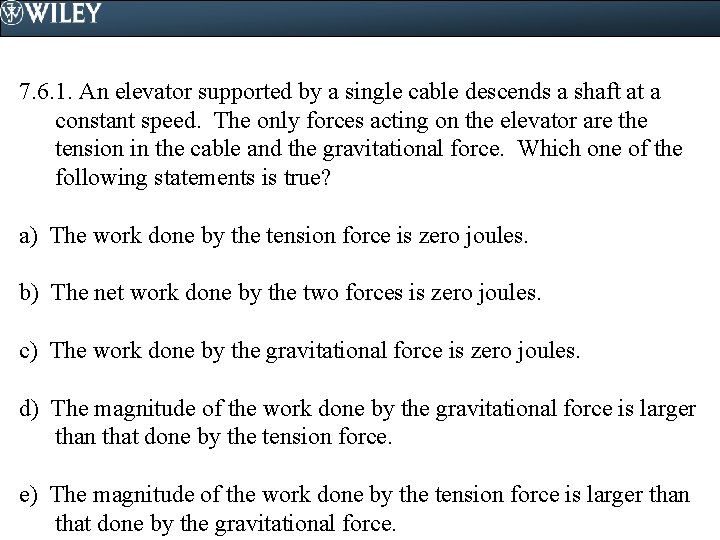
7. 6. 1. An elevator supported by a single cable descends a shaft at a constant speed. The only forces acting on the elevator are the tension in the cable and the gravitational force. Which one of the following statements is true? a) The work done by the tension force is zero joules. b) The net work done by the two forces is zero joules. c) The work done by the gravitational force is zero joules. d) The magnitude of the work done by the gravitational force is larger than that done by the tension force. e) The magnitude of the work done by the tension force is larger than that done by the gravitational force.
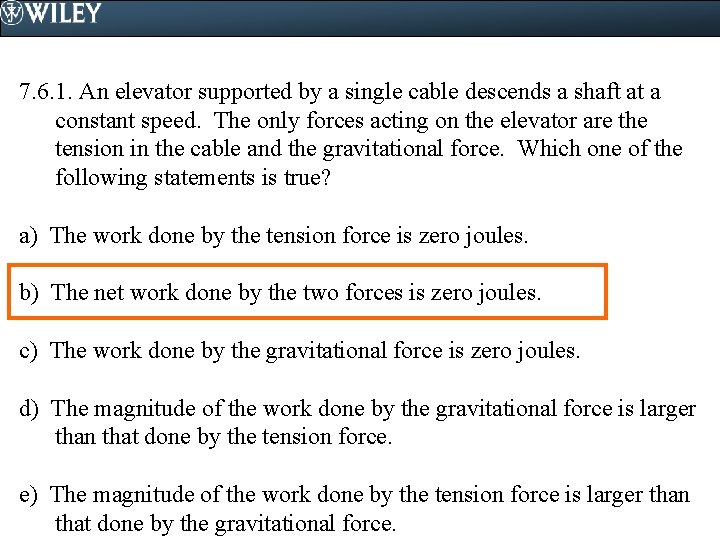
7. 6. 1. An elevator supported by a single cable descends a shaft at a constant speed. The only forces acting on the elevator are the tension in the cable and the gravitational force. Which one of the following statements is true? a) The work done by the tension force is zero joules. b) The net work done by the two forces is zero joules. c) The work done by the gravitational force is zero joules. d) The magnitude of the work done by the gravitational force is larger than that done by the tension force. e) The magnitude of the work done by the tension force is larger than that done by the gravitational force.
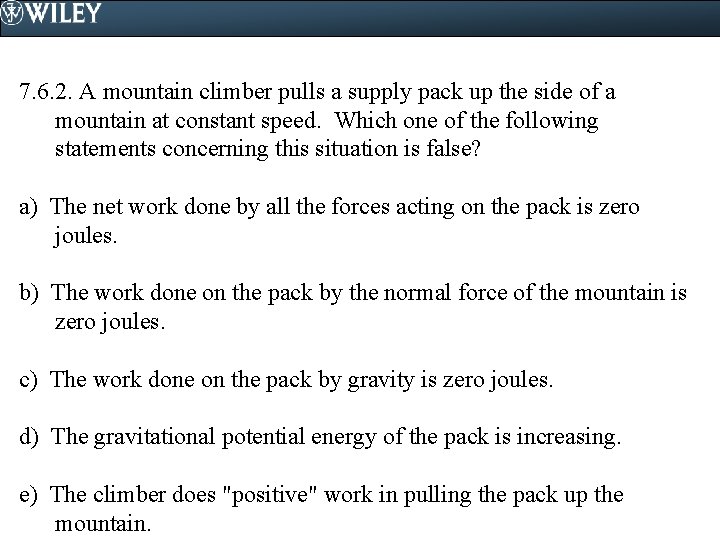
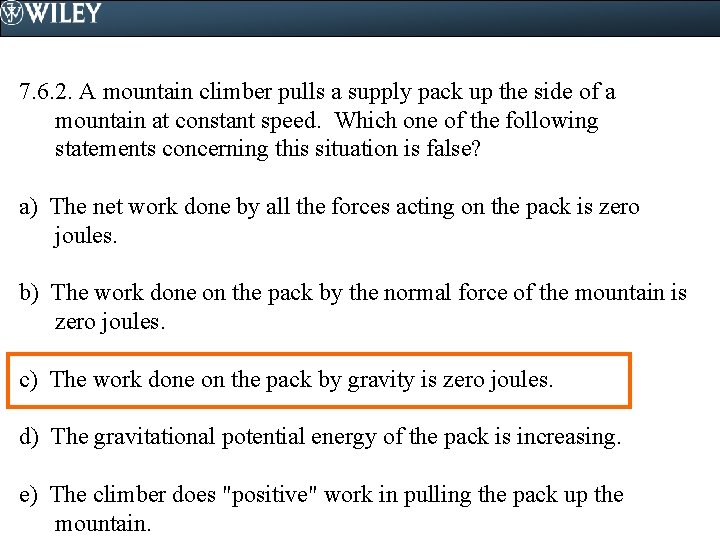
7. 6. 2. A mountain climber pulls a supply pack up the side of a mountain at constant speed. Which one of the following statements concerning this situation is false? a) The net work done by all the forces acting on the pack is zero joules. b) The work done on the pack by the normal force of the mountain is zero joules. c) The work done on the pack by gravity is zero joules. d) The gravitational potential energy of the pack is increasing. e) The climber does "positive" work in pulling the pack up the mountain.
7. 6. 2. A mountain climber pulls a supply pack up the side of a mountain at constant speed. Which one of the following statements concerning this situation is false? a) The net work done by all the forces acting on the pack is zero joules. b) The work done on the pack by the normal force of the mountain is zero joules. c) The work done on the pack by gravity is zero joules. d) The gravitational potential energy of the pack is increasing. e) The climber does "positive" work in pulling the pack up the mountain.
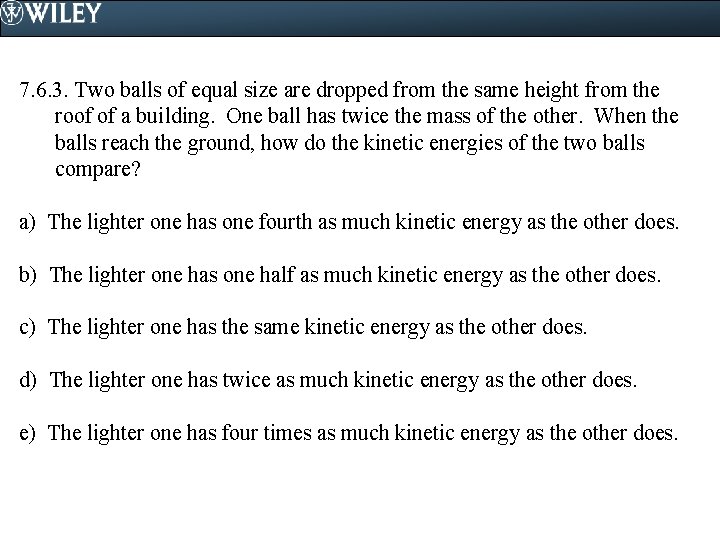
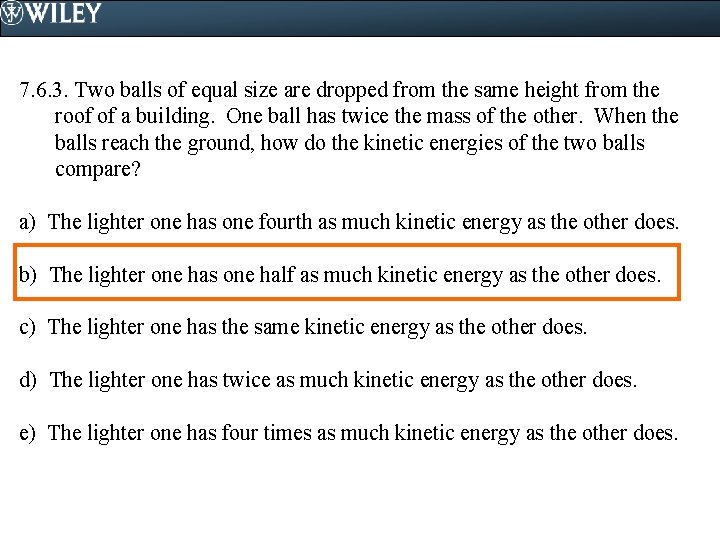
7. 6. 3. Two balls of equal size are dropped from the same height from the roof of a building. One ball has twice the mass of the other. When the balls reach the ground, how do the kinetic energies of the two balls compare? a) The lighter one has one fourth as much kinetic energy as the other does. b) The lighter one has one half as much kinetic energy as the other does. c) The lighter one has the same kinetic energy as the other does. d) The lighter one has twice as much kinetic energy as the other does. e) The lighter one has four times as much kinetic energy as the other does.
7. 6. 3. Two balls of equal size are dropped from the same height from the roof of a building. One ball has twice the mass of the other. When the balls reach the ground, how do the kinetic energies of the two balls compare? a) The lighter one has one fourth as much kinetic energy as the other does. b) The lighter one has one half as much kinetic energy as the other does. c) The lighter one has the same kinetic energy as the other does. d) The lighter one has twice as much kinetic energy as the other does. e) The lighter one has four times as much kinetic energy as the other does.
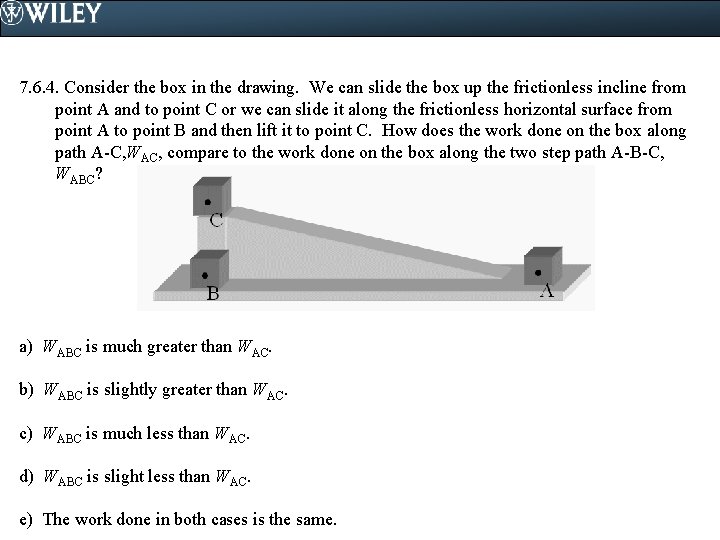
7. 6. 4. Consider the box in the drawing. We can slide the box up the frictionless incline from point A and to point C or we can slide it along the frictionless horizontal surface from point A to point B and then lift it to point C. How does the work done on the box along path A-C, WAC, compare to the work done on the box along the two step path A-B-C, WABC? a) WABC is much greater than WAC. b) WABC is slightly greater than WAC. c) WABC is much less than WAC. d) WABC is slight less than WAC. e) The work done in both cases is the same.
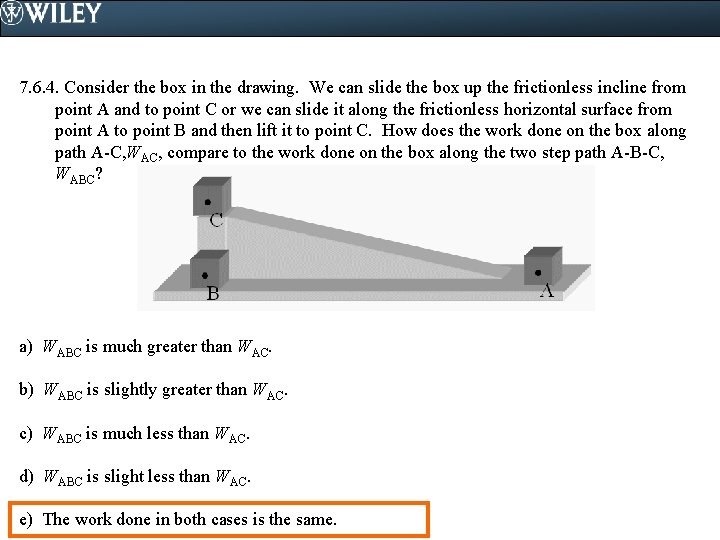
7. 6. 4. Consider the box in the drawing. We can slide the box up the frictionless incline from point A and to point C or we can slide it along the frictionless horizontal surface from point A to point B and then lift it to point C. How does the work done on the box along path A-C, WAC, compare to the work done on the box along the two step path A-B-C, WABC? a) WABC is much greater than WAC. b) WABC is slightly greater than WAC. c) WABC is much less than WAC. d) WABC is slight less than WAC. e) The work done in both cases is the same.
7. 7. 1. Block A has a mass m and block B has a mass 2 m. Block A is pressed against a spring to compress the spring by a distance x. It is then released such that the block eventually separates from the spring and it slides across a surface where the friction coefficient is µk. The same process is applied to block B. Which one of the following statements concerning the distance that each block slides before stopping is correct? a) Block A slides one-fourth the distance that block B slides. b) Block A slides one-half the distance that block B slides. c) Block A slides the same distance that block B slides. d) Block A slides twice the distance that block B slides. e) Block A slides four times the distance that block B slides.
7. 7. 1. Block A has a mass m and block B has a mass 2 m. Block A is pressed against a spring to compress the spring by a distance x. It is then released such that the block eventually separates from the spring and it slides across a surface where the friction coefficient is µk. The same process is applied to block B. Which one of the following statements concerning the distance that each block slides before stopping is correct? a) Block A slides one-fourth the distance that block B slides. b) Block A slides one-half the distance that block B slides. c) Block A slides the same distance that block B slides. d) Block A slides twice the distance that block B slides. e) Block A slides four times the distance that block B slides.
7. 7. 2. In designing a spring loaded cannon, determine the spring constant required to launch a 2. 0 kg ball with an initial speed of 1. 2 m/s from a position where the spring is displaced 0. 15 m from its equilibrium position. a) 16 N/m b) 32 N/m c) 64 N/m d) 130 N/m e) 180 N/m
7. 7. 2. In designing a spring loaded cannon, determine the spring constant required to launch a 2. 0 kg ball with an initial speed of 1. 2 m/s from a position where the spring is displaced 0. 15 m from its equilibrium position. a) 16 N/m b) 32 N/m c) 64 N/m d) 130 N/m e) 180 N/m
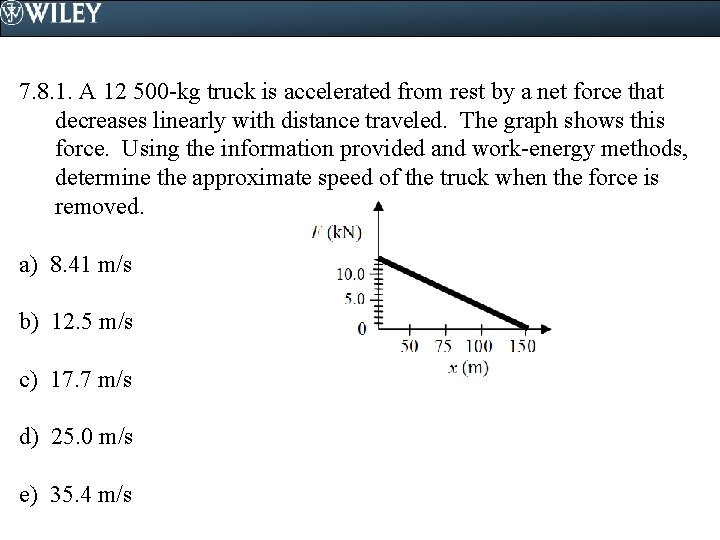
7. 8. 1. A 12 500 -kg truck is accelerated from rest by a net force that decreases linearly with distance traveled. The graph shows this force. Using the information provided and work-energy methods, determine the approximate speed of the truck when the force is removed. a) 8. 41 m/s b) 12. 5 m/s c) 17. 7 m/s d) 25. 0 m/s e) 35. 4 m/s
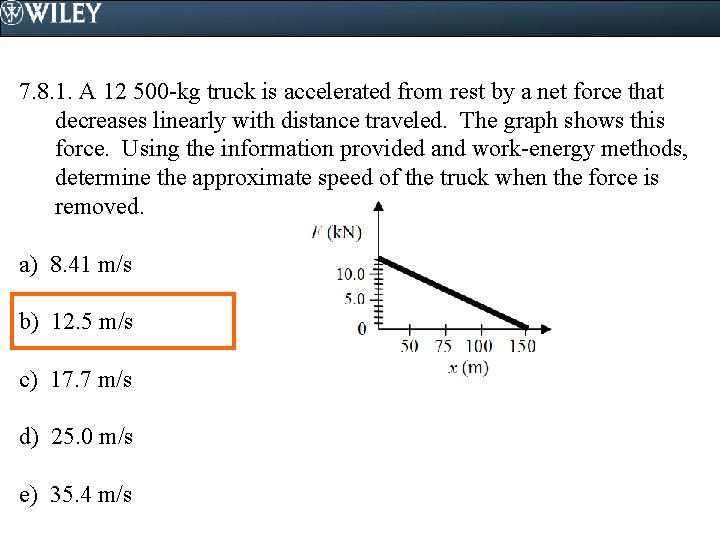
7. 8. 1. A 12 500 -kg truck is accelerated from rest by a net force that decreases linearly with distance traveled. The graph shows this force. Using the information provided and work-energy methods, determine the approximate speed of the truck when the force is removed. a) 8. 41 m/s b) 12. 5 m/s c) 17. 7 m/s d) 25. 0 m/s e) 35. 4 m/s
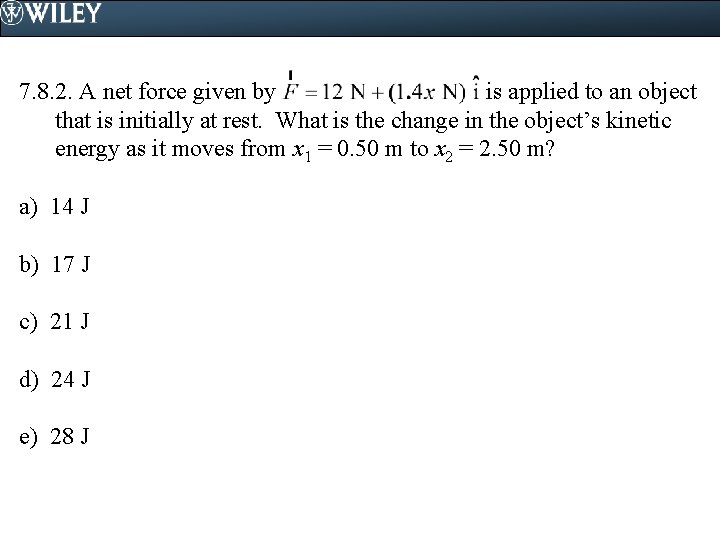
7. 8. 2. A net force given by is applied to an object that is initially at rest. What is the change in the object’s kinetic energy as it moves from x 1 = 0. 50 m to x 2 = 2. 50 m? a) 14 J b) 17 J c) 21 J d) 24 J e) 28 J
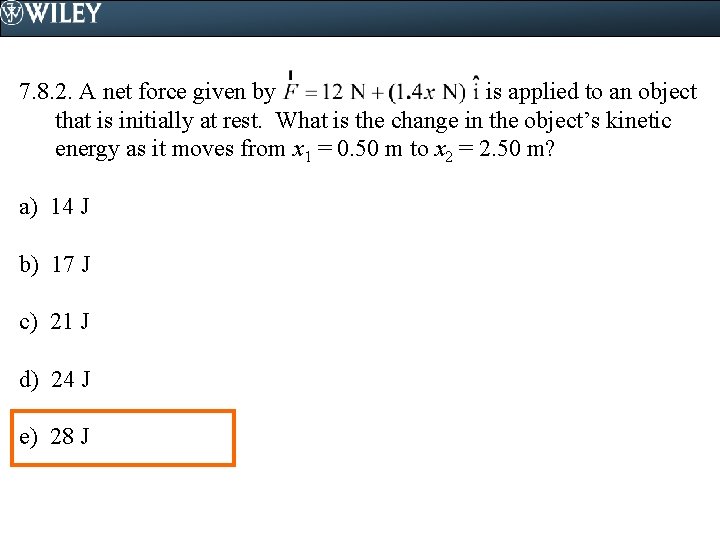
7. 8. 2. A net force given by is applied to an object that is initially at rest. What is the change in the object’s kinetic energy as it moves from x 1 = 0. 50 m to x 2 = 2. 50 m? a) 14 J b) 17 J c) 21 J d) 24 J e) 28 J