
Physics Lab 2 Graphical Analysis of Motion Eleanor
Physics Lab 2 Graphical Analysis of Motion Eleanor Roosevelt High School Chin-Sung Lin

Speed & Velocity
Speed A speed (v) is a scalar quantity Distance (d) covered per unit of time (t). Speed is a measure of how fast something is moving. It is the rate at which distance is covered v=d/t Unit: meters per second (m/s), miles per hour (mi/h), kilometers per hour (km/h)
Velocity A velocity (v) is a vector quantity Velocity is the measurement of the rate and direction of change in the displacement (d) of an object v=d/t The speed is the magnitude of velocity Unit: meters per second (m/s), miles per hour (mi/h), kilometers per hour (km/h)
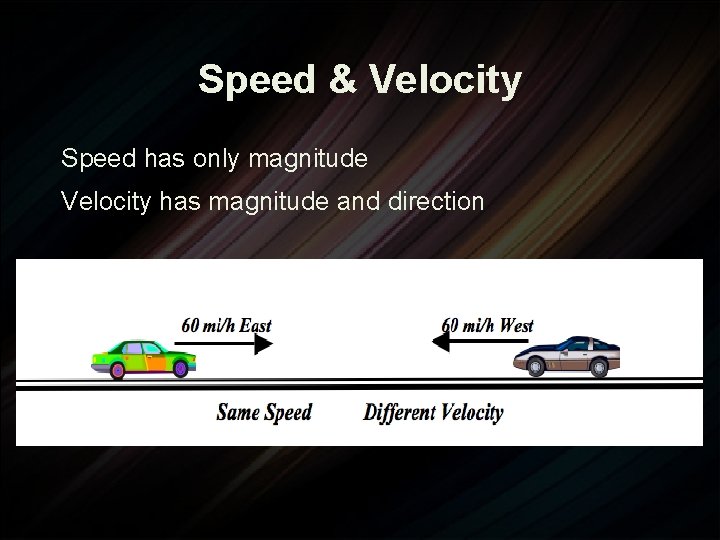
Speed & Velocity Speed has only magnitude Velocity has magnitude and direction
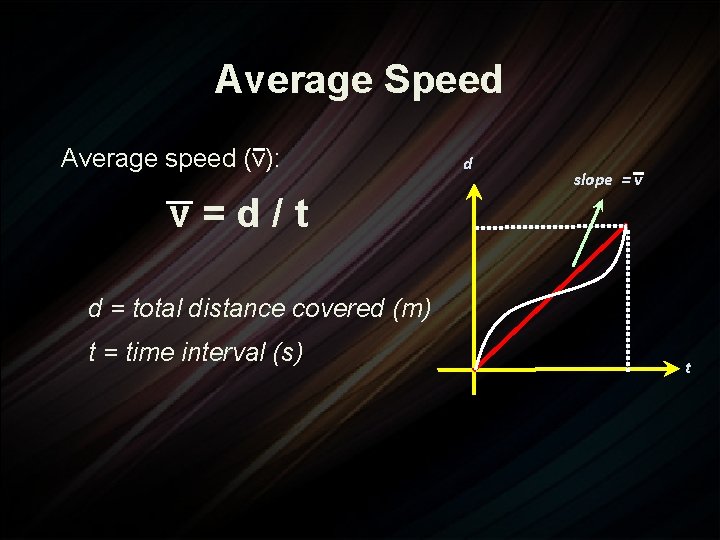
Average Speed Average speed (v): d slope = v v=d/t d = total distance covered (m) t = time interval (s) t
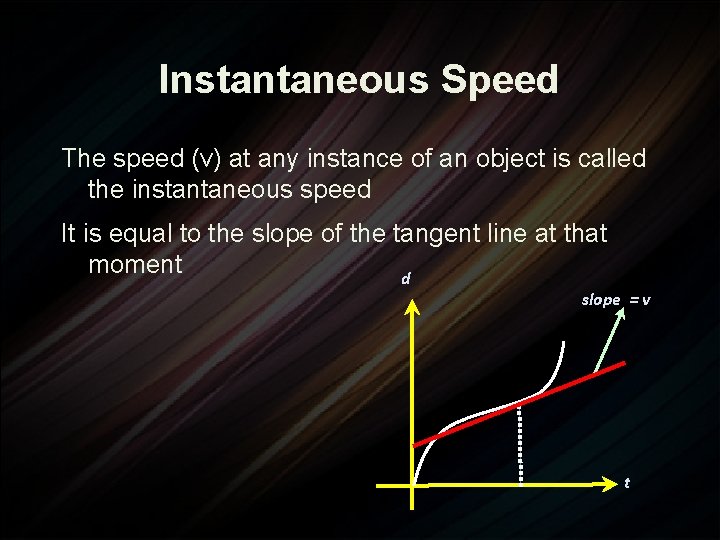
Instantaneous Speed The speed (v) at any instance of an object is called the instantaneous speed It is equal to the slope of the tangent line at that moment d slope = v t
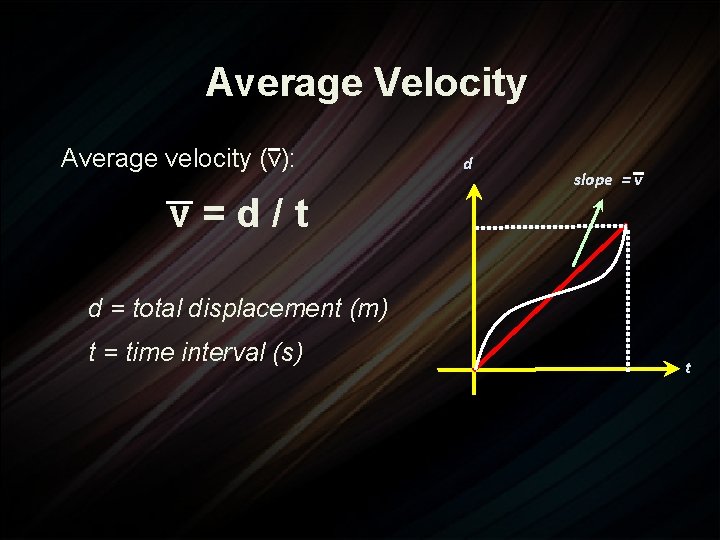
Average Velocity Average velocity (v): d slope = v v=d/t d = total displacement (m) t = time interval (s) t
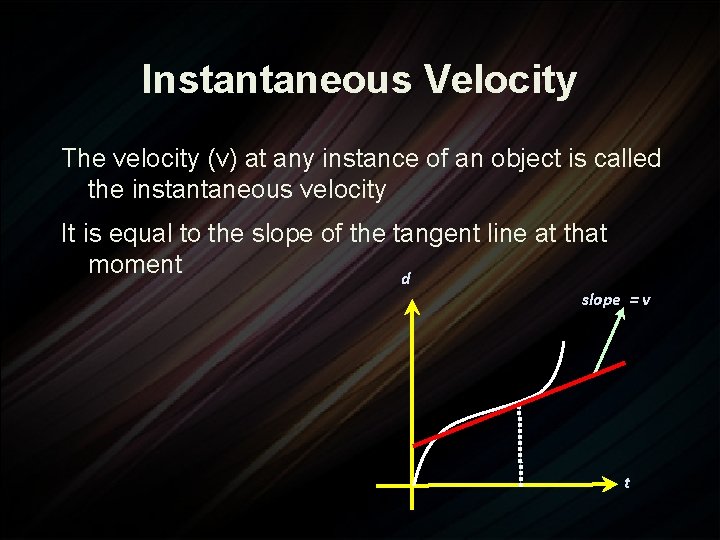
Instantaneous Velocity The velocity (v) at any instance of an object is called the instantaneous velocity It is equal to the slope of the tangent line at that moment d slope = v t

Acceleration
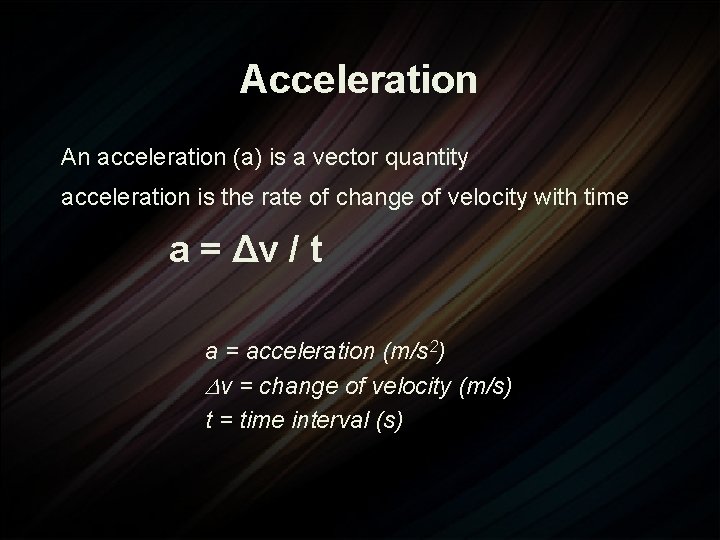
Acceleration An acceleration (a) is a vector quantity acceleration is the rate of change of velocity with time a = Δv / t a = acceleration (m/s 2) v = change of velocity (m/s) t = time interval (s)
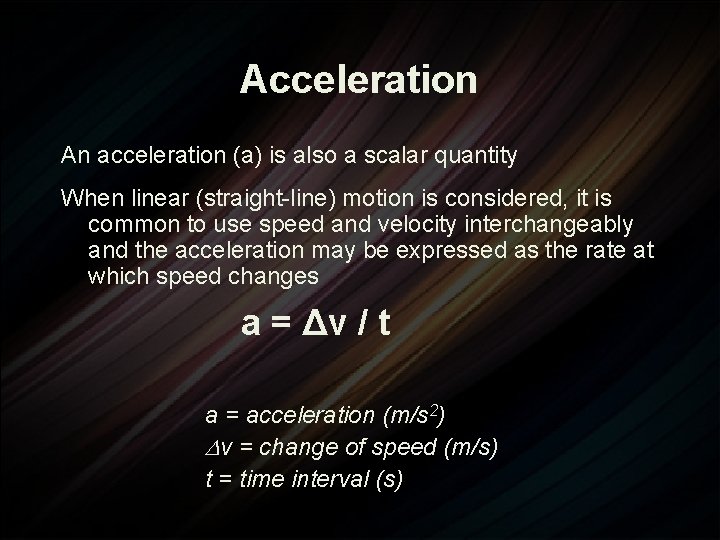
Acceleration An acceleration (a) is also a scalar quantity When linear (straight-line) motion is considered, it is common to use speed and velocity interchangeably and the acceleration may be expressed as the rate at which speed changes a = Δv / t a = acceleration (m/s 2) v = change of speed (m/s) t = time interval (s)
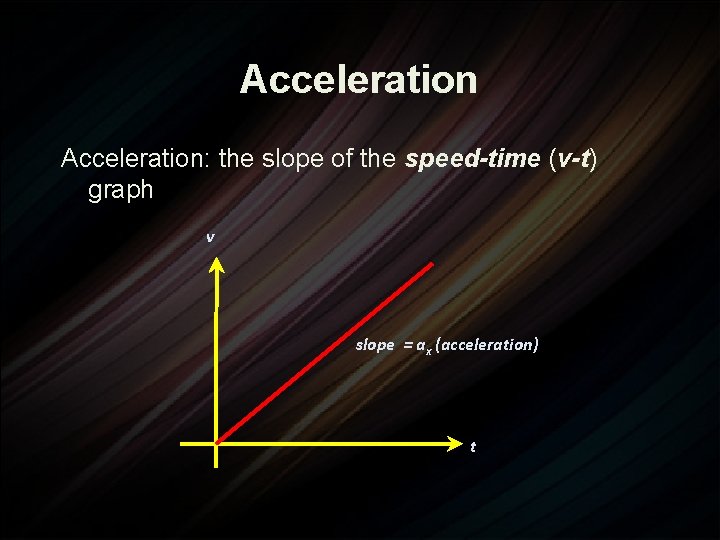
Acceleration: the slope of the speed-time (v-t) graph v slope = ax (acceleration) t
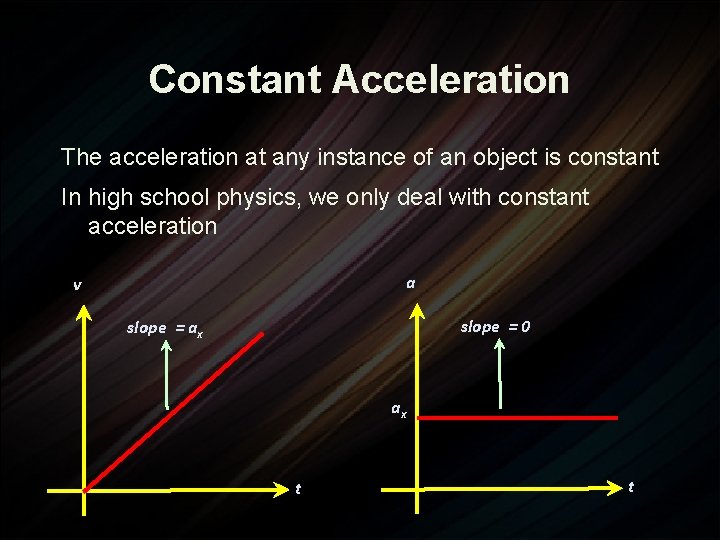
Constant Acceleration The acceleration at any instance of an object is constant In high school physics, we only deal with constant acceleration a v slope = 0 slope = ax ax t t
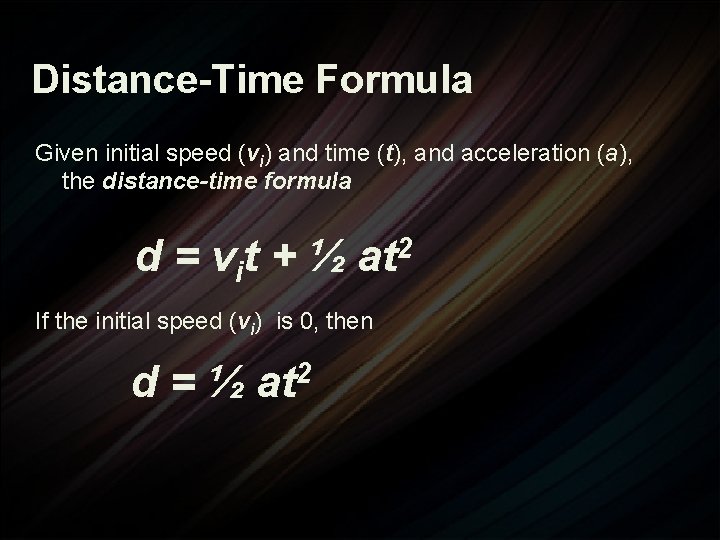
Distance-Time Formula Given initial speed (vi) and time (t), and acceleration (a), the distance-time formula d = vit + ½ at 2 If the initial speed (vi) is 0, then d=½ 2 at
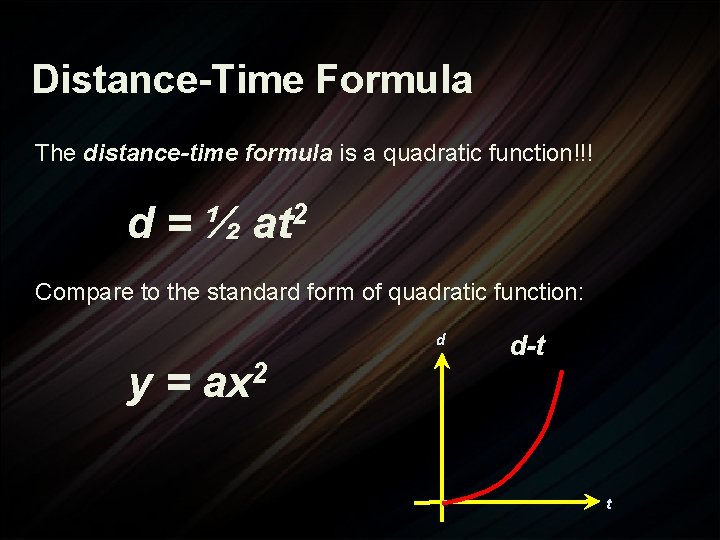
Distance-Time Formula The distance-time formula is a quadratic function!!! d = ½ at 2 Compare to the standard form of quadratic function: d y= 2 ax d-t t
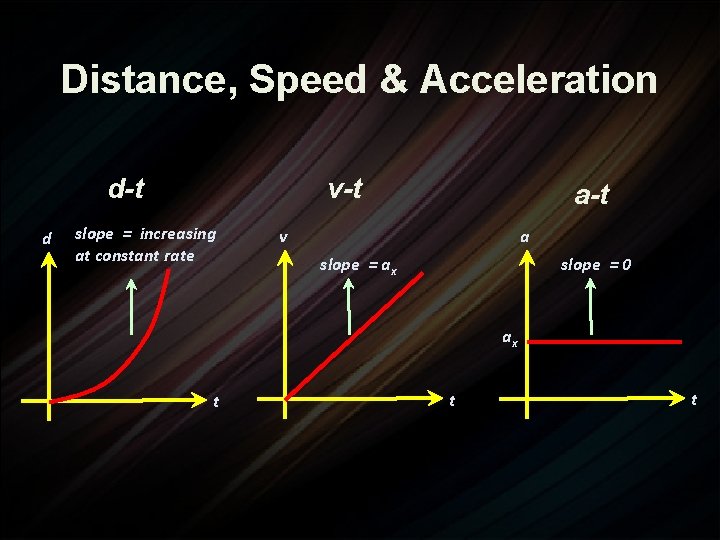
Distance, Speed & Acceleration v-t d slope = increasing at constant rate a-t a v slope = 0 slope = ax ax t t t

The End
- Slides: 18