
Physics Key Stage 4 Forces Physics Only Review
- Slides: 8
Physics - Key Stage 4 - Forces Physics Only Review Mr Saville
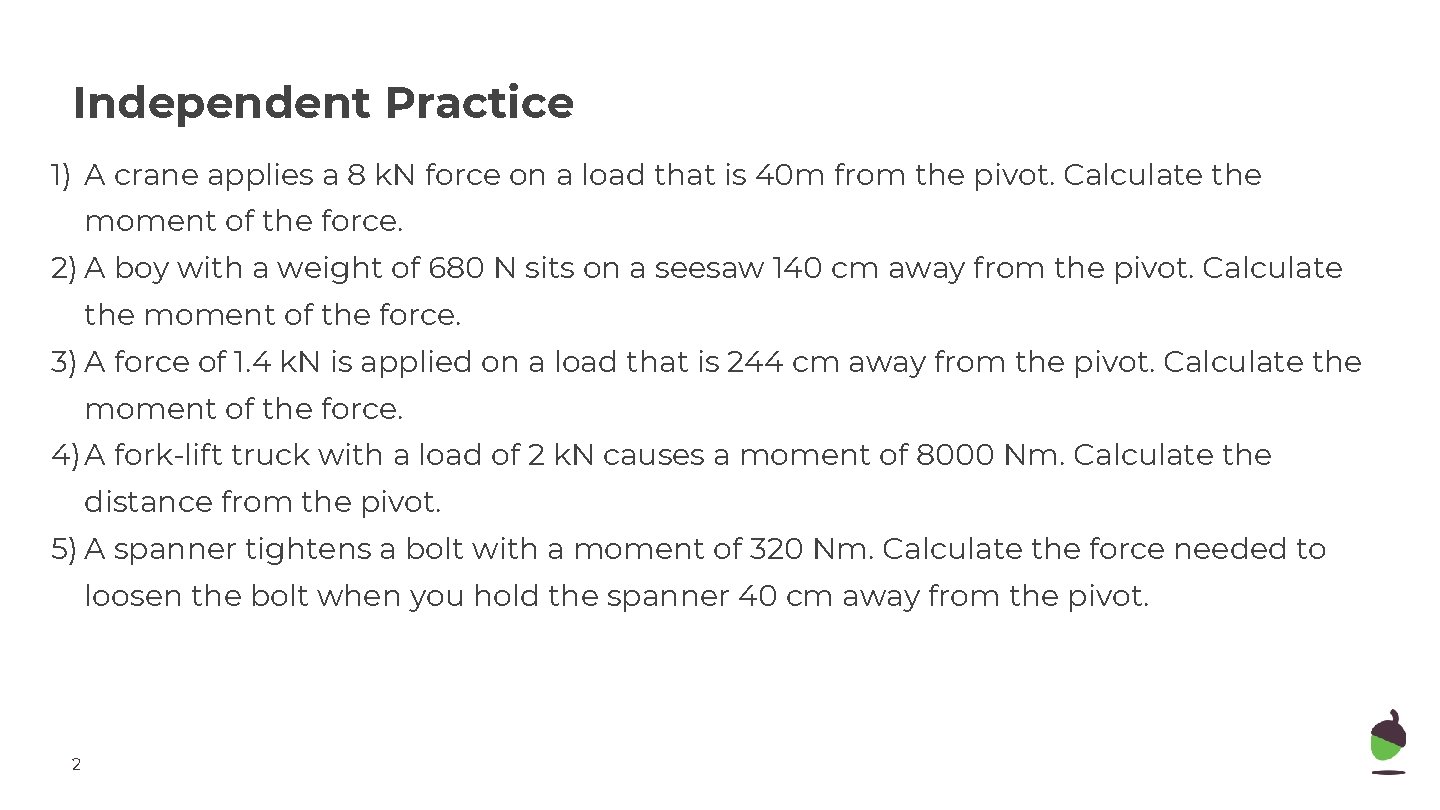
Independent Practice 1) A crane applies a 8 k. N force on a load that is 40 m from the pivot. Calculate the moment of the force. 2) A boy with a weight of 680 N sits on a seesaw 140 cm away from the pivot. Calculate the moment of the force. 3) A force of 1. 4 k. N is applied on a load that is 244 cm away from the pivot. Calculate the moment of the force. 4) A fork-lift truck with a load of 2 k. N causes a moment of 8000 Nm. Calculate the distance from the pivot. 5) A spanner tightens a bolt with a moment of 320 Nm. Calculate the force needed to loosen the bolt when you hold the spanner 40 cm away from the pivot. 2
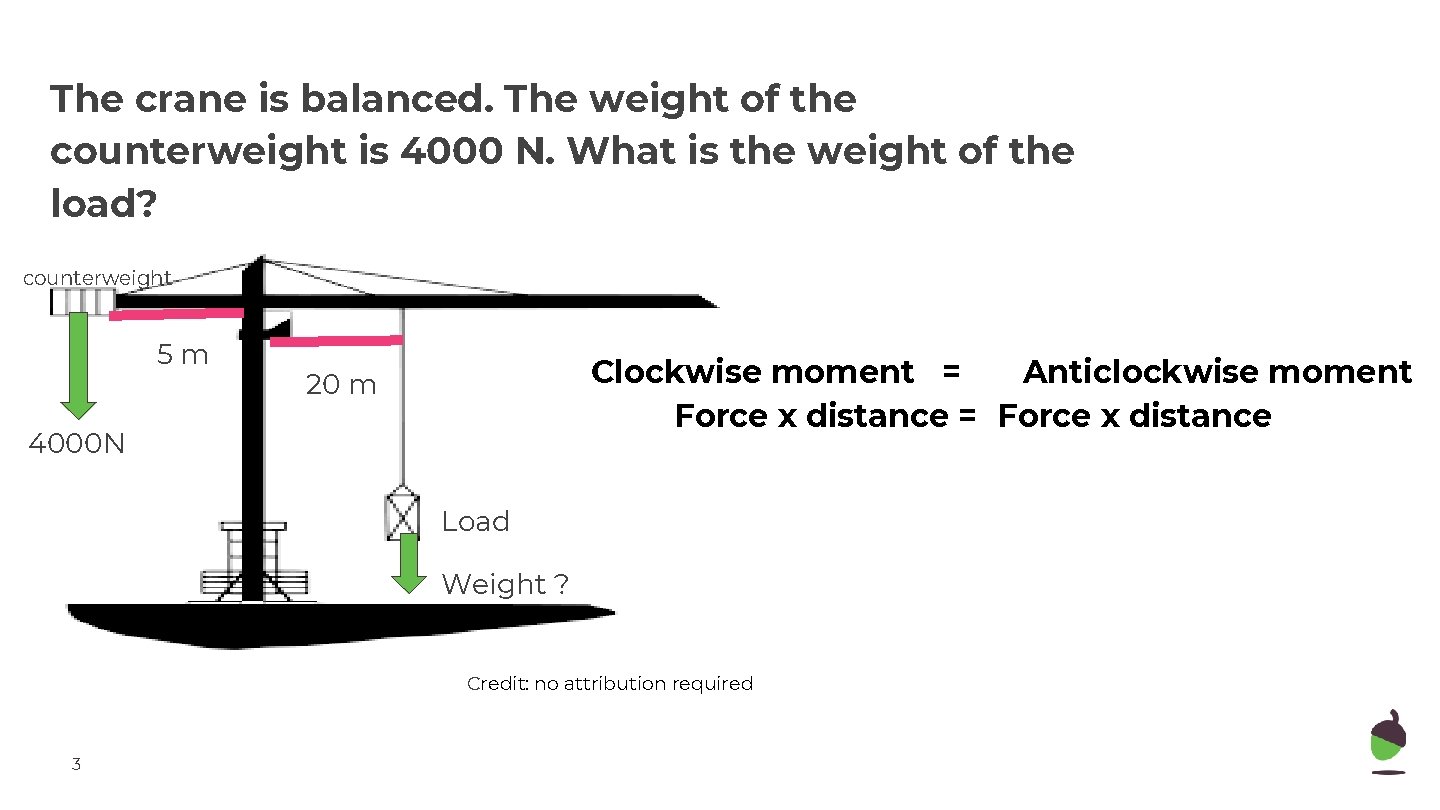
The crane is balanced. The weight of the counterweight is 4000 N. What is the weight of the load? counterweight 5 m Clockwise moment = Anticlockwise moment Force x distance = Force x distance 20 m 4000 N Load Weight ? Credit: no attribution required 3
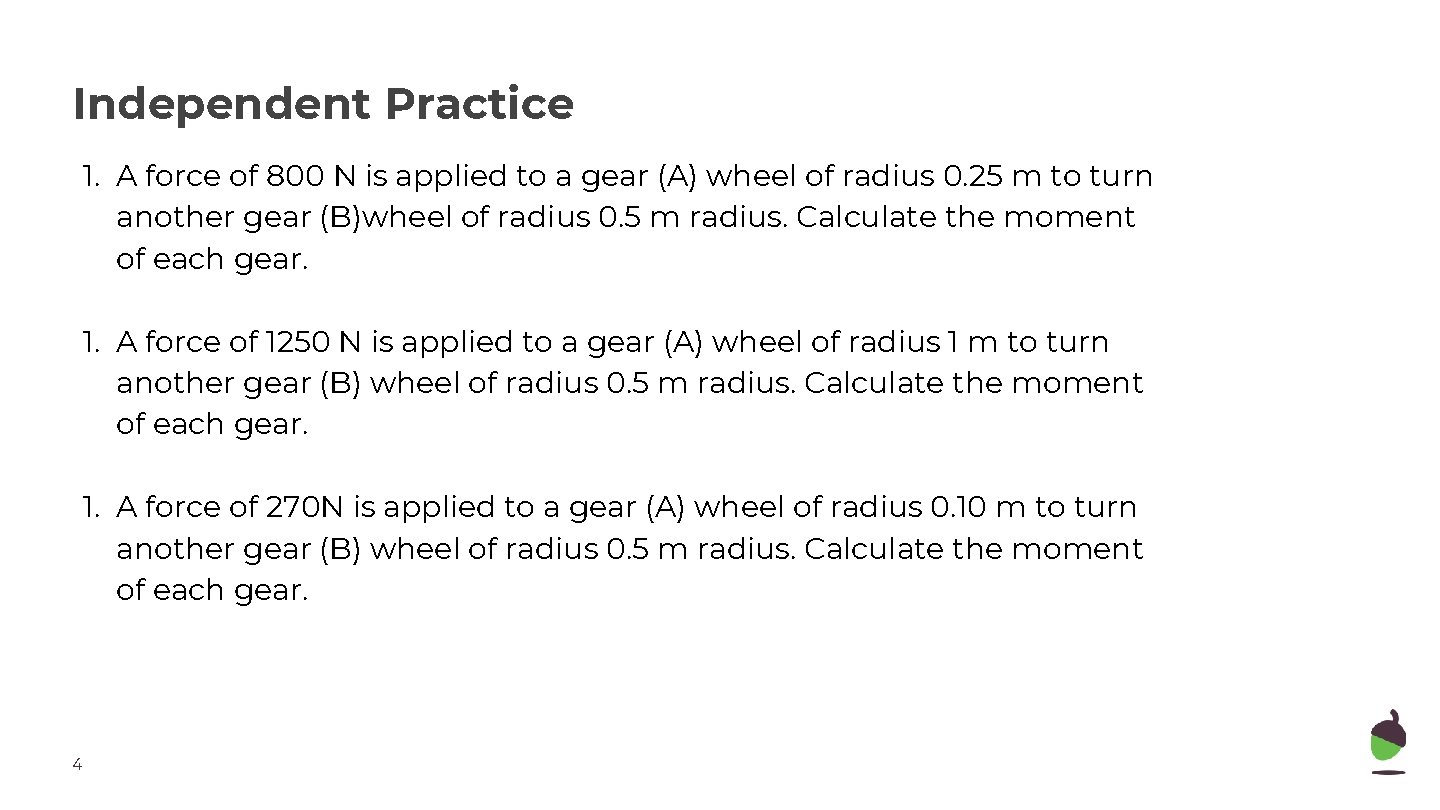
Independent Practice 1. A force of 800 N is applied to a gear (A) wheel of radius 0. 25 m to turn another gear (B)wheel of radius 0. 5 m radius. Calculate the moment of each gear. 1. A force of 1250 N is applied to a gear (A) wheel of radius 1 m to turn another gear (B) wheel of radius 0. 5 m radius. Calculate the moment of each gear. 1. A force of 270 N is applied to a gear (A) wheel of radius 0. 10 m to turn another gear (B) wheel of radius 0. 5 m radius. Calculate the moment of each gear. 4
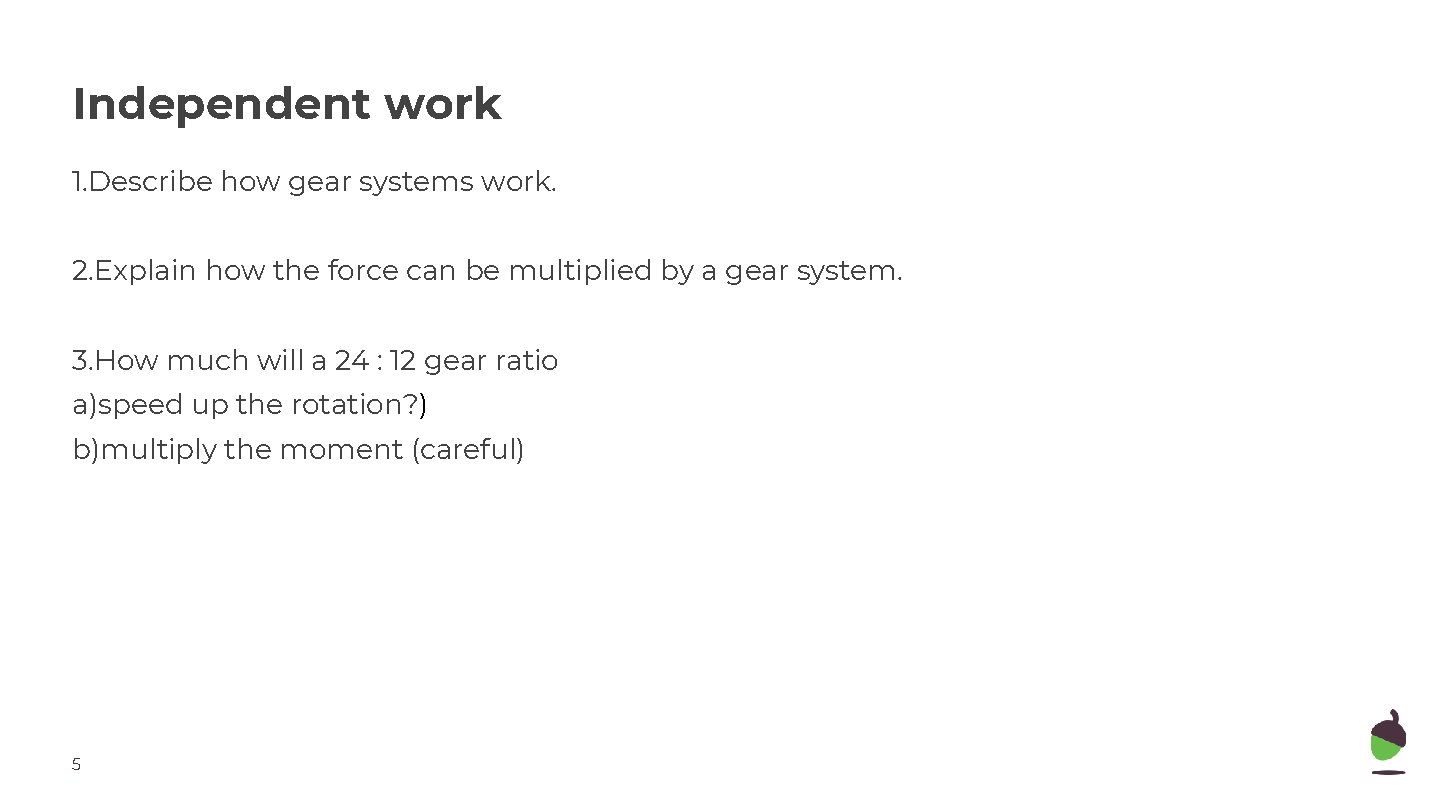
Independent work 1. Describe how gear systems work. 2. Explain how the force can be multiplied by a gear system. 3. How much will a 24 : 12 gear ratio a)speed up the rotation? ) b)multiply the moment (careful) 5
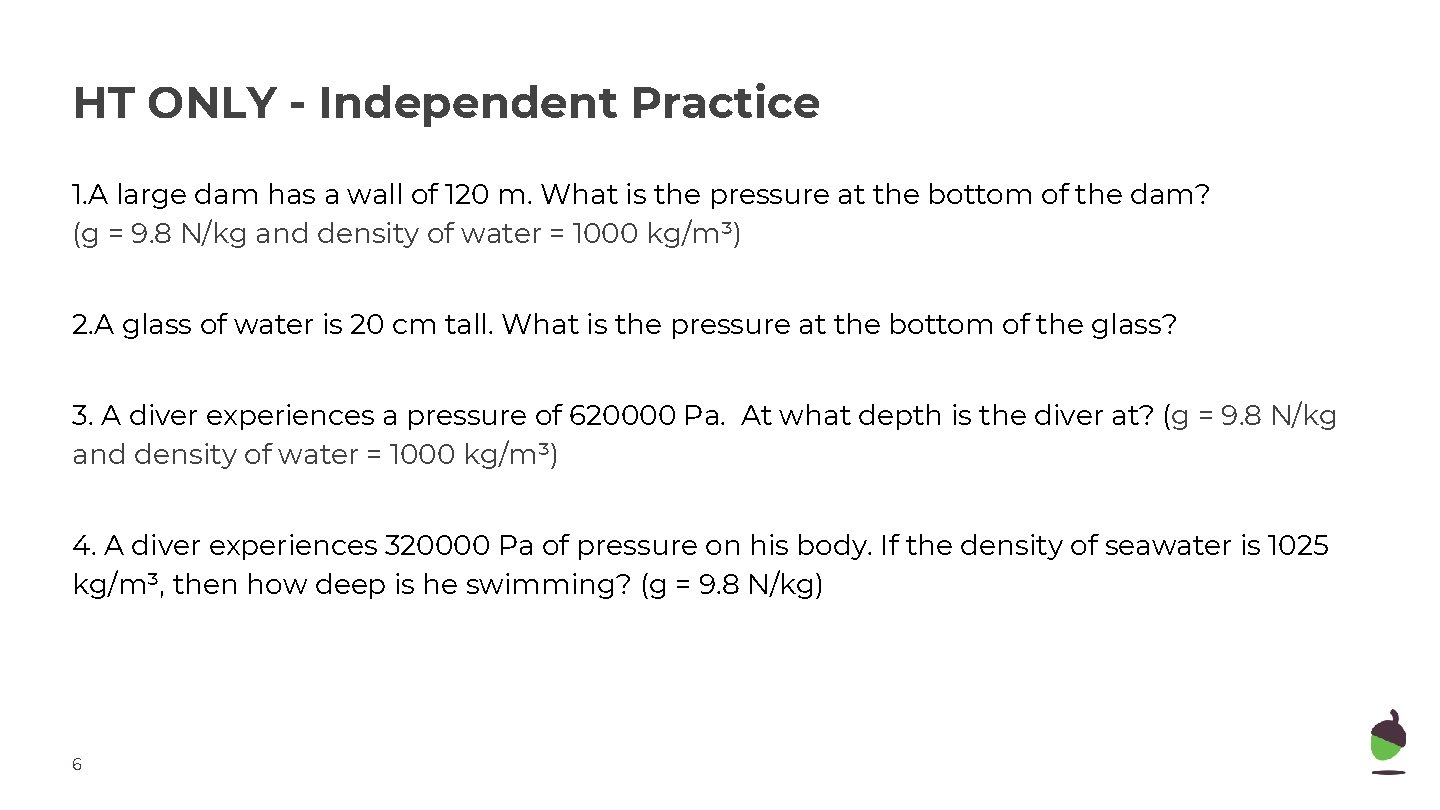
HT ONLY - Independent Practice 1. A large dam has a wall of 120 m. What is the pressure at the bottom of the dam? (g = 9. 8 N/kg and density of water = 1000 kg/m³) 2. A glass of water is 20 cm tall. What is the pressure at the bottom of the glass? 3. A diver experiences a pressure of 620000 Pa. At what depth is the diver at? (g = 9. 8 N/kg and density of water = 1000 kg/m³) 4. A diver experiences 320000 Pa of pressure on his body. If the density of seawater is 1025 kg/m³, then how deep is he swimming? (g = 9. 8 N/kg) 6
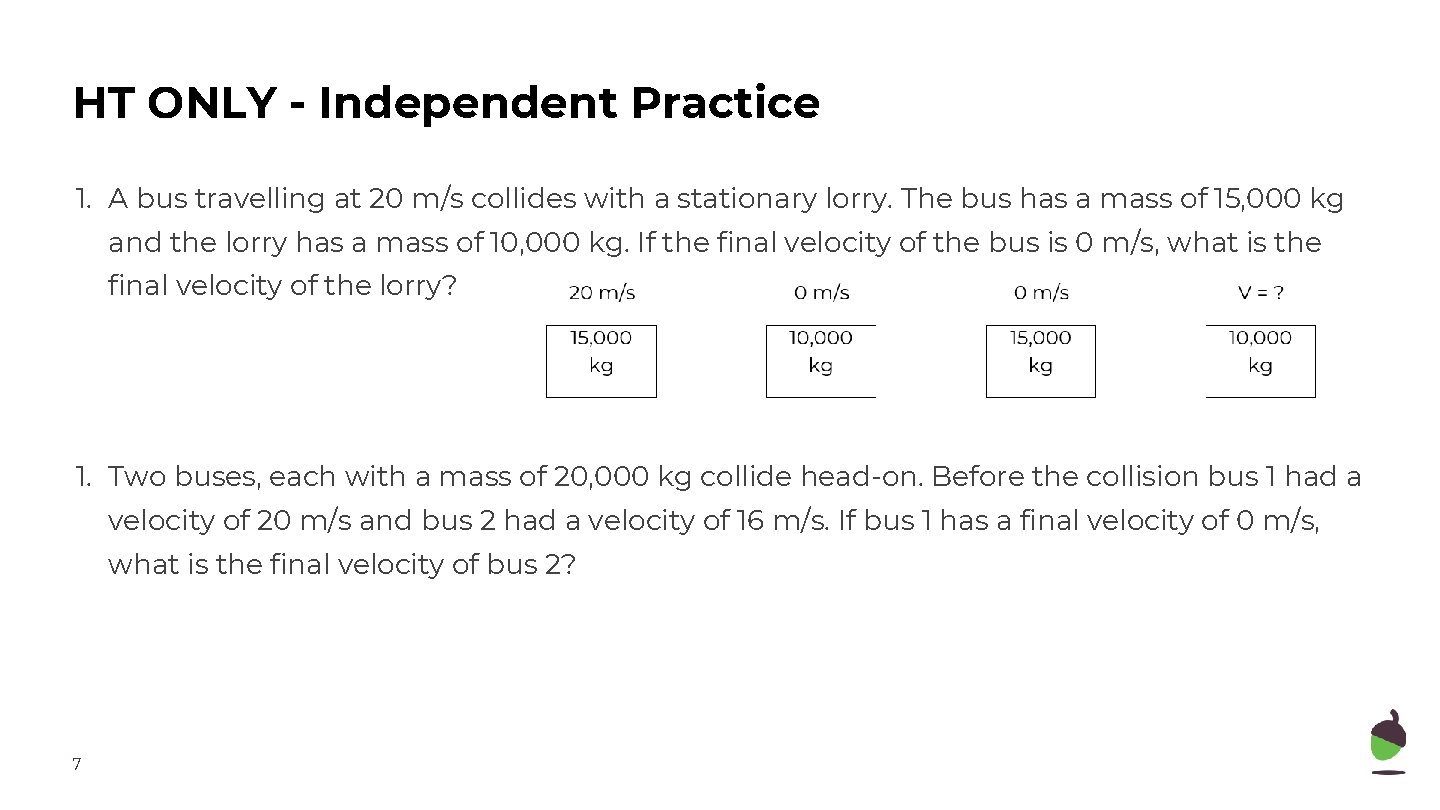
HT ONLY - Independent Practice 1. A bus travelling at 20 m/s collides with a stationary lorry. The bus has a mass of 15, 000 kg and the lorry has a mass of 10, 000 kg. If the final velocity of the bus is 0 m/s, what is the final velocity of the lorry? 1. Two buses, each with a mass of 20, 000 kg collide head-on. Before the collision bus 1 had a velocity of 20 m/s and bus 2 had a velocity of 16 m/s. If bus 1 has a final velocity of 0 m/s, what is the final velocity of bus 2? 7
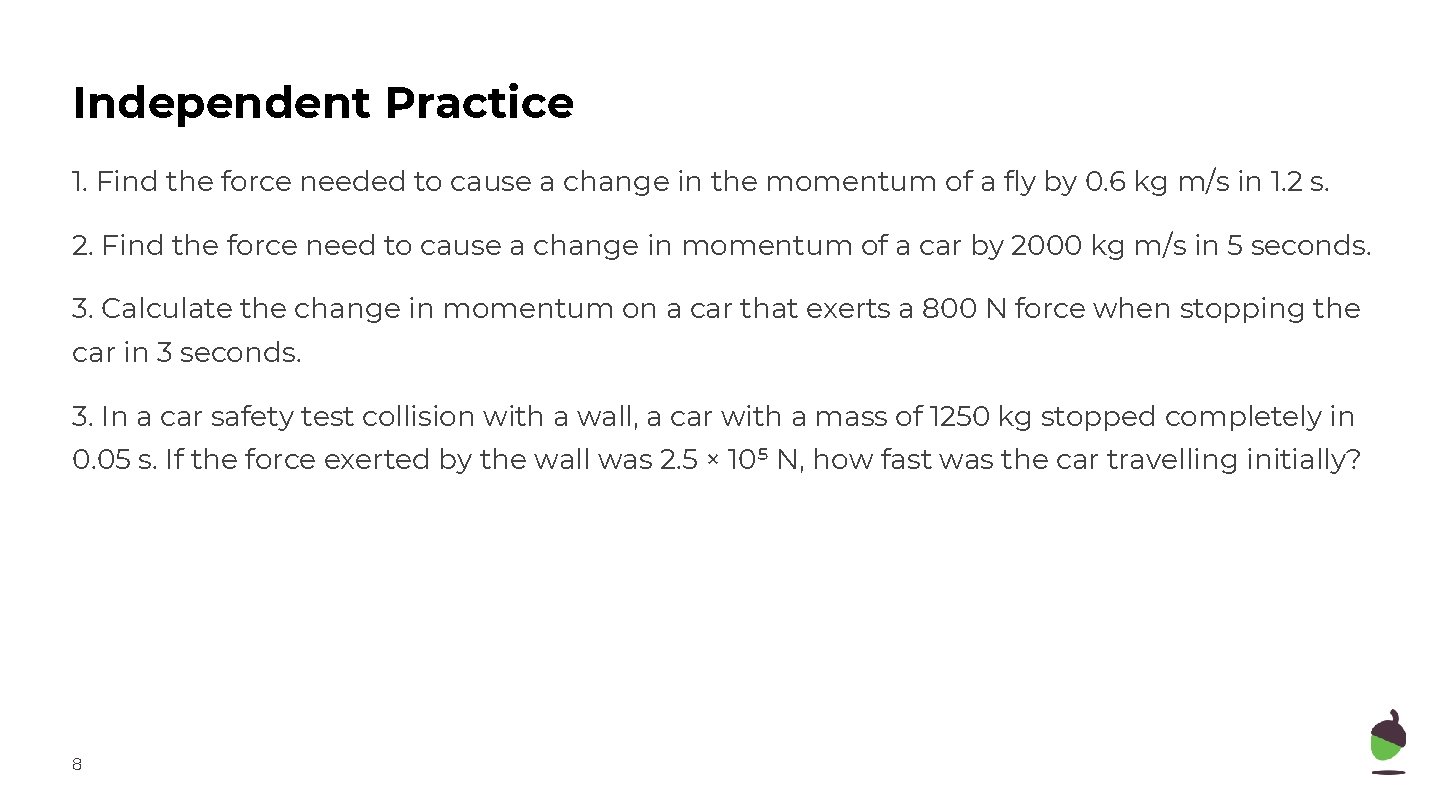
Independent Practice 1. Find the force needed to cause a change in the momentum of a fly by 0. 6 kg m/s in 1. 2 s. 2. Find the force need to cause a change in momentum of a car by 2000 kg m/s in 5 seconds. 3. Calculate the change in momentum on a car that exerts a 800 N force when stopping the car in 3 seconds. 3. In a car safety test collision with a wall, a car with a mass of 1250 kg stopped completely in 0. 05 s. If the force exerted by the wall was 2. 5 × 10⁵ N, how fast was the car travelling initially? 8