
Physics Introduction Review Topics Significant Figures Accuracy and
- Slides: 31
Physics Introduction Review Topics: Significant Figures, Accuracy and Precision, Uncertainty, Metric Prefixes and Dimensional Analysis
Significant Figures The significant digits are the digits in a measurement that can be reliably reported. All significant digits in a measurement are known with certainty except the last one, which is estimated. A digit is significant unless it is ◦ a leading zero (0. 00432 miles) ◦ a trailing zero in a measurement without a decimal point (2400 ft) 11/2/2020 2
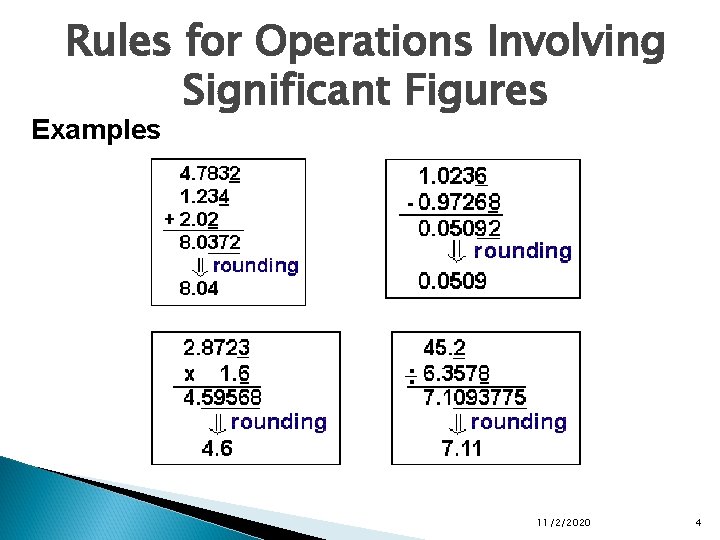
Rules for Operations Involving Significant Figures Add/Sub: The answer is rounded so that it has the its estimated digit in the same position as the least precise measurement. (The least precise measurement has its estimated digit in a position farthest to the left. Mul/Div: The answer is rounded so that it has the same number of significant figures as the measurement with the least number of significant figures. 11/2/2020 3
Rules for Operations Involving Significant Figures Examples 11/2/2020 4
Accuracy and Precision Accuracy: degree of closeness of a measured or calculated quantity to its actual (true) value. Precision: also called reproducibility or repeatability, the degree to which further measurements or calculations are likely to show the same or similar results. 11/2/2020 5
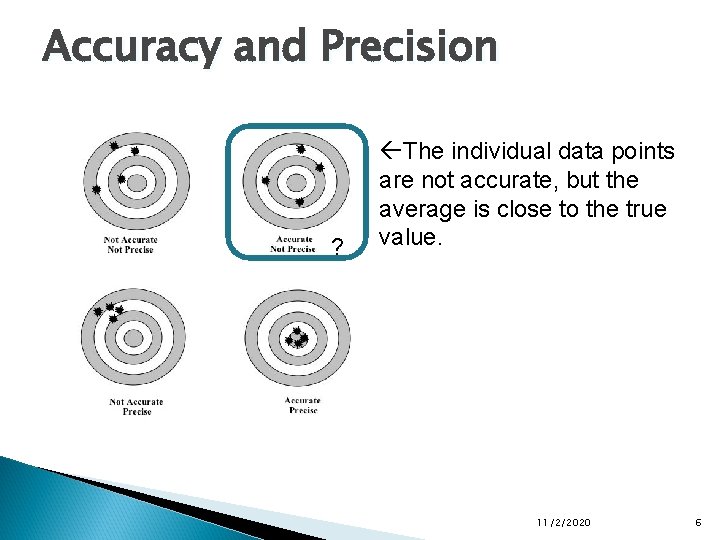
Accuracy and Precision ? ßThe individual data points are not accurate, but the average is close to the true value. 11/2/2020 6
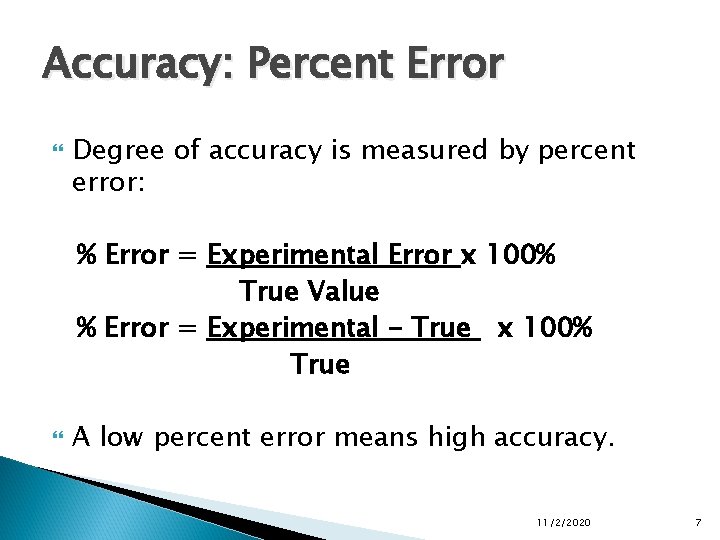
Accuracy: Percent Error Degree of accuracy is measured by percent error: % Error = Experimental Error x 100% True Value % Error = Experimental - True x 100% True A low percent error means high accuracy. 11/2/2020 7
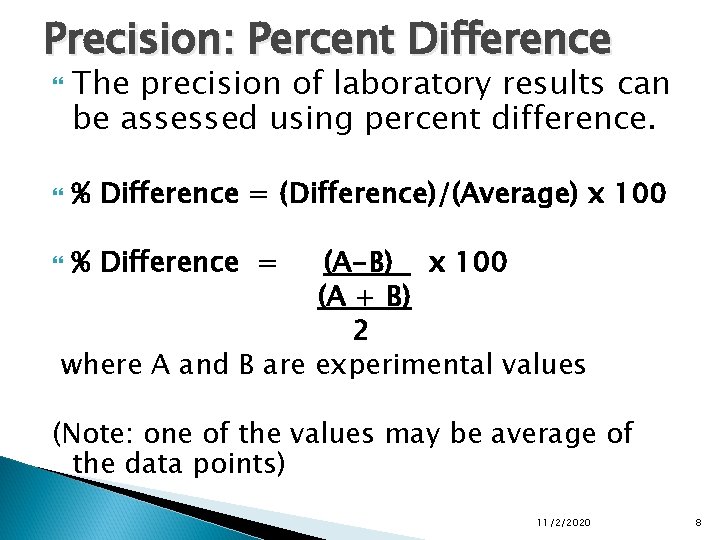
Precision: Percent Difference The precision of laboratory results can be assessed using percent difference. % Difference = (Difference)/(Average) x 100 (A-B) x 100 (A + B) 2 where A and B are experimental values % Difference = (Note: one of the values may be average of the data points) 11/2/2020 8
Uncertainty The uncertainty in a measurement is equal to one or two multiples of the estimated digit (the last significant figure). This accounts for the uncertainty associated with the tool’s precision (the smallest division). 11/2/2020 9
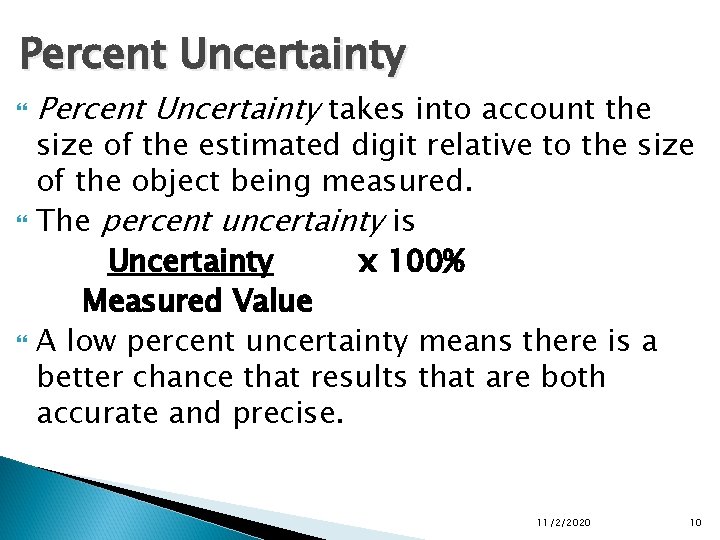
Percent Uncertainty Percent Uncertainty takes into account the size of the estimated digit relative to the size of the object being measured. The percent uncertainty is Uncertainty x 100% Measured Value A low percent uncertainty means there is a better chance that results that are both accurate and precise. 11/2/2020 10
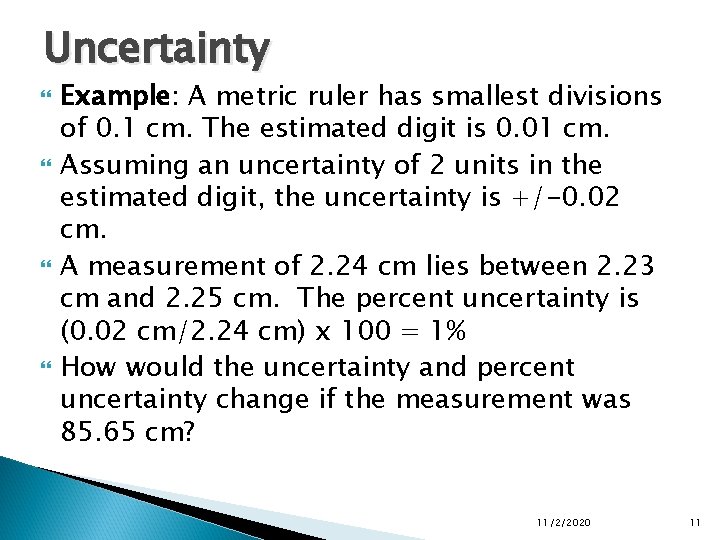
Uncertainty Example: A metric ruler has smallest divisions of 0. 1 cm. The estimated digit is 0. 01 cm. Assuming an uncertainty of 2 units in the estimated digit, the uncertainty is +/-0. 02 cm. A measurement of 2. 24 cm lies between 2. 23 cm and 2. 25 cm. The percent uncertainty is (0. 02 cm/2. 24 cm) x 100 = 1% How would the uncertainty and percent uncertainty change if the measurement was 85. 65 cm? 11/2/2020 11
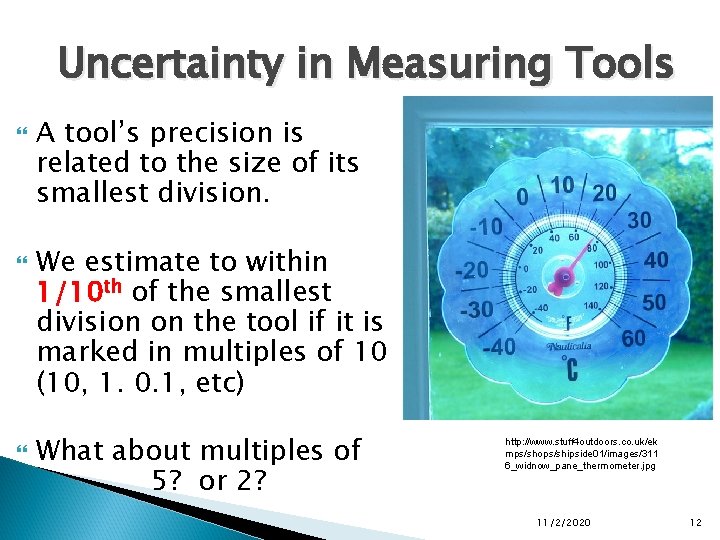
Uncertainty in Measuring Tools A tool’s precision is related to the size of its smallest division. We estimate to within 1/10 th of the smallest division on the tool if it is marked in multiples of 10 (10, 1. 0. 1, etc) What about multiples of 5? or 2? http: //www. stuff 4 outdoors. co. uk/ek mps/shops/shipside 01/images/311 6_widnow_pane_thermometer. jpg 11/2/2020 12
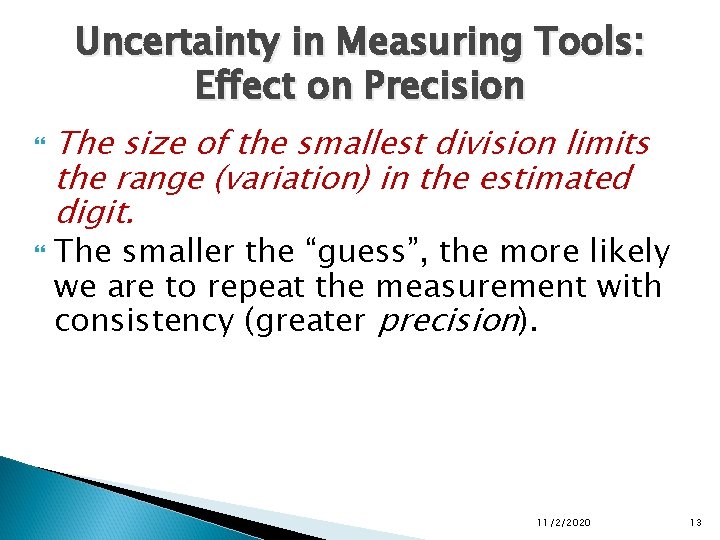
Uncertainty in Measuring Tools: Effect on Precision The size of the smallest division limits the range (variation) in the estimated digit. The smaller the “guess”, the more likely we are to repeat the measurement with consistency (greater precision). 11/2/2020 13
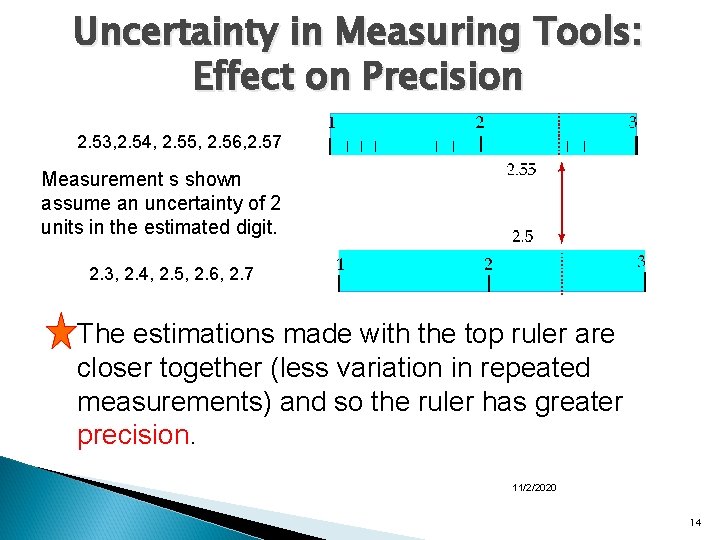
Uncertainty in Measuring Tools: Effect on Precision 2. 53, 2. 54, 2. 55, 2. 56, 2. 57 Measurement s shown assume an uncertainty of 2 units in the estimated digit. 2. 3, 2. 4, 2. 5, 2. 6, 2. 7 The estimations made with the top ruler are closer together (less variation in repeated measurements) and so the ruler has greater precision. 11/2/2020 14
Uncertainty in Measuring Tools: Effect on Accuracy The precision of the tool can limit accuracy when the size of the estimated digit is a large fraction of the object being measured. Let’s see how…. 11/2/2020 15
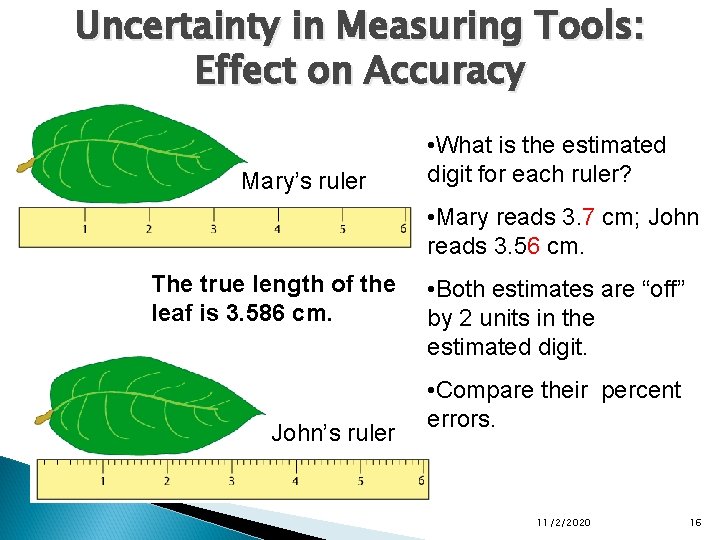
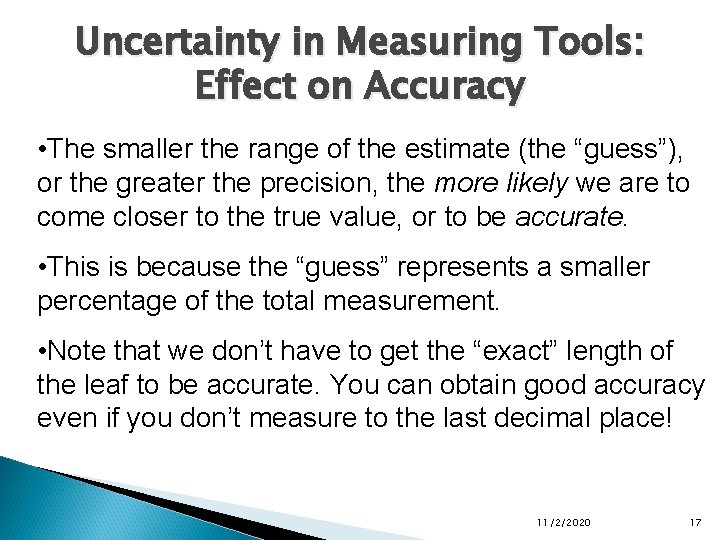
Uncertainty in Measuring Tools: Effect on Accuracy Mary’s ruler • What is the estimated digit for each ruler? • Mary reads 3. 7 cm; John reads 3. 56 cm. The true length of the leaf is 3. 586 cm. John’s ruler • Both estimates are “off” by 2 units in the estimated digit. • Compare their percent errors. 11/2/2020 16
Uncertainty in Measuring Tools: Effect on Accuracy • The smaller the range of the estimate (the “guess”), or the greater the precision, the more likely we are to come closer to the true value, or to be accurate. • This is because the “guess” represents a smaller percentage of the total measurement. • Note that we don’t have to get the “exact” length of the leaf to be accurate. You can obtain good accuracy even if you don’t measure to the last decimal place! 11/2/2020 17
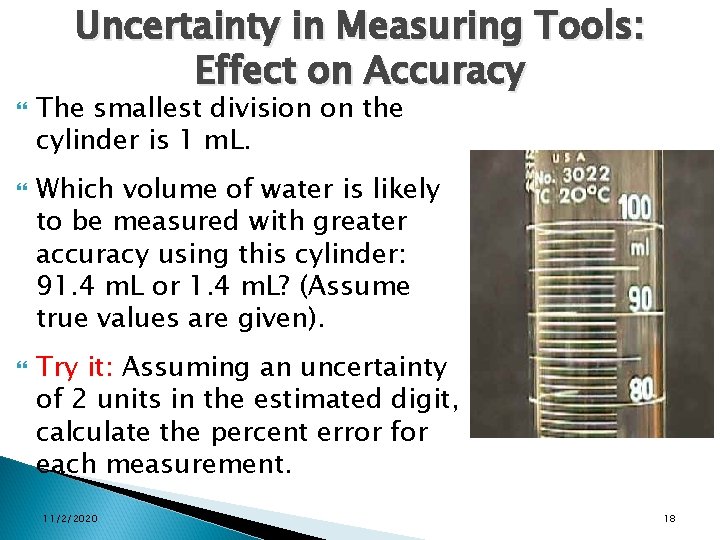
Uncertainty in Measuring Tools: Effect on Accuracy The smallest division on the cylinder is 1 m. L. Which volume of water is likely to be measured with greater accuracy using this cylinder: 91. 4 m. L or 1. 4 m. L? (Assume true values are given). Try it: Assuming an uncertainty of 2 units in the estimated digit, calculate the percent error for each measurement. 11/2/2020 18
1. 2. 3. Uncertainty in Measuring Tools: Effect on Accuracy A measurement is more likely to be accurate if the measuring tool has good precision. Good precision does not guarantee accuracy. Accuracy and precision are relative terms. Use percent uncertainty, percent error or percent difference to assess. 11/2/2020 19
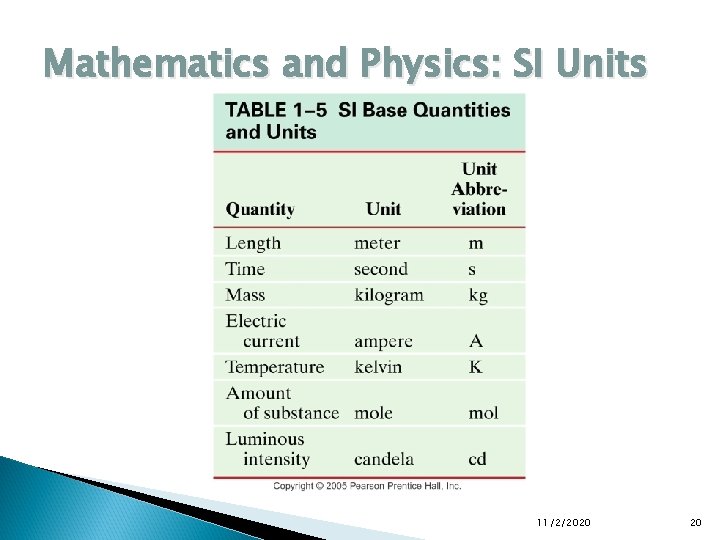
Mathematics and Physics: SI Units 11/2/2020 20
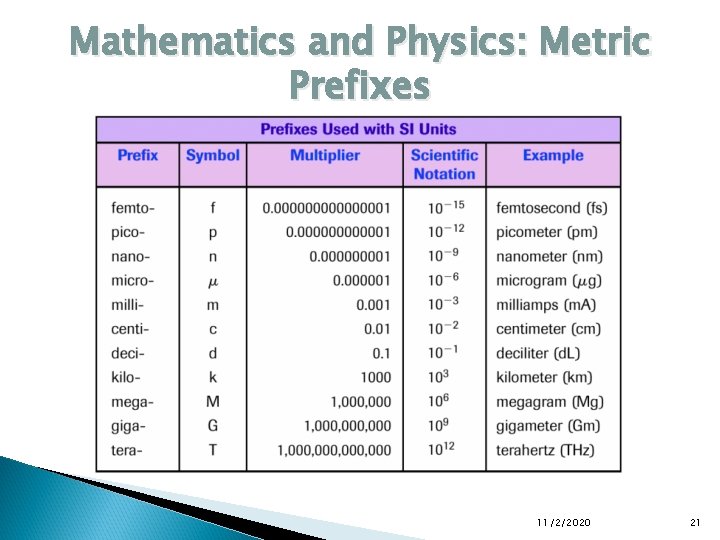
Mathematics and Physics: Metric Prefixes 11/2/2020 21
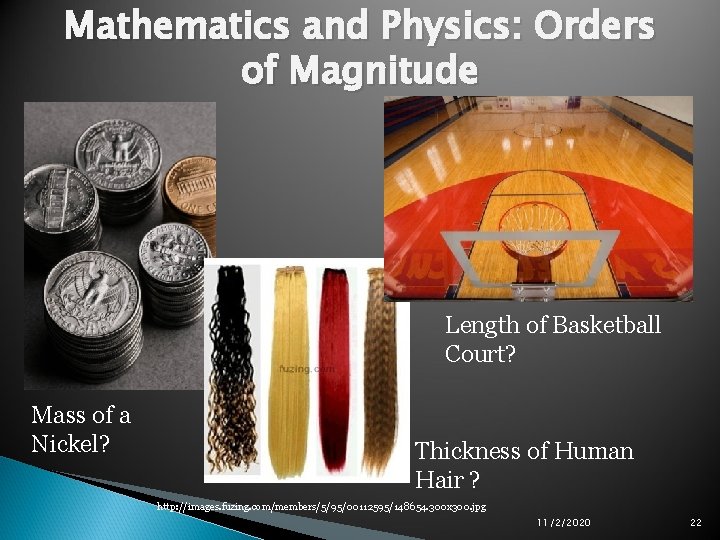
Mathematics and Physics: Orders of Magnitude Length of Basketball Court? Mass of a Nickel? Thickness of Human Hair ? http: //images. fuzing. com/members/5/95/00112595/148654. 300 x 300. jpg 11/2/2020 22
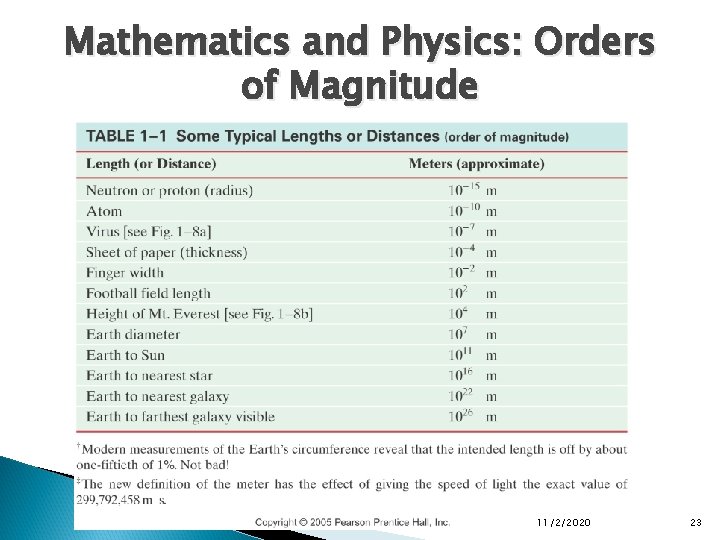
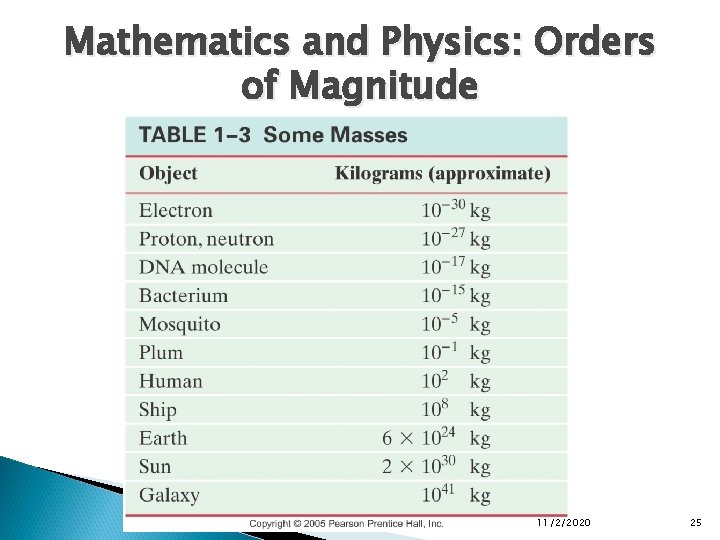
Mathematics and Physics: Orders of Magnitude 11/2/2020 23
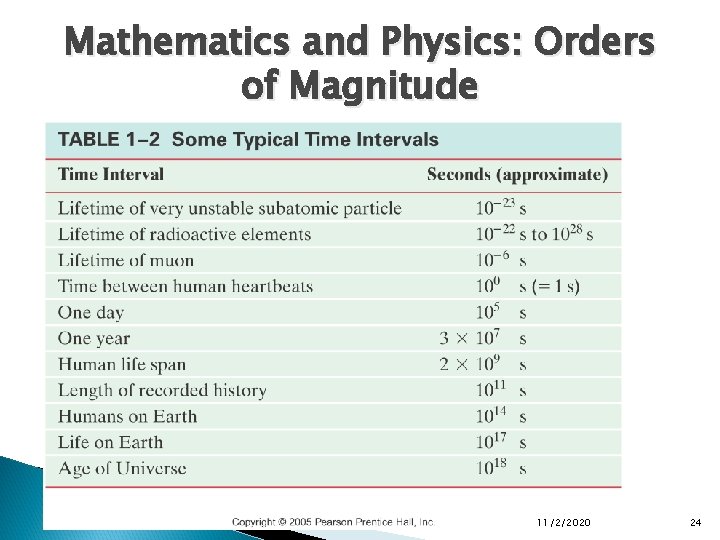
Mathematics and Physics: Orders of Magnitude 11/2/2020 24
Mathematics and Physics: Orders of Magnitude 11/2/2020 25
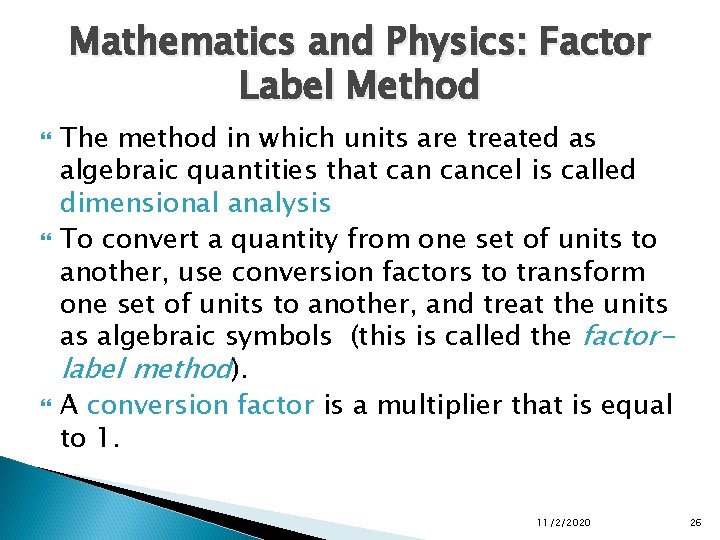
Mathematics and Physics: Factor Label Method The method in which units are treated as algebraic quantities that cancel is called dimensional analysis To convert a quantity from one set of units to another, use conversion factors to transform one set of units to another, and treat the units as algebraic symbols (this is called the factorlabel method). A conversion factor is a multiplier that is equal to 1. 11/2/2020 26
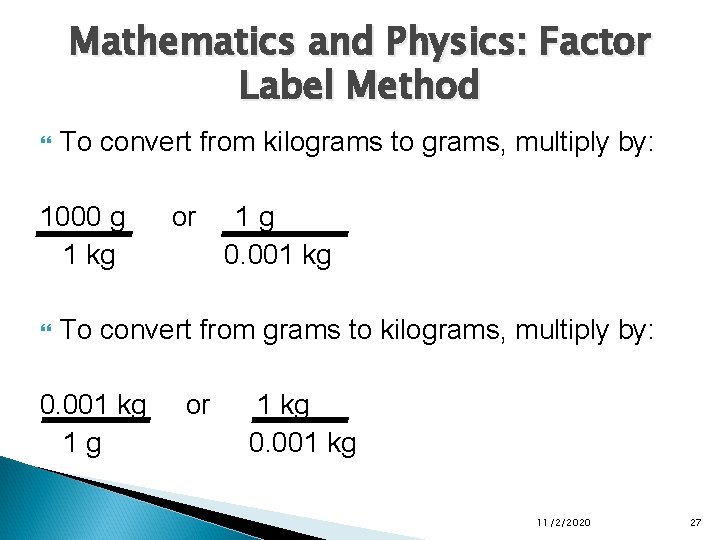
Mathematics and Physics: Factor Label Method To convert from kilograms to grams, multiply by: 1000 g 1 kg or 1 g 0. 001 kg To convert from grams to kilograms, multiply by: 0. 001 kg 1 g or 1 kg 0. 001 kg 11/2/2020 27
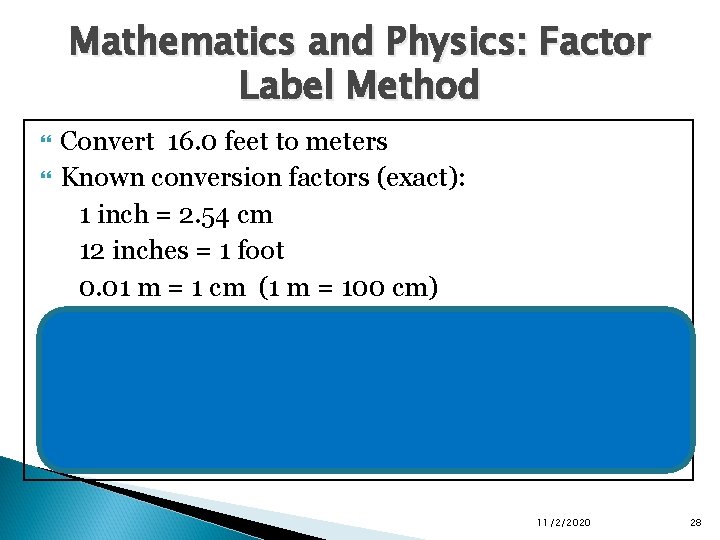
Mathematics and Physics: Factor Label Method Convert 16. 0 feet to meters Known conversion factors (exact): 1 inch = 2. 54 cm 12 inches = 1 foot 0. 01 m = 1 cm (1 m = 100 cm) Convert feet inches cm m 16. 0 ft x 12 in. x 2. 54 cm x 1 m = 4. 88 m 1 1 ft. 1 in. 100 cm 11/2/2020 28
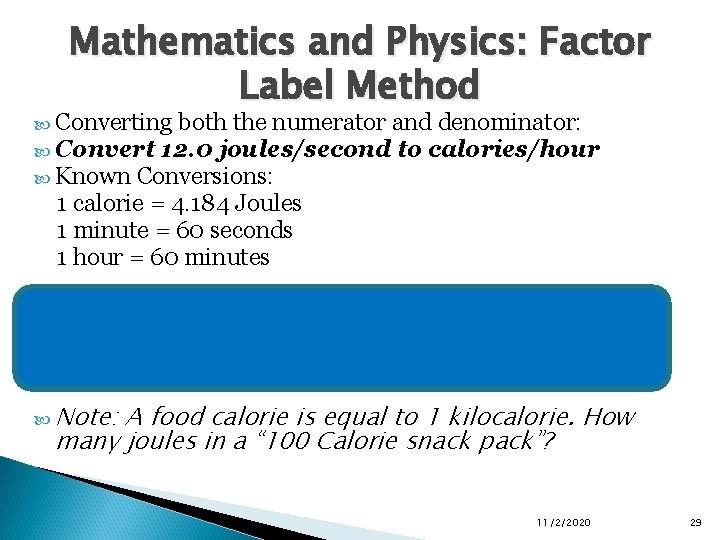
Mathematics and Physics: Factor Label Method Converting both the numerator and denominator: Convert 12. 0 joules/second to calories/hour Known Conversions: 1 calorie = 4. 184 Joules 1 minute = 60 seconds 1 hour = 60 minutes 12. 0 J x 1 cal x 60 s x 60 min = 10, 300 cal/hr s 4. 184 J 1 min 1 h Note: A food calorie is equal to 1 kilocalorie. How many joules in a “ 100 Calorie snack pack”? 11/2/2020 29
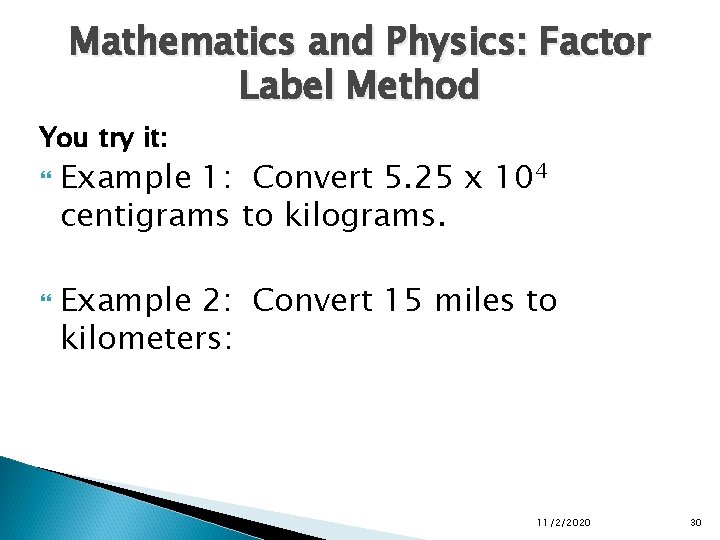
Mathematics and Physics: Factor Label Method You try it: Example 1: Convert 5. 25 x 104 centigrams to kilograms. Example 2: Convert 15 miles to kilometers: 11/2/2020 30
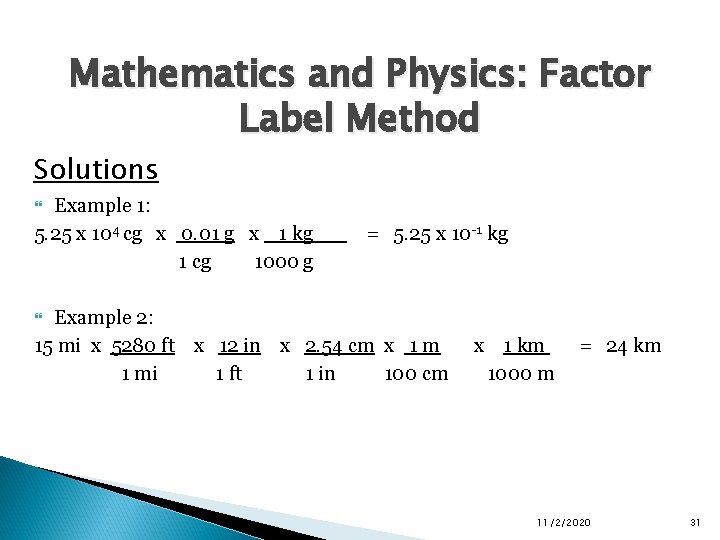
Mathematics and Physics: Factor Label Method Solutions Example 1: 5. 25 x 104 cg x 0. 01 g x 1 kg = 5. 25 x 10 -1 kg 1 cg 1000 g Example 2: 15 mi x 5280 ft x 12 in x 2. 54 cm x 1 m x 1 km = 24 km 1 mi 1 ft 1 in 100 cm 1000 m 11/2/2020 31