
Physics I a Review Distance fundamental 3 dimensions

- Slides: 57
Physics I - a Review Distance (fundamental): 3 dimensions; requires VECTORS Time (fundamental) Mass (fundamental) Motion (combines distance and time) Forces cause changes in motion (Newton’s Laws of Motion); types of forces including gravity Work and Energy (Conservation of Energy) Power (rate at which energy is used or transported) Momentum (used in collisions & explosions)
Physics I - a Review cont. Rotations (distance angle, force torque, mass moment of inertia; additional KE, momentum angular momentum) Fluids (force pressure, v fluid flow, friction viscosity; still use Cons. of energy) Heat (flow of energy – power; relate to motion of molecules, temperature) Waves (flow of energy - waves on a string, sound waves; power and intensity)
Physics II – an overview Electricity (basic force of nature; voltage; circuits) Magnetism and electromagnetism (mass spectrometers, motors and generators) Light – moving energy (reflection, refraction, lenses, diffraction, polarization) Light – how we make it: leads to atomic theory Nuclear forces - inside the atom: (two basic forces of nature) radioactivity and nuclear energy
Electricity - An Overview In this first part of the course we will consider electricity using the same concepts we developed in PHYS 201: force and energy. We we will go a little bit further and develop two more concepts that are related to force and energy: electric field and voltage. With the idea of voltage we will look at the flow of electricity in basic electric circuits.
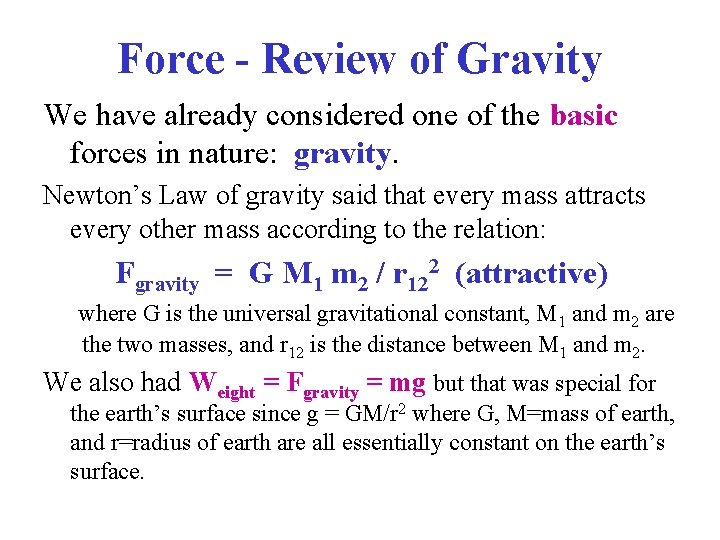
Force - Review of Gravity We have already considered one of the basic forces in nature: gravity. Newton’s Law of gravity said that every mass attracts every other mass according to the relation: Fgravity = G M 1 m 2 / r 122 (attractive) where G is the universal gravitational constant, M 1 and m 2 are the two masses, and r 12 is the distance between M 1 and m 2. We also had Weight = Fgravity = mg but that was special for the earth’s surface since g = GM/r 2 where G, M=mass of earth, and r=radius of earth are all essentially constant on the earth’s surface.
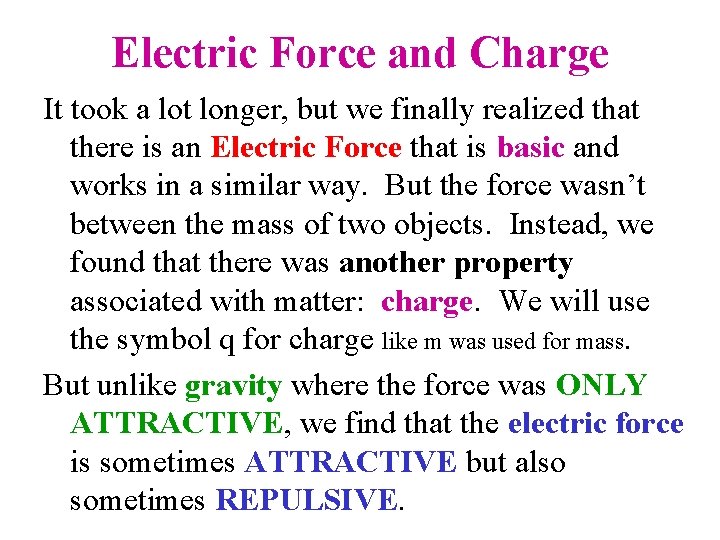
Electric Force and Charge It took a lot longer, but we finally realized that there is an Electric Force that is basic and works in a similar way. But the force wasn’t between the mass of two objects. Instead, we found that there was another property associated with matter: charge. We will use the symbol q for charge like m was used for mass. But unlike gravity where the force was ONLY ATTRACTIVE, we find that the electric force is sometimes ATTRACTIVE but also sometimes REPULSIVE.
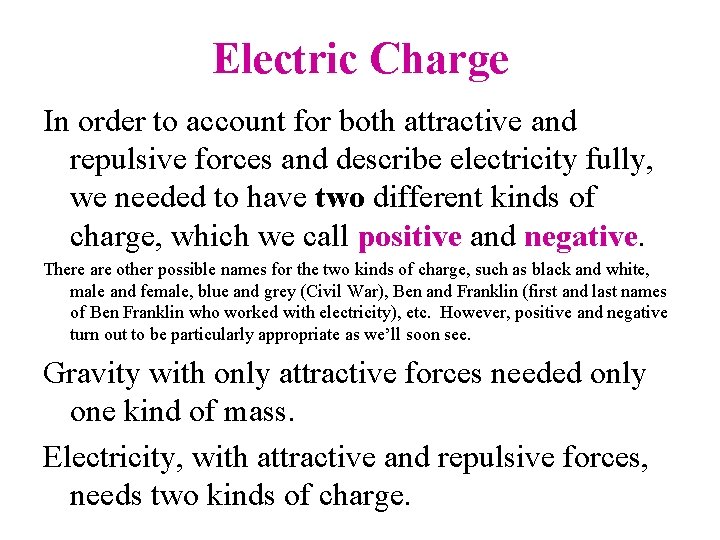
Electric Charge In order to account for both attractive and repulsive forces and describe electricity fully, we needed to have two different kinds of charge, which we call positive and negative. There are other possible names for the two kinds of charge, such as black and white, male and female, blue and grey (Civil War), Ben and Franklin (first and last names of Ben Franklin who worked with electricity), etc. However, positive and negative turn out to be particularly appropriate as we’ll soon see. Gravity with only attractive forces needed only one kind of mass. Electricity, with attractive and repulsive forces, needs two kinds of charge.
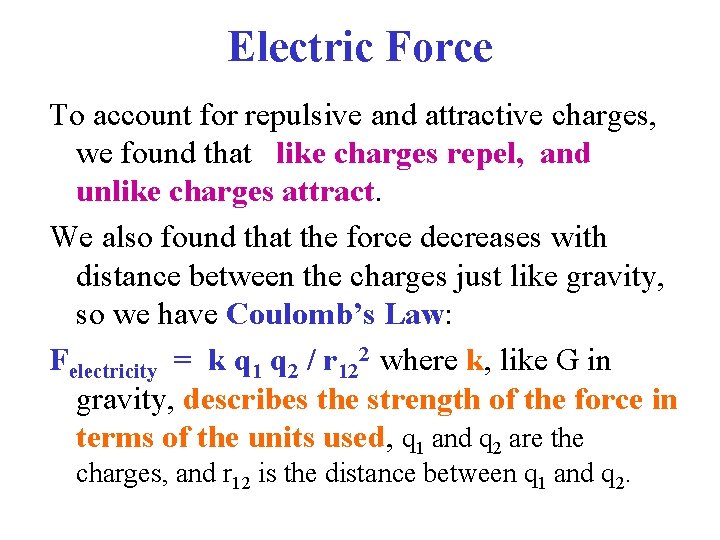
Electric Force To account for repulsive and attractive charges, we found that like charges repel, and unlike charges attract. We also found that the force decreases with distance between the charges just like gravity, so we have Coulomb’s Law: Felectricity = k q 1 q 2 / r 122 where k, like G in gravity, describes the strength of the force in terms of the units used, q 1 and q 2 are the charges, and r 12 is the distance between q 1 and q 2.
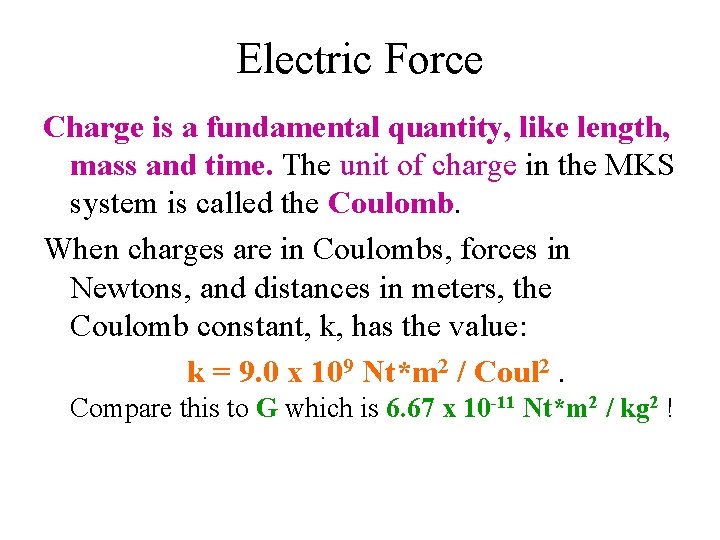
Electric Force Charge is a fundamental quantity, like length, mass and time. The unit of charge in the MKS system is called the Coulomb. When charges are in Coulombs, forces in Newtons, and distances in meters, the Coulomb constant, k, has the value: k = 9. 0 x 109 Nt*m 2 / Coul 2. Compare this to G which is 6. 67 x 10 -11 Nt*m 2 / kg 2 !
Electric Force The huge value of k compared to G indicates that electricity is VERY STRONG compared to gravity. Of course, we know that getting hit by lightning is a BIG DEAL! But how can electricity be so strong, and yet normally we don’t realize it’s there in the way we do gravity?
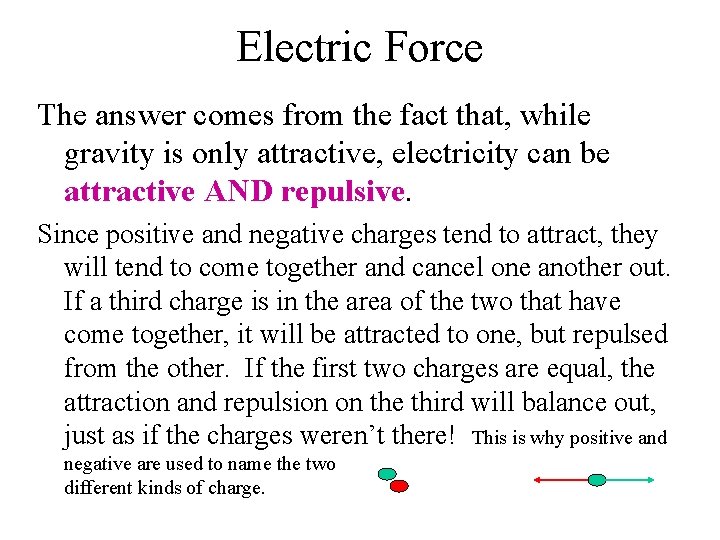
Electric Force The answer comes from the fact that, while gravity is only attractive, electricity can be attractive AND repulsive. Since positive and negative charges tend to attract, they will tend to come together and cancel one another out. If a third charge is in the area of the two that have come together, it will be attracted to one, but repulsed from the other. If the first two charges are equal, the attraction and repulsion on the third will balance out, just as if the charges weren’t there! This is why positive and negative are used to name the two different kinds of charge.
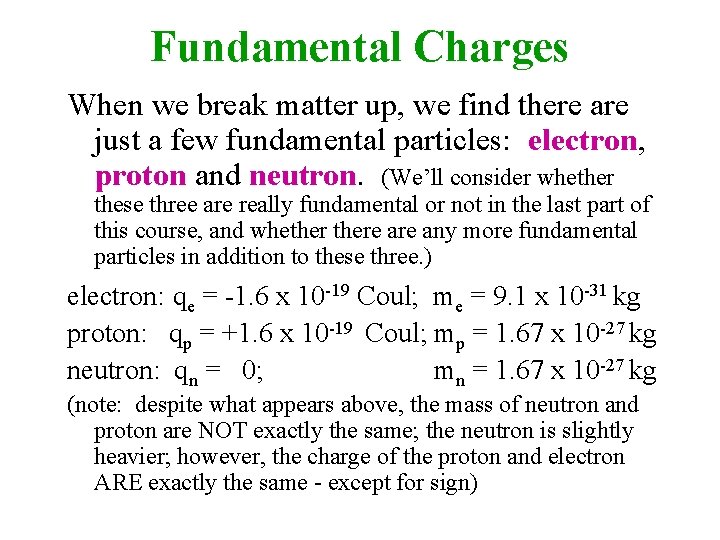
Fundamental Charges When we break matter up, we find there are just a few fundamental particles: electron, proton and neutron. (We’ll consider whether these three are really fundamental or not in the last part of this course, and whethere any more fundamental particles in addition to these three. ) electron: qe = -1. 6 x 10 -19 Coul; me = 9. 1 x 10 -31 kg proton: qp = +1. 6 x 10 -19 Coul; mp = 1. 67 x 10 -27 kg neutron: qn = 0; mn = 1. 67 x 10 -27 kg (note: despite what appears above, the mass of neutron and proton are NOT exactly the same; the neutron is slightly heavier; however, the charge of the proton and electron ARE exactly the same - except for sign)
Fundamental Charges Note that the electron and proton both have the same charge, with the electron being negative and the proton being positive. This amount of charge is often called the electronic charge, e. This electronic charge is generally considered a positive value (just like g in gravity). We add the negative sign when we need to: qelectron = -e; qproton = +e. The choice of giving the proton the positive charge and the electron the negative charge was arbitrary. Ben Franklin was the one who decided this based on very little data. It probably would have been better to reverse them as we’ll see later, but it appears to be too late to reverse them now.
Electric Forces Unlike gravity, where we usually have one big mass (such as the earth) in order to have a gravitational force worth considering, in electricity we often have lots of charges distributed around that are deserving of our attention! This leads to a concept that can aid us in considering many charges: the concept of Electric Field.
Concept of “Field” How does the electric force (or the gravitational force, for that matter, ) cause a force across a distance of space? In the case of gravity, are there “little devils” that lasso you and pull you down when you jump? Do professional athletes “pay off the devils” so that they can jump higher? Answer: We can develop a better theory than this!
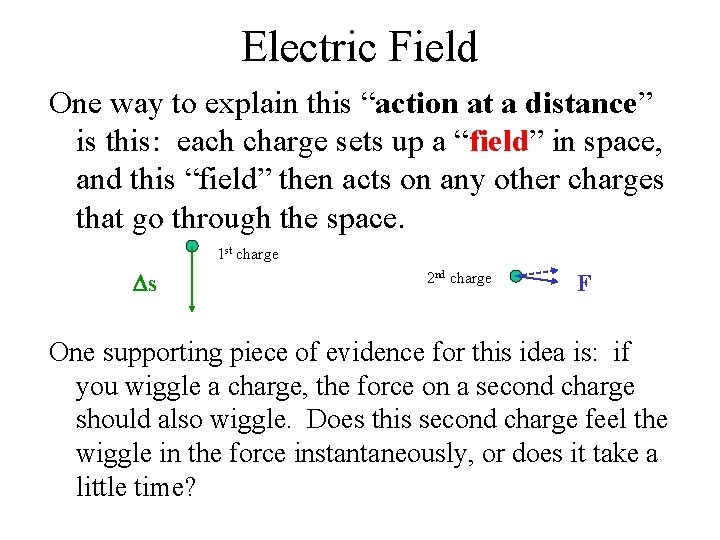
Electric Field One way to explain this “action at a distance” is this: each charge sets up a “field” in space, and this “field” then acts on any other charges that go through the space. 1 st charge Ds 2 nd charge F One supporting piece of evidence for this idea is: if you wiggle a charge, the force on a second charge should also wiggle. Does this second charge feel the wiggle in the force instantaneously, or does it take a little time?
Electric Field What we find is that it does take a little time for the information about the “wiggle” to get to the other charge. (It travels at the speed of light, so it is extremely fast, but not instantaneous!) This is the basic idea behind radio communication: we wiggle charges at the radio station, and your radio picks up the “wiggles” and decodes them to give you the information.
Gravitational Field We already started with this idea of field in gravity, although we probably didn’t identify the field concept as such: Weight = Fgravity = mg where we have g = GM/r 2. This little g we called the acceleration due to gravity, but we also call it the gravitational field due to the big M.
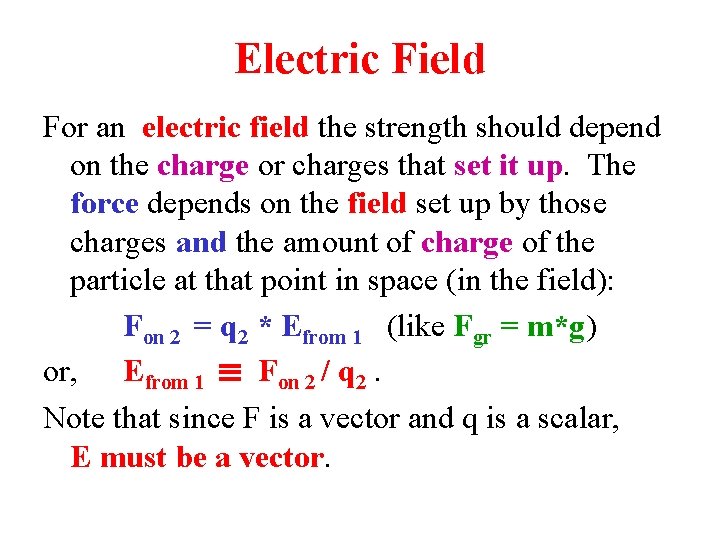
Electric Field For an electric field the strength should depend on the charge or charges that set it up. The force depends on the field set up by those charges and the amount of charge of the particle at that point in space (in the field): Fon 2 = q 2 * Efrom 1 (like Fgr = m*g) or, Efrom 1 ≡ Fon 2 / q 2. Note that since F is a vector and q is a scalar, E must be a vector.
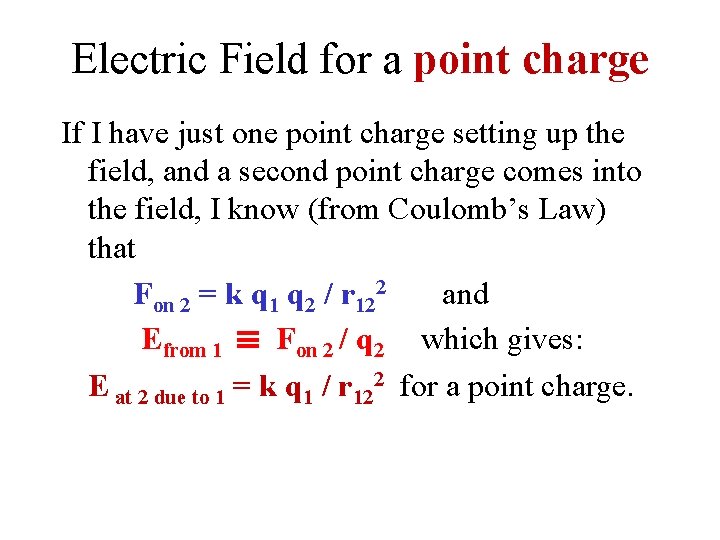
Electric Field for a point charge If I have just one point charge setting up the field, and a second point charge comes into the field, I know (from Coulomb’s Law) that Fon 2 = k q 1 q 2 / r 122 and Efrom 1 ≡ Fon 2 / q 2 which gives: E at 2 due to 1 = k q 1 / r 122 for a point charge.
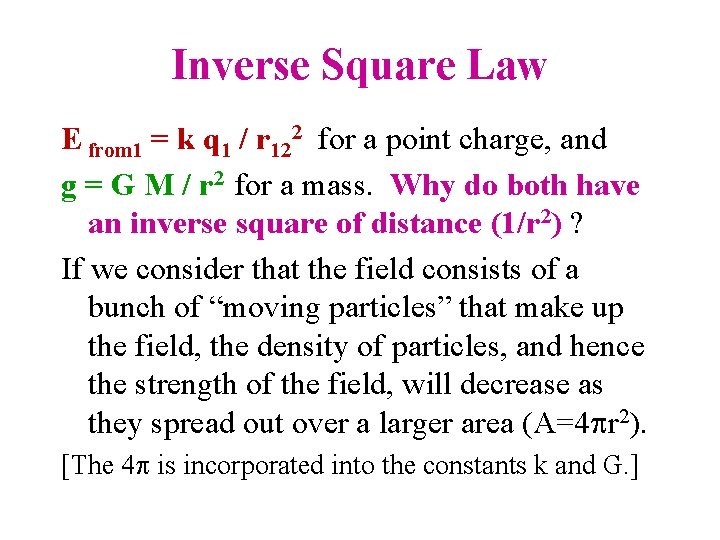
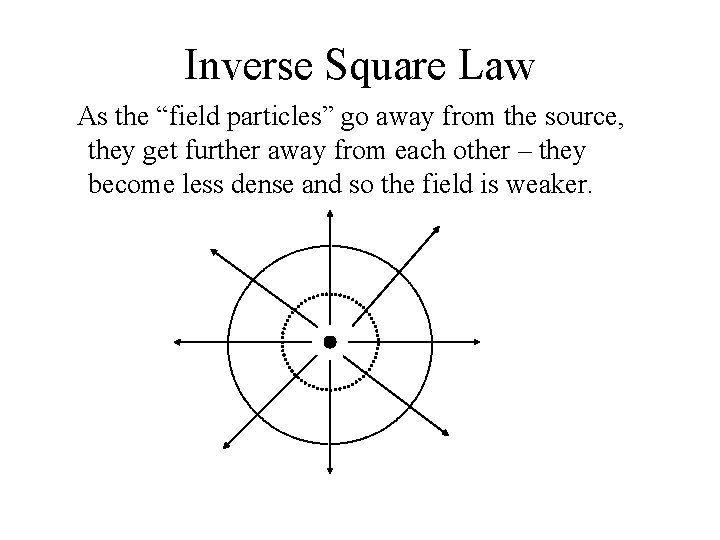
Inverse Square Law E from 1 = k q 1 / r 122 for a point charge, and g = G M / r 2 for a mass. Why do both have an inverse square of distance (1/r 2) ? If we consider that the field consists of a bunch of “moving particles” that make up the field, the density of particles, and hence the strength of the field, will decrease as they spread out over a larger area (A=4 pr 2). [The 4 p is incorporated into the constants k and G. ]
Inverse Square Law As the “field particles” go away from the source, they get further away from each other – they become less dense and so the field is weaker.
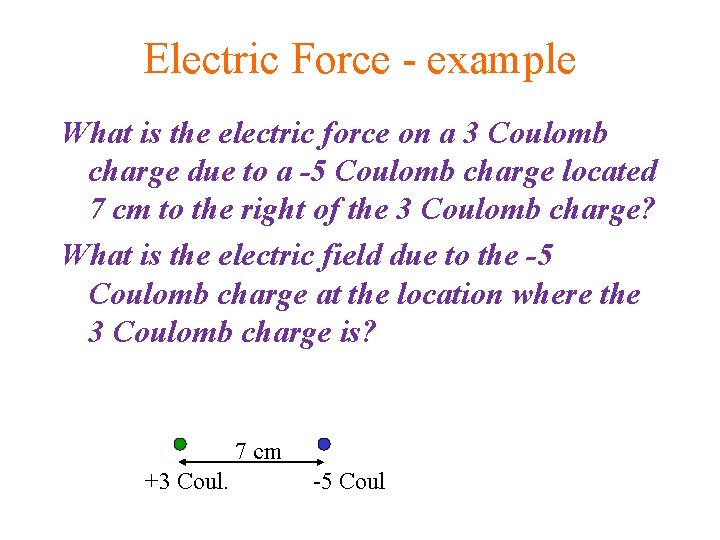
Electric Force - example What is the electric force on a 3 Coulomb charge due to a -5 Coulomb charge located 7 cm to the right of the 3 Coulomb charge? What is the electric field due to the -5 Coulomb charge at the location where the 3 Coulomb charge is? 7 cm +3 Coul. -5 Coul
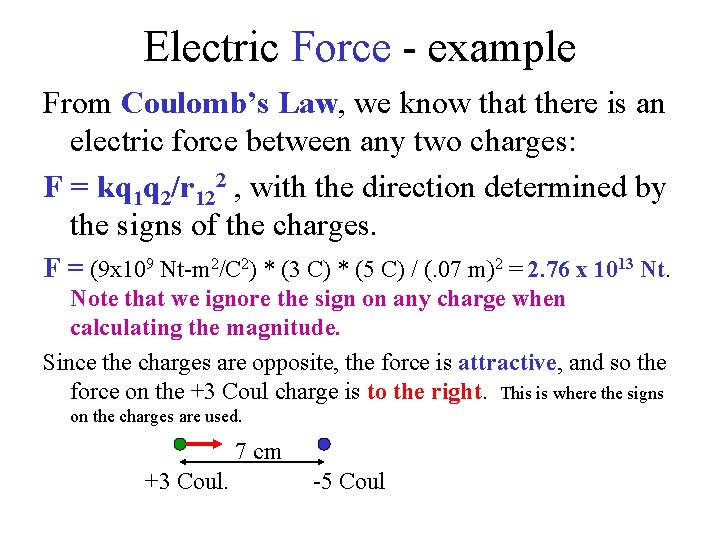
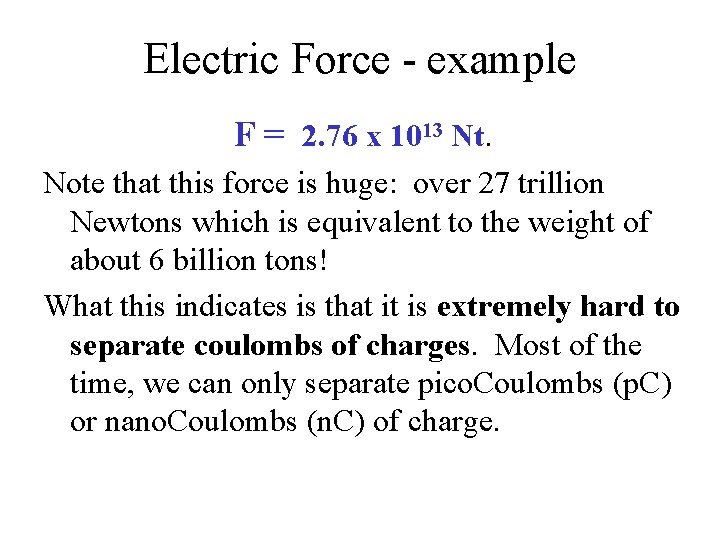
Electric Force - example From Coulomb’s Law, we know that there is an electric force between any two charges: F = kq 1 q 2/r 122 , with the direction determined by the signs of the charges. F = (9 x 10⁹ Nt-m 2/C 2) * (3 C) * (5 C) / (. 07 m)2 = 2. 76 x 1013 Nt. Note that we ignore the sign on any charge when calculating the magnitude. Since the charges are opposite, the force is attractive, and so the force on the +3 Coul charge is to the right. This is where the signs on the charges are used. 7 cm +3 Coul. -5 Coul
Electric Force - example F = 2. 76 x 1013 Nt. Note that this force is huge: over 27 trillion Newtons which is equivalent to the weight of about 6 billion tons! What this indicates is that it is extremely hard to separate coulombs of charges. Most of the time, we can only separate pico. Coulombs (p. C) or nano. Coulombs (n. C) of charge.
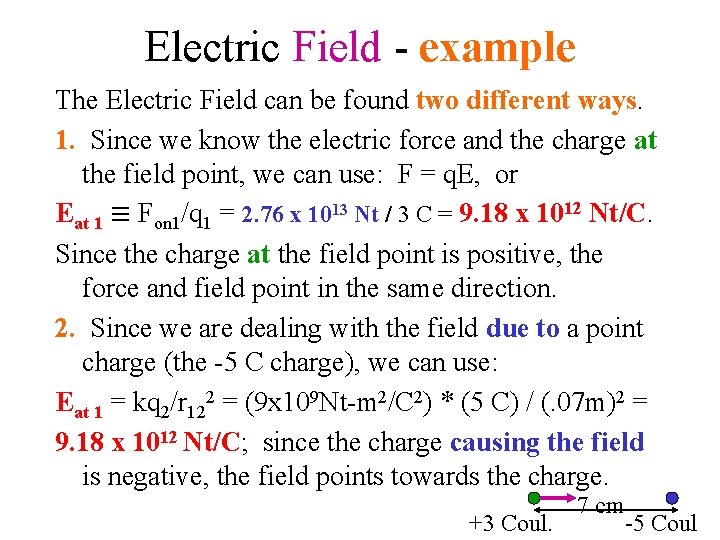
Electric Field - example The Electric Field can be found two different ways. 1. Since we know the electric force and the charge at the field point, we can use: F = q. E, or Eat 1 ≡ Fon 1/q 1 = 2. 76 x 1013 Nt / 3 C = 9. 18 x 1012 Nt/C. Since the charge at the field point is positive, the force and field point in the same direction. 2. Since we are dealing with the field due to a point charge (the -5 C charge), we can use: Eat 1 = kq 2/r 122 = (9 x 10⁹ Nt-m 2/C 2) * (5 C) / (. 07 m)2 = 9. 18 x 1012 Nt/C; since the charge causing the field is negative, the field points towards the charge. +3 Coul. 7 cm -5 Coul
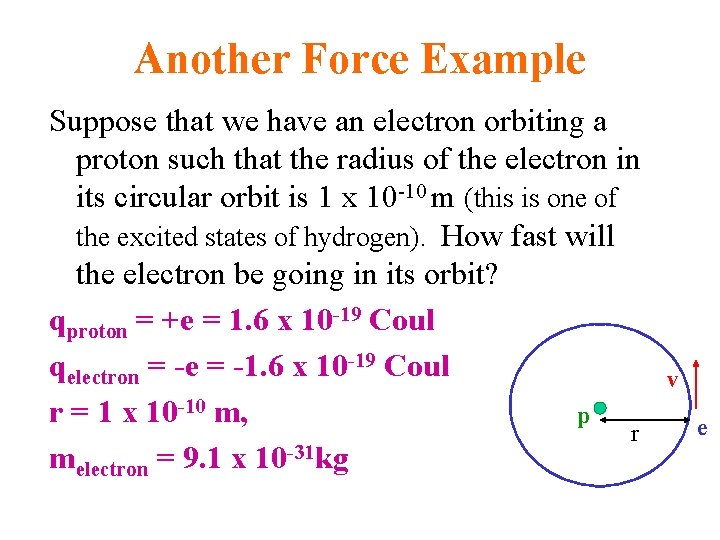
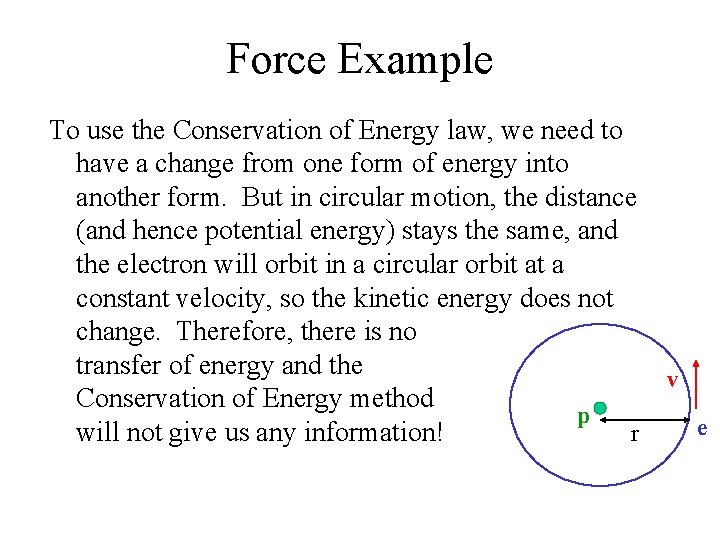
Another Force Example Suppose that we have an electron orbiting a proton such that the radius of the electron in its circular orbit is 1 x 10 -10 m (this is one of the excited states of hydrogen). How fast will the electron be going in its orbit? qproton = +e = 1. 6 x 10 -19 Coul qelectron = -e = -1. 6 x 10 -19 Coul r = 1 x 10 -10 m, p r melectron = 9. 1 x 10 -31 kg v e
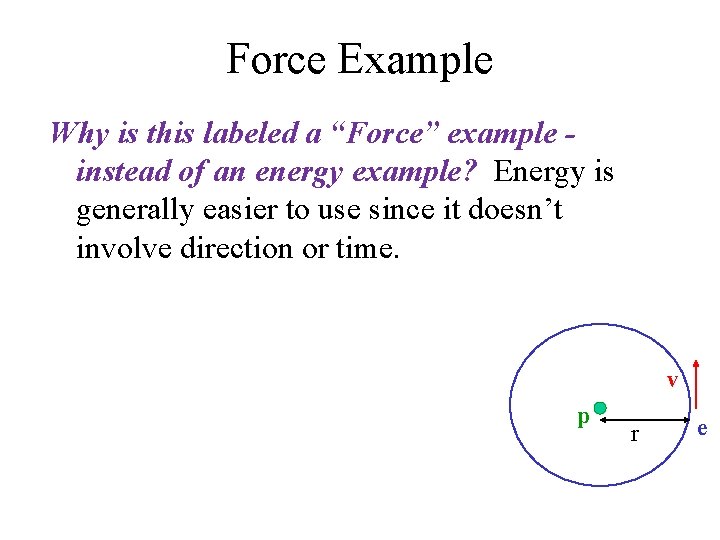
Force Example Why is this labeled a “Force” example instead of an energy example? Energy is generally easier to use since it doesn’t involve direction or time. v p r e
Force Example To use the Conservation of Energy law, we need to have a change from one form of energy into another form. But in circular motion, the distance (and hence potential energy) stays the same, and the electron will orbit in a circular orbit at a constant velocity, so the kinetic energy does not change. Therefore, there is no transfer of energy and the Conservation of Energy method p r will not give us any information! v e
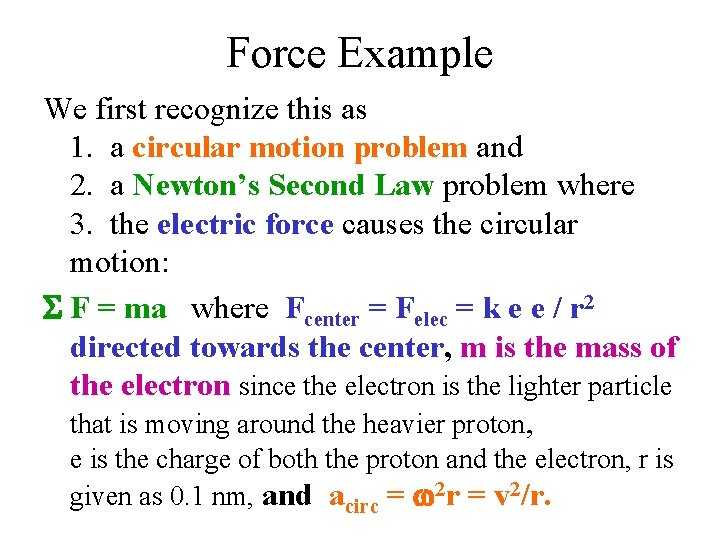
Force Example We first recognize this as 1. a circular motion problem and 2. a Newton’s Second Law problem where 3. the electric force causes the circular motion: S F = ma where Fcenter = Felec = k e e / r 2 directed towards the center, m is the mass of the electron since the electron is the lighter particle that is moving around the heavier proton, e is the charge of both the proton and the electron, r is given as 0. 1 nm, and acirc = w 2 r = v 2/r.
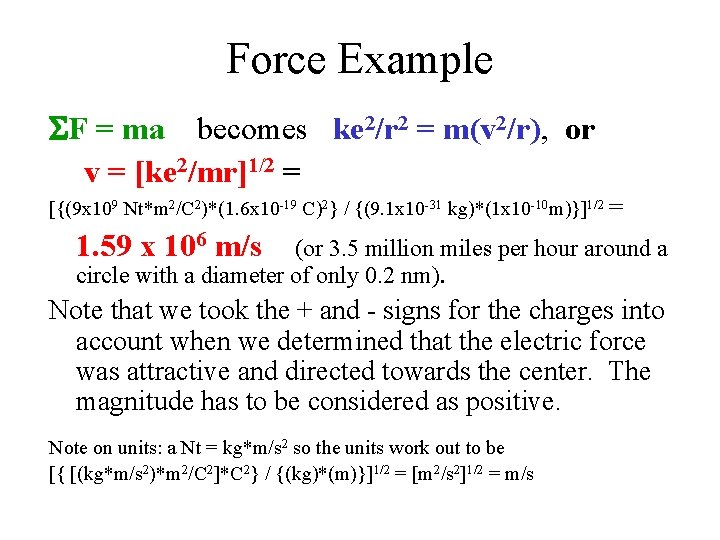
Force Example SF = ma becomes ke 2/r 2 = m(v 2/r), or v = [ke 2/mr]1/2 = [{(9 x 10⁹ Nt*m 2/C 2)*(1. 6 x 10 -19 C)2} / {(9. 1 x 10 -31 kg)*(1 x 10 -10 m)}]1/2 = 1. 59 x 106 m/s (or 3. 5 million miles per hour around a circle with a diameter of only 0. 2 nm). Note that we took the + and - signs for the charges into account when we determined that the electric force was attractive and directed towards the center. The magnitude has to be considered as positive. Note on units: a Nt = kg*m/s 2 so the units work out to be [{ [(kg*m/s 2)*m 2/C 2]*C 2} / {(kg)*(m)}]1/2 = [m 2/s 2]1/2 = m/s
Finding Electric Fields We can calculate the electric field in space due to any number of charges in space by simply adding together the many individual Electric fields due to the point charges! (See Computer Homework, Vol 3 #1 & #2 for examples. These programs are NOT required for this course, but you may want to look at the Introductions and see how to work these types of problems. If you simply type in guesses, the computer will show you how to work the problems. )
Finding Electric Fields In the first laboratory experiment, Simulation of Electric Fields, we use a computer to perform the many vector additions required to look at the electric field due to several charges in several geometries. With the calculus, we can even determine the electric fields due to certain continuous distributions of charges, such as charges on a wire or a plate.
Electrical Energies Just as Newton’s Laws worked completely, but were difficult, so to, working with Electric Forces will be difficult. Just as with gravitation, in electricity we can solve many problems using the Conservation of Energy, a scalar equation that does not involve time or direction. This requires that we find an expression for the electric energy.
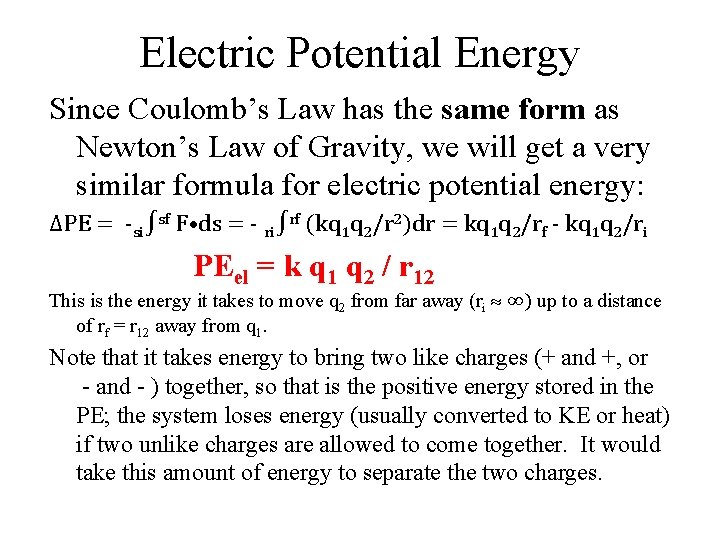
Electric Potential Energy Since Coulomb’s Law has the same form as Newton’s Law of Gravity, we will get a very similar formula for electric potential energy: ΔPE = -si∫sf F • ds = - ri∫rf (kq 1 q 2/r 2)dr = kq 1 q 2/rf - kq 1 q 2/ri PEel = k q 1 q 2 / r 12 This is the energy it takes to move q 2 from far away (ri ∞) up to a distance of rf = r 12 away from q 1. Note that it takes energy to bring two like charges (+ and +, or - and - ) together, so that is the positive energy stored in the PE; the system loses energy (usually converted to KE or heat) if two unlike charges are allowed to come together. It would take this amount of energy to separate the two charges.
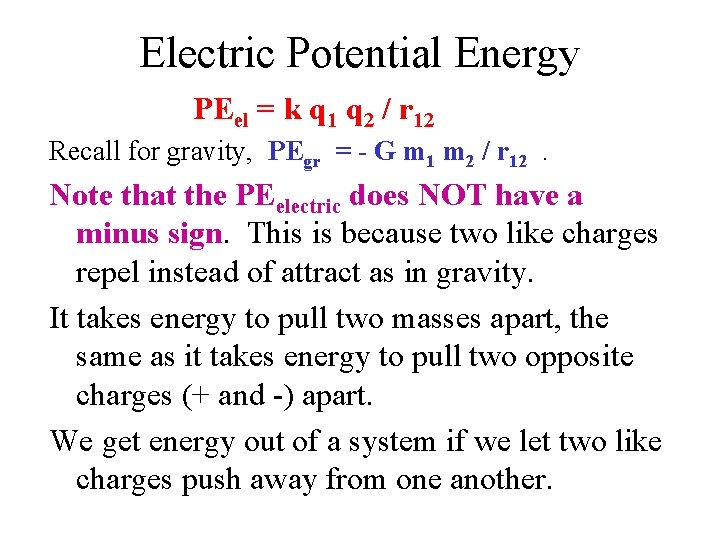
Electric Potential Energy PEel = k q 1 q 2 / r 12 Recall for gravity, PEgr = - G m 1 m 2 / r 12. Note that the PEelectric does NOT have a minus sign. This is because two like charges repel instead of attract as in gravity. It takes energy to pull two masses apart, the same as it takes energy to pull two opposite charges (+ and -) apart. We get energy out of a system if we let two like charges push away from one another.
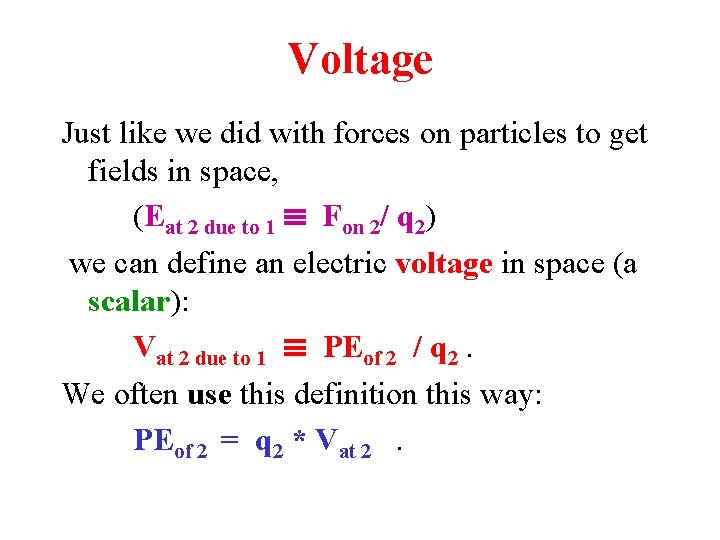
Voltage Just like we did with forces on particles to get fields in space, (Eat 2 due to 1 ≡ Fon 2/ q 2) we can define an electric voltage in space (a scalar): Vat 2 due to 1 ≡ PEof 2 / q 2. We often use this definition this way: PEof 2 = q 2 * Vat 2.
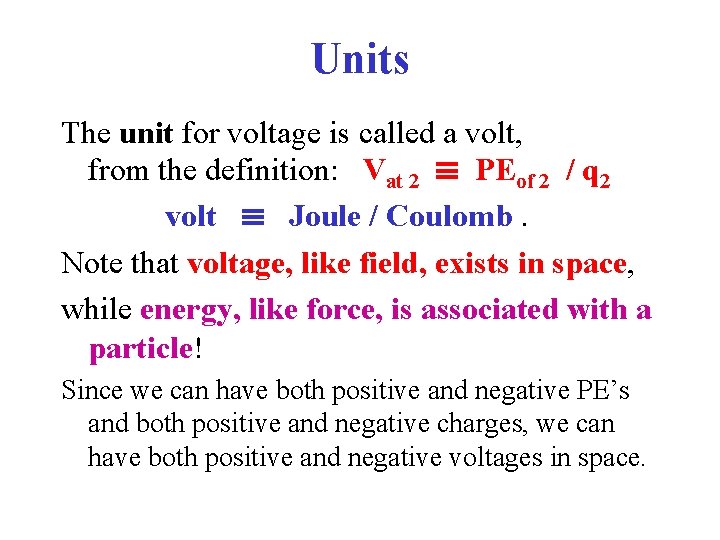
Units The unit for voltage is called a volt, from the definition: Vat 2 ≡ PEof 2 / q 2 volt ≡ Joule / Coulomb. Note that voltage, like field, exists in space, while energy, like force, is associated with a particle! Since we can have both positive and negative PE’s and both positive and negative charges, we can have both positive and negative voltages in space.
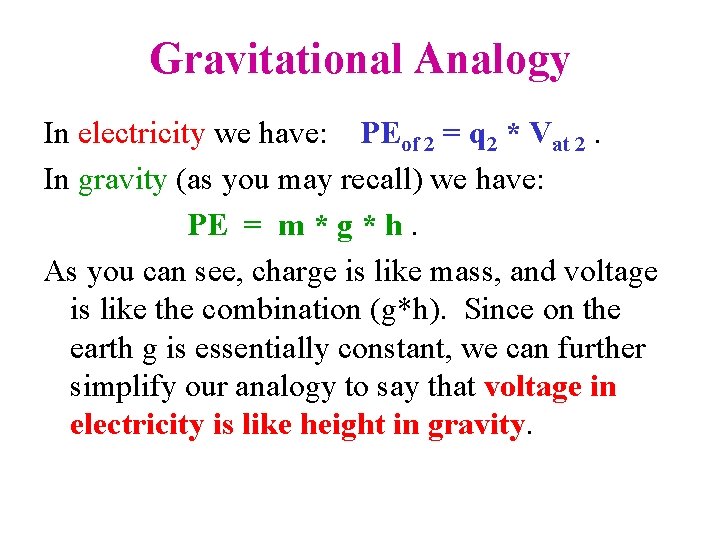
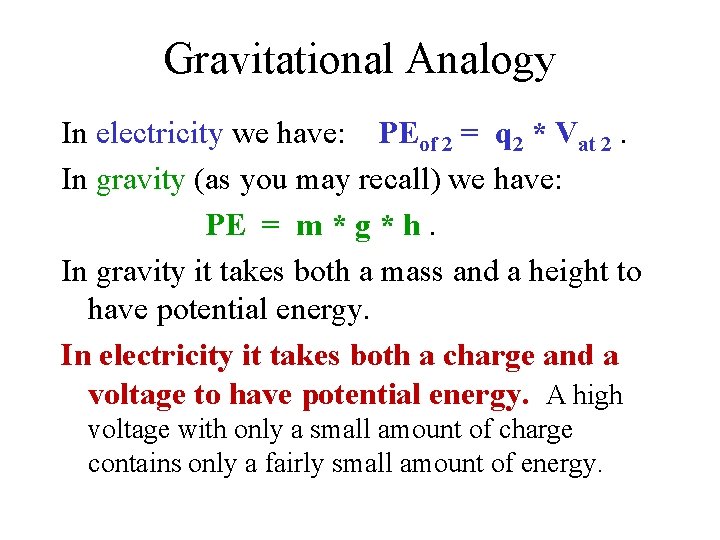
Gravitational Analogy In electricity we have: PEof 2 = q 2 * Vat 2. In gravity (as you may recall) we have: PE = m * g * h. As you can see, charge is like mass, and voltage is like the combination (g*h). Since on the earth g is essentially constant, we can further simplify our analogy to say that voltage in electricity is like height in gravity.
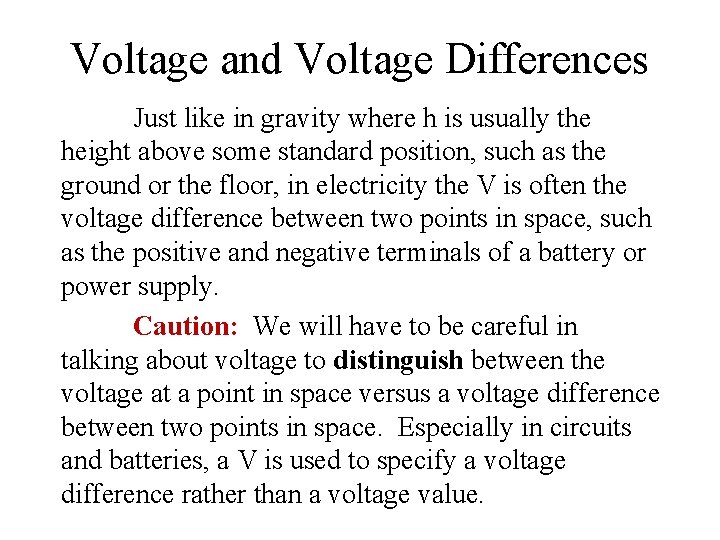
Voltage and Voltage Differences Just like in gravity where h is usually the height above some standard position, such as the ground or the floor, in electricity the V is often the voltage difference between two points in space, such as the positive and negative terminals of a battery or power supply. Caution: We will have to be careful in talking about voltage to distinguish between the voltage at a point in space versus a voltage difference between two points in space. Especially in circuits and batteries, a V is used to specify a voltage difference rather than a voltage value.
Gravitational Analogy In electricity we have: PEof 2 = q 2 * Vat 2. In gravity (as you may recall) we have: PE = m * g * h. In gravity it takes both a mass and a height to have potential energy. In electricity it takes both a charge and a voltage to have potential energy. A high voltage with only a small amount of charge contains only a fairly small amount of energy.
Different batteries what is different? 1. What is the difference between a 9 volt battery and a AAA battery? 2. What is the difference between a AAA battery and a D battery? 3. What is the difference between a 9 volt battery and a 12 volt car battery? Which is more dangerous? Why?
Batteries - cont. 1. The 9 volt battery supplies a 9 volt difference between the + and – terminals of the battery. The AAA battery supplies 1. 5 volts actually a 1. 5 volt difference between the two terminals. 2. Both the AAA battery and the D battery supply the same 1. 5 volts. Since the D battery is physically bigger, though, it has more chemicals in it that can supply more energy - it can push (lift up) MORE charge through the 1. 5 volt difference than the AAA battery can.
Batteries - cont. 3. Obviously the 9 volt battery has less voltage (actually voltage difference) than the 12 volt car battery. But does that make the car battery only 33% more dangerous? The car battery is much bigger and so has MUCH more energy. The car battery can push lots more charges through the 12 volts than the 9 volt can push through 9 volts. Remember that energy is the capacity to do work, either for good or bad.
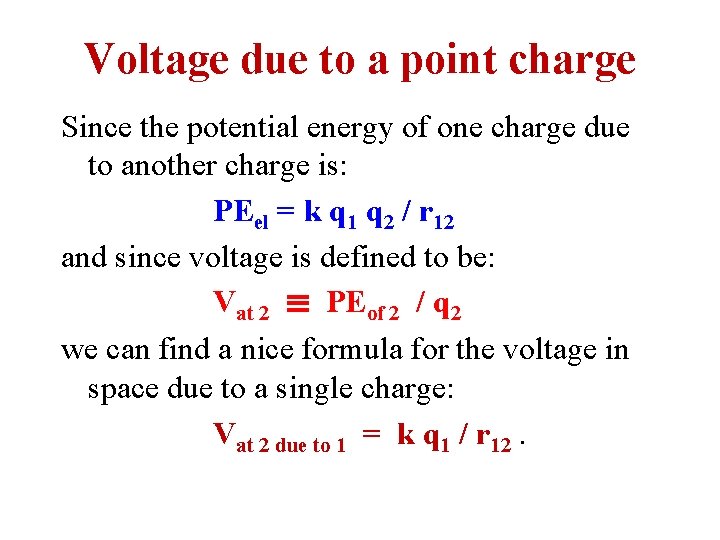
Voltage due to a point charge Since the potential energy of one charge due to another charge is: PEel = k q 1 q 2 / r 12 and since voltage is defined to be: Vat 2 ≡ PEof 2 / q 2 we can find a nice formula for the voltage in space due to a single charge: Vat 2 due to 1 = k q 1 / r 12.
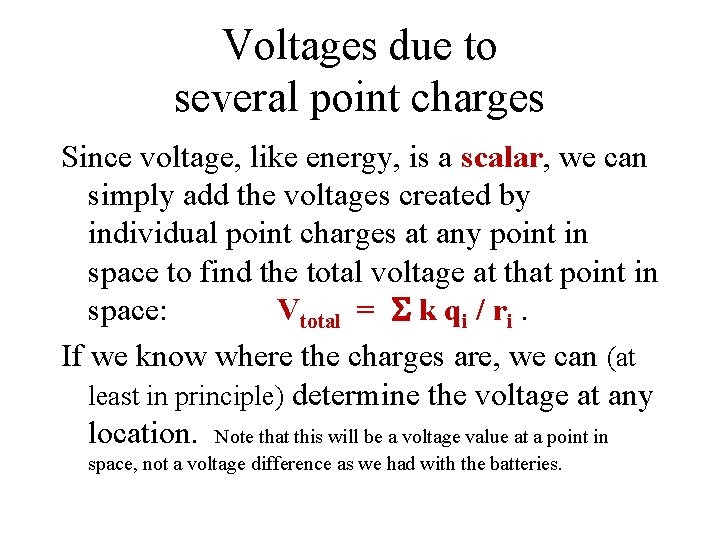
Voltages due to several point charges Since voltage, like energy, is a scalar, we can simply add the voltages created by individual point charges at any point in space to find the total voltage at that point in space: Vtotal = S k qi / ri. If we know where the charges are, we can (at least in principle) determine the voltage at any location. Note that this will be a voltage value at a point in space, not a voltage difference as we had with the batteries.
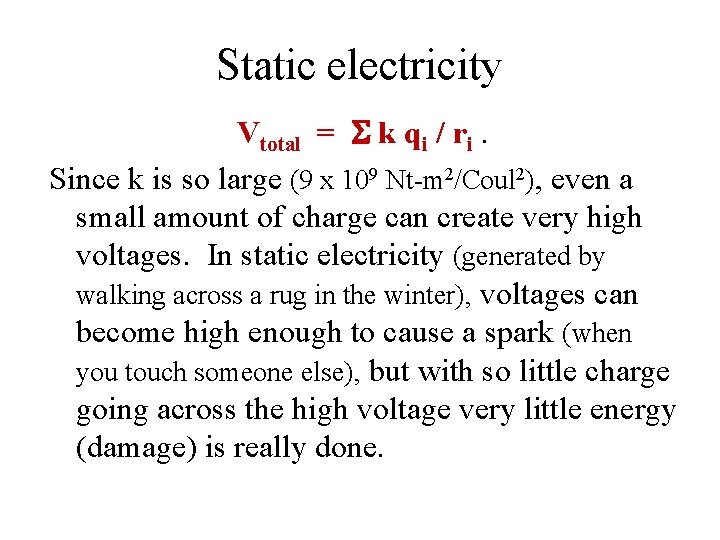
Static electricity Vtotal = S k qi / ri. Since k is so large (9 x 10⁹ Nt-m 2/Coul 2), even a small amount of charge can create very high voltages. In static electricity (generated by walking across a rug in the winter), voltages can become high enough to cause a spark (when you touch someone else), but with so little charge going across the high voltage very little energy (damage) is really done.
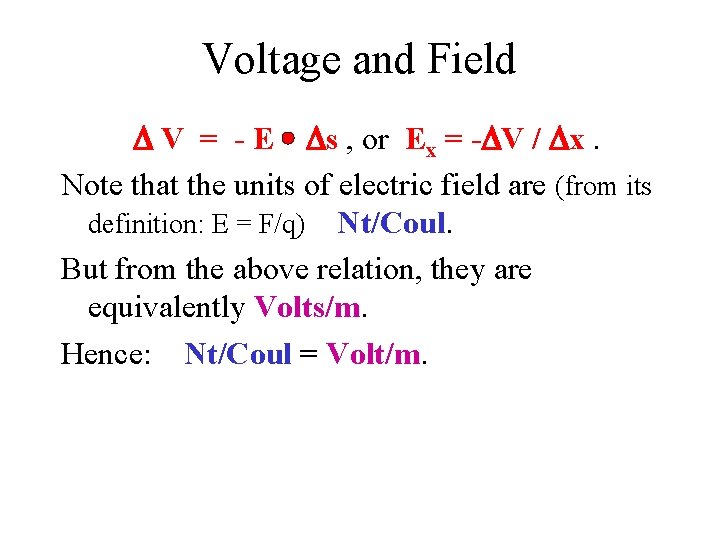
Voltages and Electric Fields Just like force and work are related, D PE = W = - F Ds, so too are electric field and voltage: D V = - E Ds. The dot indicates a vector dot product: the magnitude of the first vector times the magnitude of the second vector times the cosine of the angle between the two vectors. Note that voltage changes only in the direction of electric field. This also means that there is no electric field in directions in which the voltage is constant.
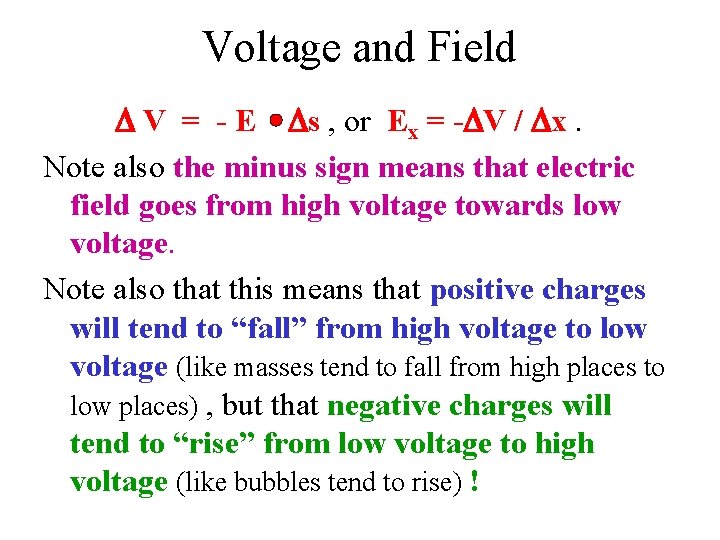
Voltage and Field D V = - E Ds , or Ex = -DV / Dx. Note also the minus sign means that electric field goes from high voltage towards low voltage. Note also that this means that positive charges will tend to “fall” from high voltage to low voltage (like masses tend to fall from high places to low places) , but that negative charges will tend to “rise” from low voltage to high voltage (like bubbles tend to rise) !
Voltage and Field D V = - E Ds , or Ex = -DV / Dx. Note that the units of electric field are (from its definition: E = F/q) Nt/Coul. But from the above relation, they are equivalently Volts/m. Hence: Nt/Coul = Volt/m.
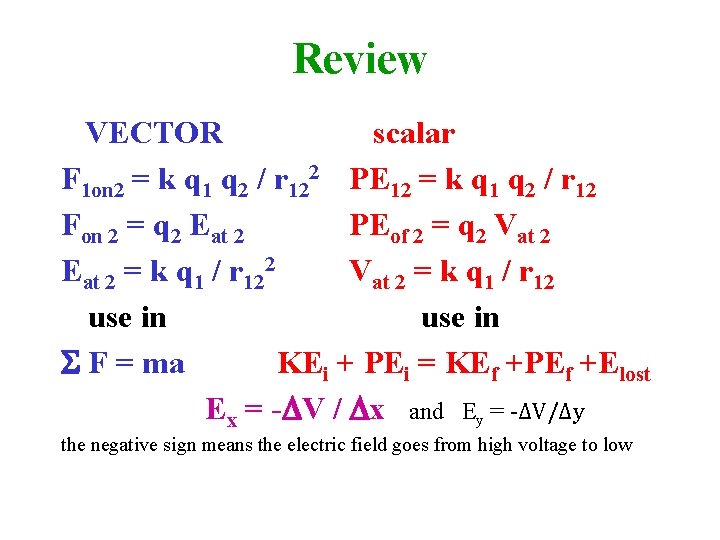
Review VECTOR scalar F 1 on 2 = k q 1 q 2 / r 122 PE 12 = k q 1 q 2 / r 12 Fon 2 = q 2 Eat 2 PEof 2 = q 2 Vat 2 Eat 2 = k q 1 / r 122 Vat 2 = k q 1 / r 12 use in S F = ma KEi + PEi = KEf +PEf +Elost Ex = -DV / Dx and Ey = -ΔV/Δy the negative sign means the electric field goes from high voltage to low
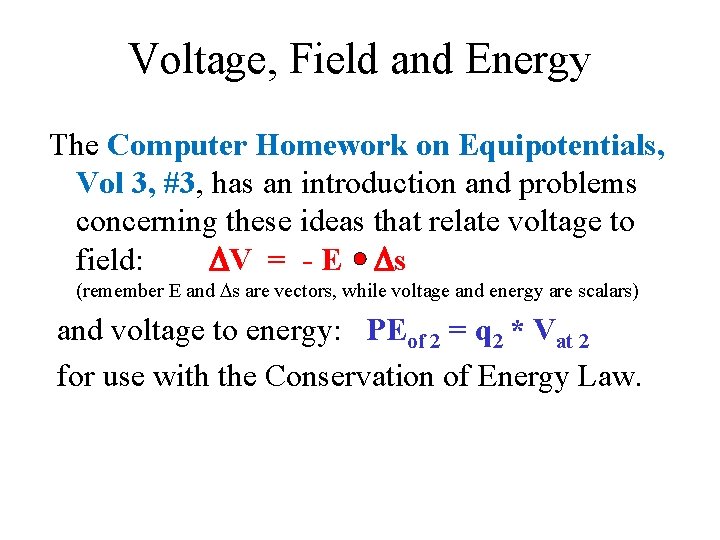
Voltage, Field and Energy The Computer Homework on Equipotentials, Vol 3, #3, has an introduction and problems concerning these ideas that relate voltage to field: DV = - E Ds (remember E and Ds are vectors, while voltage and energy are scalars) and voltage to energy: PEof 2 = q 2 * Vat 2 for use with the Conservation of Energy Law.
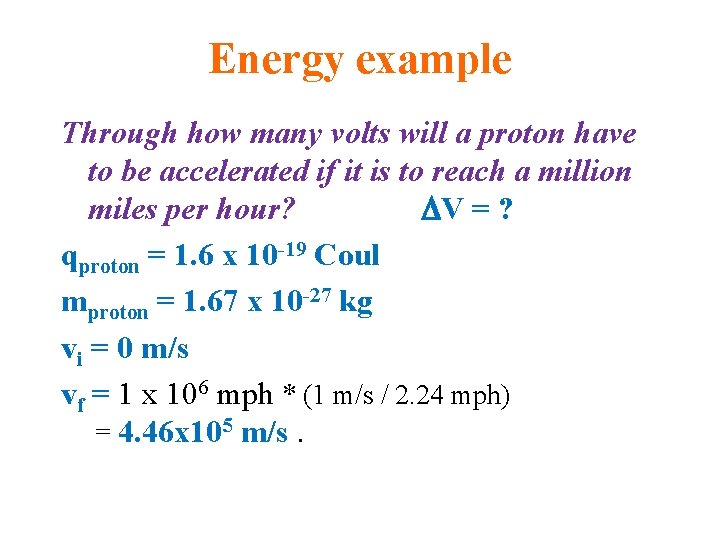
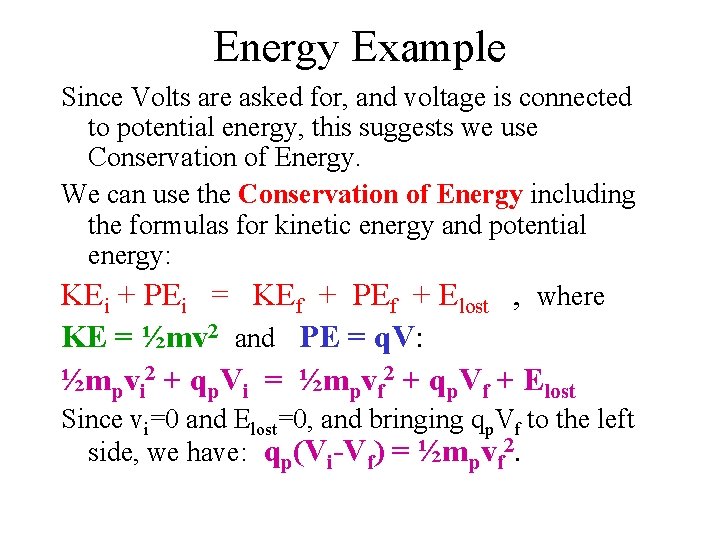
Energy example Through how many volts will a proton have to be accelerated if it is to reach a million miles per hour? DV = ? qproton = 1. 6 x 10 -19 Coul mproton = 1. 67 x 10 -27 kg vi = 0 m/s vf = 1 x 106 mph * (1 m/s / 2. 24 mph) = 4. 46 x 105 m/s.
Energy Example Since Volts are asked for, and voltage is connected to potential energy, this suggests we use Conservation of Energy. We can use the Conservation of Energy including the formulas for kinetic energy and potential energy: KEi + PEi = KEf + PEf + Elost , where KE = ½mv 2 and PE = q. V: ½mpvi 2 + qp. Vi = ½mpvf 2 + qp. Vf + Elost Since vi=0 and Elost=0, and bringing qp. Vf to the left side, we have: qp(Vi-Vf) = ½mpvf 2.
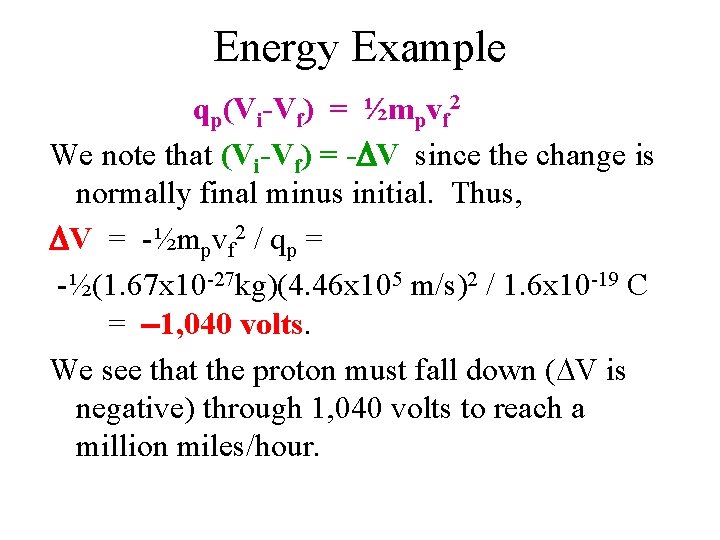
Energy Example qp(Vi-Vf) = ½mpvf 2 We note that (Vi-Vf) = -DV since the change is normally final minus initial. Thus, DV = -½mpvf 2 / qp = -½(1. 67 x 10 -27 kg)(4. 46 x 105 m/s)2 / 1. 6 x 10 -19 C = -1, 040 volts. We see that the proton must fall down (DV is negative) through 1, 040 volts to reach a million miles/hour.
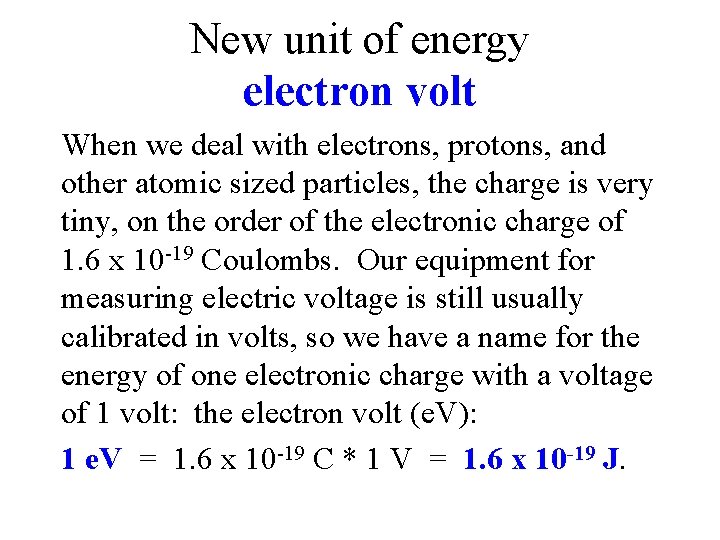
New unit of energy electron volt When we deal with electrons, protons, and other atomic sized particles, the charge is very tiny, on the order of the electronic charge of 1. 6 x 10 -19 Coulombs. Our equipment for measuring electric voltage is still usually calibrated in volts, so we have a name for the energy of one electronic charge with a voltage of 1 volt: the electron volt (e. V): 1 e. V = 1. 6 x 10 -19 C * 1 V = 1. 6 x 10 -19 J.
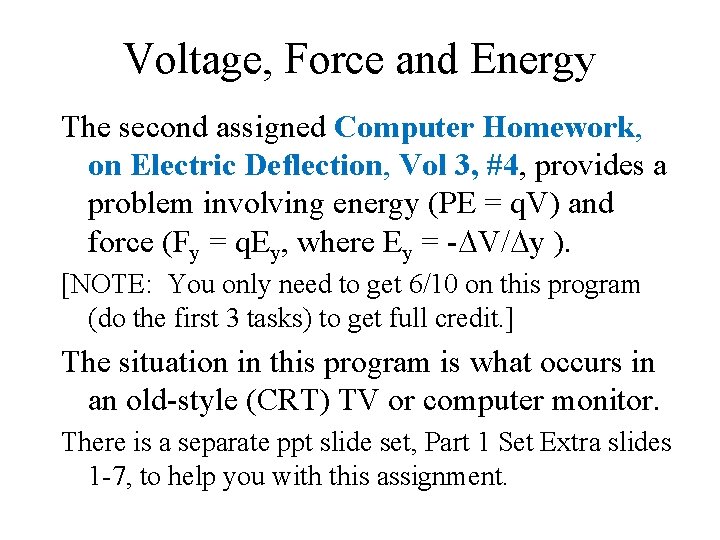
Voltage, Force and Energy The second assigned Computer Homework, on Electric Deflection, Vol 3, #4, provides a problem involving energy (PE = q. V) and force (Fy = q. Ey, where Ey = -DV/Dy ). [NOTE: You only need to get 6/10 on this program (do the first 3 tasks) to get full credit. ] The situation in this program is what occurs in an old-style (CRT) TV or computer monitor. There is a separate ppt slide set, Part 1 Set Extra slides 1 -7, to help you with this assignment.