
Physics Forces 1 Key Concepts Contact and noncontact
- Slides: 3
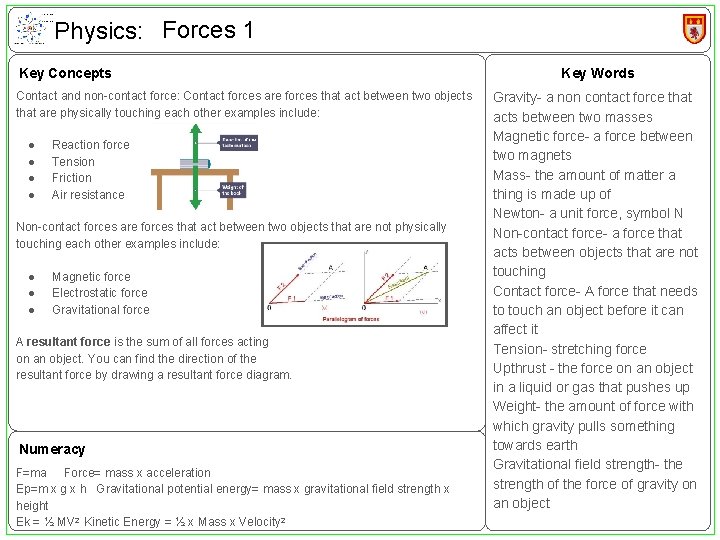
Physics: Forces 1 Key Concepts Contact and non-contact force: Contact forces are forces that act between two objects that are physically touching each other examples include: ● ● Reaction force Tension Friction Air resistance Non-contact forces are forces that act between two objects that are not physically touching each other examples include: ● ● ● Magnetic force Electrostatic force Gravitational force A resultant force is the sum of all forces acting on an object. You can find the direction of the resultant force by drawing a resultant force diagram. Numeracy F=ma Force= mass x acceleration Ep=m x g x h Gravitational potential energy= mass x gravitational field strength x height Ek = ½ MV 2 Kinetic Energy = ½ x Mass x Velocity 2 Key Words Gravity- a non contact force that acts between two masses Magnetic force- a force between two magnets Mass- the amount of matter a thing is made up of Newton- a unit force, symbol N Non-contact force- a force that acts between objects that are not touching Contact force- A force that needs to touch an object before it can affect it Tension- stretching force Upthrust - the force on an object in a liquid or gas that pushes up Weight- the amount of force with which gravity pulls something towards earth Gravitational field strength- the strength of the force of gravity on an object
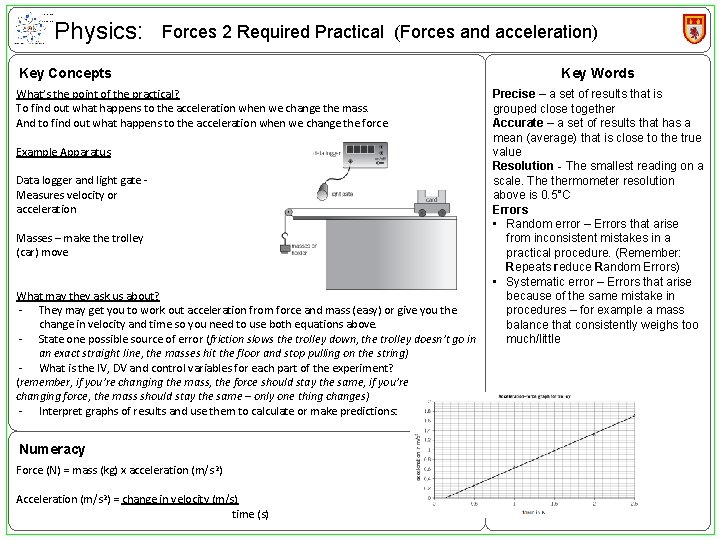
Physics: Forces 2 Required Practical (Forces and acceleration) Key Concepts What’s the point of the practical? To find out what happens to the acceleration when we change the mass. And to find out what happens to the acceleration when we change the force. Example Apparatus Data logger and light gate Measures velocity or acceleration Masses – make the trolley (car) move What may they ask us about? - They may get you to work out acceleration from force and mass (easy) or give you the change in velocity and time so you need to use both equations above. - State one possible source of error (friction slows the trolley down, the trolley doesn’t go in an exact straight line, the masses hit the floor and stop pulling on the string) - What is the IV, DV and control variables for each part of the experiment? (remember, if you’re changing the mass, the force should stay the same, if you’re changing force, the mass should stay the same – only one thing changes) - Interpret graphs of results and use them to calculate or make predictions: Numeracy Force (N) = mass (kg) x acceleration (m/s 2) Acceleration (m/s 2) = change in velocity (m/s) time (s) Key Words Precise – a set of results that is grouped close together Accurate – a set of results that has a mean (average) that is close to the true value Resolution - The smallest reading on a scale. The thermometer resolution above is 0. 5°C Errors • Random error – Errors that arise from inconsistent mistakes in a practical procedure. (Remember: Repeats reduce Random Errors) • Systematic error – Errors that arise because of the same mistake in procedures – for example a mass balance that consistently weighs too much/little
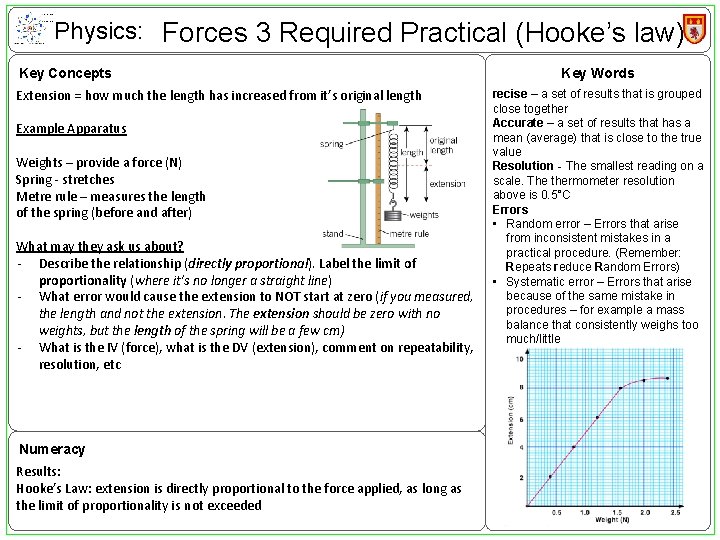
Physics: Forces 3 Required Practical (Hooke’s law) Key Concepts Extension = how much the length has increased from it’s original length Example Apparatus Weights – provide a force (N) Spring - stretches Metre rule – measures the length of the spring (before and after) What may they ask us about? - Describe the relationship (directly proportional). Label the limit of proportionality (where it’s no longer a straight line) - What error would cause the extension to NOT start at zero (if you measured, the length and not the extension. The extension should be zero with no weights, but the length of the spring will be a few cm) - What is the IV (force), what is the DV (extension), comment on repeatability, resolution, etc Numeracy Results: Hooke’s Law: extension is directly proportional to the force applied, as long as the limit of proportionality is not exceeded Key Words recise – a set of results that is grouped close together Accurate – a set of results that has a mean (average) that is close to the true value Resolution - The smallest reading on a scale. The thermometer resolution above is 0. 5°C Errors • Random error – Errors that arise from inconsistent mistakes in a practical procedure. (Remember: Repeats reduce Random Errors) • Systematic error – Errors that arise because of the same mistake in procedures – for example a mass balance that consistently weighs too much/little