
PHYSICS FORCE AND MOTION Speed Acceleration and Velocity
- Slides: 46
PHYSICS (FORCE AND MOTION): Speed, Acceleration, and Velocity Notes # 28 -37
Newton’s Theory of Motion To see well, we must stand on the shoulders of giants.
Why do we need clear, precise definitions? What’s the difference between: Øaverage speed and instantaneous speed? Øspeed and velocity? Øspeed and acceleration?
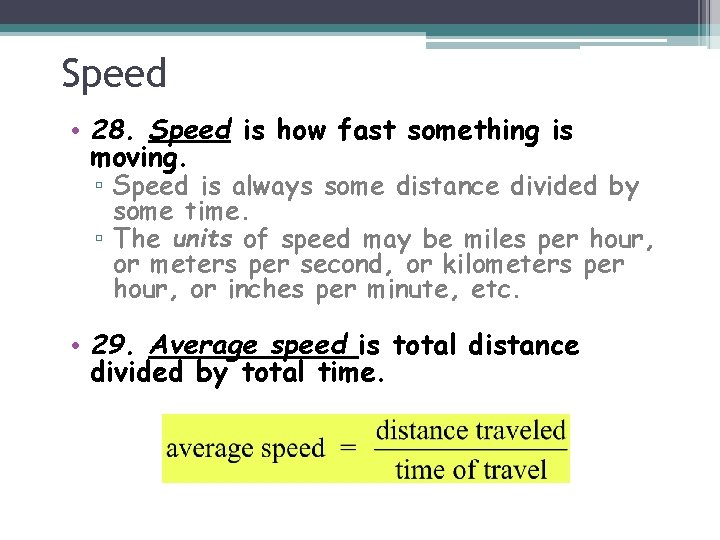
Speed • 28. Speed is how fast something is moving. ▫ Speed is always some distance divided by some time. ▫ The units of speed may be miles per hour, or meters per second, or kilometers per hour, or inches per minute, etc. • 29. Average speed is total distance divided by total time.
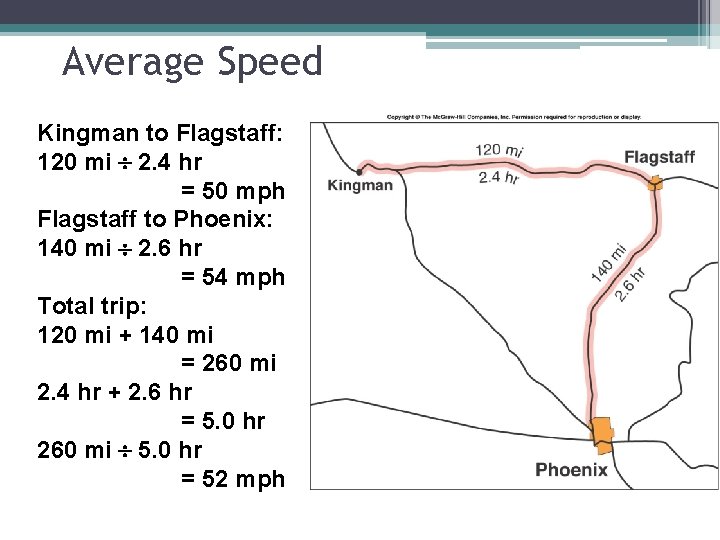
Average Speed Kingman to Flagstaff: 120 mi 2. 4 hr = 50 mph Flagstaff to Phoenix: 140 mi 2. 6 hr = 54 mph Total trip: 120 mi + 140 mi = 260 mi 2. 4 hr + 2. 6 hr = 5. 0 hr 260 mi 5. 0 hr = 52 mph
Speed (cont. ) • 30. Rate is one quantity divided by another quantity. ▫ For example: gallons per minute, pesos per dollar, points per game. ▫ So average speed is the rate at which distance is covered over time. • 31. Instantaneous speed is the speed at that precise instant in time. ▫ It is the rate at which distance is being covered at a given instant in time. ▫ It is found by calculating the average speed, over a short enough time that the speed does not change much.
What does a car’s speedometer measure? a) b) c) d) Average speed Instantaneous speed Average velocity Instantaneous velocity A speedometer measures instantaneous speed. (In a moment, we’ll see why a speedometer doesn’t measure velocity. )
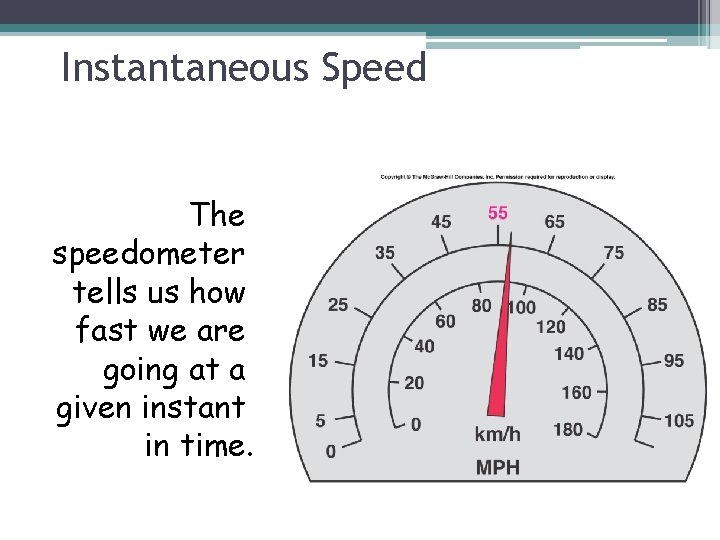
Instantaneous Speed The speedometer tells us how fast we are going at a given instant in time.
Which quantity is the highway patrol more interested in? a) Average speed b) Instantaneous speed The speed limit indicates the maximum legal instantaneous speed. To estimate the time a trip may take, you want to use average speed.
Velocity • 32. Velocity involves direction of motion as well as how fast the object is going. ▫ Velocity is a vector quantity. • 33. Vectors have both magnitude and direction. ▫ Velocity has a magnitude (the speed) and also a direction (which way the object is moving). • A change in velocity can be a change in the object’s speed or direction of motion. • A speedometer doesn’t indicate direction, so it indicates instantaneous speed but not velocity.
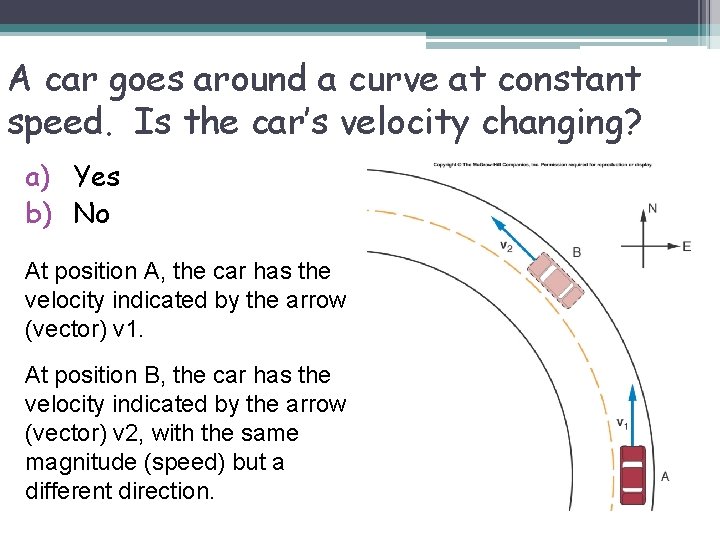
A car goes around a curve at constant speed. Is the car’s velocity changing? a) Yes b) No At position A, the car has the velocity indicated by the arrow (vector) v 1. At position B, the car has the velocity indicated by the arrow (vector) v 2, with the same magnitude (speed) but a different direction.
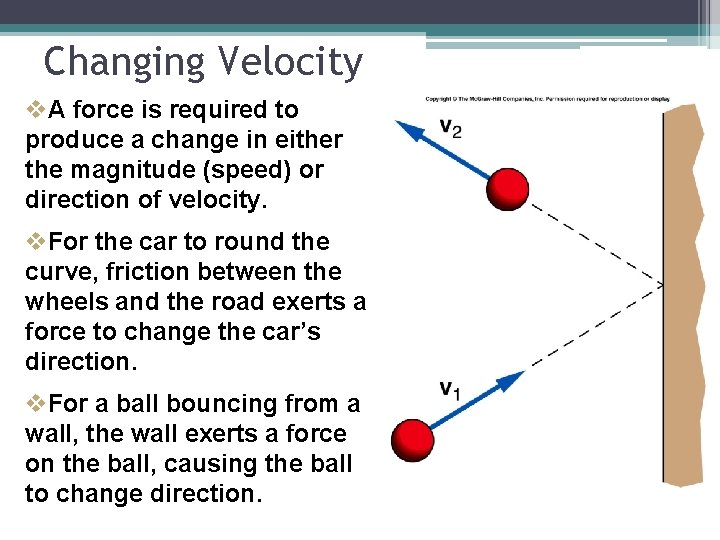
Changing Velocity v. A force is required to produce a change in either the magnitude (speed) or direction of velocity. v. For the car to round the curve, friction between the wheels and the road exerts a force to change the car’s direction. v. For a ball bouncing from a wall, the wall exerts a force on the ball, causing the ball to change direction.
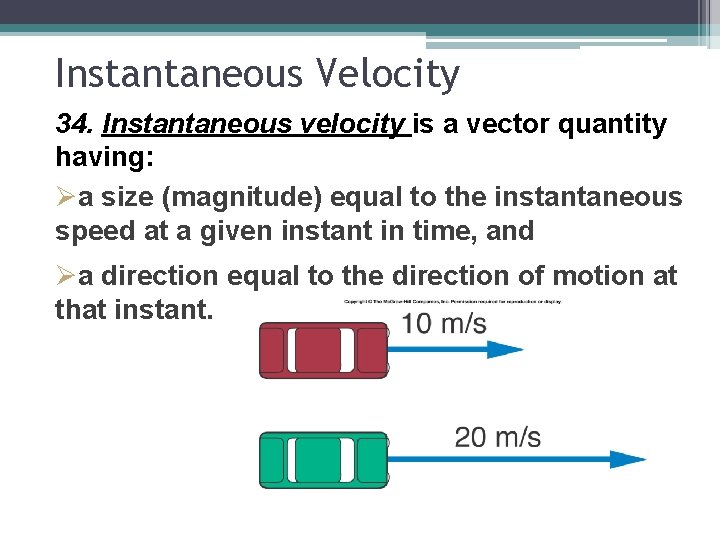
Instantaneous Velocity 34. Instantaneous velocity is a vector quantity having: Øa size (magnitude) equal to the instantaneous speed at a given instant in time, and Øa direction equal to the direction of motion at that instant.
Acceleration v 35. Acceleration can be either a change in the object’s speed or direction of motion. ▫ Our bodies feel acceleration. A car changing speed or direction. An elevator speeding up or slowing down. Our bodies don’t feel velocity, if the velocity is constant. Acceleration is the rate at which velocity changes.
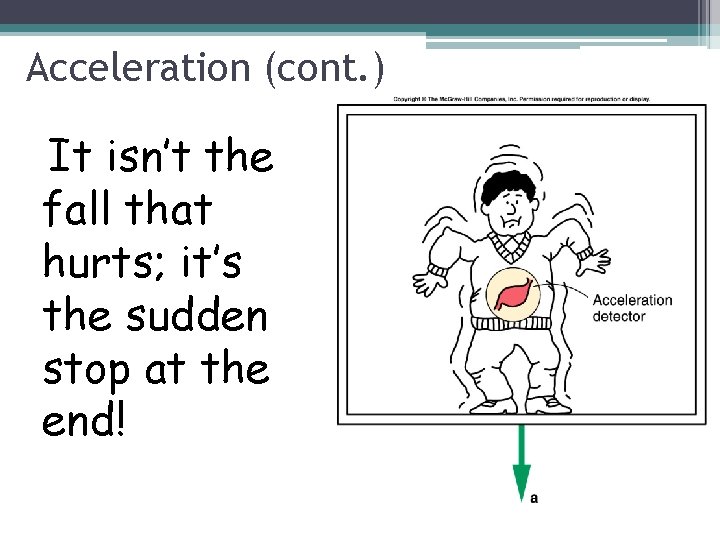
Acceleration (cont. ) It isn’t the fall that hurts; it’s the sudden stop at the end!
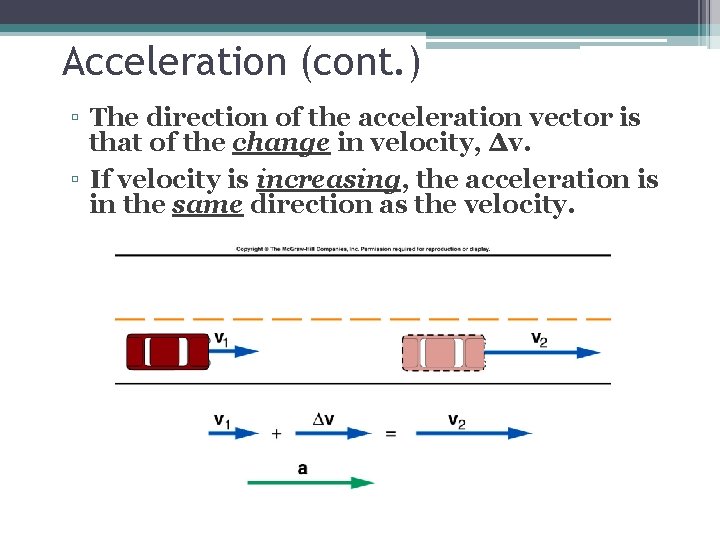
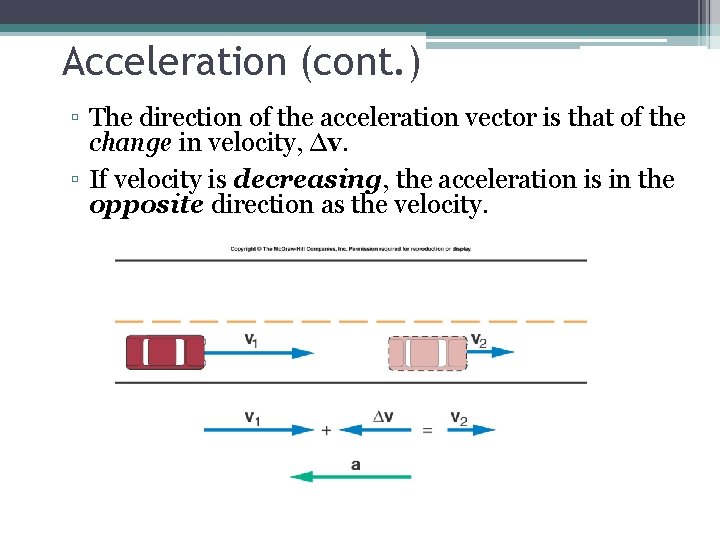
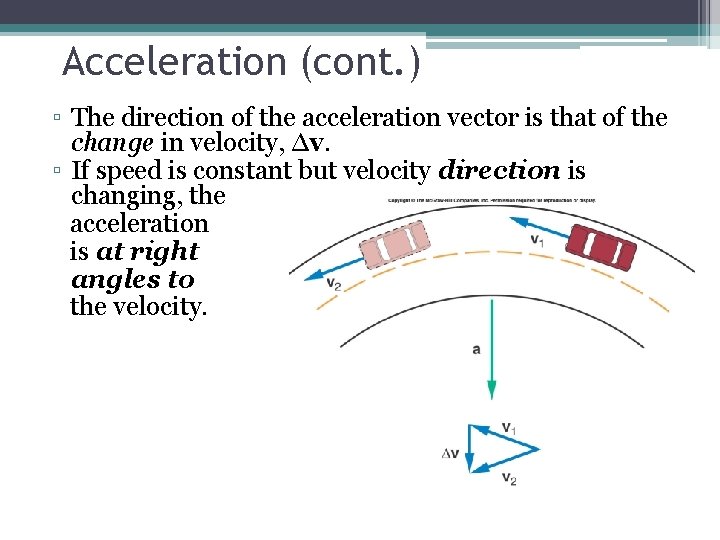
Acceleration (cont. ) • Acceleration is also a vector quantity, with magnitude and direction. ▫ The direction of the acceleration vector is that of the change in velocity, ∆v. ▫ Acceleration refers to any change in velocity. ▫ We even refer to a decrease in velocity (a slowing down) as an acceleration.
Acceleration (cont. ) ▫ The direction of the acceleration vector is that of the change in velocity, ∆v. ▫ If velocity is increasing, the acceleration is in the same direction as the velocity.
Acceleration (cont. ) ▫ The direction of the acceleration vector is that of the change in velocity, ∆v. ▫ If velocity is decreasing, the acceleration is in the opposite direction as the velocity.
Acceleration (cont. ) ▫ The direction of the acceleration vector is that of the change in velocity, ∆v. ▫ If speed is constant but velocity direction is changing, the acceleration is at right angles to the velocity.
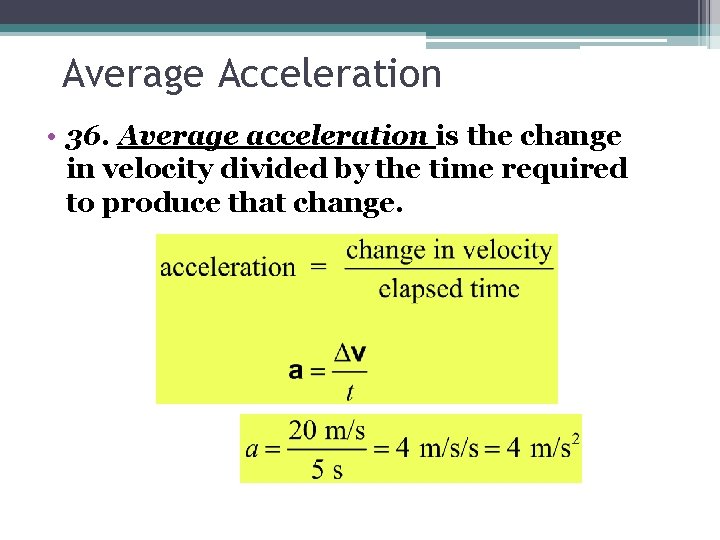
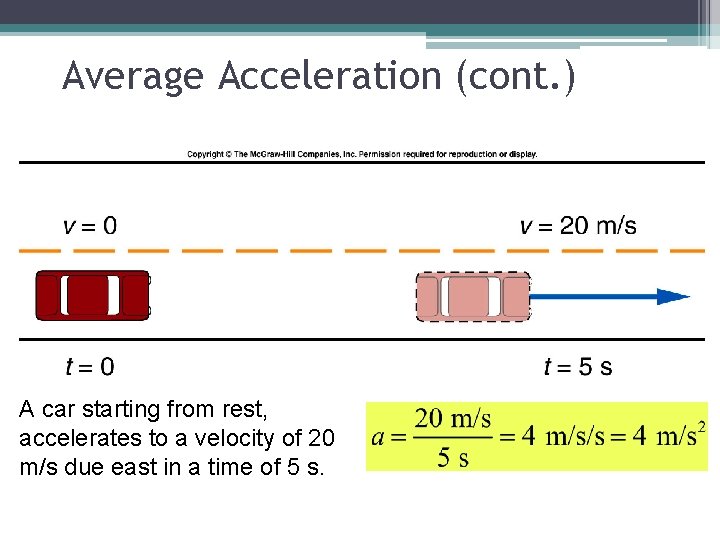
Average Acceleration • 36. Average acceleration is the change in velocity divided by the time required to produce that change.
Average Acceleration (cont. ) A car starting from rest, accelerates to a velocity of 20 m/s due east in a time of 5 s.
Instantaneous Acceleration v 37. Instantaneous acceleration is the acceleration at that precise instant in time. l. It is the rate at which velocity is changing at a given instant in time. l. It is found by calculating the average speed, over a short enough time that the speed does not change much.
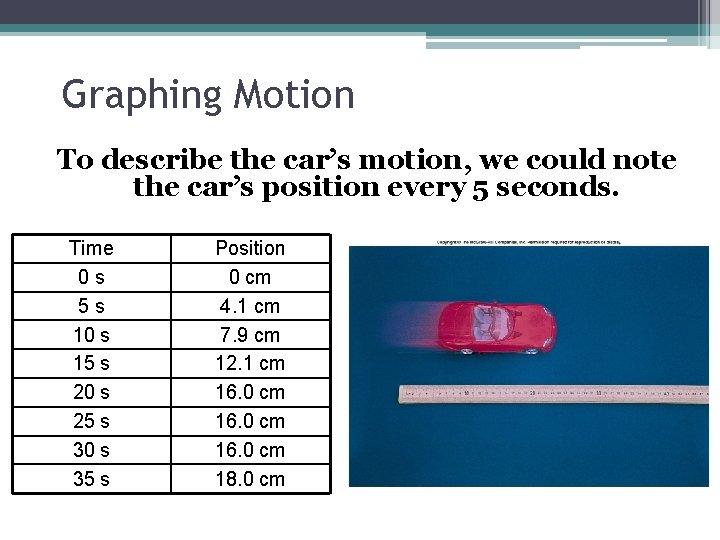
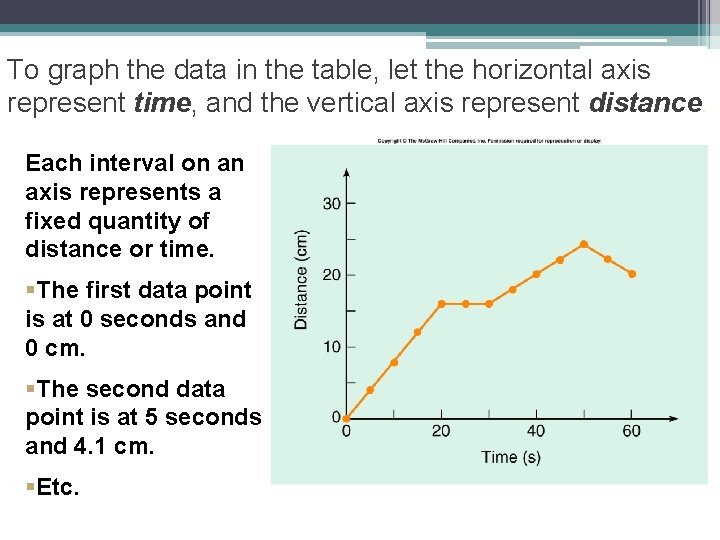
Graphing Motion To describe the car’s motion, we could note the car’s position every 5 seconds. Time 0 s 5 s 10 s 15 s 20 s 25 s 30 s 35 s Position 0 cm 4. 1 cm 7. 9 cm 12. 1 cm 16. 0 cm 18. 0 cm
Practice • Susan is on her bike going 6 miles to her friend Cindy’s house. What would her average speed be if it took her 1 hour to ride there. • S=D/T
To graph the data in the table, let the horizontal axis represent time, and the vertical axis represent distance. Each interval on an axis represents a fixed quantity of distance or time. §The first data point is at 0 seconds and 0 cm. §The second data point is at 5 seconds and 4. 1 cm. §Etc.
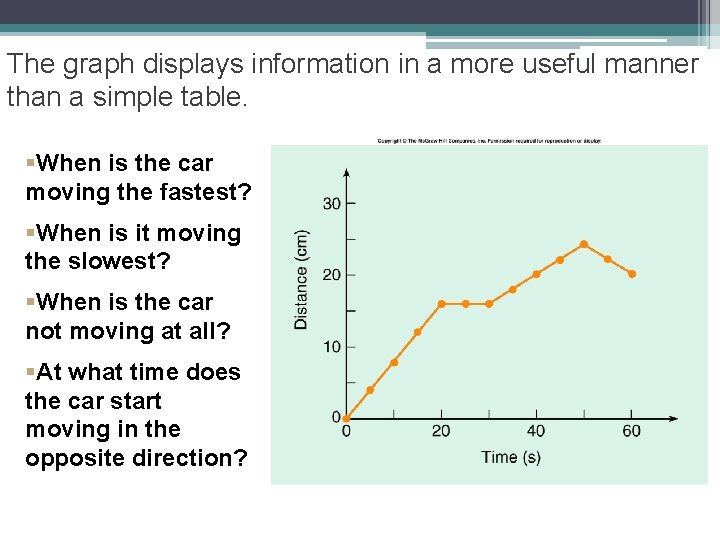
The graph displays information in a more useful manner than a simple table. §When is the car moving the fastest? §When is it moving the slowest? §When is the car not moving at all? §At what time does the car start moving in the opposite direction?
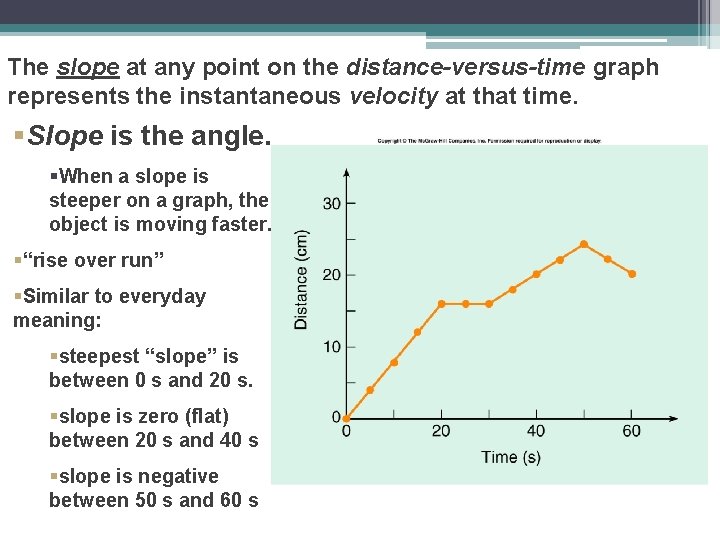
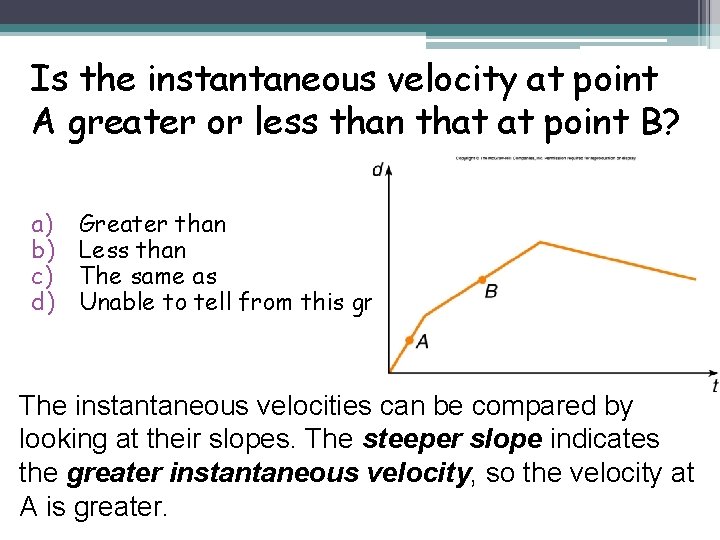
The slope at any point on the distance-versus-time graph represents the instantaneous velocity at that time. §Slope is the angle. §When a slope is steeper on a graph, the object is moving faster. §“rise over run” §Similar to everyday meaning: §steepest “slope” is between 0 s and 20 s. §slope is zero (flat) between 20 s and 40 s §slope is negative between 50 s and 60 s
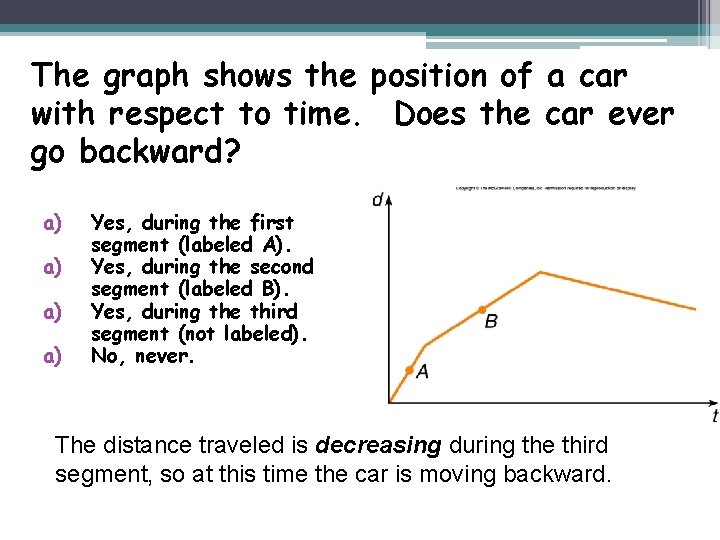
The graph shows the position of a car with respect to time. Does the car ever go backward? a) a) Yes, during the first segment (labeled A). Yes, during the second segment (labeled B). Yes, during the third segment (not labeled). No, never. The distance traveled is decreasing during the third segment, so at this time the car is moving backward.
Is the instantaneous velocity at point A greater or less than that at point B? a) b) c) d) Greater than Less than The same as Unable to tell from this graph The instantaneous velocities can be compared by looking at their slopes. The steeper slope indicates the greater instantaneous velocity, so the velocity at A is greater.
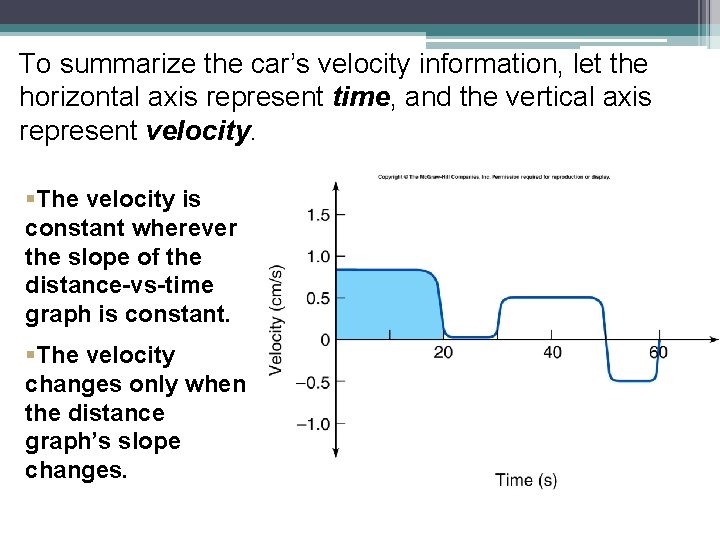
To summarize the car’s velocity information, let the horizontal axis represent time, and the vertical axis represent velocity. §The velocity is constant wherever the slope of the distance-vs-time graph is constant. §The velocity changes only when the distance graph’s slope changes.
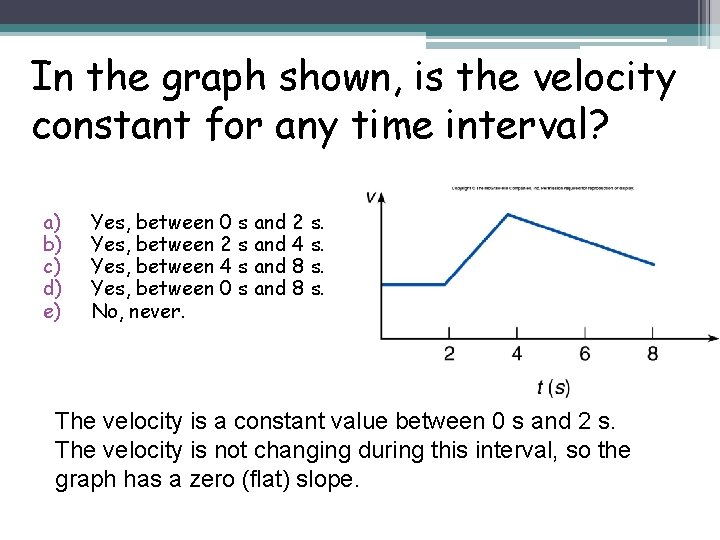
In the graph shown, is the velocity constant for any time interval? a) b) c) d) e) Yes, between 0 s and 2 s. Yes, between 2 s and 4 s. Yes, between 4 s and 8 s. Yes, between 0 s and 8 s. No, never. The velocity is a constant value between 0 s and 2 s. The velocity is not changing during this interval, so the graph has a zero (flat) slope.
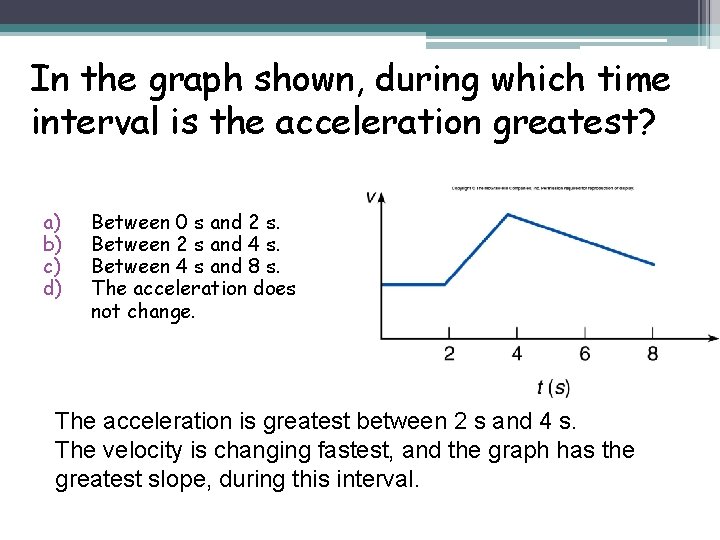
In the graph shown, during which time interval is the acceleration greatest? a) b) c) d) Between 0 s and 2 s. Between 2 s and 4 s. Between 4 s and 8 s. The acceleration does not change. The acceleration is greatest between 2 s and 4 s. The velocity is changing fastest, and the graph has the greatest slope, during this interval.
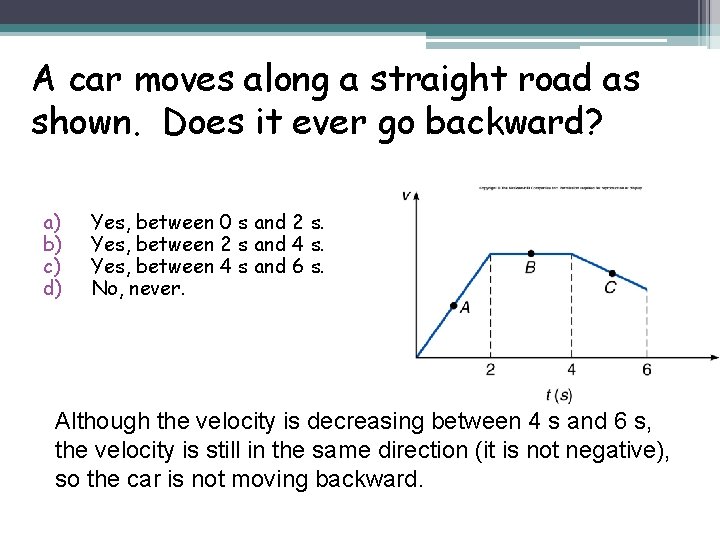
A car moves along a straight road as shown. Does it ever go backward? a) b) c) d) Yes, between 0 s and 2 s. Yes, between 2 s and 4 s. Yes, between 4 s and 6 s. No, never. Although the velocity is decreasing between 4 s and 6 s, the velocity is still in the same direction (it is not negative), so the car is not moving backward.
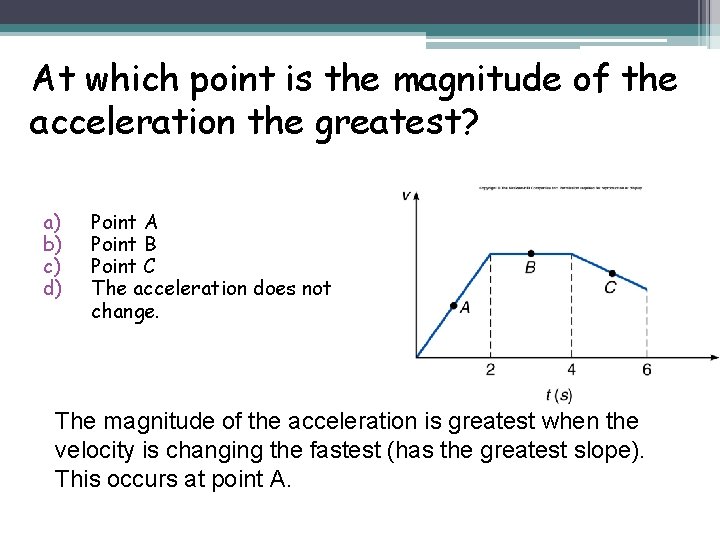
At which point is the magnitude of the acceleration the greatest? a) b) c) d) Point A Point B Point C The acceleration does not change. The magnitude of the acceleration is greatest when the velocity is changing the fastest (has the greatest slope). This occurs at point A.
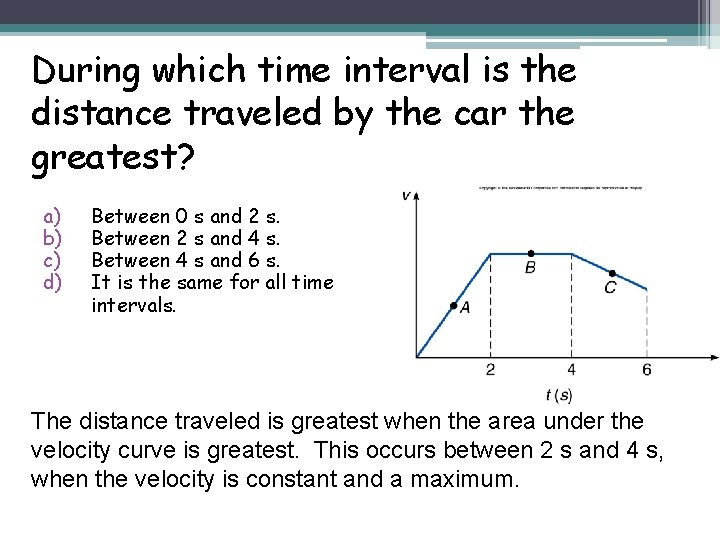
During which time interval is the distance traveled by the car the greatest? a) b) c) d) Between 0 s and 2 s. Between 2 s and 4 s. Between 4 s and 6 s. It is the same for all time intervals. The distance traveled is greatest when the area under the velocity curve is greatest. This occurs between 2 s and 4 s, when the velocity is constant and a maximum.
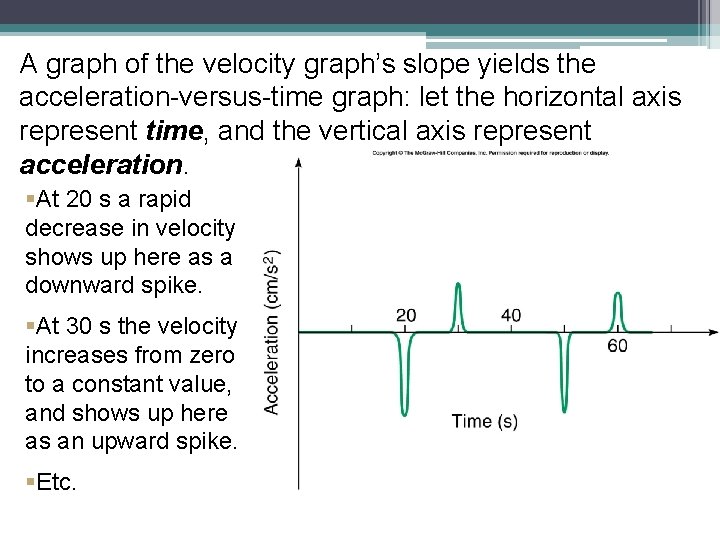
A graph of the velocity graph’s slope yields the acceleration-versus-time graph: let the horizontal axis represent time, and the vertical axis represent acceleration. §At 20 s a rapid decrease in velocity shows up here as a downward spike. §At 30 s the velocity increases from zero to a constant value, and shows up here as an upward spike. §Etc.
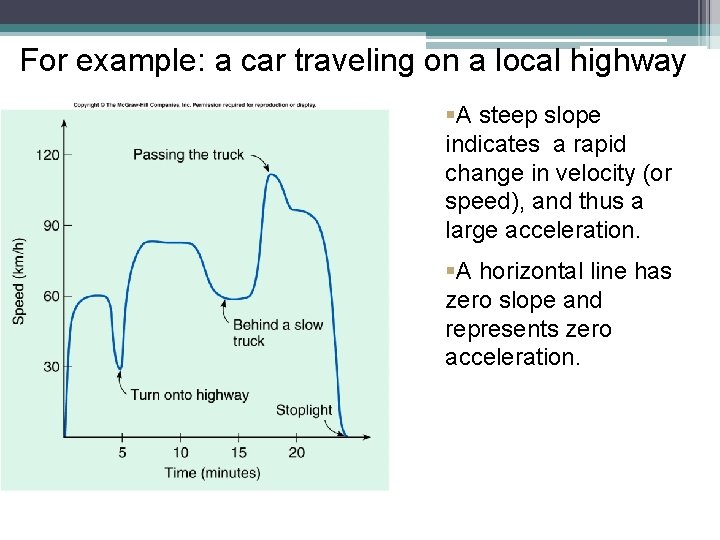
For example: a car traveling on a local highway §A steep slope indicates a rapid change in velocity (or speed), and thus a large acceleration. §A horizontal line has zero slope and represents zero acceleration.
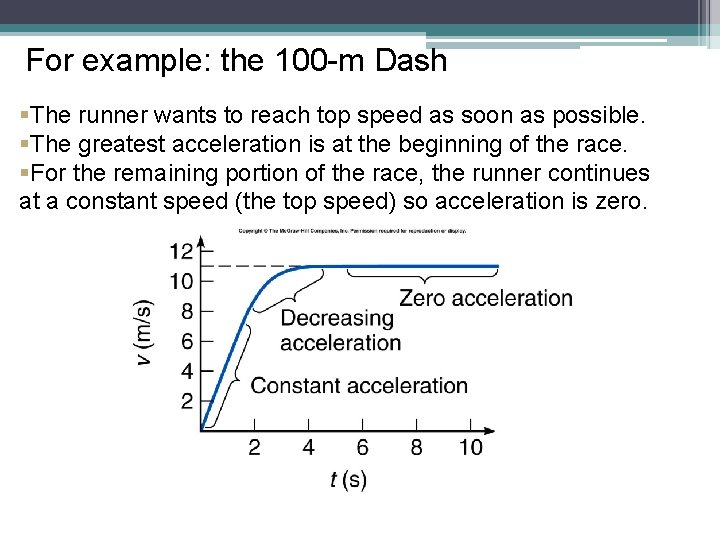
For example: the 100 -m Dash §The runner wants to reach top speed as soon as possible. §The greatest acceleration is at the beginning of the race. §For the remaining portion of the race, the runner continues at a constant speed (the top speed) so acceleration is zero.
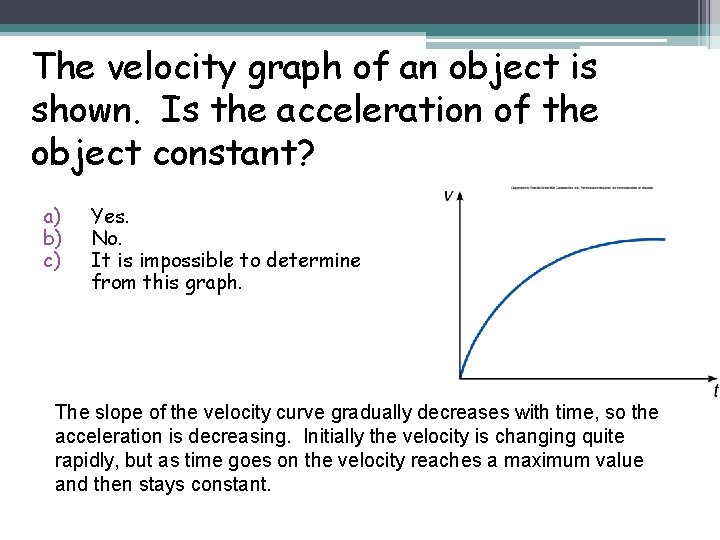
The velocity graph of an object is shown. Is the acceleration of the object constant? a) b) c) Yes. No. It is impossible to determine from this graph. The slope of the velocity curve gradually decreases with time, so the acceleration is decreasing. Initially the velocity is changing quite rapidly, but as time goes on the velocity reaches a maximum value and then stays constant.
Uniform Acceleration • S. N. Uniform Acceleration is the simplest form of acceleration. ▫ It occurs whenever there is a constant force acting on an object. ▫ Most of the examples we consider will involve constant acceleration. A falling rock or other falling object. A car accelerating at a constant rate. ▫ The acceleration does not change as the motion proceeds.
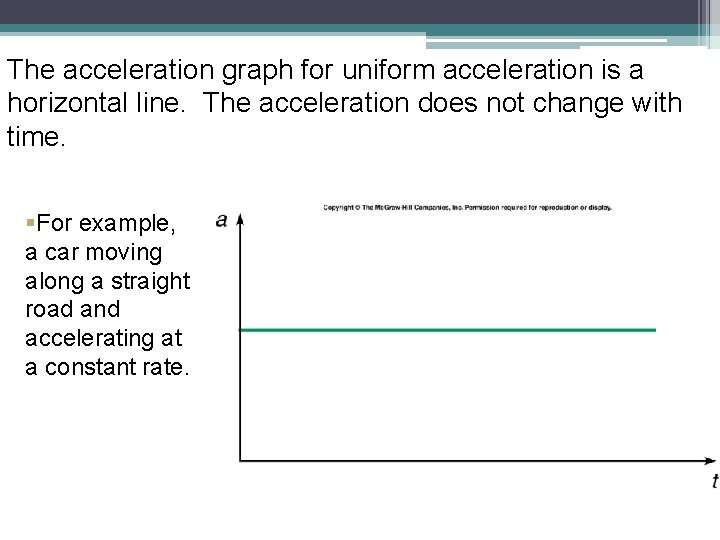
The acceleration graph for uniform acceleration is a horizontal line. The acceleration does not change with time. §For example, a car moving along a straight road and accelerating at a constant rate.
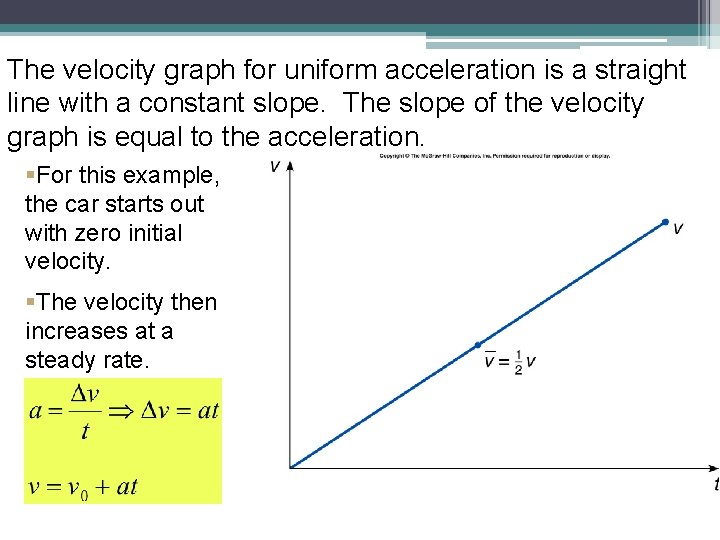
The velocity graph for uniform acceleration is a straight line with a constant slope. The slope of the velocity graph is equal to the acceleration. §For this example, the car starts out with zero initial velocity. §The velocity then increases at a steady rate.
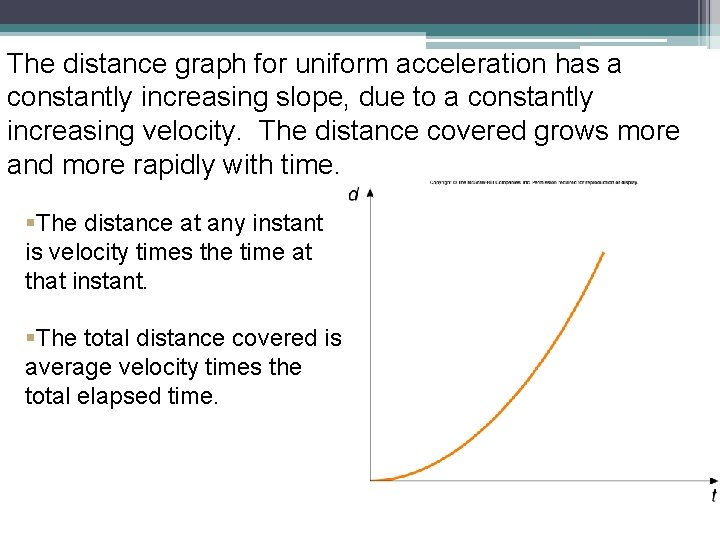
The distance graph for uniform acceleration has a constantly increasing slope, due to a constantly increasing velocity. The distance covered grows more and more rapidly with time. §The distance at any instant is velocity times the time at that instant. §The total distance covered is average velocity times the total elapsed time.
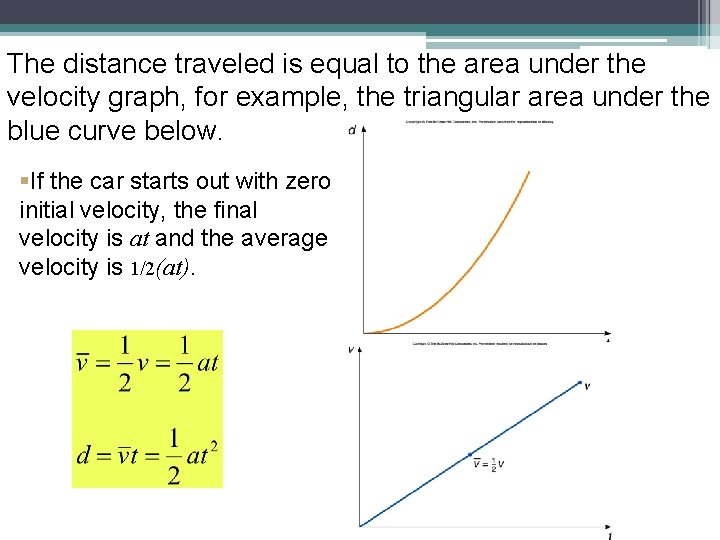
The distance traveled is equal to the area under the velocity graph, for example, the triangular area under the blue curve below. §If the car starts out with zero initial velocity, the final velocity is at and the average velocity is 1/2(at).
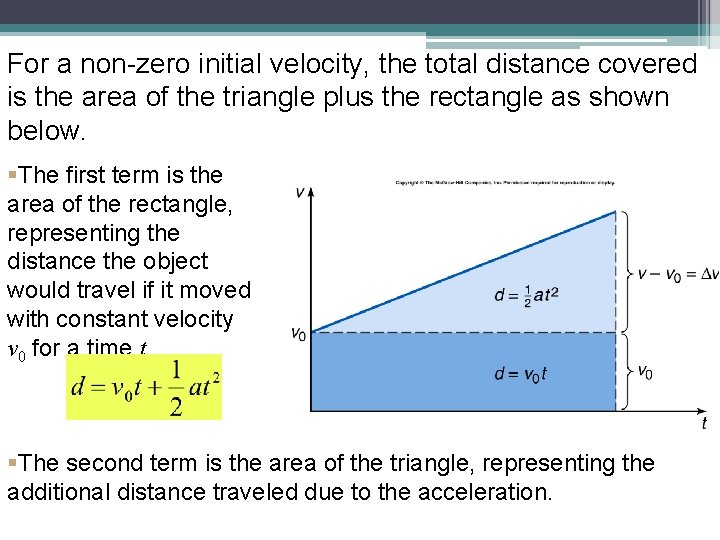
For a non-zero initial velocity, the total distance covered is the area of the triangle plus the rectangle as shown below. §The first term is the area of the rectangle, representing the distance the object would travel if it moved with constant velocity v 0 for a time t. §The second term is the area of the triangle, representing the additional distance traveled due to the acceleration.
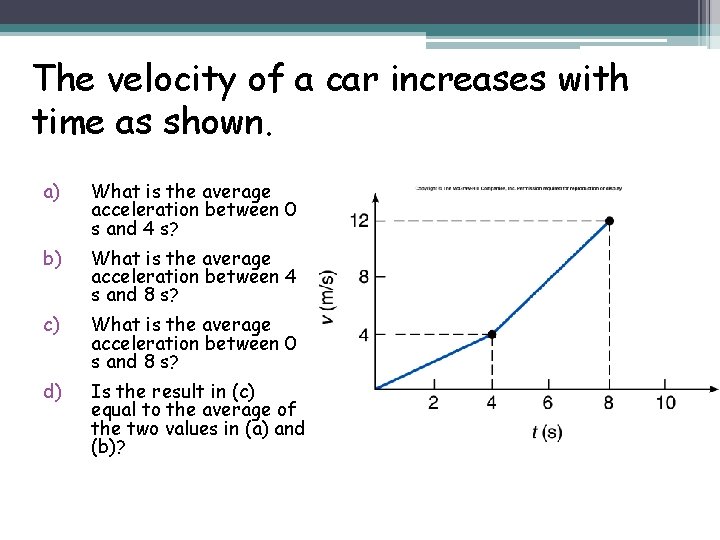
The velocity of a car increases with time as shown. a) What is the average acceleration between 0 s and 4 s? b) What is the average acceleration between 4 s and 8 s? c) What is the average acceleration between 0 s and 8 s? d) Is the result in (c) equal to the average of the two values in (a) and (b)?