
Physics Electrostatics Charges and Coulombs Law Charges and
Physics Electrostatics
Charges and Coulomb’s Law
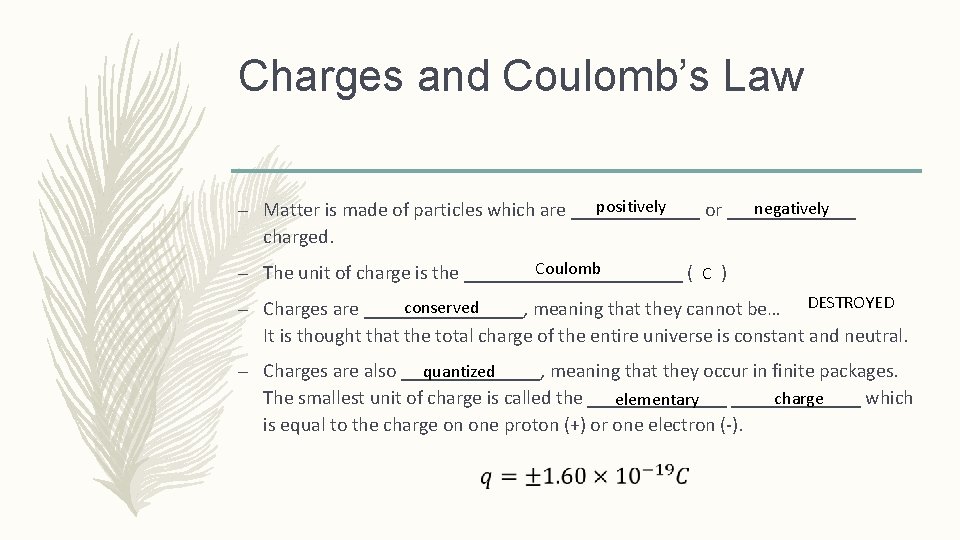
Charges and Coulomb’s Law positively negatively – Matter is made of particles which are _______ or _______ charged. Coulomb – The unit of charge is the ___________ ( C ) conserved – Charges are ________, meaning that they cannot be… DESTROYED It is thought that the total charge of the entire universe is constant and neutral. – Charges are also _______, meaning that they occur in finite packages. quantized charge The smallest unit of charge is called the _______ which elementary is equal to the charge on one proton (+) or one electron (-).
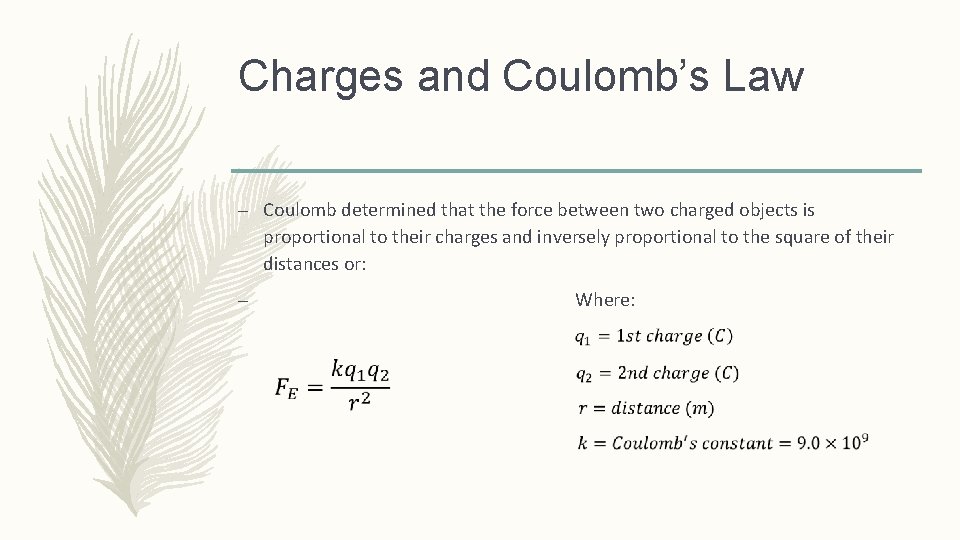
Charges and Coulomb’s Law – Coulomb determined that the force between two charged objects is proportional to their charges and inversely proportional to the square of their distances or: – Where:
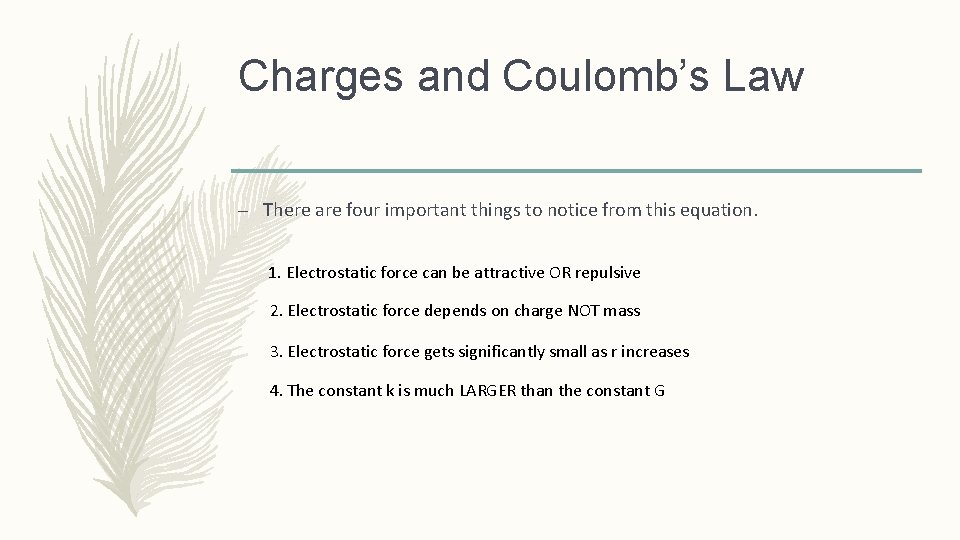
Charges and Coulomb’s Law – There are four important things to notice from this equation. 1. Electrostatic force can be attractive OR repulsive 2. Electrostatic force depends on charge NOT mass 3. Electrostatic force gets significantly small as r increases 4. The constant k is much LARGER than the constant G
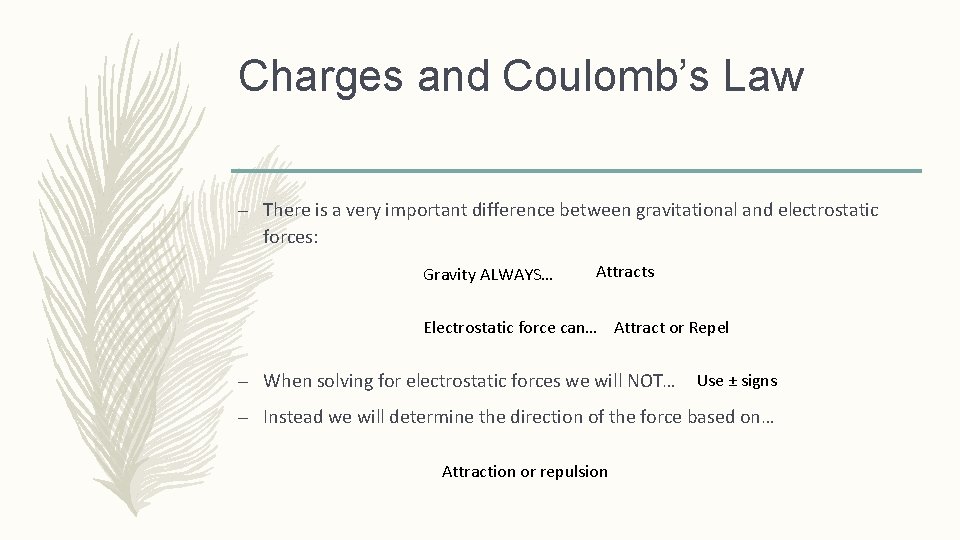
Charges and Coulomb’s Law – There is a very important difference between gravitational and electrostatic forces: Gravity ALWAYS… Attracts Electrostatic force can… Attract or Repel – When solving for electrostatic forces we will NOT… Use ± signs – Instead we will determine the direction of the force based on… Attraction or repulsion
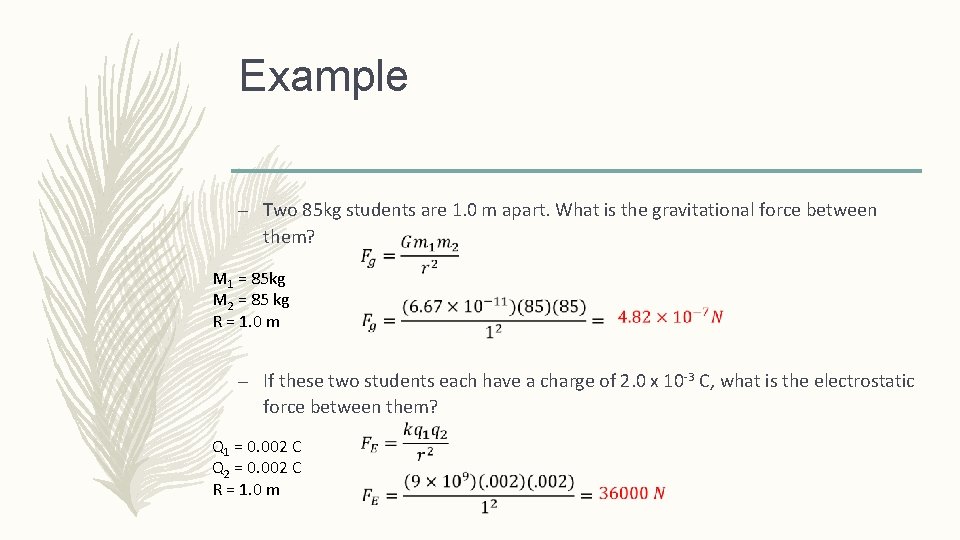
Example – Two 85 kg students are 1. 0 m apart. What is the gravitational force between them? M 1 = 85 kg M 2 = 85 kg R = 1. 0 m – If these two students each have a charge of 2. 0 x 10 -3 C, what is the electrostatic force between them? Q 1 = 0. 002 C Q 2 = 0. 002 C R = 1. 0 m
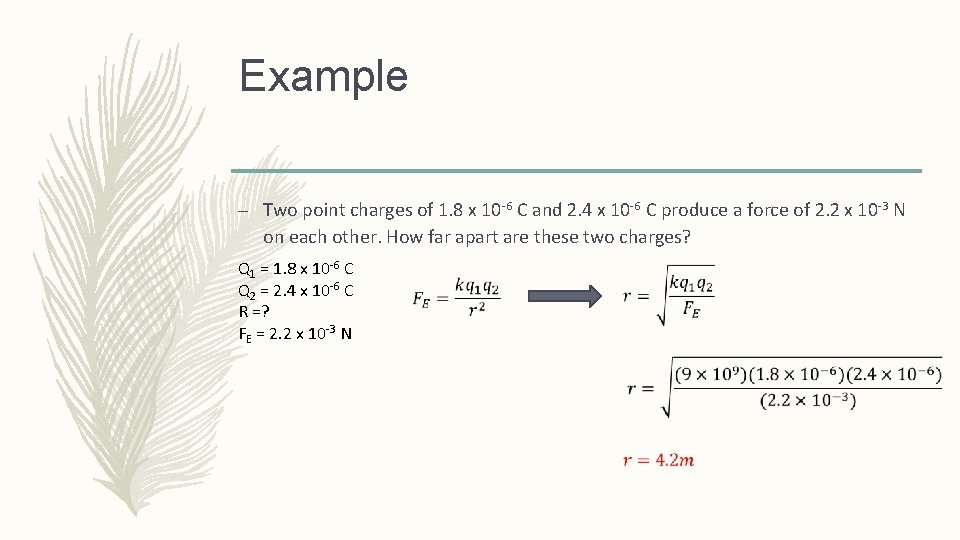
Example – Two point charges of 1. 8 x 10 -6 C and 2. 4 x 10 -6 C produce a force of 2. 2 x 10 -3 N on each other. How far apart are these two charges? Q 1 = 1. 8 x 10 -6 C Q 2 = 2. 4 x 10 -6 C R =? FE = 2. 2 x 10 -3 N
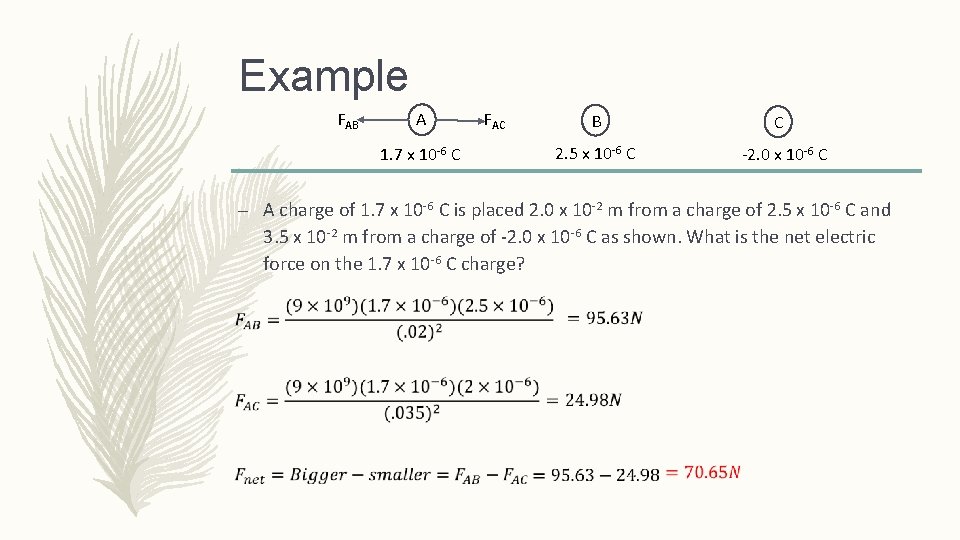
Example FAB A 1. 7 x 10 -6 C FAC B 2. 5 x 10 -6 C C -2. 0 x 10 -6 C – A charge of 1. 7 x 10 -6 C is placed 2. 0 x 10 -2 m from a charge of 2. 5 x 10 -6 C and 3. 5 x 10 -2 m from a charge of -2. 0 x 10 -6 C as shown. What is the net electric force on the 1. 7 x 10 -6 C charge?
Electric Field Single Charge
Electric Field – There are many similarities between gravitational and electrostatic forces. One such similarity is that both forces can be exerted on objects that are not in contact. – In the same way that any mass is surrounded by a gravitational field, we will imagine that any charged object is surrounded by an electric field. – Similar to gravitational fields, an electric field will depend on: Distance from Size of – _______ and ________ the charge.
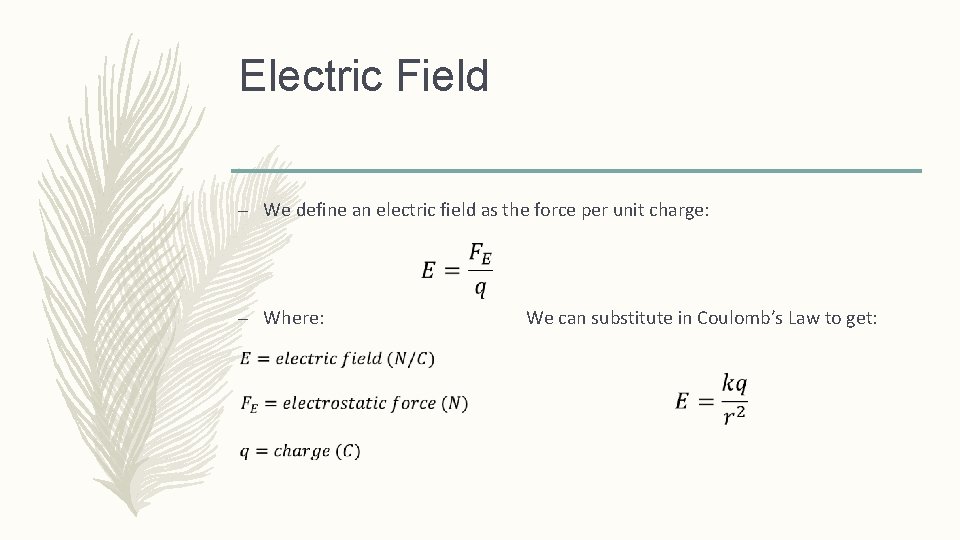
Electric Field – We define an electric field as the force per unit charge: – Where: We can substitute in Coulomb’s Law to get:
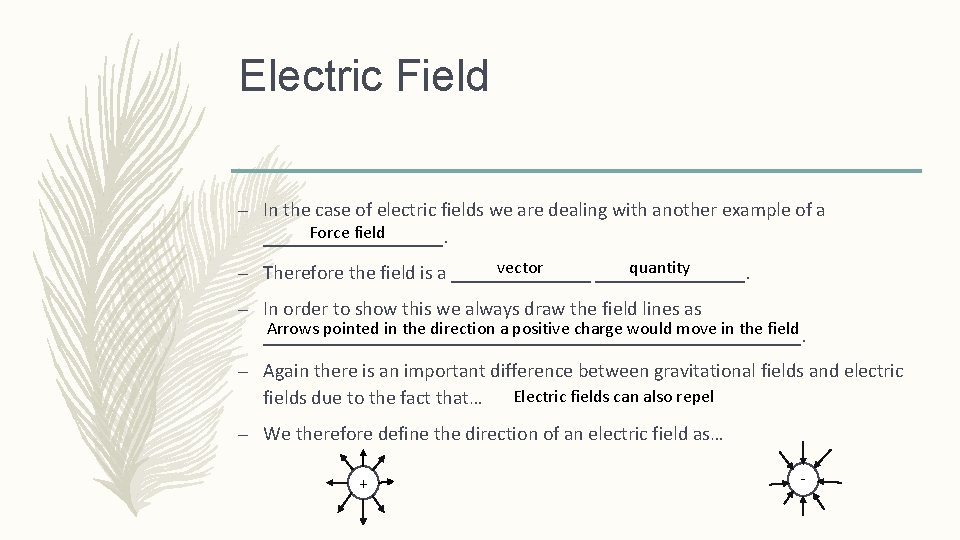
Electric Field – In the case of electric fields we are dealing with another example of a Force field _________. vector quantity – Therefore the field is a _______________. – In order to show this we always draw the field lines as Arrows pointed in the direction a positive charge would move in the field ___________________________. – Again there is an important difference between gravitational fields and electric fields due to the fact that… Electric fields can also repel – We therefore define the direction of an electric field as… + -
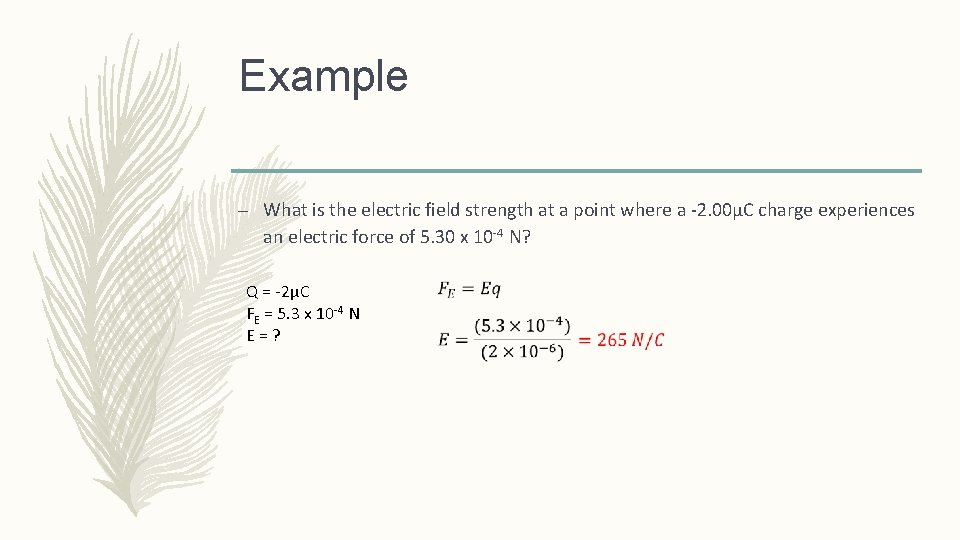
Example – What is the electric field strength at a point where a -2. 00µC charge experiences an electric force of 5. 30 x 10 -4 N? Q = -2µC FE = 5. 3 x 10 -4 N E=?
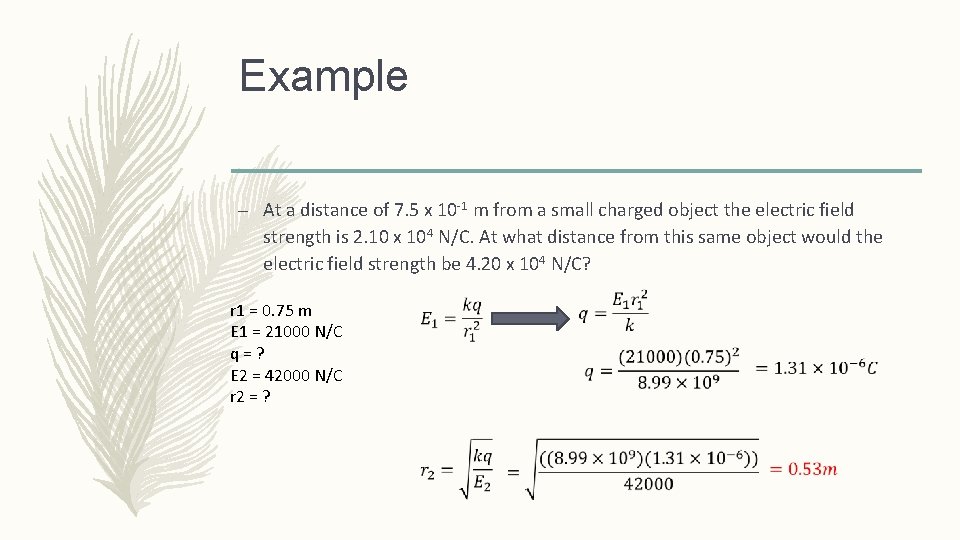
Example – At a distance of 7. 5 x 10 -1 m from a small charged object the electric field strength is 2. 10 x 104 N/C. At what distance from this same object would the electric field strength be 4. 20 x 104 N/C? r 1 = 0. 75 m E 1 = 21000 N/C q=? E 2 = 42000 N/C r 2 = ?
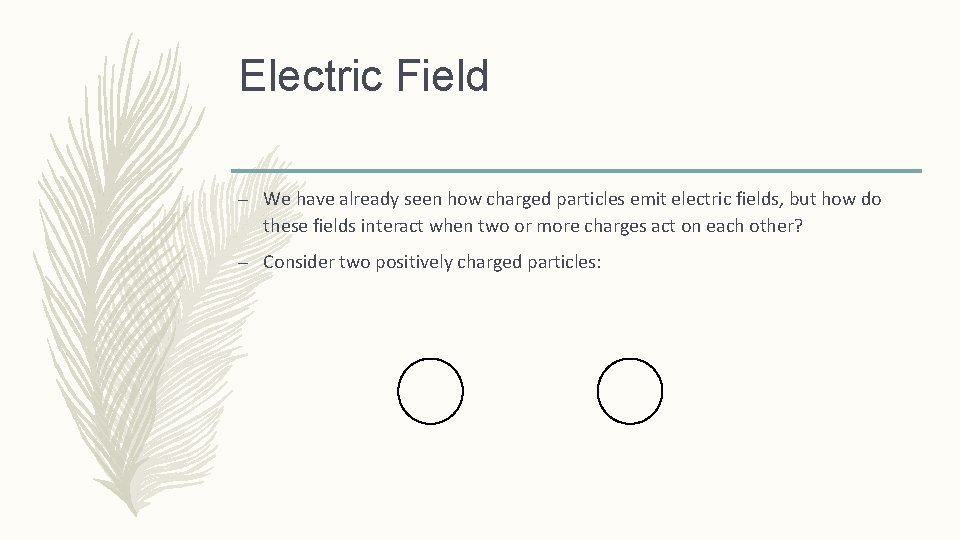
Electric Field – We have already seen how charged particles emit electric fields, but how do these fields interact when two or more charges act on each other? – Consider two positively charged particles:
Electric Field – Now, two negatively charged particles:
Electric Field in opposition – Note that the electric field lines point __________ to each other _________. Because this electric field is a force add them field, it is a vector. So when multiple fields overlap we simply _______. – Ok, now try two opposite charges: connect – Again the two fields interact, only this time they ___________.
- Slides: 18