
Physics Chapter 5 Section 4 Sounds from Vibrating
Physics Chapter 5, Section 4 Sounds from Vibrating Air
HW: p 526 #1, 4 -6 § Learning Objective § Explain how sound is produced by longitudinal compression waves § Write a conclusion that includes IV, DV, evidence, and the big idea § Success Criteria § Identify standing waves in different kinds of air-filled tubes § Observe how pitch changes with the length of the tube § Observe the effect of closing one end of the tube on the pitch of the sound § Observe sound bending around corners and spreading § Relate observations of pitch to drawings of standing waves § Organize observations to find a pattern § Do Now § Write LO and SC on new left page § p 518 WDYS/WDYT § Agenda § Do Now § Investigation 5. 4 § Summary
Investigation 5. 4 § Part A (groups) § 1 -3 - with straws § 4, 5 with test tubes § Part B § 1 - Class demo § 2 - with group § Part C § In groups
HW: p 526 #1, 4 -6 § Learning Objective § Explain how sound is produced by longitudinal compression waves § Write a conclusion that includes IV, DV, evidence, and the big idea § Success Criteria § Identify standing waves in different kinds of air-filled tubes § Observe how pitch changes with the length of the tube § Observe the effect of closing one end of the tube on the pitch of the sound § Observe sound bending around corners and spreading § Relate observations of pitch to drawings of standing waves § Organize observations to find a pattern § Do Now § How did closing the end of the tube change the sound? § Agenda § Do Now § Investigation 5. 4 § Summary
Physics Talk 5. 4 § What kind of waves does sound make? § How does this relate to springs? § Compressional (longitudinal) waves
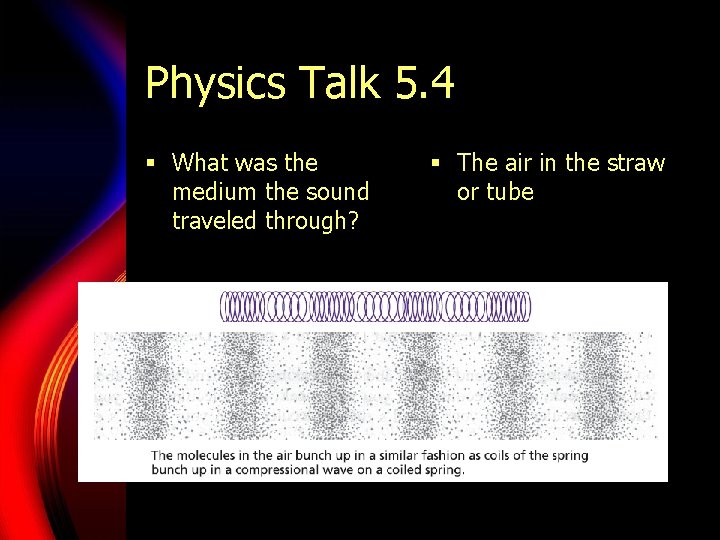
Physics Talk 5. 4 § What was the medium the sound traveled through? § The air in the straw or tube
Physics Talk 5. 4 § How do these related to the standing waves created by the stringed instrument? § Air molecules cannot vibrate at the bottom of the test tube, so this is a node of the wave § The open end of the test tube provides the wave’s amplitude § The vibration of the air at this end, is the sound you hear § This is the antinode of the wave
Physics Talk 5. 4 § What is diffraction? § The ability of sound waves to spread out or change direction as the emerge from an opening § This is why you can hear someone talking around a corner
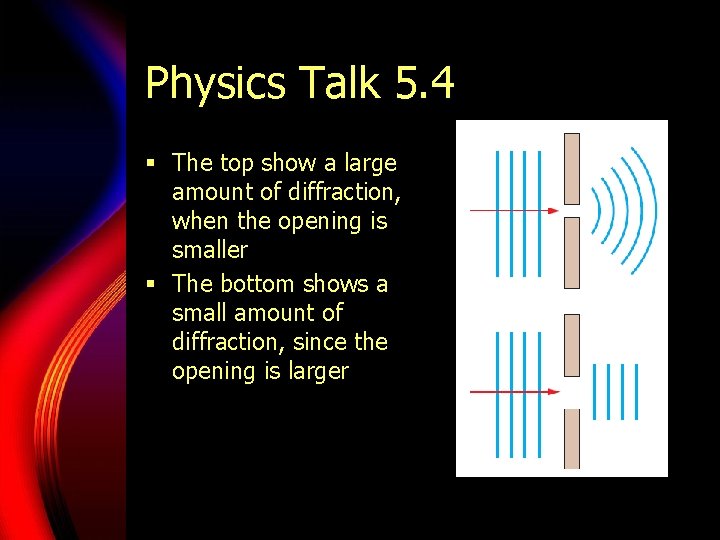
Physics Talk 5. 4 § The top show a large amount of diffraction, when the opening is smaller § The bottom shows a small amount of diffraction, since the opening is larger
Physics Talk 5. 4 § How do megaphones work? § A megaphone increases the diffraction of sound, due to the small opening you tell into § The best opening size depends on the sound being produced

Vibrating Columns of Air
Physics Talk § How does changing wavelength effect frequency? § When keeping a constant wave speed, increasing the wavelength will decrease the frequency - causing a lower pitch
Physics Talk 5. 4 § Open tube wavelength § Closed tube wavelength § Half of the wavelength will fit § The wavelength is 2 x the length of the tube § One quarter of the wavelength will fit § The wavelength is 4 x the length of the tube
Physics Talk 5. 4 § Why does the closed straw have a lower pitch? § Why does the open straw have a higher pitch? § The wavelength is longer (4 x), meaning the frequency is lower § The wavelength is shorter (2 x), meaning the frequency is higher
What do you think now? § How do flutes and organ pipes produce sound? USE PHYSICS!
- Slides: 15