
Physics beyond the Standard Model Matt Sullivan 20
Physics beyond the Standard Model Matt Sullivan • 20. 08. 2018
● What we can’t explain with the Standard Model Overview ○ ○ ○ Dark matter Matter-antimatter asymmetry Hierarchy problem ● Physics beyond the Standard Model ○ ○ ○ What are we looking for? How do we detect it? SUSY & HGB ● What next? 2
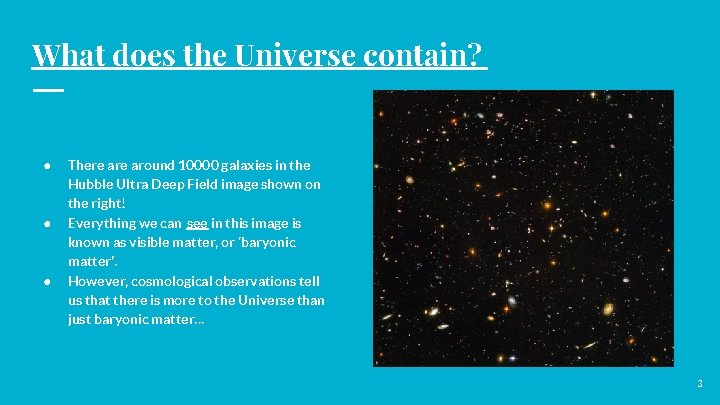
What does the Universe contain? ● ● ● There around 10000 galaxies in the Hubble Ultra Deep Field image shown on the right! Everything we can see in this image is known as visible matter, or ‘baryonic matter’. However, cosmological observations tell us that there is more to the Universe than just baryonic matter. . . 3
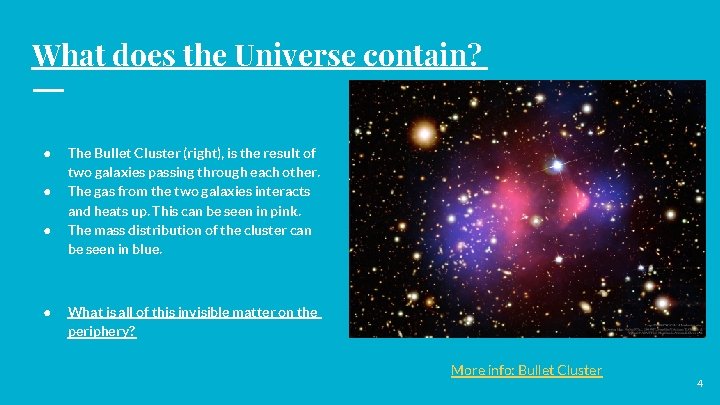
What does the Universe contain? ● ● The Bullet Cluster (right), is the result of two galaxies passing through each other. The gas from the two galaxies interacts and heats up. This can be seen in pink. The mass distribution of the cluster can be seen in blue. What is all of this invisible matter on the periphery? More info: Bullet Cluster 4
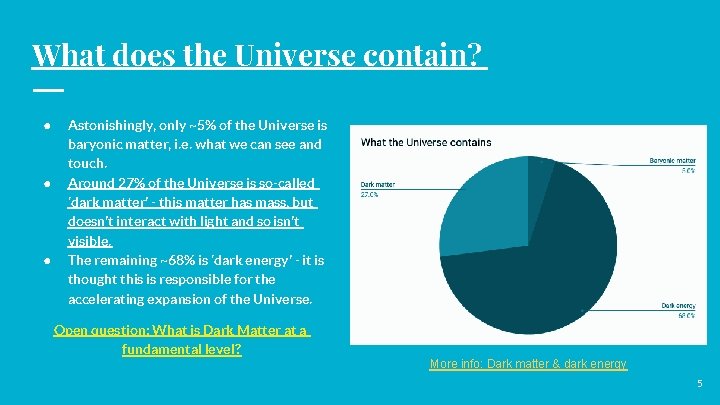
What does the Universe contain? ● ● ● Astonishingly, only ~5% of the Universe is baryonic matter, i. e. what we can see and touch. Around 27% of the Universe is so-called ‘dark matter’ - this matter has mass, but doesn’t interact with light and so isn’t visible. The remaining ~68% is ‘dark energy’ - it is thought this is responsible for the accelerating expansion of the Universe. Open question: What is Dark Matter at a fundamental level? More info: Dark matter & dark energy 5
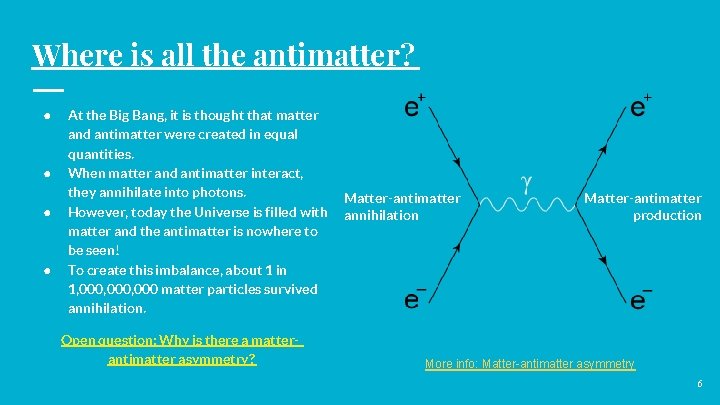
Where is all the antimatter? ● ● At the Big Bang, it is thought that matter and antimatter were created in equal quantities. When matter and antimatter interact, they annihilate into photons. However, today the Universe is filled with matter and the antimatter is nowhere to be seen! To create this imbalance, about 1 in 1, 000, 000 matter particles survived annihilation. Open question: Why is there a matterantimatter asymmetry? Matter-antimatter annihilation Matter-antimatter production More info: Matter-antimatter asymmetry 6

Why is there an apparent ‘hierarchy’? ● ● The strength of the strong, weak, electromagetic and gravitational interactions varies greatly. A simple calculation yields surprising results: Gravitational attraction: F g = Gm 1 m 2 / r 2 Electrostatic attraction: F E = ke 1 e 2 / r 2 Strong force: ~1 EM: ~1/137 Weak force: 1 x 10 -6 FE/F g = ~10 36 (protons) Gravity: 1 x 10 -40 Open question: Why is there a ‘hierarchy’? 7
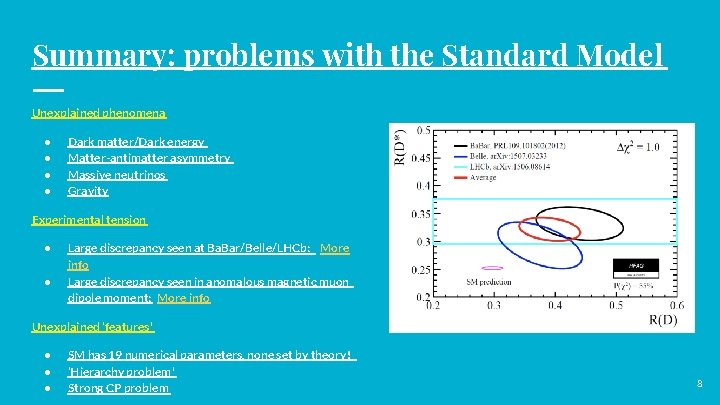
Summary: problems with the Standard Model Unexplained phenomena ● ● Dark matter/Dark energy Matter-antimatter asymmetry Massive neutrinos Gravity Experimental tension ● ● Large discrepancy seen at Ba. Bar/Belle/LHCb: More info Large discrepancy seen in anomalous magnetic muon dipole moment: More info Unexplained ‘features’ ● ● ● SM has 19 numerical parameters, none set by theory! ‘Hierarchy problem’ Strong CP problem 8

Physics beyond the Standard Model 9
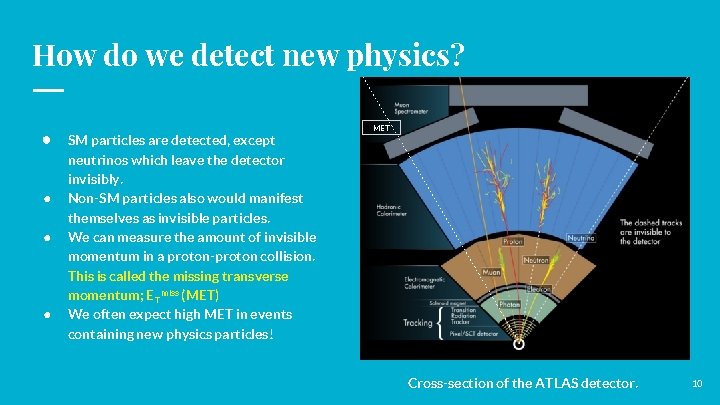
How do we detect new physics? ● ● SM particles are detected, except neutrinos which leave the detector invisibly. Non-SM particles also would manifest themselves as invisible particles. We can measure the amount of invisible momentum in a proton-proton collision. This is called the missing transverse momentum; E Tmiss (MET) We often expect high MET in events containing new physics particles! MET Cross-section of the ATLAS detector. 10
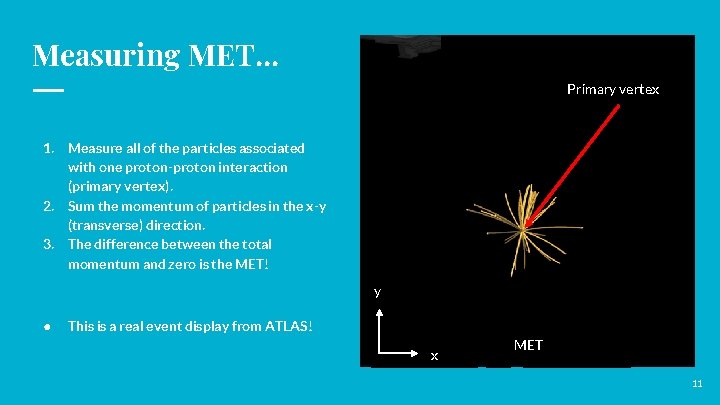
Measuring MET. . . Primary vertex 1. Measure all of the particles associated with one proton-proton interaction (primary vertex). 2. Sum the momentum of particles in the x-y (transverse) direction. 3. The difference between the total momentum and zero is the MET! y ● This is a real event display from ATLAS! x MET 11
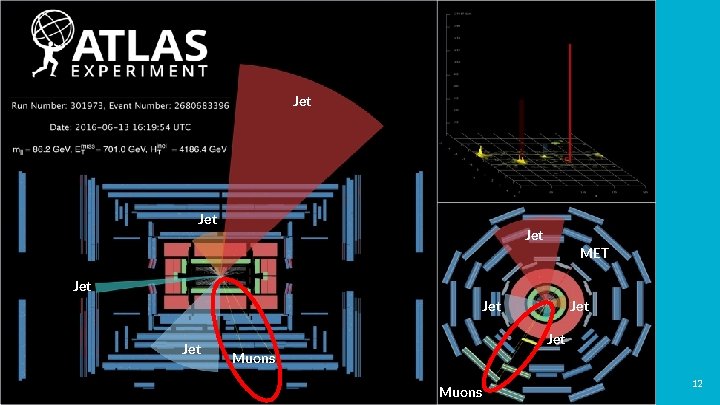
How do we detect new physics? Jet ● ● SM particles are detected, except neutrinos which leave the detector invisibly. Non-SM particles also would manifest themselves as invisible Jetparticles. We can measure the amount of invisible momentum in a proton-proton collision. This is called the missing transverse Jet momentum; E Tmiss (MET) We often expect high MET in events containing new physics particles! Jet Muons Jet MET Jet Jet Muons 12
What new physics are we looking for? The new physics we search for should: ● ● ● Preserve the Standard Model! Answer some (preferably all) of the open questions previously discussed. Make predictions which are testable at current/next-gen experiments. Many new physics theories are searched for today at the LHC: ● ● Supersymmetry (SUSY) Heavy gauge bosons Extended Higgs sectors Hidden extra dimensions 13
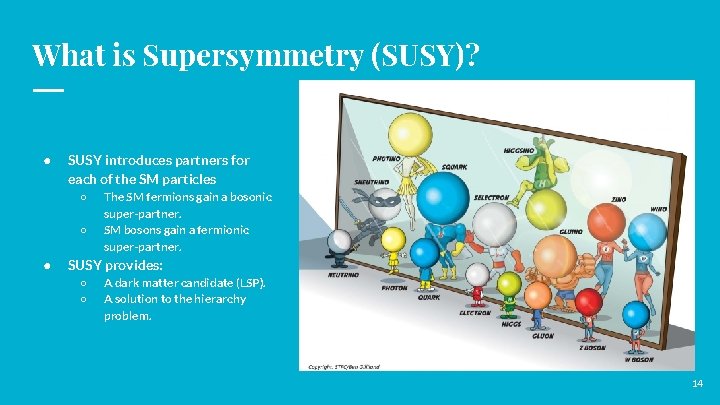
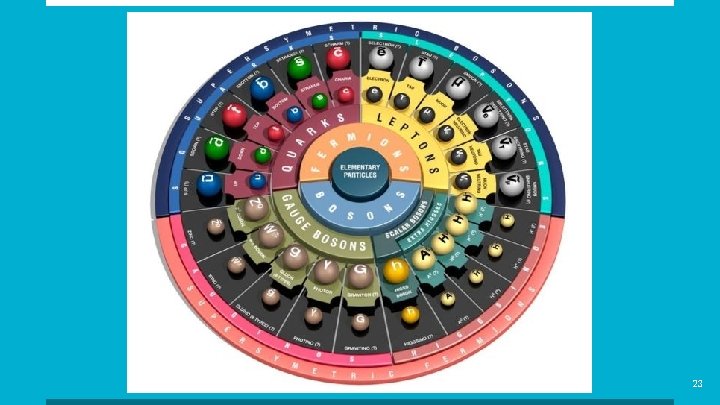
What is Supersymmetry (SUSY)? ● SUSY introduces partners for each of the SM particles ○ ○ ● The SM fermions gain a bosonic super-partner. SM bosons gain a fermionic super-partner. SUSY provides: ○ ○ A dark matter candidate (LSP). A solution to the hierarchy problem. 14
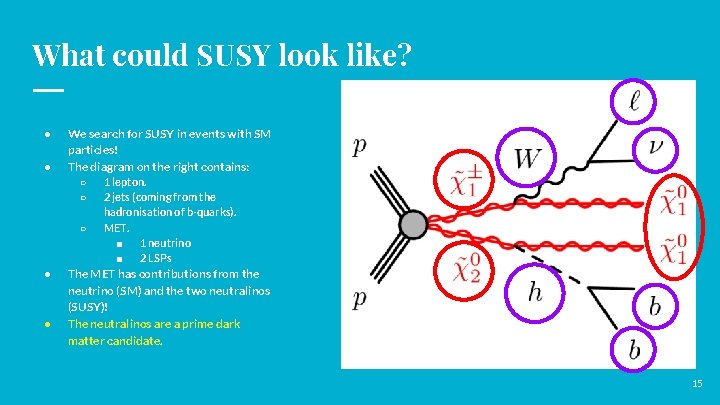
What could SUSY look like? ● ● We search for SUSY in events with SM particles! The diagram on the right contains: ○ ○ ○ ● ● 1 lepton. 2 jets (coming from the hadronisation of b-quarks). MET. ■ 1 neutrino ■ 2 LSPs The MET has contributions from the neutrino (SM) and the two neutralinos (SUSY)! The neutralinos are a prime dark matter candidate. 15
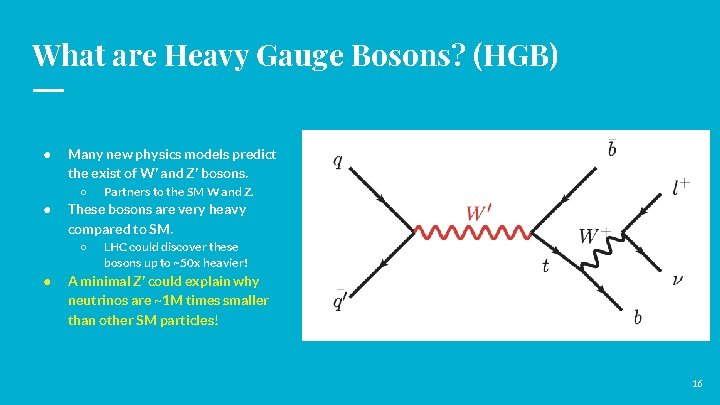
What are Heavy Gauge Bosons? (HGB) ● Many new physics models predict the exist of W’ and Z’ bosons. ○ ● These bosons are very heavy compared to SM. ○ ● Partners to the SM W and Z. LHC could discover these bosons up to ~50 x heavier! A minimal Z’ could explain why neutrinos are ~1 M times smaller than other SM particles! 16
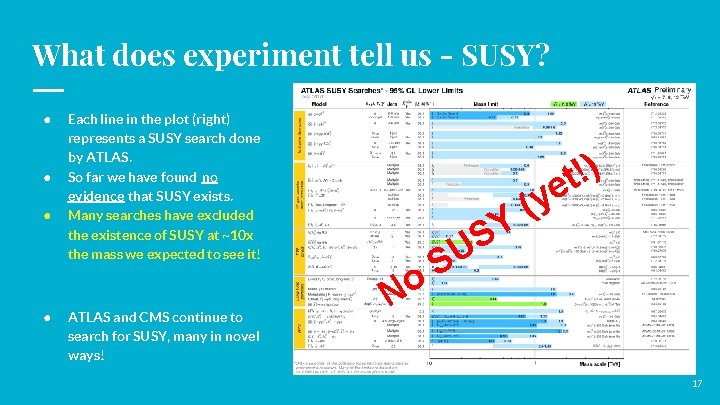
What does experiment tell us - SUSY? ● ● Each line in the plot (right) represents a SUSY search done by ATLAS. So far we have found no evidence that SUSY exists. Many searches have excluded the existence of SUSY at ~10 x the mass we expected to see it! ATLAS and CMS continue to search for SUSY, many in novel ways! o N Y S SU ) ! t e (y 17
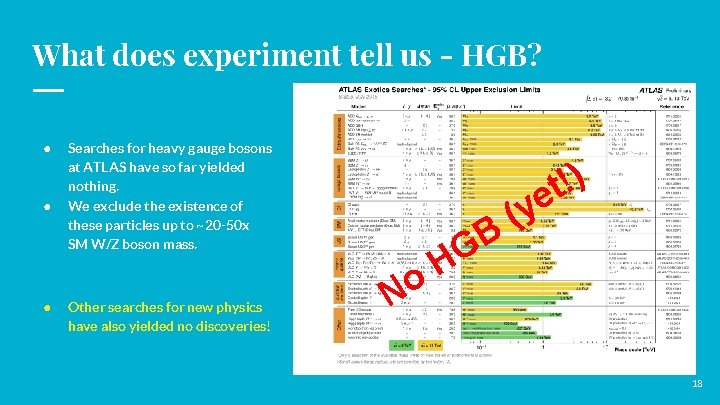
What does experiment tell us - HGB? ● ● ● Searches for heavy gauge bosons at ATLAS have so far yielded nothing. We exclude the existence of these particles up to ~20 -50 x SM W/Z boson mass. Other searches for new physics have also yielded no discoveries! H o B G ) ! et (y N 18
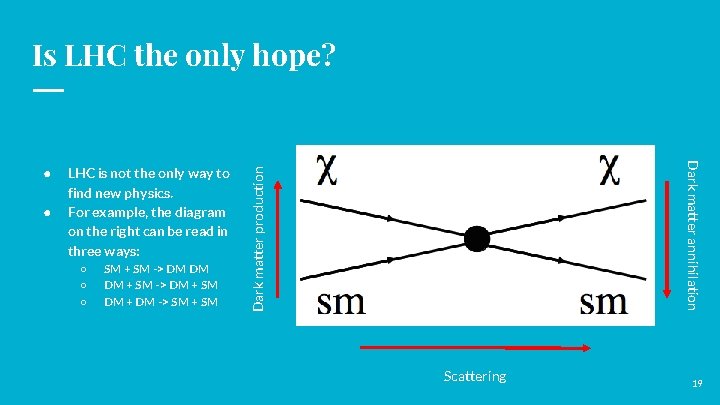
Is LHC the only hope? ○ ○ ○ SM + SM -> DM DM DM + SM -> DM + SM DM + DM -> SM + SM Dark matter production ● LHC is not the only way to find new physics. For example, the diagram on the right can be read in three ways: Dark matter annihilation ● Scattering 19
What next? ● LHC will continue the search for new physics for ~20 more years. ○ ○ ● Will other experiments find new physics? ○ ○ ● In 2025, the LHC will be upgraded to the High Luminosity LHC (HL-LHC). We will be able to take 10 x the data we take now during this phase! Direct detection - LHC/HL-LHC, CLi. C, FCC, ILC Indirect detection - LZ, g-2, Hyper. K, DUNE Is new physics hiding in the data we have already taken? 20
1. SM leaves many open questions unanswered. Conclusion 2. LHC experiments searching for new physics, e. g. SUSY & HGB. 3. No evidence for any new physics yet observed. 21

Thanks for your attention! Any questions? 22
23
- Slides: 23