
Physics around ISOLDE K Riisager on behalf on
Physics around ISOLDE K. Riisager on behalf on Danish ISOLDE users RECFA meeting, Copenhagen, May 3 -4 2013
Overview The ISOLDE facility Nuclear structure (2 staff, 4 phd-students + theory) Ø Decay experiments (ISOLDE) Ø Reaction experiments (ISOLDE) Ø Nuclear astrophysics (ISOLDE + Aarhus + …) Condensed matter (1) Biochemistry and biophysics (2) 2

The ISOLDE facility http: //www. scholarpedia. org/article/The_ISOLDE_facility 3
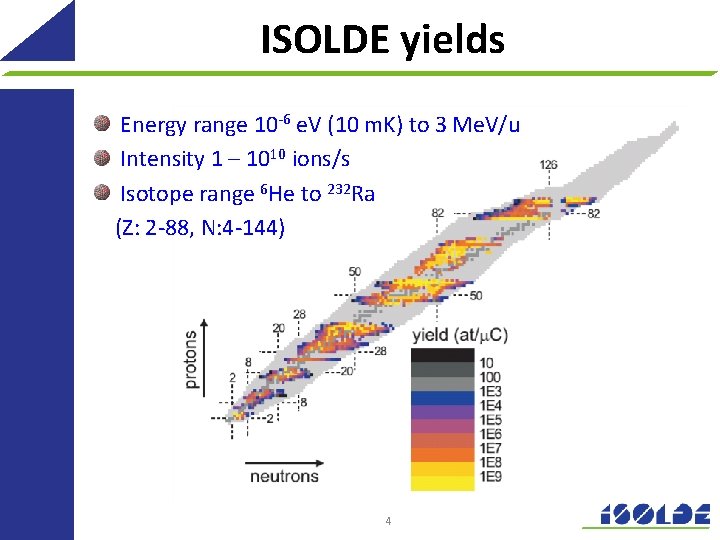
ISOLDE yields Energy range 10 -6 e. V (10 m. K) to 3 Me. V/u Intensity 1 – 1010 ions/s Isotope range 6 He to 232 Ra (Z: 2 -88, N: 4 -144) 4
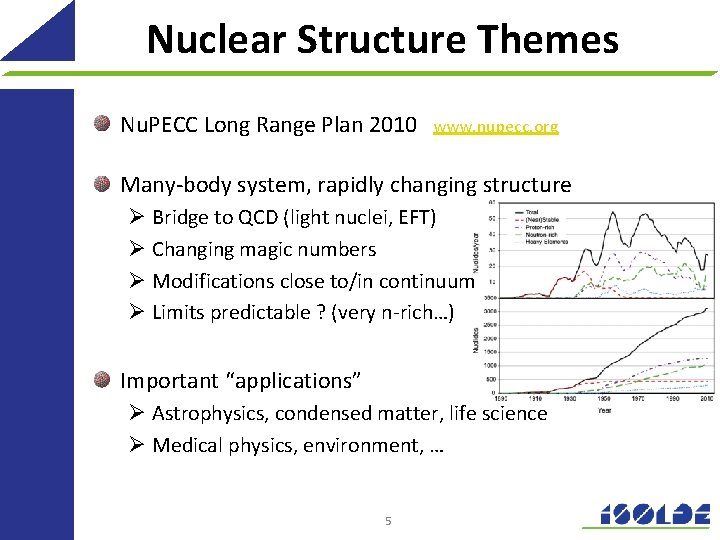
Nuclear Structure Themes Nu. PECC Long Range Plan 2010 www. nupecc. org Many-body system, rapidly changing structure Ø Bridge to QCD (light nuclei, EFT) Ø Changing magic numbers Ø Modifications close to/in continuum Ø Limits predictable ? (very n-rich…) Important “applications” Ø Astrophysics, condensed matter, life science Ø Medical physics, environment, … 5
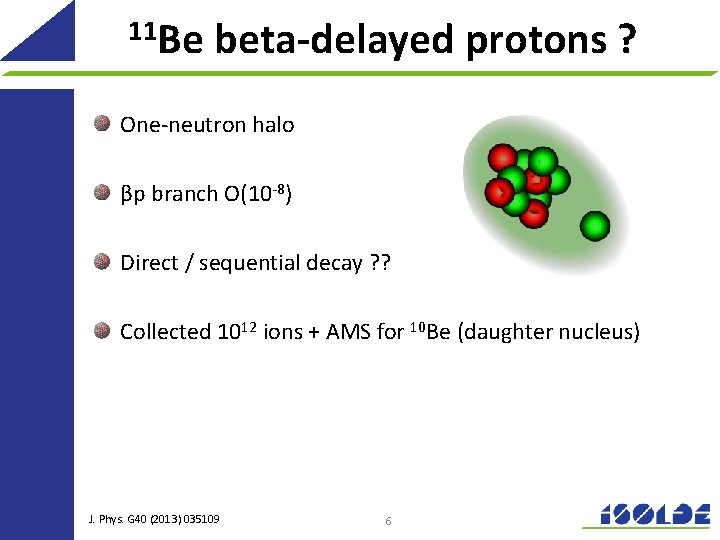
11 Be beta-delayed protons ? One-neutron halo βp branch O(10 -8) Direct / sequential decay ? ? Collected 1012 ions + AMS for 10 Be (daughter nucleus) J. Phys. G 40 (2013) 035109 6
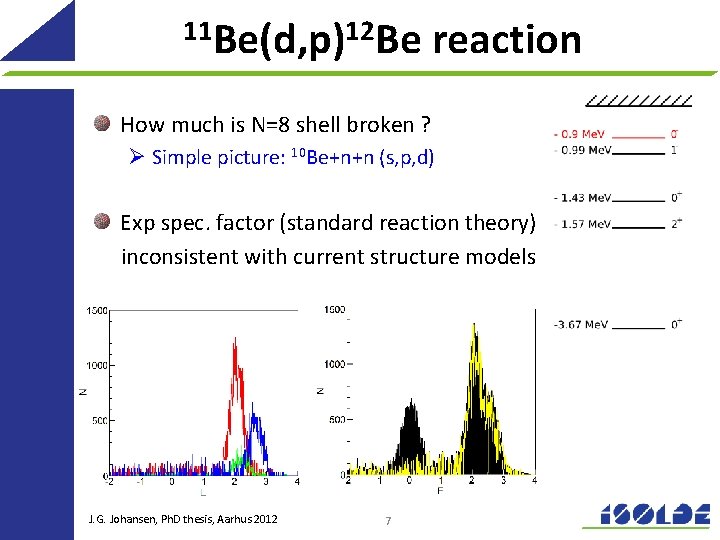
11 Be(d, p)12 Be reaction How much is N=8 shell broken ? Ø Simple picture: 10 Be+n+n (s, p, d) Exp spec. factor (standard reaction theory) inconsistent with current structure models J. G. Johansen, Ph. D thesis, Aarhus 2012 7
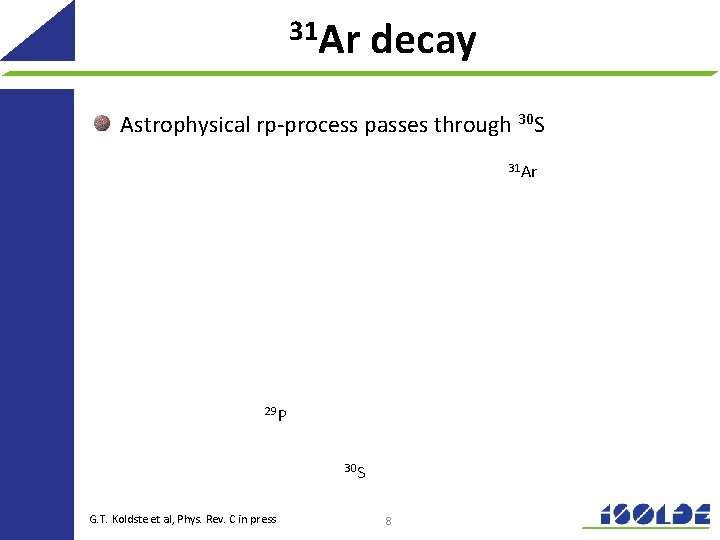
31 Ar decay Astrophysical rp-process passes through 30 S 31 Ar 29 P 30 S G. T. Koldste et al, Phys. Rev. C in press 8
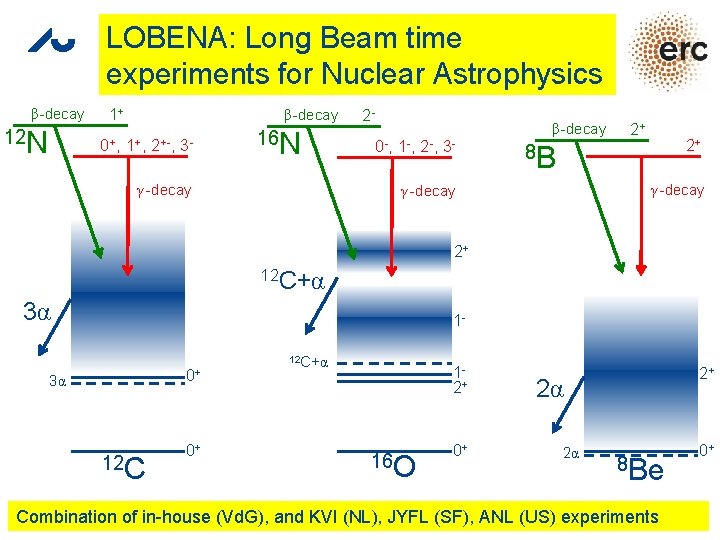
LOBENA: Long Beam time experiments for Nuclear Astrophysics β-decay 12 N 1+ β-decay 0+, 1+, 2+-, 3 - 16 N γ -decay 20 - , 1 - , 2 - , 3 - β-decay 2+ 2+ 8 B γ -decay 2+ 12 C+α 3α 10+ 3α 12 C 0+ 12 C+α 12+ 16 O 0+ 2+ 2α 2α 8 Be Combination of in-house (Vd. G), and KVI (NL), JYFL (SF), ANL (US) experiments 0+
Collaborators / nuclear structure Denmark: H. O. U. Fynbo, K. Riisager, G. T. Koldste, K. L. Laursen, M. V. Lund, J. Refsgaard CERN: M. J. G. Borge, J. Kurcewicz, M. Pfützner Spain: L. Fraile, O. Tengblad + students Sweden: B. Jonson, T. Nilsson, G. Nyman, J. Cederkäll + … Germany: T. Kröll, D. Mücher, J. G. Johansen + Finland: J. Äystö, A. Jokinen, I. Moore + UK: C. A. Diget, B. Fulton + Belgium: R. Raabe + France: B. Blank + Austria: O. Forstner + Canada: O. Kirsebom, R. Krücken 10
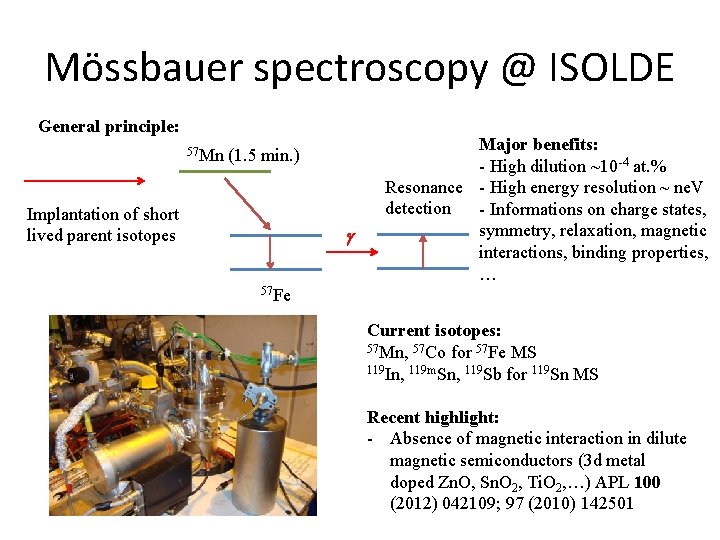
Mössbauer spectroscopy @ ISOLDE General principle: 57 Mn (1. 5 min. ) Implantation of short lived parent isotopes g Major benefits: - High dilution ~10 -4 at. % Resonance - High energy resolution ~ ne. V detection - Informations on charge states, symmetry, relaxation, magnetic interactions, binding properties, … 57 Fe Current isotopes: 57 Mn, 57 Co for 57 Fe MS 119 In, 119 m. Sn, 119 Sb for 119 Sn MS Recent highlight: - Absence of magnetic interaction in dilute magnetic semiconductors (3 d metal doped Zn. O, Sn. O 2, Ti. O 2, …) APL 100 (2012) 042109; 97 (2010) 142501
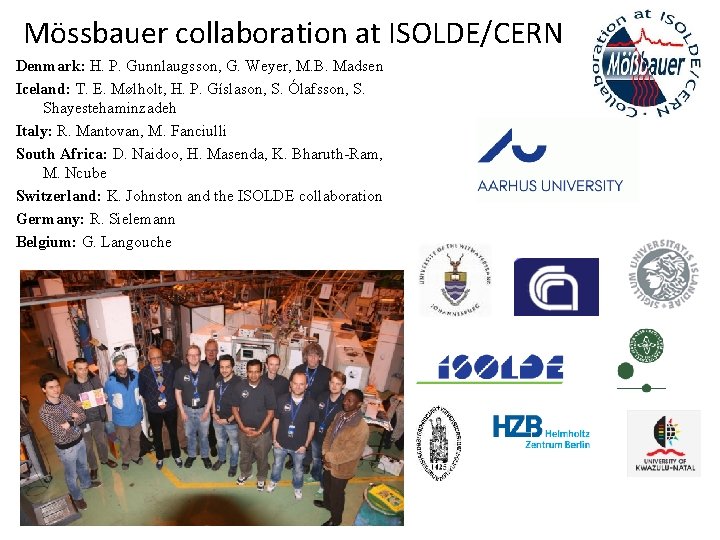
Mössbauer collaboration at ISOLDE/CERN Denmark: H. P. Gunnlaugsson, G. Weyer, M. B. Madsen Iceland: T. E. Mølholt, H. P. Gíslason, S. Ólafsson, S. Shayestehaminzadeh Italy: R. Mantovan, M. Fanciulli South Africa: D. Naidoo, H. Masenda, K. Bharuth-Ram, M. Ncube Switzerland: K. Johnston and the ISOLDE collaboration Germany: R. Sielemann Belgium: G. Langouche
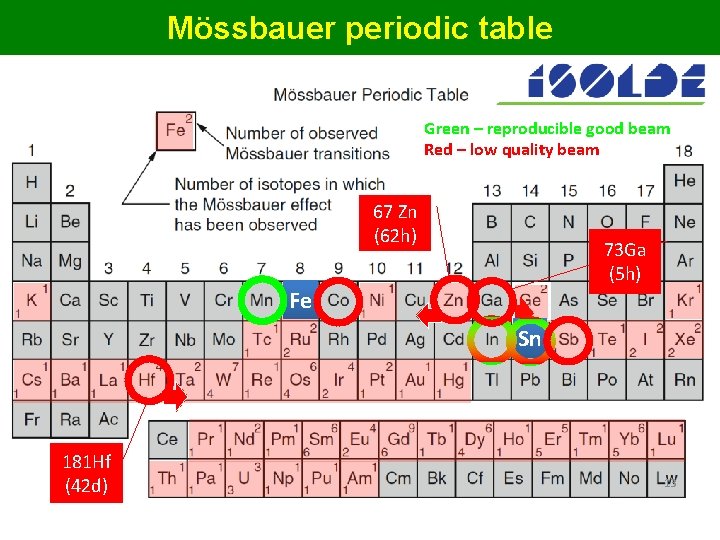
Mössbauer periodic table Green – reproducible good beam Red – low quality beam 67 Zn (62 h) 73 Ga (5 h) Fe Sn 181 Hf (42 d) 13

Metal ion transfer between proteins: The Cu(I) binding protein HAH 1 199 m. Hg PAC p. H 7. 5 p. H 8. 5 p. H 9. 4 p. H 9. 8 μs to ns exchange dynamics p. H 10. 2 p. H 7. 5 p. H 9. 4 0 2 4 6 8 Angular frequency (rad/ns) Luczkowski , Zeider, Hinz, Stachura, Chakraborty, Hemmimgsen, Huffmann, Pecoraro , accepted Eur. J. Chem.
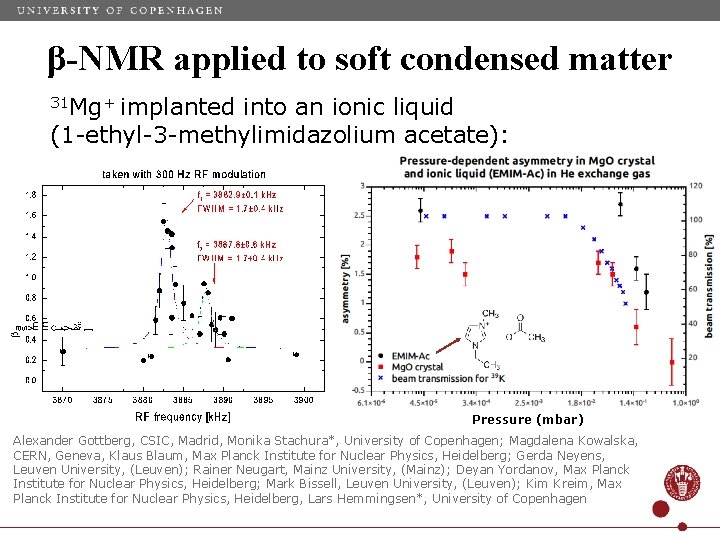
β-NMR applied to soft condensed matter 31 Mg+ implanted into an ionic liquid (1 -ethyl-3 -methylimidazolium acetate): Pressure (mbar) Alexander Gottberg, CSIC, Madrid, Monika Stachura*, University of Copenhagen; Magdalena Kowalska, CERN, Geneva, Klaus Blaum, Max Planck Institute for Nuclear Physics, Heidelberg; Gerda Neyens, Leuven University, (Leuven); Rainer Neugart, Mainz University, (Mainz); Deyan Yordanov, Max Planck Institute for Nuclear Physics, Heidelberg; Mark Bissell, Leuven University, (Leuven); Kim Kreim, Max Planck Institute for Nuclear Physics, Heidelberg, Lars Hemmingsen*, University of Copenhagen
Immediate future Exploit new opportunities at HIE-ISOLDE Develop nuclear astrophysics research “at home” Seek funding for expanding biochemistry at CERN 16
17
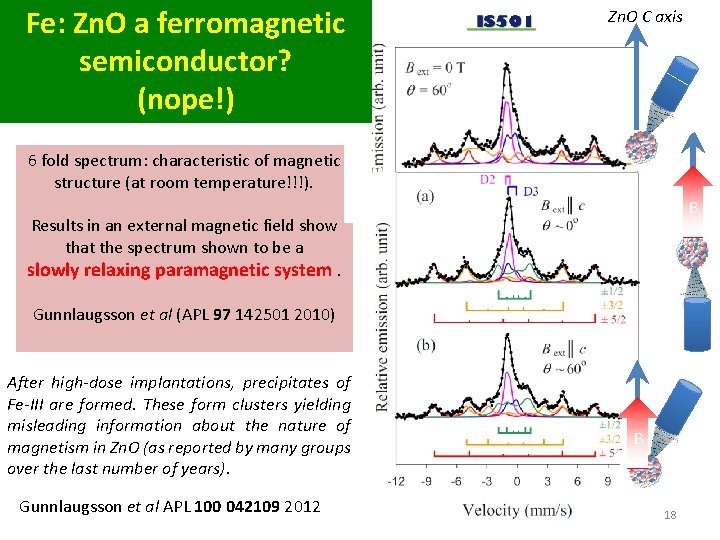
Fe: Zn. O a ferromagnetic semiconductor? (nope!) Zn. O C axis 6 fold spectrum: characteristic of magnetic structure (at room temperature!!!). B Results in an external magnetic field show that the spectrum shown to be a slowly relaxing paramagnetic system. Gunnlaugsson et al (APL 97 142501 2010) After high-dose implantations, precipitates of Fe-III are formed. These form clusters yielding misleading information about the nature of magnetism in Zn. O (as reported by many groups over the last number of years). Gunnlaugsson et al APL 100 042109 2012 B 18
- Slides: 18