
Physics 704804 Electromagnetic Theory II G A Krafft
- Slides: 40
Physics 704/804 Electromagnetic Theory II G. A. Krafft Jefferson Lab Professor of Physics Old Dominion University 02 -23 -10 Physics 804 Electromagnetic Theory II
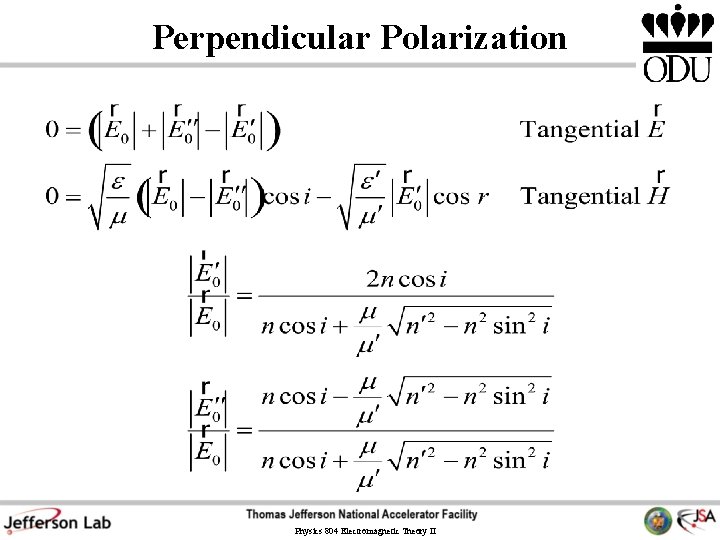
Perpendicular Polarization Physics 804 Electromagnetic Theory II
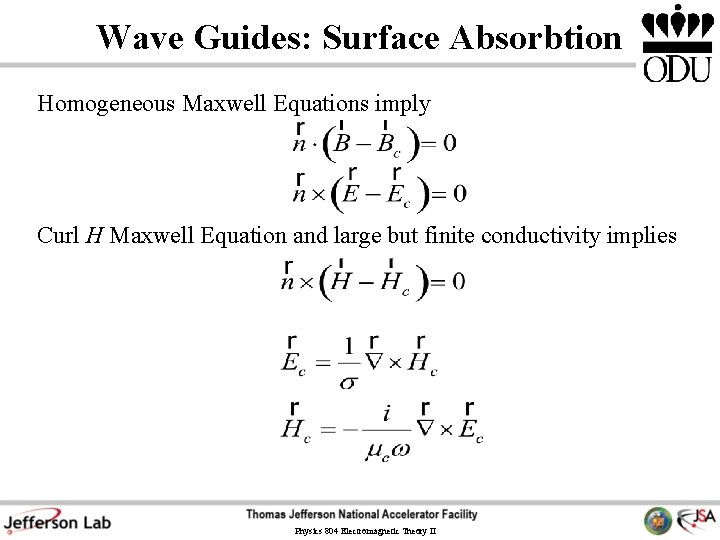
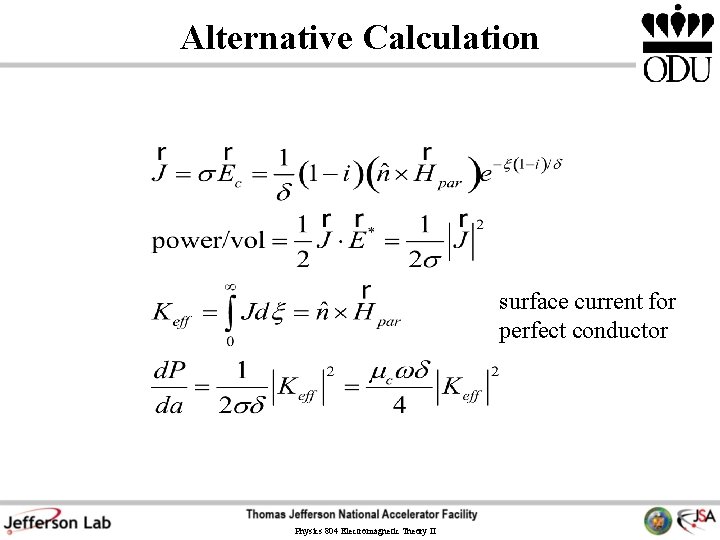
Wave Guides: Surface Absorbtion Homogeneous Maxwell Equations imply Curl H Maxwell Equation and large but finite conductivity implies Physics 804 Electromagnetic Theory II
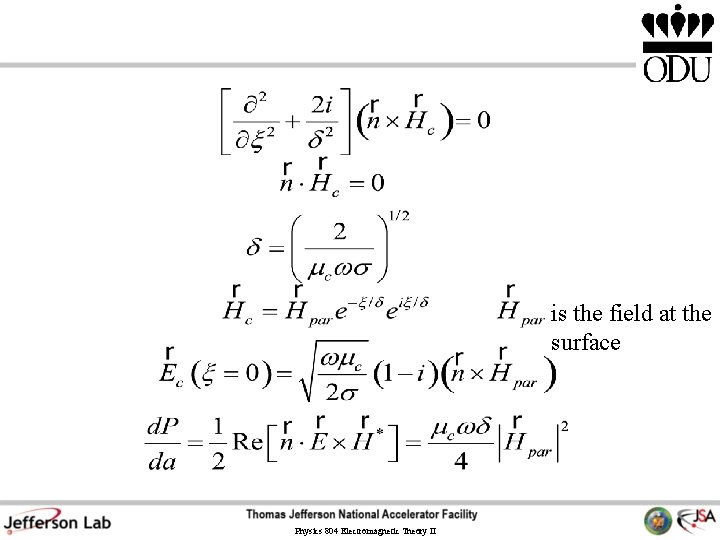
is the field at the surface Physics 804 Electromagnetic Theory II
Alternative Calculation surface current for perfect conductor Physics 804 Electromagnetic Theory II
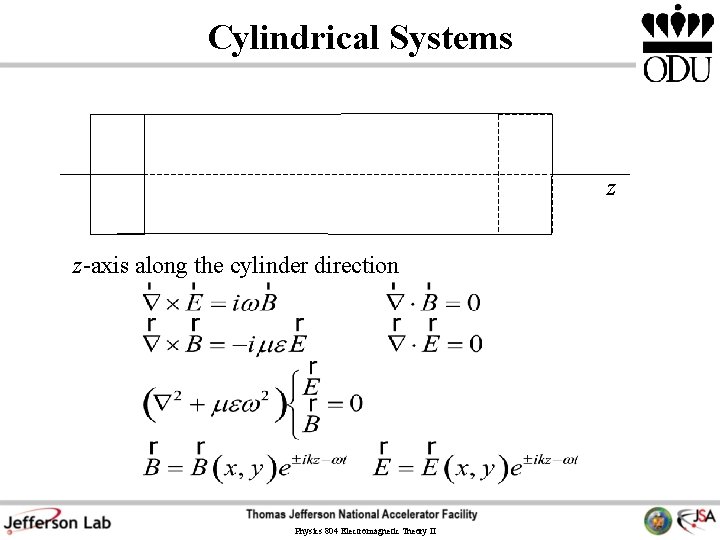
Cylindrical Systems z z-axis along the cylinder direction Physics 804 Electromagnetic Theory II
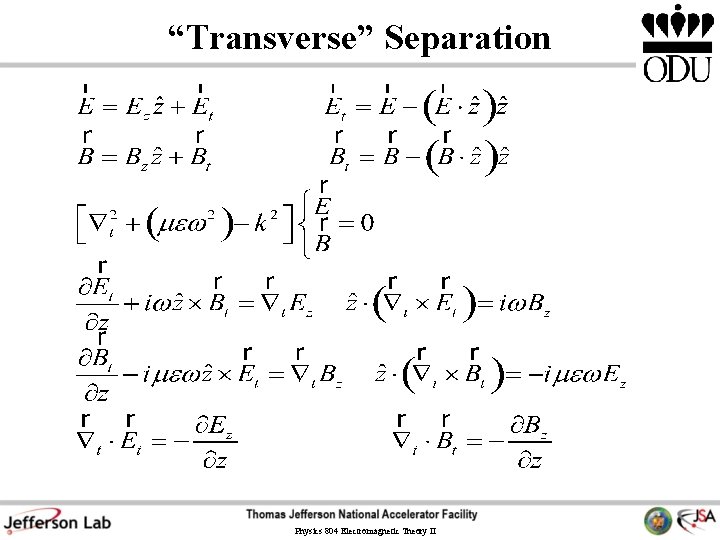
“Transverse” Separation Physics 804 Electromagnetic Theory II
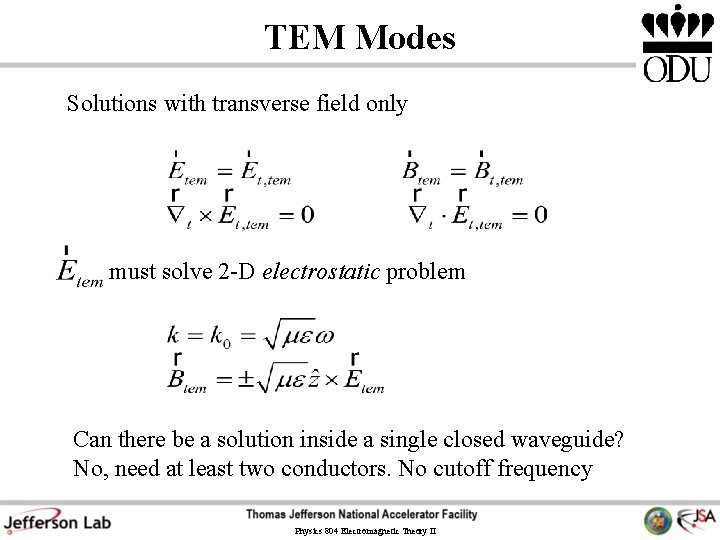
TEM Modes Solutions with transverse field only must solve 2 -D electrostatic problem Can there be a solution inside a single closed waveguide? No, need at least two conductors. No cutoff frequency Physics 804 Electromagnetic Theory II
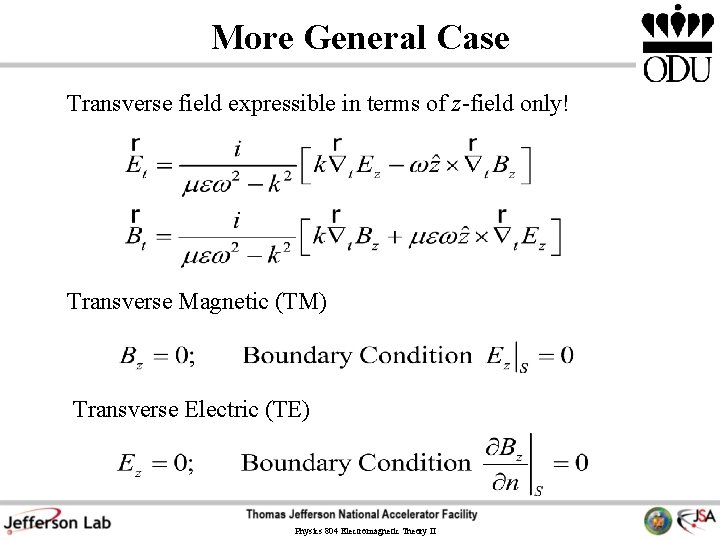
More General Case Transverse field expressible in terms of z-field only! Transverse Magnetic (TM) Transverse Electric (TE) Physics 804 Electromagnetic Theory II
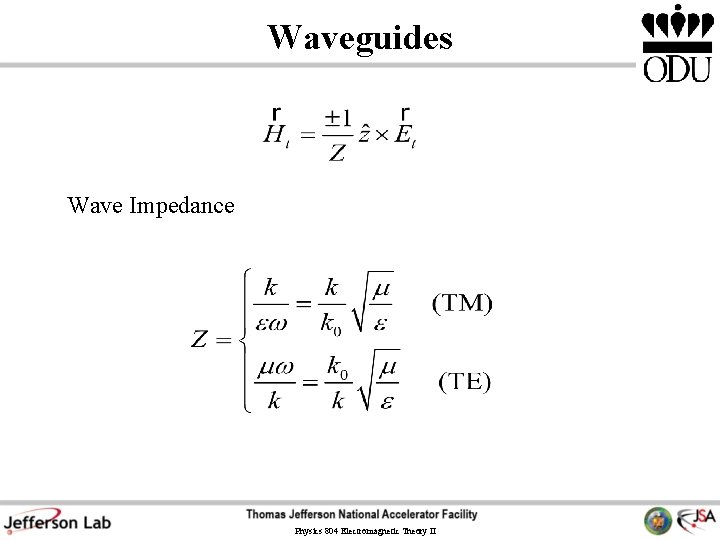
Waveguides Wave Impedance Physics 804 Electromagnetic Theory II
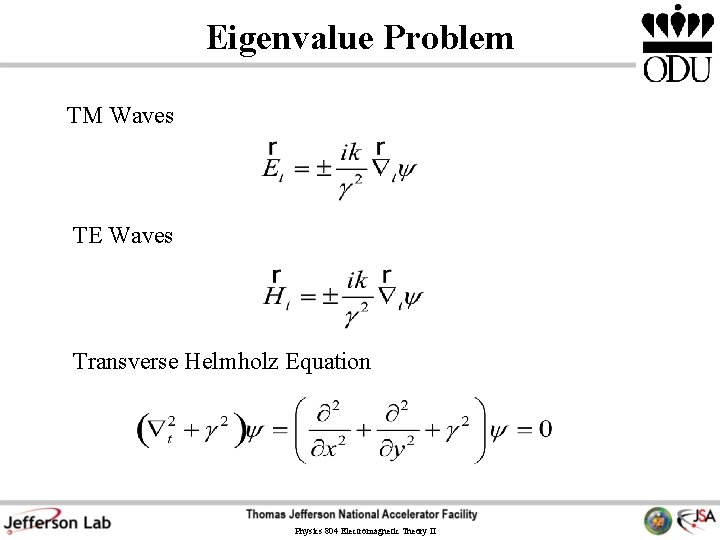
Eigenvalue Problem TM Waves TE Waves Transverse Helmholz Equation Physics 804 Electromagnetic Theory II
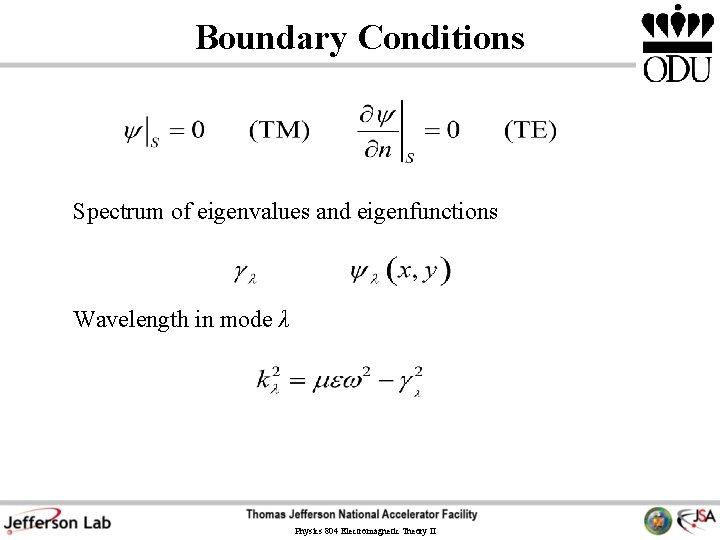
Boundary Conditions Spectrum of eigenvalues and eigenfunctions Wavelength in mode λ Physics 804 Electromagnetic Theory II
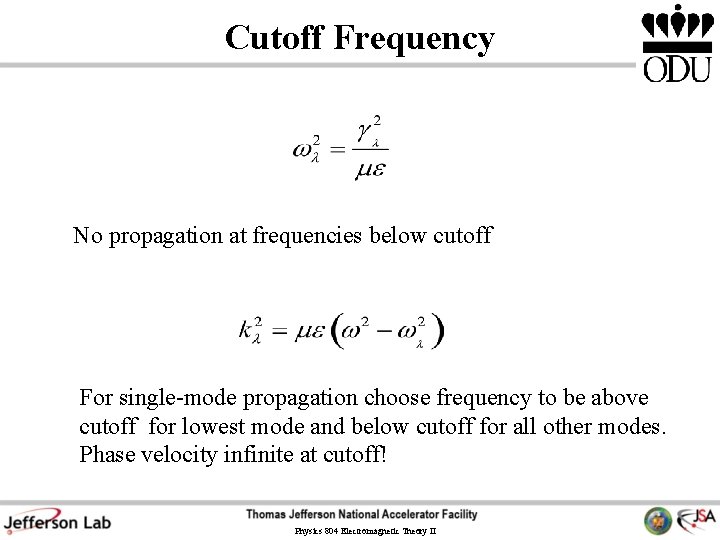
Cutoff Frequency No propagation at frequencies below cutoff For single-mode propagation choose frequency to be above cutoff for lowest mode and below cutoff for all other modes. Phase velocity infinite at cutoff! Physics 804 Electromagnetic Theory II
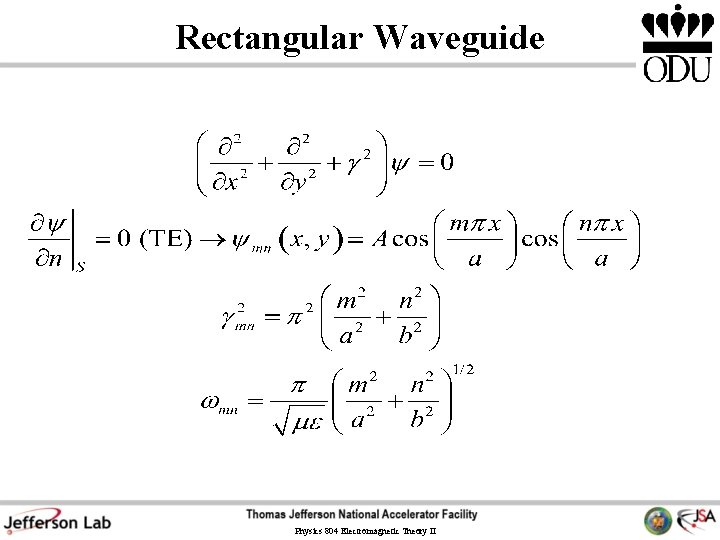
Rectangular Waveguide Physics 804 Electromagnetic Theory II
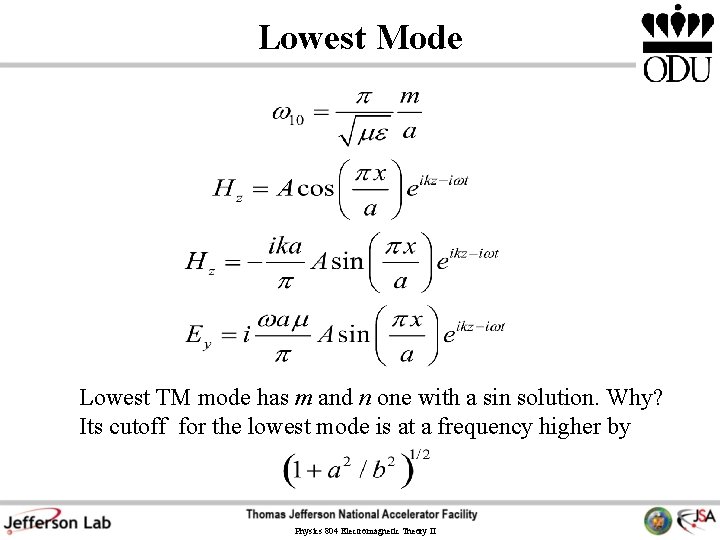
Lowest Mode Lowest TM mode has m and n one with a sin solution. Why? Its cutoff for the lowest mode is at a frequency higher by Physics 804 Electromagnetic Theory II
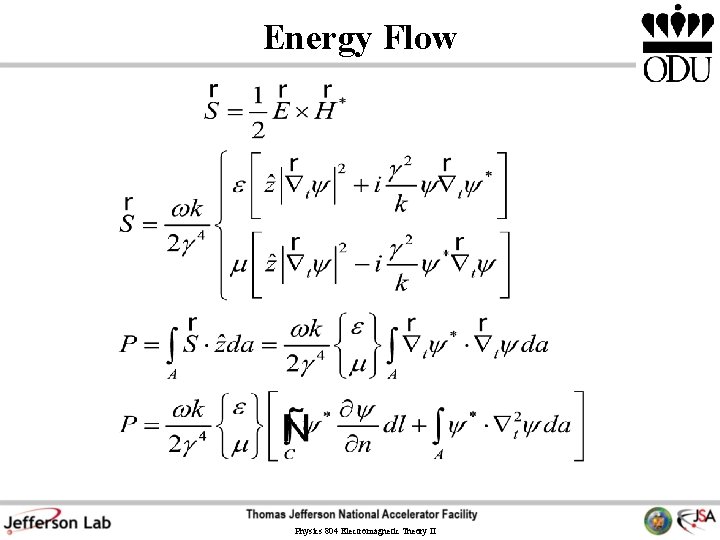
Energy Flow Physics 804 Electromagnetic Theory II
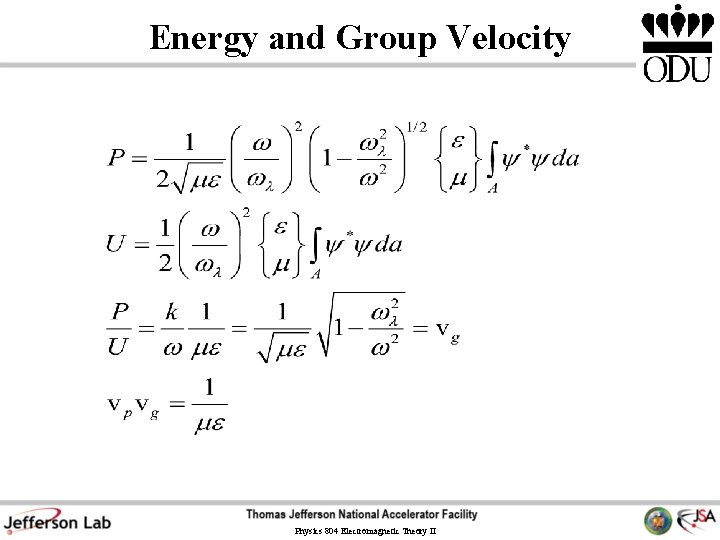
Energy and Group Velocity Physics 804 Electromagnetic Theory II
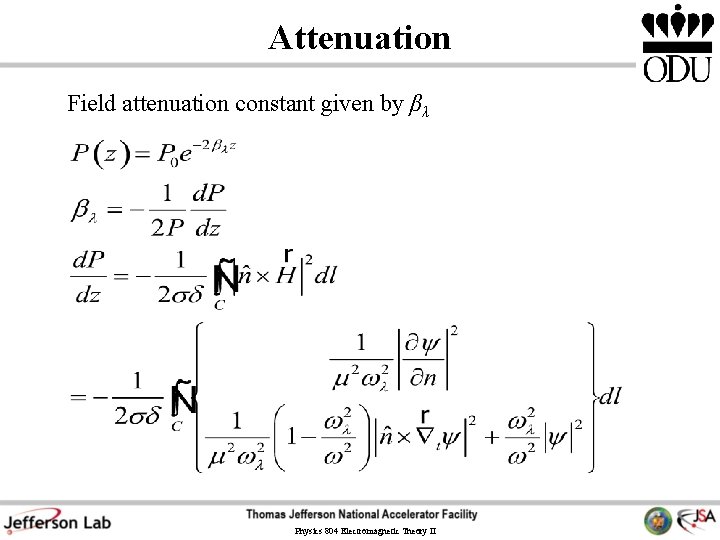
Attenuation Field attenuation constant given by βλ Physics 804 Electromagnetic Theory II
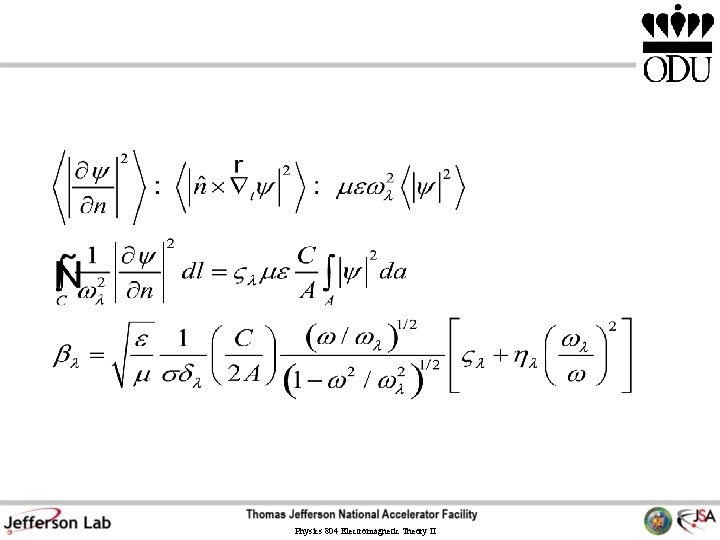
Physics 804 Electromagnetic Theory II
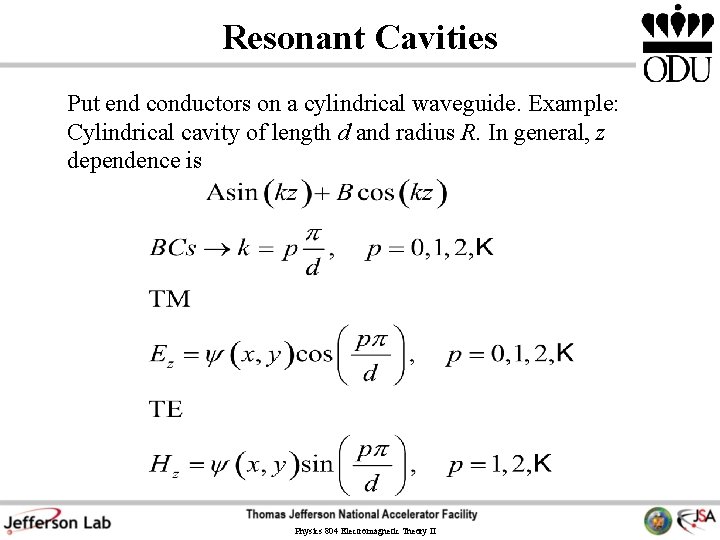
Resonant Cavities Put end conductors on a cylindrical waveguide. Example: Cylindrical cavity of length d and radius R. In general, z dependence is Physics 804 Electromagnetic Theory II
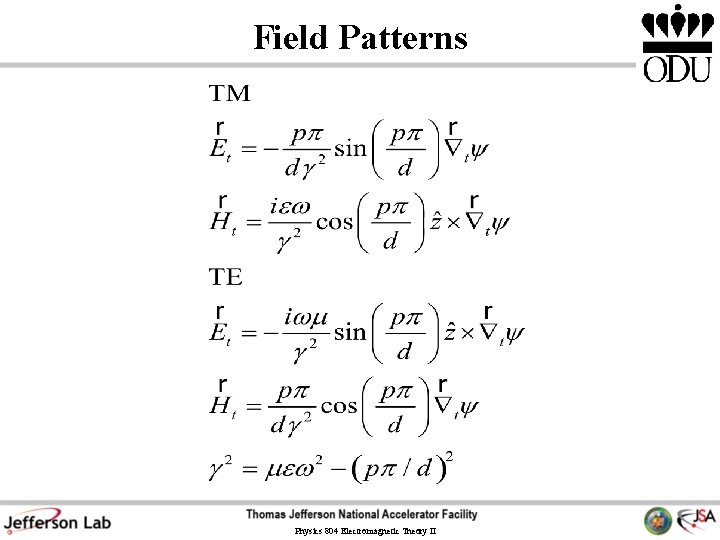
Field Patterns Physics 804 Electromagnetic Theory II
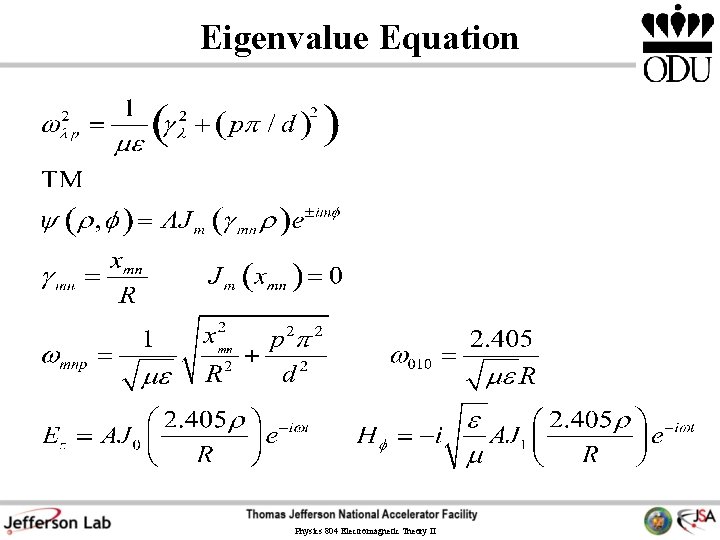
Eigenvalue Equation Physics 804 Electromagnetic Theory II
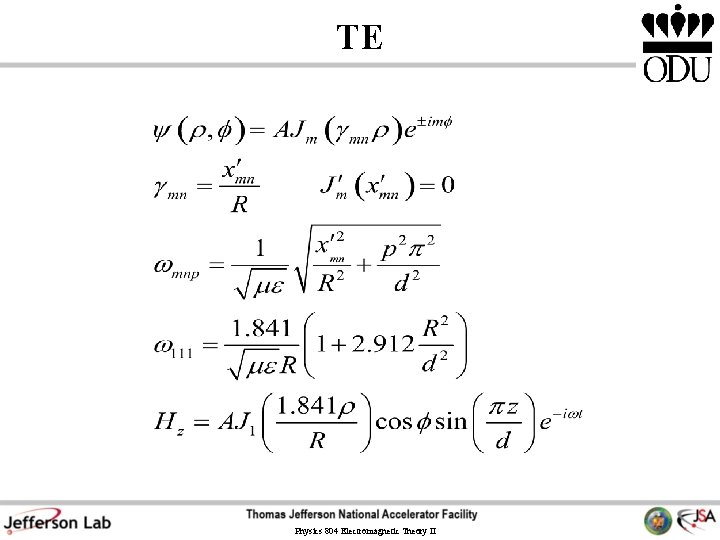
TE Physics 804 Electromagnetic Theory II
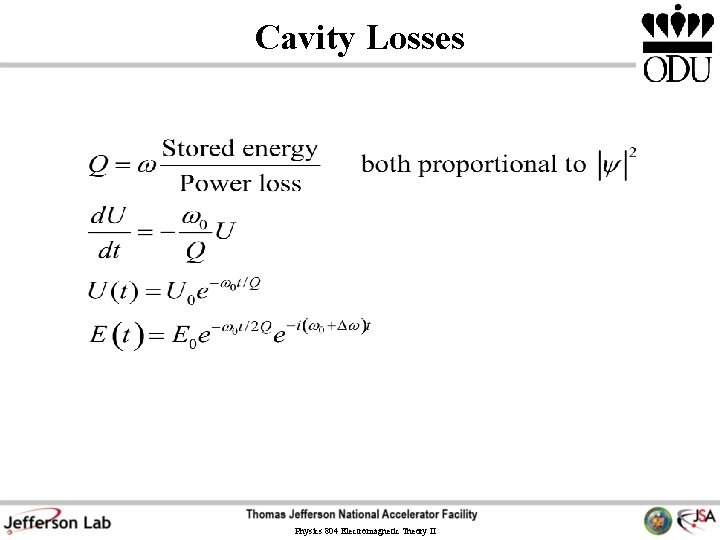
Cavity Losses Physics 804 Electromagnetic Theory II
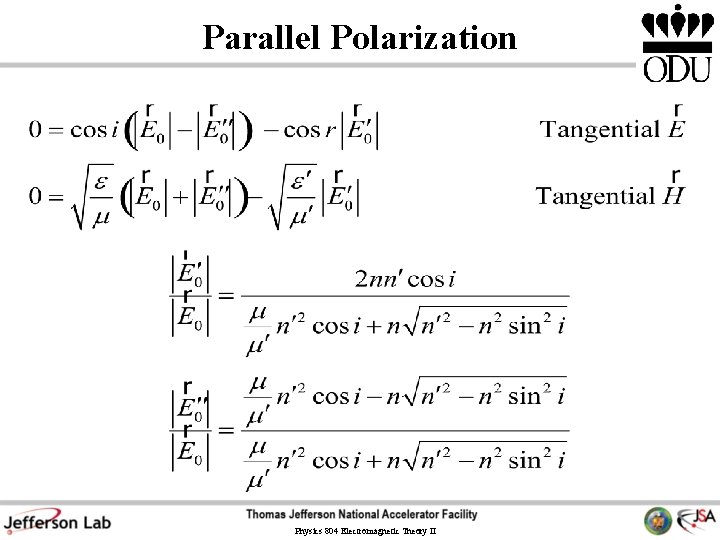
Parallel Polarization Physics 804 Electromagnetic Theory II
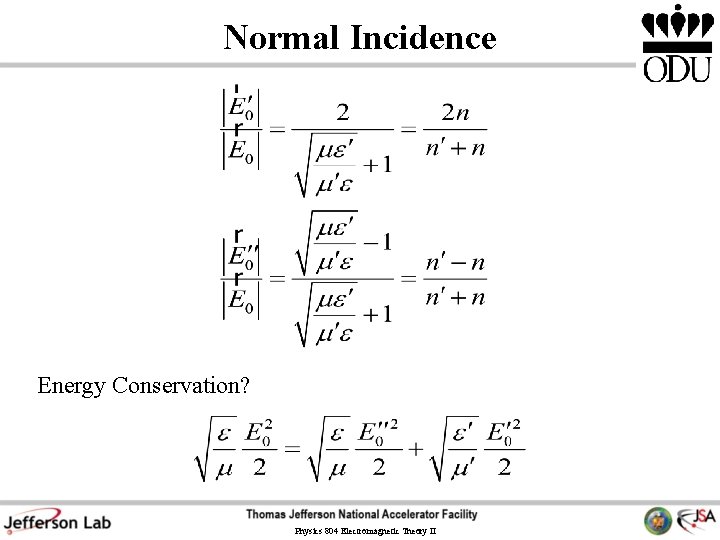
Normal Incidence Energy Conservation? Physics 804 Electromagnetic Theory II
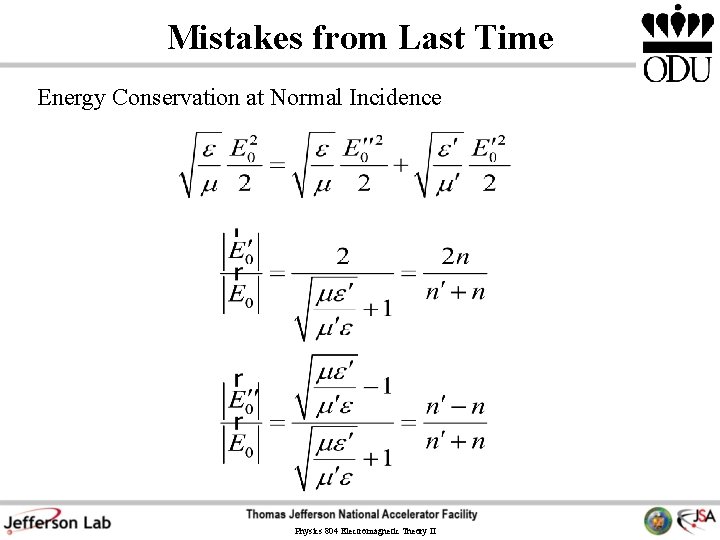
Mistakes from Last Time Energy Conservation at Normal Incidence Physics 804 Electromagnetic Theory II
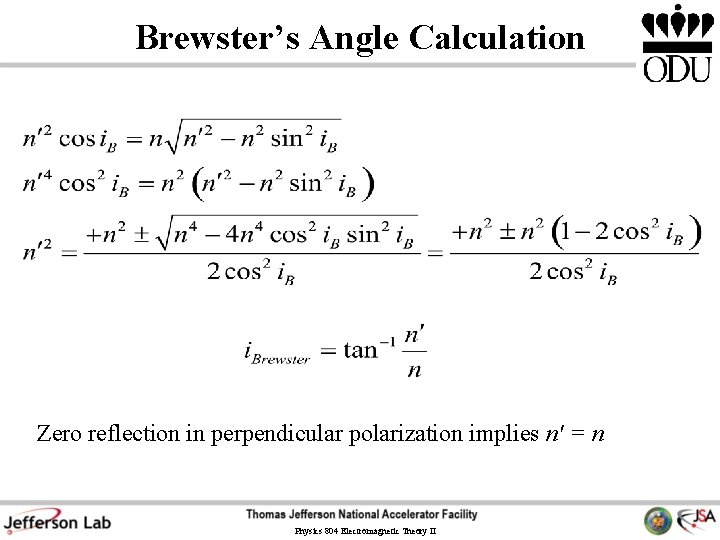
Brewster’s Angle Calculation Zero reflection in perpendicular polarization implies n' = n Physics 804 Electromagnetic Theory II
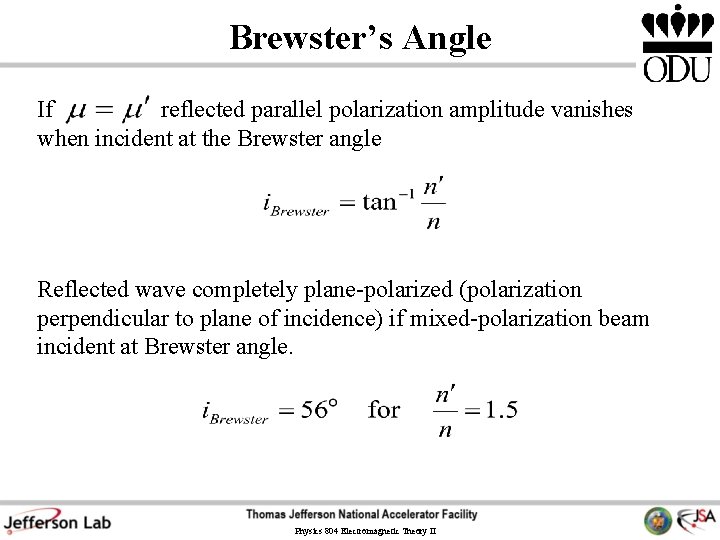
Brewster’s Angle If reflected parallel polarization amplitude vanishes when incident at the Brewster angle Reflected wave completely plane-polarized (polarization perpendicular to plane of incidence) if mixed-polarization beam incident at Brewster angle. Physics 804 Electromagnetic Theory II
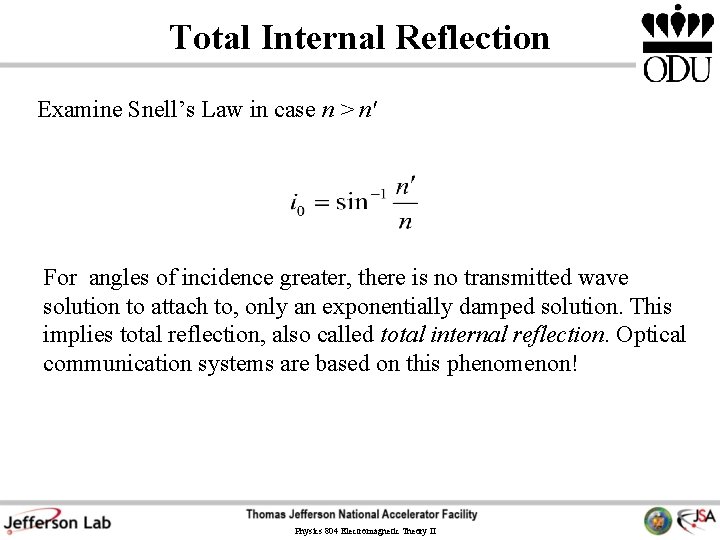
Total Internal Reflection Examine Snell’s Law in case n > n' For angles of incidence greater, there is no transmitted wave solution to attach to, only an exponentially damped solution. This implies total reflection, also called total internal reflection. Optical communication systems are based on this phenomenon! Physics 804 Electromagnetic Theory II
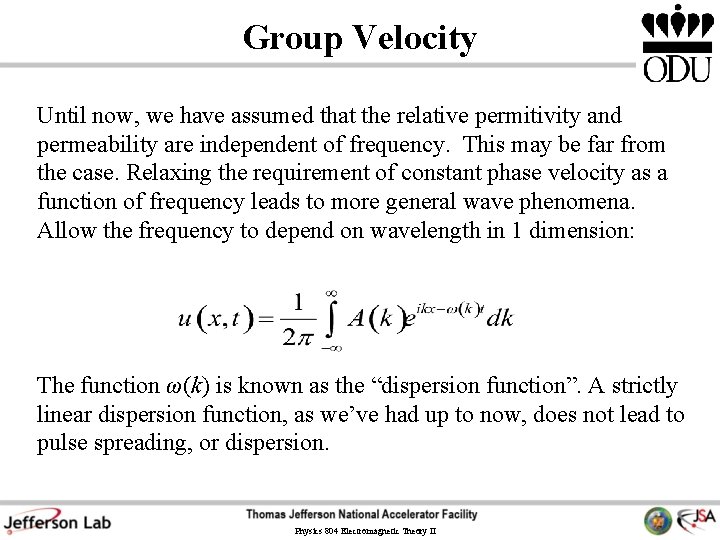
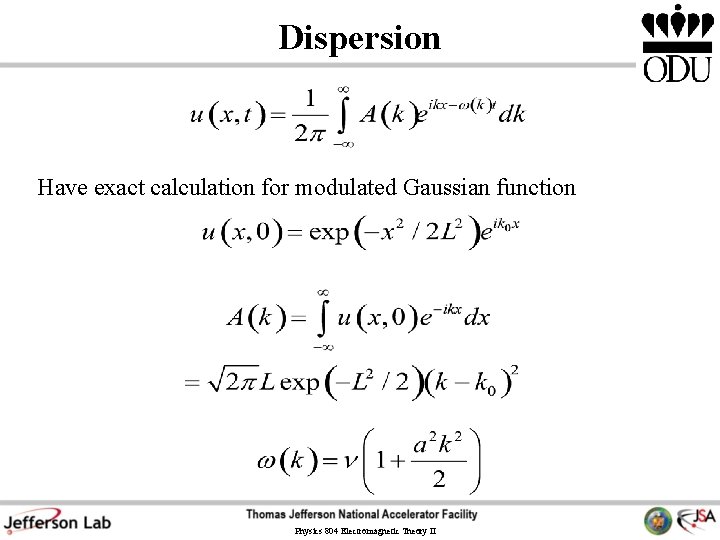
Group Velocity Until now, we have assumed that the relative permitivity and permeability are independent of frequency. This may be far from the case. Relaxing the requirement of constant phase velocity as a function of frequency leads to more general wave phenomena. Allow the frequency to depend on wavelength in 1 dimension: The function ω(k) is known as the “dispersion function”. A strictly linear dispersion function, as we’ve had up to now, does not lead to pulse spreading, or dispersion. Physics 804 Electromagnetic Theory II
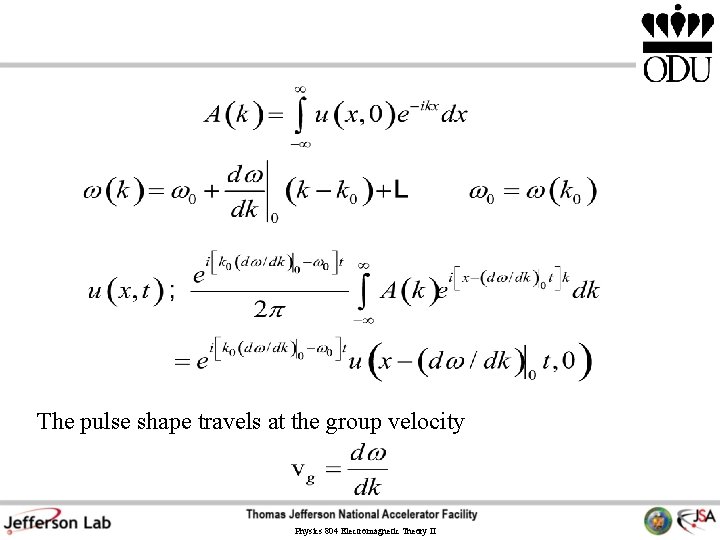
The pulse shape travels at the group velocity Physics 804 Electromagnetic Theory II
Dispersion Have exact calculation for modulated Gaussian function Physics 804 Electromagnetic Theory II
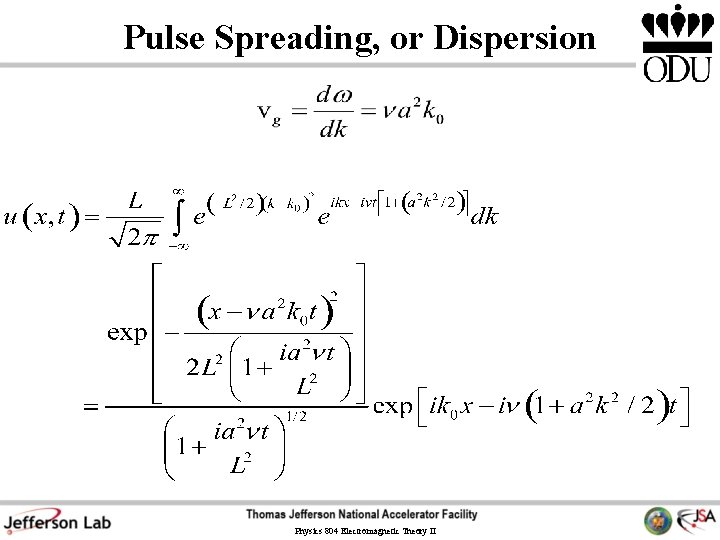
Pulse Spreading, or Dispersion Physics 804 Electromagnetic Theory II
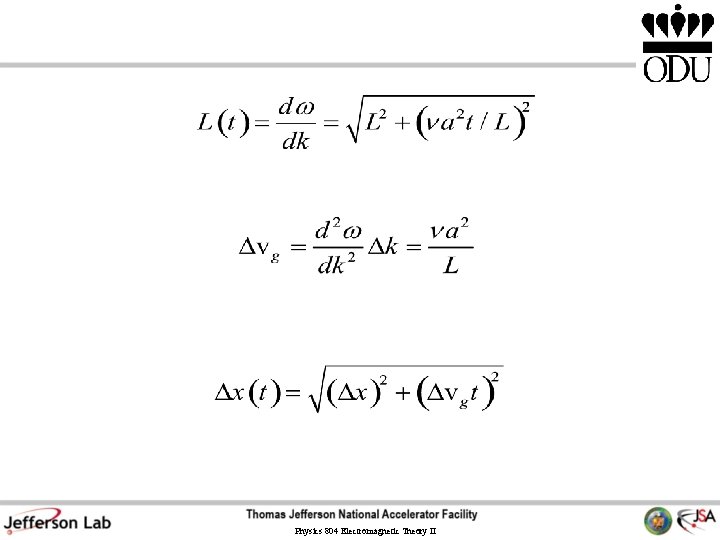
Physics 804 Electromagnetic Theory II
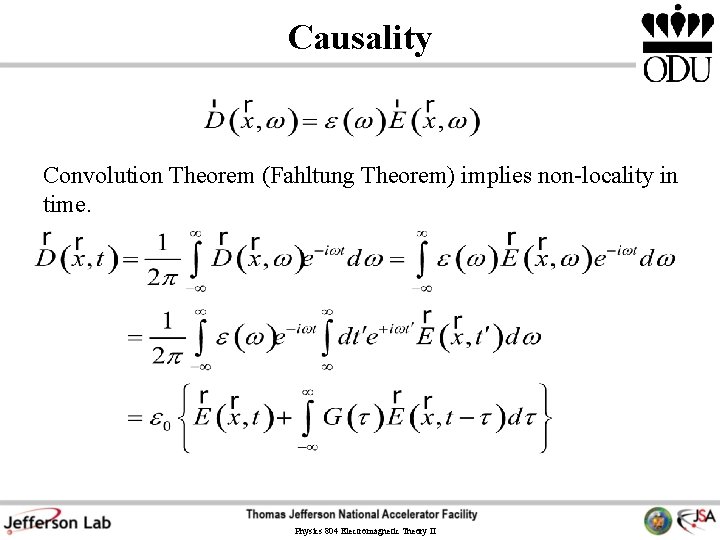
Causality Convolution Theorem (Fahltung Theorem) implies non-locality in time. Physics 804 Electromagnetic Theory II
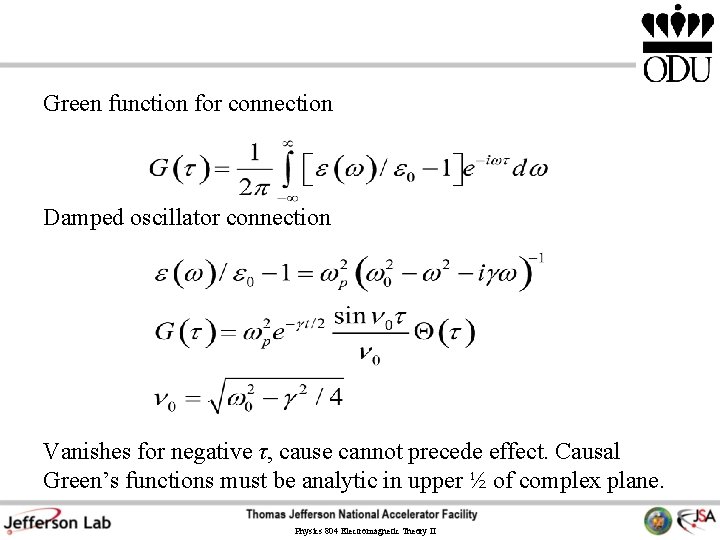
Green function for connection Damped oscillator connection Vanishes for negative τ, cause cannot precede effect. Causal Green’s functions must be analytic in upper ½ of complex plane. Physics 804 Electromagnetic Theory II
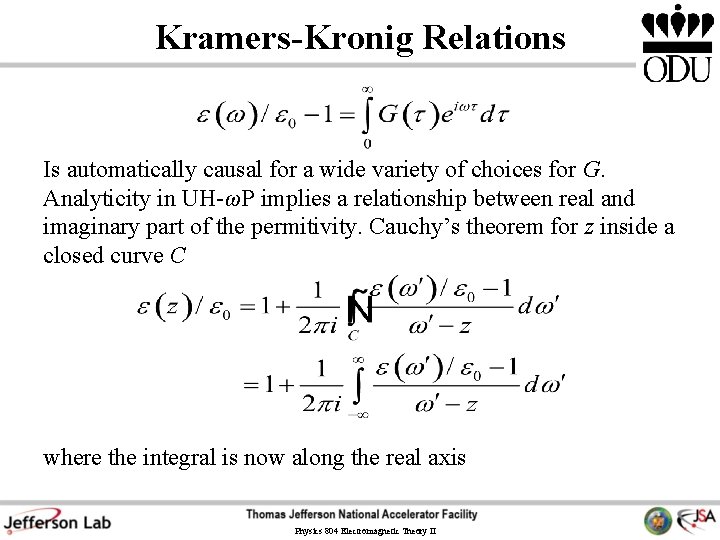
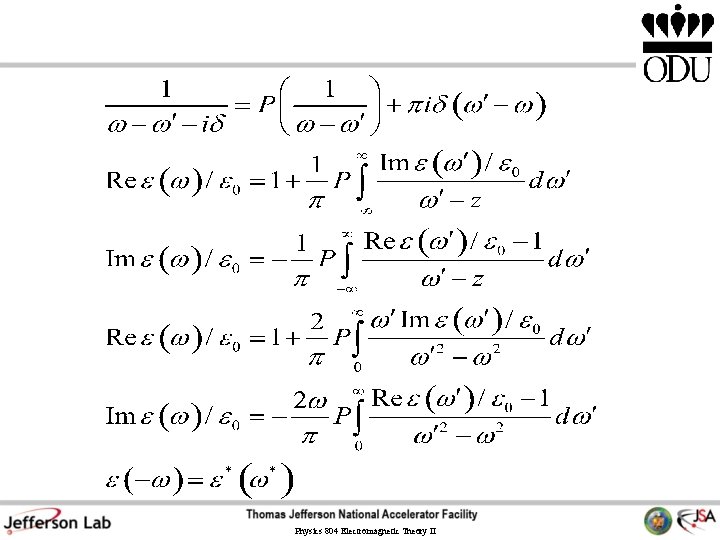
Kramers-Kronig Relations Is automatically causal for a wide variety of choices for G. Analyticity in UH-ωP implies a relationship between real and imaginary part of the permitivity. Cauchy’s theorem for z inside a closed curve C where the integral is now along the real axis Physics 804 Electromagnetic Theory II
Physics 804 Electromagnetic Theory II
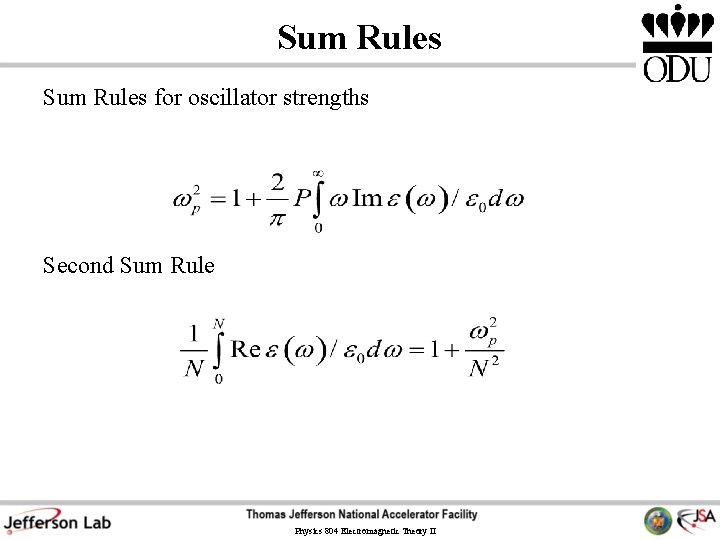
Sum Rules for oscillator strengths Second Sum Rule Physics 804 Electromagnetic Theory II