
Physics 6 B Stress Strain and Elastic Deformations
Physics 6 B Stress, Strain and Elastic Deformations Prepared by Vince Zaccone For Campus Learning Assistance Services at UCSB
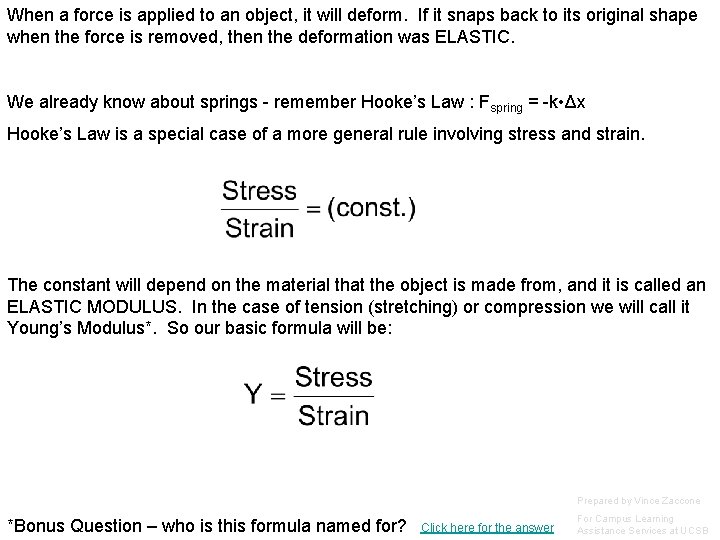
When a force is applied to an object, it will deform. If it snaps back to its original shape when the force is removed, then the deformation was ELASTIC. We already know about springs - remember Hooke’s Law : Fspring = -k • Δx Hooke’s Law is a special case of a more general rule involving stress and strain. The constant will depend on the material that the object is made from, and it is called an ELASTIC MODULUS. In the case of tension (stretching) or compression we will call it Young’s Modulus*. So our basic formula will be: Prepared by Vince Zaccone *Bonus Question – who is this formula named for? Click here for the answer For Campus Learning Assistance Services at UCSB
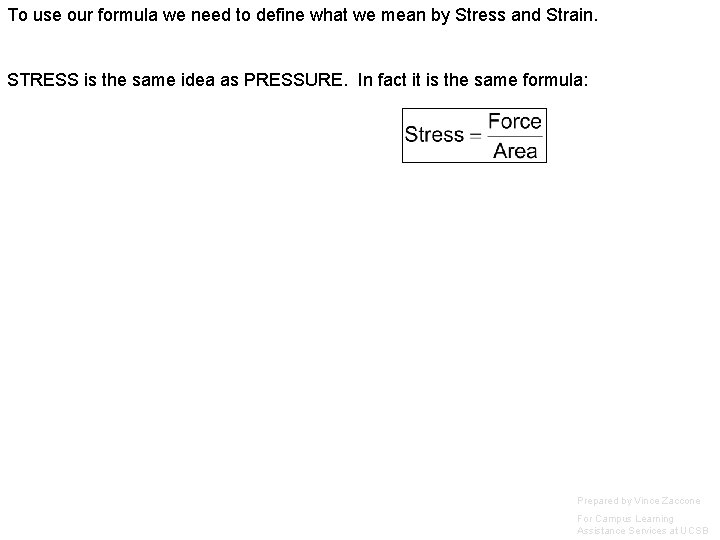
To use our formula we need to define what we mean by Stress and Strain. STRESS is the same idea as PRESSURE. In fact it is the same formula: Prepared by Vince Zaccone For Campus Learning Assistance Services at UCSB
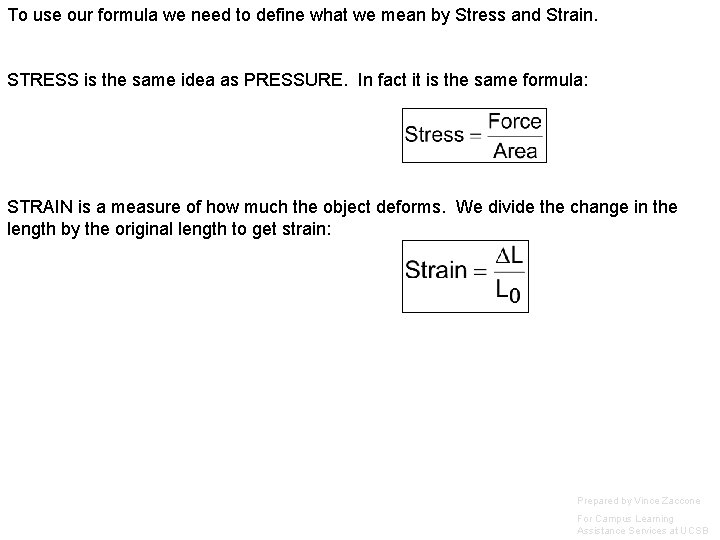
To use our formula we need to define what we mean by Stress and Strain. STRESS is the same idea as PRESSURE. In fact it is the same formula: STRAIN is a measure of how much the object deforms. We divide the change in the length by the original length to get strain: Prepared by Vince Zaccone For Campus Learning Assistance Services at UCSB
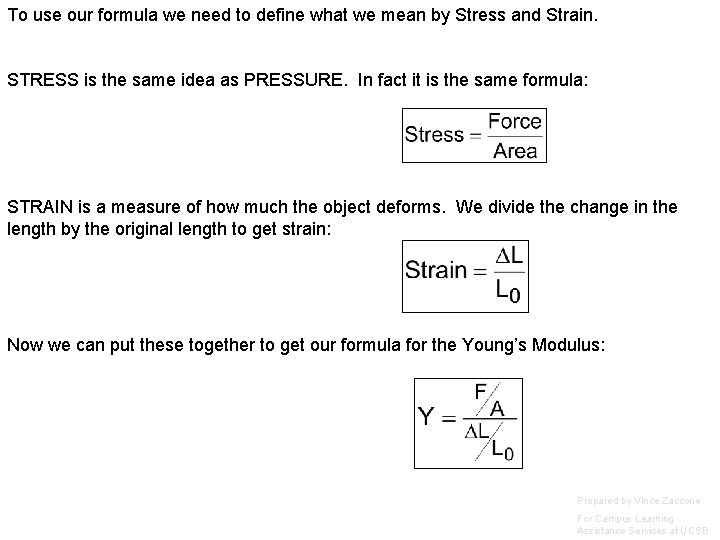
To use our formula we need to define what we mean by Stress and Strain. STRESS is the same idea as PRESSURE. In fact it is the same formula: STRAIN is a measure of how much the object deforms. We divide the change in the length by the original length to get strain: Now we can put these together to get our formula for the Young’s Modulus: Prepared by Vince Zaccone For Campus Learning Assistance Services at UCSB
Problem 11. 6 A nylon rope used by mountaineers elongates 1. 10 m under the weight of a 65. 0 kg climber. If the rope is initially 45. 0 m in length and 7. 0 mm in diameter, what is Young’s modulus for this nylon? Prepared by Vince Zaccone For Campus Learning Assistance Services at UCSB
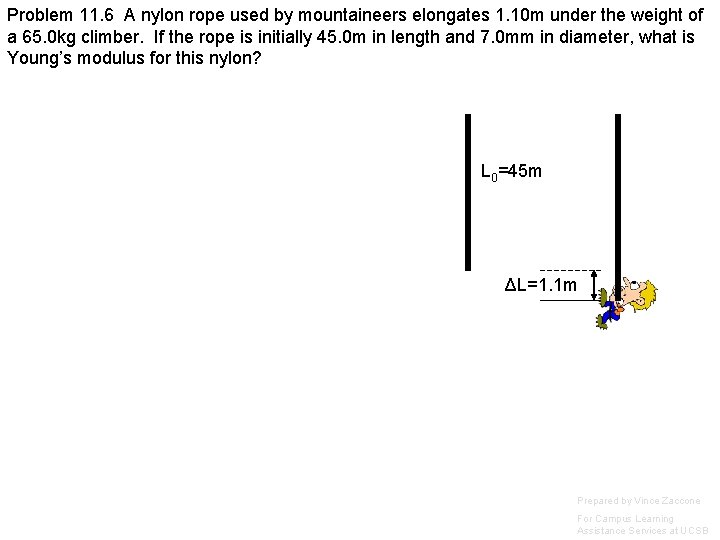
Problem 11. 6 A nylon rope used by mountaineers elongates 1. 10 m under the weight of a 65. 0 kg climber. If the rope is initially 45. 0 m in length and 7. 0 mm in diameter, what is Young’s modulus for this nylon? L 0=45 m ΔL=1. 1 m Prepared by Vince Zaccone For Campus Learning Assistance Services at UCSB
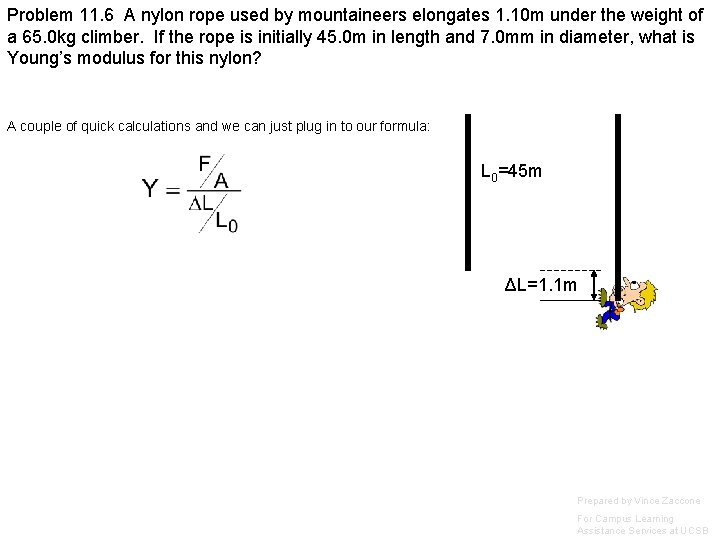
Problem 11. 6 A nylon rope used by mountaineers elongates 1. 10 m under the weight of a 65. 0 kg climber. If the rope is initially 45. 0 m in length and 7. 0 mm in diameter, what is Young’s modulus for this nylon? A couple of quick calculations and we can just plug in to our formula: L 0=45 m ΔL=1. 1 m Prepared by Vince Zaccone For Campus Learning Assistance Services at UCSB
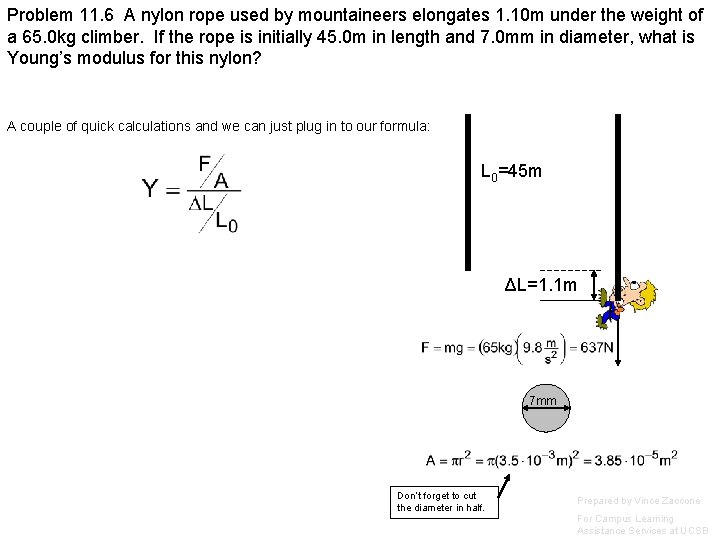
Problem 11. 6 A nylon rope used by mountaineers elongates 1. 10 m under the weight of a 65. 0 kg climber. If the rope is initially 45. 0 m in length and 7. 0 mm in diameter, what is Young’s modulus for this nylon? A couple of quick calculations and we can just plug in to our formula: L 0=45 m ΔL=1. 1 m 7 mm Don’t forget to cut the diameter in half. Prepared by Vince Zaccone For Campus Learning Assistance Services at UCSB
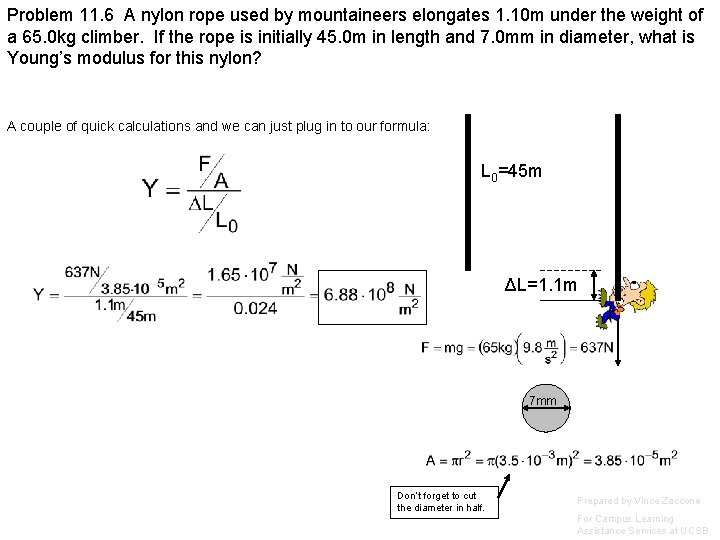
Problem 11. 6 A nylon rope used by mountaineers elongates 1. 10 m under the weight of a 65. 0 kg climber. If the rope is initially 45. 0 m in length and 7. 0 mm in diameter, what is Young’s modulus for this nylon? A couple of quick calculations and we can just plug in to our formula: L 0=45 m ΔL=1. 1 m 7 mm Don’t forget to cut the diameter in half. Prepared by Vince Zaccone For Campus Learning Assistance Services at UCSB
Problem 11. 7 A steel wire 2. 00 m long with circular cross-section must stretch no more than 0. 25 cm when a 400. 0 N weight is hung from one of its ends. What minimum diameter must this wire have? Prepared by Vince Zaccone For Campus Learning Assistance Services at UCSB
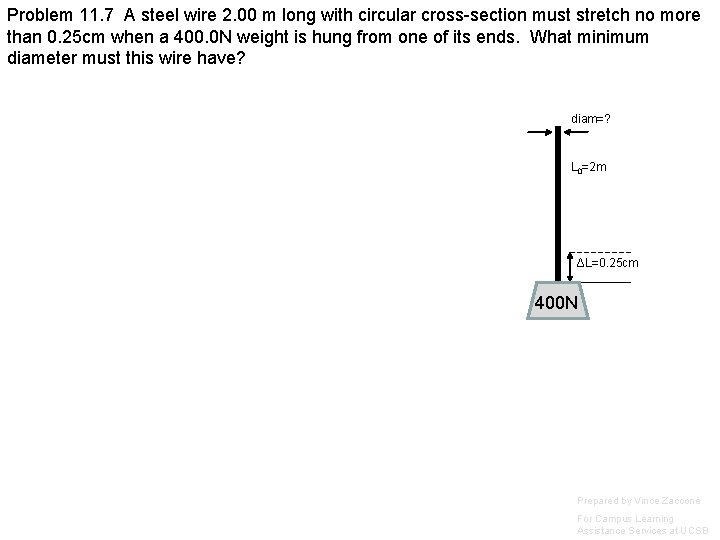
Problem 11. 7 A steel wire 2. 00 m long with circular cross-section must stretch no more than 0. 25 cm when a 400. 0 N weight is hung from one of its ends. What minimum diameter must this wire have? diam=? L 0=2 m ΔL=0. 25 cm 400 N Prepared by Vince Zaccone For Campus Learning Assistance Services at UCSB
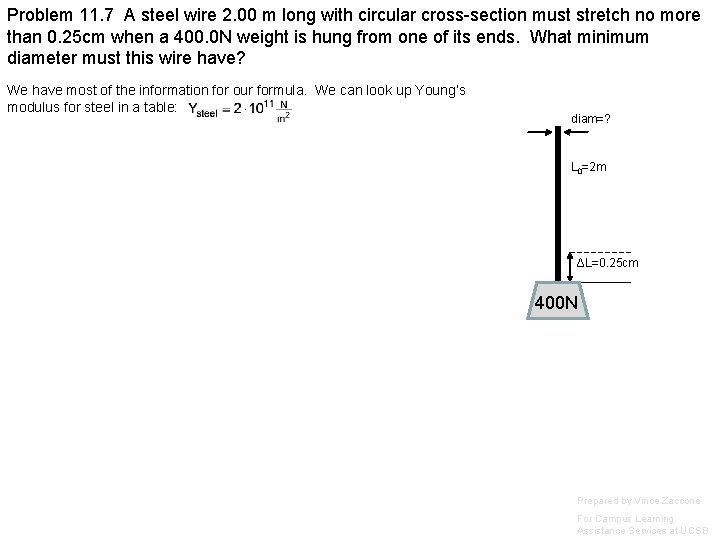
Problem 11. 7 A steel wire 2. 00 m long with circular cross-section must stretch no more than 0. 25 cm when a 400. 0 N weight is hung from one of its ends. What minimum diameter must this wire have? We have most of the information for our formula. We can look up Young’s modulus for steel in a table: diam=? L 0=2 m ΔL=0. 25 cm 400 N Prepared by Vince Zaccone For Campus Learning Assistance Services at UCSB
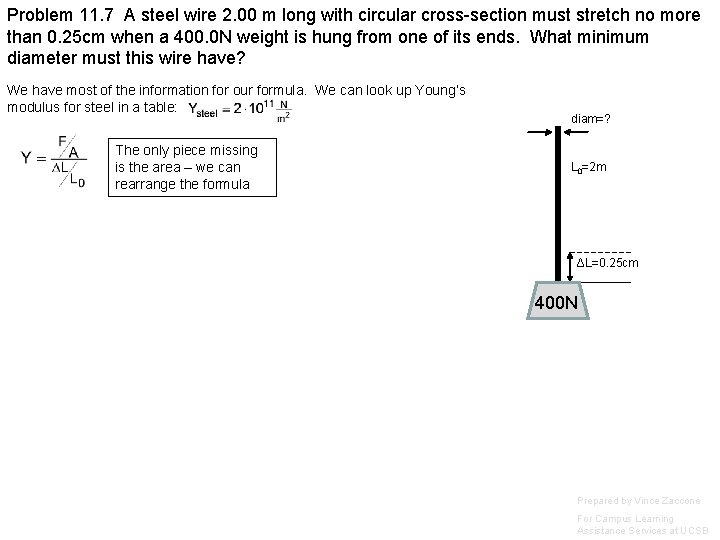
Problem 11. 7 A steel wire 2. 00 m long with circular cross-section must stretch no more than 0. 25 cm when a 400. 0 N weight is hung from one of its ends. What minimum diameter must this wire have? We have most of the information for our formula. We can look up Young’s modulus for steel in a table: The only piece missing is the area – we can rearrange the formula diam=? L 0=2 m ΔL=0. 25 cm 400 N Prepared by Vince Zaccone For Campus Learning Assistance Services at UCSB
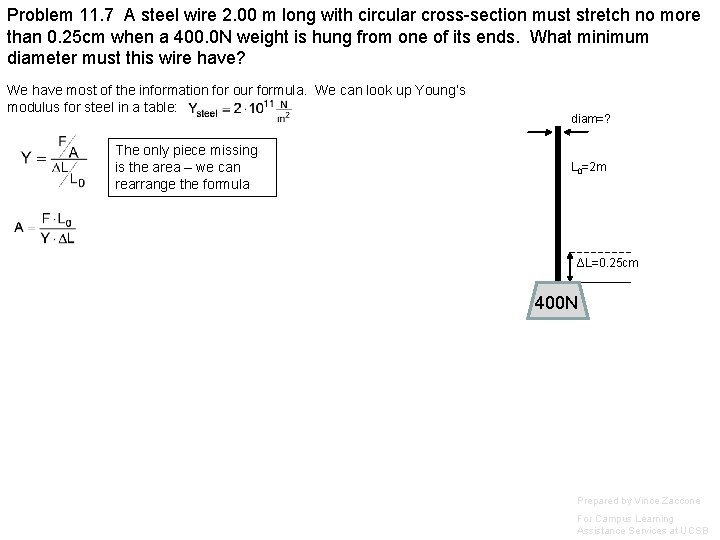
Problem 11. 7 A steel wire 2. 00 m long with circular cross-section must stretch no more than 0. 25 cm when a 400. 0 N weight is hung from one of its ends. What minimum diameter must this wire have? We have most of the information for our formula. We can look up Young’s modulus for steel in a table: The only piece missing is the area – we can rearrange the formula diam=? L 0=2 m ΔL=0. 25 cm 400 N Prepared by Vince Zaccone For Campus Learning Assistance Services at UCSB
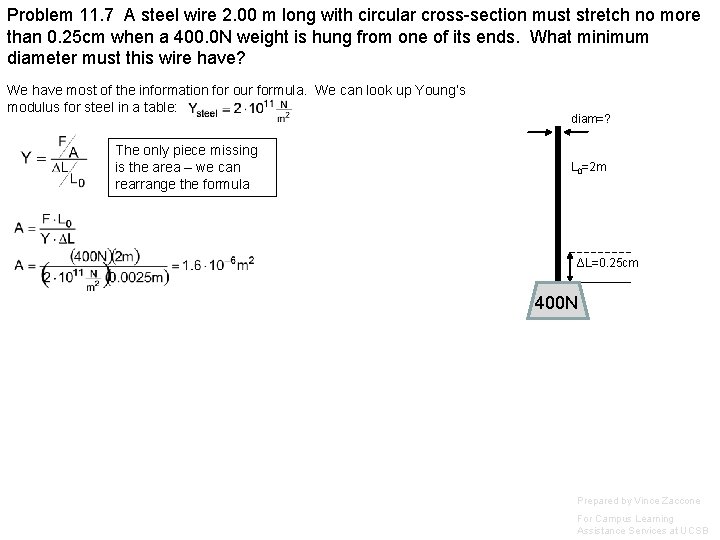
Problem 11. 7 A steel wire 2. 00 m long with circular cross-section must stretch no more than 0. 25 cm when a 400. 0 N weight is hung from one of its ends. What minimum diameter must this wire have? We have most of the information for our formula. We can look up Young’s modulus for steel in a table: The only piece missing is the area – we can rearrange the formula diam=? L 0=2 m ΔL=0. 25 cm 400 N Prepared by Vince Zaccone For Campus Learning Assistance Services at UCSB
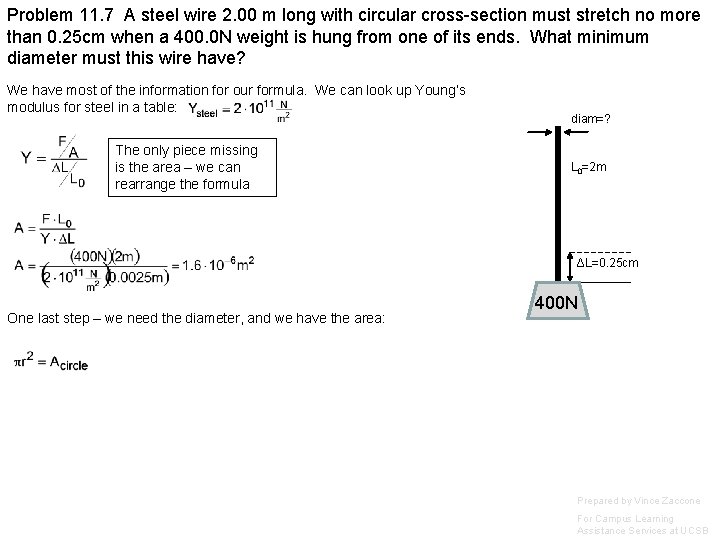
Problem 11. 7 A steel wire 2. 00 m long with circular cross-section must stretch no more than 0. 25 cm when a 400. 0 N weight is hung from one of its ends. What minimum diameter must this wire have? We have most of the information for our formula. We can look up Young’s modulus for steel in a table: The only piece missing is the area – we can rearrange the formula diam=? L 0=2 m ΔL=0. 25 cm One last step – we need the diameter, and we have the area: 400 N Prepared by Vince Zaccone For Campus Learning Assistance Services at UCSB
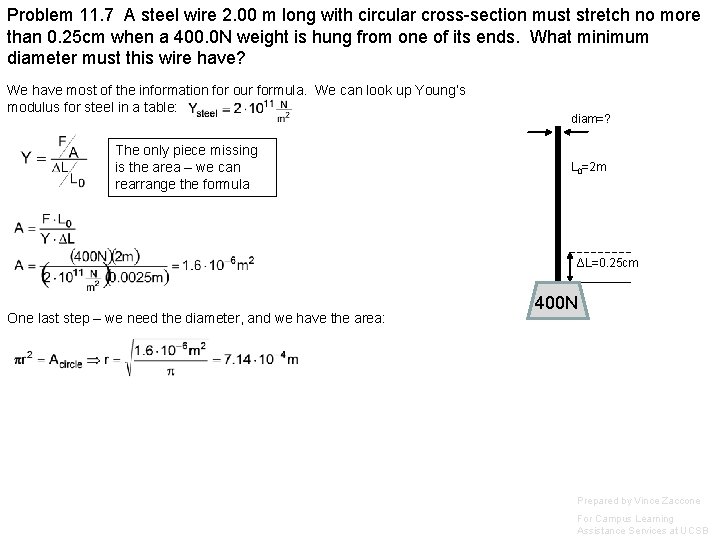
Problem 11. 7 A steel wire 2. 00 m long with circular cross-section must stretch no more than 0. 25 cm when a 400. 0 N weight is hung from one of its ends. What minimum diameter must this wire have? We have most of the information for our formula. We can look up Young’s modulus for steel in a table: The only piece missing is the area – we can rearrange the formula diam=? L 0=2 m ΔL=0. 25 cm One last step – we need the diameter, and we have the area: 400 N Prepared by Vince Zaccone For Campus Learning Assistance Services at UCSB
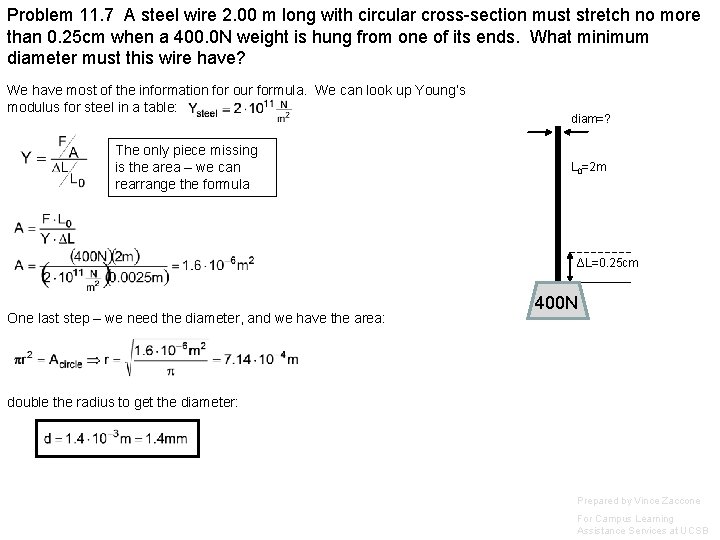
Problem 11. 7 A steel wire 2. 00 m long with circular cross-section must stretch no more than 0. 25 cm when a 400. 0 N weight is hung from one of its ends. What minimum diameter must this wire have? We have most of the information for our formula. We can look up Young’s modulus for steel in a table: The only piece missing is the area – we can rearrange the formula diam=? L 0=2 m ΔL=0. 25 cm One last step – we need the diameter, and we have the area: 400 N double the radius to get the diameter: Prepared by Vince Zaccone For Campus Learning Assistance Services at UCSB
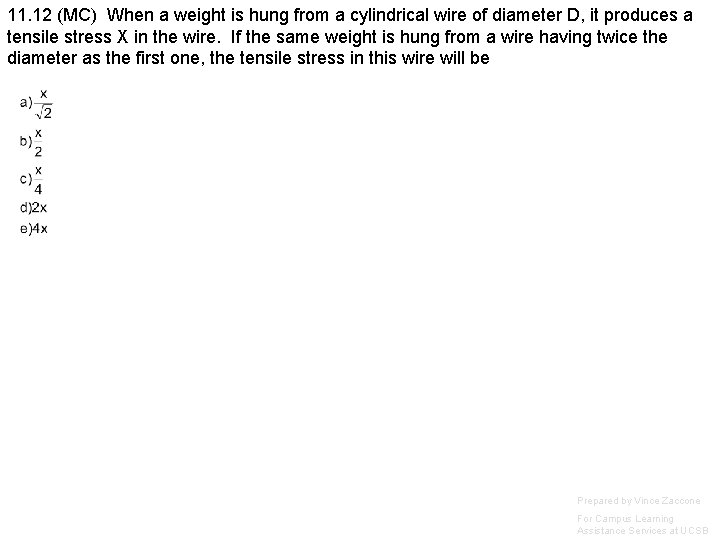
11. 12 (MC) When a weight is hung from a cylindrical wire of diameter D, it produces a tensile stress X in the wire. If the same weight is hung from a wire having twice the diameter as the first one, the tensile stress in this wire will be Prepared by Vince Zaccone For Campus Learning Assistance Services at UCSB
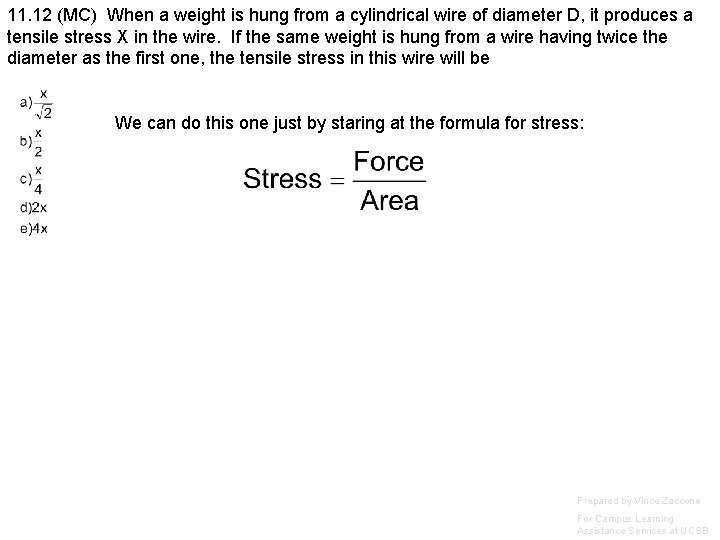
11. 12 (MC) When a weight is hung from a cylindrical wire of diameter D, it produces a tensile stress X in the wire. If the same weight is hung from a wire having twice the diameter as the first one, the tensile stress in this wire will be We can do this one just by staring at the formula for stress: Prepared by Vince Zaccone For Campus Learning Assistance Services at UCSB
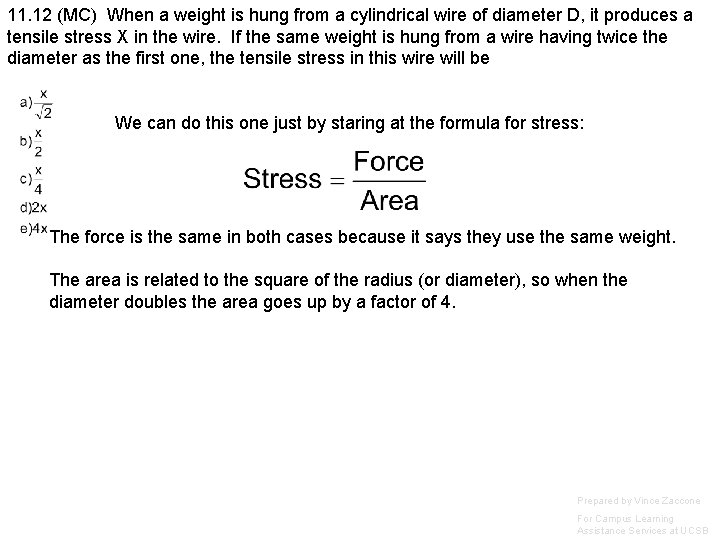
11. 12 (MC) When a weight is hung from a cylindrical wire of diameter D, it produces a tensile stress X in the wire. If the same weight is hung from a wire having twice the diameter as the first one, the tensile stress in this wire will be We can do this one just by staring at the formula for stress: The force is the same in both cases because it says they use the same weight. The area is related to the square of the radius (or diameter), so when the diameter doubles the area goes up by a factor of 4. Prepared by Vince Zaccone For Campus Learning Assistance Services at UCSB
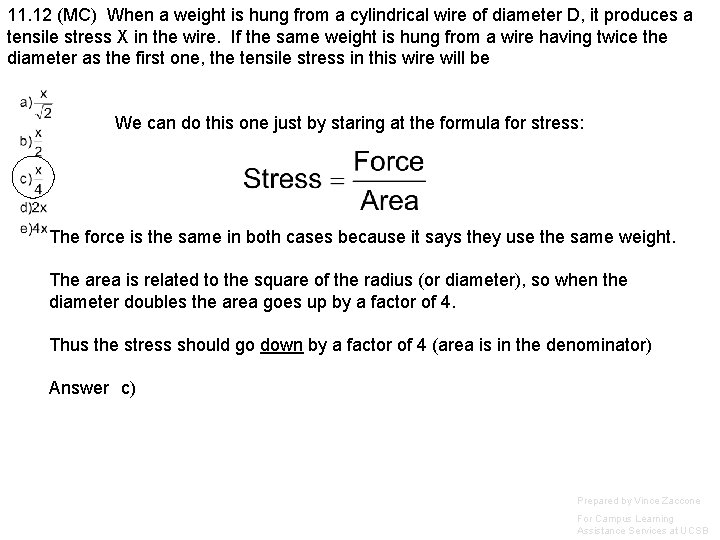
11. 12 (MC) When a weight is hung from a cylindrical wire of diameter D, it produces a tensile stress X in the wire. If the same weight is hung from a wire having twice the diameter as the first one, the tensile stress in this wire will be We can do this one just by staring at the formula for stress: The force is the same in both cases because it says they use the same weight. The area is related to the square of the radius (or diameter), so when the diameter doubles the area goes up by a factor of 4. Thus the stress should go down by a factor of 4 (area is in the denominator) Answer c) Prepared by Vince Zaccone For Campus Learning Assistance Services at UCSB
- Slides: 23