
Physics 6 B Electric Current And DC Circuit
Physics 6 B Electric Current And DC Circuit Examples Prepared by Vince Zaccone For Campus Learning Assistance Services at UCSB
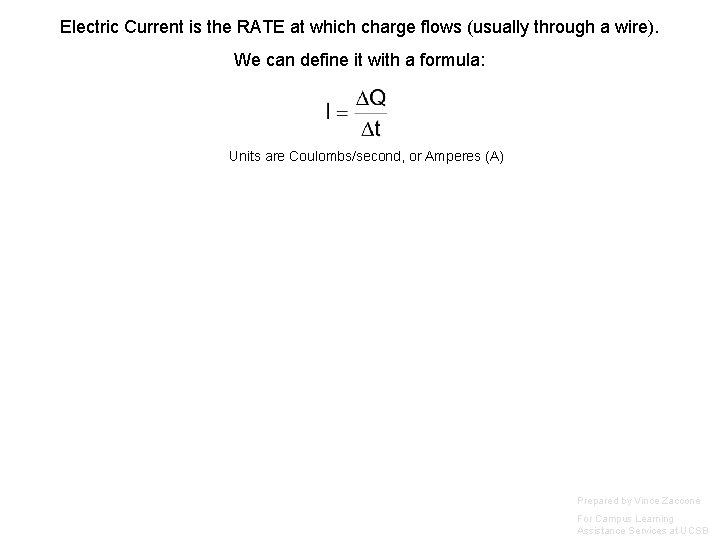
Electric Current is the RATE at which charge flows (usually through a wire). We can define it with a formula: Units are Coulombs/second, or Amperes (A) Prepared by Vince Zaccone For Campus Learning Assistance Services at UCSB
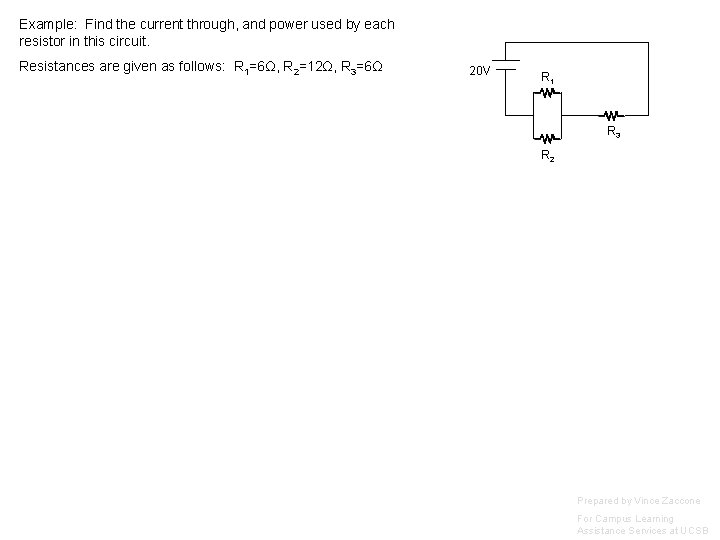
Example: Find the current through, and power used by each resistor in this circuit. Resistances are given as follows: R 1=6Ω, R 2=12Ω, R 3=6Ω 20 V R 1 R 3 R 2 Prepared by Vince Zaccone For Campus Learning Assistance Services at UCSB
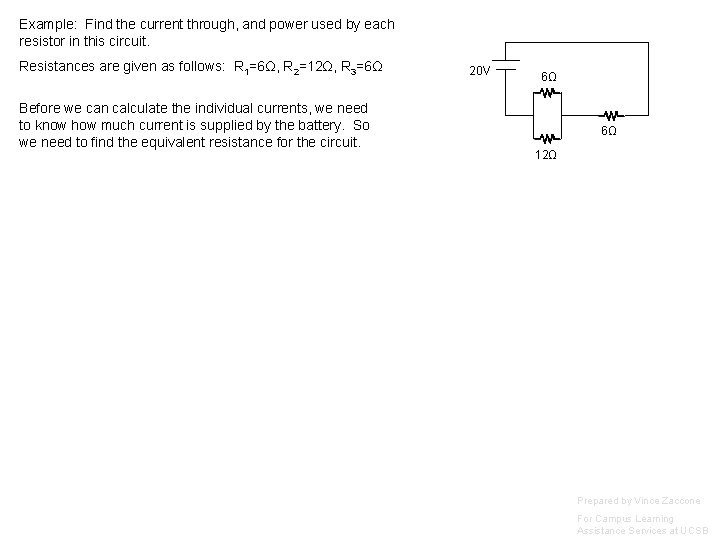
Example: Find the current through, and power used by each resistor in this circuit. Resistances are given as follows: R 1=6Ω, R 2=12Ω, R 3=6Ω Before we can calculate the individual currents, we need to know how much current is supplied by the battery. So we need to find the equivalent resistance for the circuit. 20 V 6Ω 6Ω 12Ω Prepared by Vince Zaccone For Campus Learning Assistance Services at UCSB

Example: Find the current through, and power used by each resistor in this circuit. Resistances are given as follows: R 1=6Ω, R 2=12Ω, R 3=6Ω Before we can calculate the individual currents, we need to know how much current is supplied by the battery. So we need to find the equivalent resistance for the circuit. 20 V 6Ω Parallel – Req=4Ω 12Ω Notice that R 1 and R 2 are in parallel. We can combine them into one single resistor: This shortcut formula will work for any pair of parallel resistors. 6Ω 20 V 4Ω 6Ω Prepared by Vince Zaccone For Campus Learning Assistance Services at UCSB

Example: Find the current through, and power used by each resistor in this circuit. Resistances are given as follows: R 1=6Ω, R 2=12Ω, R 3=6Ω Before we can calculate the individual currents, we need to know how much current is supplied by the battery. So we need to find the equivalent resistance for the circuit. 20 V 6Ω Parallel – Req=4Ω 12Ω Notice that R 1 and R 2 are in parallel. We can combine them into one single resistor: This shortcut formula will work for any pair of parallel resistors. 6Ω 20 V Series – Req=10Ω 4Ω 6Ω The next step is to combine the remaining resistors, which are in series. The formula is simple – just add them together. 20 V 10Ω Prepared by Vince Zaccone For Campus Learning Assistance Services at UCSB
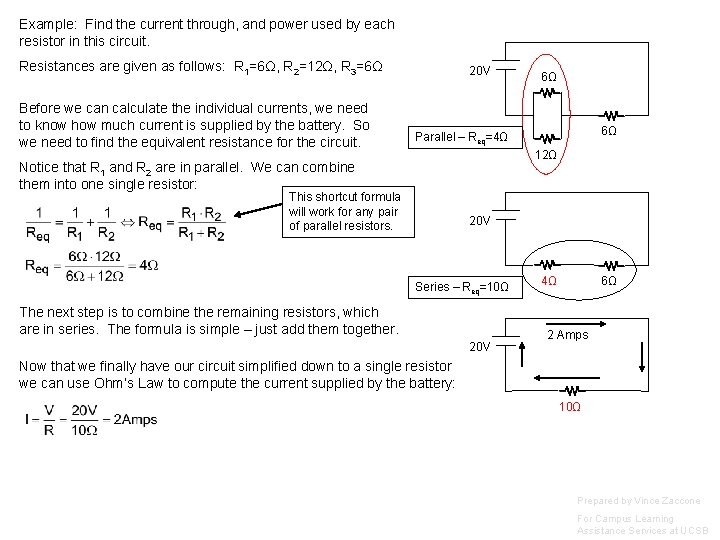
Example: Find the current through, and power used by each resistor in this circuit. Resistances are given as follows: R 1=6Ω, R 2=12Ω, R 3=6Ω Before we can calculate the individual currents, we need to know how much current is supplied by the battery. So we need to find the equivalent resistance for the circuit. 20 V 6Ω 6Ω Parallel – Req=4Ω 12Ω Notice that R 1 and R 2 are in parallel. We can combine them into one single resistor: This shortcut formula will work for any pair of parallel resistors. 20 V Series – Req=10Ω The next step is to combine the remaining resistors, which are in series. The formula is simple – just add them together. 20 V 4Ω 6Ω 2 Amps Now that we finally have our circuit simplified down to a single resistor we can use Ohm’s Law to compute the current supplied by the battery: 10Ω Prepared by Vince Zaccone For Campus Learning Assistance Services at UCSB
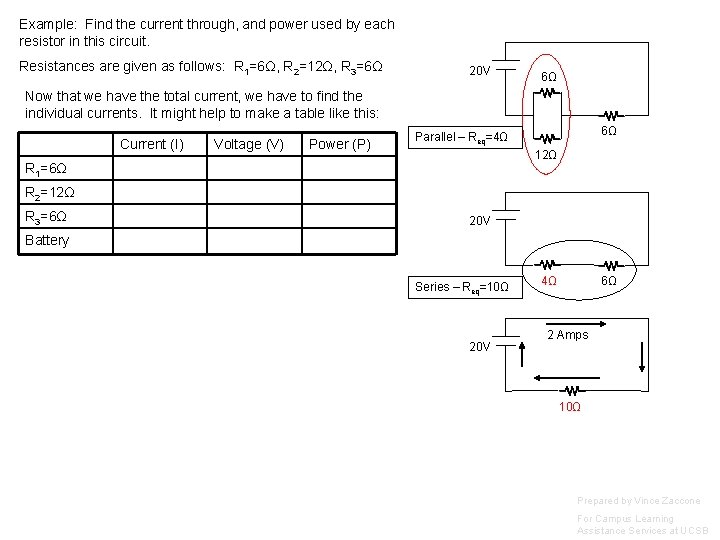
Example: Find the current through, and power used by each resistor in this circuit. Resistances are given as follows: R 1=6Ω, R 2=12Ω, R 3=6Ω 20 V 6Ω Now that we have the total current, we have to find the individual currents. It might help to make a table like this: Current (I) Voltage (V) Power (P) 6Ω Parallel – Req=4Ω 12Ω R 1=6Ω R 2=12Ω R 3=6Ω 20 V Battery Series – Req=10Ω 20 V 4Ω 6Ω 2 Amps 10Ω Prepared by Vince Zaccone For Campus Learning Assistance Services at UCSB
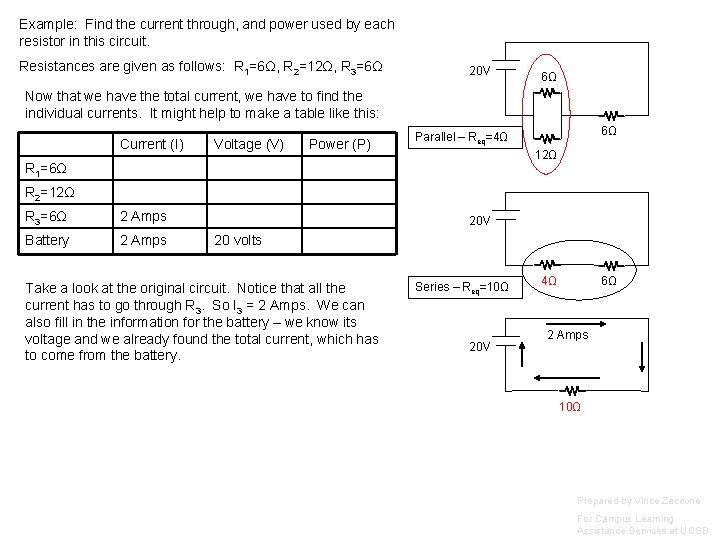
Example: Find the current through, and power used by each resistor in this circuit. Resistances are given as follows: R 1=6Ω, R 2=12Ω, R 3=6Ω 20 V 6Ω Now that we have the total current, we have to find the individual currents. It might help to make a table like this: Current (I) Voltage (V) Power (P) 6Ω Parallel – Req=4Ω 12Ω R 1=6Ω R 2=12Ω R 3=6Ω 2 Amps Battery 2 Amps 20 V 20 volts Take a look at the original circuit. Notice that all the current has to go through R 3. So I 3 = 2 Amps. We can also fill in the information for the battery – we know its voltage and we already found the total current, which has to come from the battery. Series – Req=10Ω 20 V 4Ω 6Ω 2 Amps 10Ω Prepared by Vince Zaccone For Campus Learning Assistance Services at UCSB
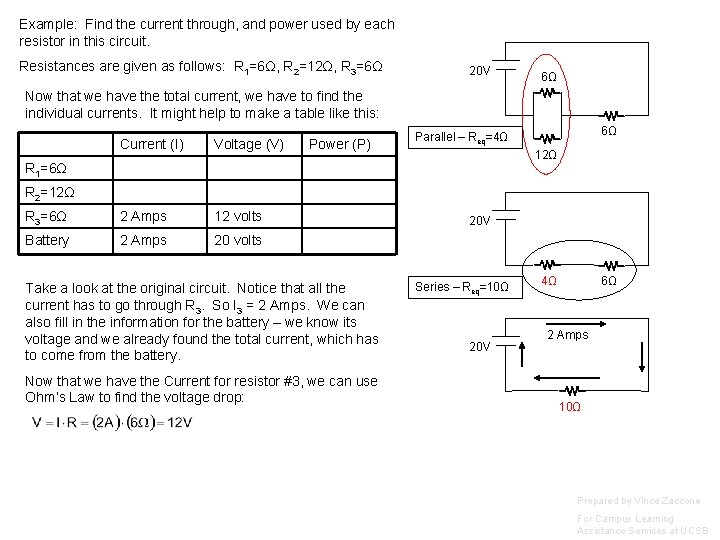
Example: Find the current through, and power used by each resistor in this circuit. Resistances are given as follows: R 1=6Ω, R 2=12Ω, R 3=6Ω 20 V 6Ω Now that we have the total current, we have to find the individual currents. It might help to make a table like this: Current (I) Voltage (V) R 3=6Ω 2 Amps 12 volts Battery 2 Amps 20 volts Power (P) 6Ω Parallel – Req=4Ω 12Ω R 1=6Ω R 2=12Ω Take a look at the original circuit. Notice that all the current has to go through R 3. So I 3 = 2 Amps. We can also fill in the information for the battery – we know its voltage and we already found the total current, which has to come from the battery. Now that we have the Current for resistor #3, we can use Ohm’s Law to find the voltage drop: 20 V Series – Req=10Ω 20 V 4Ω 6Ω 2 Amps 10Ω Prepared by Vince Zaccone For Campus Learning Assistance Services at UCSB
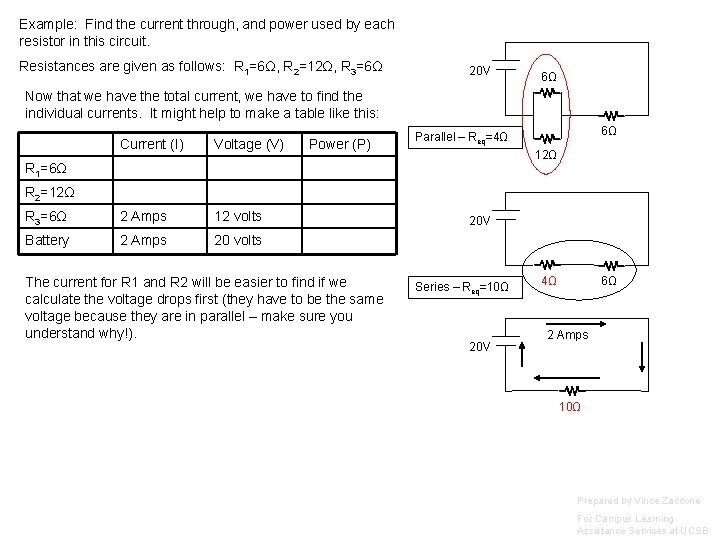
Example: Find the current through, and power used by each resistor in this circuit. Resistances are given as follows: R 1=6Ω, R 2=12Ω, R 3=6Ω 20 V 6Ω Now that we have the total current, we have to find the individual currents. It might help to make a table like this: Current (I) Voltage (V) R 3=6Ω 2 Amps 12 volts Battery 2 Amps 20 volts Power (P) 6Ω Parallel – Req=4Ω 12Ω R 1=6Ω R 2=12Ω The current for R 1 and R 2 will be easier to find if we calculate the voltage drops first (they have to be the same voltage because they are in parallel – make sure you understand why!). 20 V Series – Req=10Ω 20 V 4Ω 6Ω 2 Amps 10Ω Prepared by Vince Zaccone For Campus Learning Assistance Services at UCSB
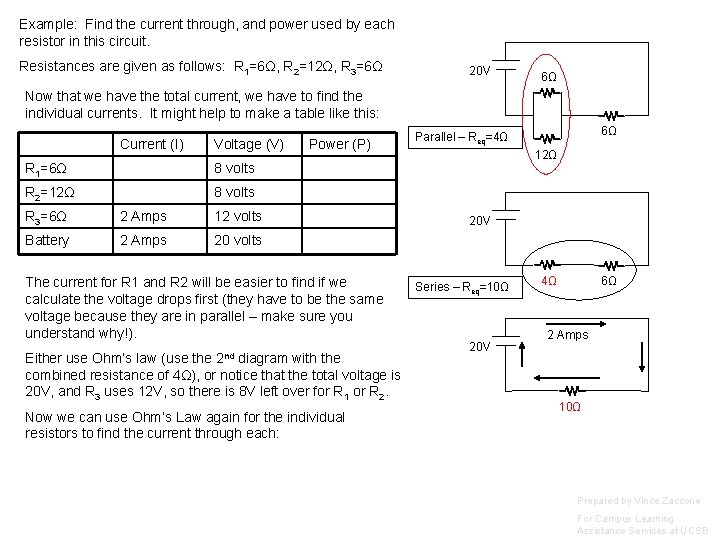
Example: Find the current through, and power used by each resistor in this circuit. Resistances are given as follows: R 1=6Ω, R 2=12Ω, R 3=6Ω 20 V 6Ω Now that we have the total current, we have to find the individual currents. It might help to make a table like this: Current (I) Voltage (V) R 1=6Ω 8 volts R 2=12Ω 8 volts R 3=6Ω 2 Amps 12 volts Battery 2 Amps 20 volts Power (P) The current for R 1 and R 2 will be easier to find if we calculate the voltage drops first (they have to be the same voltage because they are in parallel – make sure you understand why!). Either use Ohm’s law (use the 2 nd diagram with the combined resistance of 4Ω), or notice that the total voltage is 20 V, and R 3 uses 12 V, so there is 8 V left over for R 1 or R 2. Now we can use Ohm’s Law again for the individual resistors to find the current through each: 6Ω Parallel – Req=4Ω 12Ω 20 V Series – Req=10Ω 20 V 4Ω 6Ω 2 Amps 10Ω Prepared by Vince Zaccone For Campus Learning Assistance Services at UCSB
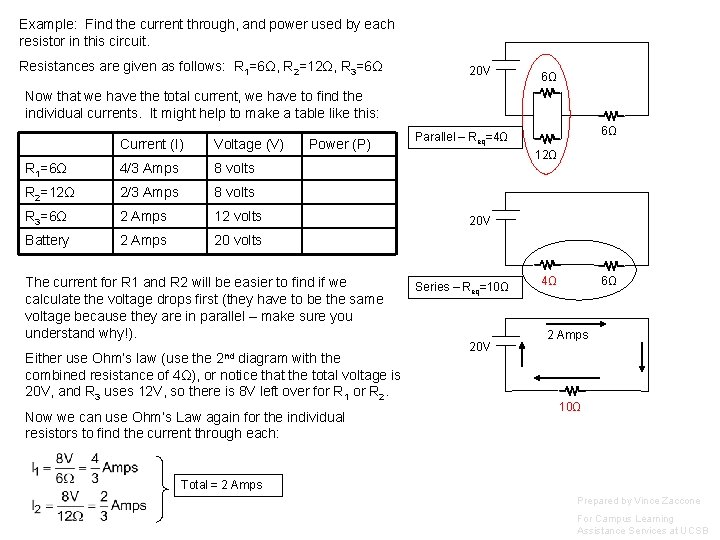
Example: Find the current through, and power used by each resistor in this circuit. Resistances are given as follows: R 1=6Ω, R 2=12Ω, R 3=6Ω 20 V 6Ω Now that we have the total current, we have to find the individual currents. It might help to make a table like this: Current (I) Voltage (V) R 1=6Ω 4/3 Amps 8 volts R 2=12Ω 2/3 Amps 8 volts R 3=6Ω 2 Amps 12 volts Battery 2 Amps 20 volts Power (P) The current for R 1 and R 2 will be easier to find if we calculate the voltage drops first (they have to be the same voltage because they are in parallel – make sure you understand why!). Either use Ohm’s law (use the 2 nd diagram with the combined resistance of 4Ω), or notice that the total voltage is 20 V, and R 3 uses 12 V, so there is 8 V left over for R 1 or R 2. Now we can use Ohm’s Law again for the individual resistors to find the current through each: 6Ω Parallel – Req=4Ω 12Ω 20 V Series – Req=10Ω 20 V 4Ω 6Ω 2 Amps 10Ω Total = 2 Amps Prepared by Vince Zaccone For Campus Learning Assistance Services at UCSB
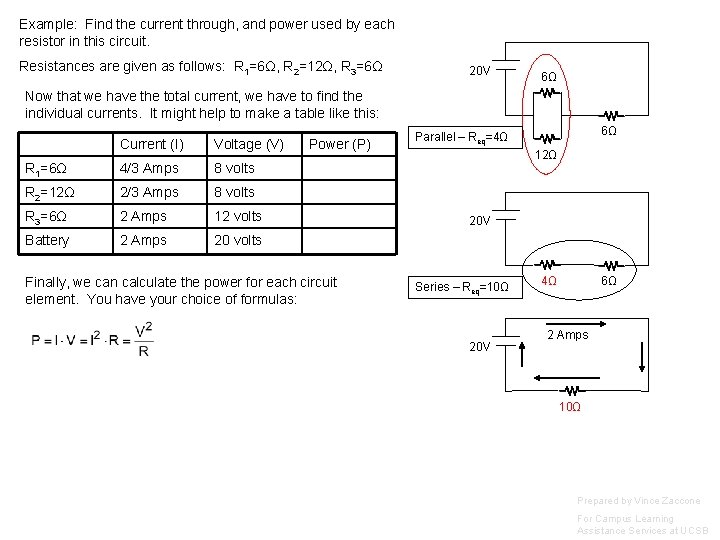
Example: Find the current through, and power used by each resistor in this circuit. Resistances are given as follows: R 1=6Ω, R 2=12Ω, R 3=6Ω 20 V 6Ω Now that we have the total current, we have to find the individual currents. It might help to make a table like this: Current (I) Voltage (V) R 1=6Ω 4/3 Amps 8 volts R 2=12Ω 2/3 Amps 8 volts R 3=6Ω 2 Amps 12 volts Battery 2 Amps 20 volts Power (P) Finally, we can calculate the power for each circuit element. You have your choice of formulas: 6Ω Parallel – Req=4Ω 12Ω 20 V Series – Req=10Ω 20 V 4Ω 6Ω 2 Amps 10Ω Prepared by Vince Zaccone For Campus Learning Assistance Services at UCSB
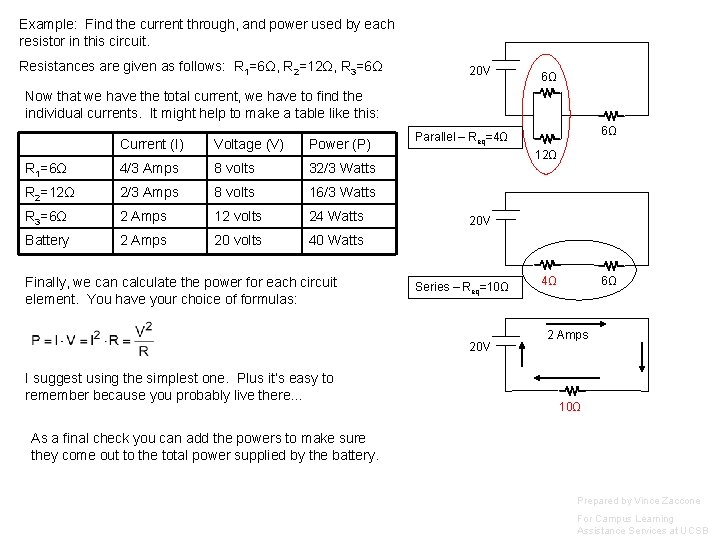
Example: Find the current through, and power used by each resistor in this circuit. Resistances are given as follows: R 1=6Ω, R 2=12Ω, R 3=6Ω 20 V 6Ω Now that we have the total current, we have to find the individual currents. It might help to make a table like this: Current (I) Voltage (V) Power (P) R 1=6Ω 4/3 Amps 8 volts 32/3 Watts R 2=12Ω 2/3 Amps 8 volts 16/3 Watts R 3=6Ω 2 Amps 12 volts 24 Watts Battery 2 Amps 20 volts 40 Watts Finally, we can calculate the power for each circuit element. You have your choice of formulas: 12Ω 20 V Series – Req=10Ω 20 V I suggest using the simplest one. Plus it’s easy to remember because you probably live there… 6Ω Parallel – Req=4Ω 4Ω 6Ω 2 Amps 10Ω As a final check you can add the powers to make sure they come out to the total power supplied by the battery. Prepared by Vince Zaccone For Campus Learning Assistance Services at UCSB
- Slides: 15