
Physics 320 Telescopes and Detectors Lecture 5 Dale
- Slides: 17
Physics 320: Telescopes and Detectors (Lecture 5) Dale Gary NJIT Physics Department
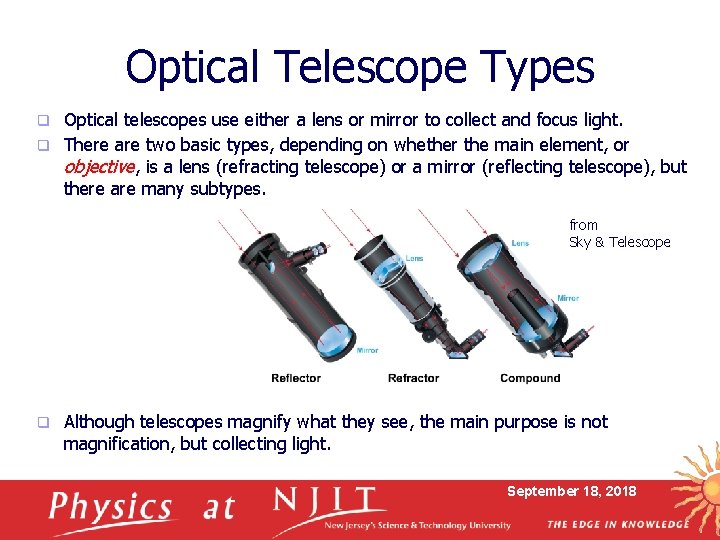
Optical Telescope Types Optical telescopes use either a lens or mirror to collect and focus light. q There are two basic types, depending on whether the main element, or objective, is a lens (refracting telescope) or a mirror (reflecting telescope), but there are many subtypes. q from Sky & Telescope q Although telescopes magnify what they see, the main purpose is not magnification, but collecting light. September 18, 2018
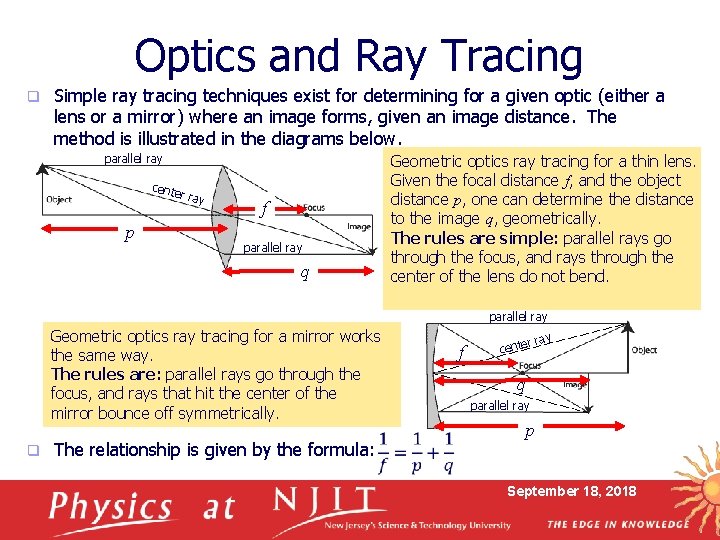
Optics and Ray Tracing q Simple ray tracing techniques exist for determining for a given optic (either a lens or a mirror) where an image forms, given an image distance. The method is illustrated in the diagrams below. parallel ray cente r ray p f parallel ray q Geometric optics ray tracing for a thin lens. Given the focal distance f, and the object distance p, one can determine the distance to the image q, geometrically. The rules are simple: parallel rays go through the focus, and rays through the center of the lens do not bend. parallel ray Geometric optics ray tracing for a mirror works the same way. The rules are: parallel rays go through the focus, and rays that hit the center of the mirror bounce off symmetrically. q The relationship is given by the formula: f r ray cente q parallel ray p September 18, 2018
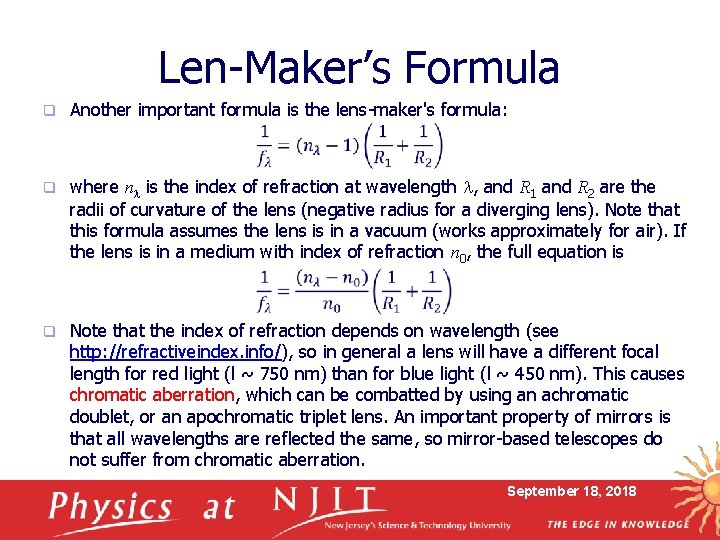
Len-Maker’s Formula q Another important formula is the lens-maker's formula: q where nl is the index of refraction at wavelength l, and R 1 and R 2 are the radii of curvature of the lens (negative radius for a diverging lens). Note that this formula assumes the lens is in a vacuum (works approximately for air). If the lens is in a medium with index of refraction n 0, the full equation is q Note that the index of refraction depends on wavelength (see http: //refractiveindex. info/), so in general a lens will have a different focal length for red light (l ~ 750 nm) than for blue light (l ~ 450 nm). This causes chromatic aberration, which can be combatted by using an achromatic doublet, or an apochromatic triplet lens. An important property of mirrors is that all wavelengths are reflected the same, so mirror-based telescopes do not suffer from chromatic aberration. September 18, 2018
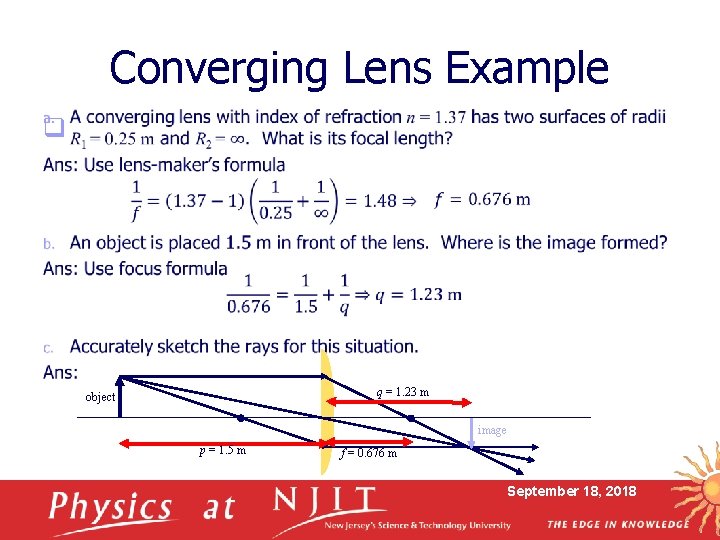
Converging Lens Example q q = 1. 23 m object image p = 1. 5 m f = 0. 676 m September 18, 2018
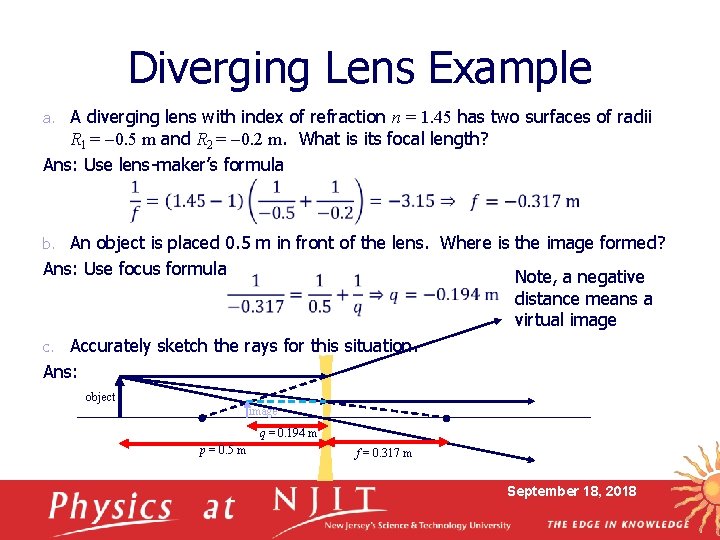
Diverging Lens Example A diverging lens with index of refraction n = 1. 45 has two surfaces of radii R 1 = -0. 5 m and R 2 = -0. 2 m. What is its focal length? Ans: Use lens-maker’s formula a. An object is placed 0. 5 m in front of the lens. Where is the image formed? Ans: Use focus formula Note, a negative b. distance means a virtual image Accurately sketch the rays for this situation. Ans: c. object image q = 0. 194 m p = 0. 5 m f = 0. 317 m September 18, 2018
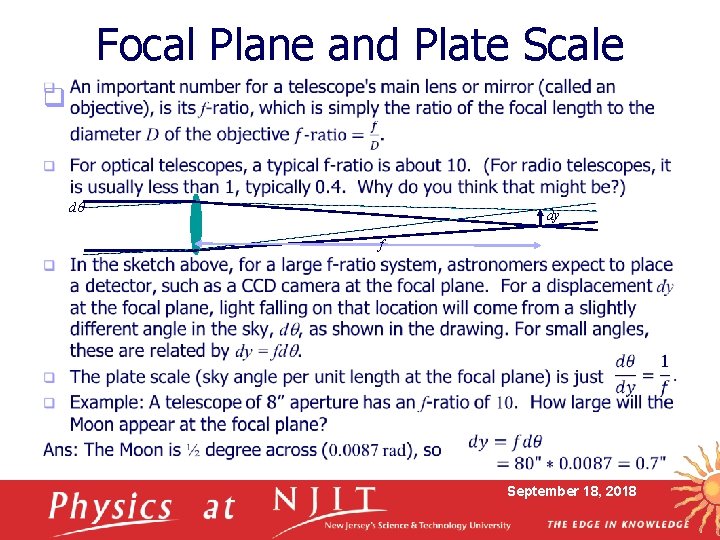
Focal Plane and Plate Scale q dq dy f September 18, 2018
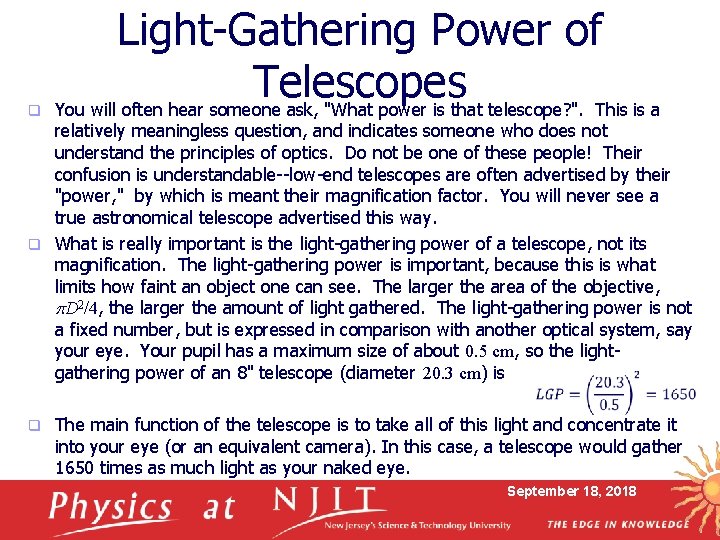
q Light-Gathering Power of Telescopes You will often hear someone ask, "What power is that telescope? ". This is a relatively meaningless question, and indicates someone who does not understand the principles of optics. Do not be one of these people! Their confusion is understandable--low-end telescopes are often advertised by their "power, " by which is meant their magnification factor. You will never see a true astronomical telescope advertised this way. q What is really important is the light-gathering power of a telescope, not its magnification. The light-gathering power is important, because this is what limits how faint an object one can see. The larger the area of the objective, p. D 2/4, the larger the amount of light gathered. The light-gathering power is not a fixed number, but is expressed in comparison with another optical system, say your eye. Your pupil has a maximum size of about 0. 5 cm, so the lightgathering power of an 8" telescope (diameter 20. 3 cm) is q The main function of the telescope is to take all of this light and concentrate it into your eye (or an equivalent camera). In this case, a telescope would gather 1650 times as much light as your naked eye. September 18, 2018
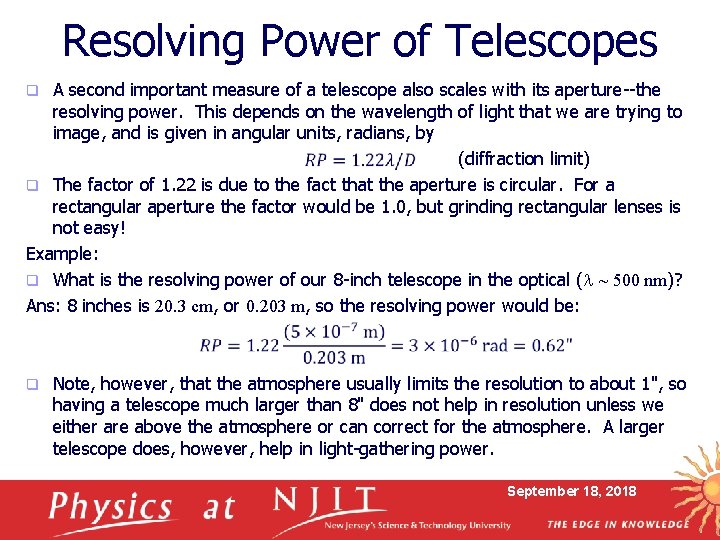
Resolving Power of Telescopes A second important measure of a telescope also scales with its aperture--the resolving power. This depends on the wavelength of light that we are trying to image, and is given in angular units, radians, by (diffraction limit) q The factor of 1. 22 is due to the fact that the aperture is circular. For a rectangular aperture the factor would be 1. 0, but grinding rectangular lenses is not easy! Example: q What is the resolving power of our 8 -inch telescope in the optical (l ~ 500 nm)? Ans: 8 inches is 20. 3 cm, or 0. 203 m, so the resolving power would be: q q Note, however, that the atmosphere usually limits the resolution to about 1", so having a telescope much larger than 8" does not help in resolution unless we either are above the atmosphere or can correct for the atmosphere. A larger telescope does, however, help in light-gathering power. September 18, 2018
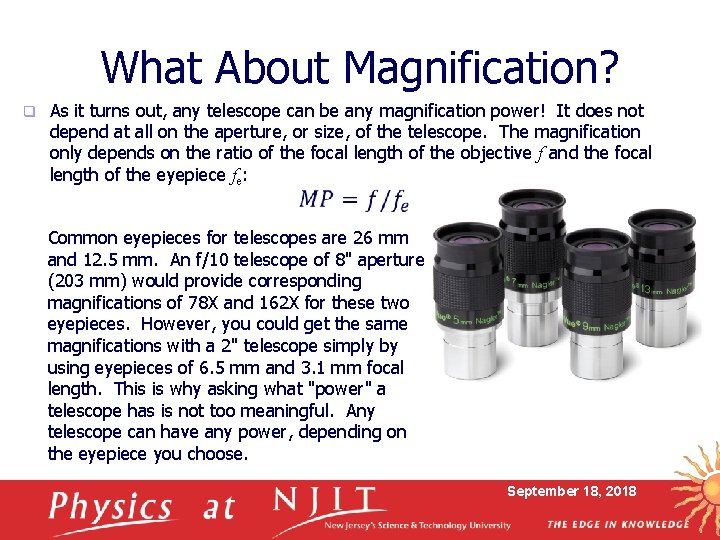
What About Magnification? q As it turns out, any telescope can be any magnification power! It does not depend at all on the aperture, or size, of the telescope. The magnification only depends on the ratio of the focal length of the objective f and the focal length of the eyepiece fe: Common eyepieces for telescopes are 26 mm and 12. 5 mm. An f/10 telescope of 8" aperture (203 mm) would provide corresponding magnifications of 78 X and 162 X for these two eyepieces. However, you could get the same magnifications with a 2" telescope simply by using eyepieces of 6. 5 mm and 3. 1 mm focal length. This is why asking what "power" a telescope has is not too meaningful. Any telescope can have any power, depending on the eyepiece you choose. September 18, 2018
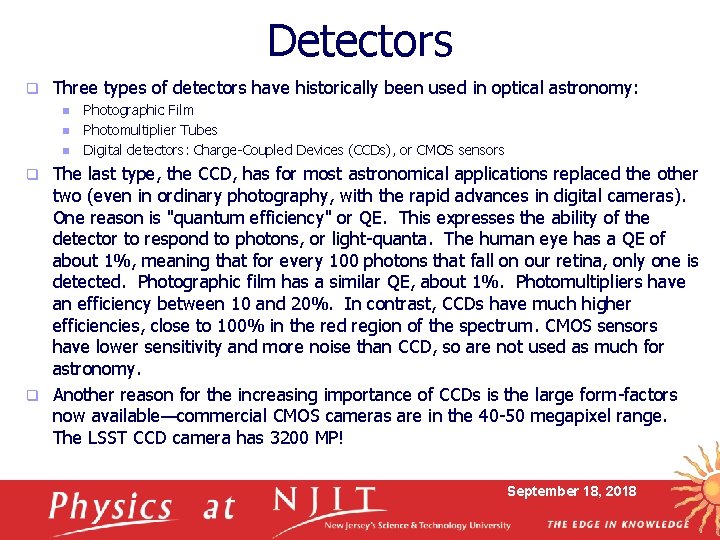
Detectors q Three types of detectors have historically been used in optical astronomy: n n n Photographic Film Photomultiplier Tubes Digital detectors: Charge-Coupled Devices (CCDs), or CMOS sensors The last type, the CCD, has for most astronomical applications replaced the other two (even in ordinary photography, with the rapid advances in digital cameras). One reason is "quantum efficiency" or QE. This expresses the ability of the detector to respond to photons, or light-quanta. The human eye has a QE of about 1%, meaning that for every 100 photons that fall on our retina, only one is detected. Photographic film has a similar QE, about 1%. Photomultipliers have an efficiency between 10 and 20%. In contrast, CCDs have much higher efficiencies, close to 100% in the red region of the spectrum. CMOS sensors have lower sensitivity and more noise than CCD, so are not used as much for astronomy. q Another reason for the increasing importance of CCDs is the large form-factors now available—commercial CMOS cameras are in the 40 -50 megapixel range. The LSST CCD camera has 3200 MP! q September 18, 2018
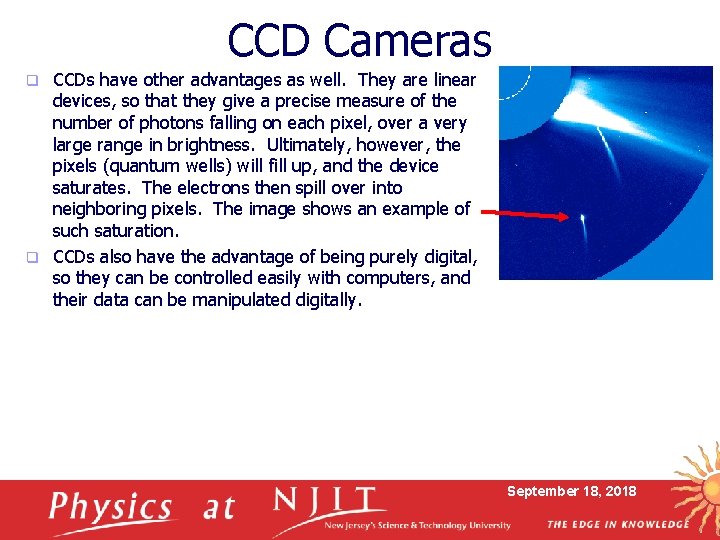
CCD Cameras CCDs have other advantages as well. They are linear devices, so that they give a precise measure of the number of photons falling on each pixel, over a very large range in brightness. Ultimately, however, the pixels (quantum wells) will fill up, and the device saturates. The electrons then spill over into neighboring pixels. The image shows an example of such saturation. q CCDs also have the advantage of being purely digital, so they can be controlled easily with computers, and their data can be manipulated digitally. q September 18, 2018
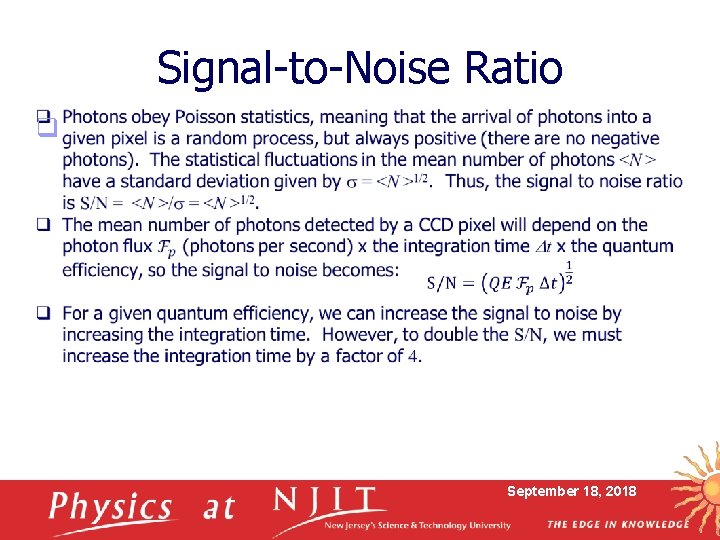
Signal-to-Noise Ratio q September 18, 2018
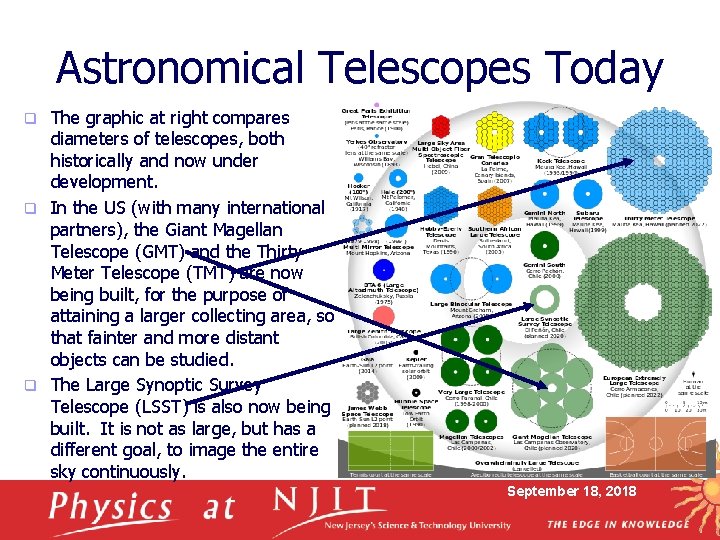
Astronomical Telescopes Today The graphic at right compares diameters of telescopes, both historically and now under development. q In the US (with many international partners), the Giant Magellan Telescope (GMT) and the Thirty Meter Telescope (TMT) are now being built, for the purpose of attaining a larger collecting area, so that fainter and more distant objects can be studied. q The Large Synoptic Survey Telescope (LSST) is also now being built. It is not as large, but has a different goal, to image the entire sky continuously. q September 18, 2018
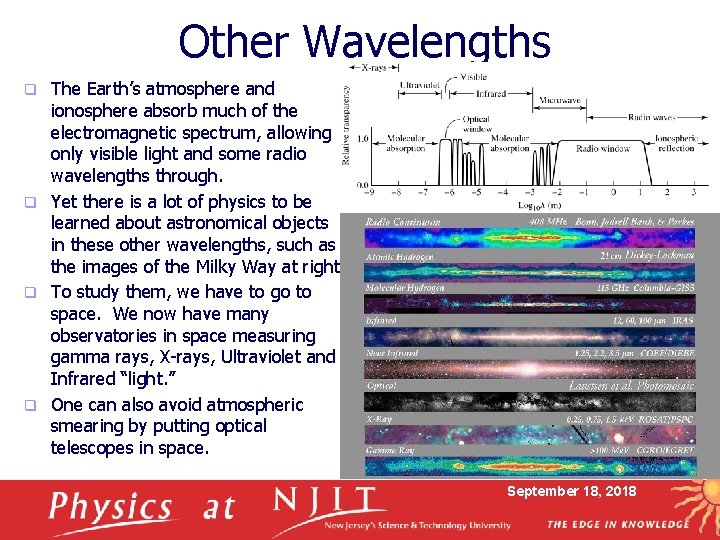
Other Wavelengths The Earth’s atmosphere and ionosphere absorb much of the electromagnetic spectrum, allowing only visible light and some radio wavelengths through. q Yet there is a lot of physics to be learned about astronomical objects in these other wavelengths, such as the images of the Milky Way at right. q To study them, we have to go to space. We now have many observatories in space measuring gamma rays, X-rays, Ultraviolet and Infrared “light. ” q One can also avoid atmospheric smearing by putting optical telescopes in space. q September 18, 2018
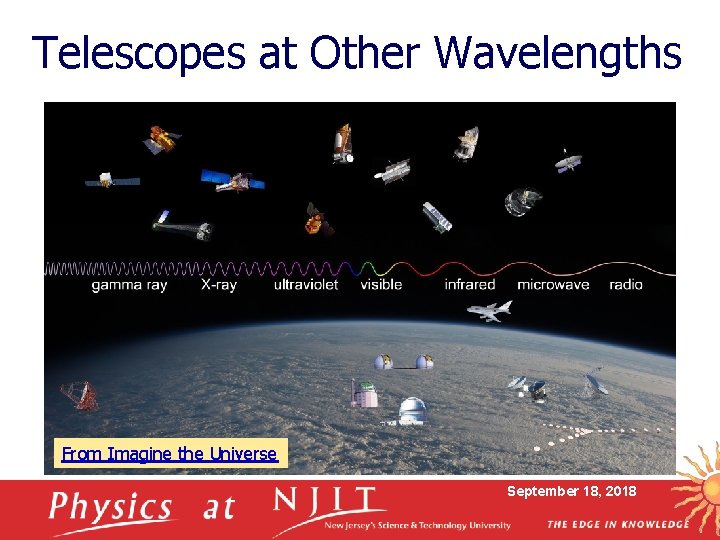
Telescopes at Other Wavelengths From Imagine the Universe September 18, 2018
What We’ve Learned q q q Know the differences in the two main types of telescopes, refracting and reflecting telescopes. Know the fundamental relationship for an optic (lens or mirror) connecting focal length, image distance, and object distance. Know the lens-maker’s formula and how to use it to solve problems. Know the basics of graphically sketching (ray tracing) of optical elements. Be familiar with the principle measures for telescopes, and how to calculate them: n n n q f-ratio Plate scale Light-gathering power Resolving power Magnification factor Signal to noise (for CCDs) Understand the importance of space telescopes, and observing at other wavelengths. September 18, 2018