
Physics 320 Star Distances and Magnitudes Lecture 6

- Slides: 13
Physics 320: Star Distances and Magnitudes (Lecture 6) Dale Gary NJIT Physics Department
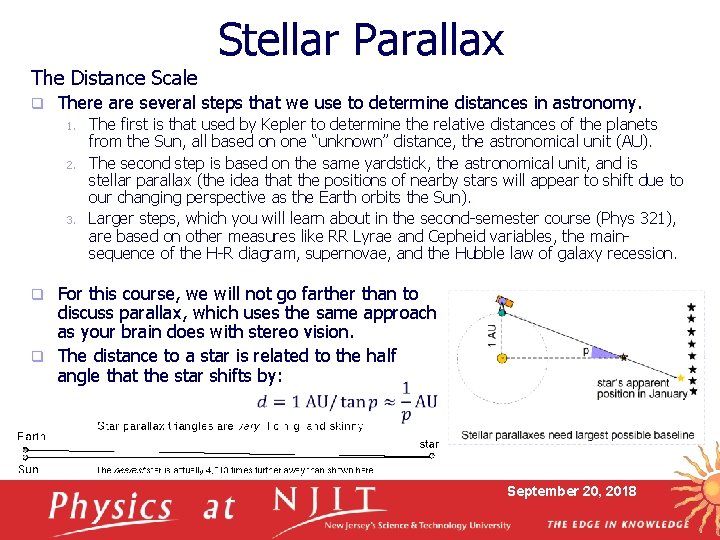
Stellar Parallax The Distance Scale q There are several steps that we use to determine distances in astronomy. 1. 2. 3. The first is that used by Kepler to determine the relative distances of the planets from the Sun, all based on one “unknown” distance, the astronomical unit (AU). The second step is based on the same yardstick, the astronomical unit, and is stellar parallax (the idea that the positions of nearby stars will appear to shift due to our changing perspective as the Earth orbits the Sun). Larger steps, which you will learn about in the second-semester course (Phys 321), are based on other measures like RR Lyrae and Cepheid variables, the mainsequence of the H-R diagram, supernovae, and the Hubble law of galaxy recession. For this course, we will not go farther than to discuss parallax, which uses the same approach as your brain does with stereo vision. q The distance to a star is related to the half angle that the star shifts by: q September 20, 2018
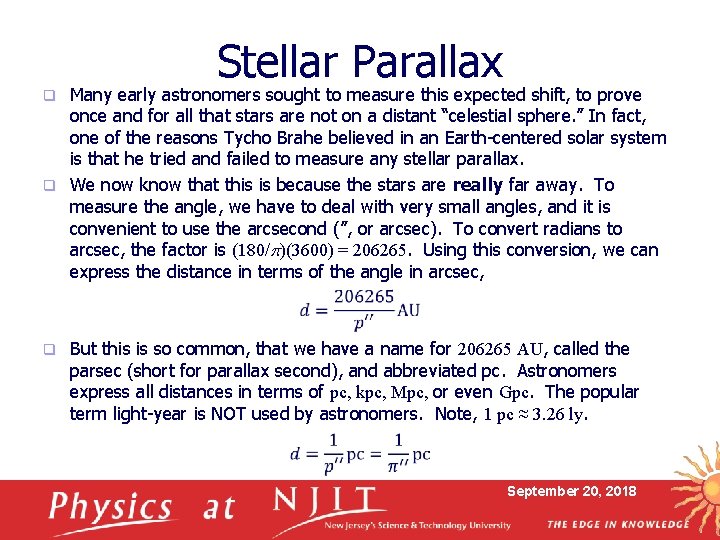
Stellar Parallax Many early astronomers sought to measure this expected shift, to prove once and for all that stars are not on a distant “celestial sphere. ” In fact, one of the reasons Tycho Brahe believed in an Earth-centered solar system is that he tried and failed to measure any stellar parallax. q We now know that this is because the stars are really far away. To measure the angle, we have to deal with very small angles, and it is convenient to use the arcsecond (ˮ, or arcsec). To convert radians to arcsec, the factor is (180/p)(3600) = 206265. Using this conversion, we can express the distance in terms of the angle in arcsec, q q But this is so common, that we have a name for 206265 AU, called the parsec (short for parallax second), and abbreviated pc. Astronomers express all distances in terms of pc, kpc, Mpc, or even Gpc. The popular term light-year is NOT used by astronomers. Note, 1 pc ≈ 3. 26 ly. September 20, 2018
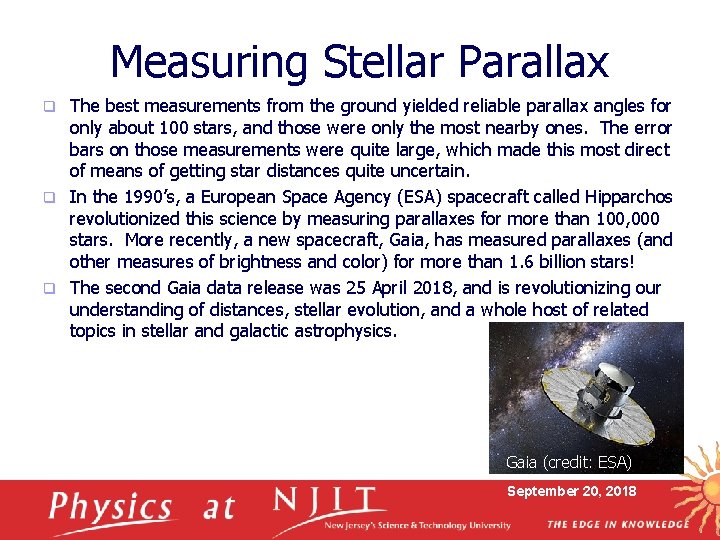
Measuring Stellar Parallax The best measurements from the ground yielded reliable parallax angles for only about 100 stars, and those were only the most nearby ones. The error bars on those measurements were quite large, which made this most direct of means of getting star distances quite uncertain. q In the 1990’s, a European Space Agency (ESA) spacecraft called Hipparchos revolutionized this science by measuring parallaxes for more than 100, 000 stars. More recently, a new spacecraft, Gaia, has measured parallaxes (and other measures of brightness and color) for more than 1. 6 billion stars! q The second Gaia data release was 25 April 2018, and is revolutionizing our understanding of distances, stellar evolution, and a whole host of related topics in stellar and galactic astrophysics. q Gaia (credit: ESA) September 20, 2018
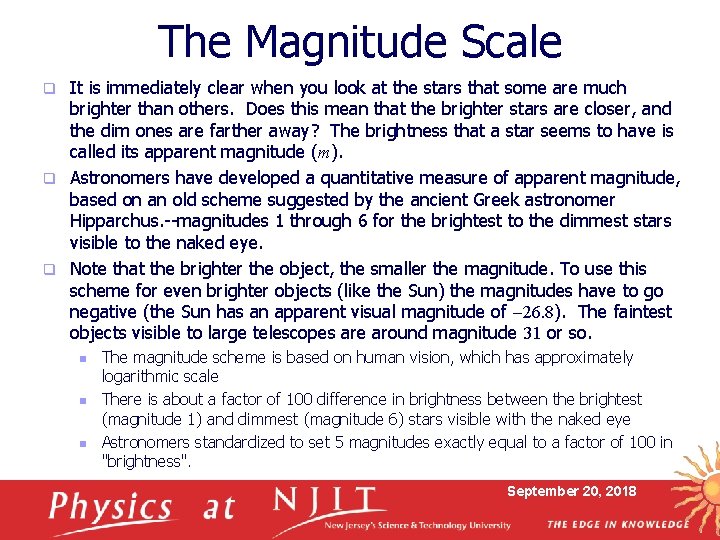
The Magnitude Scale It is immediately clear when you look at the stars that some are much brighter than others. Does this mean that the brighter stars are closer, and the dim ones are farther away? The brightness that a star seems to have is called its apparent magnitude (m). q Astronomers have developed a quantitative measure of apparent magnitude, based on an old scheme suggested by the ancient Greek astronomer Hipparchus. --magnitudes 1 through 6 for the brightest to the dimmest stars visible to the naked eye. q Note that the brighter the object, the smaller the magnitude. To use this scheme for even brighter objects (like the Sun) the magnitudes have to go negative (the Sun has an apparent visual magnitude of -26. 8). The faintest objects visible to large telescopes are around magnitude 31 or so. q n n n The magnitude scheme is based on human vision, which has approximately logarithmic scale There is about a factor of 100 difference in brightness between the brightest (magnitude 1) and dimmest (magnitude 6) stars visible with the naked eye Astronomers standardized to set 5 magnitudes exactly equal to a factor of 100 in "brightness". September 20, 2018
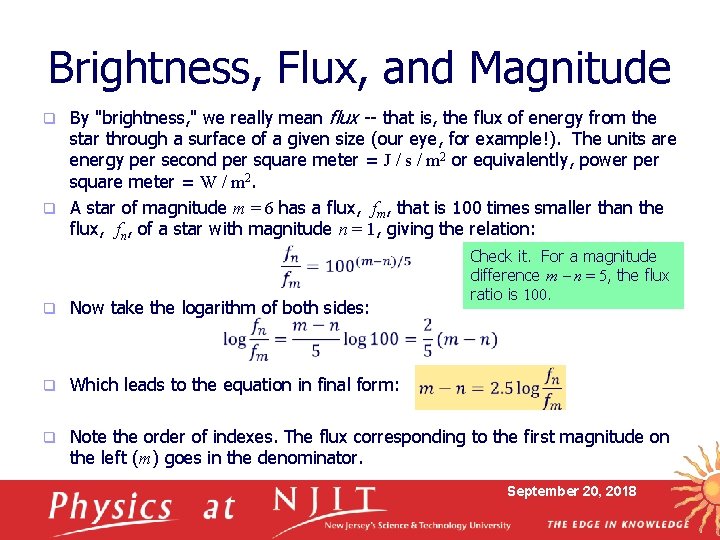
Brightness, Flux, and Magnitude By "brightness, " we really mean flux -- that is, the flux of energy from the star through a surface of a given size (our eye, for example!). The units are energy per second per square meter = J / s / m 2 or equivalently, power per square meter = W / m 2. q A star of magnitude m = 6 has a flux, fm, that is 100 times smaller than the flux, fn, of a star with magnitude n = 1, giving the relation: q q Now take the logarithm of both sides: Check it. For a magnitude difference m - n = 5, the flux ratio is 100. q Which leads to the equation in final form: q Note the order of indexes. The flux corresponding to the first magnitude on the left (m) goes in the denominator. September 20, 2018
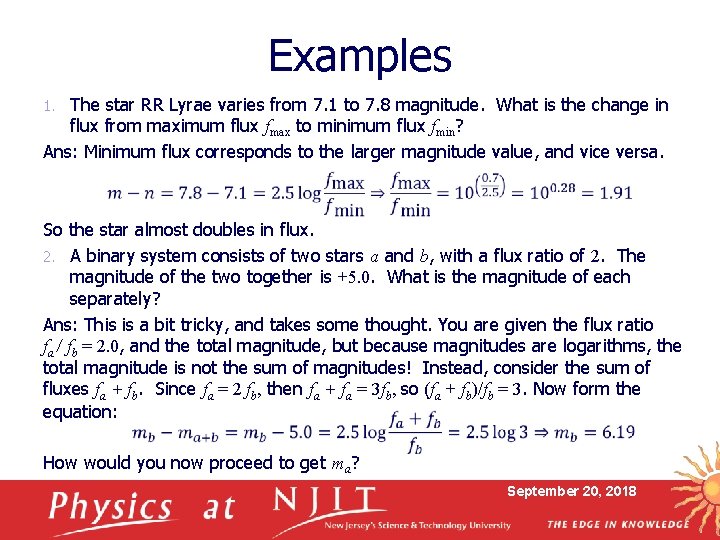
Examples The star RR Lyrae varies from 7. 1 to 7. 8 magnitude. What is the change in flux from maximum flux fmax to minimum flux fmin? Ans: Minimum flux corresponds to the larger magnitude value, and vice versa. 1. So the star almost doubles in flux. 2. A binary system consists of two stars a and b, with a flux ratio of 2. The magnitude of the two together is +5. 0. What is the magnitude of each separately? Ans: This is a bit tricky, and takes some thought. You are given the flux ratio fa / fb = 2. 0, and the total magnitude, but because magnitudes are logarithms, the total magnitude is not the sum of magnitudes! Instead, consider the sum of fluxes fa + fb. Since fa = 2 fb, then fa + fa = 3 fb, so (fa + fb)/fb = 3. Now form the equation: How would you now proceed to get ma? September 20, 2018
q Absolute Magnitude and Distance Modulus September 20, 2018
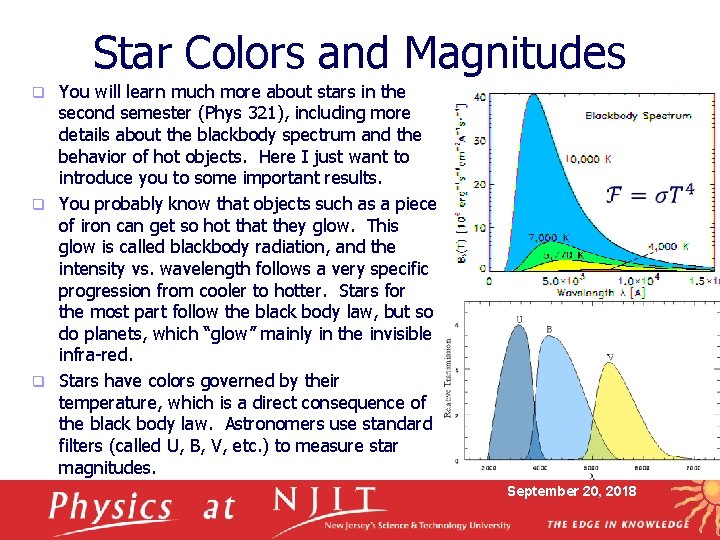
Star Colors and Magnitudes You will learn much more about stars in the second semester (Phys 321), including more details about the blackbody spectrum and the behavior of hot objects. Here I just want to introduce you to some important results. q You probably know that objects such as a piece of iron can get so hot that they glow. This glow is called blackbody radiation, and the intensity vs. wavelength follows a very specific progression from cooler to hotter. Stars for the most part follow the black body law, but so do planets, which “glow” mainly in the invisible infra-red. q Stars have colors governed by their temperature, which is a direct consequence of the black body law. Astronomers use standard filters (called U, B, V, etc. ) to measure star magnitudes. q September 20, 2018
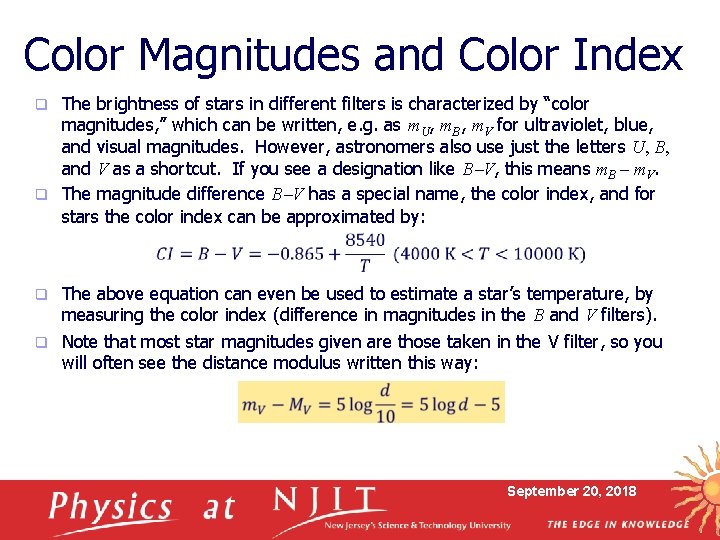
Color Magnitudes and Color Index The brightness of stars in different filters is characterized by “color magnitudes, ” which can be written, e. g. as m. U, m. B, m. V for ultraviolet, blue, and visual magnitudes. However, astronomers also use just the letters U, B, and V as a shortcut. If you see a designation like B-V, this means m. B - m. V. q The magnitude difference B-V has a special name, the color index, and for stars the color index can be approximated by: q The above equation can even be used to estimate a star’s temperature, by measuring the color index (difference in magnitudes in the B and V filters). q Note that most star magnitudes given are those taken in the V filter, so you will often see the distance modulus written this way: q September 20, 2018
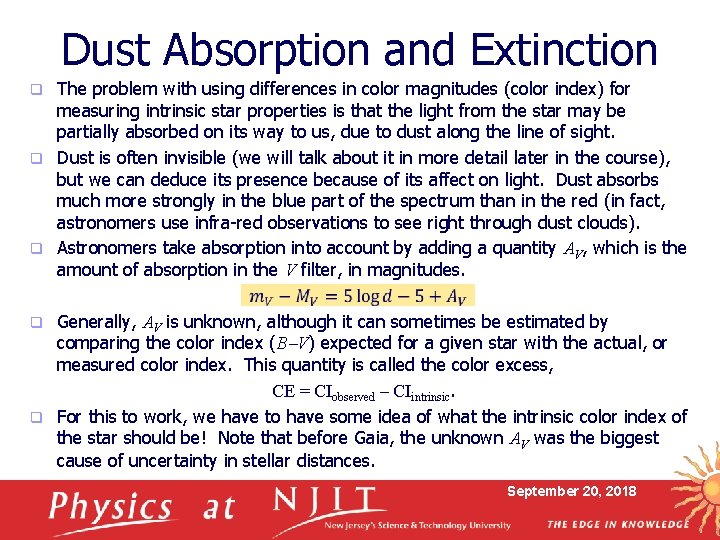
Dust Absorption and Extinction The problem with using differences in color magnitudes (color index) for measuring intrinsic star properties is that the light from the star may be partially absorbed on its way to us, due to dust along the line of sight. q Dust is often invisible (we will talk about it in more detail later in the course), but we can deduce its presence because of its affect on light. Dust absorbs much more strongly in the blue part of the spectrum than in the red (in fact, astronomers use infra-red observations to see right through dust clouds). q Astronomers take absorption into account by adding a quantity AV, which is the amount of absorption in the V filter, in magnitudes. q Generally, AV is unknown, although it can sometimes be estimated by comparing the color index (B-V) expected for a given star with the actual, or measured color index. This quantity is called the color excess, CE = CIobserved – CIintrinsic. q For this to work, we have to have some idea of what the intrinsic color index of the star should be! Note that before Gaia, the unknown AV was the biggest cause of uncertainty in stellar distances. q September 20, 2018
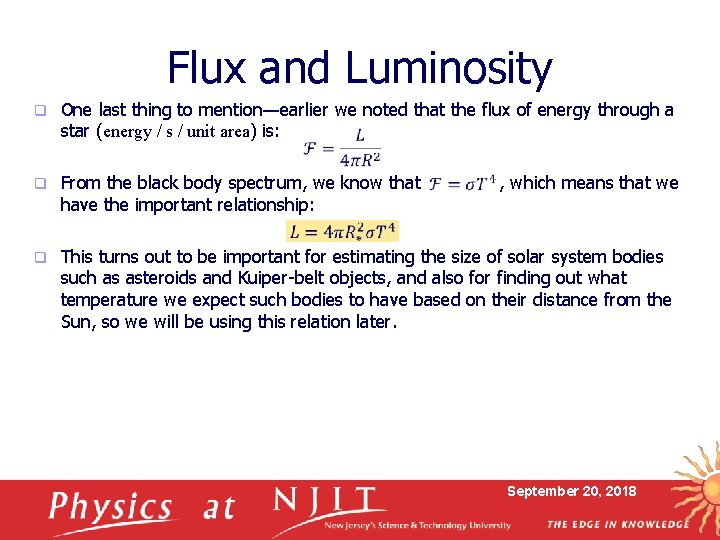
Flux and Luminosity q q q One last thing to mention—earlier we noted that the flux of energy through a star (energy / s / unit area) is: From the black body spectrum, we know that , which means that we have the important relationship: This turns out to be important for estimating the size of solar system bodies such as asteroids and Kuiper-belt objects, and also for finding out what temperature we expect such bodies to have based on their distance from the Sun, so we will be using this relation later. September 20, 2018
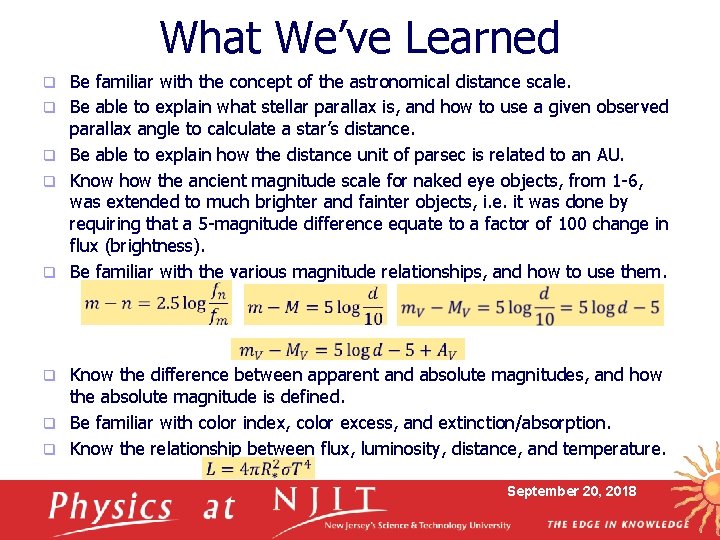
What We’ve Learned q q q Be familiar with the concept of the astronomical distance scale. Be able to explain what stellar parallax is, and how to use a given observed parallax angle to calculate a star’s distance. Be able to explain how the distance unit of parsec is related to an AU. Know how the ancient magnitude scale for naked eye objects, from 1 -6, was extended to much brighter and fainter objects, i. e. it was done by requiring that a 5 -magnitude difference equate to a factor of 100 change in flux (brightness). Be familiar with the various magnitude relationships, and how to use them. Know the difference between apparent and absolute magnitudes, and how the absolute magnitude is defined. q Be familiar with color index, color excess, and extinction/absorption. q Know the relationship between flux, luminosity, distance, and temperature. q September 20, 2018