
Physics 320 Kuiper Belt Objects and Pluto Lecture
Physics 320: Kuiper Belt Objects and Pluto (Lecture 20) Dale Gary NJIT Physics Department
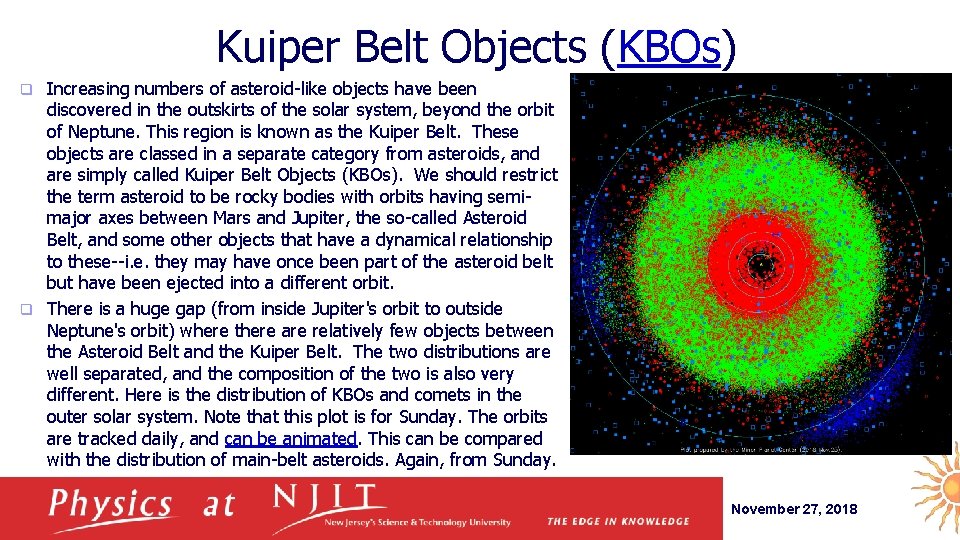
Kuiper Belt Objects (KBOs) Increasing numbers of asteroid-like objects have been discovered in the outskirts of the solar system, beyond the orbit of Neptune. This region is known as the Kuiper Belt. These objects are classed in a separate category from asteroids, and are simply called Kuiper Belt Objects (KBOs). We should restrict the term asteroid to be rocky bodies with orbits having semimajor axes between Mars and Jupiter, the so-called Asteroid Belt, and some other objects that have a dynamical relationship to these--i. e. they may have once been part of the asteroid belt but have been ejected into a different orbit. q There is a huge gap (from inside Jupiter's orbit to outside Neptune's orbit) where there are relatively few objects between the Asteroid Belt and the Kuiper Belt. The two distributions are well separated, and the composition of the two is also very different. Here is the distribution of KBOs and comets in the outer solar system. Note that this plot is for Sunday. The orbits are tracked daily, and can be animated. This can be compared with the distribution of main-belt asteroids. Again, from Sunday. q November 27, 2018
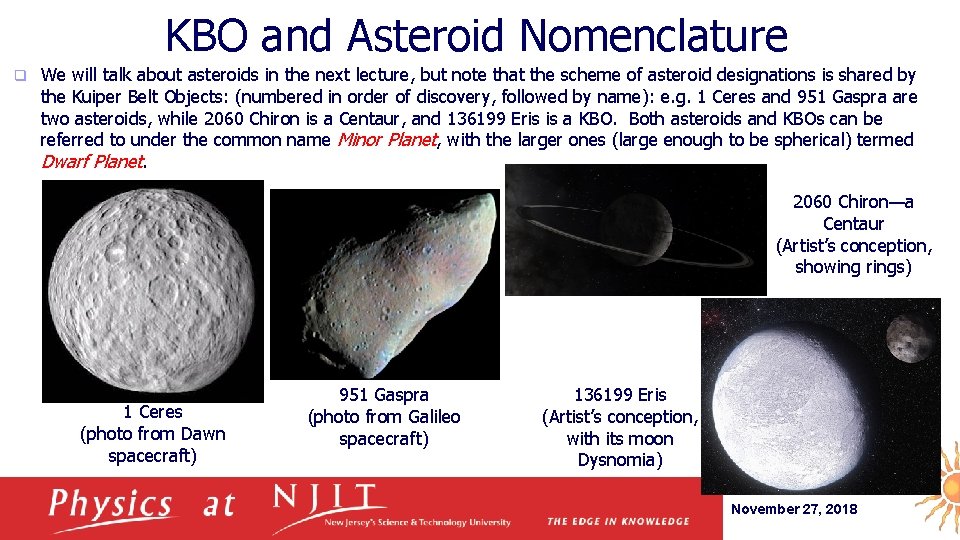
KBO and Asteroid Nomenclature q We will talk about asteroids in the next lecture, but note that the scheme of asteroid designations is shared by the Kuiper Belt Objects: (numbered in order of discovery, followed by name): e. g. 1 Ceres and 951 Gaspra are two asteroids, while 2060 Chiron is a Centaur, and 136199 Eris is a KBO. Both asteroids and KBOs can be referred to under the common name Minor Planet, with the larger ones (large enough to be spherical) termed Dwarf Planet. 2060 Chiron—a Centaur (Artist’s conception, showing rings) 1 Ceres (photo from Dawn spacecraft) 951 Gaspra (photo from Galileo spacecraft) 136199 Eris (Artist’s conception, with its moon Dysnomia) November 27, 2018
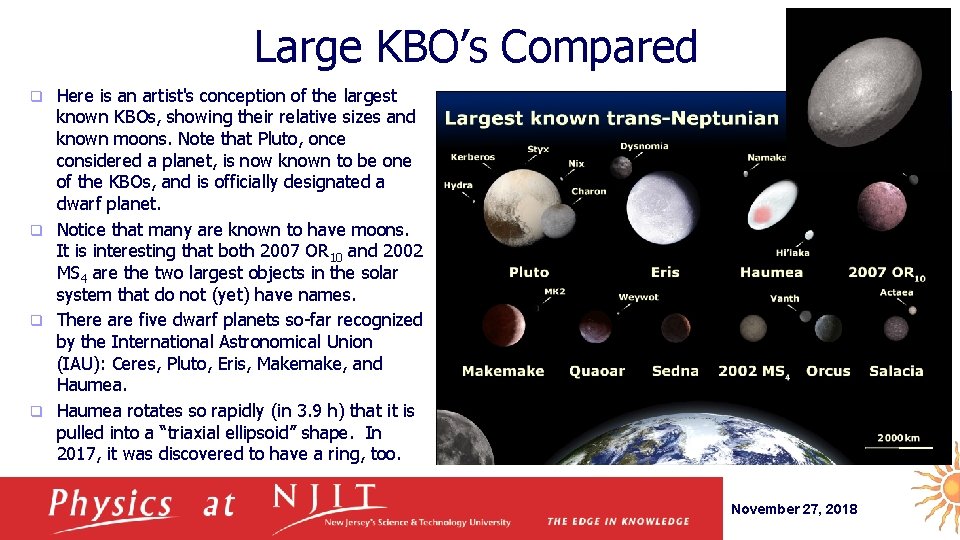
Large KBO’s Compared Here is an artist's conception of the largest known KBOs, showing their relative sizes and known moons. Note that Pluto, once considered a planet, is now known to be one of the KBOs, and is officially designated a dwarf planet. q Notice that many are known to have moons. It is interesting that both 2007 OR 10 and 2002 MS 4 are the two largest objects in the solar system that do not (yet) have names. q There are five dwarf planets so-far recognized by the International Astronomical Union (IAU): Ceres, Pluto, Eris, Makemake, and Haumea. q Haumea rotates so rapidly (in 3. 9 h) that it is pulled into a “triaxial ellipsoid” shape. In 2017, it was discovered to have a ring, too. q November 27, 2018
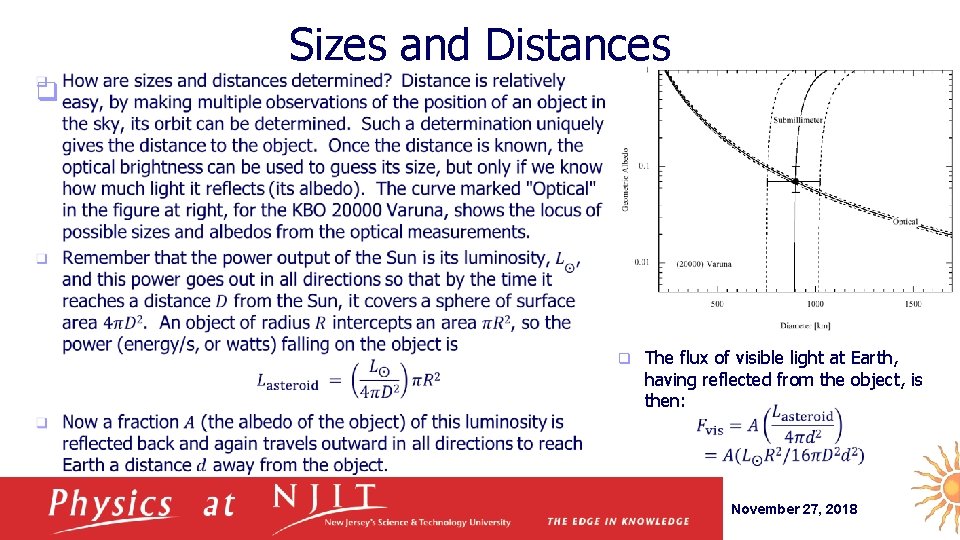
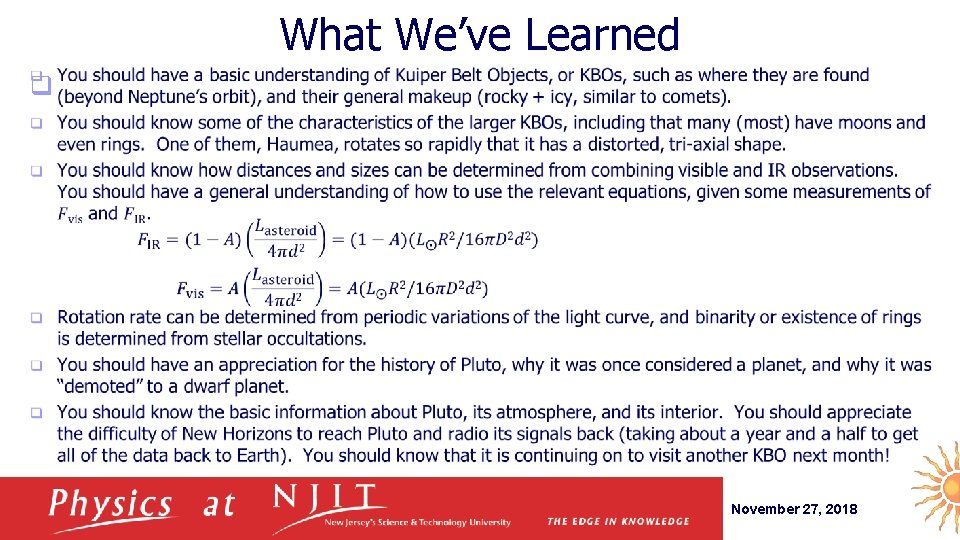
Sizes and Distances q q The flux of visible light at Earth, having reflected from the object, is then: November 27, 2018
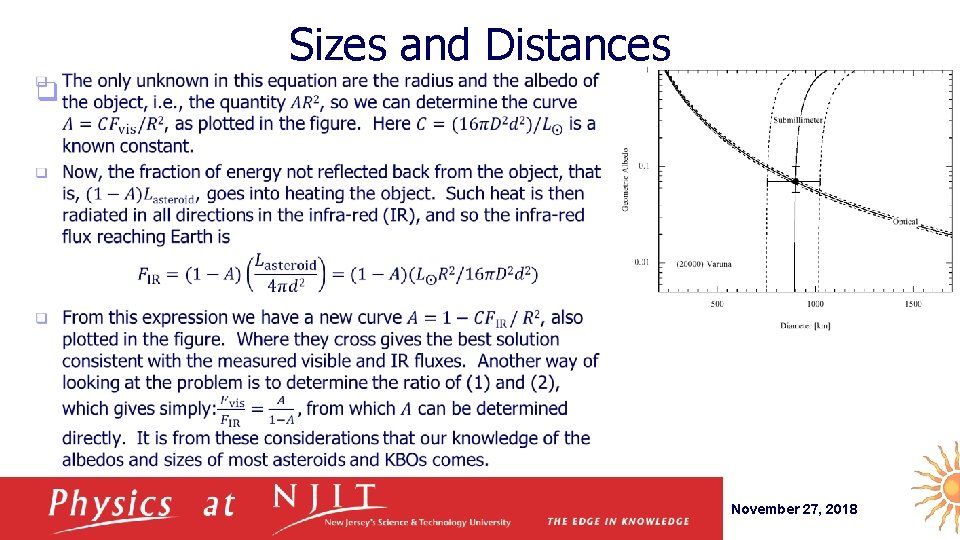
Sizes and Distances q November 27, 2018

KBO Types Interestingly, KBOs show evidence of resonances, where they cluster around at least the 3: 2 resonance instead of avoiding it. q One explanation that has been put forth is that objects in this 3: 2 resonance never come near Neptune at their closest approach (see figure below right). The dynamical families of asteroids and KBOs are: Asteroids q n n Main belt asteroids (between Mars and Jupiter) Trojan asteroids (at Lagrangian points with Jupiter, 60 o ahead and behind) Blue points are KBOS in resonant orbits(from http: //www 2. ess. ucla. edu/~jewitt/kb. html) Near Earth asteroids Centaur asteroids (a small family with semi-major axes between Saturn and Uranus) KBOs n n Classical KBOs Scattered KBOs Plutinos (objects like Pluto that are in 3: 2 resonance with Neptune) Centaur KBOs (a small family with semi-major axes between Saturn and Uranus, that can remain there only ~10 My) Two consecutive perihelions of Pluto November 27, 2018
Pluto History Pluto is interesting because of its history as the first-discovered KBO, and its designation as a planet. It also has an interesting prehistory (the time before it was discovered). Starting in 1906, Percival Lowell began a concerted effort to find "Planet X, " a hypothetical planet beyond Neptune. The location to search was based on calculations of the orbit of Neptune that seemed to suggest a perturbation by some unknown body. Recall that Neptune was discovered after similar calculations of the perturbations of Uranus, so the idea was plausible. After a 10 -year search, Percival Lowell came up empty and died without discovering Planet X. However, in 1930 his protege Clyde Tombaugh discovered Pluto near the location for Planet X. This discovery made huge news world-wide, and a school girl in Britain suggested the name Pluto, which Tombaugh liked because its first two letters, PL, are the initials of Percival Lowell. As the only planet discovered by an American, Pluto quickly became part of the American psyche, helped along by Walt Disney's creation of Mickey Mouse's lovable pet dog Pluto. q Unfortunately, it was quickly determined that Pluto was much too small to be Planet X--it could not be the source of the apparent perturbations of Neptune. In the end, it has been determined that these perturbations were simply errors in the original mass for Neptune, and with the precise value determined during the flyby of Voyager 2 past Neptune, the evidence for a planet X has disappeared. Nevertheless, Pluto was considered the ninth planet until the discovery of other KBOs caused murmurs of discontent among some scientists. The issue came to a head when Eris was discovered in 2005 by Mike Brown. Because it appeared to be larger than Pluto, Eris was informally called the 10 th planet, but this motivated the International Astronomical Union to face the issue of Pluto and KBOs. q November 27, 2018
Pluto History (continued) The problem is that it has been predicted that there may be hundreds of Pluto-sized KBOs out there, most still undiscovered. We could either have hundreds of planets, or Pluto could be demoted to be a member of a different club, the so-called dwarf planets. In 2006, in a rather controversial vote on the issue, an IAU resolution did create a definition for the term planet that did not include Pluto, and so demoted Pluto to dwarf planet status. There are deficiencies in the definition that make it still controversial--for one thing, the definition only applies to planets around our own Sun, not other stars. There are currently 5 known dwarf planets, Eris, Pluto, Ceres (an asteroid), Haumea, and Makemake. q Note that this same sequence of events occurred in the 19 th century after Ceres, the largest main-belt asteroid, was discovered on Jan 1, 1801 by Giuseppe Piazzi. It, too, was thought to be a planet until its small size was determined and the discovery was quickly followed by several more asteroids (Pallas, Juno, Vesta) in a similar orbit. Eventually it was decided that Ceres was just the largest of a new class of bodies called asteroids (which we'll talk about next lecture). So the case of Pluto is highly parallel, except that the time between Pluto's discovery in 1930 and the discovery of other KBOs was longer. q Pluto's demotion is also complicated by the fact that it occurred after the launch of the New Horizons mission to Pluto, which arrived and flew through the system in 2015. I call Pluto a system, because it is known by now to have at least 4 moons (the largest, Charon, is so large than the Pluto-Charon system has been called a "double-planet" system). Below are some images documenting the discoveries of the moons, one after the other. Check out these videos from New Horizons: q November 27, 2018
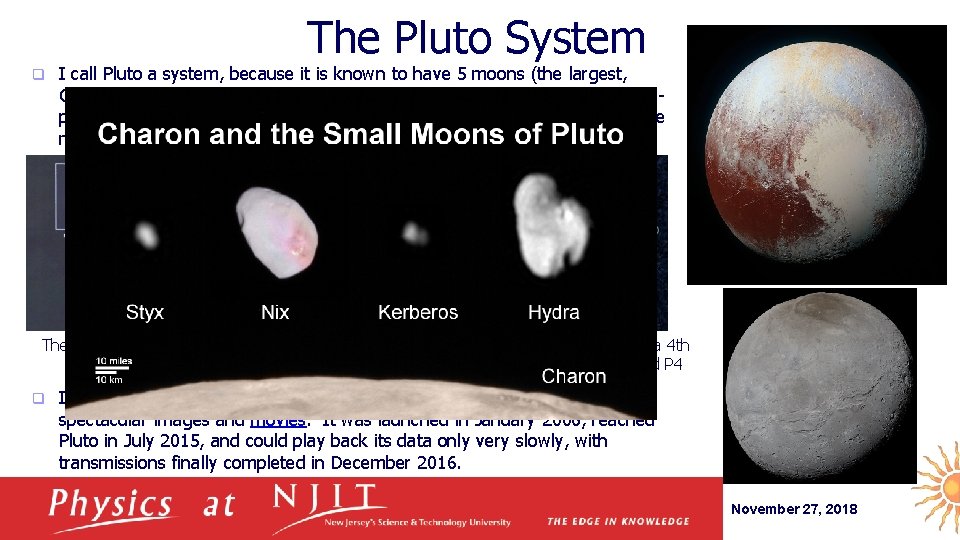
The Pluto System q I call Pluto a system, because it is known to have 5 moons (the largest, Charon, is so large than the Pluto-Charon system has been called a "doubleplanet" system). Below are some images documenting the discoveries of the moons, one after the other. The best groundbased photo HST's discovery of two of the "double-planet" more moons, Nix and Hydra q HST image showing yet a 4 th moon, so far designated P 4 In 2015, the New Horizons probe flew through the Pluto system, giving spectacular images and movies. It was launched in January 2006, reached Pluto in July 2015, and could play back its data only very slowly, with transmissions finally completed in December 2016. November 27, 2018
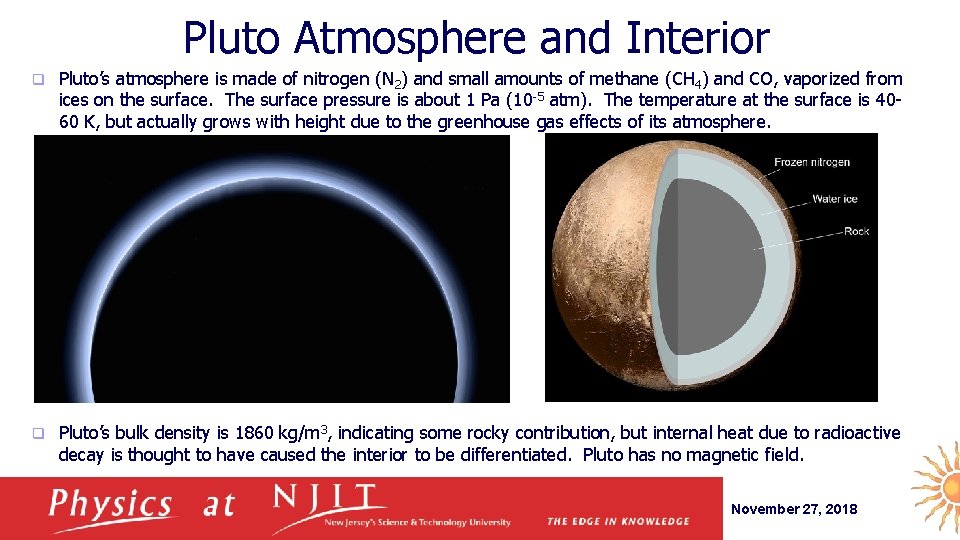
Pluto Atmosphere and Interior q Pluto’s atmosphere is made of nitrogen (N 2) and small amounts of methane (CH 4) and CO, vaporized from ices on the surface. The surface pressure is about 1 Pa (10 -5 atm). The temperature at the surface is 4060 K, but actually grows with height due to the greenhouse gas effects of its atmosphere. q Pluto’s bulk density is 1860 kg/m 3, indicating some rocky contribution, but internal heat due to radioactive decay is thought to have caused the interior to be differentiated. Pluto has no magnetic field. November 27, 2018
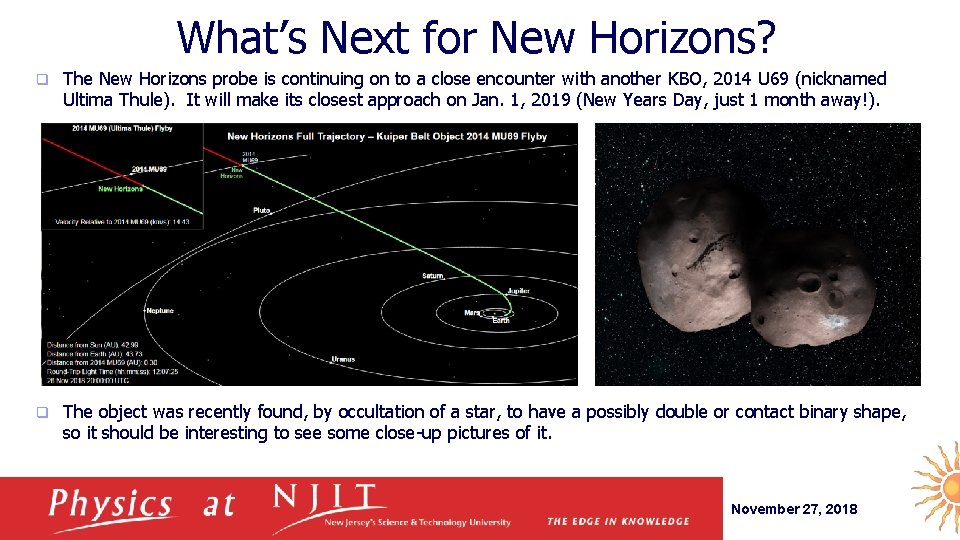
What’s Next for New Horizons? q The New Horizons probe is continuing on to a close encounter with another KBO, 2014 U 69 (nicknamed Ultima Thule). It will make its closest approach on Jan. 1, 2019 (New Years Day, just 1 month away!). q The object was recently found, by occultation of a star, to have a possibly double or contact binary shape, so it should be interesting to see some close-up pictures of it. November 27, 2018
What We’ve Learned q November 27, 2018
- Slides: 13