
Physics 218 Lecture 11 Dr David Toback Physics
Physics 218 Lecture 11 Dr. David Toback Physics 218, Lecture XI 1
Checklist for Today • Things that were due Monday: – Chaps. 3 and 4 HW on Web. CT – Progress on 5&6 problems • Things that were due Tuesday: – Reading for Chapter 7 • Things due for Wednesday’s Recitation: – Problems from Chap 5&6 • Things due for Today: – Read Chapters 7, 8 & 9 • Things due Monday – Chap 5&6 turned in on Web. CT Physics 218, Lecture XI 2
Chapters 7, 8 & 9 Cont Last time: • Work This time • More on Work • Work and Energy – Work using the Work-Energy relationship • Potential Energy • Conservation of Mechanical Energy Physics 218, Lecture XI 3

Physics 218, Lecture XI 4

Physics 218, Lecture XI 5
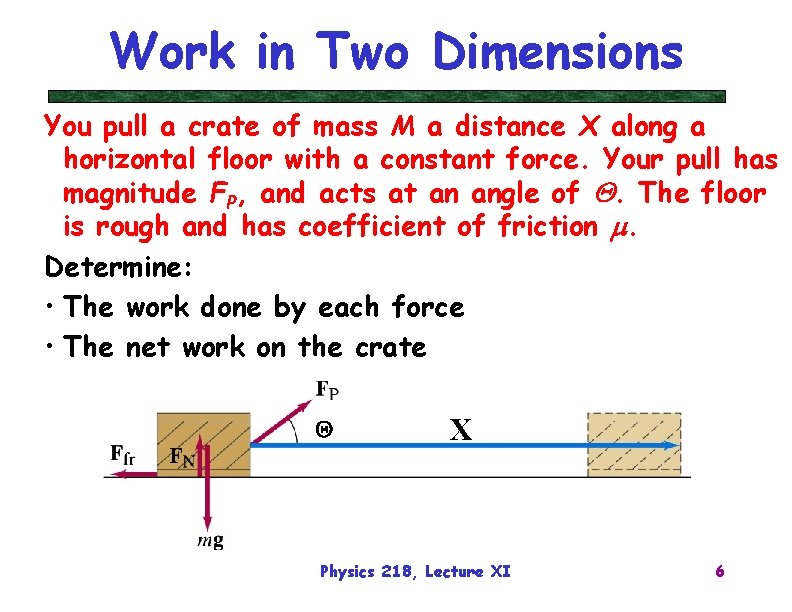
Work in Two Dimensions You pull a crate of mass M a distance X along a horizontal floor with a constant force. Your pull has magnitude FP, and acts at an angle of Q. The floor is rough and has coefficient of friction m. Determine: • The work done by each force • The net work on the crate Q X Physics 218, Lecture XI 6
What if the Force is changing direction? What if the Force is changing magnitude? Physics 218, Lecture XI 7
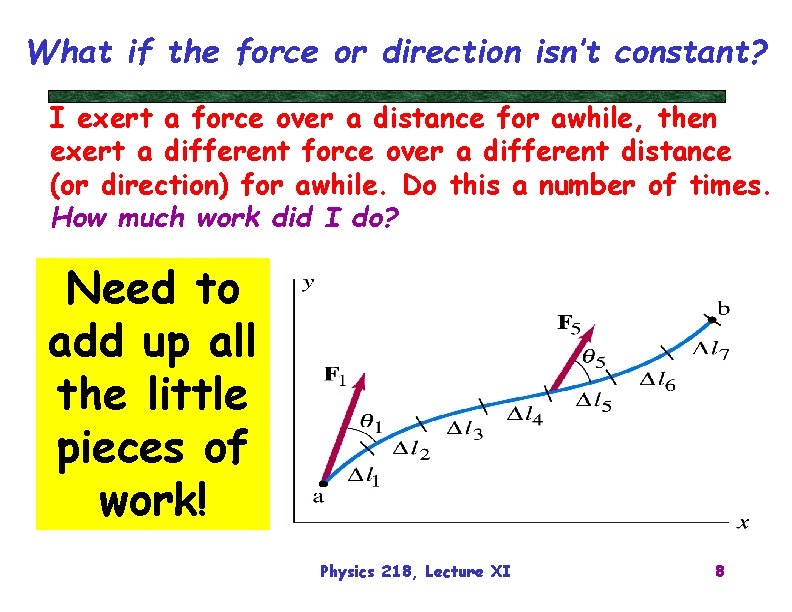
What if the force or direction isn’t constant? I exert a force over a distance for awhile, then exert a different force over a different distance (or direction) for awhile. Do this a number of times. How much work did I do? Need to add up all the little pieces of work! Physics 218, Lecture XI 8

Find the work: Calculus To find the total work, we must sum up all the little pieces of work (i. e. , F. d). If the force is continually changing, then we have to take smaller and smaller lengths to add. In the limit, this sum becomes an integral. Fancy sum notation Integral Physics 218, Lecture XI 9

Use an Integral for a Constant Force Assume a constant Force, F, doing work in the same direction, starting at x=0 and continuing for a distance d. What is the work? Region of integration W=Fd Physics 218, Lecture XI 10

Non-Constant Force: Springs • Springs are a good example of the types of problems we come back to over and over again! • Hooke’s Law Some constant Displacement • Force is NOT CONSTANT over a Physics 218, Lecture XI distance 11
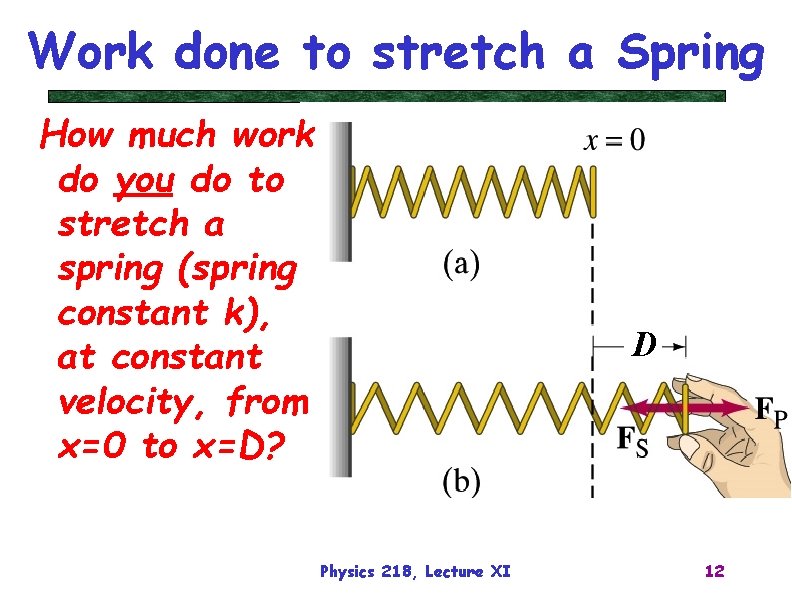
Work done to stretch a Spring How much work do you do to stretch a spring (spring constant k), at constant velocity, from x=0 to x=D? D Physics 218, Lecture XI 12
Kinetic Energy and Work-Energy • Energy is another big concept in physics • If I do work, I’ve expended energy – It takes energy to do work (I get tired) • If net work is done on a stationary box it speeds up. It now has energy • We say this box has “kinetic” energy! Think of it as Mechanical Energy or the Energy of Motion 2 Kinetic Energy = ½m. V Physics 218, Lecture XI 13
Work-Energy Relationship • If net work has been done on an object, then it has a change in its kinetic energy (usually this means that the speed changes) • Equivalent statement: If there is a change in kinetic energy then there has been net work on an object Can use the change in energy to calculate the work Physics 218, Lecture XI 14
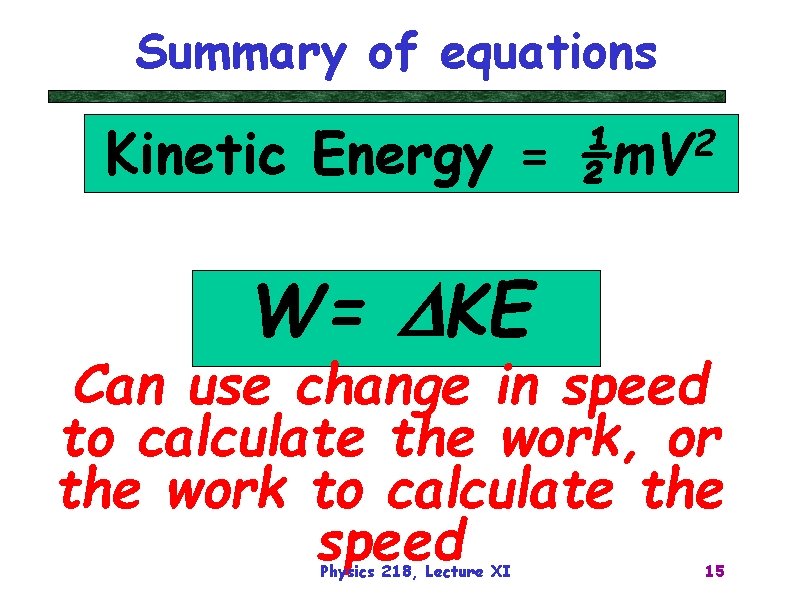
Summary of equations Kinetic Energy = 2 ½m. V W= DKE Can use change in speed to calculate the work, or the work to calculate the speed Physics 218, Lecture XI 15
Multiple ways to calculate the work done Multiple ways to calculate the velocity Physics 218, Lecture XI 16
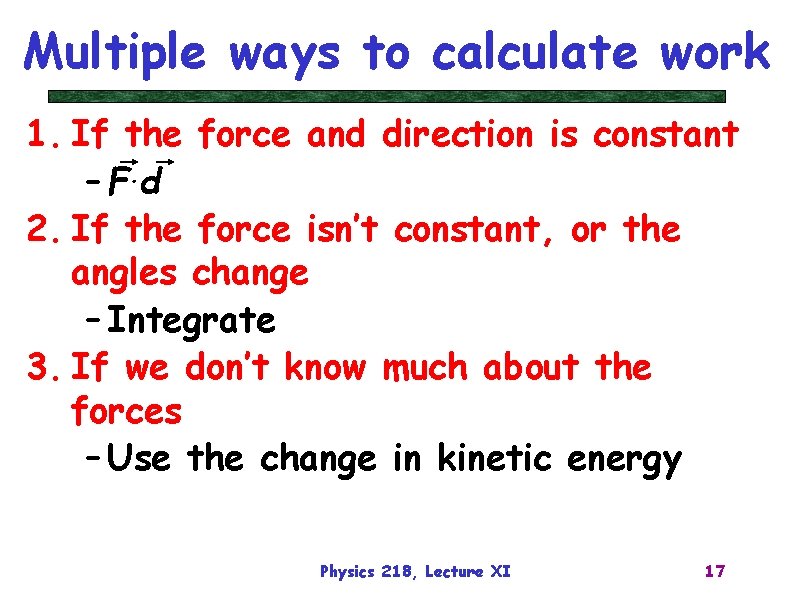
Multiple ways to calculate work 1. If the force and direction is constant – F. d 2. If the force isn’t constant, or the angles change – Integrate 3. If we don’t know much about the forces – Use the change in kinetic energy Physics 218, Lecture XI 17
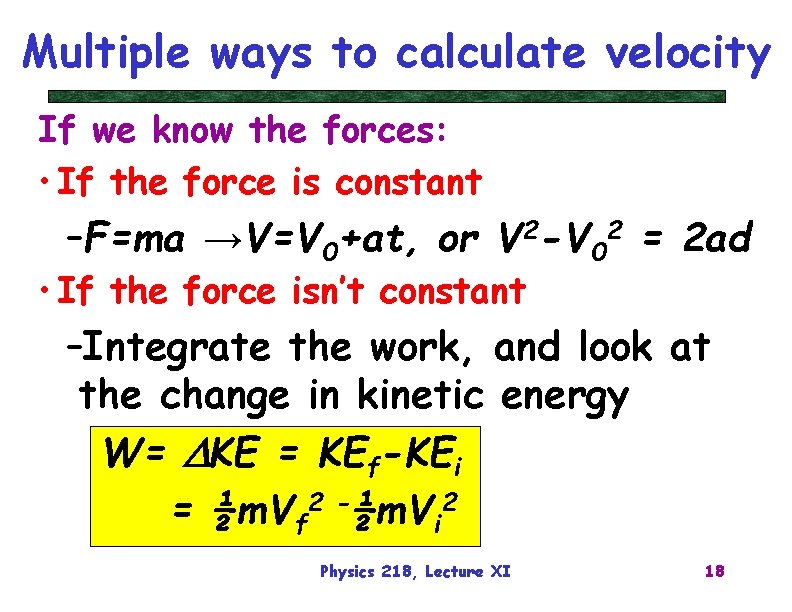
Multiple ways to calculate velocity If we know the forces: • If the force is constant –F=ma →V=V 0+at, or V 2 -V 02 = 2 ad • If the force isn’t constant –Integrate the work, and look at the change in kinetic energy W= DKE = KEf-KEi = ½m. Vf 2 -½m. Vi 2 Physics 218, Lecture XI 18
Quick Problem I can do work on an object and it doesn’t change the kinetic energy. How? Example? Physics 218, Lecture XI 19
Problem Solving How do you solve Work and Energy problems? BEFORE and AFTER Diagrams Physics 218, Lecture XI 20
Problem Solving Before and After diagrams 1. What’s going on before work is done 2. What’s going on after work is done Look at the energy before and the energy after Physics 218, Lecture XI 21
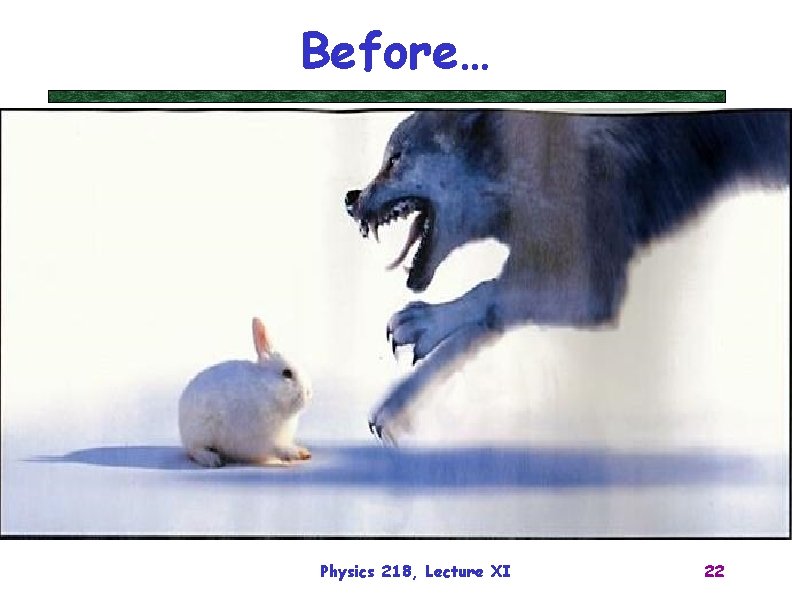
Before… Physics 218, Lecture XI 22
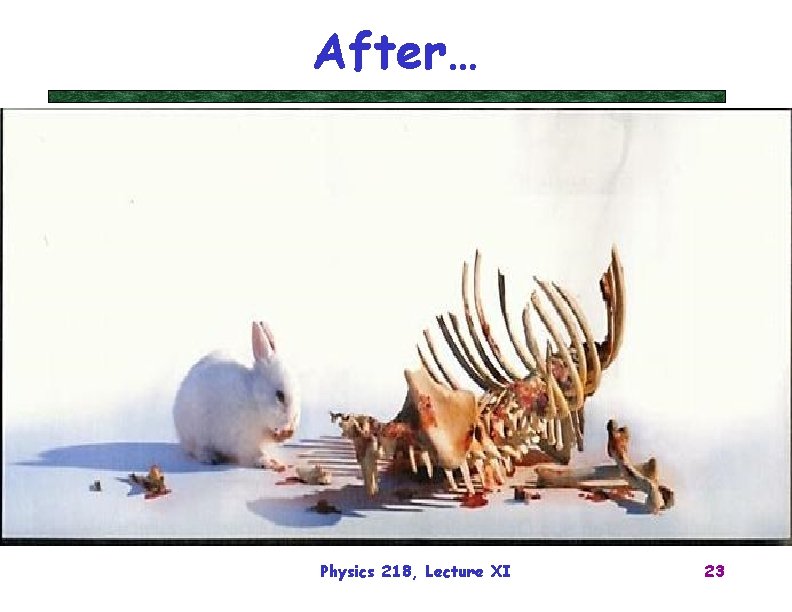
After… Physics 218, Lecture XI 23
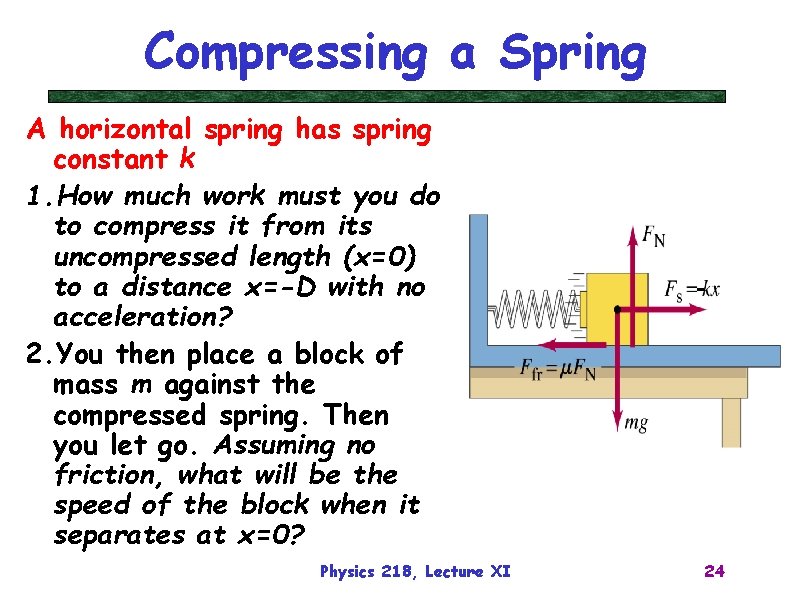
Compressing a Spring A horizontal spring has spring constant k 1. How much work must you do to compress it from its uncompressed length (x=0) to a distance x=-D with no acceleration? 2. You then place a block of mass m against the compressed spring. Then you let go. Assuming no friction, what will be the speed of the block when it separates at x=0? Physics 218, Lecture XI 24
Potential Energy • Things with potential: COULD do work – “This woman has great potential as an engineer!” • Here we kinda mean the same thing • E. g. Gravitation potential energy: – If you lift up a brick it has the potential to do damage Physics 218, Lecture XI 25
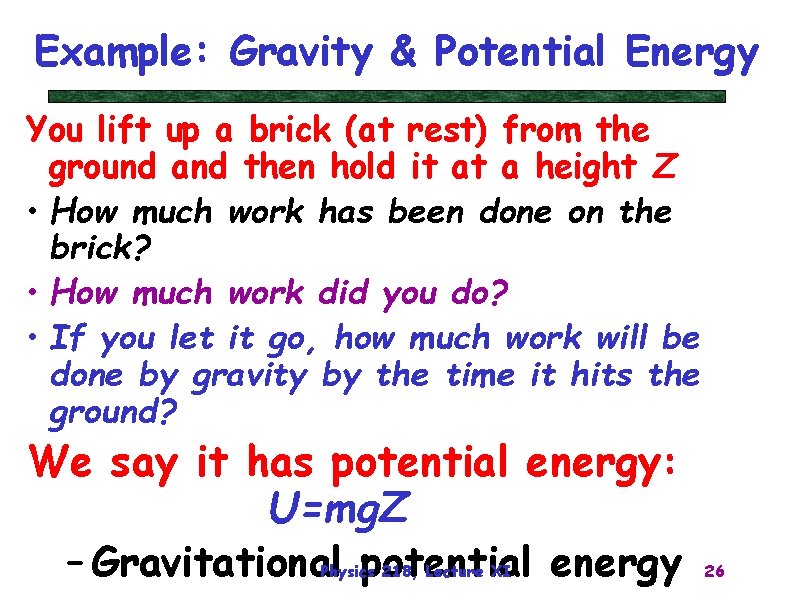
Example: Gravity & Potential Energy You lift up a brick (at rest) from the ground and then hold it at a height Z • How much work has been done on the brick? • How much work did you do? • If you let it go, how much work will be done by gravity by the time it hits the ground? We say it has potential energy: U=mg. Z – Gravitational potential energy Physics 218, Lecture XI 26
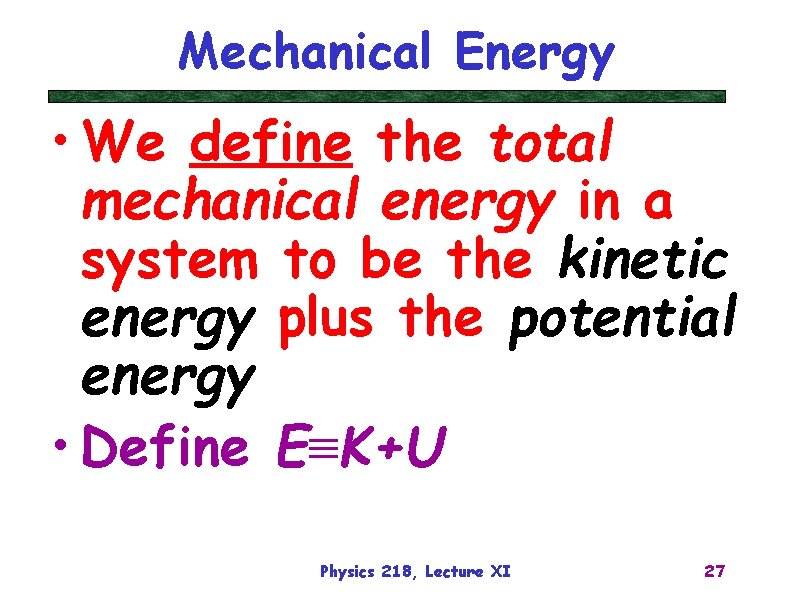
Mechanical Energy • We define the total mechanical energy in a system to be the kinetic energy plus the potential energy • Define E≡K+U Physics 218, Lecture XI 27
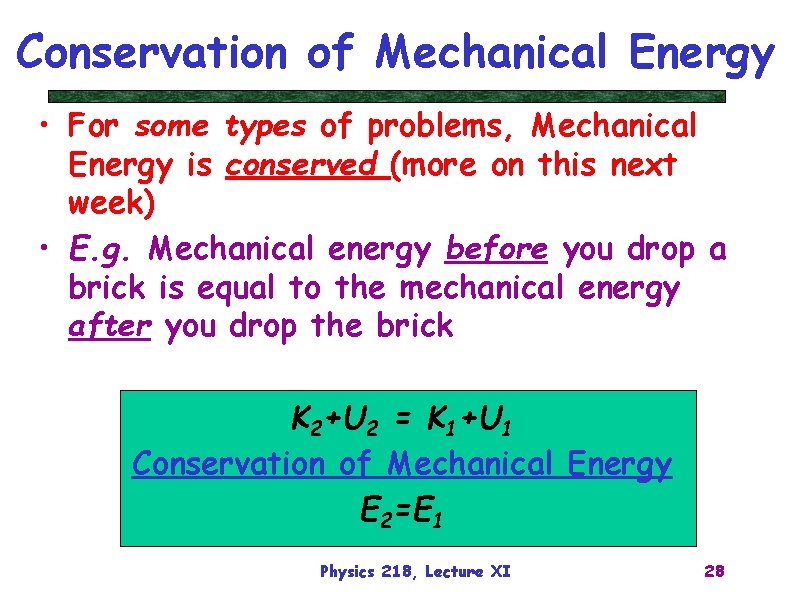
Conservation of Mechanical Energy • For some types of problems, Mechanical Energy is conserved (more on this next week) • E. g. Mechanical energy before you drop a brick is equal to the mechanical energy after you drop the brick K 2+U 2 = K 1+U 1 Conservation of Mechanical Energy E 2=E 1 Physics 218, Lecture XI 28
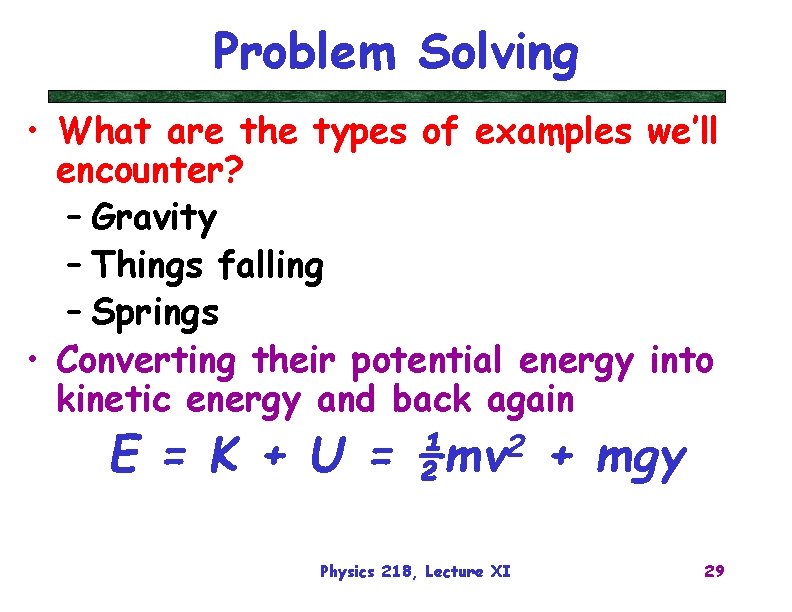
Problem Solving • What are the types of examples we’ll encounter? – Gravity – Things falling – Springs • Converting their potential energy into kinetic energy and back again E = K + U = ½mv 2 + mgy Physics 218, Lecture XI 29
Problem Solving For Conservation of Energy problems: BEFORE and AFTER diagrams Physics 218, Lecture XI 30
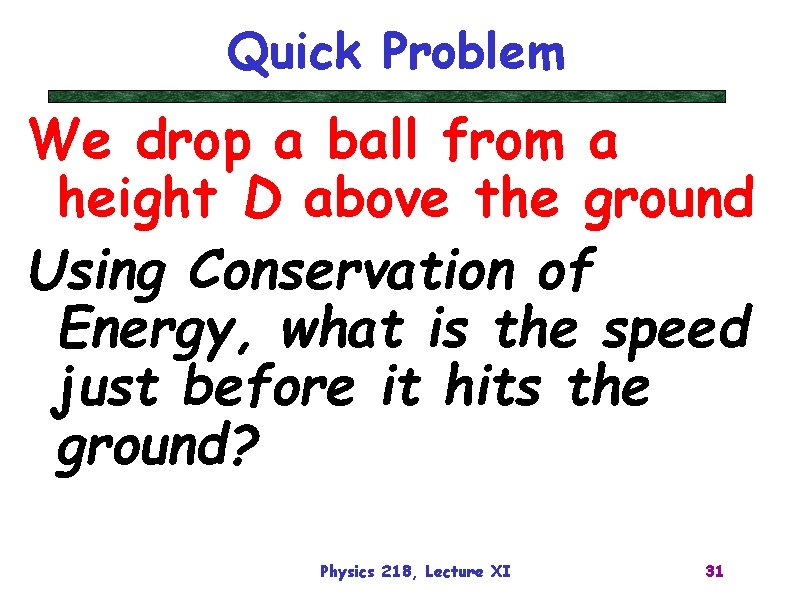
Quick Problem We drop a ball from a height D above the ground Using Conservation of Energy, what is the speed just before it hits the ground? Physics 218, Lecture XI 31
Next Week • Reading for Next Time: – Finish Chapters 7, 8 and 9 if you haven’t already – Non-conservative forces & Energy • Chapter 5&6 Due Monday on Web. CT • Start working on Chapter 7 for recitation next week Physics 218, Lecture XI 32
Physics 218, Lecture XI 33
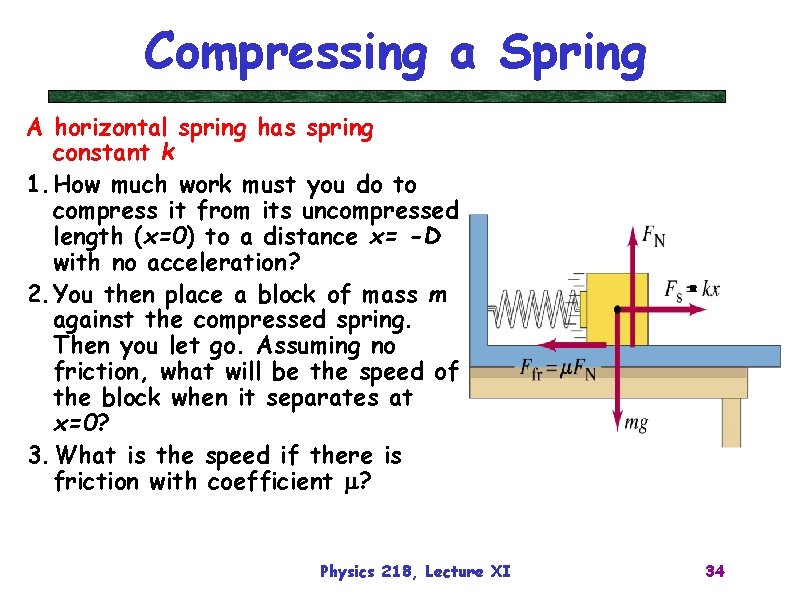
Compressing a Spring A horizontal spring has spring constant k 1. How much work must you do to compress it from its uncompressed length (x=0) to a distance x= -D with no acceleration? 2. You then place a block of mass m against the compressed spring. Then you let go. Assuming no friction, what will be the speed of the block when it separates at x=0? 3. What is the speed if there is friction with coefficient m? Physics 218, Lecture XI 34
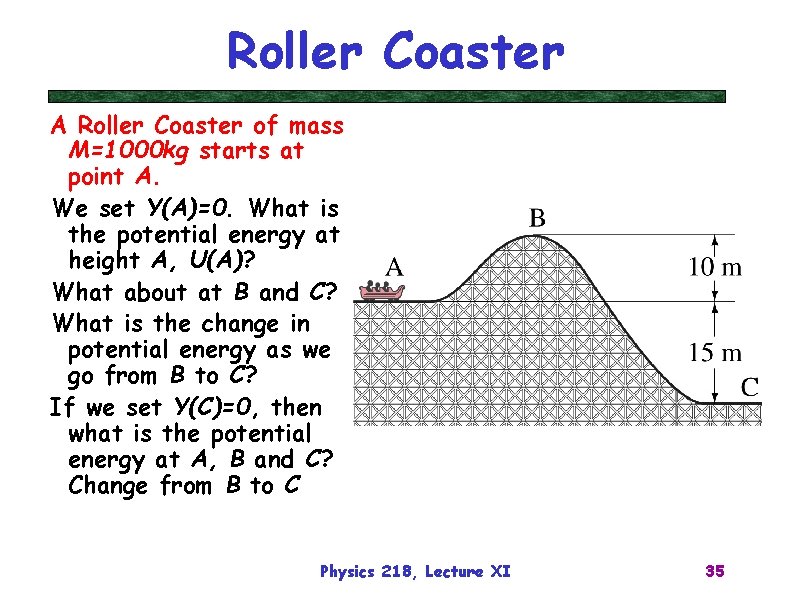
Roller Coaster A Roller Coaster of mass M=1000 kg starts at point A. We set Y(A)=0. What is the potential energy at height A, U(A)? What about at B and C? What is the change in potential energy as we go from B to C? If we set Y(C)=0, then what is the potential energy at A, B and C? Change from B to C Physics 218, Lecture XI 35
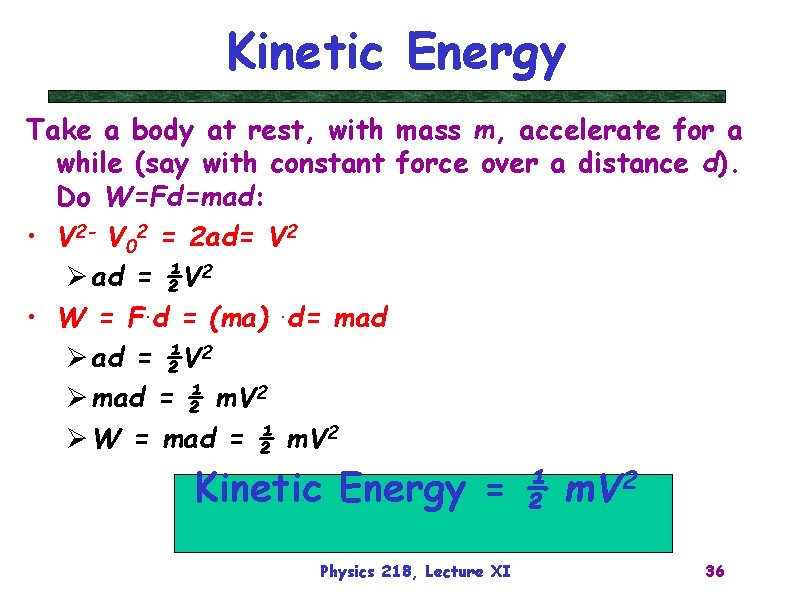
Kinetic Energy Take a body at rest, with mass m, accelerate for a while (say with constant force over a distance d). Do W=Fd=mad: • V 2 - V 02 = 2 ad= V 2 Ø ad = ½V 2 • W = F. d = (ma). d= mad Ø ad = ½V 2 Ø mad = ½ m. V 2 Ø W = mad = ½ m. V 2 Kinetic Energy = ½ m. V 2 Physics 218, Lecture XI 36
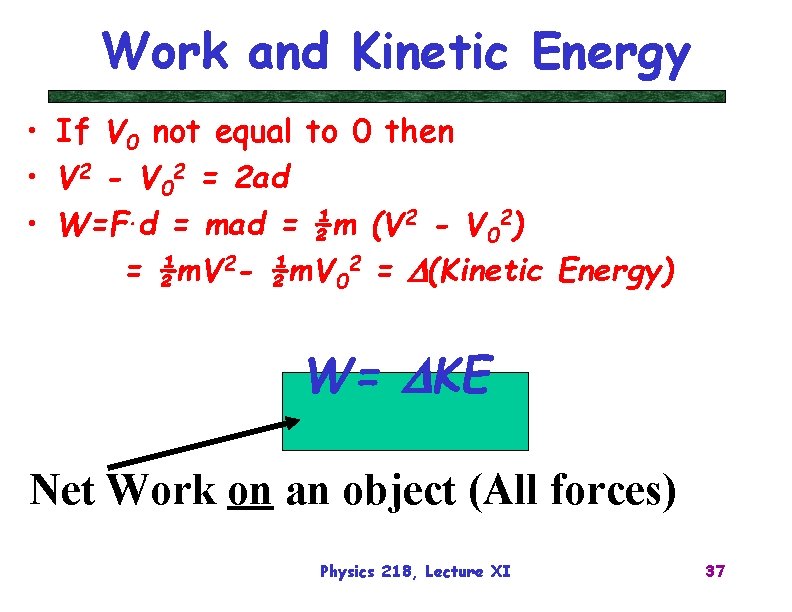
Work and Kinetic Energy • If V 0 not equal to 0 then • V 2 - V 02 = 2 ad • W=F. d = mad = ½m (V 2 - V 02) = ½m. V 2 - ½m. V 02 = D(Kinetic Energy) W= DKE Net Work on an object (All forces) Physics 218, Lecture XI 37
A football is thrown A 145 g football starts at rest and is thrown with a speed of 25 m/s. 1. What is the final kinetic energy? 2. How much work was done to reach this velocity? We don’t know the forces exerted by the arm as a function of time, but this allows us to sum them all up to calculate the work Physics 218, Lecture XI 38
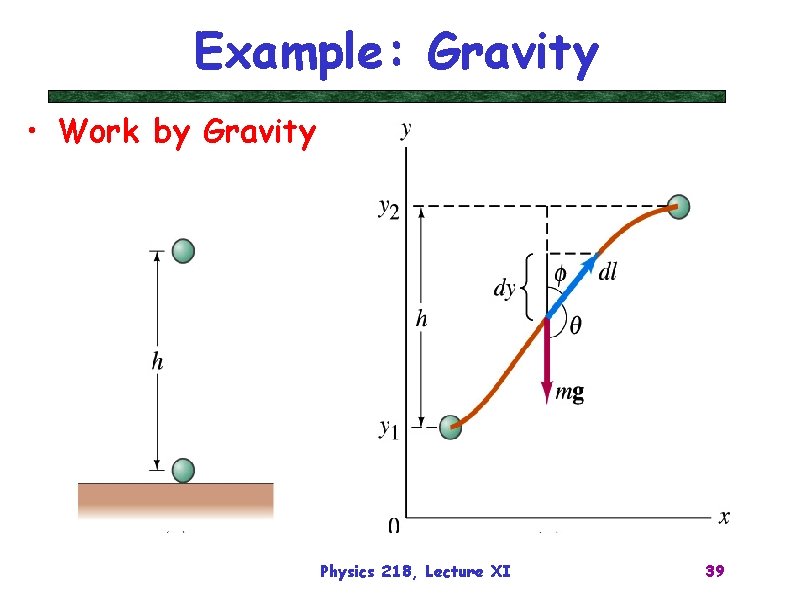
Example: Gravity • Work by Gravity Physics 218, Lecture XI 39
Potential Energy in General • Is the potential energy always equal to the work done on the object? – No, non-conservative forces – Other cases? • What about for conservative forces? Physics 218, Lecture XI 40
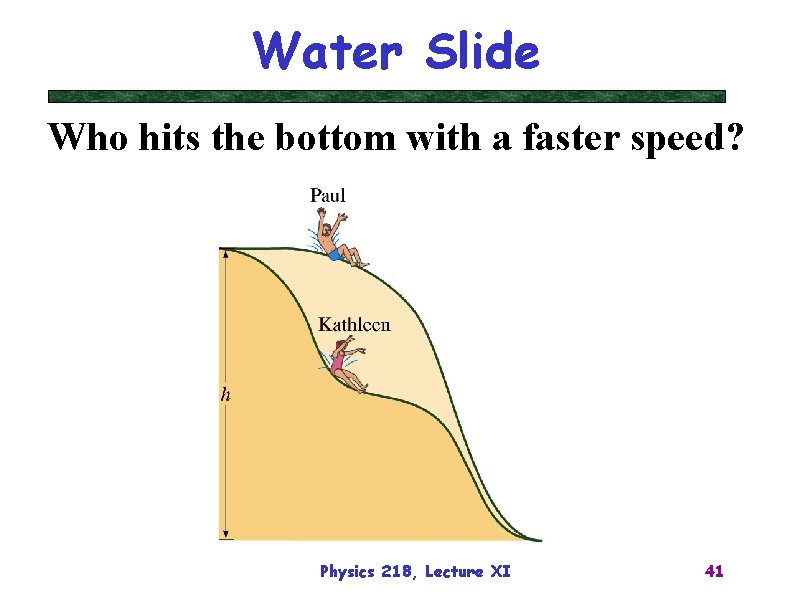
Water Slide Who hits the bottom with a faster speed? Physics 218, Lecture XI 41
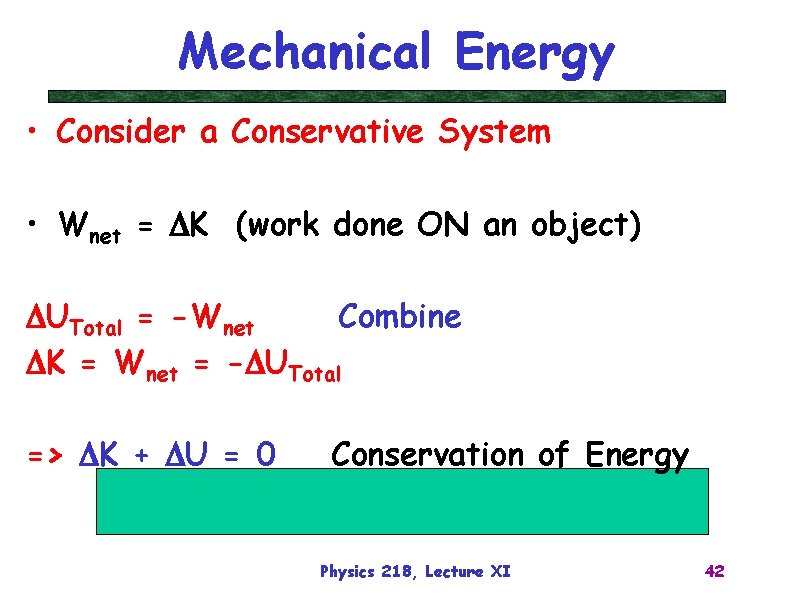
Mechanical Energy • Consider a Conservative System • Wnet = DK (work done ON an object) DUTotal = -Wnet Combine DK = Wnet = -DUTotal => DK + DU = 0 Conservation of Energy Physics 218, Lecture XI 42
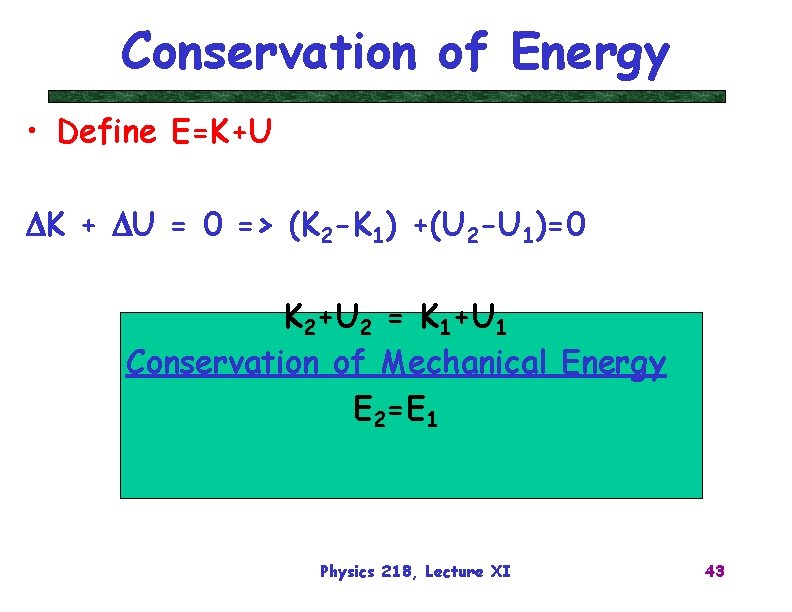
Conservation of Energy • Define E=K+U DK + DU = 0 => (K 2 -K 1) +(U 2 -U 1)=0 K 2+U 2 = K 1+U 1 Conservation of Mechanical Energy E 2=E 1 Physics 218, Lecture XI 43
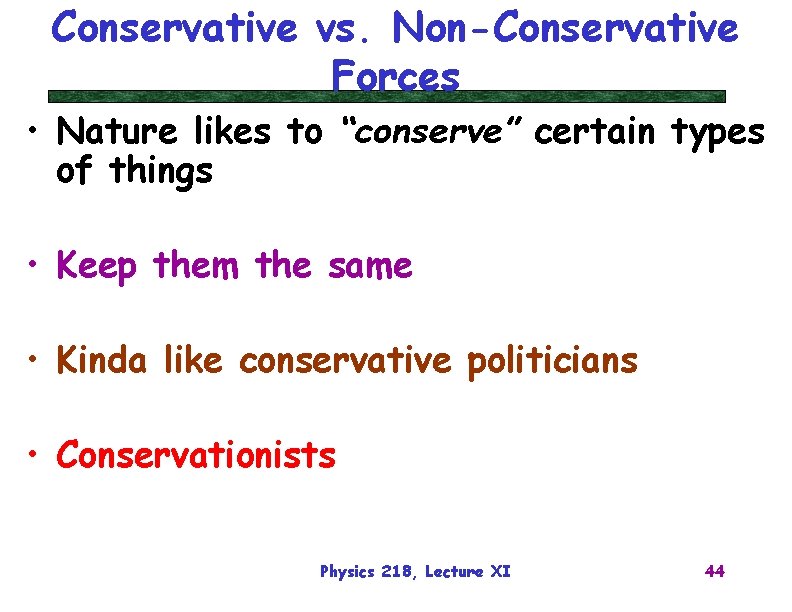
Conservative vs. Non-Conservative Forces • Nature likes to “conserve” certain types of things • Keep them the same • Kinda like conservative politicians • Conservationists Physics 218, Lecture XI 44
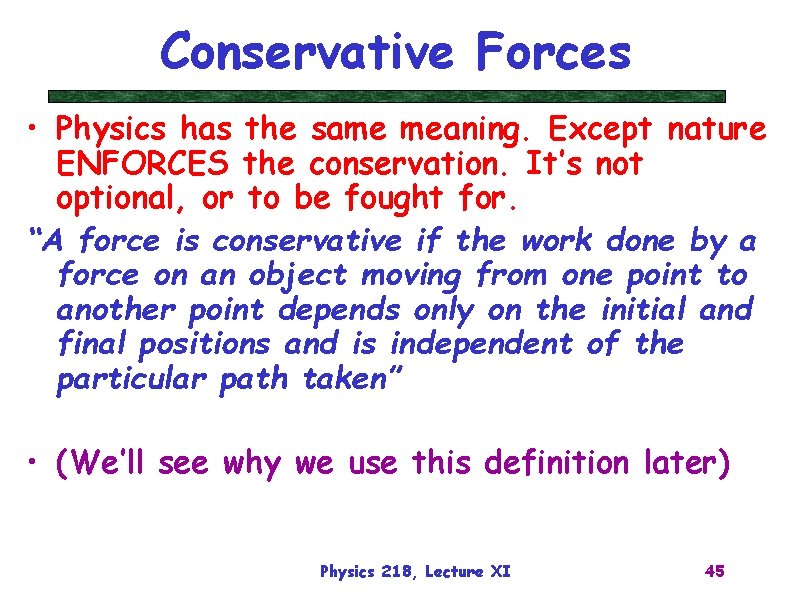
Conservative Forces • Physics has the same meaning. Except nature ENFORCES the conservation. It’s not optional, or to be fought for. “A force is conservative if the work done by a force on an object moving from one point to another point depends only on the initial and final positions and is independent of the particular path taken” • (We’ll see why we use this definition later) Physics 218, Lecture XI 45
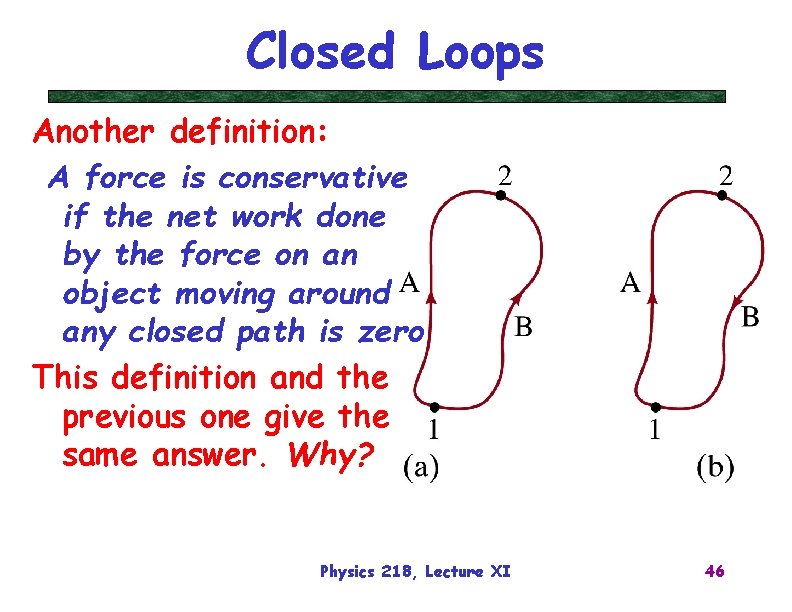
Closed Loops Another definition: A force is conservative if the net work done by the force on an object moving around any closed path is zero This definition and the previous one give the same answer. Why? Physics 218, Lecture XI 46
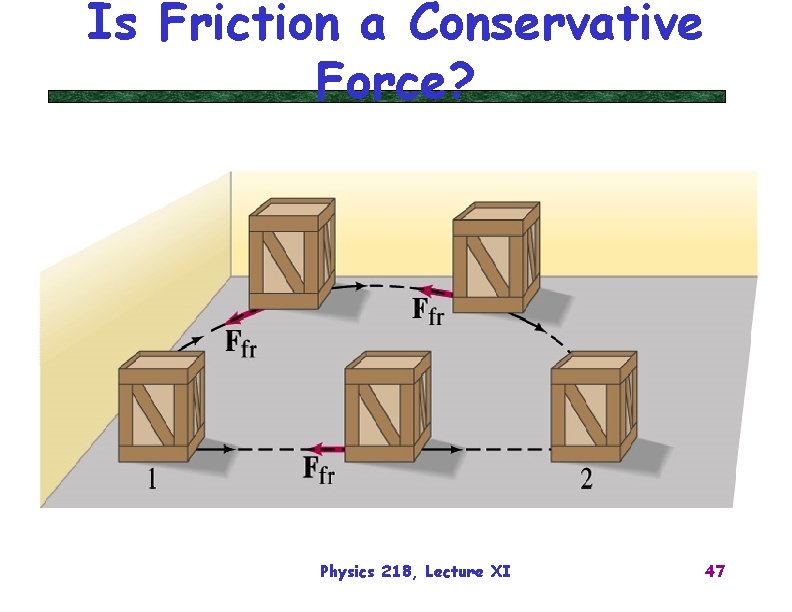
Is Friction a Conservative Force? Physics 218, Lecture XI 47
Integral Examples we know… Physics 218, Lecture XI 48
Work done to stretch a Spring Physics 218, Lecture XI 49
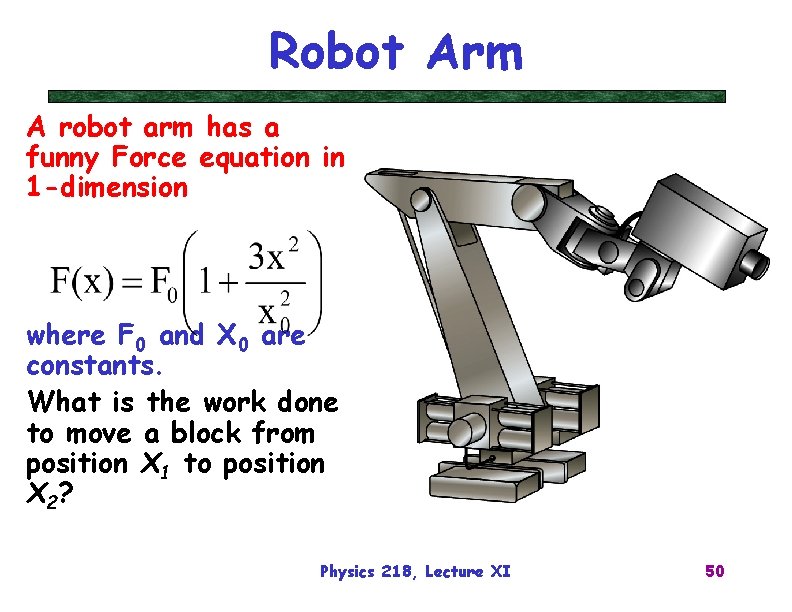
Robot Arm A robot arm has a funny Force equation in 1 -dimension where F 0 and X 0 are constants. What is the work done to move a block from position X 1 to position X 2? Physics 218, Lecture XI 50
Stretch a Spring A person pulls on a spring and stretches it a from the equilibrium point for a total distance D. At this distance the force required to keep the spring stretched is F. How much work is done on the spring in terms of the given variables? Can we use F. d? Physics 218, Lecture XI 51
- Slides: 51