
Physics 214 3 Interference Diffraction and Polarization Youngs
- Slides: 30
Physics 214 3: Interference Diffraction and Polarization • Young’s Double-Slit Experiment • Intensity Distribution of the Double-Slit Interference Pattern • Interference in Thin Films • Single Slit Diffraction • Diffraction Grating • Diffraction by Crystals • Polarization of Light Waves
In order to observe interference in light rays, light must be: • Coherent • Monochromatic Superposition Principle must apply Double Slit Experiment
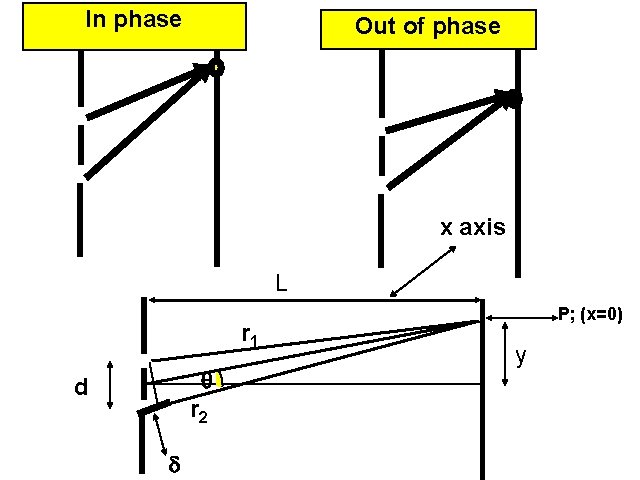
In phase Out of phase x axis L r 1 d r 2 P; (x=0) y
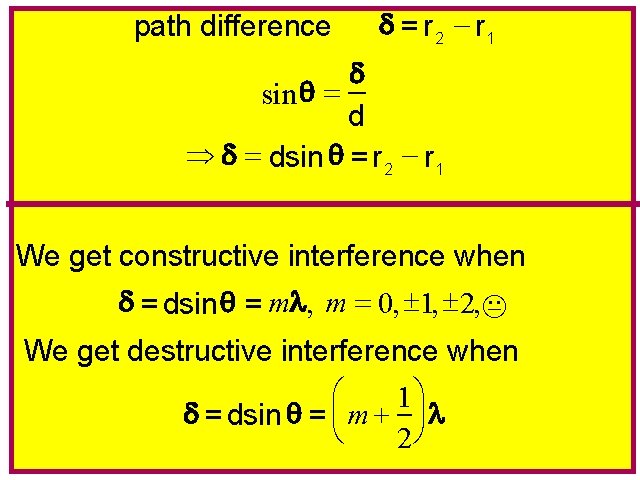
path difference = r 2 - r 1 sin = d Þ = dsin = r 2 - r 1 We get constructive interference when = dsin = ml, m = 0, ± 1, ± 2, K We get destructive interference when æ 1ö = dsin = ç m + ÷ l è 2ø
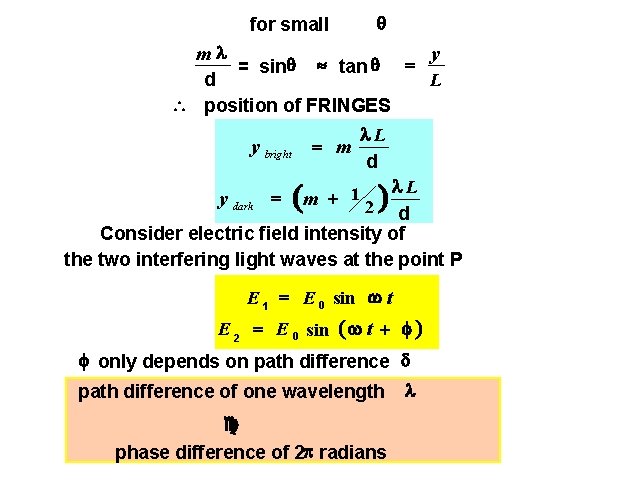
for small ml y » = sin tan L d position of FRINGES l. L y bright m d l. L y dark m + 1 2 d Consider electric field intensity of the two interfering light waves at the point P ( ) E 1 E 0 sin w t E 2 E 0 sin ( w t + ) only depends on path difference of one wavelength l c phase difference of 2 p radians
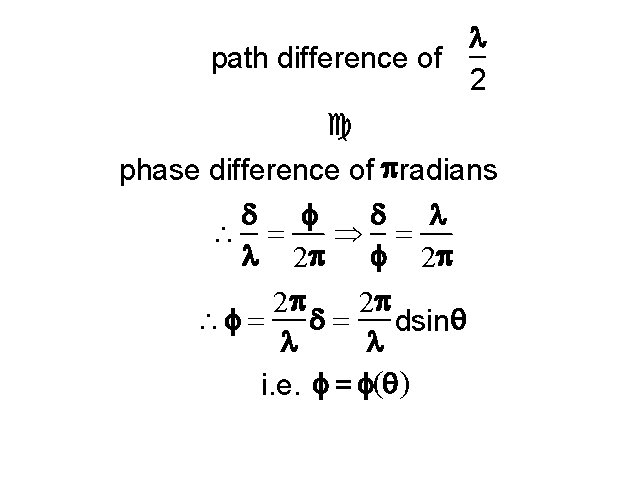
l path difference of 2 c phase difference of p radians l = Þ = l 2 p 2 p 2 p = = dsin l l i. e. = ( )
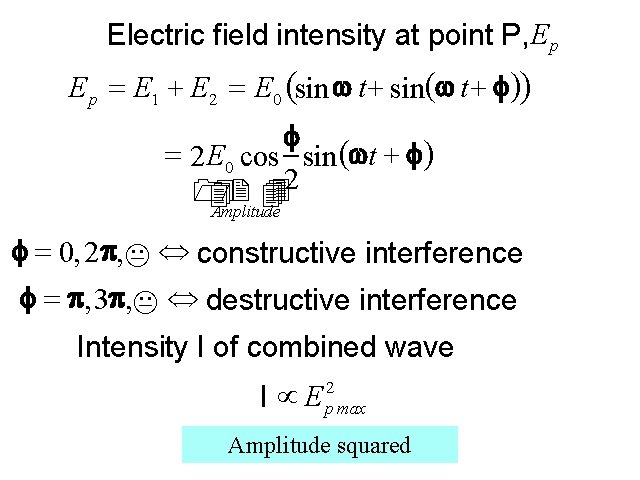
Electric field intensity at point P, Ep E p = E 1 + E 2 = E 0 (sin w t + sin(w t + )) = 2 E 0 cos sin (wt + ) 1 42 4 32 Amplitude = 0, 2 p, K Û constructive interference = p, 3 p, K Û destructive interference Intensity I of combined wave I µ E p 2 max Amplitude squared
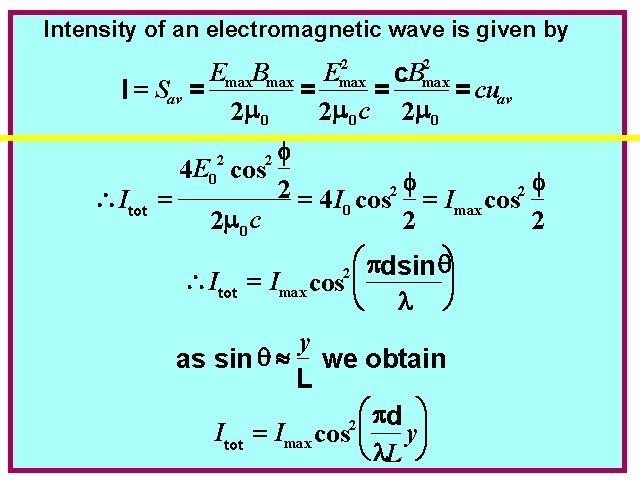
Intensity of an electromagnetic wave is given by 2 2 Emax. Bmax Emax c. Bmax I Sav = = cuav 2 m 0 c 2 m 0 4 E 0 cos 2 2 2 4 I 0 cos Imax cos 2 m 0 c 2 2 2 Itot 2 æ pdsin ö Itot Imax cos ç ÷ è l ø y as sin » we obtain L æ ö 2 pd Itot Imax cos ç y÷ è l. L ø 2
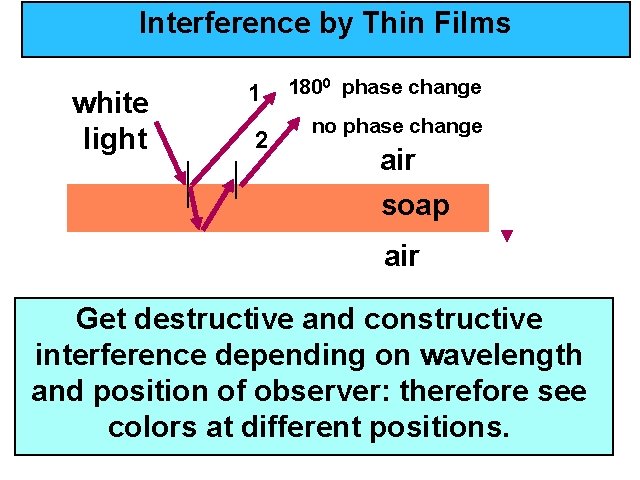
Interference by Thin Films white light 1 2 1800 phase change no phase change air soap air Get destructive and constructive interference depending on wavelength and position of observer: therefore see colors at different positions.
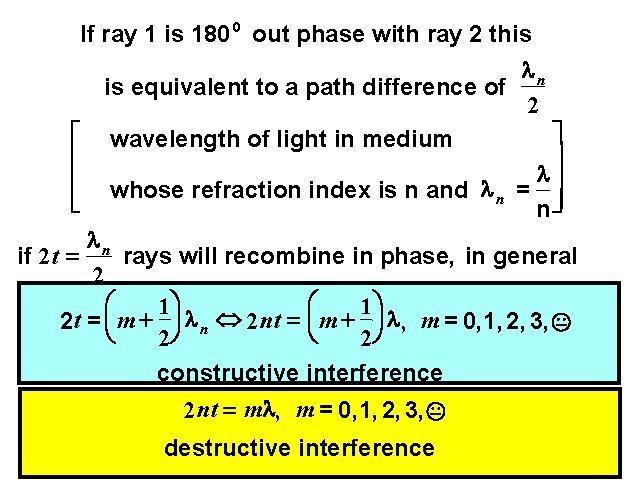
If ray 1 is 180 0 out phase with ray 2 this ln is equivalent to a path difference of 2 é wavelength of light in medium ù ê ú l ú ê whose refraction index is n and l n = ú ê ë n û ln if 2 t rays will recombine in phase, in general 2 æ æ 1 ö 2 t = ç m + ÷ l n Û 2 nt ç m + ÷ l , m = 0, 1, 2, 3, K è è 2 ø constructive interference 2 nt ml, m = 0, 1, 2, 3, K destructive interference
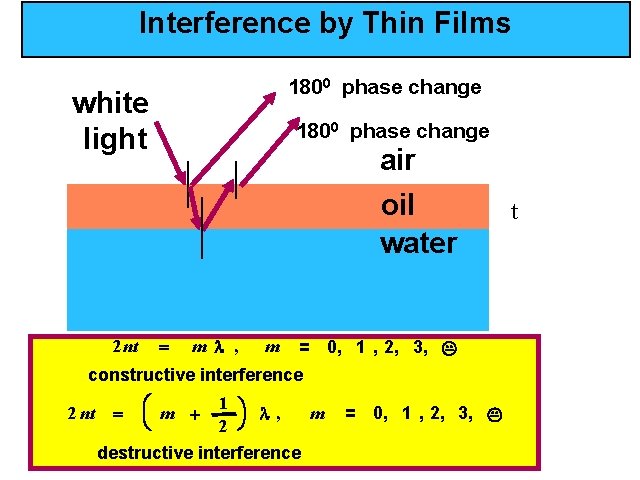
Interference by Thin Films 1800 phase change white light 1800 phase change air oil water m l , = 0, 1 , 2, 3, K constructive interference 2 nt 2 nt æ m + è m 1 ö m l , ø 2 destructive interference = 0, 1 , 2, 3, K t
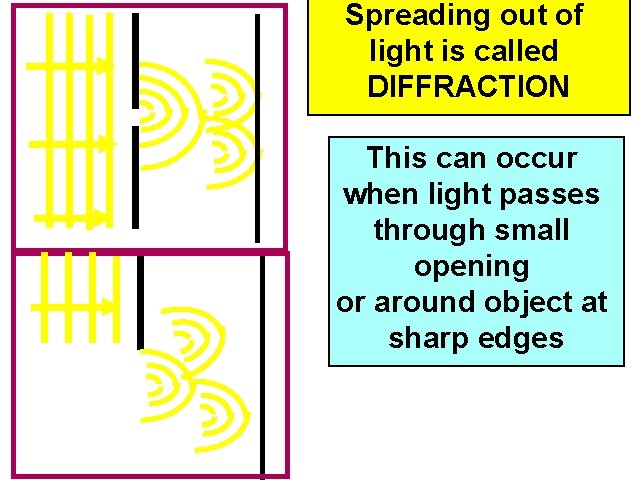
Spreading out of light is called DIFFRACTION This can occur when light passes through small opening or around object at sharp edges
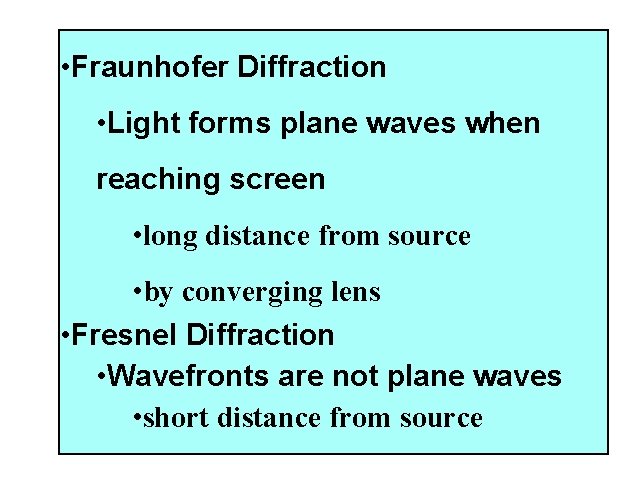
• Fraunhofer Diffraction • Light forms plane waves when reaching screen • long distance from source • by converging lens • Fresnel Diffraction • Wavefronts are not plane waves • short distance from source
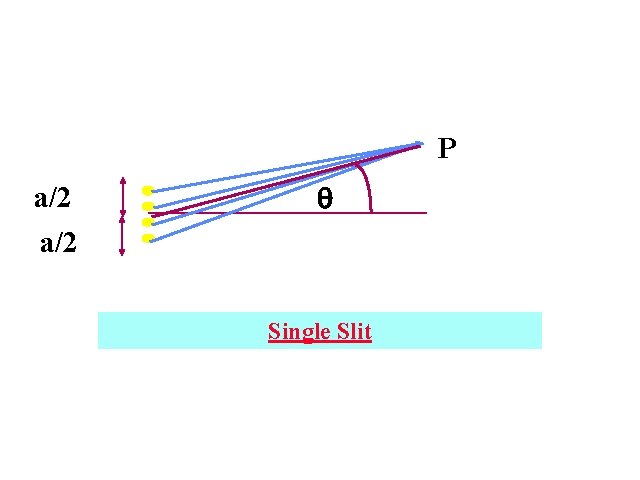
P a/2 Single Slit
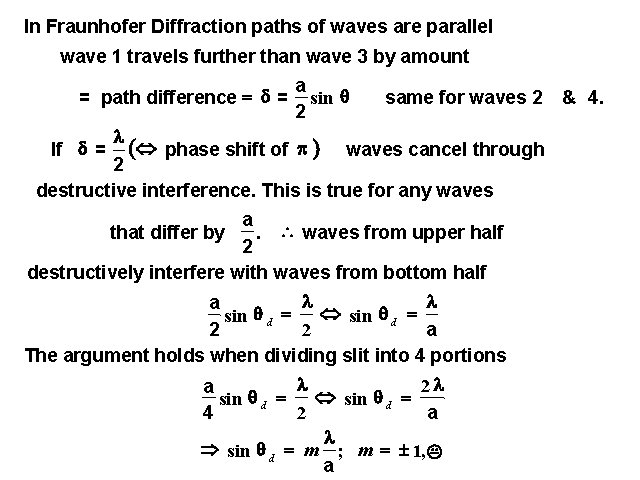
In Fraunhofer Diffraction paths of waves are parallel wave 1 travels further than wave 3 by amount = path difference = a sin 2 same for waves 2 l (Û phase shift of p ) waves cancel through 2 destructive interference. This is true for any waves If = a. waves from upper half 2 destructively interfere with waves from bottom half l l a Û sin d 2 2 a The argument holds when dividing slit into 4 portions l 2 l a Û sin d 2 4 a l Þ sin d m ; m ± 1, K a that differ by & 4.
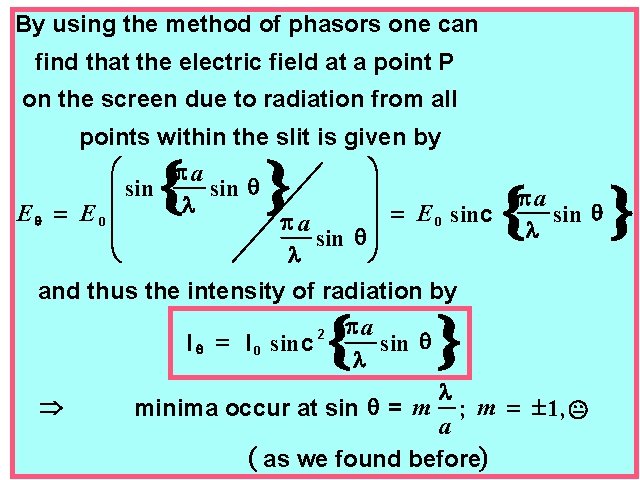
By using the method of phasors one can find that the electric field at a point P on the screen due to radiation from all points within the slit is given by æ ö pa sin ç sin ÷ l ÷ E 0 sinc E E 0 ç pa ç sin ÷ è ø l { } { pa sin l and thus the intensity of radiation by pa 2 sin I I 0 sinc l l Þ minima occur at sin = m ; m ± 1, K a ( as we found before) { } }
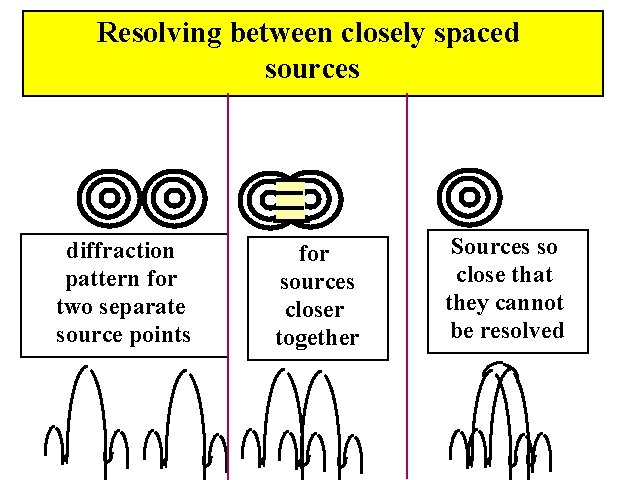
Resolving between closely spaced sources diffraction pattern for two separate source points for sources closer together Sources so close that they cannot be resolved
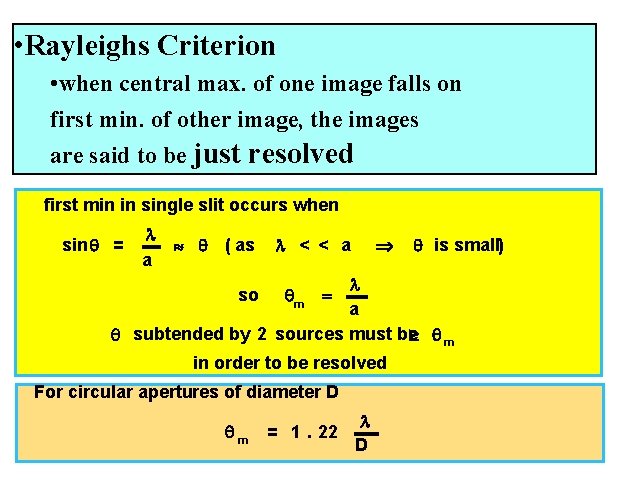
• Rayleighs Criterion • when central max. of one image falls on first min. of other image, the images are said to be just resolved first min in single slit occurs when sin = l a » ( as l < < a Þ is small) l a subtended by 2 sources must be ³ m so m in order to be resolved For circular apertures of diameter D m = 1. 22 l D
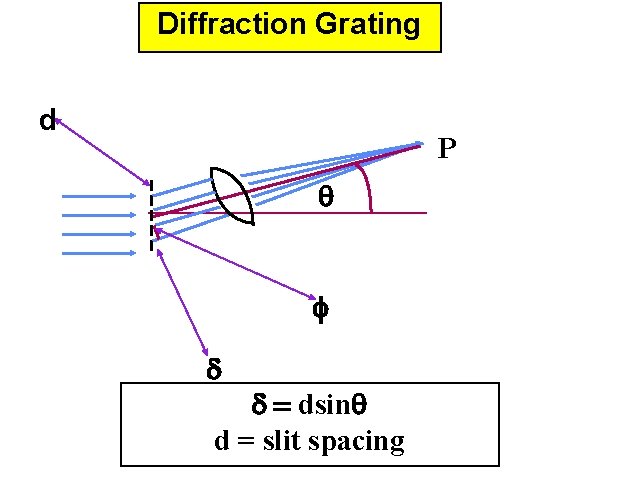
Diffraction Grating d P dsin d = slit spacing
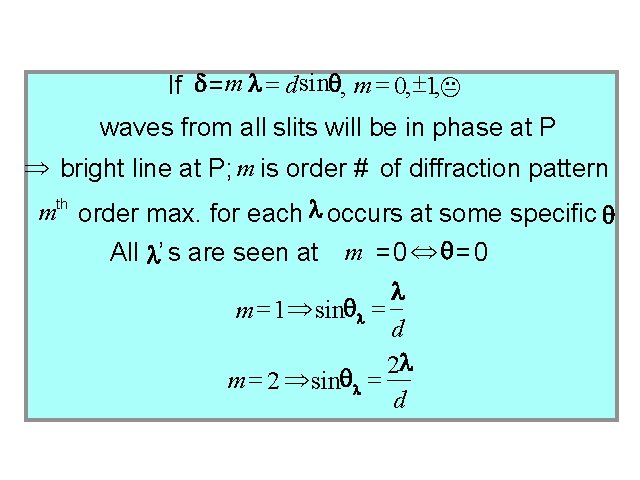
If =m l = d sin , m = 0, ± 1, K waves from all slits will be in phase at P Þ bright line at P; m is order # of diffraction pattern mth order max. for each l occurs at some specific All l’ s are seen at m =0 Û =0 l m = 1 Þ sin l = d 2 l m = 2 Þ sin l = d
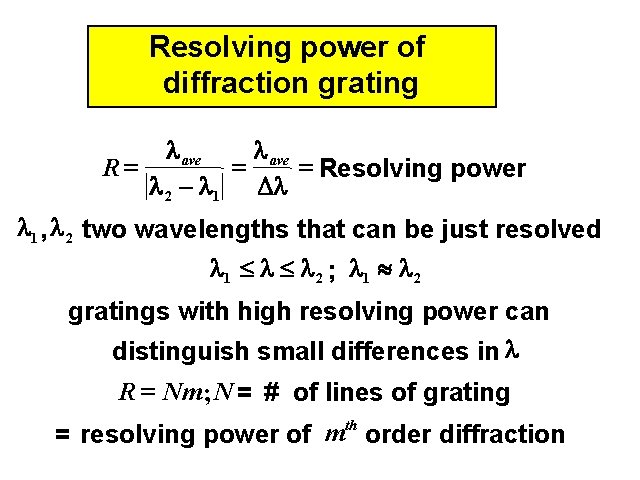
Resolving power of diffraction grating l ave Resolving power R l 2 - l 1 Dl l 1 , l 2 two wavelengths that can be just resolved l 1 £ l 2 ; l 1 » l 2 gratings with high resolving power can distinguish small differences in l R Nm ; N = # of lines of grating = resolving power of mth order diffraction
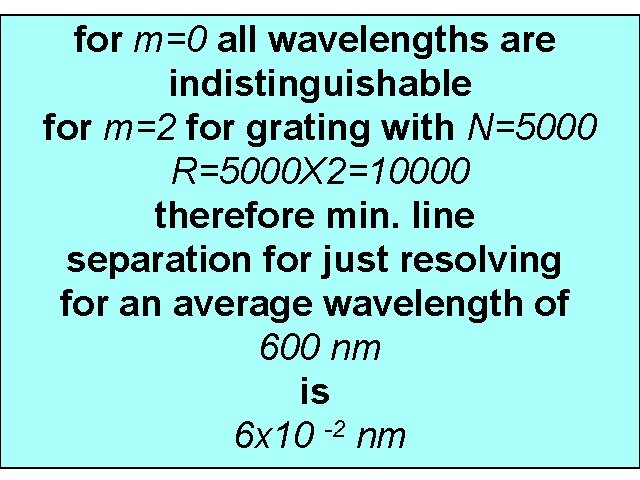
for m=0 all wavelengths are indistinguishable for m=2 for grating with N=5000 R=5000 X 2=10000 therefore min. line separation for just resolving for an average wavelength of 600 nm is 6 x 10 -2 nm
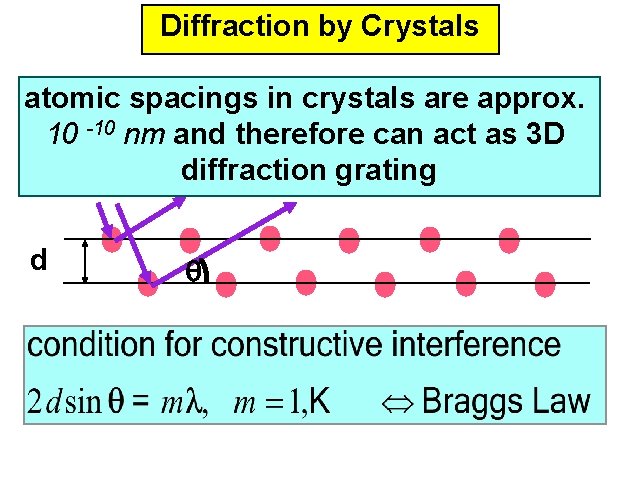
Diffraction by Crystals atomic spacings in crystals are approx. 10 -10 nm and therefore can act as 3 D diffraction grating d
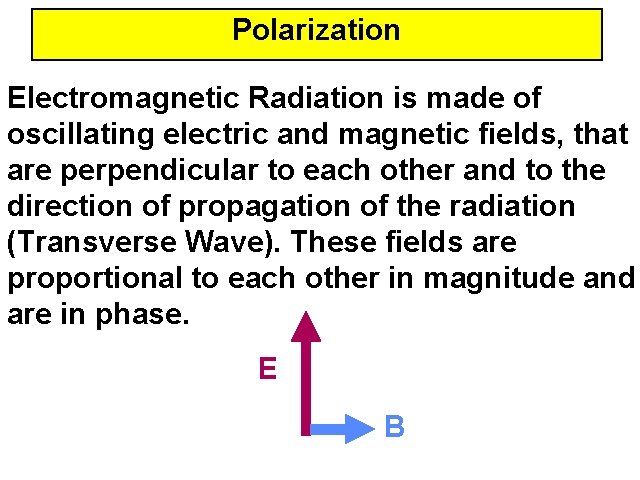
Polarization Electromagnetic Radiation is made of oscillating electric and magnetic fields, that are perpendicular to each other and to the direction of propagation of the radiation (Transverse Wave). These fields are proportional to each other in magnitude and are in phase. E B
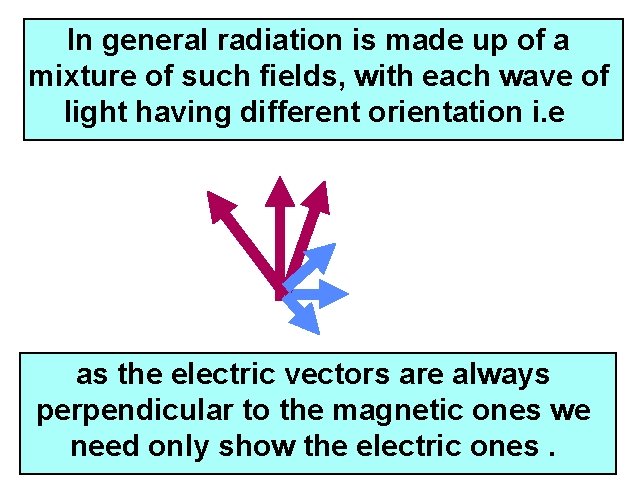
In general radiation is made up of a mixture of such fields, with each wave of light having different orientation i. e as the electric vectors are always perpendicular to the magnetic ones we need only show the electric ones.
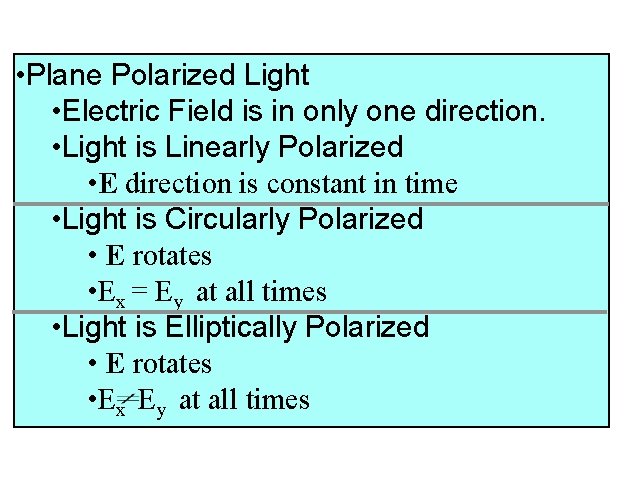
• Plane Polarized Light • Electric Field is in only one direction. • Light is Linearly Polarized • E direction is constant in time • Light is Circularly Polarized • E rotates • Ex = Ey at all times • Light is Elliptically Polarized • E rotates • Ex Ey at all times
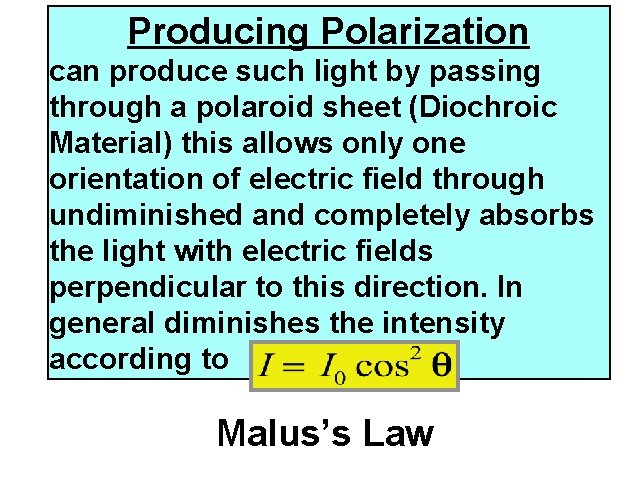
Producing Polarization can produce such light by passing through a polaroid sheet (Diochroic Material) this allows only one orientation of electric field through undiminished and completely absorbs the light with electric fields perpendicular to this direction. In general diminishes the intensity according to Malus’s Law
polarized light is also produced by reflection When light strikes a nonmetallic surface at any angle other than perpendicular, the reflected beam is polarized preferentially in the plane parallel to the surface. (light polarized in plane perpendicular to surface is preferentially absorbed or transmitted).
Why is the Sky Blue and daylight polarized? Polarization by Scattering • Higher frequencies are scattered more than lower ones (refracted more) by the oxygen and nitrogen molecules • All the visible frequencies are scattered the same by larger objects e. g. water droplets in clouds. • Scattered light is polarized.
Polarization by Double Refraction • Materials that have two indices of refraction depending on the direction of incident rays are called Double Refracting or Birefringent • These materials produce polarized light