
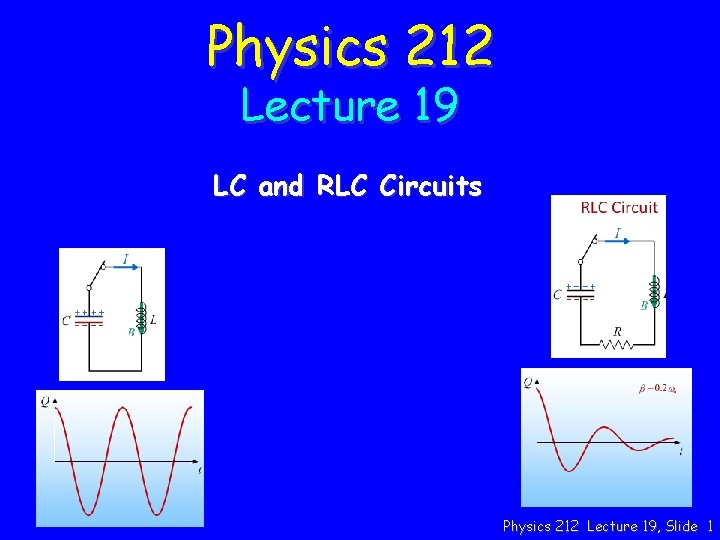
Physics 212 Lecture 19 LC and RLC Circuits
- Slides: 19
Physics 212 Lecture 19 LC and RLC Circuits Physics 212 Lecture 19, Slide 1
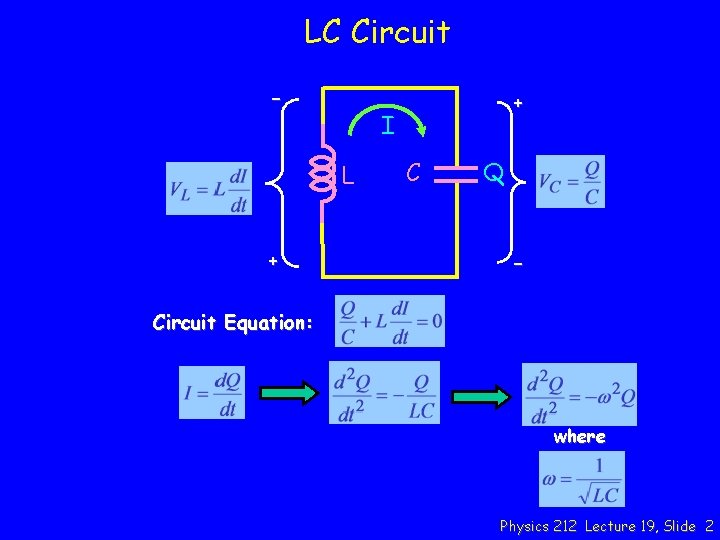
LC Circuit - I L + + C Q - Circuit Equation: where Physics 212 Lecture 19, Slide 2
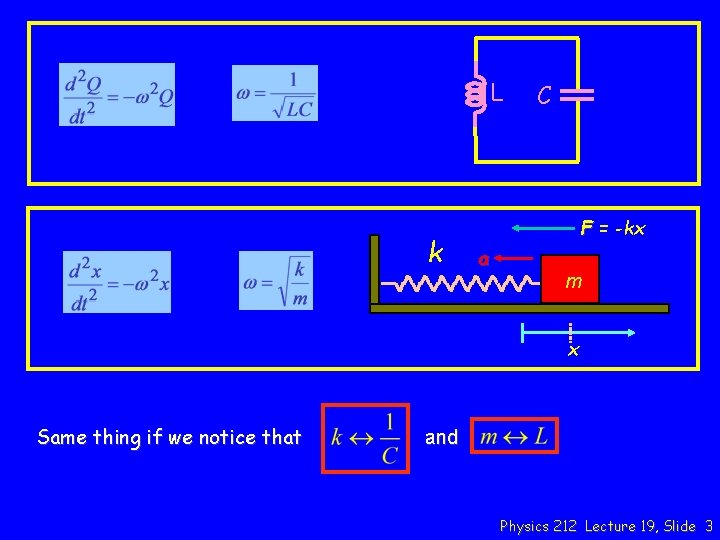
L k C F = -kx a m x Same thing if we notice that and Physics 212 Lecture 19, Slide 3
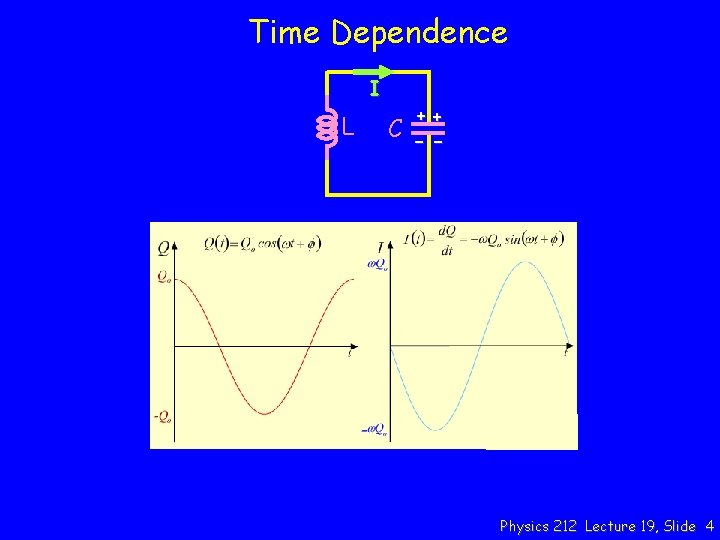
Time Dependence I L C ++ -- Physics 212 Lecture 19, Slide 4
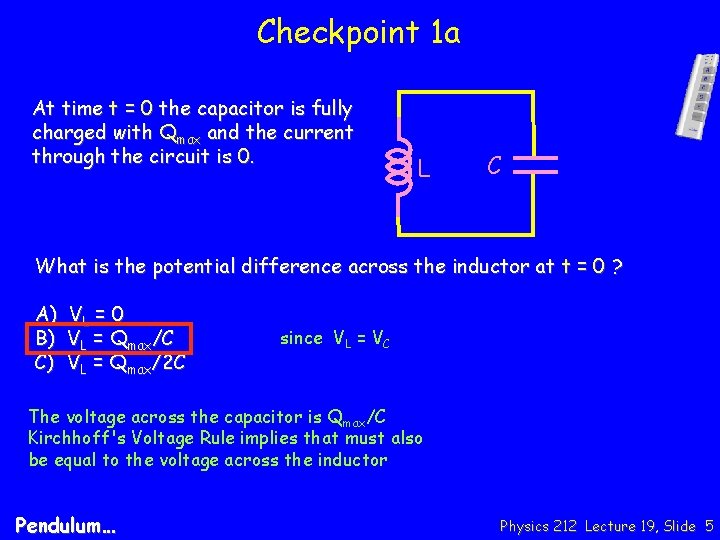
Checkpoint 1 a At time t = 0 the capacitor is fully charged with Qmax and the current through the circuit is 0. L C What is the potential difference across the inductor at t = 0 ? A) VL = 0 B) VL = Qmax/C C) VL = Qmax/2 C since VL = VC The voltage across the capacitor is Qmax/C Kirchhoff's Voltage Rule implies that must also be equal to the voltage across the inductor Pendulum… Physics 212 Lecture 19, Slide 5
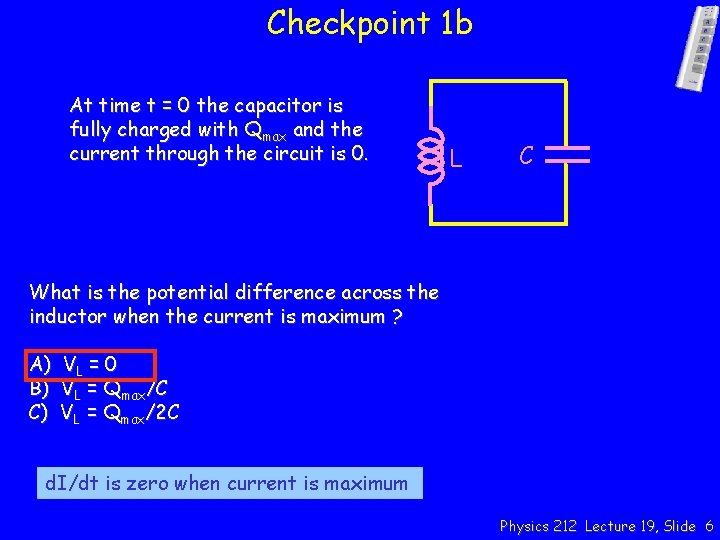
Checkpoint 1 b At time t = 0 the capacitor is fully charged with Qmax and the current through the circuit is 0. L C What is the potential difference across the inductor when the current is maximum ? A) VL = 0 B) VL = Qmax/C C) VL = Qmax/2 C d. I/dt is zero when current is maximum Physics 212 Lecture 19, Slide 6
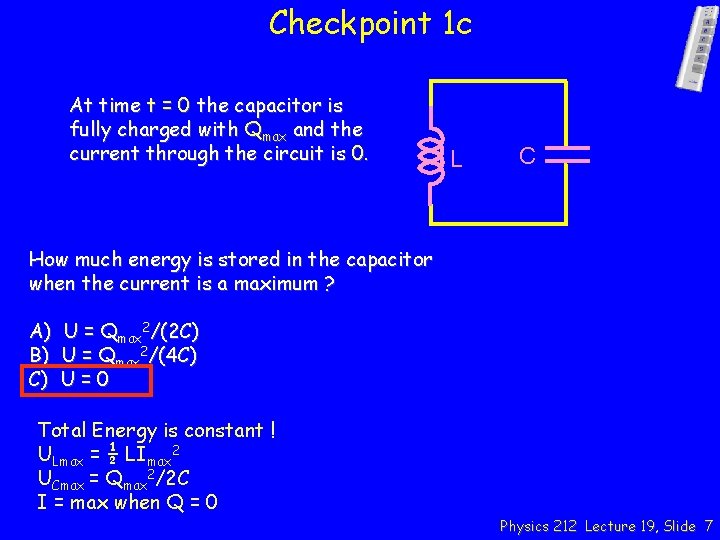
Checkpoint 1 c At time t = 0 the capacitor is fully charged with Qmax and the current through the circuit is 0. L C How much energy is stored in the capacitor when the current is a maximum ? A) U = Qmax 2/(2 C) B) U = Qmax 2/(4 C) C) U = 0 Total Energy is constant ! ULmax = ½ LImax 2 UCmax = Qmax 2/2 C I = max when Q = 0 Physics 212 Lecture 19, Slide 7
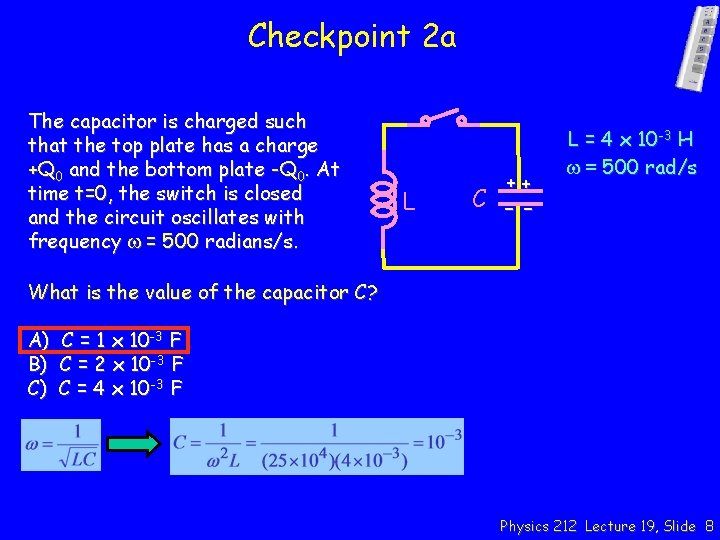
Checkpoint 2 a The capacitor is charged such that the top plate has a charge +Q 0 and the bottom plate -Q 0. At time t=0, the switch is closed and the circuit oscillates with frequency w = 500 radians/s. L C ++ -- L = 4 x 10 -3 H w = 500 rad/s What is the value of the capacitor C? A) C = 1 x 10 -3 F B) C = 2 x 10 -3 F C) C = 4 x 10 -3 F Physics 212 Lecture 19, Slide 8
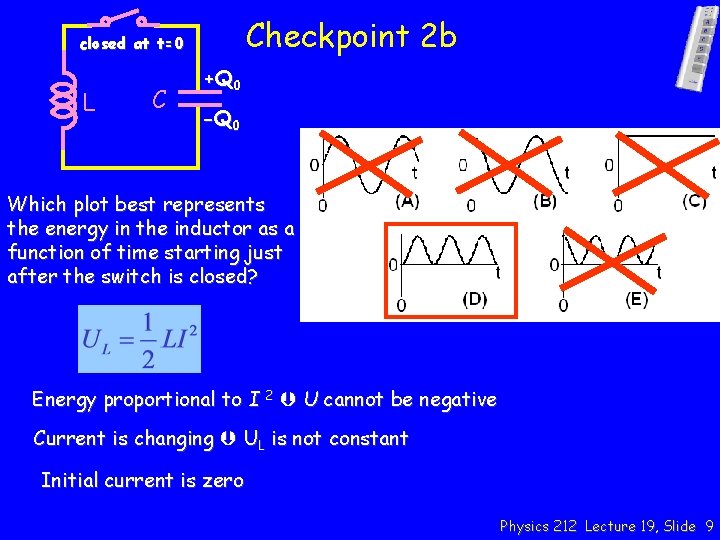
Checkpoint 2 b closed at t=0 L C +Q 0 -Q 0 Which plot best represents the energy in the inductor as a function of time starting just after the switch is closed? Energy proportional to I 2 U cannot be negative Current is changing UL is not constant Initial current is zero Physics 212 Lecture 19, Slide 9
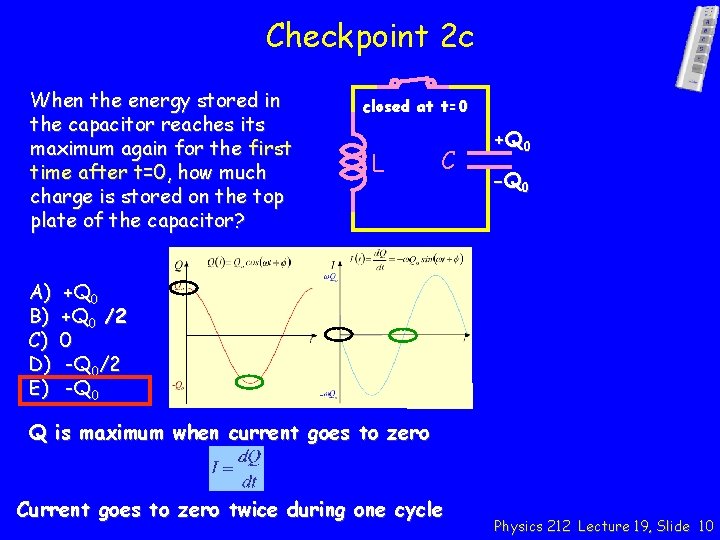
Checkpoint 2 c When the energy stored in the capacitor reaches its maximum again for the first time after t=0, how much charge is stored on the top plate of the capacitor? closed at t=0 L C +Q 0 -Q 0 A) +Q 0 B) +Q 0 /2 C) 0 D) -Q 0/2 E) -Q 0 Q is maximum when current goes to zero Current goes to zero twice during one cycle Physics 212 Lecture 19, Slide 10
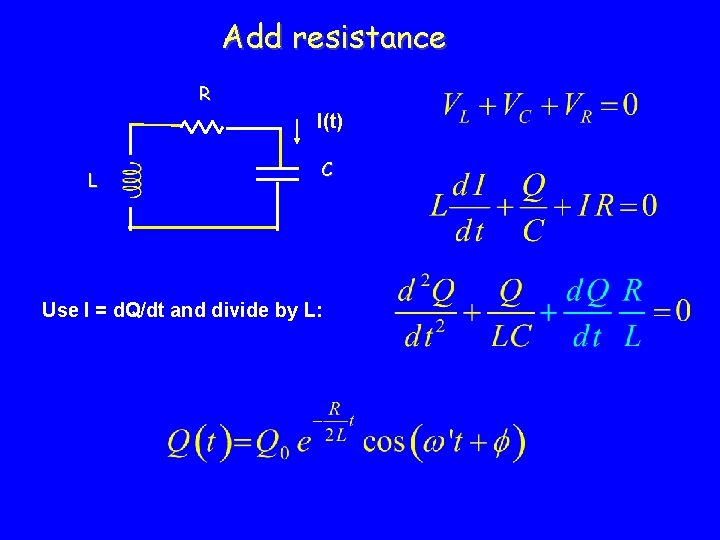
Add resistance R I(t) L C Use I = d. Q/dt and divide by L:
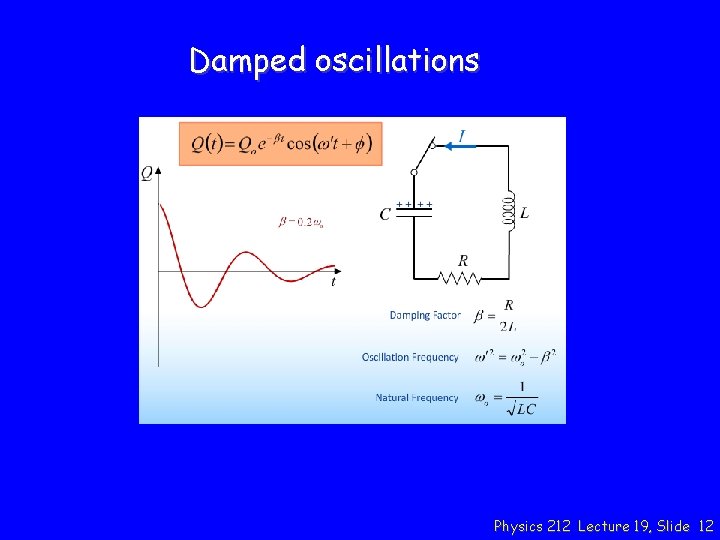
Damped oscillations Physics 212 Lecture 19, Slide 12
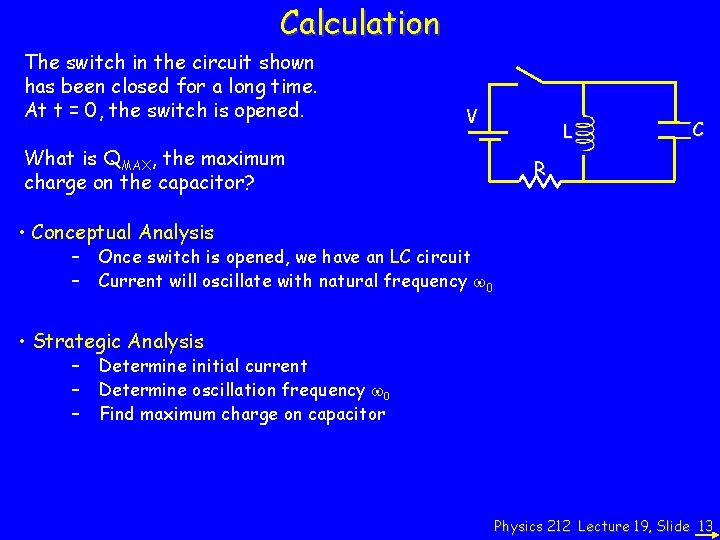
Calculation The switch in the circuit shown has been closed for a long time. At t = 0, the switch is opened. V What is QMAX, the maximum charge on the capacitor? L C R • Conceptual Analysis – – Once switch is opened, we have an LC circuit Current will oscillate with natural frequency w 0 • Strategic Analysis – – – Determine initial current Determine oscillation frequency w 0 Find maximum charge on capacitor Physics 212 Lecture 19, Slide 13
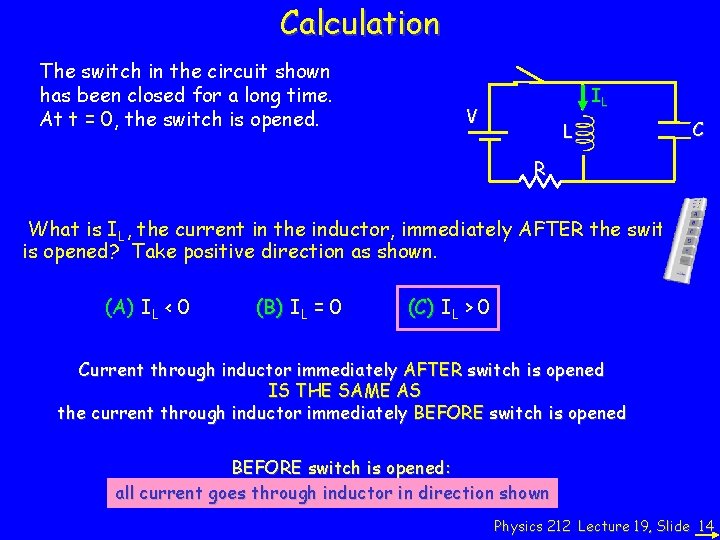
Calculation The switch in the circuit shown has been closed for a long time. At t = 0, the switch is opened. IL V L C R What is IL, the current in the inductor, immediately AFTER the switch is opened? Take positive direction as shown. (A) IL < 0 (B) IL = 0 (C) IL > 0 Current through inductor immediately AFTER switch is opened IS THE SAME AS the current through inductor immediately BEFORE switch is opened: all current goes through inductor in direction shown Physics 212 Lecture 19, Slide 14
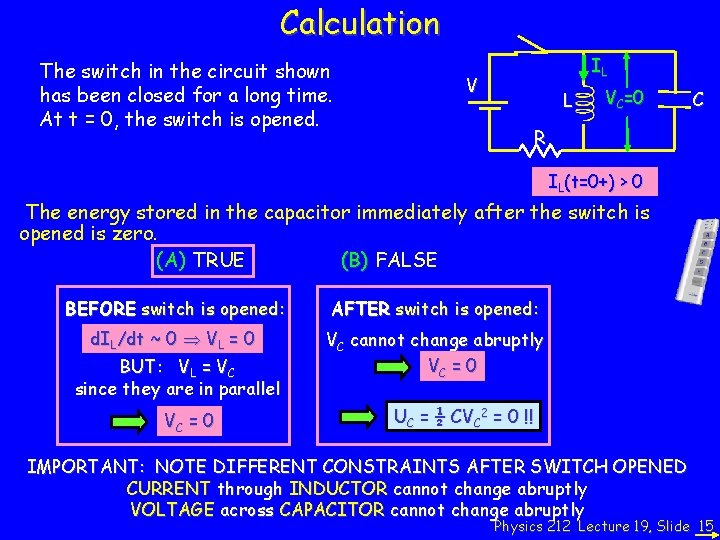
Calculation The switch in the circuit shown has been closed for a long time. At t = 0, the switch is opened. IL V L VC=0 C R IL(t=0+) > 0 The energy stored in the capacitor immediately after the switch is opened is zero. (A) TRUE (B) FALSE BEFORE switch is opened: AFTER switch is opened: d. IL/dt ~ 0 VL = 0 VC cannot change abruptly VC = 0 BUT: VL = VC since they are in parallel VC = 0 UC = ½ CVC 2 = 0 !! IMPORTANT: NOTE DIFFERENT CONSTRAINTS AFTER SWITCH OPENED CURRENT through INDUCTOR cannot change abruptly VOLTAGE across CAPACITOR cannot change abruptly Physics 212 Lecture 19, Slide 15
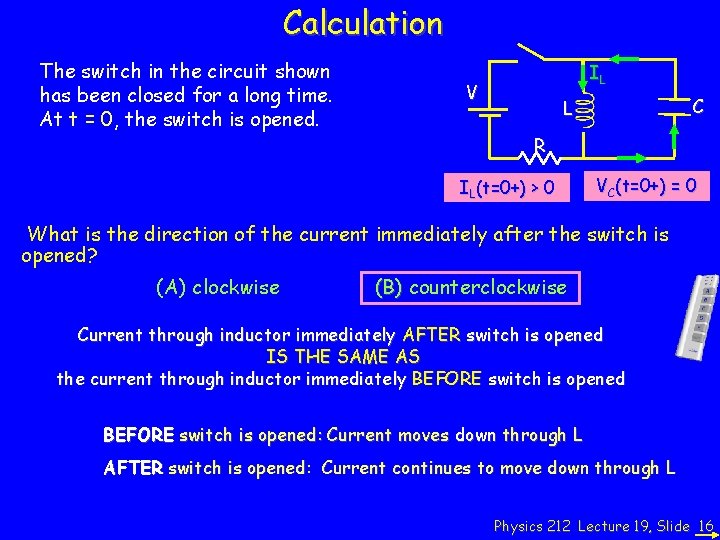
Calculation The switch in the circuit shown has been closed for a long time. At t = 0, the switch is opened. IL V C L R IL(t=0+) > 0 VC(t=0+) = 0 What is the direction of the current immediately after the switch is opened? (A) clockwise (B) counterclockwise Current through inductor immediately AFTER switch is opened IS THE SAME AS the current through inductor immediately BEFORE switch is opened: Current moves down through L AFTER switch is opened: Current continues to move down through L Physics 212 Lecture 19, Slide 16
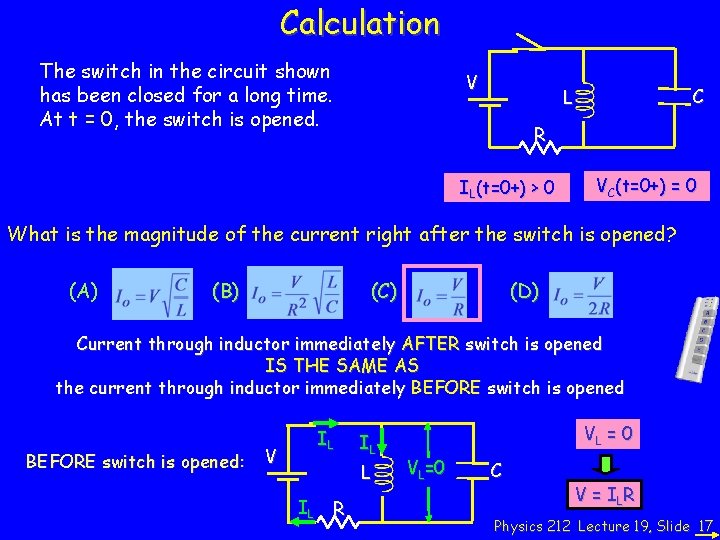
Calculation The switch in the circuit shown has been closed for a long time. At t = 0, the switch is opened. V C L R IL(t=0+) > 0 VC(t=0+) = 0 What is the magnitude of the current right after the switch is opened? (A) (B) (C) (D) Current through inductor immediately AFTER switch is opened IS THE SAME AS the current through inductor immediately BEFORE switch is opened: IL V IL L IL R VL = 0 VL=0 C V = ILR Physics 212 Lecture 19, Slide 17
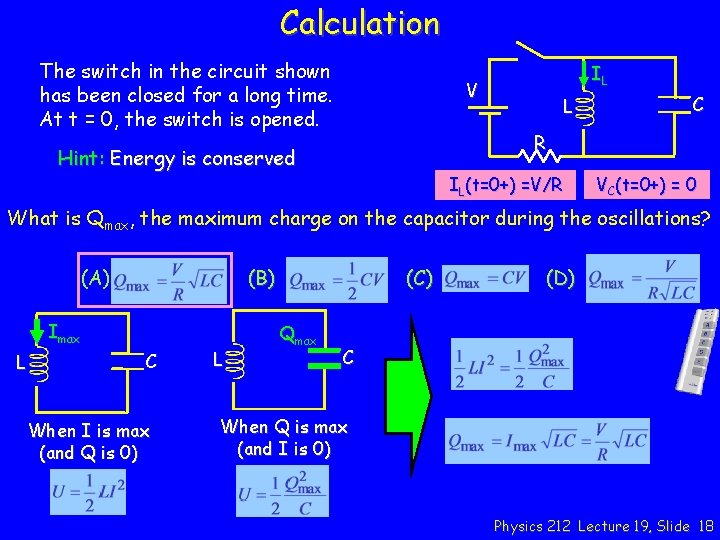
Calculation The switch in the circuit shown has been closed for a long time. At t = 0, the switch is opened. IL V L C R Hint: Energy is conserved IL(t=0+) =V/R VC(t=0+) = 0 What is Qmax, the maximum charge on the capacitor during the oscillations? (A) (B) Imax L C When I is max (and Q is 0) L (C) Qmax (D) C When Q is max (and I is 0) Physics 212 Lecture 19, Slide 18
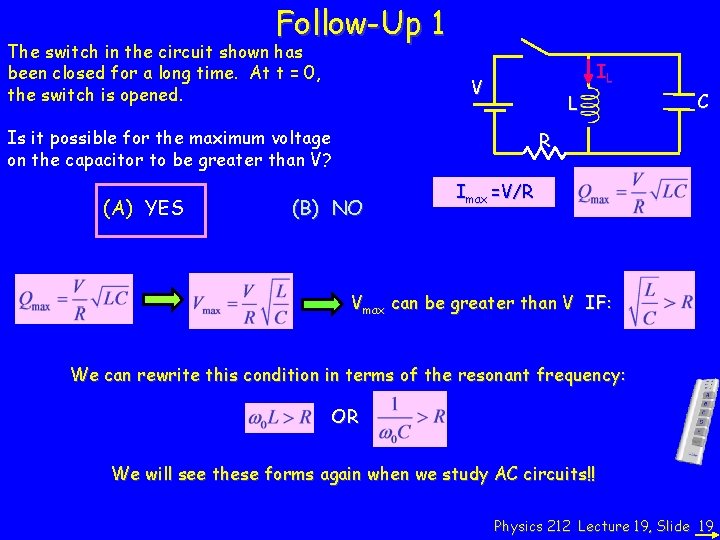
Follow-Up 1 The switch in the circuit shown has been closed for a long time. At t = 0, the switch is opened. IL V L Is it possible for the maximum voltage on the capacitor to be greater than V? (A) YES C R (B) NO Imax =V/R Vmax can be greater than V IF: We can rewrite this condition in terms of the resonant frequency: OR We will see these forms again when we study AC circuits!! Physics 212 Lecture 19, Slide 19