
Physics 212 Lecture 16 Motional EMF Conductors moving








- Slides: 22
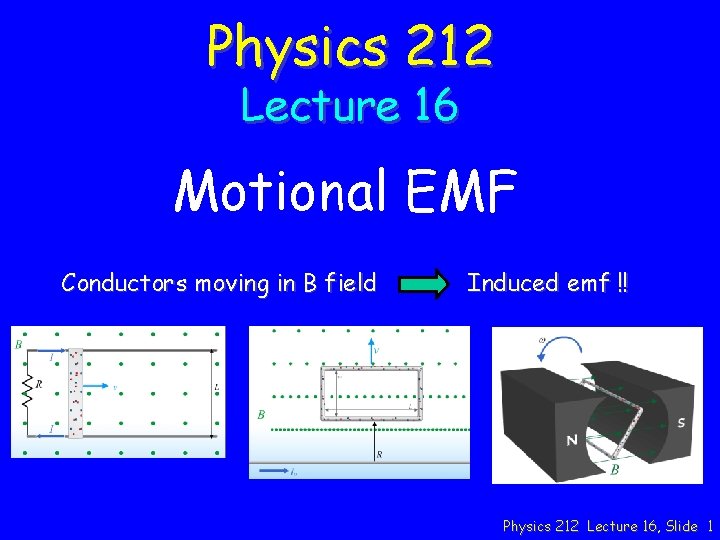
Physics 212 Lecture 16 Motional EMF Conductors moving in B field Induced emf !! Physics 212 Lecture 16, Slide 1
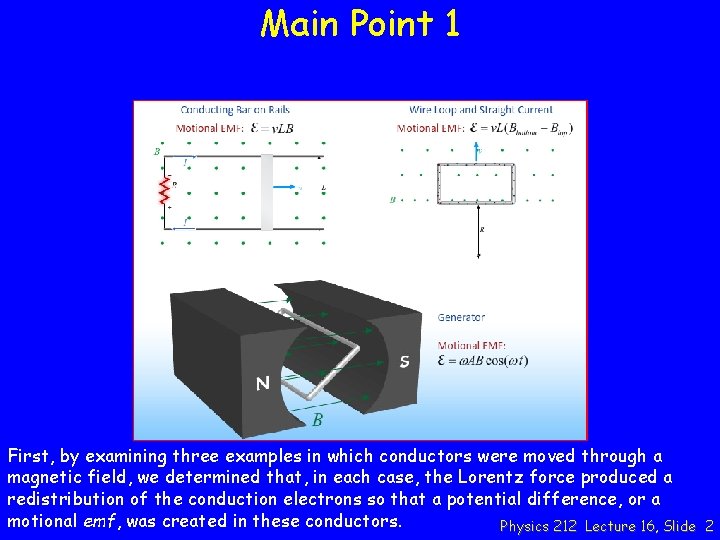
Main Point 1 First, by examining three examples in which conductors were moved through a magnetic field, we determined that, in each case, the Lorentz force produced a redistribution of the conduction electrons so that a potential difference, or a motional emf, was created in these conductors. Physics 212 Lecture 16, Slide 2
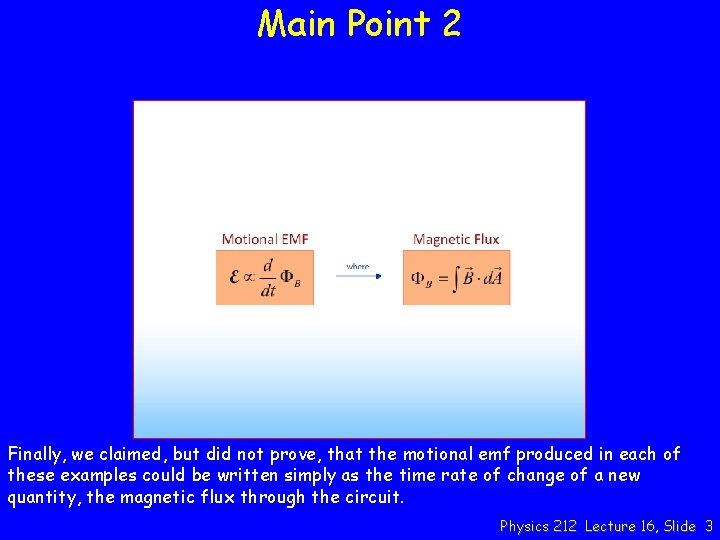
Main Point 2 Finally, we claimed, but did not prove, that the motional emf produced in each of these examples could be written simply as the time rate of change of a new quantity, the magnetic flux through the circuit. Physics 212 Lecture 16, Slide 3
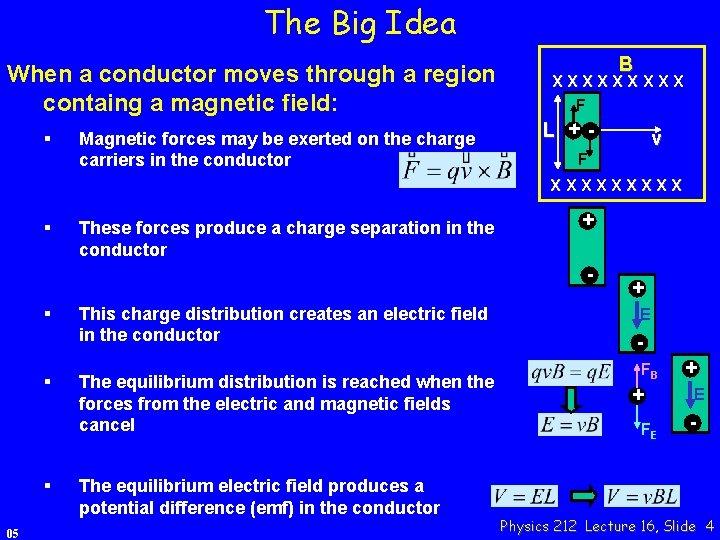
The Big Idea When a conductor moves through a region containg a magnetic field: § Magnetic forces may be exerted on the charge carriers in the conductor B XXXXX F L +- v F XXXXX § These forces produce a charge separation in the conductor + - § § § 05 This charge distribution creates an electric field in the conductor The equilibrium distribution is reached when the forces from the electric and magnetic fields cancel The equilibrium electric field produces a potential difference (emf) in the conductor + E FB + FE + E - Physics 212 Lecture 16, Slide 4
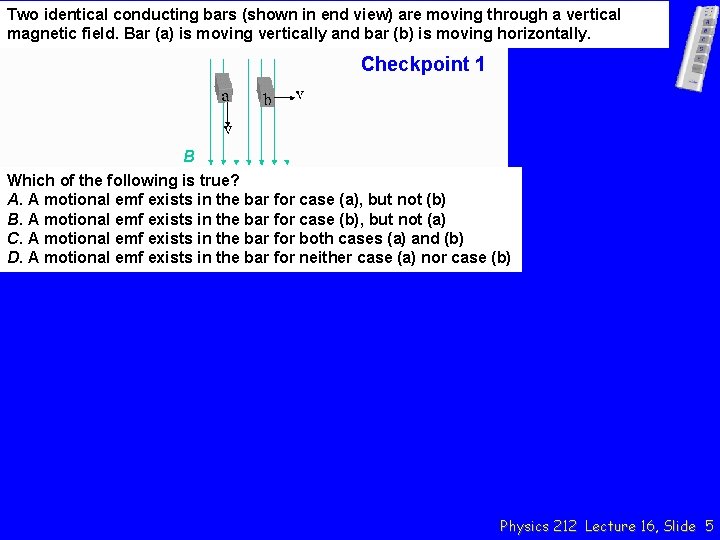
Two identical conducting bars (shown in end view) are moving through a vertical magnetic field. Bar (a) is moving vertically and bar (b) is moving horizontally. Checkpoint 1 B Which of the following is true? A. A A motional emf exists in the bar for case (a), but not (b) B A motional emf exists in the bar for case (b), but not (a) B. C A motional emf exists in the bar for both cases (a) and (b) C. D D. A motional emf exists in the bar for neither case (a) nor case (b) Physics 212 Lecture 16, Slide 5
Physics 212 Lecture 16, Slide 6
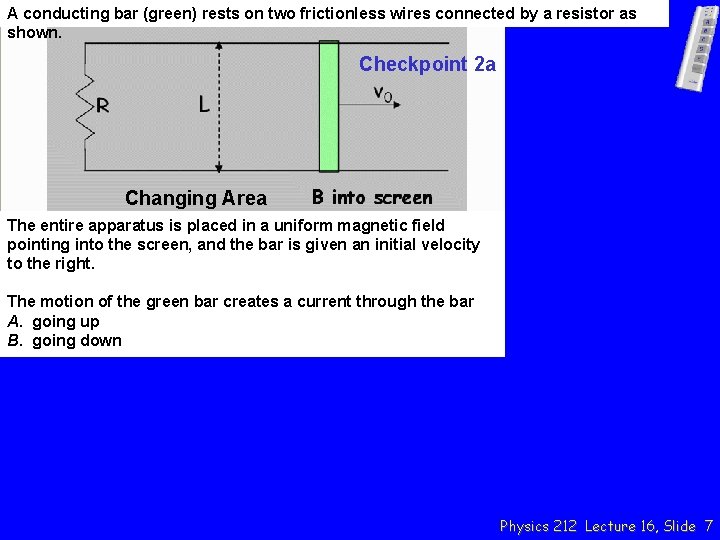
A conducting bar (green) rests on two frictionless wires connected by a resistor as shown. Checkpoint 2 a Changing Area A B The C entire apparatus is placed in a uniform magnetic field pointing into the screen, and the bar is given an initial velocity D to the right. Rotate picture by 90 o The motion of the green bar creates a current through the bar A going up A. B B. going down Physics 212 Lecture 16, Slide 7
Physics 212 Lecture 16, Slide 8
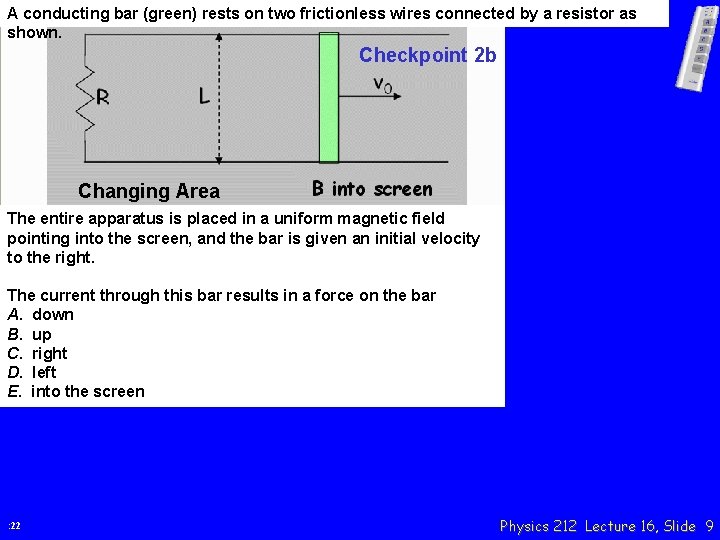
A conducting bar (green) rests on two frictionless wires connected by a resistor as shown. Checkpoint 2 b Changing Area A B The entire apparatus is placed in a uniform magnetic field C pointing into the screen, and the bar is given an initial velocity D to the right. The A current through this bar results in a force on the bar A. B down Preflight C up B. D C. E right D. left E. into the screen : 22 5 Physics 212 Lecture 16, Slide 9
Physics 212 Lecture 16, Slide 10
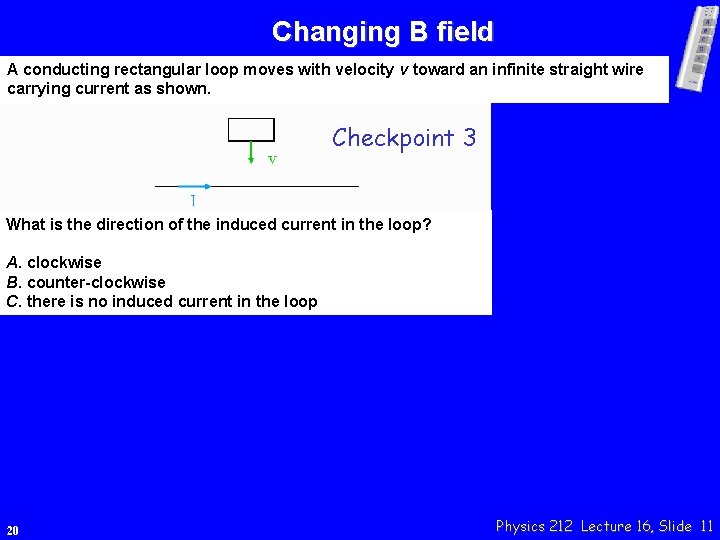
Changing B field A conducting rectangular loop moves with velocity v toward an infinite straight wire carrying current as shown. Checkpoint 3 What is the direction of the induced current in the loop? A. clockwise B. counter-clockwise C. there is no induced current in the loop 20 Physics 212 Lecture 16, Slide 11
Physics 212 Lecture 16, Slide 12
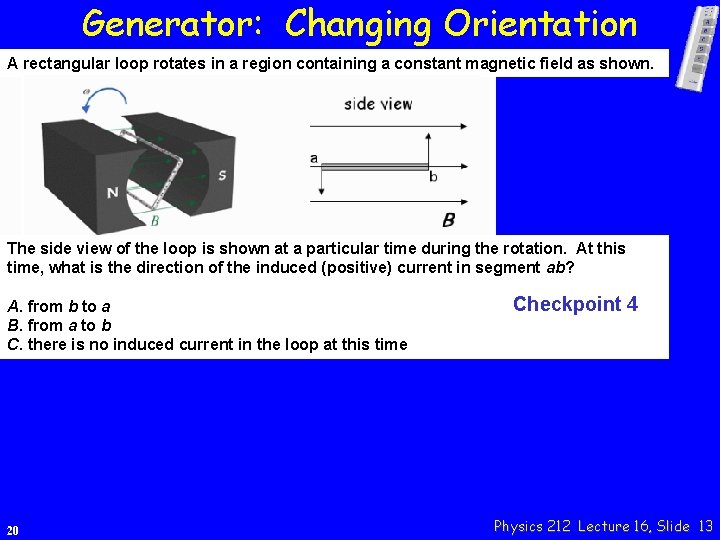
Generator: Changing Orientation A rectangular loop rotates in a region containing a constant magnetic field as shown. The side view of the loop is shown at a particular time during the rotation. At this time, what is the direction of the induced (positive) current in segment ab? A. from b to a B. from a to b C. there is no induced current in the loop at this time 20 Checkpoint 4 Physics 212 Lecture 16, Slide 13
Physics 212 Lecture 16, Slide 14
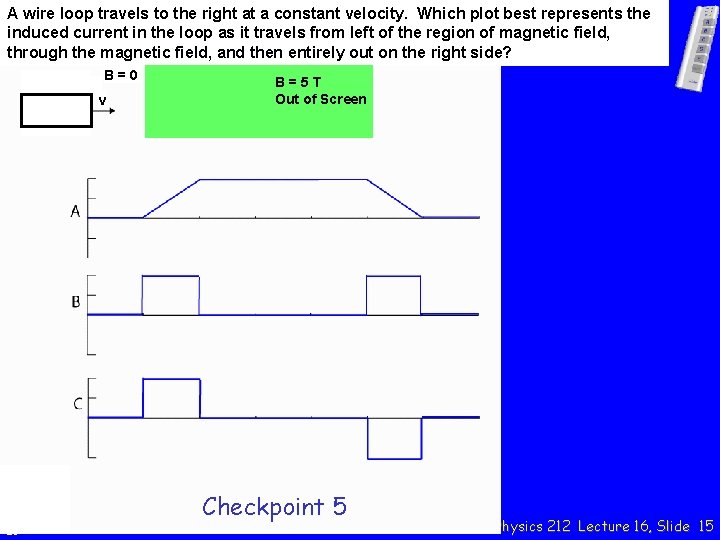
A wire loop travels to the right at a constant velocity. Which plot best represents the induced current in the loop as it travels from left of the region of magnetic field, through the magnetic field, and then entirely out on the right side? B=0 v B=5 T Out of Screen Checkpoint 5 20 Physics 212 Lecture 16, Slide 15
Physics 212 Lecture 16, Slide 16
Physics 212 Lecture 16, Slide 17
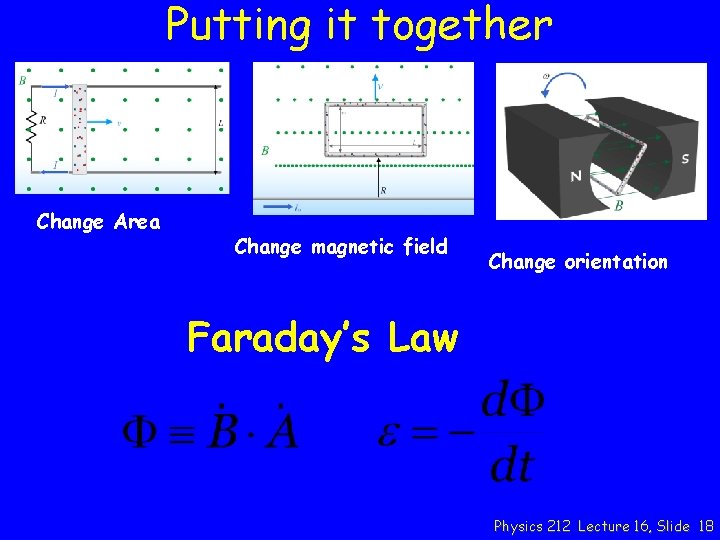
Putting it together Change Area Change magnetic field Change orientation Faraday’s Law Physics 212 Lecture 16, Slide 18
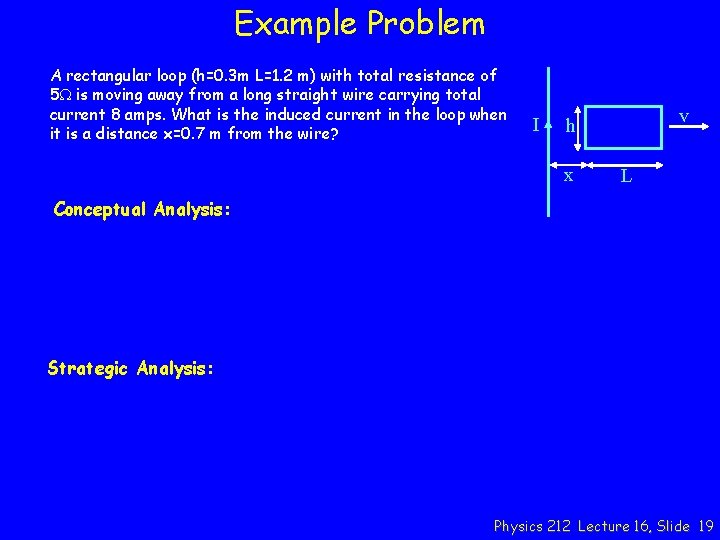
Example Problem A rectangular loop (h=0. 3 m L=1. 2 m) with total resistance of 5 W is moving away from a long straight wire carrying total current 8 amps. What is the induced current in the loop when it is a distance x=0. 7 m from the wire? I v h x L Conceptual Analysis: Strategic Analysis: Physics 212 Lecture 16, Slide 19
Physics 212 Lecture 16, Slide 20
Physics 212 Lecture 16, Slide 21
Physics 212 Lecture 16, Slide 22