
Physics 211 lecture 28 Sound Waves mechanical longitudinal

- Slides: 10
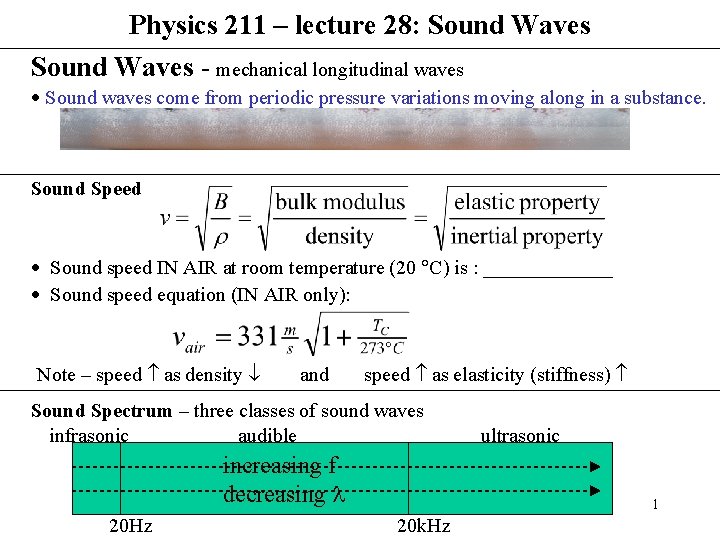
Physics 211 – lecture 28: Sound Waves - mechanical longitudinal waves · Sound waves come from periodic pressure variations moving along in a substance. Sound Speed · Sound speed IN AIR at room temperature (20 C) is : _______ · Sound speed equation (IN AIR only): Note – speed as density and speed as elasticity (stiffness) Sound Spectrum – three classes of sound waves infrasonic audible increasing f decreasing 20 Hz ultrasonic 1 20 k. Hz
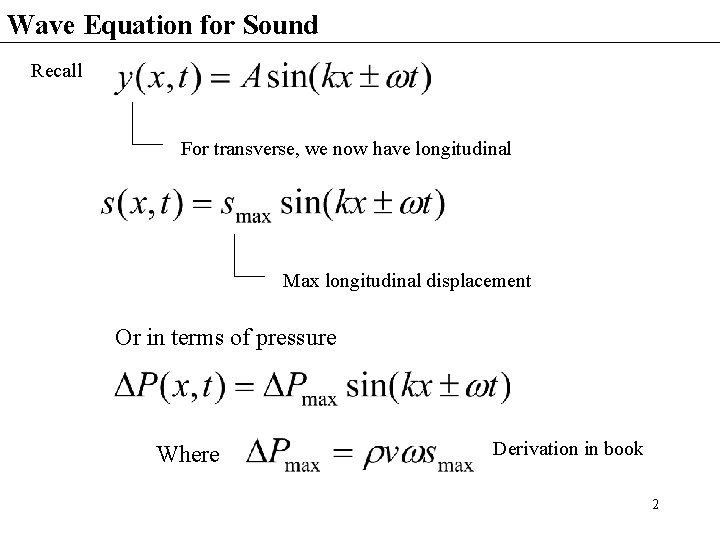
Wave Equation for Sound Recall For transverse, we now have longitudinal Max longitudinal displacement Or in terms of pressure Where Derivation in book 2
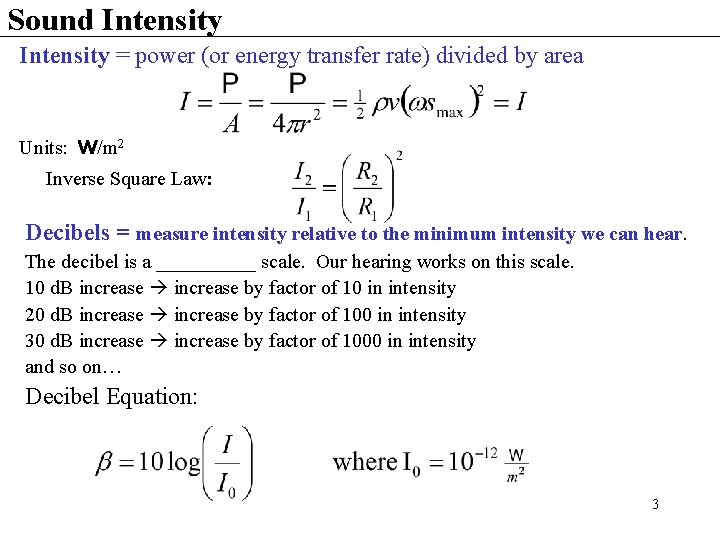
Sound Intensity = power (or energy transfer rate) divided by area Units: W/m 2 Inverse Square Law: Decibels = measure intensity relative to the minimum intensity we can hear. The decibel is a _____ scale. Our hearing works on this scale. 10 d. B increase by factor of 10 in intensity 20 d. B increase by factor of 100 in intensity 30 d. B increase by factor of 1000 in intensity and so on… Decibel Equation: 3
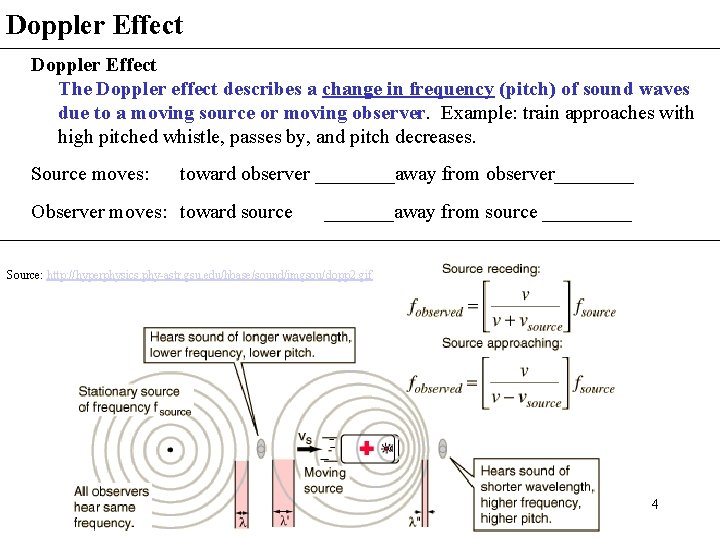
Doppler Effect The Doppler effect describes a change in frequency (pitch) of sound waves due to a moving source or moving observer. Example: train approaches with high pitched whistle, passes by, and pitch decreases. Source moves: toward observer ____away from observer____ Observer moves: toward source _______away from source _____ Source: http: //hyperphysics. phy-astr. gsu. edu/hbase/sound/imgsou/dopp 2. gif 4
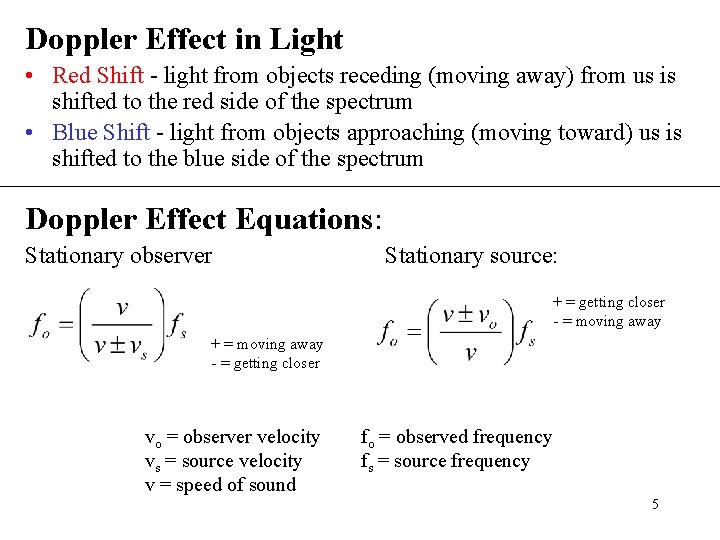
Doppler Effect in Light • Red Shift - light from objects receding (moving away) from us is shifted to the red side of the spectrum • Blue Shift - light from objects approaching (moving toward) us is shifted to the blue side of the spectrum Doppler Effect Equations: Stationary observer Stationary source: + = getting closer - = moving away + = moving away - = getting closer vo = observer velocity vs = source velocity v = speed of sound fo = observed frequency fs = source frequency 5
Example (Doppler Effect): A storm is formulating with winds of up to 150 km/hr. A Doppler radar device is monitoring the storm by sending out a 35 MHz signal? What frequency will bounce back to the station if the storm winds are A) approaching? B) receding ? Given Path Want Conversions/Equations Note: Storm is like observer moving toward storm. Then, it bounces back signals with same frequency it observed. 6
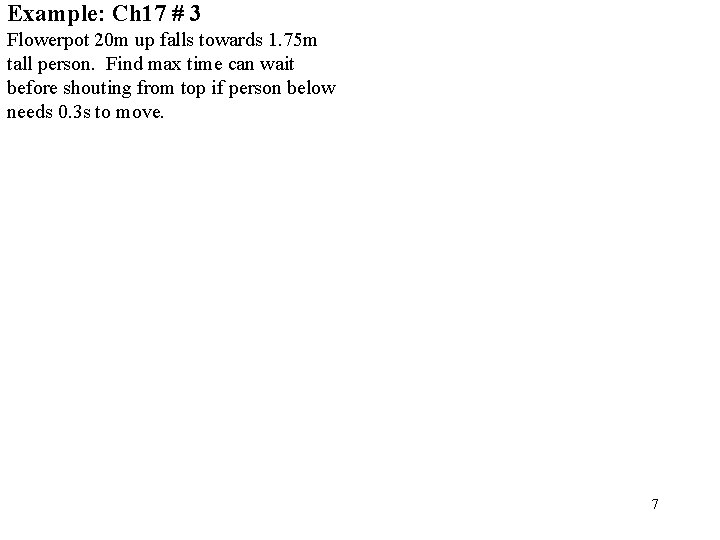
Example: Ch 17 # 3 Flowerpot 20 m up falls towards 1. 75 m tall person. Find max time can wait before shouting from top if person below needs 0. 3 s to move. 7
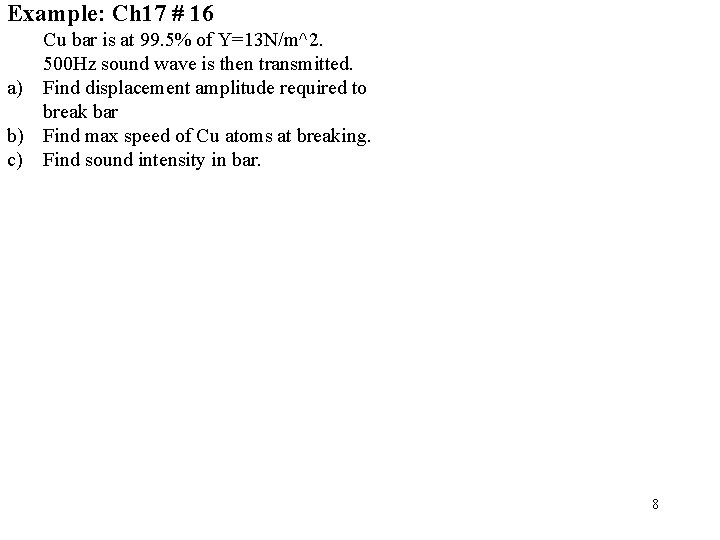
Example: Ch 17 # 16 Cu bar is at 99. 5% of Y=13 N/m^2. 500 Hz sound wave is then transmitted. a) Find displacement amplitude required to break bar b) Find max speed of Cu atoms at breaking. c) Find sound intensity in bar. 8
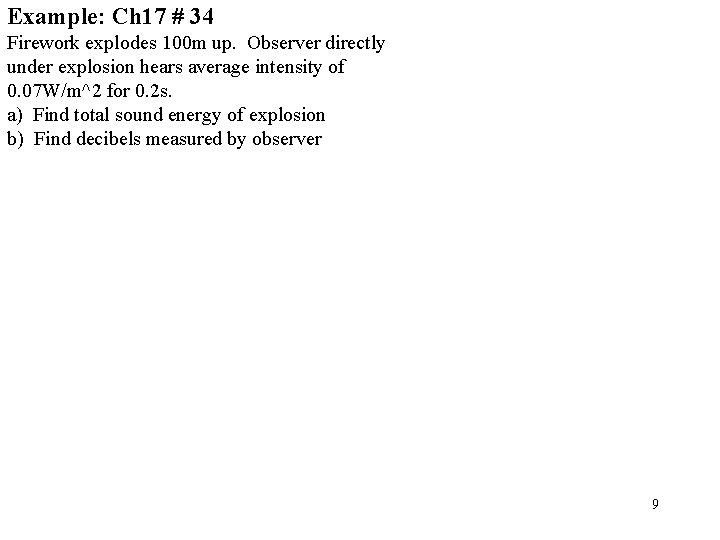
Example: Ch 17 # 34 Firework explodes 100 m up. Observer directly under explosion hears average intensity of 0. 07 W/m^2 for 0. 2 s. a) Find total sound energy of explosion b) Find decibels measured by observer 9
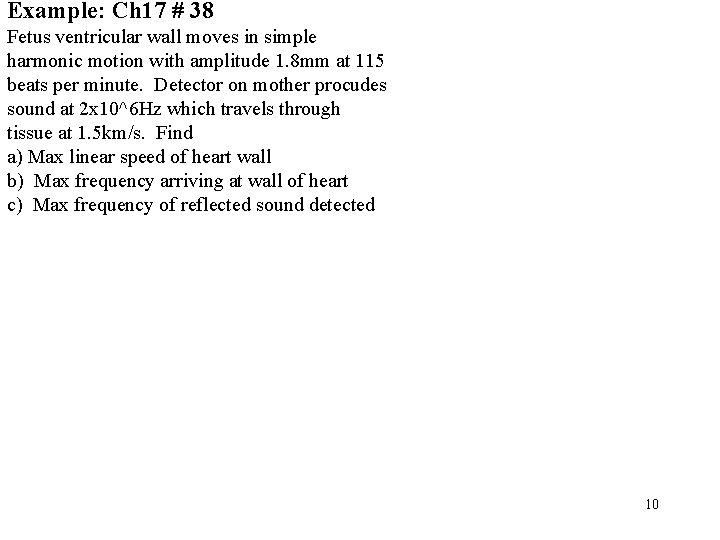
Example: Ch 17 # 38 Fetus ventricular wall moves in simple harmonic motion with amplitude 1. 8 mm at 115 beats per minute. Detector on mother procudes sound at 2 x 10^6 Hz which travels through tissue at 1. 5 km/s. Find a) Max linear speed of heart wall b) Max frequency arriving at wall of heart c) Max frequency of reflected sound detected 10