
Physics 211 4 Classical Mechanics Newtons Laws Force
![Measuring force Hookes Law for elastic materials F = -kd Restoring force = [constant]](https://slidetodoc.com/presentation_image_h2/26016cd900b9a6c8905edf683d170ffb/image-4.jpg "Measuring force Hookes Law for elastic materials F = -kd Restoring force = [constant]")
- Slides: 18
Physics 211 4: Classical Mechanics - Newtons Laws • Force and Equilibrium • Hookes Law • Newtons Laws • Weight • Friction • Free Body Diagrams • Force Problems
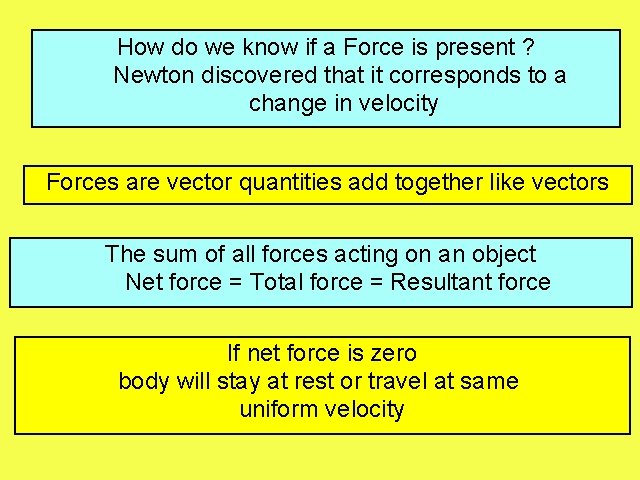
How do we know if a Force is present ? Newton discovered that it corresponds to a change in velocity Forces are vector quantities add together like vectors The sum of all forces acting on an object Net force = Total force = Resultant force If net force is zero body will stay at rest or travel at same uniform velocity
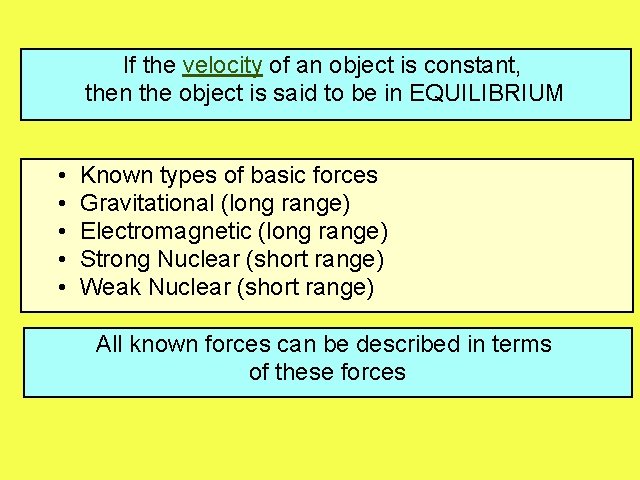
If the velocity of an object is constant, then the object is said to be in EQUILIBRIUM • • • Known types of basic forces Gravitational (long range) Electromagnetic (long range) Strong Nuclear (short range) Weak Nuclear (short range) All known forces can be described in terms of these forces
Measuring force Hookes Law for elastic materials F = -kd Restoring force = [constant] X [displacement from equilibrium position] The magnitude of the force exerted on an elastic object is equal to the restoring force (when equilibrium is reached) thus proportional to the displacement d
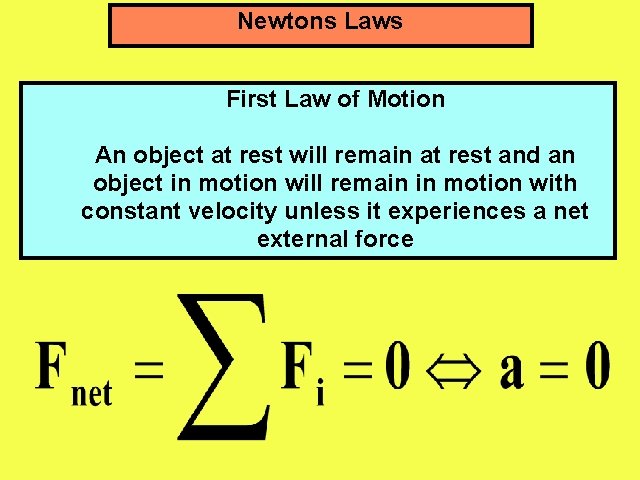
Newtons Laws First Law of Motion An object at rest will remain at rest and an object in motion will remain in motion with constant velocity unless it experiences a net external force
Inertial reference frame • An inertial frame of reference is one in which an object, subject to no force, moves with constant velocity. • A reference frame in which Newtons first law is valid is an inertial frame of reference.
• Can identify inertial frames of reference with coordinate systems moving with constant velocity • If one finds one such frame, then all frames moving with constant velocity with respect to this one are also inertial frames of reference • Non inertial frames are ones that are accelerating • In such frames we observe fictitious forces
Inertial mass • If you attempt to change state of motion of an object, the object will resist this change • This is a consequence of inertia • Mass is a measure of inertia Gravitational mass • Objects with mass exert gravitational forces on each other • The gravitational force exerted by a celestial body (earth, moon, sun etc) on an object on (or near) its surface is called the WEIGHT of the object
the magnitude of the weight force is proportional to the (gravitational) mass of the object and the celestial body mass measured through the effects of gravity agrees with mass measured through the effects of other forces mass of an object does not depend on its position or relation to other objects weight of an object does The force of gravity acts at the center of mass of an object
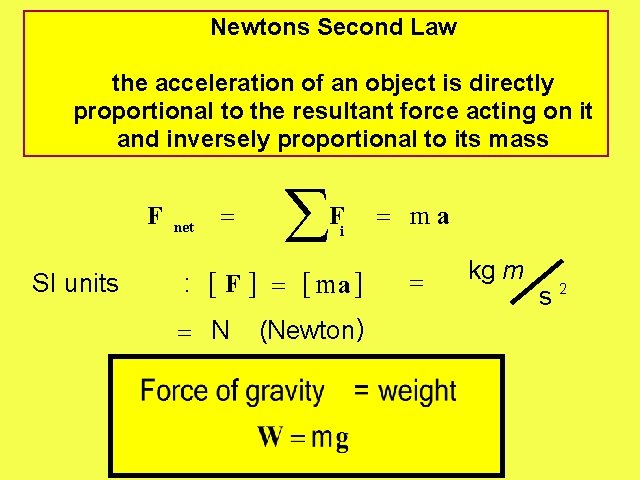
Newtons Second Law the acceleration of an object is directly proportional to the resultant force acting on it and inversely proportional to its mass F SI units net = å Fi : [ F ] = [ ma ] = N (Newton) = ma = kg m s 2
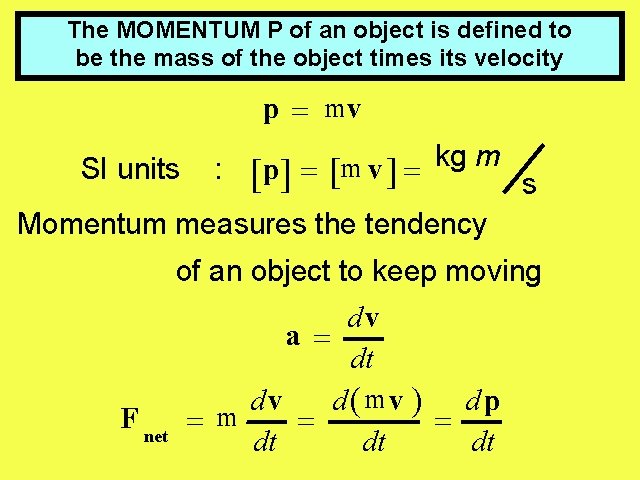
The MOMENTUM P of an object is defined to be the mass of the object times its velocity p = mv kg m m p v = = [ ] s Momentum measures the tendency SI units : of an object to keep moving F net dv a = dt dv d( mv ) dp = m = = dt dt dt
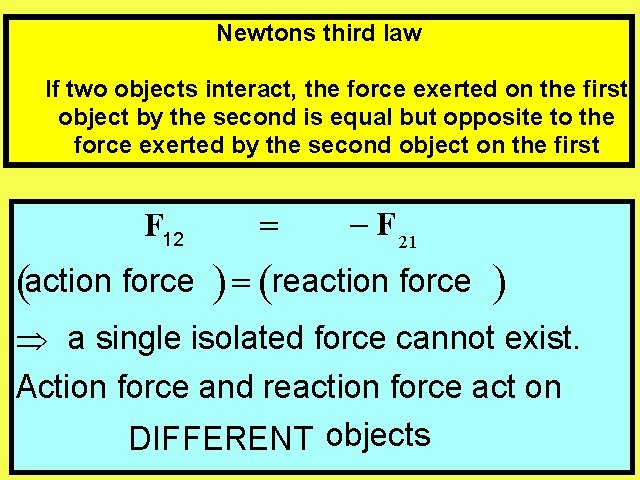
Newtons third law If two objects interact, the force exerted on the first object by the second is equal but opposite to the force exerted by the second object on the first F 12 = - F 21 (action force ) = (reaction force ) Þ a single isolated force cannot exist. Action force and reaction force act on DIFFERENT objects
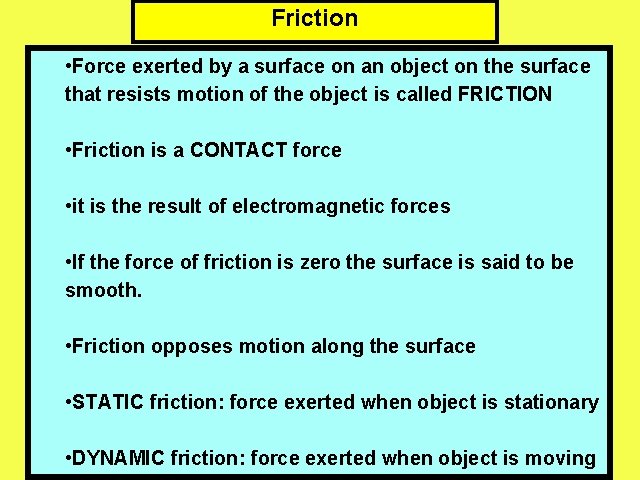
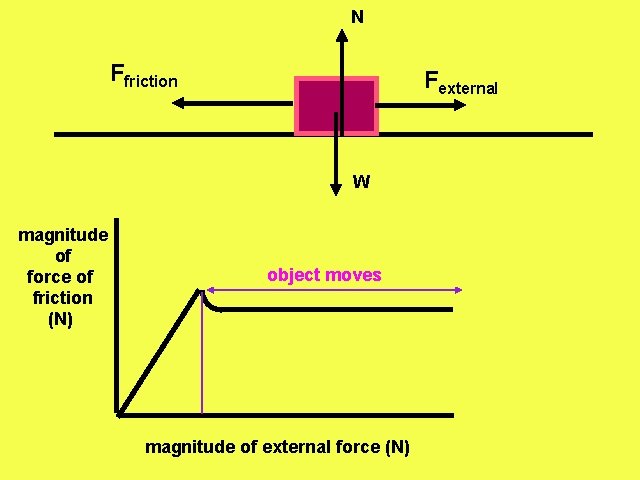
Friction • Force exerted by a surface on an object on the surface that resists motion of the object is called FRICTION • Friction is a CONTACT force • it is the result of electromagnetic forces • If the force of friction is zero the surface is said to be smooth. • Friction opposes motion along the surface • STATIC friction: force exerted when object is stationary • DYNAMIC friction: force exerted when object is moving
N Ffriction Fexternal W magnitude of force of friction (N) object moves magnitude of external force (N)
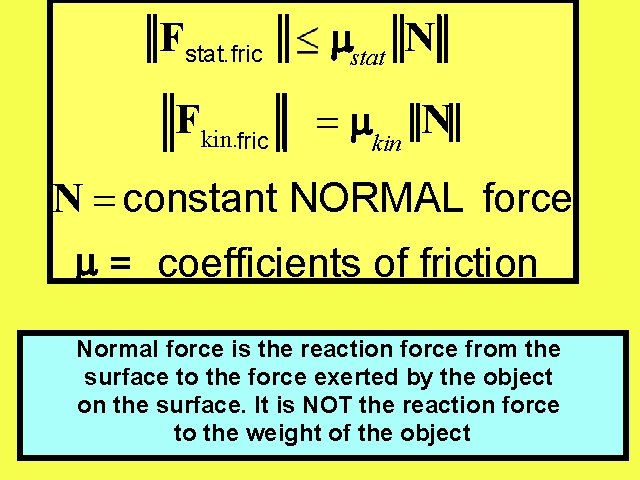
F stat. fric mstat N F kin. fric = mkin N N = constant NORMAL force m = coefficients of friction Normal force is the reaction force from the surface to the force exerted by the object on the surface. It is NOT the reaction force to the weight of the object
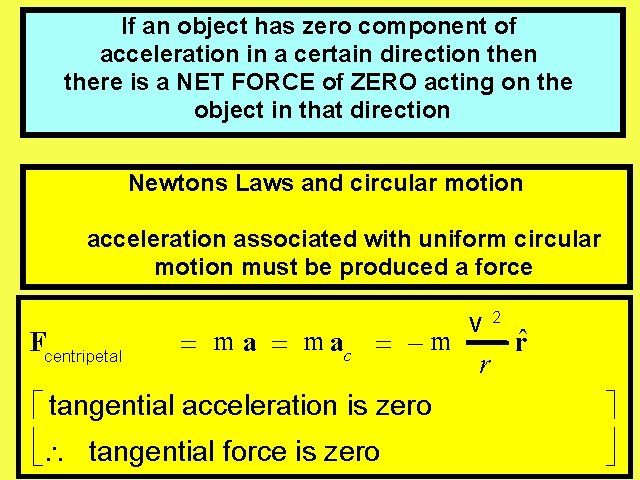
If an object has zero component of acceleration in a certain direction there is a NET FORCE of ZERO acting on the object in that direction Newtons Laws and circular motion acceleration associated with uniform circular motion must be produced a force v 2 Fcentripetal rˆ = m ac = - m r é tangential acceleration is zero êë tangential force is zero ù úû
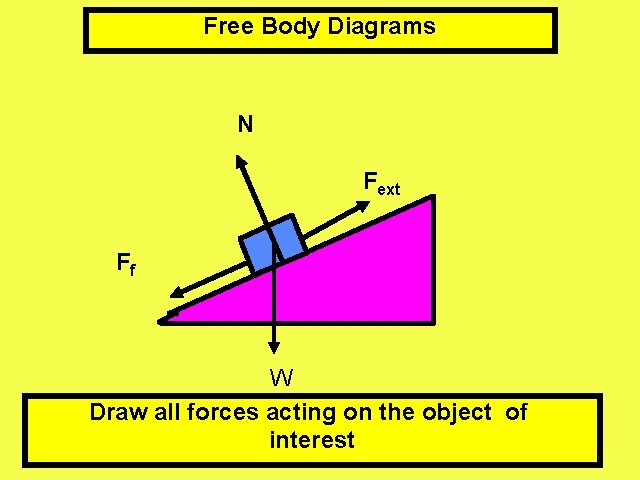
Free Body Diagrams N Fext Ff W Draw all forces acting on the object of interest
If the object is stationary then the total net force on the object MUST be zero Thus the components of the net force in any direction must be zero If the objects velocity in one direction does not change then the net force in that direction is zero