
Physics 2102 Gabriela Gonzlez Physics 2102 Capacitors Summary
Physics 2102 Gabriela González Physics 2102 Capacitors
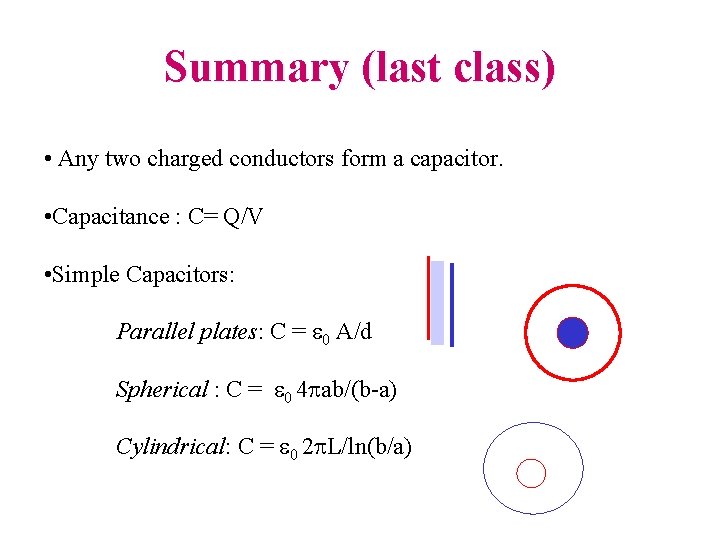
Summary (last class) • Any two charged conductors form a capacitor. • Capacitance : C= Q/V • Simple Capacitors: Parallel plates: C = 0 A/d Spherical : C = 0 4 pab/(b-a) Cylindrical: C = 0 2 p. L/ln(b/a)
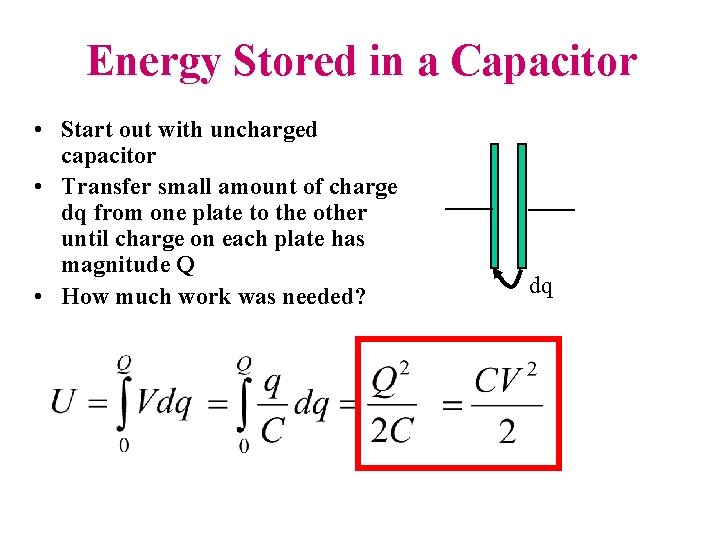
Energy Stored in a Capacitor • Start out with uncharged capacitor • Transfer small amount of charge dq from one plate to the other until charge on each plate has magnitude Q • How much work was needed? dq
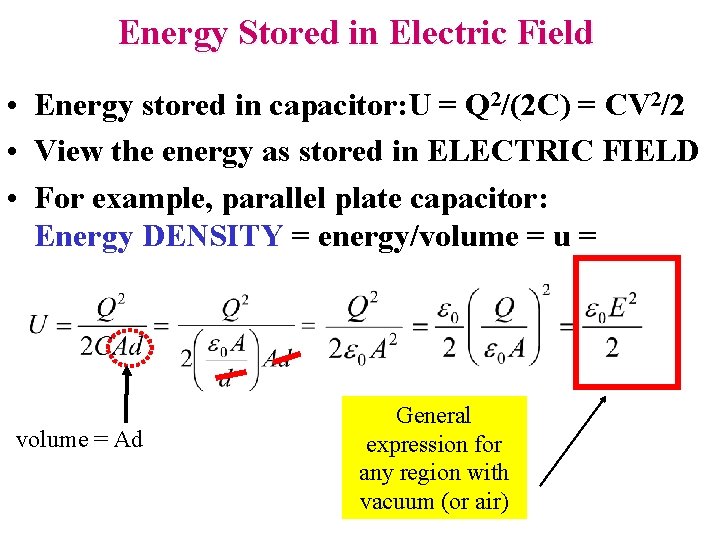
Energy Stored in Electric Field • Energy stored in capacitor: U = Q 2/(2 C) = CV 2/2 • View the energy as stored in ELECTRIC FIELD • For example, parallel plate capacitor: Energy DENSITY = energy/volume = u = volume = Ad General expression for any region with vacuum (or air)
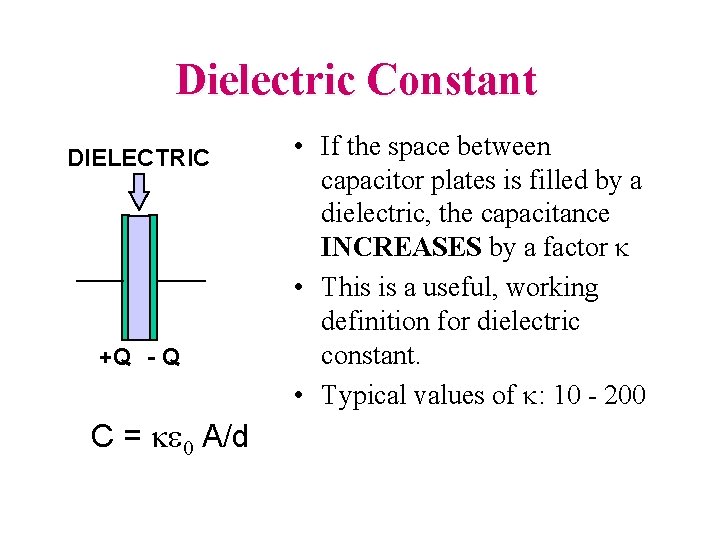
Dielectric Constant DIELECTRIC +Q - Q C = A/d • If the space between capacitor plates is filled by a dielectric, the capacitance INCREASES by a factor • This is a useful, working definition for dielectric constant. • Typical values of : 10 - 200
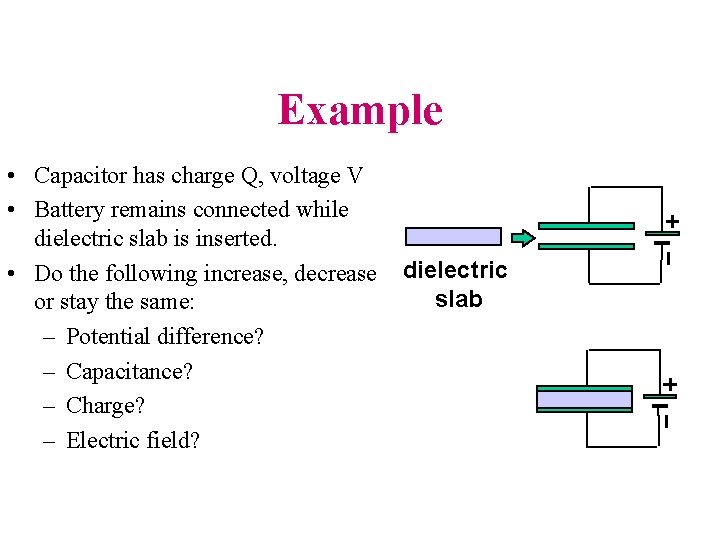
Example • Capacitor has charge Q, voltage V • Battery remains connected while dielectric slab is inserted. • Do the following increase, decrease or stay the same: – Potential difference? – Capacitance? – Charge? – Electric field? dielectric slab
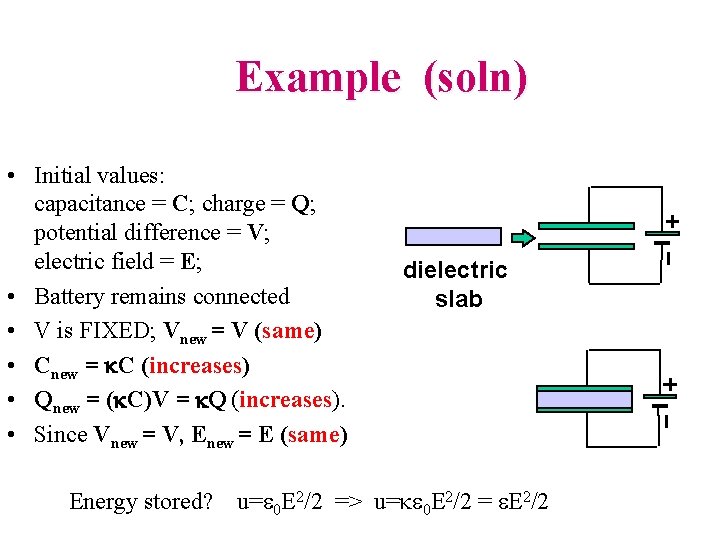
Example (soln) • Initial values: capacitance = C; charge = Q; potential difference = V; electric field = E; • Battery remains connected • V is FIXED; Vnew = V (same) • Cnew = k. C (increases) • Qnew = (k. C)V = k. Q (increases). • Since Vnew = V, Enew = E (same) Energy stored? dielectric slab u= 0 E 2/2 => u= 0 E 2/2 = E 2/2
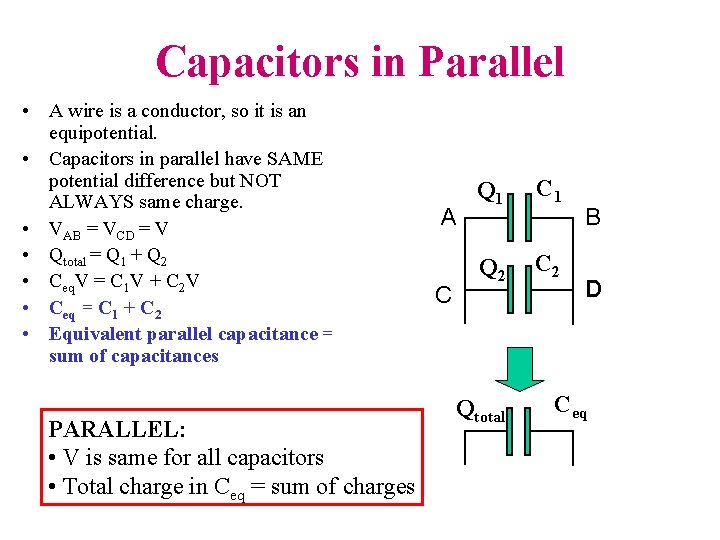
Capacitors in Parallel • A wire is a conductor, so it is an equipotential. • Capacitors in parallel have SAME potential difference but NOT ALWAYS same charge. • VAB = VCD = V • Qtotal = Q 1 + Q 2 • Ceq. V = C 1 V + C 2 V • Ceq = C 1 + C 2 • Equivalent parallel capacitance = sum of capacitances PARALLEL: • V is same for all capacitors • Total charge in Ceq = sum of charges A C Q 1 C 1 Q 2 C 2 Qtotal B D Ceq
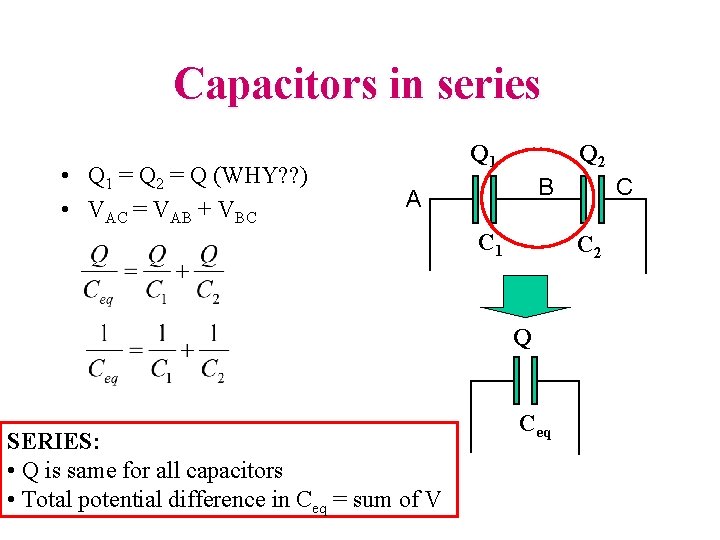
Capacitors in series • Q 1 = Q 2 = Q (WHY? ? ) • VAC = VAB + VBC Q 1 Q 2 B A C 1 C 2 Q SERIES: • Q is same for all capacitors • Total potential difference in Ceq = sum of V C Ceq
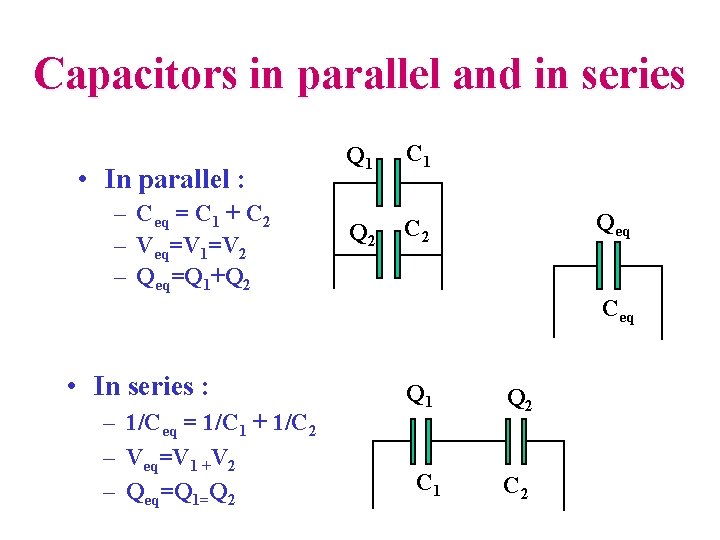
Capacitors in parallel and in series • In parallel : – Ceq = C 1 + C 2 – Veq=V 1=V 2 – Qeq=Q 1+Q 2 Q 1 C 1 Q 2 C 2 Qeq Ceq • In series : – 1/Ceq = 1/C 1 + 1/C 2 – Veq=V 1 +V 2 – Qeq=Q 1=Q 2 Q 1 C 1 Q 2 C 2
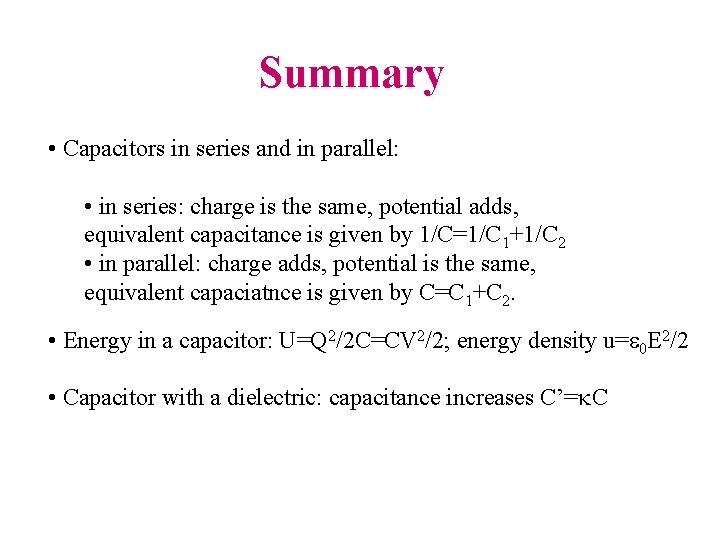
Summary • Capacitors in series and in parallel: • in series: charge is the same, potential adds, equivalent capacitance is given by 1/C=1/C 1+1/C 2 • in parallel: charge adds, potential is the same, equivalent capaciatnce is given by C=C 1+C 2. • Energy in a capacitor: U=Q 2/2 C=CV 2/2; energy density u= 0 E 2/2 • Capacitor with a dielectric: capacitance increases C’= C
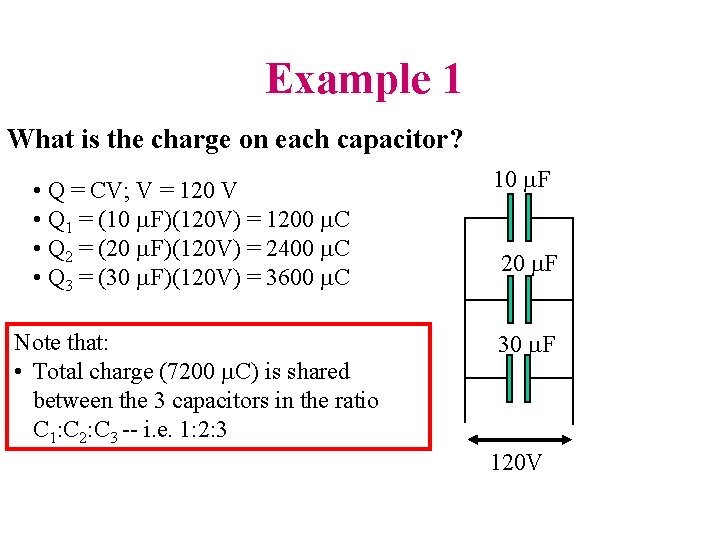
Example 1 What is the charge on each capacitor? • Q = CV; V = 120 V • Q 1 = (10 m. F)(120 V) = 1200 m. C • Q 2 = (20 m. F)(120 V) = 2400 m. C • Q 3 = (30 m. F)(120 V) = 3600 m. C Note that: • Total charge (7200 m. C) is shared between the 3 capacitors in the ratio C 1: C 2: C 3 -- i. e. 1: 2: 3 10 m. F 20 m. F 30 m. F 120 V
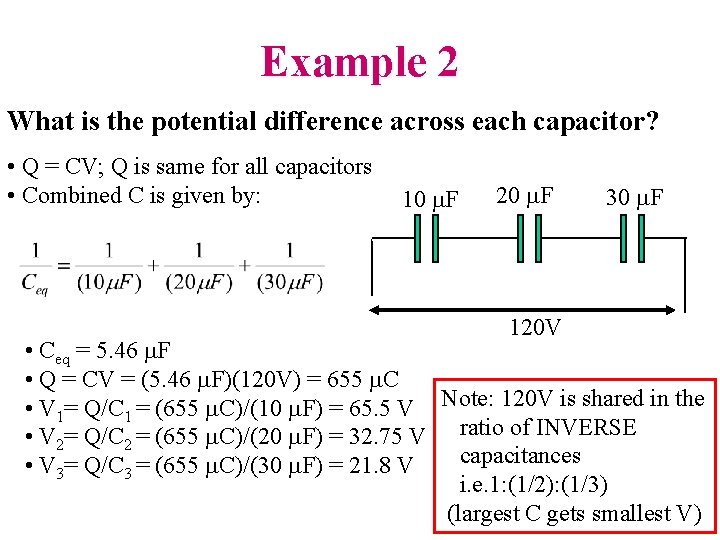
Example 2 What is the potential difference across each capacitor? • Q = CV; Q is same for all capacitors • Combined C is given by: 10 m. F 20 m. F 120 V 30 m. F • Ceq = 5. 46 m. F • Q = CV = (5. 46 m. F)(120 V) = 655 m. C • V 1= Q/C 1 = (655 m. C)/(10 m. F) = 65. 5 V Note: 120 V is shared in the • V 2= Q/C 2 = (655 m. C)/(20 m. F) = 32. 75 V ratio of INVERSE capacitances • V 3= Q/C 3 = (655 m. C)/(30 m. F) = 21. 8 V i. e. 1: (1/2): (1/3) (largest C gets smallest V)
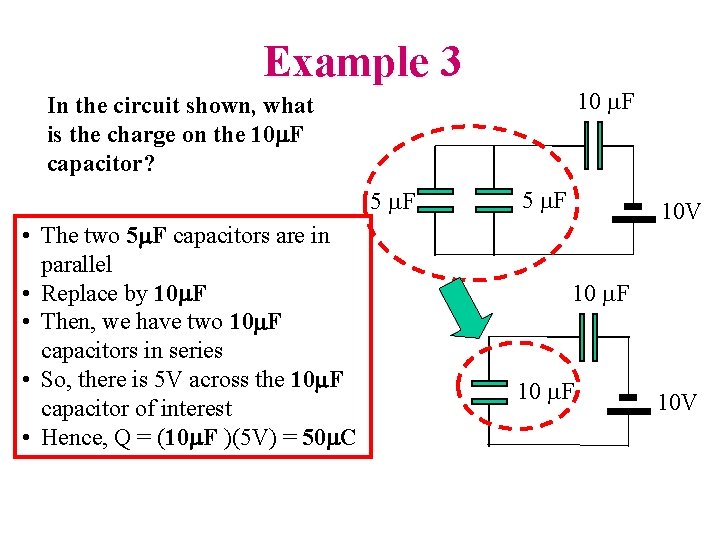
Example 3 10 m. F In the circuit shown, what is the charge on the 10 F capacitor? 5 m. F • The two 5 F capacitors are in parallel • Replace by 10 F • Then, we have two 10 F capacitors in series • So, there is 5 V across the 10 F capacitor of interest • Hence, Q = (10 F )(5 V) = 50 C 5 m. F 10 V 10 m. F 10 V
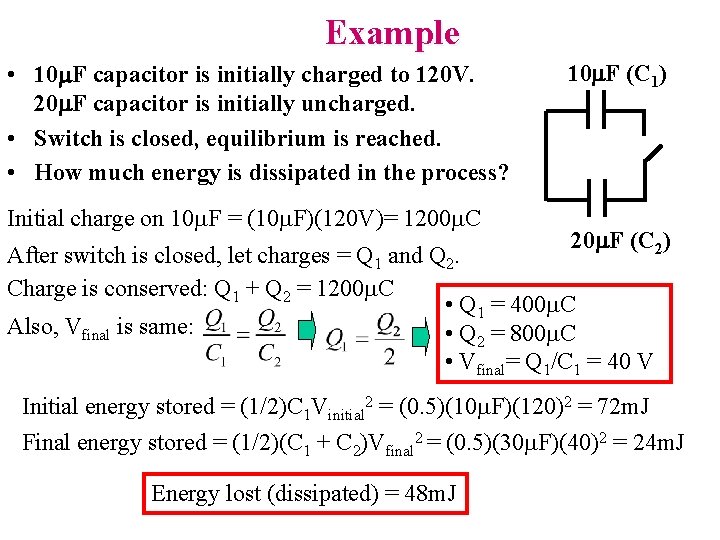
Example • 10 F capacitor is initially charged to 120 V. 20 F capacitor is initially uncharged. • Switch is closed, equilibrium is reached. • How much energy is dissipated in the process? Initial charge on 10 m. F = (10 m. F)(120 V)= 1200 m. C 10 F (C 1) 20 F (C 2) After switch is closed, let charges = Q 1 and Q 2. Charge is conserved: Q 1 + Q 2 = 1200 m. C • Q 1 = 400 m. C Also, Vfinal is same: • Q 2 = 800 m. C • Vfinal= Q 1/C 1 = 40 V Initial energy stored = (1/2)C 1 Vinitial 2 = (0. 5)(10 m. F)(120)2 = 72 m. J Final energy stored = (1/2)(C 1 + C 2)Vfinal 2 = (0. 5)(30 m. F)(40)2 = 24 m. J Energy lost (dissipated) = 48 m. J
Physics 2102 Gabriela González Physics 2102 Current and resistance Georg Simon Ohm (1789 -1854)
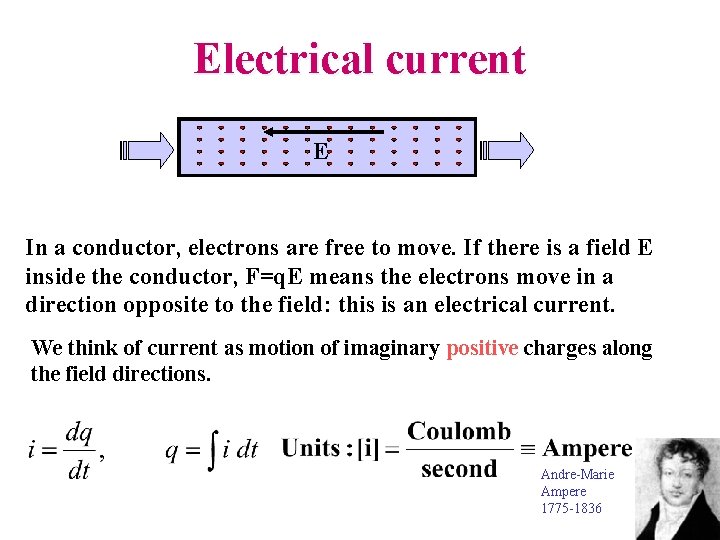
Electrical current E In a conductor, electrons are free to move. If there is a field E inside the conductor, F=q. E means the electrons move in a direction opposite to the field: this is an electrical current. We think of current as motion of imaginary positive charges along the field directions. Andre-Marie Ampere 1775 -1836
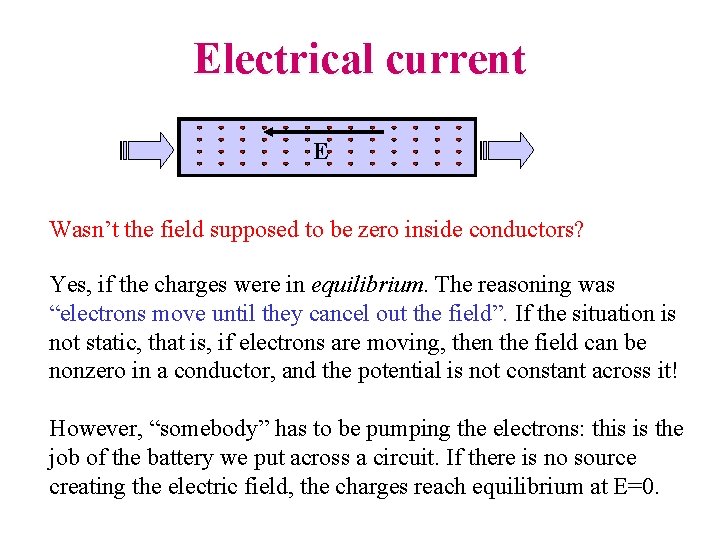
Electrical current E Wasn’t the field supposed to be zero inside conductors? Yes, if the charges were in equilibrium. The reasoning was “electrons move until they cancel out the field”. If the situation is not static, that is, if electrons are moving, then the field can be nonzero in a conductor, and the potential is not constant across it! However, “somebody” has to be pumping the electrons: this is the job of the battery we put across a circuit. If there is no source creating the electric field, the charges reach equilibrium at E=0.
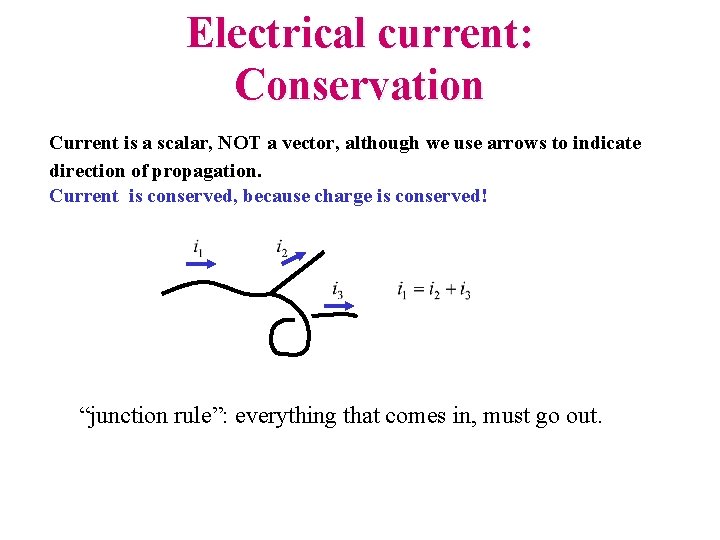
Electrical current: Conservation Current is a scalar, NOT a vector, although we use arrows to indicate direction of propagation. Current is conserved, because charge is conserved! “junction rule”: everything that comes in, must go out.
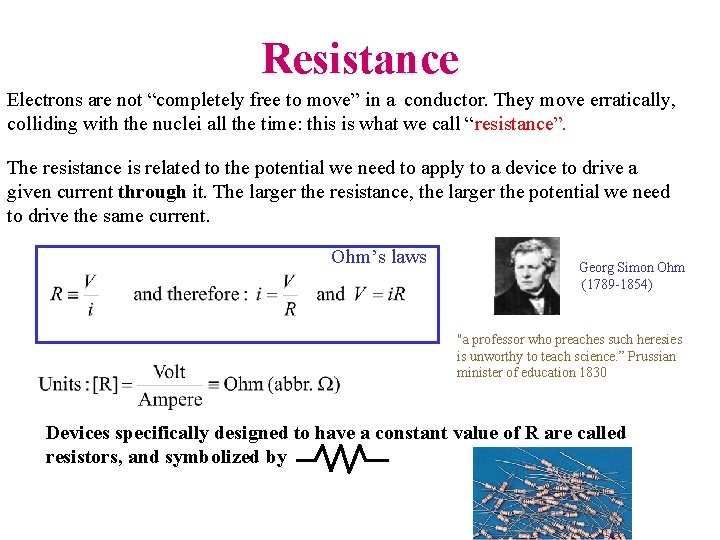
Resistance Electrons are not “completely free to move” in a conductor. They move erratically, colliding with the nuclei all the time: this is what we call “resistance”. The resistance is related to the potential we need to apply to a device to drive a given current through it. The larger the resistance, the larger the potential we need to drive the same current. Ohm’s laws Georg Simon Ohm (1789 -1854) "a professor who preaches such heresies is unworthy to teach science. ” Prussian minister of education 1830 Devices specifically designed to have a constant value of R are called resistors, and symbolized by
- Slides: 20