
Physics 2 6 Demonstrate understanding of electricity and
- Slides: 41
Physics 2. 6 Demonstrate understanding of electricity and electromagnetism Credits 6 This achievement standard involves knowledge and understanding of phenomena, concepts, principles, and relationships related to electricity and electromagnetism, and the use of appropriate methods to solve related problems.
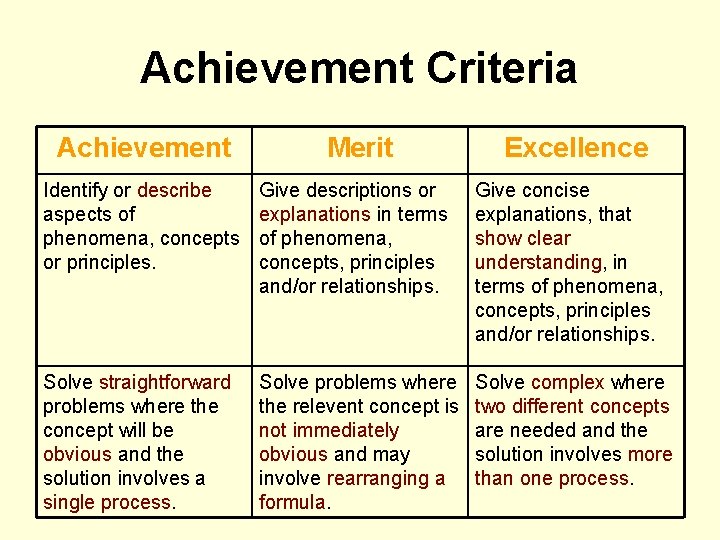
Achievement Criteria Achievement Merit Excellence Identify or describe aspects of phenomena, concepts or principles. Give descriptions or explanations in terms of phenomena, concepts, principles and/or relationships. Give concise explanations, that show clear understanding, in terms of phenomena, concepts, principles and/or relationships. Solve straightforward problems where the concept will be obvious and the solution involves a single process. Solve problems where the relevent concept is not immediately obvious and may involve rearranging a formula. Solve complex where two different concepts are needed and the solution involves more than one process.
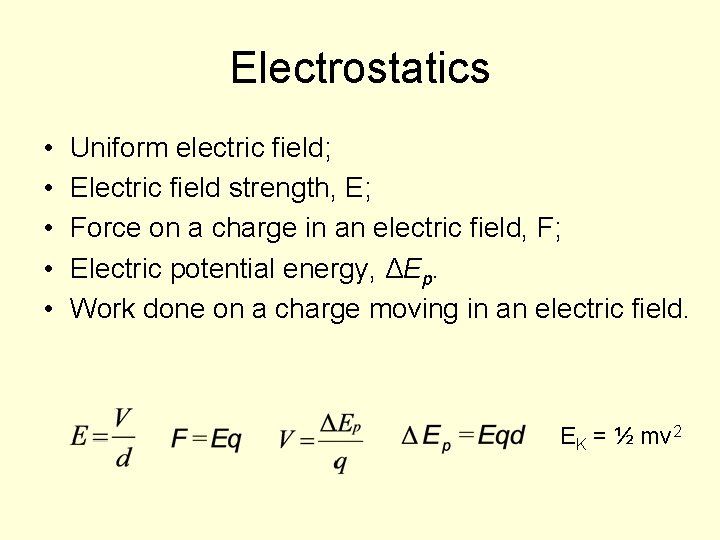
Electrostatics • • • Uniform electric field; Electric field strength, E; Force on a charge in an electric field, F; Electric potential energy, ΔEp. Work done on a charge moving in an electric field. EK = ½ mv 2
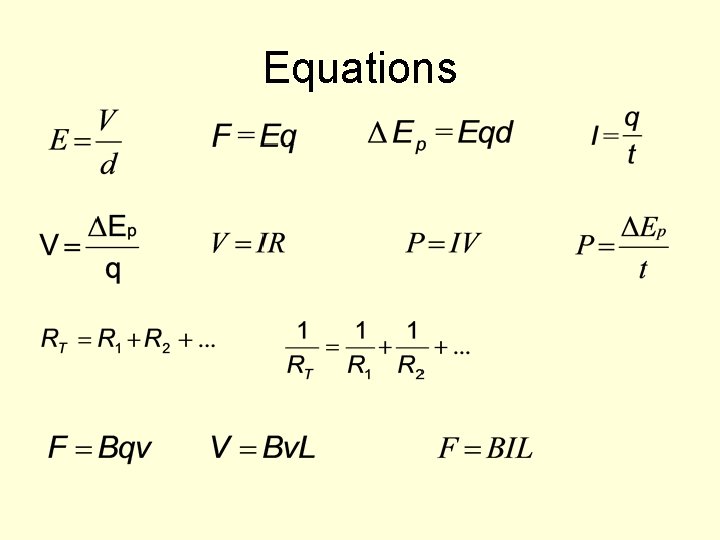
Equations
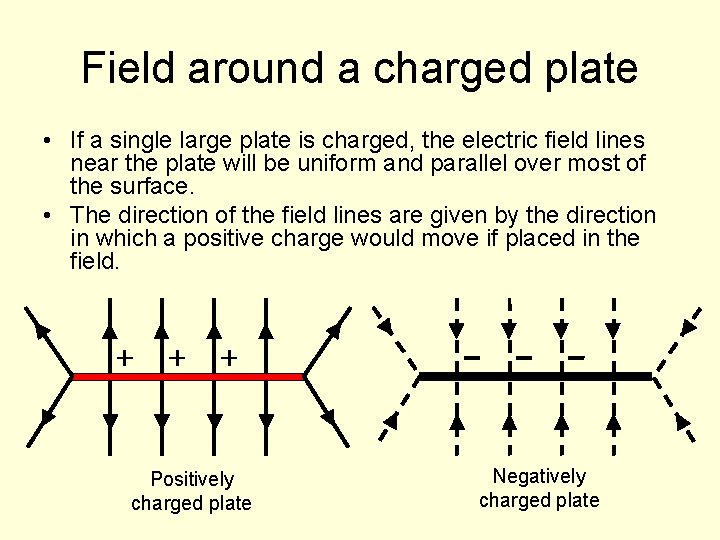
Field around a charged plate • If a single large plate is charged, the electric field lines near the plate will be uniform and parallel over most of the surface. • The direction of the field lines are given by the direction in which a positive charge would move if placed in the field. Positively charged plate Negatively charged plate
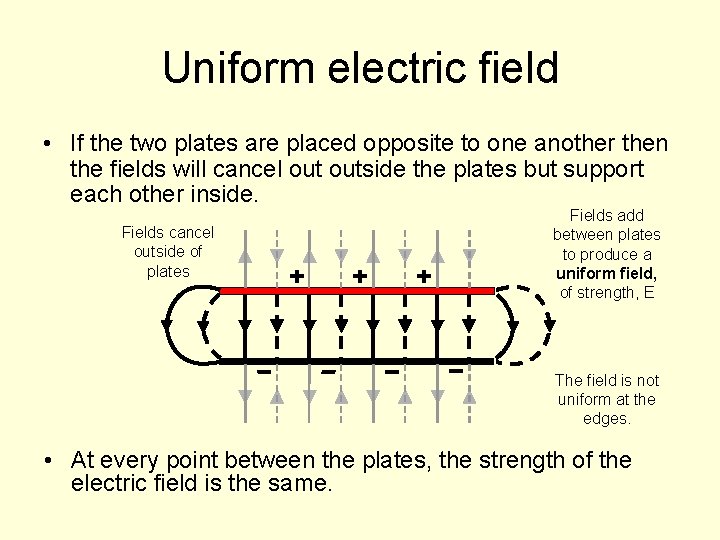
Uniform electric field • If the two plates are placed opposite to one another then the fields will cancel outside the plates but support each other inside. Fields cancel outside of plates Fields add between plates to produce a uniform field, of strength, E The field is not uniform at the edges. • At every point between the plates, the strength of the electric field is the same.
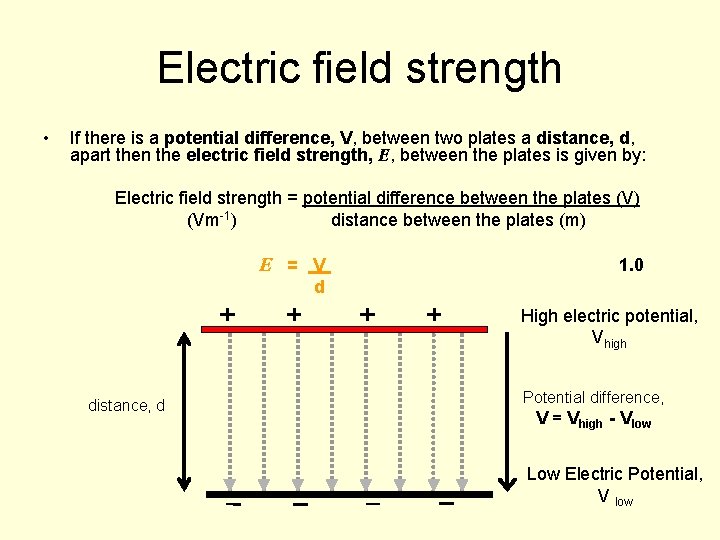
Electric field strength • If there is a potential difference, V, between two plates a distance, d, apart then the electric field strength, E, between the plates is given by: Electric field strength = potential difference between the plates (V) (Vm-1) distance between the plates (m) E = V 1. 0 d High electric potential, Vhigh distance, d Potential difference, V = Vhigh - Vlow Low Electric Potential, V low
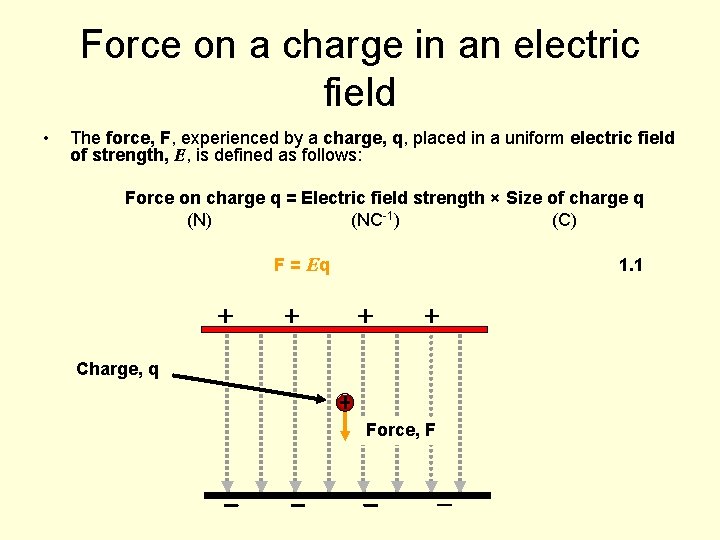
Force on a charge in an electric field • The force, F, experienced by a charge, q, placed in a uniform electric field of strength, E, is defined as follows: Force on charge q = Electric field strength × Size of charge q (N) (NC-1) (C) F = Eq 1. 1 Charge, q Force, F
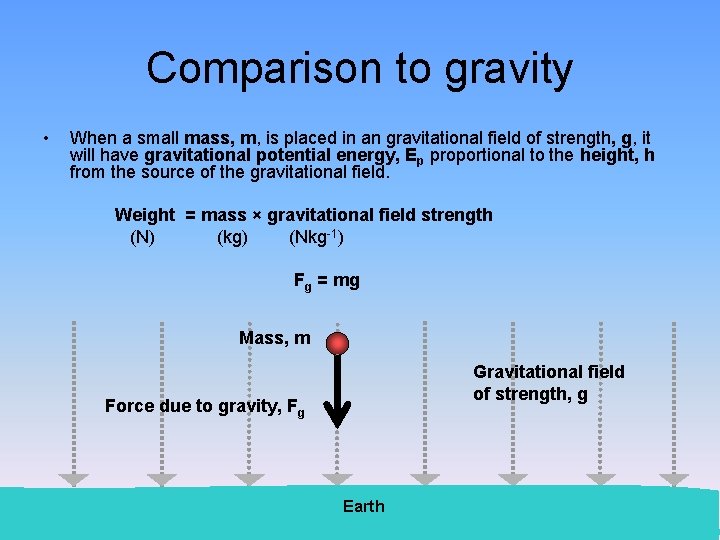
Comparison to gravity • When a small mass, m, is placed in an gravitational field of strength, g, it will have gravitational potential energy, Ep proportional to the height, h from the source of the gravitational field. Weight = mass × gravitational field strength (N) (kg) (Nkg-1) Fg = mg Mass, m Gravitational field of strength, g Force due to gravity, Fg Earth
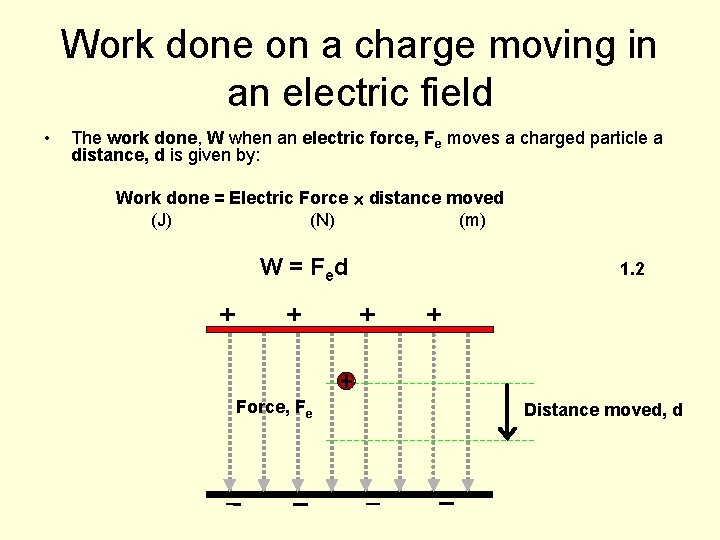
Work done on a charge moving in an electric field • The work done, W when an electric force, Fe moves a charged particle a distance, d is given by: Work done = Electric Force distance moved (J) (N) (m) W = F ed Force, Fe 1. 2 Distance moved, d
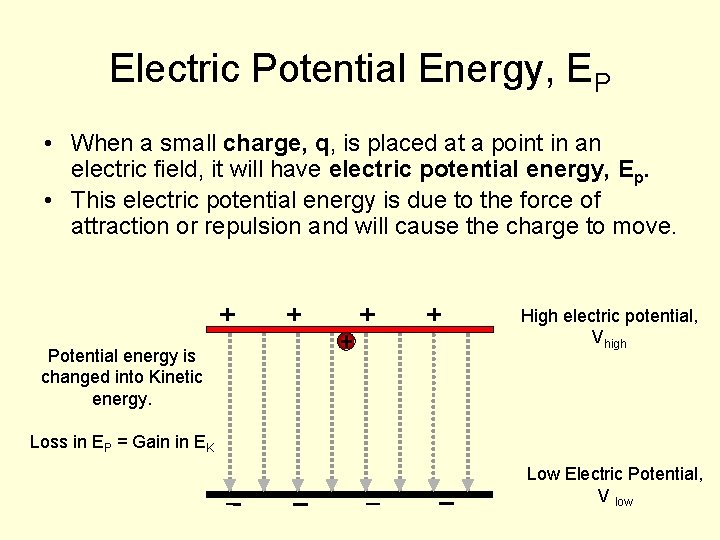
Electric Potential Energy, EP • When a small charge, q, is placed at a point in an electric field, it will have electric potential energy, Ep. • This electric potential energy is due to the force of attraction or repulsion and will cause the charge to move. Potential energy is changed into Kinetic energy. High electric potential, Vhigh Loss in EP = Gain in EK Low Electric Potential, V low
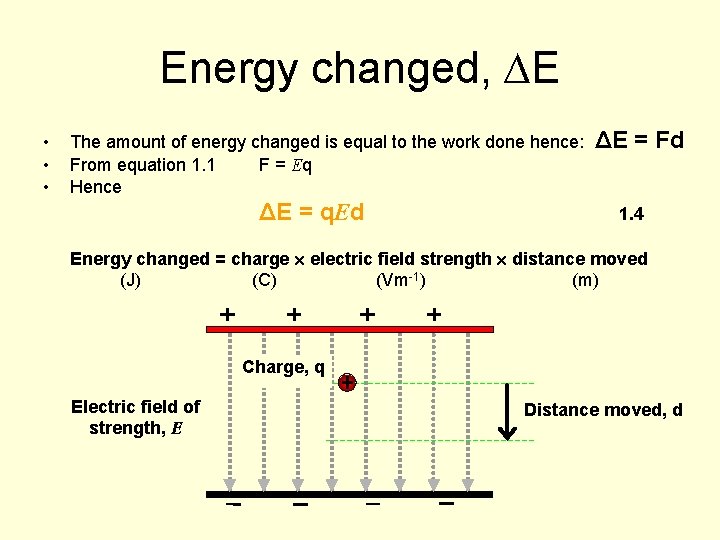
Energy changed, ∆E • • • The amount of energy changed is equal to the work done hence: From equation 1. 1 F = Eq Hence ΔE = q. Ed ΔE = Fd 1. 4 Energy changed = charge electric field strength distance moved (J) (C) (Vm-1) (m) Charge, q Electric field of strength, E Distance moved, d
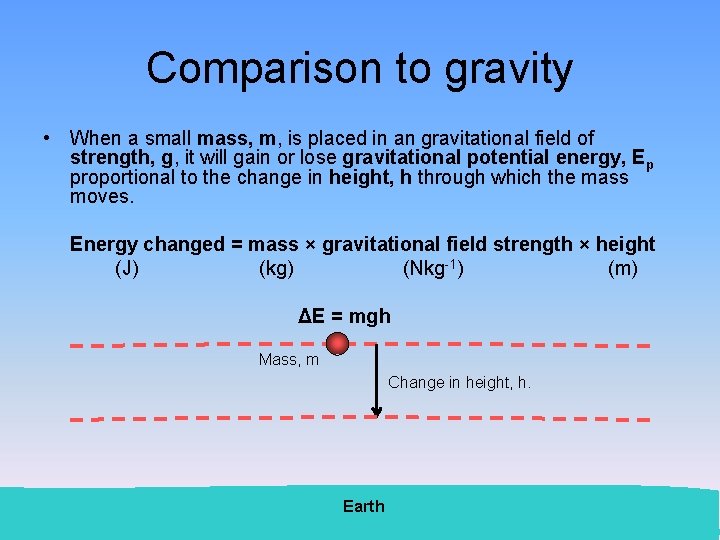
Comparison to gravity • When a small mass, m, is placed in an gravitational field of strength, g, it will gain or lose gravitational potential energy, Ep proportional to the change in height, h through which the mass moves. Energy changed = mass × gravitational field strength × height (J) (kg) (Nkg-1) (m) ΔE = mgh Mass, m Change in height, h. Earth
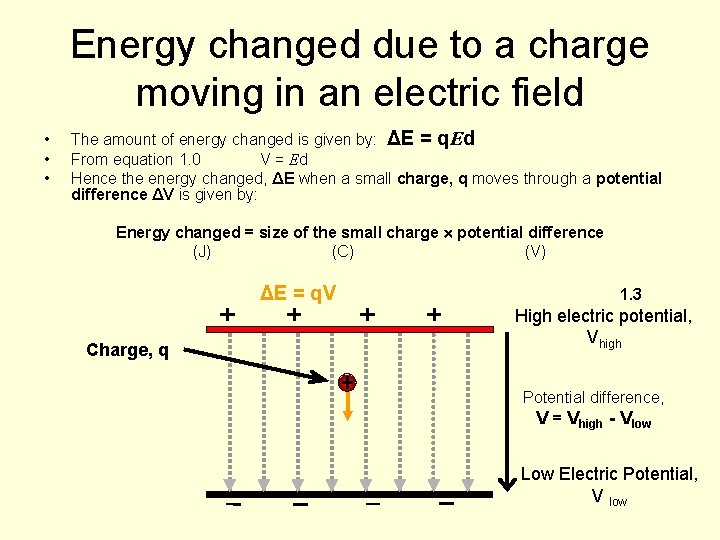
Energy changed due to a charge moving in an electric field • • • The amount of energy changed is given by: ΔE = q. Ed From equation 1. 0 V = Ed Hence the energy changed, ΔE when a small charge, q moves through a potential difference ΔV is given by: Energy changed = size of the small charge potential difference (J) (C) (V) ΔE = q. V Charge, q 1. 3 High electric potential, Vhigh Potential difference, V = Vhigh - Vlow Low Electric Potential, V low
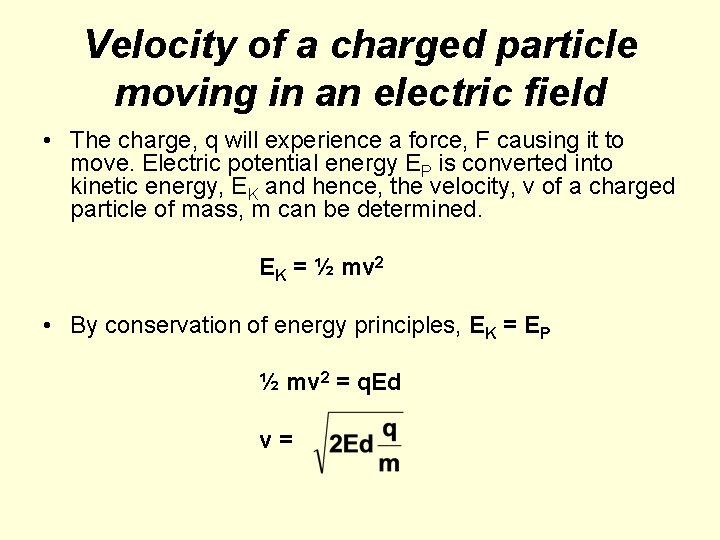
Velocity of a charged particle moving in an electric field • The charge, q will experience a force, F causing it to move. Electric potential energy EP is converted into kinetic energy, EK and hence, the velocity, v of a charged particle of mass, m can be determined. EK = ½ mv 2 • By conservation of energy principles, EK = EP ½ mv 2 = q. Ed v=
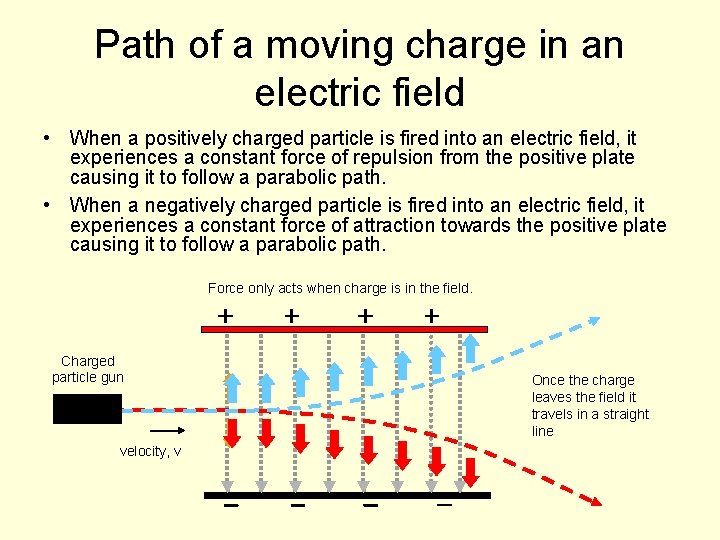
Path of a moving charge in an electric field • When a positively charged particle is fired into an electric field, it experiences a constant force of repulsion from the positive plate causing it to follow a parabolic path. • When a negatively charged particle is fired into an electric field, it experiences a constant force of attraction towards the positive plate causing it to follow a parabolic path. Force only acts when charge is in the field. Charged particle gun velocity, v Once the charge leaves the field it travels in a straight line
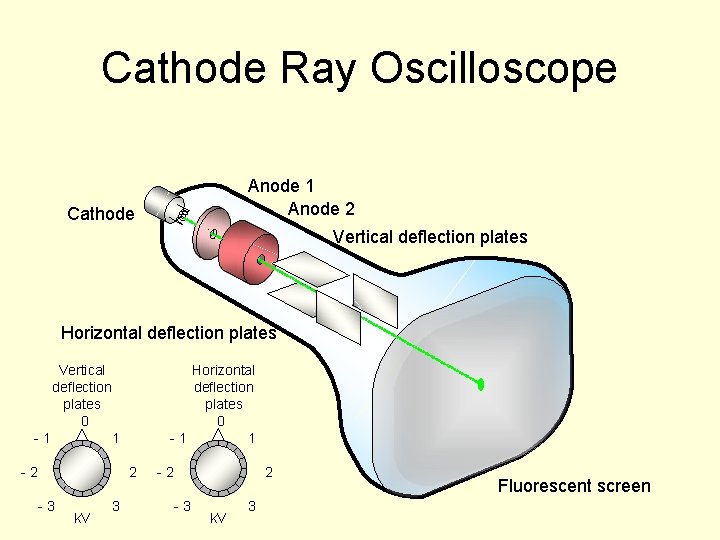
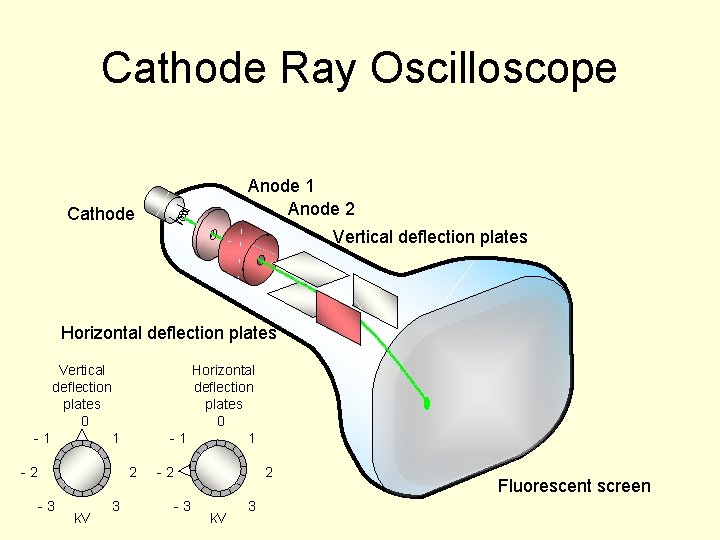
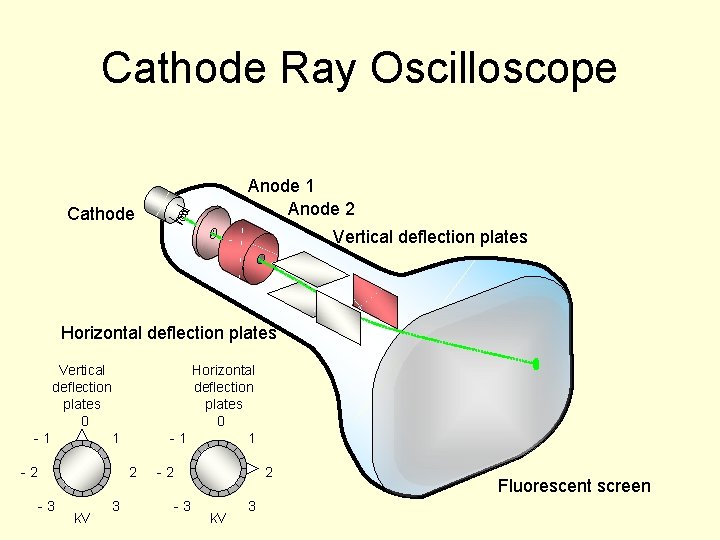
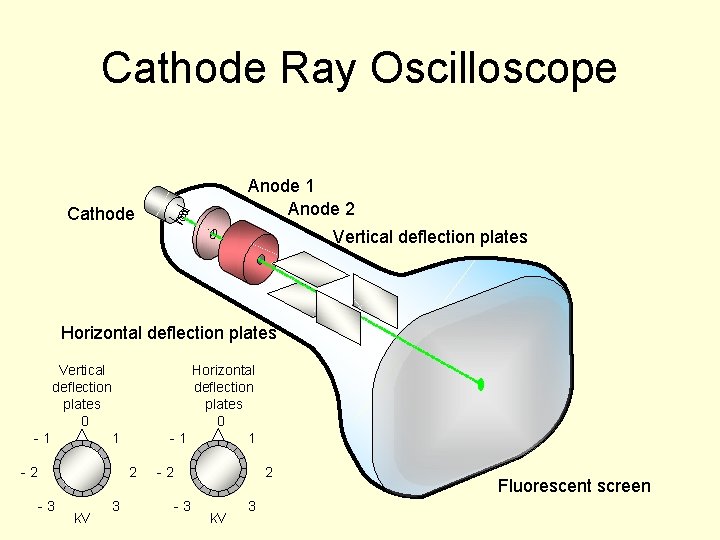
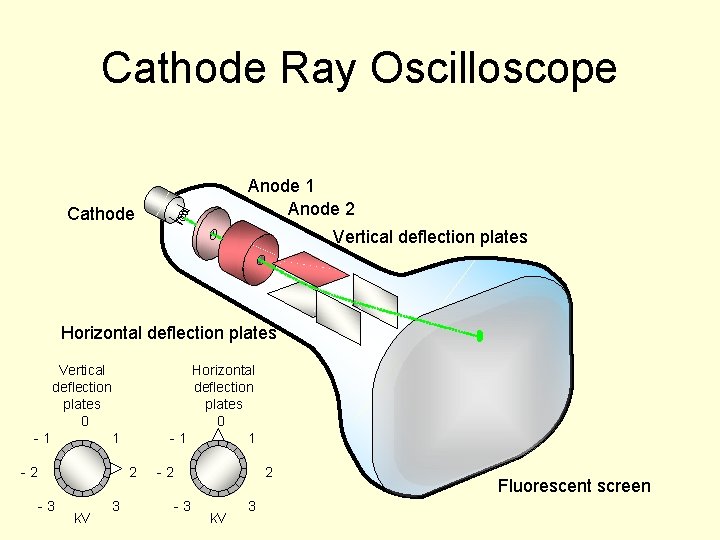
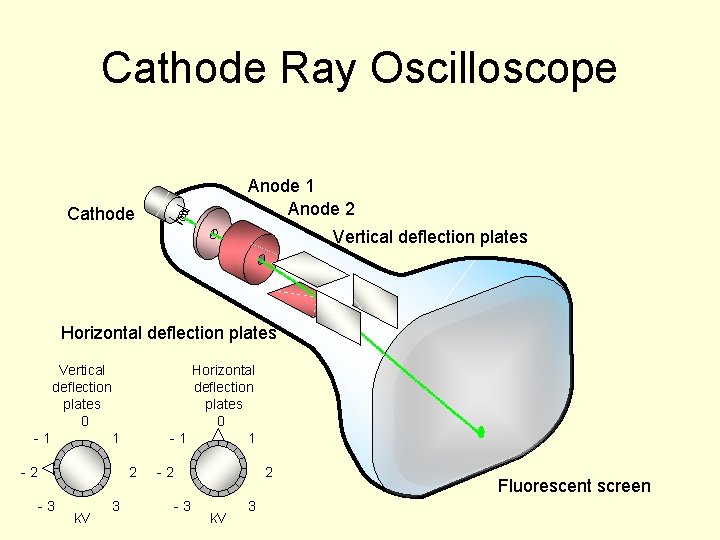
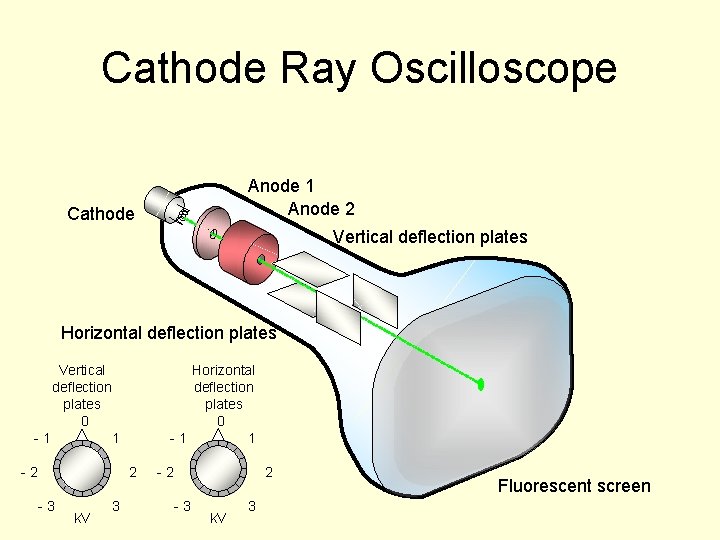
Cathode Ray Oscilloscope Anode 1 Anode 2 Cathode Vertical deflection plates Horizontal deflection plates Vertical deflection plates 0 -1 Horizontal deflection plates 0 -1 1 1 -2 2 -3 k. V 3 Fluorescent screen
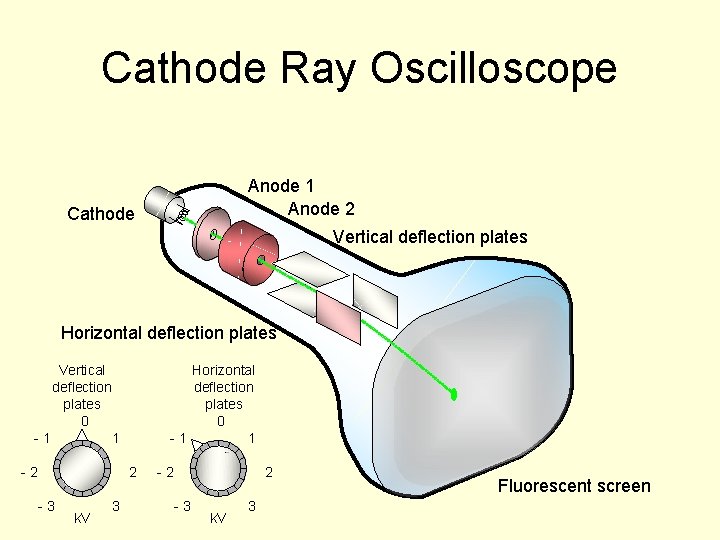
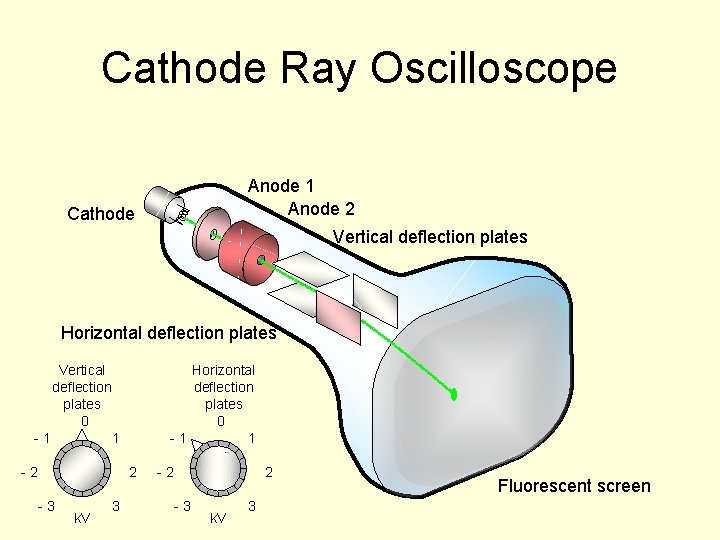
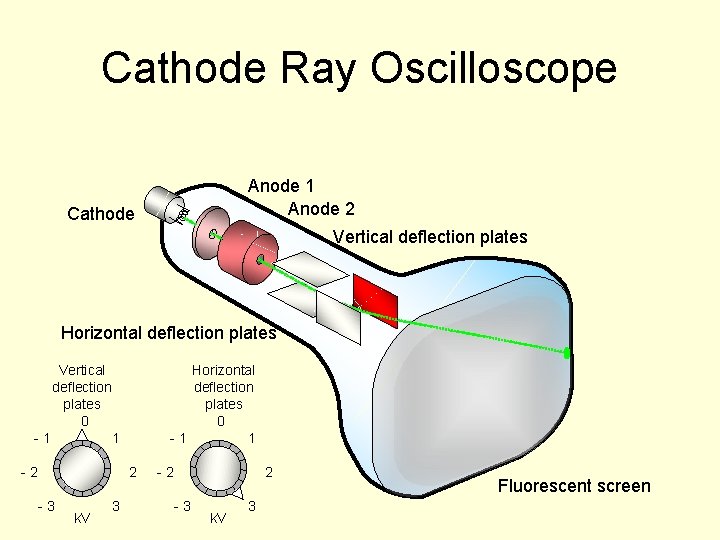
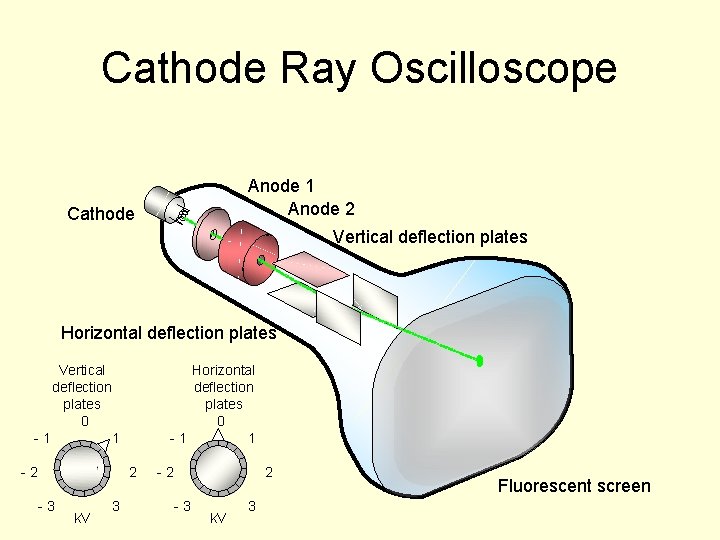
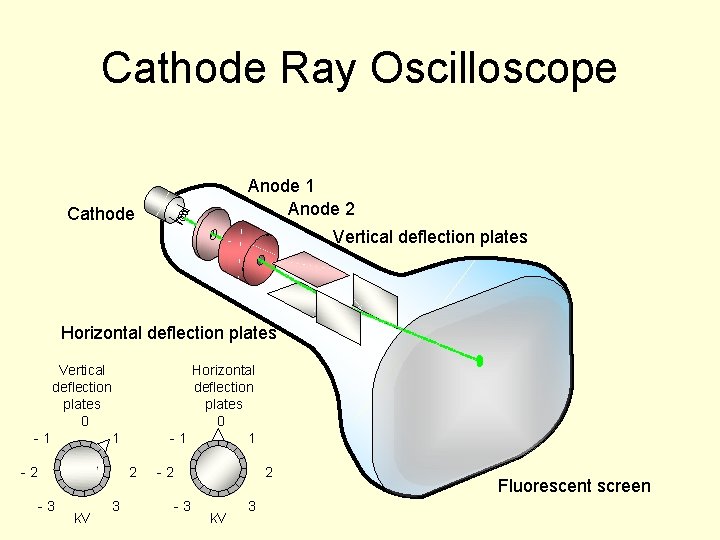
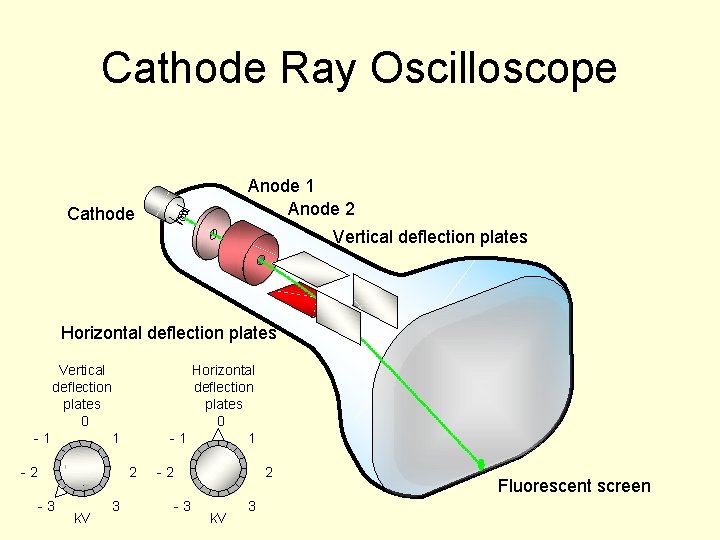
Cathode Ray Oscilloscope Anode 1 Anode 2 Cathode Vertical deflection plates Horizontal deflection plates Vertical deflection plates 0 -1 Horizontal deflection plates 0 -1 1 1 -2 2 -3 k. V 3 Fluorescent screen
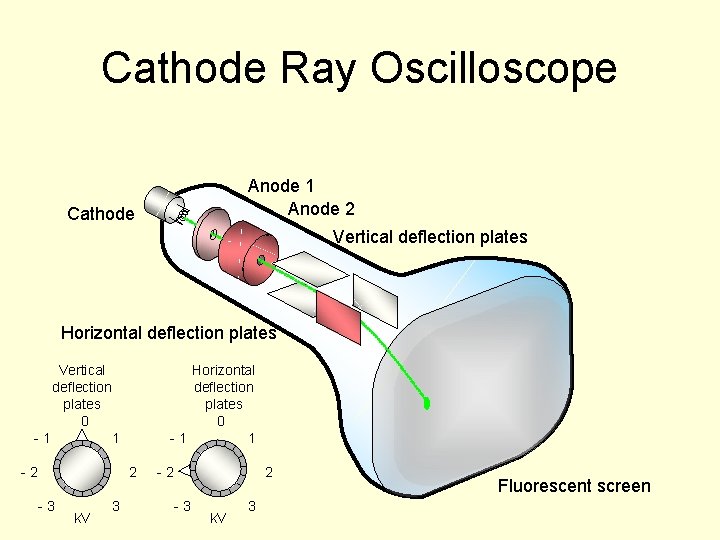
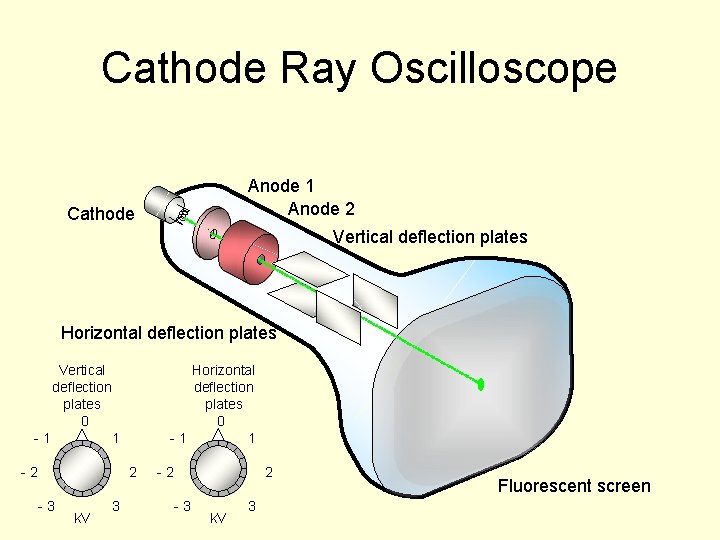
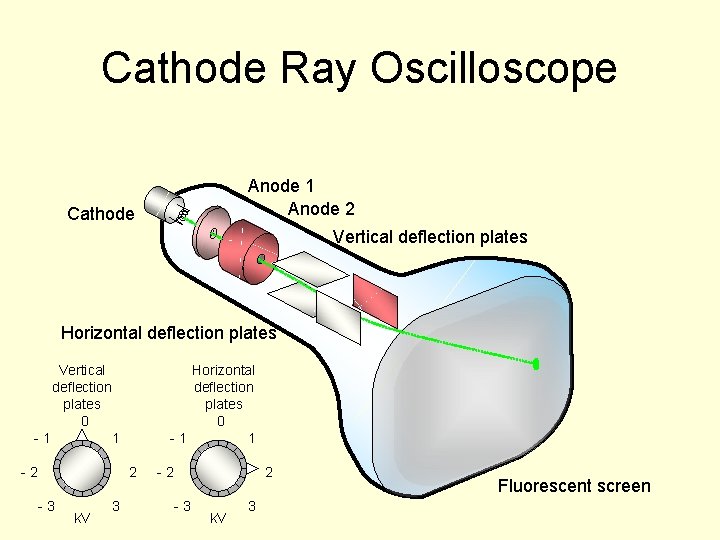
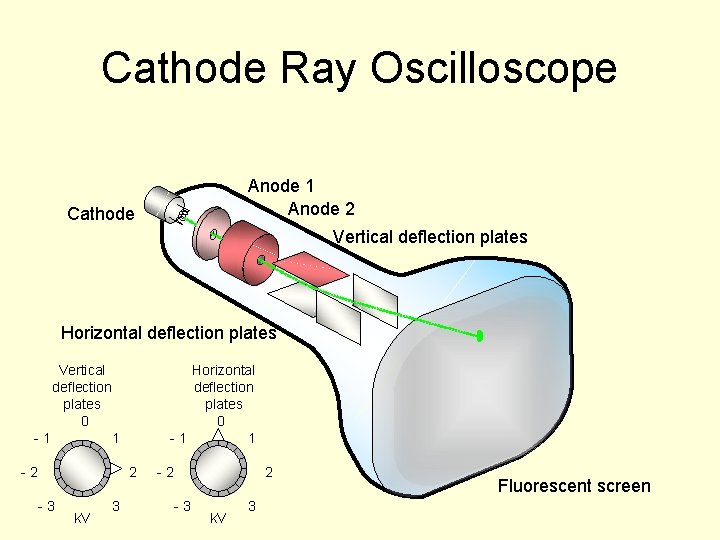
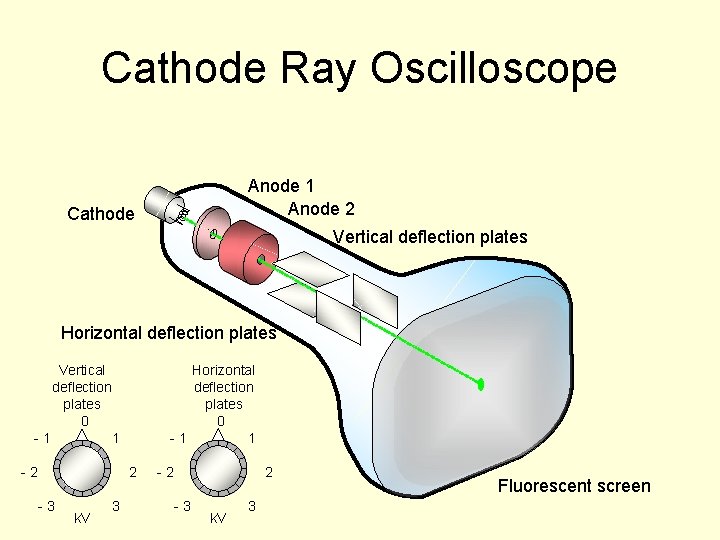
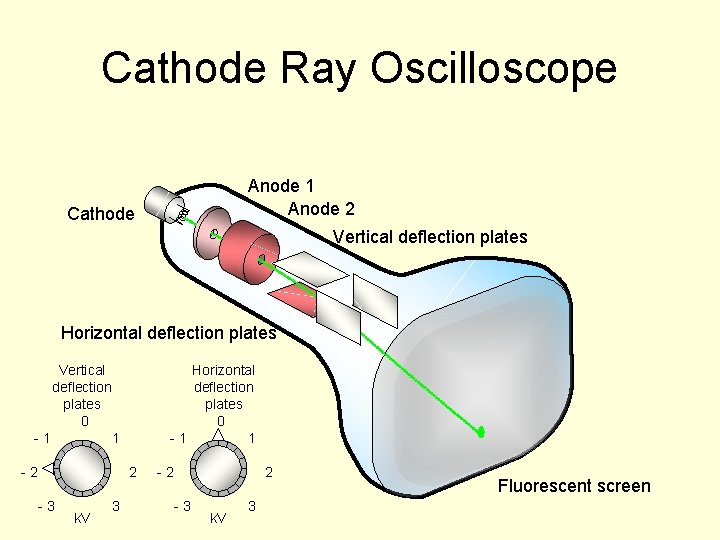
Cathode Ray Oscilloscope Anode 1 Anode 2 Cathode Vertical deflection plates Horizontal deflection plates Vertical deflection plates 0 -1 Horizontal deflection plates 0 -1 1 1 -2 2 -3 k. V 3 Fluorescent screen
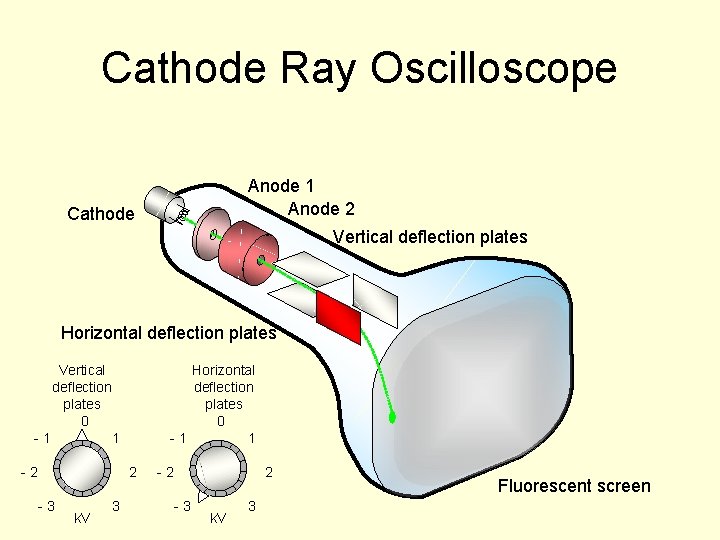
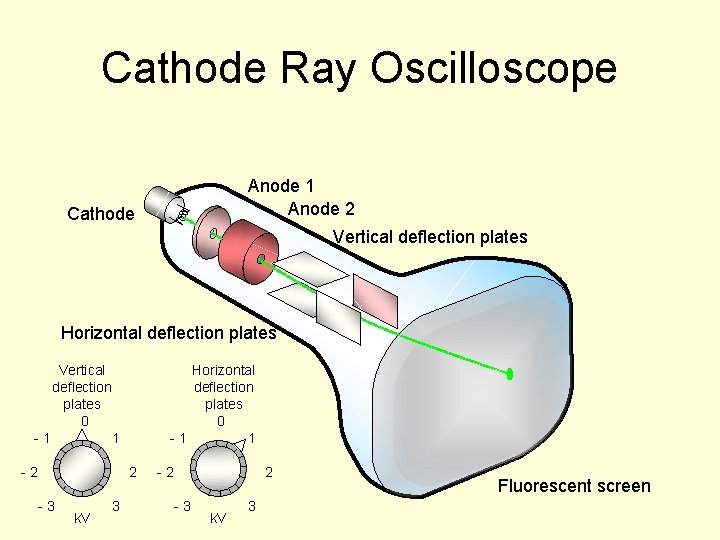
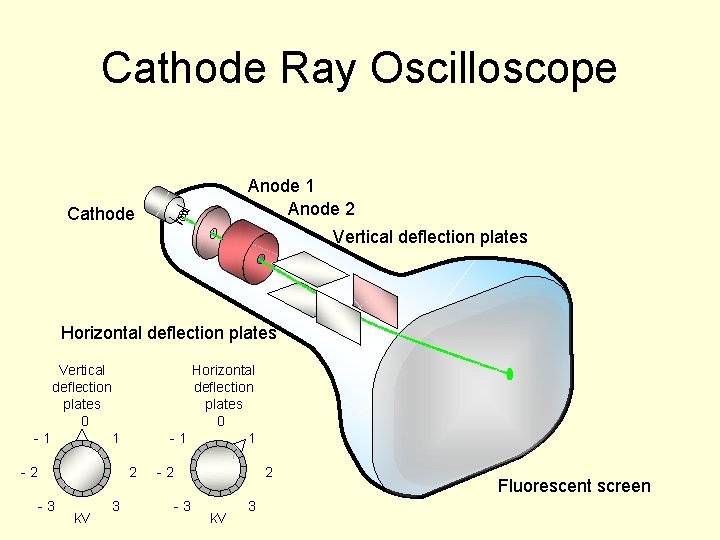
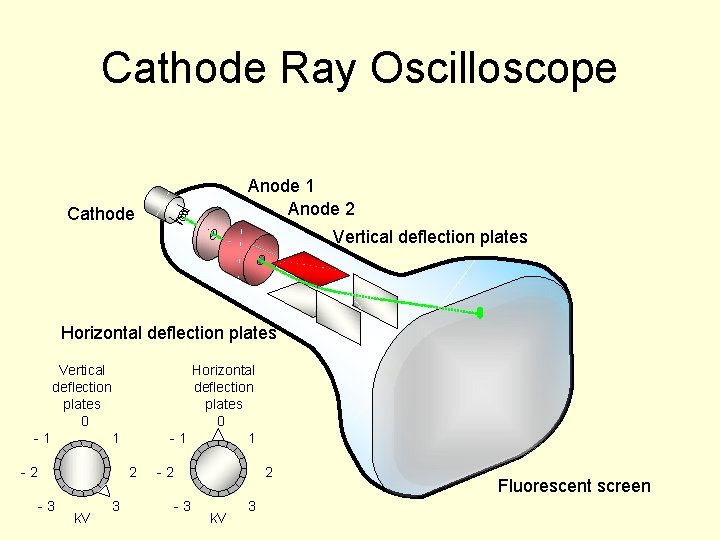
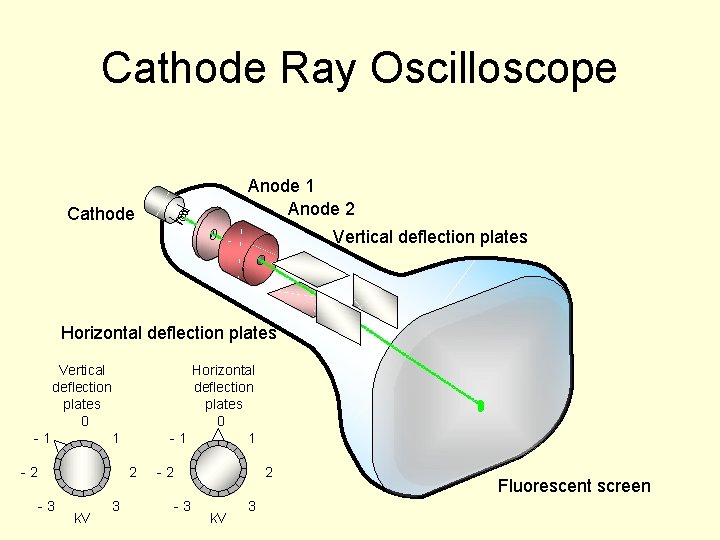
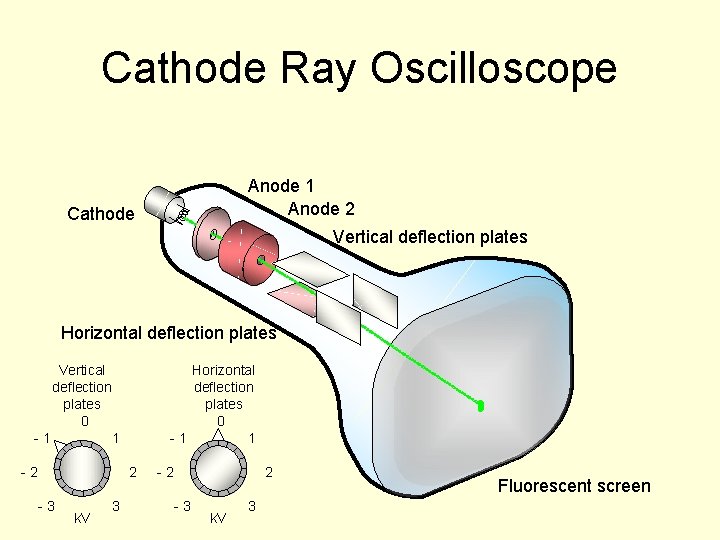
Cathode Ray Oscilloscope Anode 1 Anode 2 Cathode Vertical deflection plates Horizontal deflection plates Vertical deflection plates 0 -1 Horizontal deflection plates 0 -1 1 1 -2 2 -3 k. V 3 Fluorescent screen
Cathode Ray Oscilloscope Anode 1 Anode 2 Cathode Vertical deflection plates Horizontal deflection plates Vertical deflection plates 0 -1 Horizontal deflection plates 0 -1 1 1 -2 2 -3 k. V 3 Fluorescent screen
Cathode Ray Oscilloscope Anode 1 Anode 2 Cathode Vertical deflection plates Horizontal deflection plates Vertical deflection plates 0 -1 Horizontal deflection plates 0 -1 1 1 -2 2 -3 k. V 3 Fluorescent screen
Cathode Ray Oscilloscope Anode 1 Anode 2 Cathode Vertical deflection plates Horizontal deflection plates Vertical deflection plates 0 -1 Horizontal deflection plates 0 -1 1 1 -2 2 -3 k. V 3 Fluorescent screen
Cathode Ray Oscilloscope Anode 1 Anode 2 Cathode Vertical deflection plates Horizontal deflection plates Vertical deflection plates 0 -1 Horizontal deflection plates 0 -1 1 1 -2 2 -3 k. V 3 Fluorescent screen
Cathode Ray Oscilloscope Anode 1 Anode 2 Cathode Vertical deflection plates Horizontal deflection plates Vertical deflection plates 0 -1 Horizontal deflection plates 0 -1 1 1 -2 2 -3 k. V 3 Fluorescent screen
Cathode Ray Oscilloscope Anode 1 Anode 2 Cathode Vertical deflection plates Horizontal deflection plates Vertical deflection plates 0 -1 Horizontal deflection plates 0 -1 1 1 -2 2 -3 k. V 3 Fluorescent screen
Cathode Ray Oscilloscope Anode 1 Anode 2 Cathode Vertical deflection plates Horizontal deflection plates Vertical deflection plates 0 -1 Horizontal deflection plates 0 -1 1 1 -2 2 -3 k. V 3 Fluorescent screen
Cathode Ray Oscilloscope Anode 1 Anode 2 Cathode Vertical deflection plates Horizontal deflection plates Vertical deflection plates 0 -1 Horizontal deflection plates 0 -1 1 1 -2 2 -3 k. V 3 Fluorescent screen
Cathode Ray Oscilloscope Anode 1 Anode 2 Cathode Vertical deflection plates Horizontal deflection plates Vertical deflection plates 0 -1 Horizontal deflection plates 0 -1 1 1 -2 2 -3 k. V 3 Fluorescent screen
Cathode Ray Oscilloscope Anode 1 Anode 2 Cathode Vertical deflection plates Horizontal deflection plates Vertical deflection plates 0 -1 Horizontal deflection plates 0 -1 1 1 -2 2 -3 k. V 3 Fluorescent screen
Cathode Ray Oscilloscope Anode 1 Anode 2 Cathode Vertical deflection plates Horizontal deflection plates Vertical deflection plates 0 -1 Horizontal deflection plates 0 -1 1 1 -2 2 -3 k. V 3 Fluorescent screen
Cathode Ray Oscilloscope Anode 1 Anode 2 Cathode Vertical deflection plates Horizontal deflection plates Vertical deflection plates 0 -1 Horizontal deflection plates 0 -1 1 1 -2 2 -3 k. V 3 Fluorescent screen
Cathode Ray Oscilloscope Anode 1 Anode 2 Cathode Vertical deflection plates Horizontal deflection plates Vertical deflection plates 0 -1 Horizontal deflection plates 0 -1 1 1 -2 2 -3 k. V 3 Fluorescent screen
Cathode Ray Oscilloscope Anode 1 Anode 2 Cathode Vertical deflection plates Horizontal deflection plates Vertical deflection plates 0 -1 Horizontal deflection plates 0 -1 1 1 -2 2 -3 k. V 3 Fluorescent screen
Cathode Ray Oscilloscope Anode 1 Anode 2 Cathode Vertical deflection plates Horizontal deflection plates Vertical deflection plates 0 -1 Horizontal deflection plates 0 -1 1 1 -2 2 -3 k. V 3 Fluorescent screen
Cathode Ray Oscilloscope Anode 1 Anode 2 Cathode Vertical deflection plates Horizontal deflection plates Vertical deflection plates 0 -1 Horizontal deflection plates 0 -1 1 1 -2 2 -3 k. V 3 Fluorescent screen
Cathode Ray Oscilloscope Anode 1 Anode 2 Cathode Vertical deflection plates Horizontal deflection plates Vertical deflection plates 0 -1 Horizontal deflection plates 0 -1 1 1 -2 2 -3 k. V 3 Fluorescent screen
Cathode Ray Oscilloscope Anode 1 Anode 2 Cathode Vertical deflection plates Horizontal deflection plates Vertical deflection plates 0 -1 Horizontal deflection plates 0 -1 1 1 -2 2 -3 k. V 3 Fluorescent screen
Cathode Ray Oscilloscope Anode 1 Anode 2 Cathode Vertical deflection plates Horizontal deflection plates Vertical deflection plates 0 -1 Horizontal deflection plates 0 -1 1 1 -2 2 -3 k. V 3 Fluorescent screen
Cathode Ray Oscilloscope Anode 1 Anode 2 Cathode Vertical deflection plates Horizontal deflection plates Vertical deflection plates 0 -1 Horizontal deflection plates 0 -1 1 1 -2 2 -3 k. V 3 Fluorescent screen
Cathode Ray Oscilloscope Anode 1 Anode 2 Cathode Vertical deflection plates Horizontal deflection plates Vertical deflection plates 0 -1 Horizontal deflection plates 0 -1 1 1 -2 2 -3 k. V 3 Fluorescent screen