
PHYSICS 197 Section 1 Chapter September 11 2017
PHYSICS 197 Section 1 Chapter September 11, 2017
Announcements Technical issues with last daily HW – You’ll get credit if you finished on time. Whenever possible, please try to complete the assignments well in advance. Blackboard may not properly import the scores from Learnsmart, if you have changed section. Please try relinking your Blackboard to this section on Connect. If sync doesn’t work, let me know your Connect score and I’ll update it manually on Blackboard. First Lab today. More info (and Lab assignment) at http: //physics. wustl. edu/introphys/Fall/
Law of Conservation of Momentum-transfer principle: Only external interactions can cause momentum to flow into or out of a system. Isolated system: A system that does not participate in any external interactions. An isolated system’s total momentum is conserved. Consequence of translation symmetry. Can we have a physical system truly isolated? Then how useful is the momentum conservation law?
Degree of Isolation A system’s momentum is nearly conserved in processes where external interactions fail to transport a significant amount of momentum into or out of the system. Three general categories of such processes: 1. Floats in space: External gravitational interactions can be ignored in a freely floating reference frame. 2. Functionally isolated: When momentum flows due to external interactions cancel out. 3. Collision: Internal interactions act only briefly and deliver much larger impulse than any external interactions during that time.
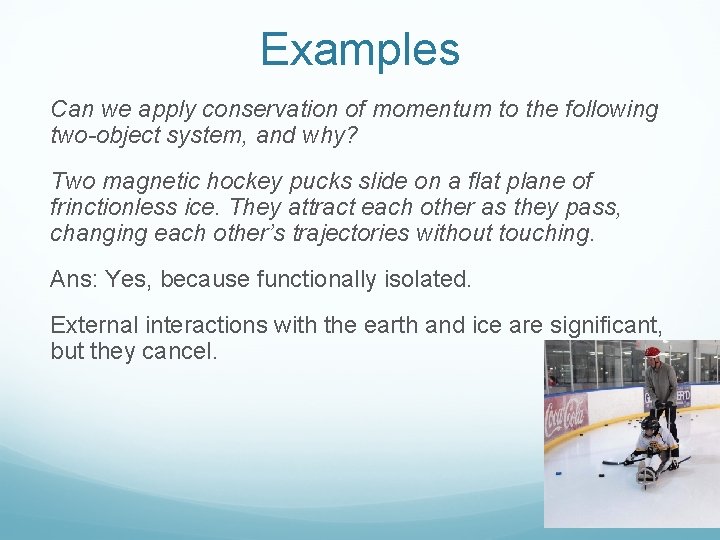
Examples Can we apply conservation of momentum to the following two-object system, and why? Two magnetic hockey pucks slide on a flat plane of frinctionless ice. They attract each other as they pass, changing each other’s trajectories without touching. Ans: Yes, because functionally isolated. External interactions with the earth and ice are significant, but they cancel.
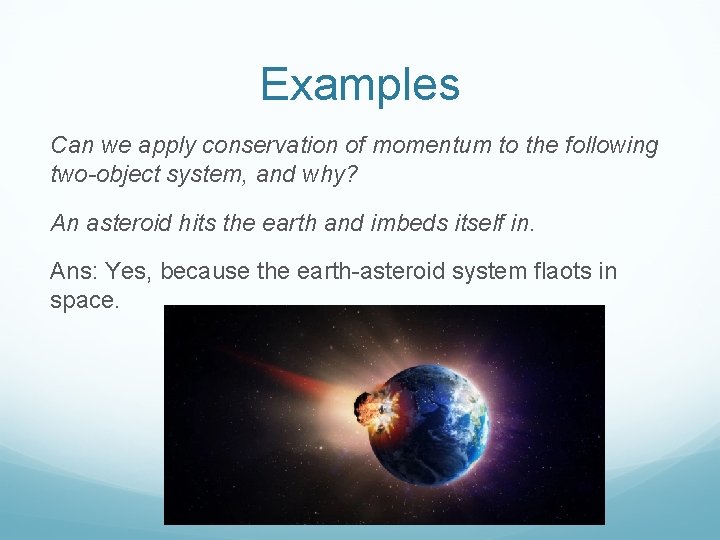
Examples Can we apply conservation of momentum to the following two-object system, and why? An asteroid hits the earth and imbeds itself in. Ans: Yes, because the earth-asteroid system flaots in space.
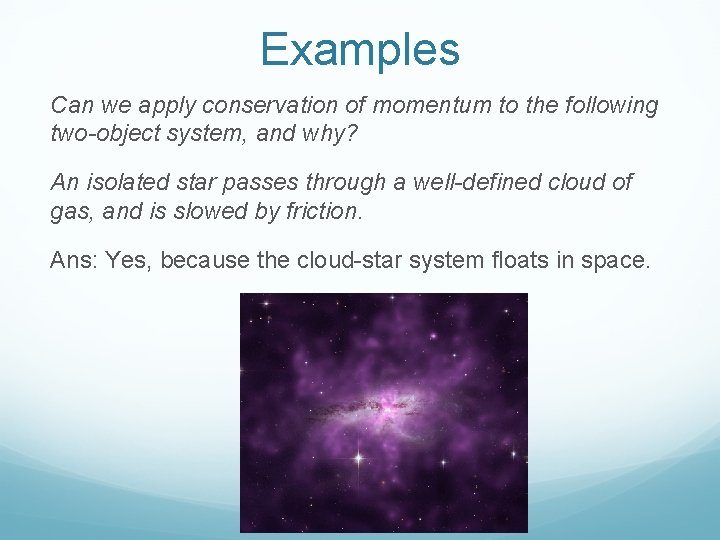
Examples Can we apply conservation of momentum to the following two-object system, and why? An isolated star passes through a well-defined cloud of gas, and is slowed by friction. Ans: Yes, because the cloud-star system floats in space.
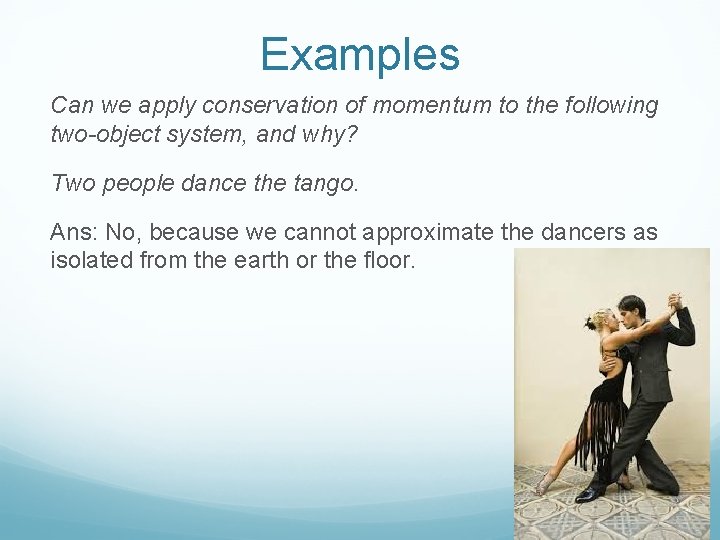
Examples Can we apply conservation of momentum to the following two-object system, and why? Two people dance the tango. Ans: No, because we cannot approximate the dancers as isolated from the earth or the floor.
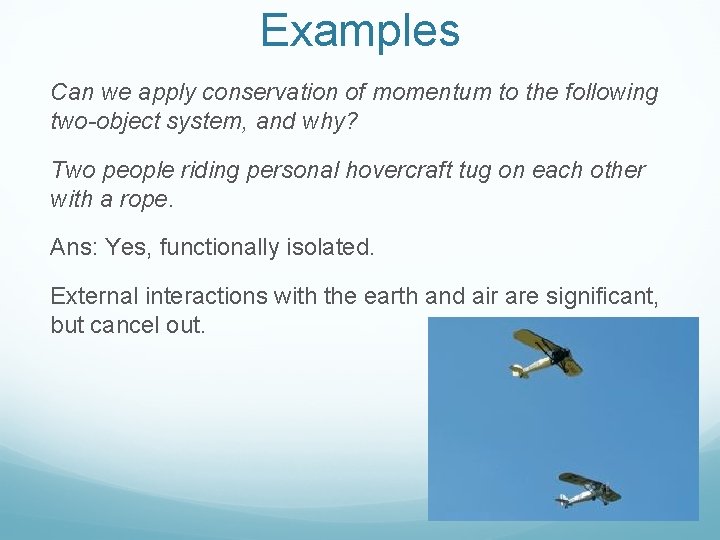
Examples Can we apply conservation of momentum to the following two-object system, and why? Two people riding personal hovercraft tug on each other with a rope. Ans: Yes, functionally isolated. External interactions with the earth and air are significant, but cancel out.
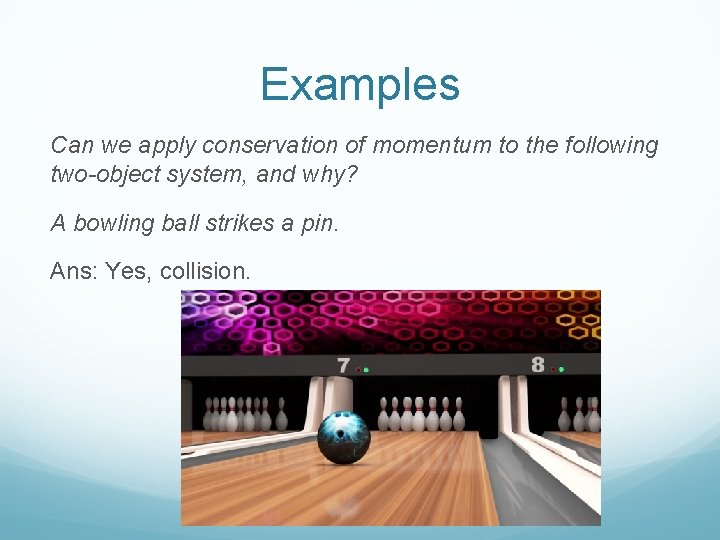
Examples Can we apply conservation of momentum to the following two-object system, and why? A bowling ball strikes a pin. Ans: Yes, collision.
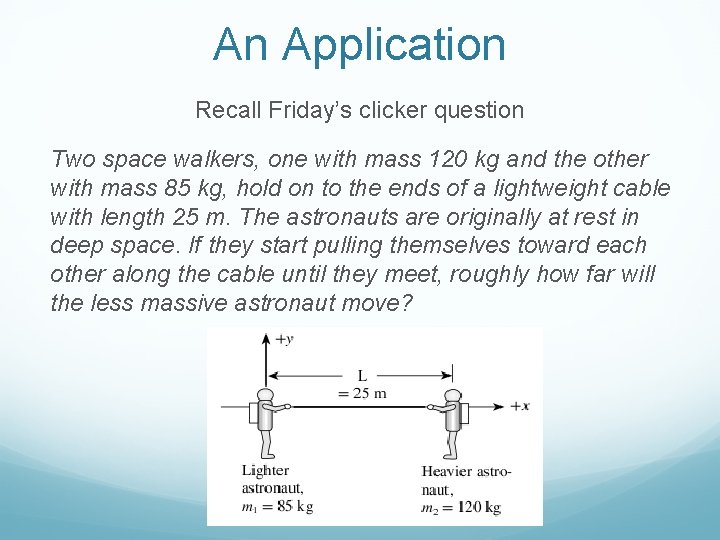
An Application Recall Friday’s clicker question Two space walkers, one with mass 120 kg and the other with mass 85 kg, hold on to the ends of a lightweight cable with length 25 m. The astronauts are originally at rest in deep space. If they start pulling themselves toward each other along the cable until they meet, roughly how far will the less massive astronaut move?
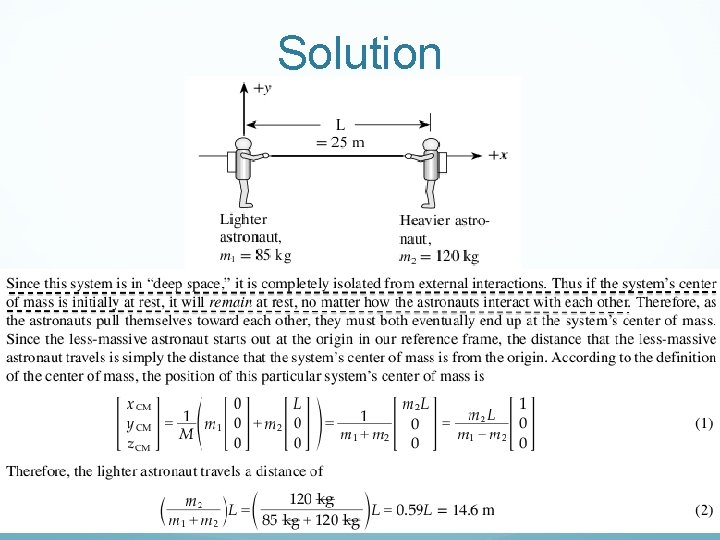
Solution
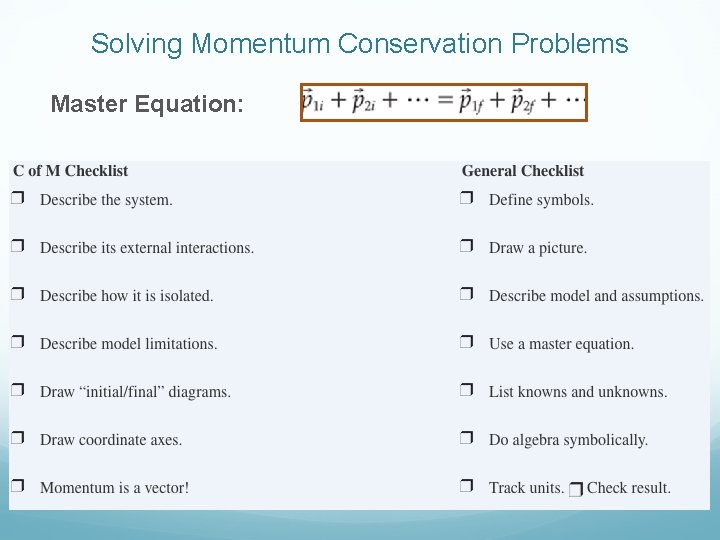
Solving Momentum Conservation Problems Master Equation:
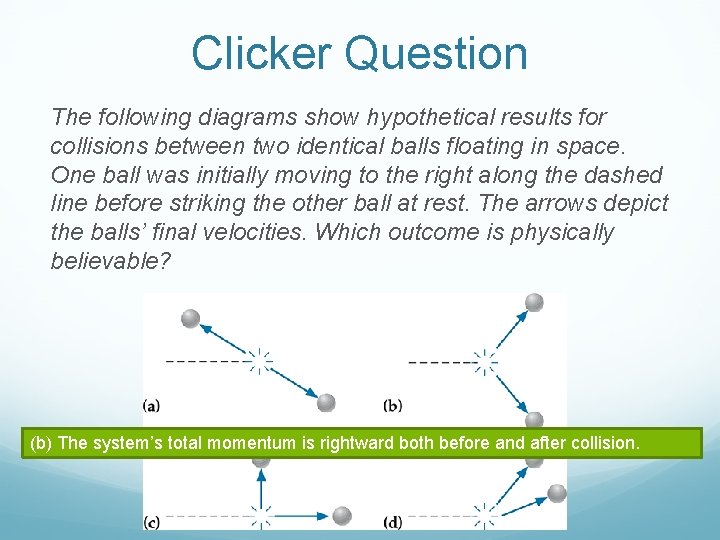
Clicker Question The following diagrams show hypothetical results for collisions between two identical balls floating in space. One ball was initially moving to the right along the dashed line before striking the other ball at rest. The arrows depict the balls’ final velocities. Which outcome is physically believable? (b) The system’s total momentum is rightward both before and after collision.
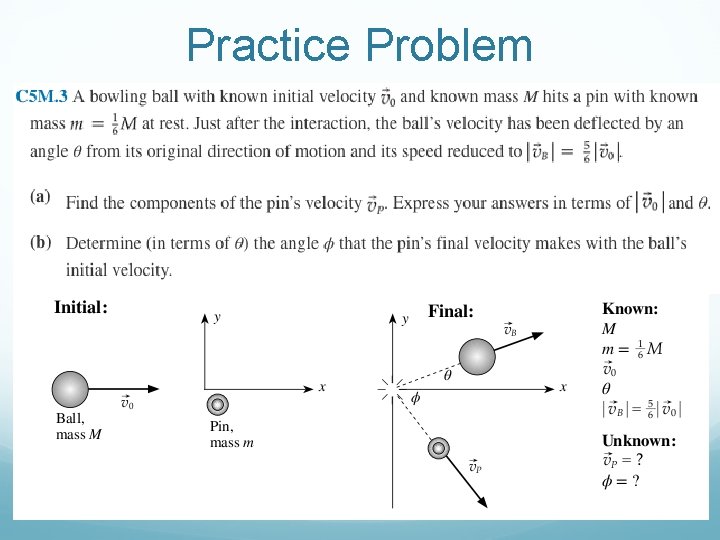
Practice Problem
- Slides: 15