
Physics 121 Practice Problem Solutions 03 Electric Field
Physics 121 Practice Problem Solutions 03 Electric Field Contents: 121 P 03 - 1 Q, 4 P, 6 P, 8 P, 13 P, 21 P, 23 P, 39 P • • Recap & Definition of Electric Field Lines Charges in External Electric Fields Field due to a Point Charge Field Lines for Superpositions of Charges Field of an Electric Dipole in an External Field: Torque and Potential Energy Method for Finding Field due to Charge Distributions – – • Arc of Charge Ring of Charge Disc of Charge Infinite line of Charge Summary 1 Fall 2012
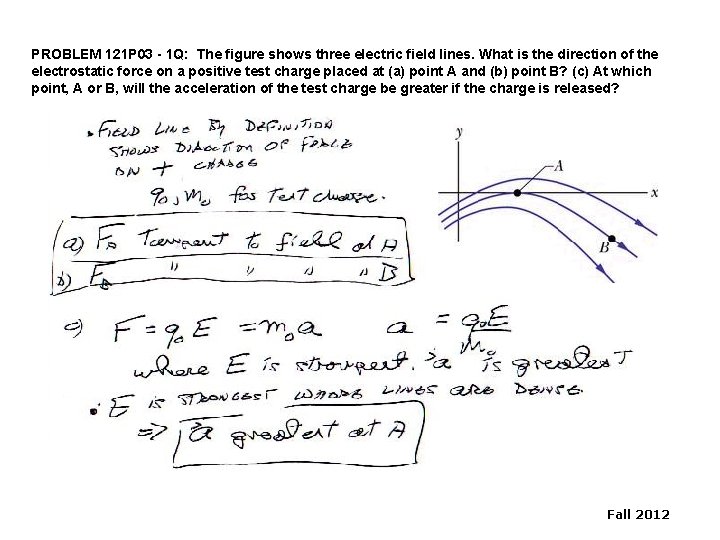
PROBLEM 121 P 03 - 1 Q: The figure shows three electric field lines. What is the direction of the electrostatic force on a positive test charge placed at (a) point A and (b) point B? (c) At which point, A or B, will the acceleration of the test charge be greater if the charge is released? Fall 2012
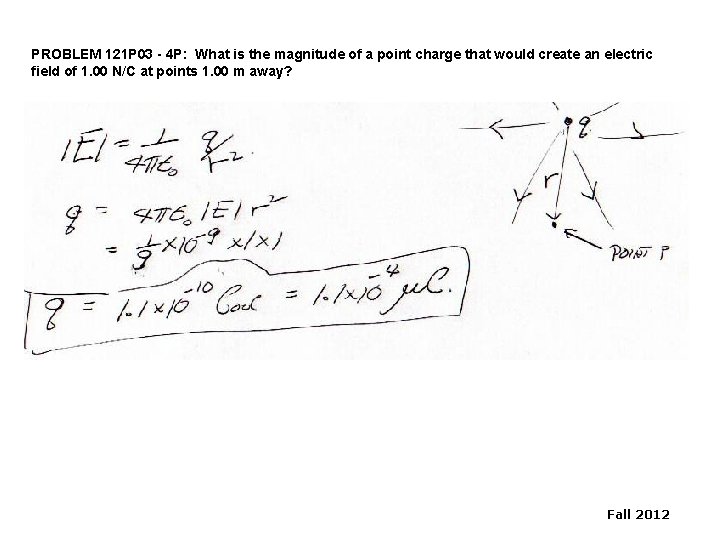
PROBLEM 121 P 03 - 4 P: What is the magnitude of a point charge that would create an electric field of 1. 00 N/C at points 1. 00 m away? Fall 2012
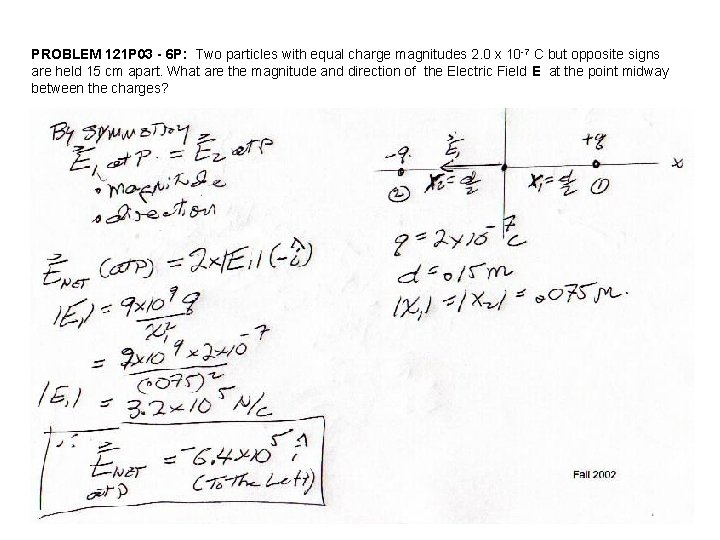
PROBLEM 121 P 03 - 6 P: Two particles with equal charge magnitudes 2. 0 x 10 -7 C but opposite signs are held 15 cm apart. What are the magnitude and direction of the Electric Field E at the point midway between the charges? Fall 2012
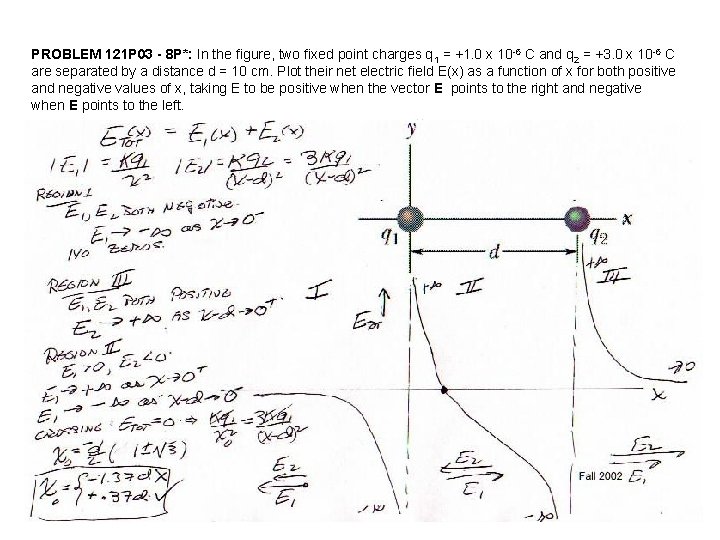
PROBLEM 121 P 03 - 8 P*: In the figure, two fixed point charges q 1 = +1. 0 x 10 -6 C and q 2 = +3. 0 x 10 -6 C are separated by a distance d = 10 cm. Plot their net electric field E(x) as a function of x for both positive and negative values of x, taking E to be positive when the vector E points to the right and negative when E points to the left. Fall 2012
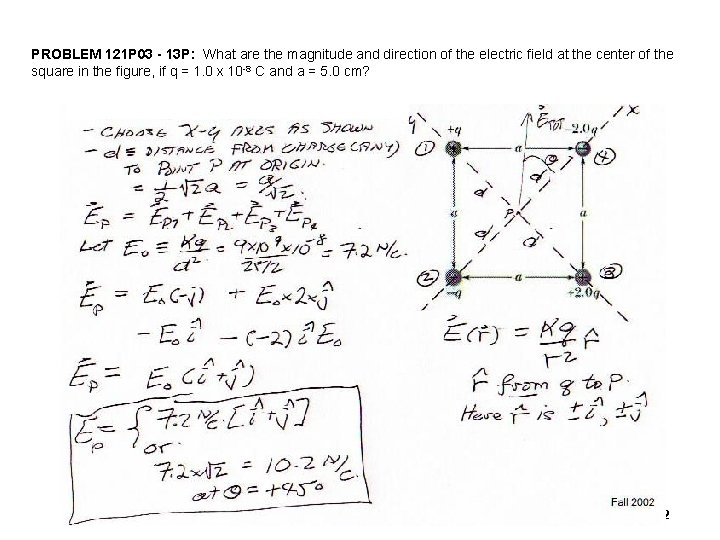
PROBLEM 121 P 03 - 13 P: What are the magnitude and direction of the electric field at the center of the square in the figure, if q = 1. 0 x 10 -8 C and a = 5. 0 cm? Fall 2012
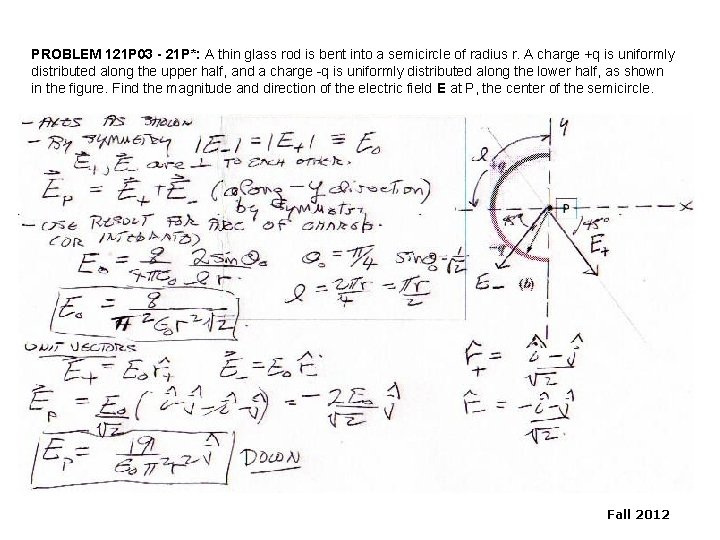
PROBLEM 121 P 03 - 21 P*: A thin glass rod is bent into a semicircle of radius r. A charge +q is uniformly distributed along the upper half, and a charge -q is uniformly distributed along the lower half, as shown in the figure. Find the magnitude and direction of the electric field E at P, the center of the semicircle. P Fall 2012
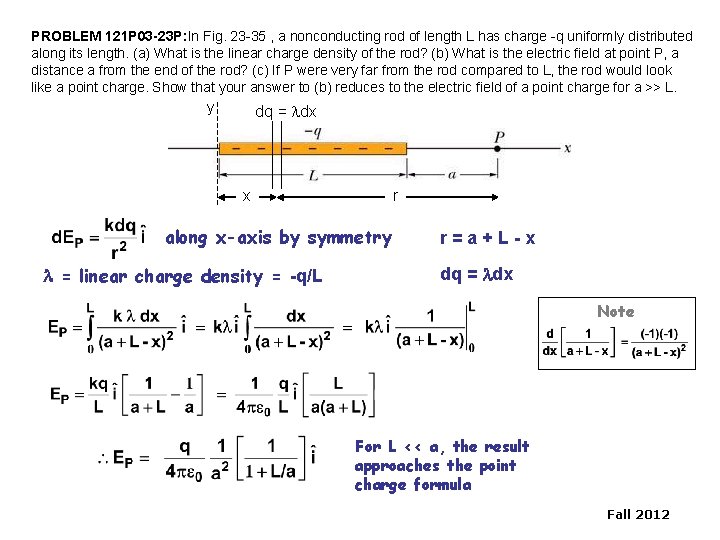
PROBLEM 121 P 03 -23 P: In Fig. 23 -35 , a nonconducting rod of length L has charge -q uniformly distributed along its length. (a) What is the linear charge density of the rod? (b) What is the electric field at point P, a distance a from the end of the rod? (c) If P were very far from the rod compared to L, the rod would look like a point charge. Show that your answer to (b) reduces to the electric field of a point charge for a >> L. y dq = ldx x r along x-axis by symmetry l = linear charge density = -q/L r=a+L-x dq = ldx Note For L << a, the result approaches the point charge formula Fall 2012
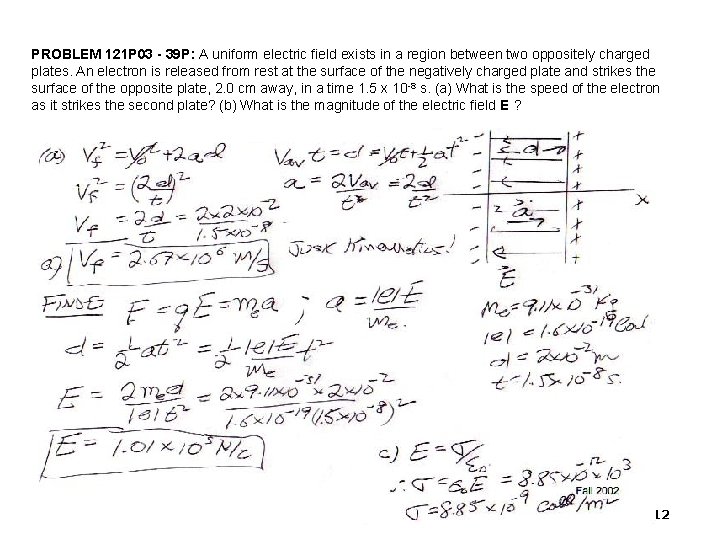
PROBLEM 121 P 03 - 39 P: A uniform electric field exists in a region between two oppositely charged plates. An electron is released from rest at the surface of the negatively charged plate and strikes the surface of the opposite plate, 2. 0 cm away, in a time 1. 5 x 10 -8 s. (a) What is the speed of the electron as it strikes the second plate? (b) What is the magnitude of the electric field E ? Fall 2012
- Slides: 9