
Physics 1202 Lecture 9 Todays Agenda Announcements Team
- Slides: 42
Physics 1202: Lecture 9 Today’s Agenda • Announcements: – Team problems start being sent Friday … • Office hours: Monday 2: 30 -3: 30 Thursday 3: 00 -4: 00 • Homework #4: due this coming Friday • Chapter 22: Magnetism – Review: » Magnetic field (B) & force, motion of charges » Force on wire, loop, and torque » Ampère’s law & Force between two wires – New topics: » Solenoids & Magnetic materials • Chapter 23: induction – Emf induced by varying magnetic flux …
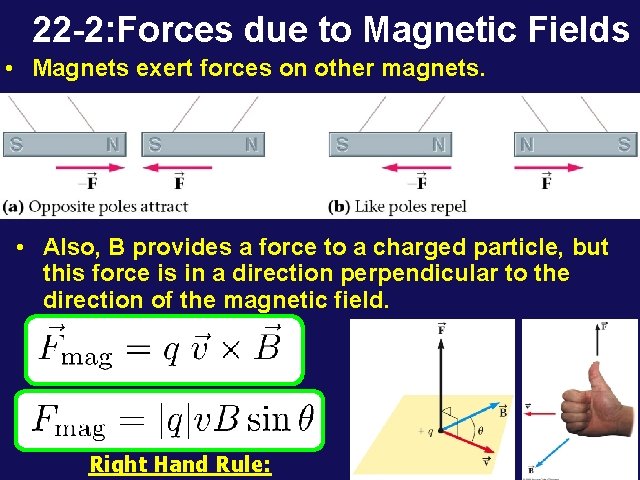
22 -2: Forces due to Magnetic Fields • Magnets exert forces on other magnets. • Also, B provides a force to a charged particle, but this force is in a direction perpendicular to the direction of the magnetic field. Right Hand Rule:
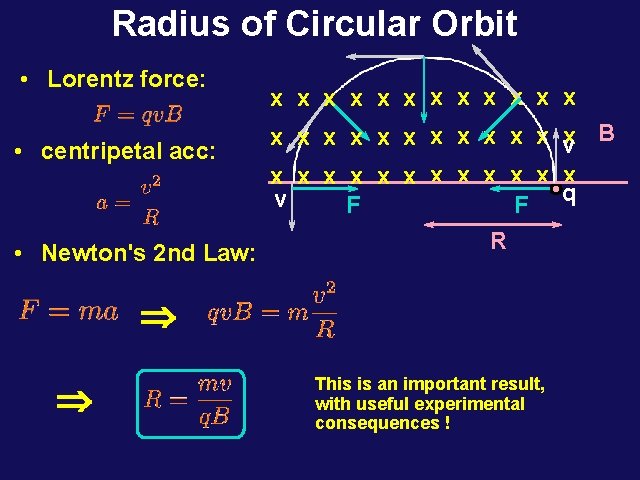
Radius of Circular Orbit • Lorentz force: • centripetal acc: • Newton's 2 nd Law: x x x x B x x x x x x v F F q R Þ Þ This is an important result, with useful experimental consequences !
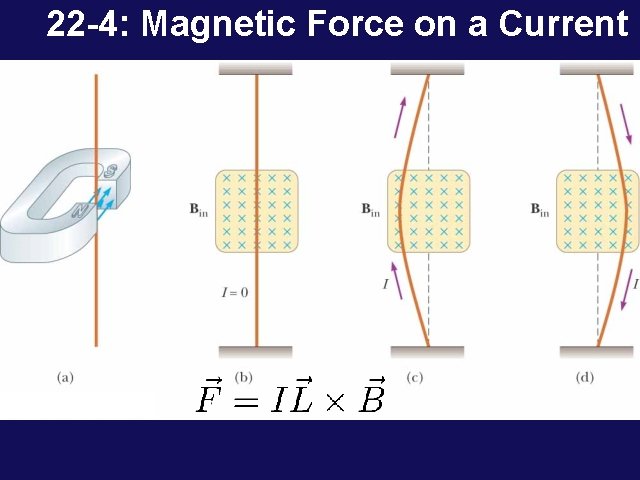
22 -4: Magnetic Force on a Current
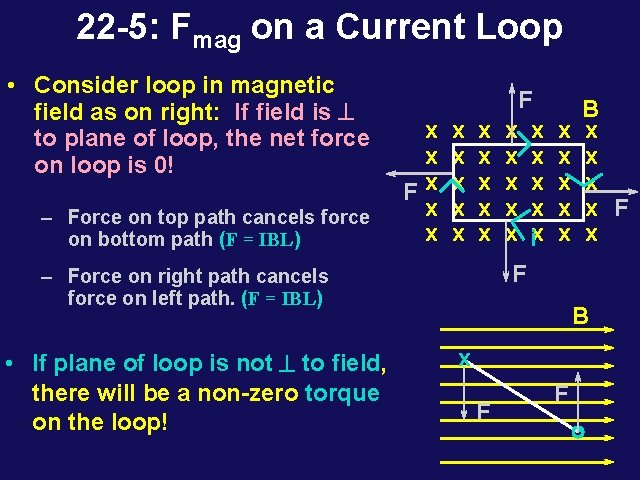
22 -5: Fmag on a Current Loop • Consider loop in magnetic field as on right: If field is to plane of loop, the net force on loop is 0! – Force on top path cancels force on bottom path (F = IBL) x x Fx x x x – Force on right path cancels force on left path. (F = IBL) • If plane of loop is not to field, there will be a non-zero torque on the loop! F x x x x x ix F x x x B x x F x B x F F.
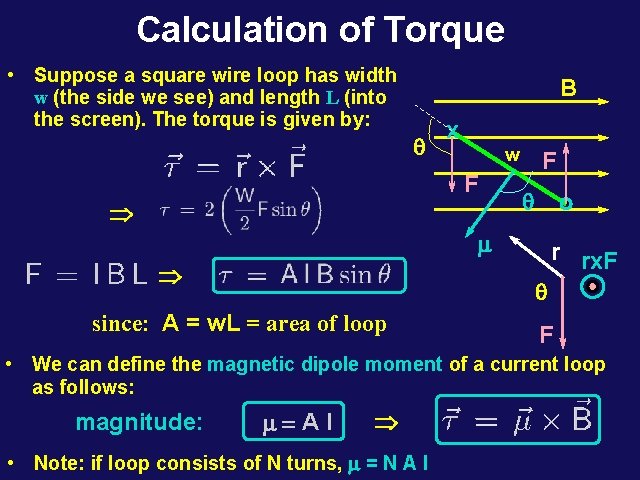
Calculation of Torque • Suppose a square wire loop has width w (the side we see) and length L (into the screen). The torque is given by: B q x w F Þ F. q m Þ r rx. F q since: A = w. L = area of loop F • We can define the magnetic dipole moment of a current loop as follows: magnitude: m=AI Þ • Note: if loop consists of N turns, m = N A I
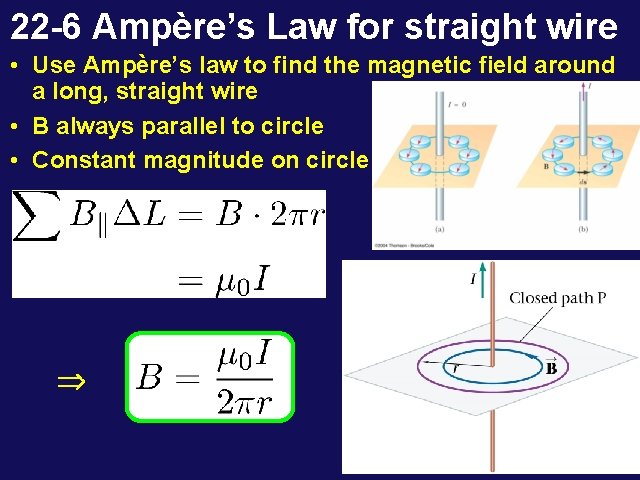
22 -6 Ampère’s Law for straight wire • Use Ampère’s law to find the magnetic field around a long, straight wire • B always parallel to circle • Constant magnitude on circle André-Marie Ampère Þ Born: Jan. 20, 1775 Lyon, France Died: June 10, 1836 Marseille, France
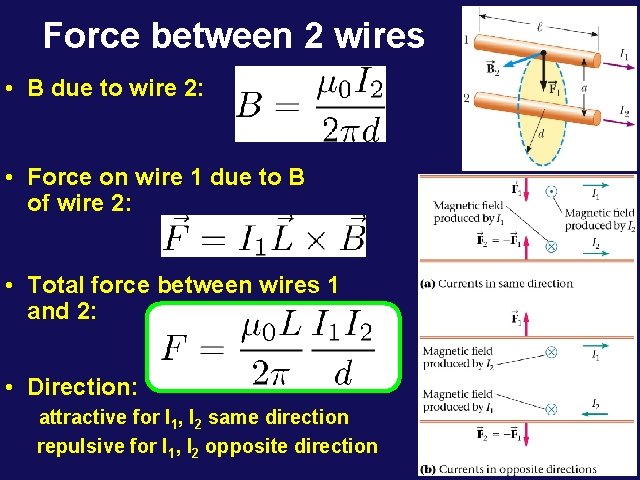
Force between 2 wires • B due to wire 2: • Force on wire 1 due to B of wire 2: • Total force between wires 1 and 2: • Direction: attractive for I 1, I 2 same direction repulsive for I 1, I 2 opposite direction
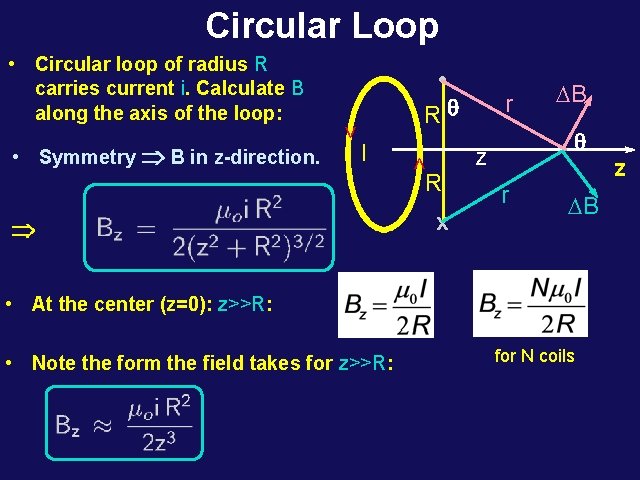
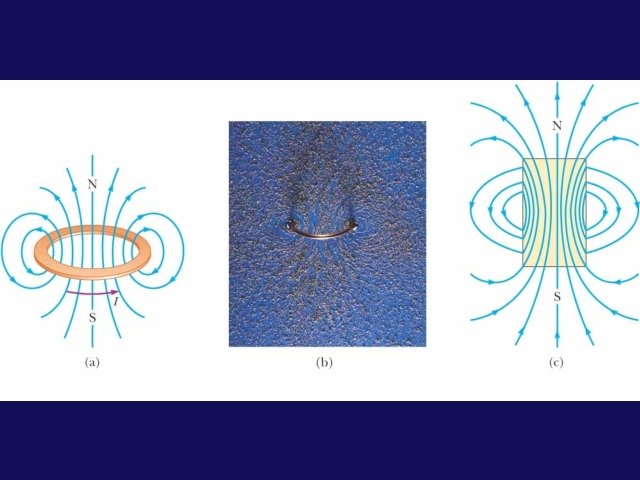
Circular Loop > • Symmetry Þ B in z-direction. I • Rq > • Circular loop of radius R carries current i. Calculate B along the axis of the loop: R Þ x r DB q z r DB • At the center (z=0): z>>R: • Note the form the field takes for z>>R: for N coils z
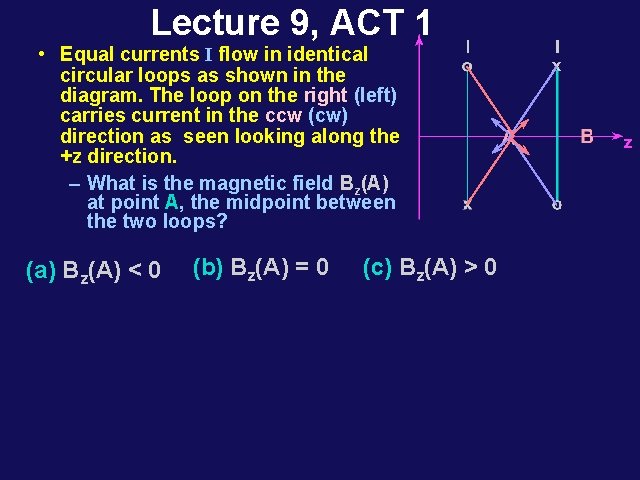
Lecture 9, ACT 1 • Equal currents I flow in identical circular loops as shown in the diagram. The loop on the right (left) carries current in the ccw (cw) direction as seen looking along the +z direction. – What is the magnetic field Bz(A) at point A, the midpoint between the two loops? (a) Bz(A) < 0 (b) Bz(A) = 0 (c) Bz(A) > 0
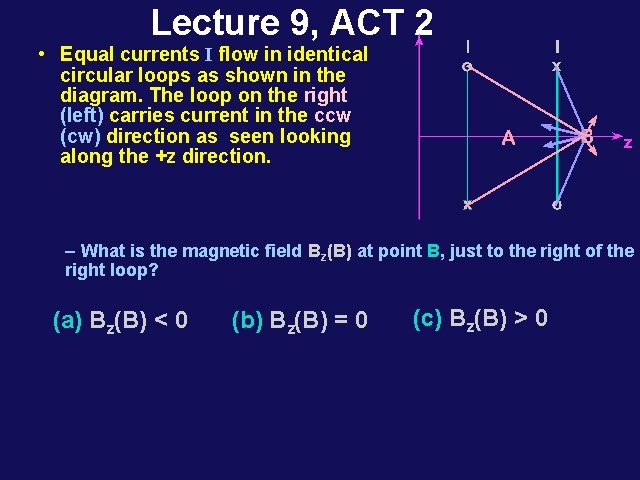
Lecture 9, ACT 2 • Equal currents I flow in identical circular loops as shown in the diagram. The loop on the right (left) carries current in the ccw (cw) direction as seen looking along the +z direction. – What is the magnetic field Bz(B) at point B, just to the right of the right loop? (a) Bz(B) < 0 (b) Bz(B) = 0 (c) Bz(B) > 0
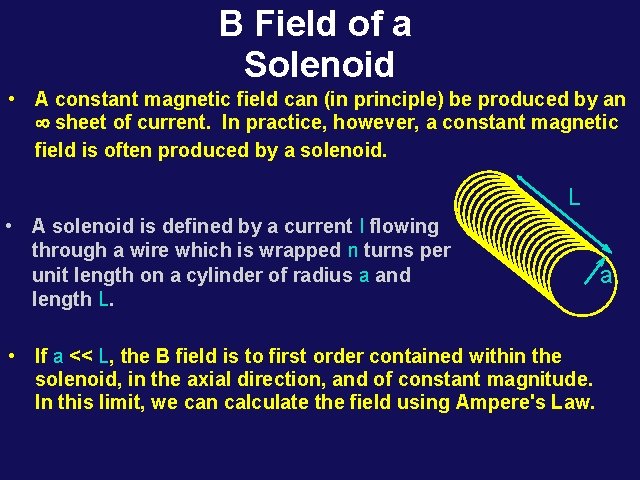
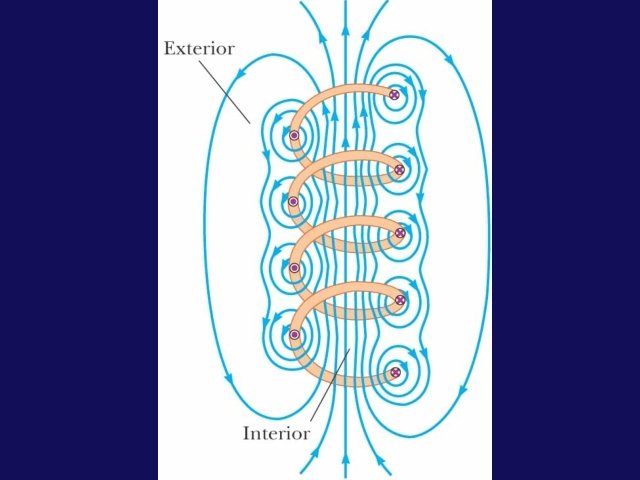
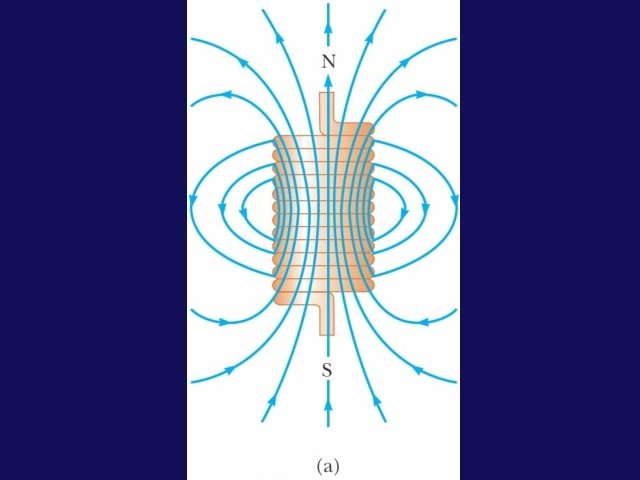
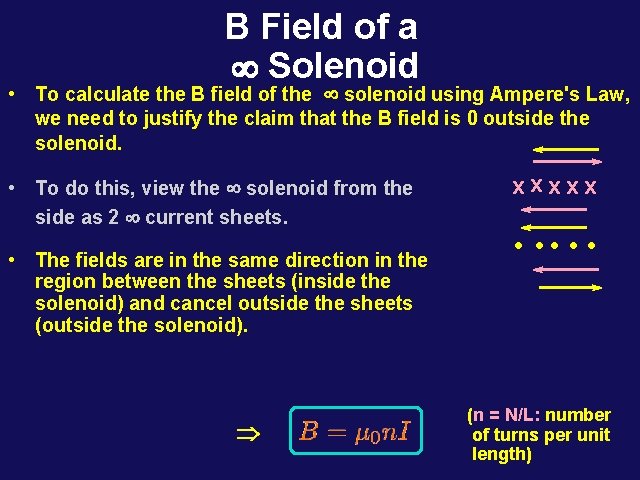
B Field of a Solenoid • A constant magnetic field can (in principle) be produced by an ¥ sheet of current. In practice, however, a constant magnetic field is often produced by a solenoid. L • A solenoid is defined by a current I flowing through a wire which is wrapped n turns per unit length on a cylinder of radius a and length L. • If a << L, the B field is to first order contained within the solenoid, in the axial direction, and of constant magnitude. In this limit, we can calculate the field using Ampere's Law. a
B Field of a ¥ Solenoid • To calculate the B field of the ¥ solenoid using Ampere's Law, we need to justify the claim that the B field is 0 outside the solenoid. • To do this, view the ¥ solenoid from the side as 2 ¥ current sheets. • The fields are in the same direction in the region between the sheets (inside the solenoid) and cancel outside the sheets (outside the solenoid). Þ xxxxx • • • (n = N/L: number of turns per unit length)
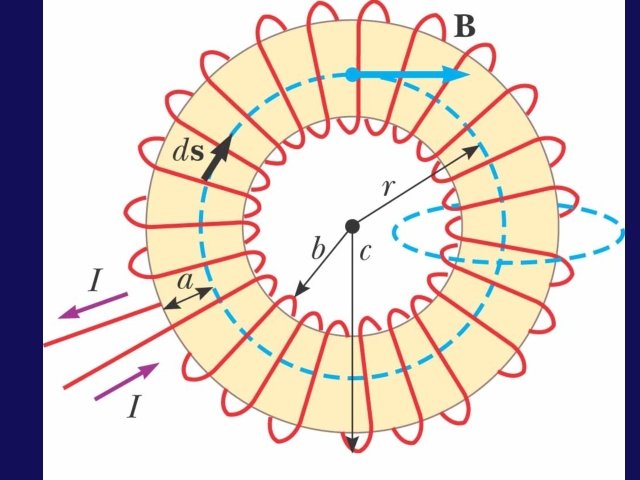
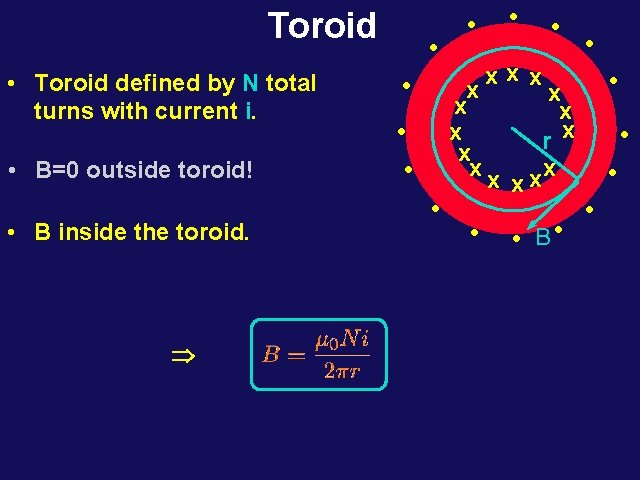
Toroid • Toroid defined by N total turns with current i. • B=0 outside toroid! • B inside the toroid. Þ • • xx x x xx • • • x x r xx xx • B • •
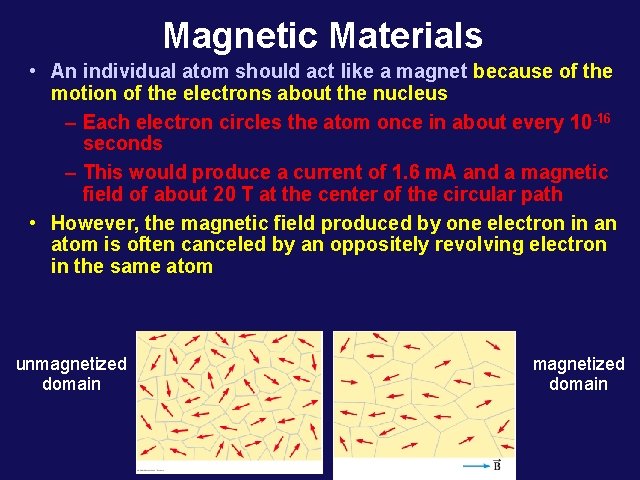
Magnetic Materials • An individual atom should act like a magnet because of the motion of the electrons about the nucleus – Each electron circles the atom once in about every 10 -16 seconds – This would produce a current of 1. 6 m. A and a magnetic field of about 20 T at the center of the circular path • However, the magnetic field produced by one electron in an atom is often canceled by an oppositely revolving electron in the same atom unmagnetized domain
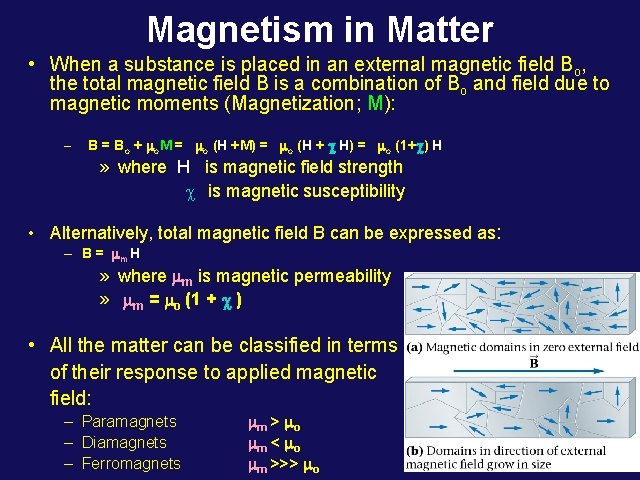
Magnetism in Matter • When a substance is placed in an external magnetic field Bo, the total magnetic field B is a combination of Bo and field due to magnetic moments (Magnetization; M): – B = Bo + mo. M = mo (H +M) = mo (H + c H) = mo (1+c) H » where H is magnetic field strength c is magnetic susceptibility • Alternatively, total magnetic field B can be expressed as: – B = mm H » where mm is magnetic permeability » mm = mo (1 + c ) • All the matter can be classified in terms of their response to applied magnetic field: – Paramagnets – Diamagnets – Ferromagnets mm > mo mm < mo mm >>> mo
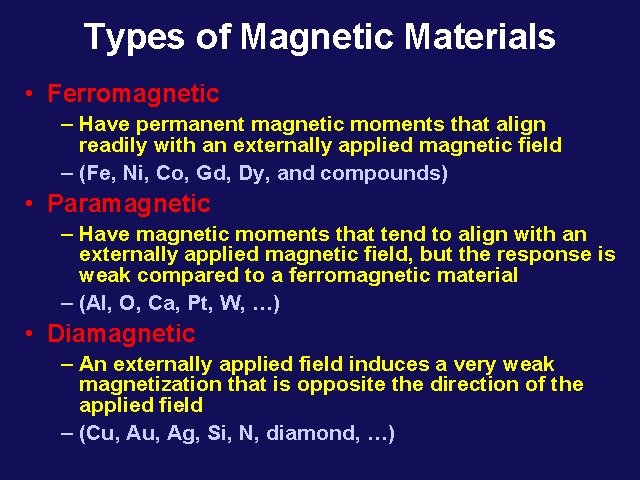
Types of Magnetic Materials • Ferromagnetic – Have permanent magnetic moments that align readily with an externally applied magnetic field – (Fe, Ni, Co, Gd, Dy, and compounds) • Paramagnetic – Have magnetic moments that tend to align with an externally applied magnetic field, but the response is weak compared to a ferromagnetic material – (Al, O, Ca, Pt, W, …) • Diamagnetic – An externally applied field induces a very weak magnetization that is opposite the direction of the applied field – (Cu, Ag, Si, N, diamond, …)
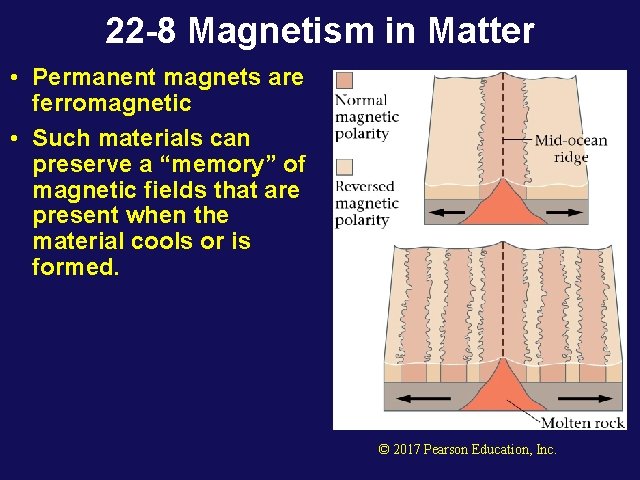
22 -8 Magnetism in Matter • Permanent magnets are ferromagnetic • Such materials can preserve a “memory” of magnetic fields that are present when the material cools or is formed. © 2017 Pearson Education, Inc.
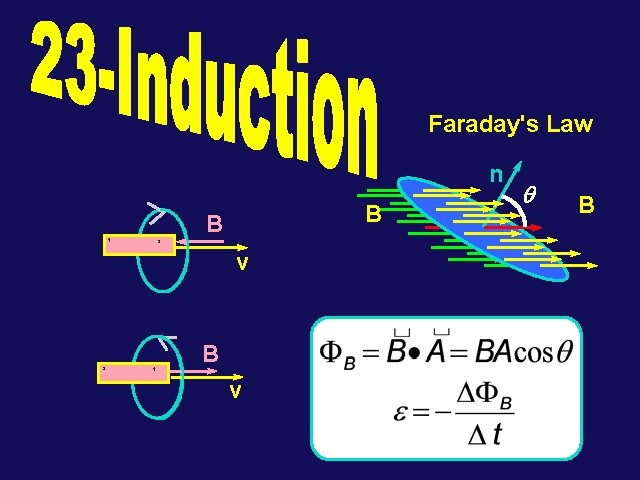
Faraday's Law n B B N S v S N B v q B
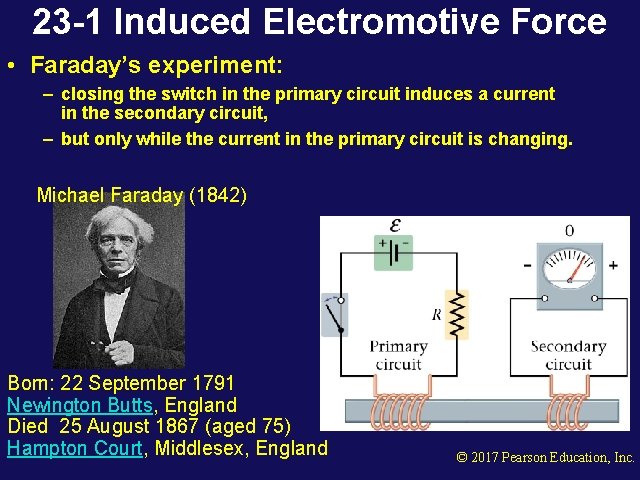
23 -1 Induced Electromotive Force • Faraday’s experiment: – closing the switch in the primary circuit induces a current in the secondary circuit, – but only while the current in the primary circuit is changing. Michael Faraday (1842) Born: 22 September 1791 Newington Butts, England Died 25 August 1867 (aged 75) Hampton Court, Middlesex, England © 2017 Pearson Education, Inc.
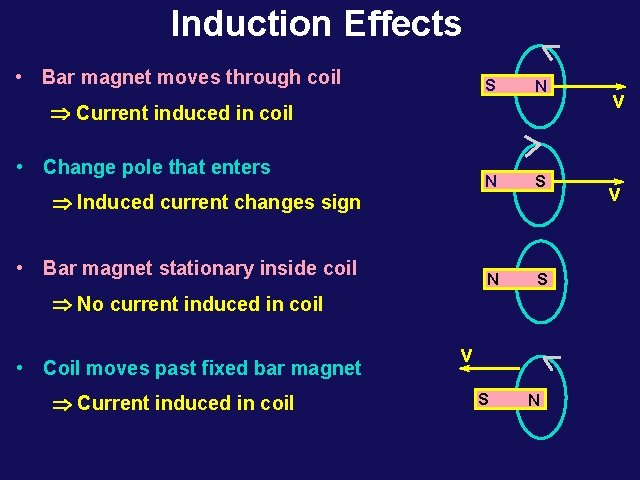
Induction Effects • Bar magnet moves through coil S N N S Þ Current induced in coil • Change pole that enters Þ Induced current changes sign • Bar magnet stationary inside coil Þ No current induced in coil • Coil moves past fixed bar magnet Þ Current induced in coil v S N v v
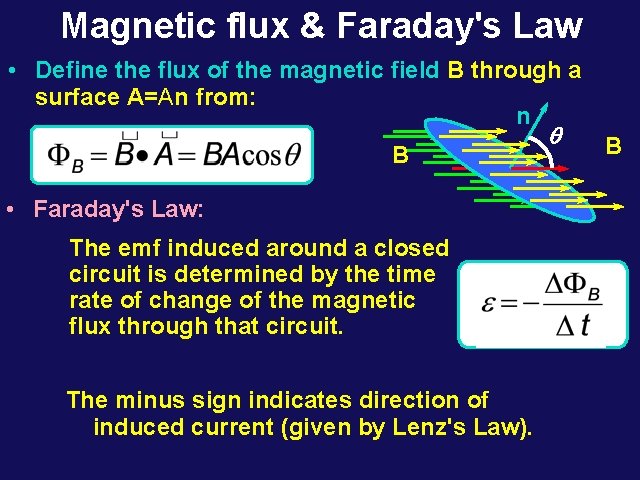
Magnetic flux & Faraday's Law • Define the flux of the magnetic field B through a surface A=An from: n q B B • Faraday's Law: The emf induced around a closed circuit is determined by the time rate of change of the magnetic flux through that circuit. The minus sign indicates direction of induced current (given by Lenz's Law).
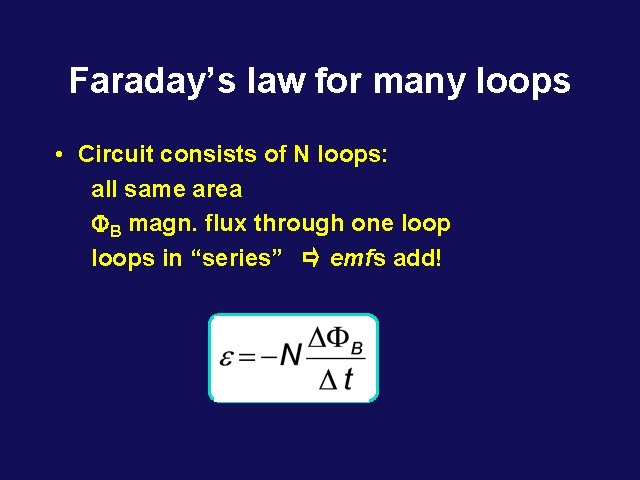
Faraday’s law for many loops • Circuit consists of N loops: all same area FB magn. flux through one loops in “series” emfs add!
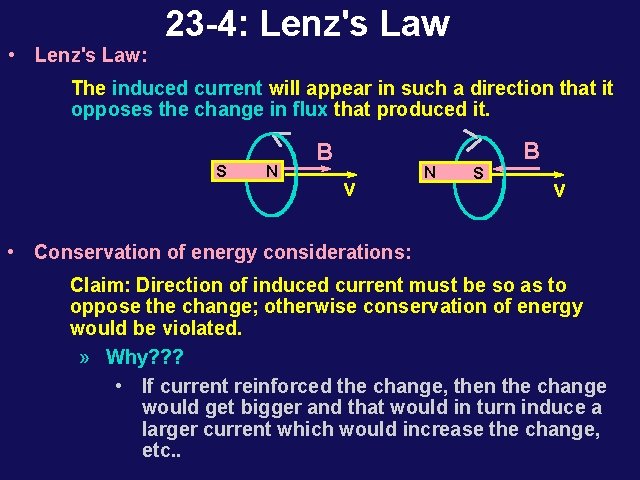
• Lenz's Law: 23 -4: Lenz's Law The induced current will appear in such a direction that it opposes the change in flux that produced it. S N B v N B S v • Conservation of energy considerations: Claim: Direction of induced current must be so as to oppose the change; otherwise conservation of energy would be violated. » Why? ? ? • If current reinforced the change, then the change would get bigger and that would in turn induce a larger current which would increase the change, etc. .
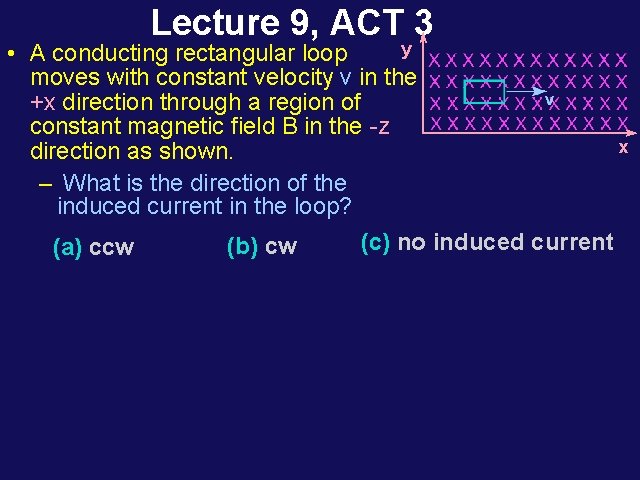
Lecture 9, ACT 3 y • A conducting rectangular loop moves with constant velocity v in the +x direction through a region of constant magnetic field B in the -z x direction as shown. – What is the direction of the induced current in the loop? (c) no induced current (b) cw (a) ccw
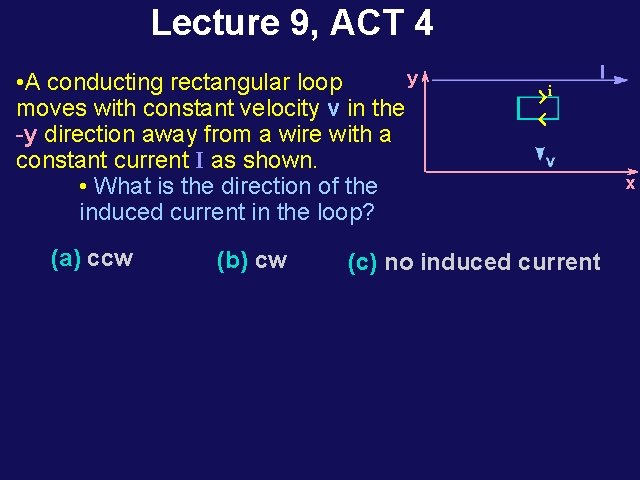
Lecture 9, ACT 4 y • A conducting rectangular loop moves with constant velocity v in the -y direction away from a wire with a constant current I as shown. • What is the direction of the induced current in the loop? (a) ccw (b) cw i (c) no induced current x
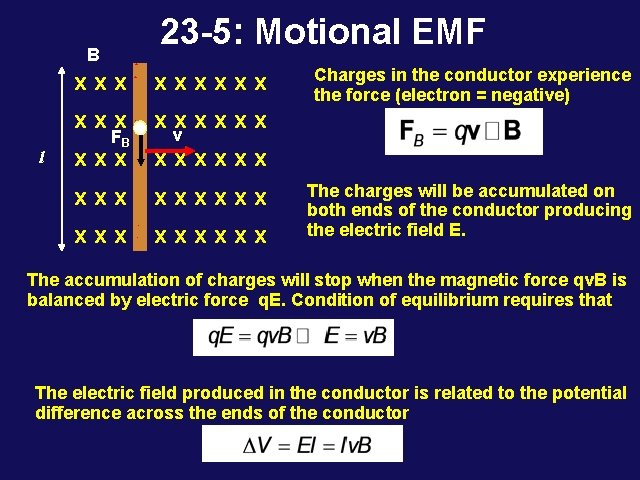
23 -5: Motional EMF B + xxxxx + Charges in the conductor experience the force (electron = negative) xxxxx - l v FB xxxxxxxxxx - - The charges will be accumulated on both ends of the conductor producing the electric field E. The accumulation of charges will stop when the magnetic force qv. B is balanced by electric force q. E. Condition of equilibrium requires that The electric field produced in the conductor is related to the potential difference across the ends of the conductor
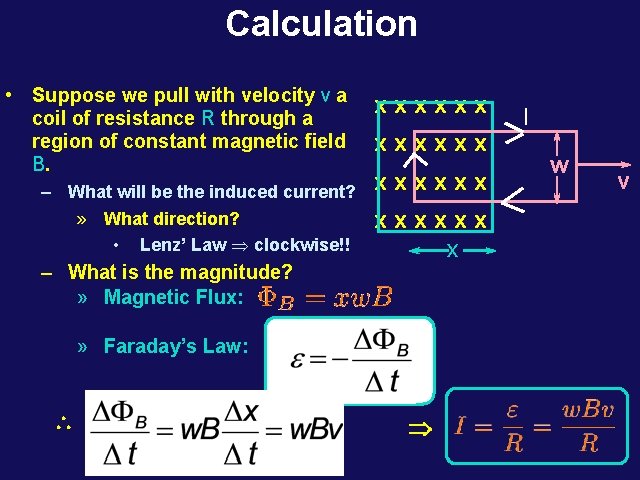
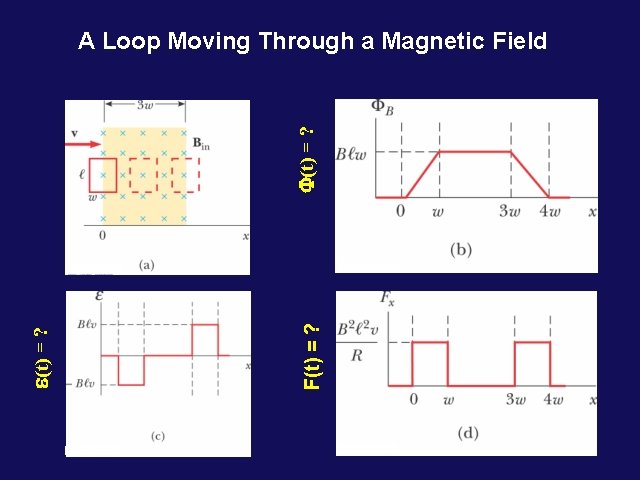
Calculation • Suppose we pull with velocity v a coil of resistance R through a region of constant magnetic field B. – What will be the induced current? » What direction? • Lenz’ Law Þ clockwise!! – What is the magnitude? » Magnetic Flux: xxxxxx x » Faraday’s Law: Þ I w v
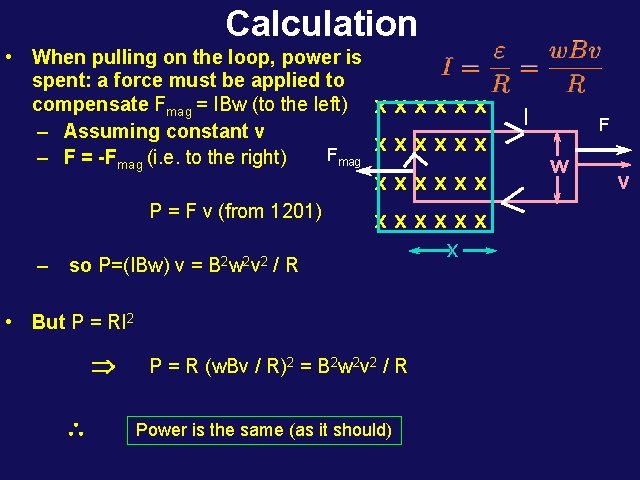
Calculation • When pulling on the loop, power is spent: a force must be applied to compensate Fmag = IBw (to the left) x x x – Assuming constant v xxxxxx F – F = -Fmag (i. e. to the right) mag xxxxxx P = F v (from 1201) – so P=(IBw) v = B 2 w 2 v 2 / R xxxxxx x • But P = RI 2 Þ P = R (w. Bv / R)2 = B 2 w 2 v 2 / R Power is the same (as it should) I F w v
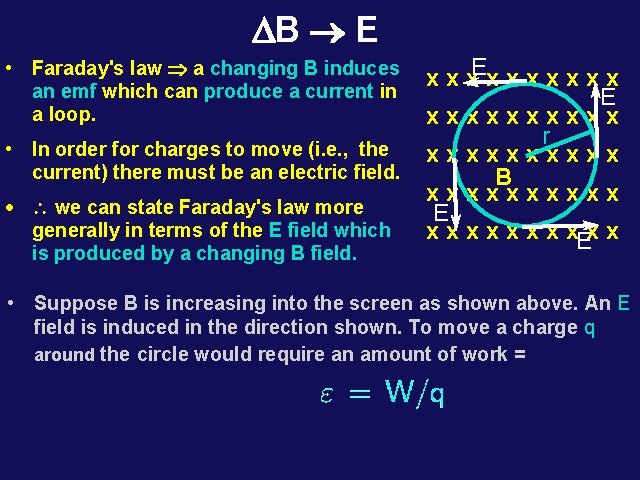
DB ® E • Faraday's law Þ a changing B induces an emf which can produce a current in a loop. • In order for charges to move (i. e. , the current) there must be an electric field. · we can state Faraday's law more generally in terms of the E field which is produced by a changing B field. x x x. Ex x x x E xxxxx r xxxxx B xxxxx E x x x x. Ex x • Suppose B is increasing into the screen as shown above. An E field is induced in the direction shown. To move a charge q around the circle would require an amount of work =
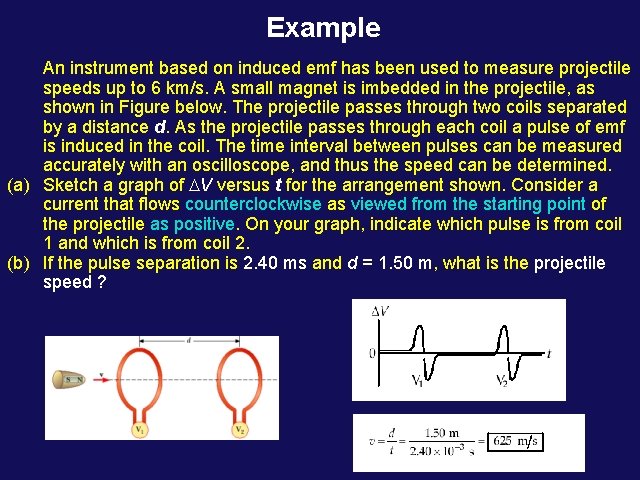
Example An instrument based on induced emf has been used to measure projectile speeds up to 6 km/s. A small magnet is imbedded in the projectile, as shown in Figure below. The projectile passes through two coils separated by a distance d. As the projectile passes through each coil a pulse of emf is induced in the coil. The time interval between pulses can be measured accurately with an oscilloscope, and thus the speed can be determined. (a) Sketch a graph of DV versus t for the arrangement shown. Consider a current that flows counterclockwise as viewed from the starting point of the projectile as positive. On your graph, indicate which pulse is from coil 1 and which is from coil 2. (b) If the pulse separation is 2. 40 ms and d = 1. 50 m, what is the projectile speed ?
F(t) = ? e(t) = ? F(t) = ? A Loop Moving Through a Magnetic Field
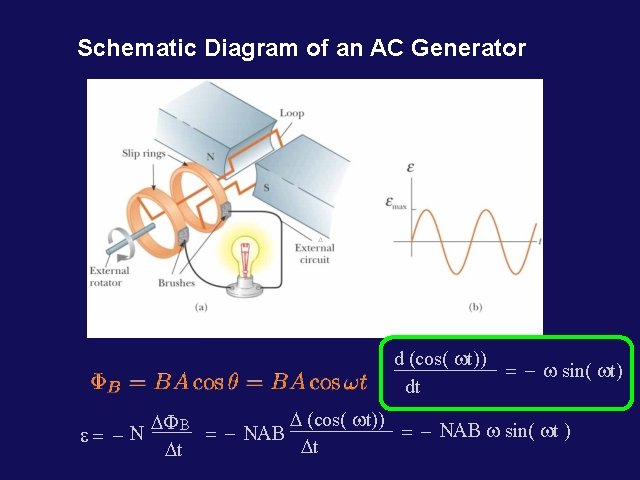
Schematic Diagram of an AC Generator D d (cos( wt)) = - w sin( wt) dt D (cos( wt)) DF B = - NAB w sin( wt ) = - NAB e= -N Dt Dt
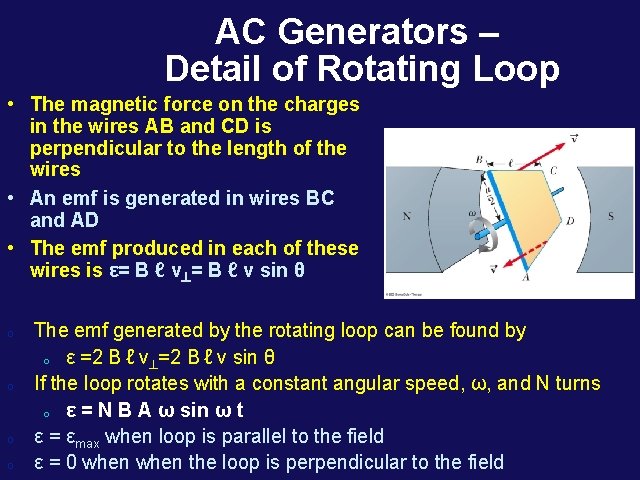
AC Generators – Detail of Rotating Loop • The magnetic force on the charges in the wires AB and CD is perpendicular to the length of the wires • An emf is generated in wires BC and AD • The emf produced in each of these wires is ε= B ℓ v sin θ o o The emf generated by the rotating loop can be found by o ε =2 B ℓ v sin θ If the loop rotates with a constant angular speed, ω, and N turns o ε = N B A ω sin ω t ε = εmax when loop is parallel to the field ε = 0 when the loop is perpendicular to the field
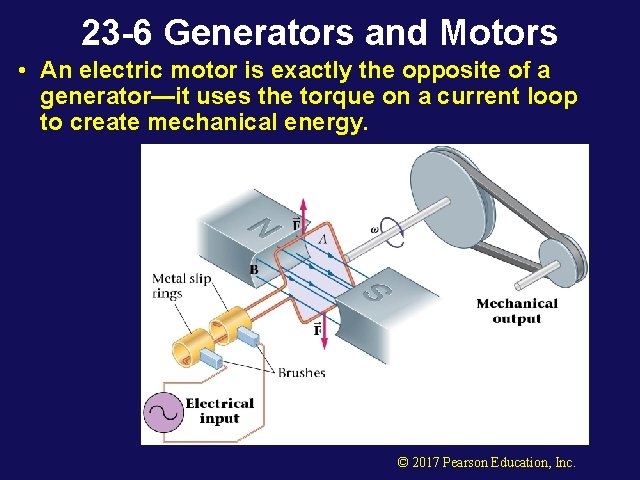
23 -6 Generators and Motors • An electric motor is exactly the opposite of a generator—it uses the torque on a current loop to create mechanical energy. © 2017 Pearson Education, Inc.
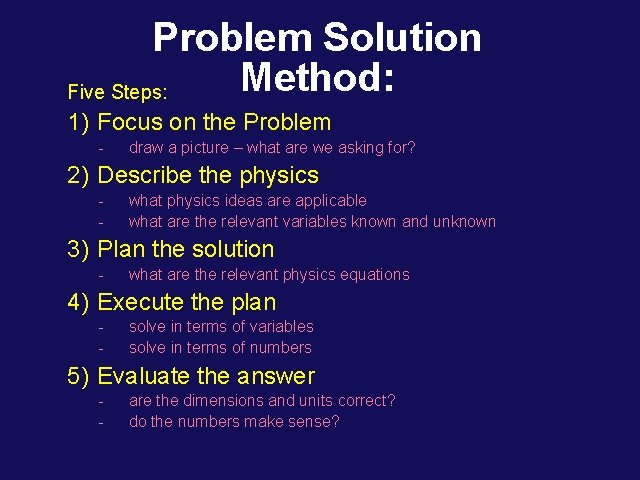
Problem Solution Method: Five Steps: 1) Focus on the Problem - draw a picture – what are we asking for? 2) Describe the physics - what physics ideas are applicable what are the relevant variables known and unknown 3) Plan the solution - what are the relevant physics equations 4) Execute the plan - solve in terms of variables solve in terms of numbers 5) Evaluate the answer - are the dimensions and units correct? do the numbers make sense?
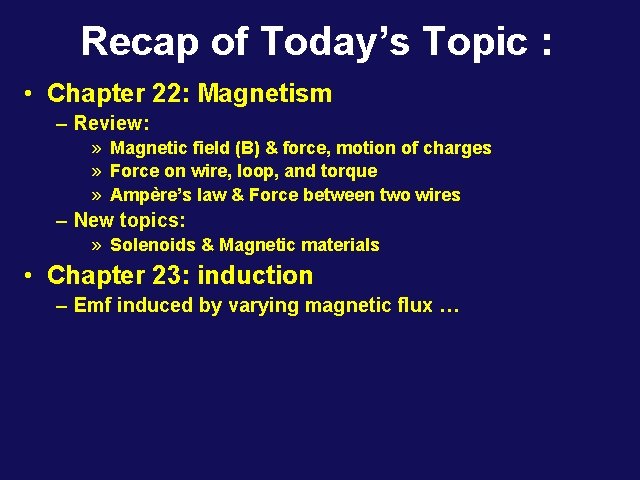
Recap of Today’s Topic : • Chapter 22: Magnetism – Review: » Magnetic field (B) & force, motion of charges » Force on wire, loop, and torque » Ampère’s law & Force between two wires – New topics: » Solenoids & Magnetic materials • Chapter 23: induction – Emf induced by varying magnetic flux …