
Physics 1202 Lecture 3 Todays Agenda Announcements Lectures
- Slides: 39
Physics 1202: Lecture 3 Today’s Agenda • Announcements: – Lectures posted on: www. phys. uconn. edu/~rcote/ – HW assignments, solutions etc. • Homework #1: – On Masterphysics: due this coming Friday – Go to the syllabus and click on instructions to register (in textbook section). – Make sure to input oyur information to google form https: //www. pearsonmylabandmastering. com/no rthamerica/ • Labs: Begin this week
Today’s Topic : • Chapter 19: Gauss’s law – Examples … • Chapter 20: Electric energy & potential – – Definition How to compute them Point charges Equipotentials
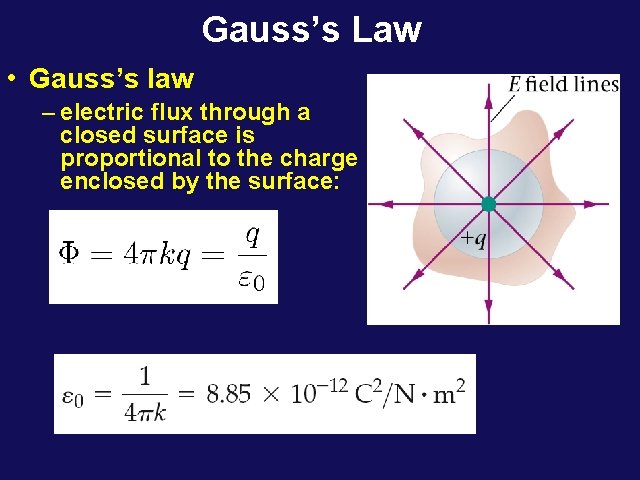
Gauss’s Law • Gauss’s law – electric flux through a closed surface is proportional to the charge enclosed by the surface:
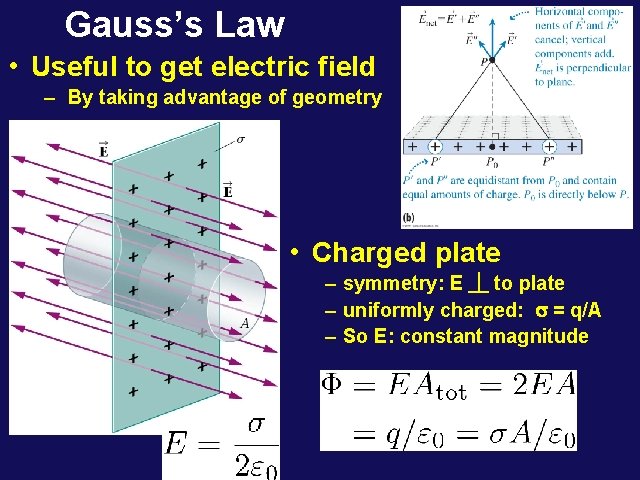
Gauss’s Law • Useful to get electric field – By taking advantage of geometry • Charged plate – symmetry: E ⏊ to plate – uniformly charged: s = q/A – So E: constant magnitude
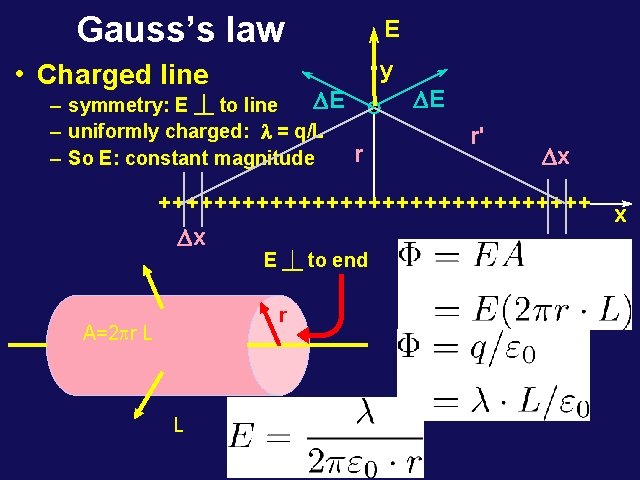
Gauss’s law E y • Charged line DE – symmetry: E ⏊ to line – uniformly charged: l = q/L r – So E: constant magnitude DE r' Dx ++++++++++++++++ x Dx E ⏊ to end r A=2 pr L L
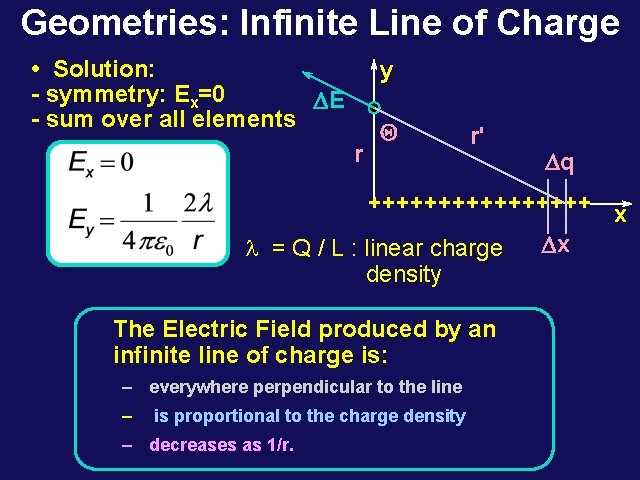
Geometries: Infinite Line of Charge • Solution: - symmetry: Ex=0 DE - sum over all elements y r Q r' Dq ++++++++ x Dx l = Q / L : linear charge density The Electric Field produced by an infinite line of charge is: – everywhere perpendicular to the line – is proportional to the charge density – decreases as 1/r.
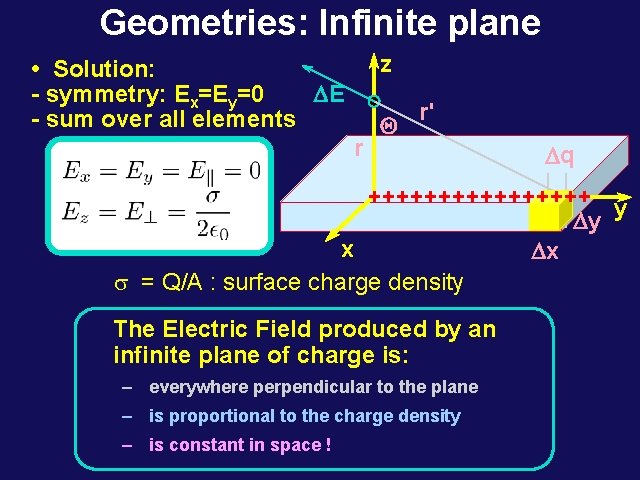
Geometries: Infinite plane z • Solution: DE - symmetry: Ex=Ey=0 - sum over all elements r Q r' Dq ++++++++ y Dy x Dx s = Q/A : surface charge density The Electric Field produced by an infinite plane of charge is: – everywhere perpendicular to the plane – is proportional to the charge density – is constant in space !
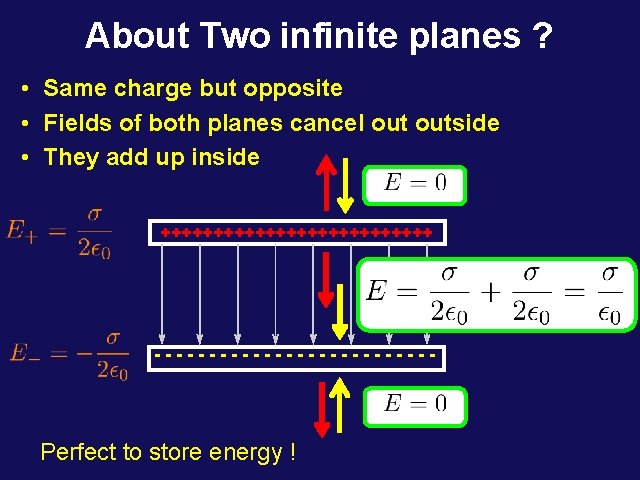
About Two infinite planes ? • Same charge but opposite • Fields of both planes cancel outside • They add up inside +++++++++++++ ------------- Perfect to store energy !
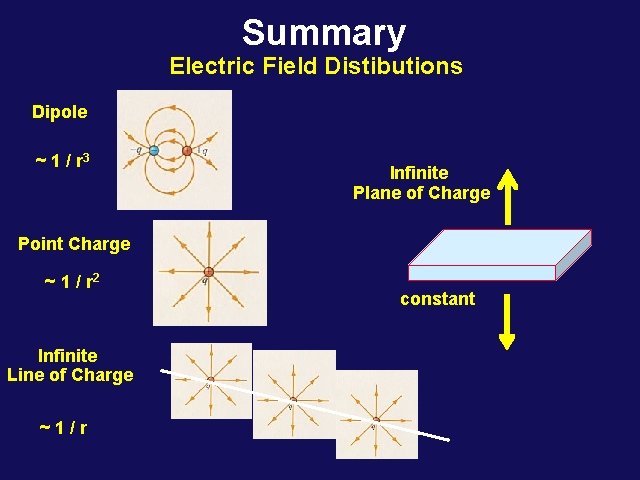
Summary Electric Field Distibutions Dipole ~ 1 / r 3 Infinite Plane of Charge Point Charge ~ 1 / r 2 Infinite Line of Charge ~1/r constant
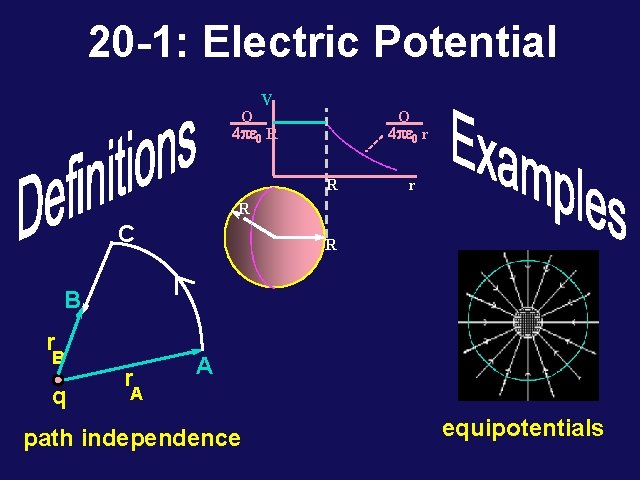
20 -1: Electric Potential V Q 4 pe 0 r Q 4 pe 0 R R r R C R B r B q r A A path independence equipotentials
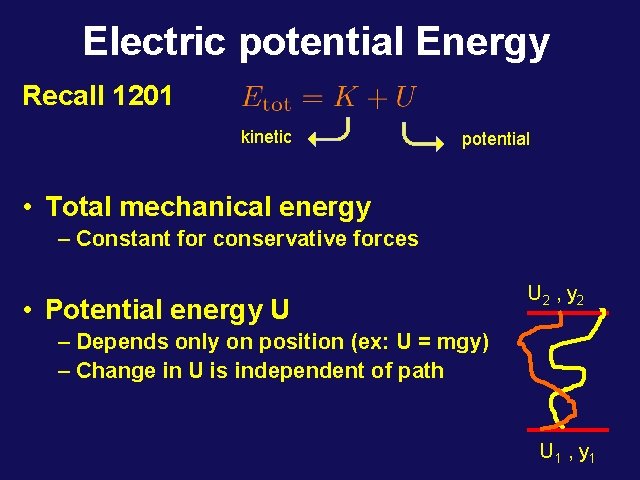
Electric potential Energy Recall 1201 kinetic potential • Total mechanical energy – Constant for conservative forces • Potential energy U U 2 , y 2 – Depends only on position (ex: U = mgy) – Change in U is independent of path U 1 , y 1
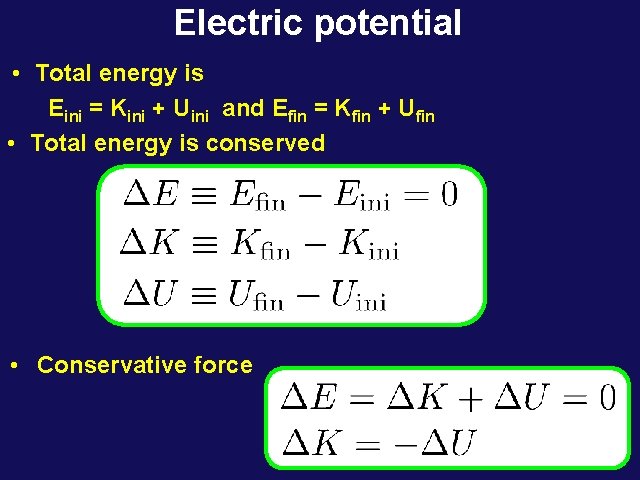
Electric potential • Total energy is Eini = Kini + Uini and Efin = Kfin + Ufin • Total energy is conserved • Conservative force
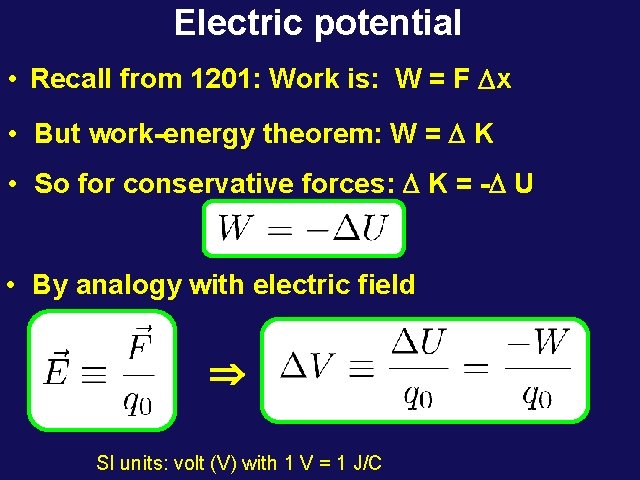
Electric potential • Recall from 1201: Work is: W = F Dx • But work-energy theorem: W = D K • So for conservative forces: D K = -D U • By analogy with electric field Þ SI units: volt (V) with 1 V = 1 J/C
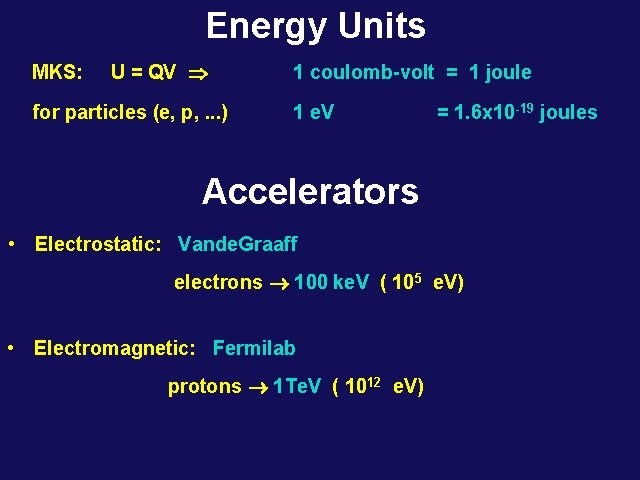
Energy Units MKS: U = QV Þ for particles (e, p, . . . ) 1 coulomb-volt = 1 joule 1 e. V = 1. 6 x 10 -19 joules Accelerators • Electrostatic: Vande. Graaff electrons ® 100 ke. V ( 105 e. V) • Electromagnetic: Fermilab protons ® 1 Te. V ( 1012 e. V)
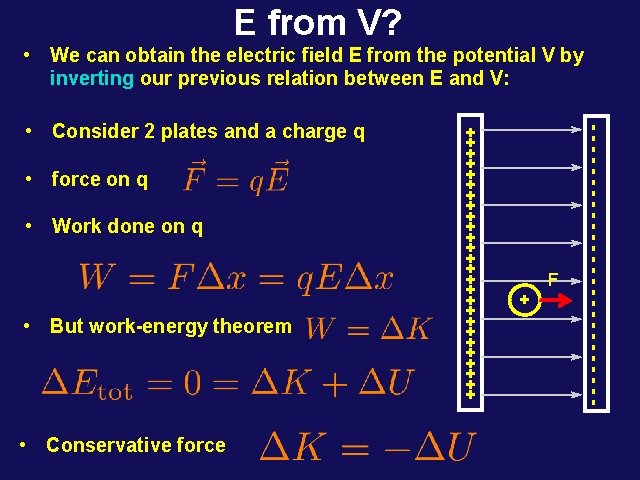
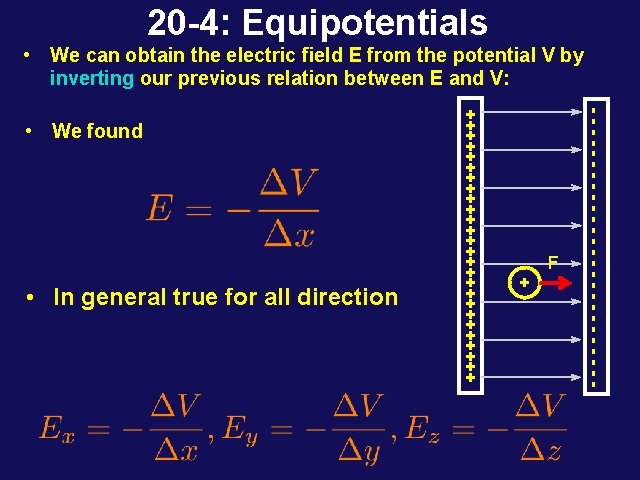
E from V? • Work done on q • But work-energy theorem • Conservative force F ------------- • force on q + • Consider 2 plates and a charge q +++++++++++++ • We can obtain the electric field E from the potential V by inverting our previous relation between E and V:
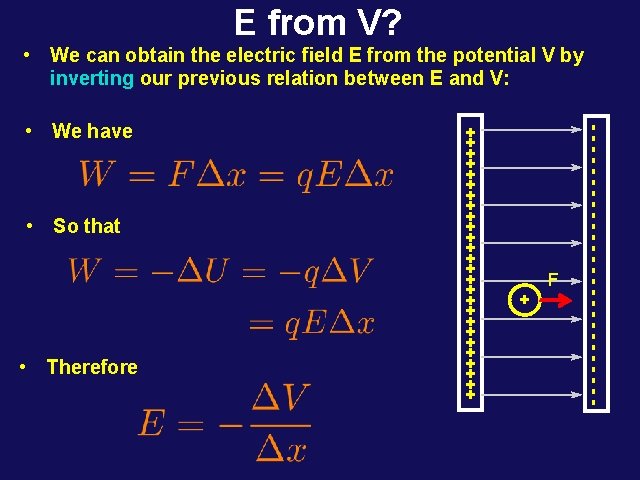
E from V? • Therefore F ------------- • So that + • We have +++++++++++++ • We can obtain the electric field E from the potential V by inverting our previous relation between E and V:
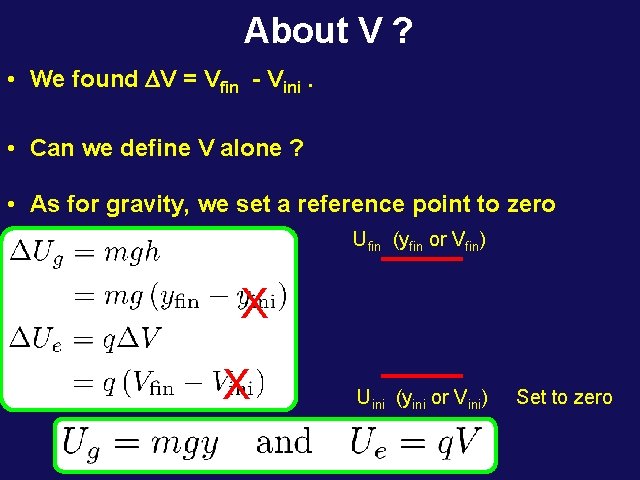
About V ? • We found DV = Vfin - Vini. • Can we define V alone ? • As for gravity, we set a reference point to zero Ufin (yfin or Vfin) X X Uini (yini or Vini) Set to zero
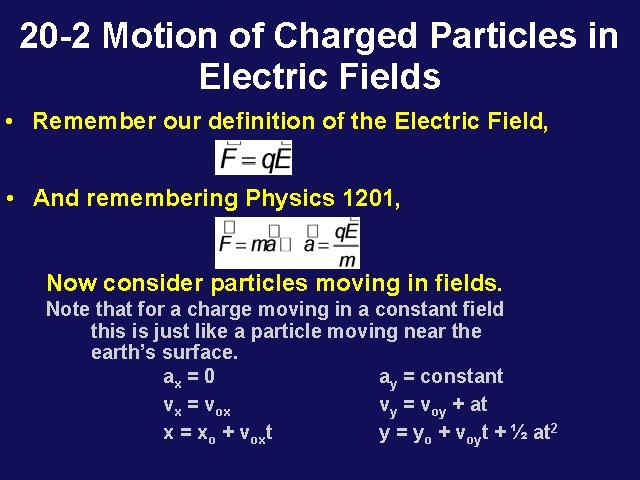
20 -2 Motion of Charged Particles in Electric Fields • Remember our definition of the Electric Field, • And remembering Physics 1201, Now consider particles moving in fields. Note that for a charge moving in a constant field this is just like a particle moving near the earth’s surface. ax = 0 ay = constant vx = vox vy = voy + at x = xo + voxt y = yo + voyt + ½ at 2
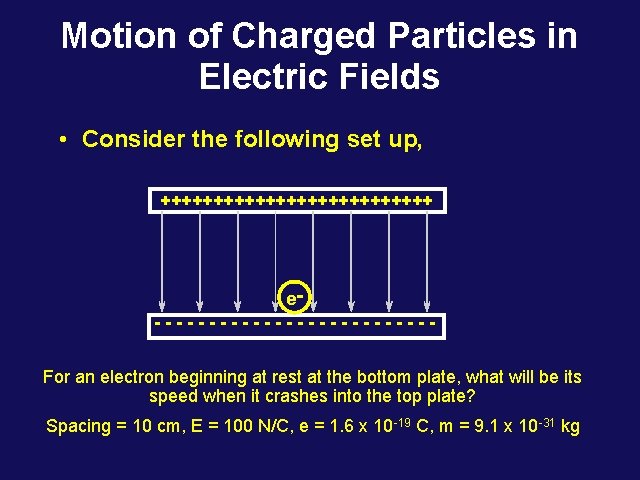
Motion of Charged Particles in Electric Fields • Consider the following set up, +++++++++++++ e-------------For an electron beginning at rest at the bottom plate, what will be its speed when it crashes into the top plate? Spacing = 10 cm, E = 100 N/C, e = 1. 6 x 10 -19 C, m = 9. 1 x 10 -31 kg
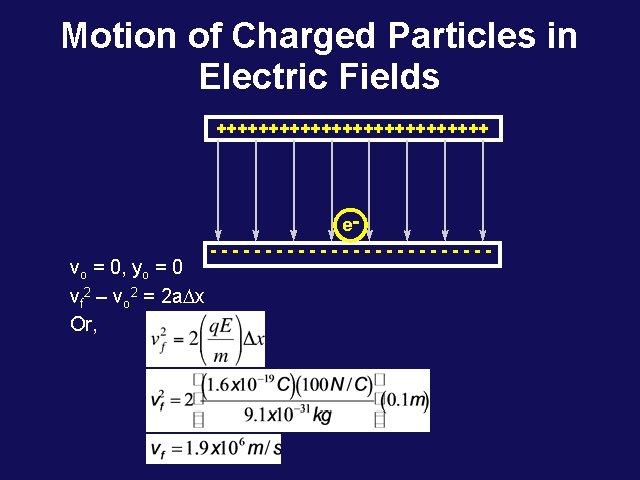
Motion of Charged Particles in Electric Fields +++++++++++++ vo = 0, yo = 0 vf 2 – vo 2 = 2 a. Dx Or, e-------------
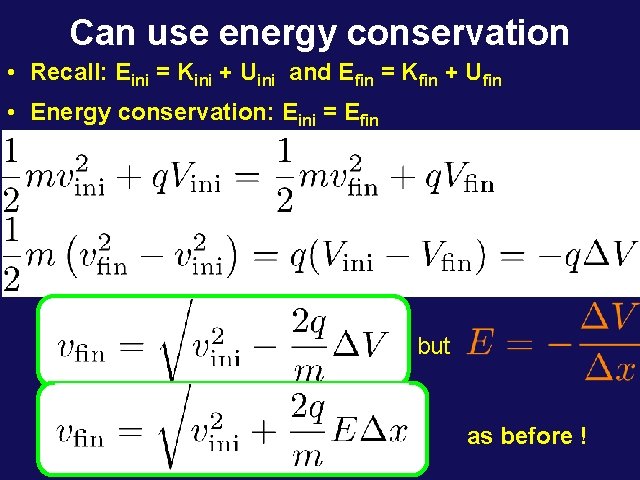
Can use energy conservation • Recall: Eini = Kini + Uini and Efin = Kfin + Ufin • Energy conservation: Eini = Efin but as before !
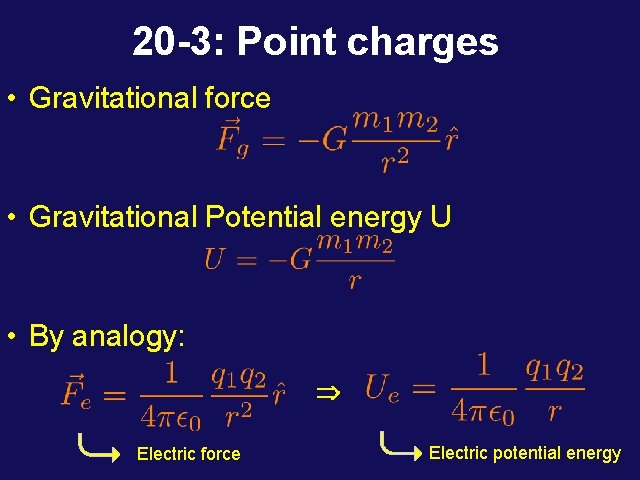
20 -3: Point charges • Gravitational force • Gravitational Potential energy U • By analogy: Þ Electric force Electric potential energy
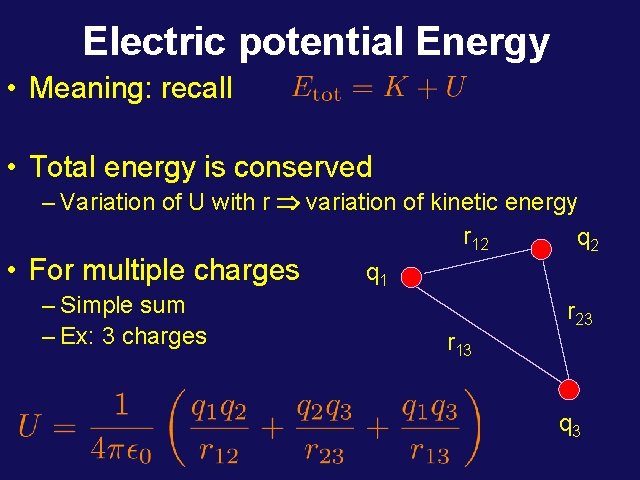
Electric potential Energy • Meaning: recall • Total energy is conserved • – Variation of U with r Þ variation of kinetic energy r 12 q 2 For multiple charges q 1 – Simple sum r 23 – Ex: 3 charges r 13 q 3
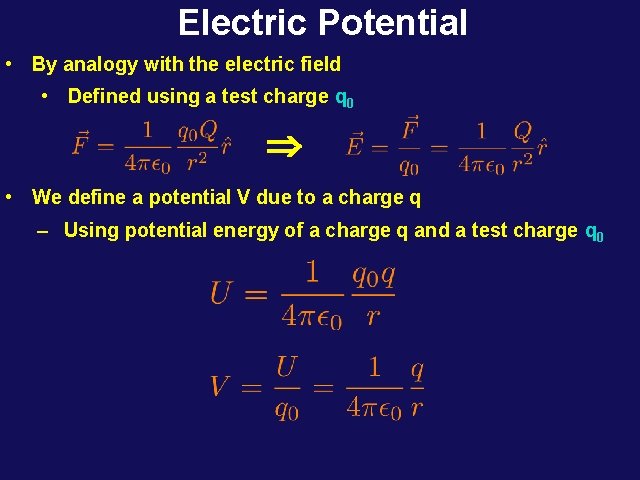
Electric Potential • By analogy with the electric field • Defined using a test charge q 0 Þ • We define a potential V due to a charge q – Using potential energy of a charge q and a test charge q 0
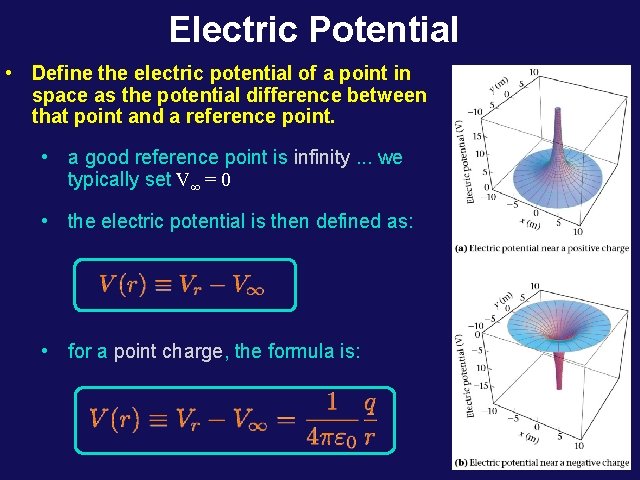
Electric Potential • Define the electric potential of a point in space as the potential difference between that point and a reference point. • a good reference point is infinity. . . we typically set V = 0 • the electric potential is then defined as: • for a point charge, the formula is:
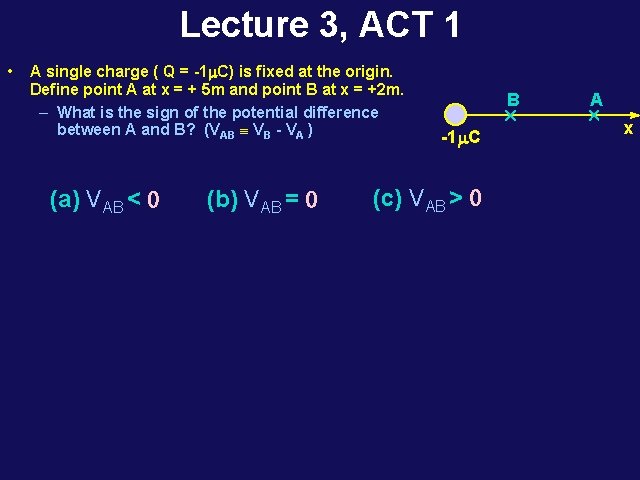
Lecture 3, ACT 1 • A single charge ( Q = -1 m. C) is fixed at the origin. Define point A at x = + 5 m and point B at x = +2 m. – What is the sign of the potential difference between A and B? (VAB º VB - VA ) (a) VAB < 0 (b) VAB = 0 B ´ -1 m. C (c) VAB > 0 A ´ x
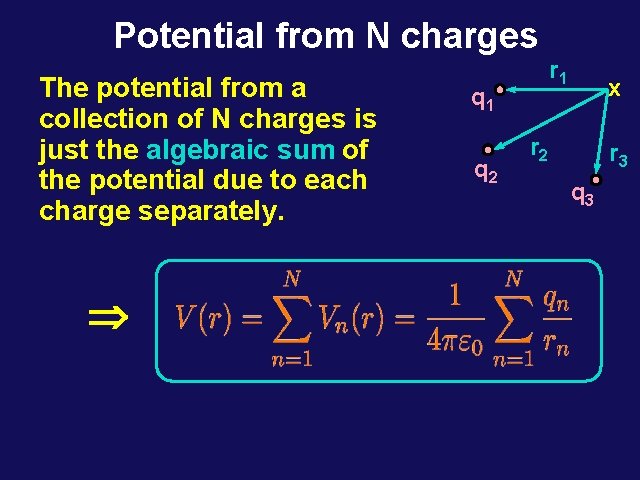
Potential from N charges The potential from a collection of N charges is just the algebraic sum of the potential due to each charge separately. Þ r 1 q 2 x r 2 r 3 q 3
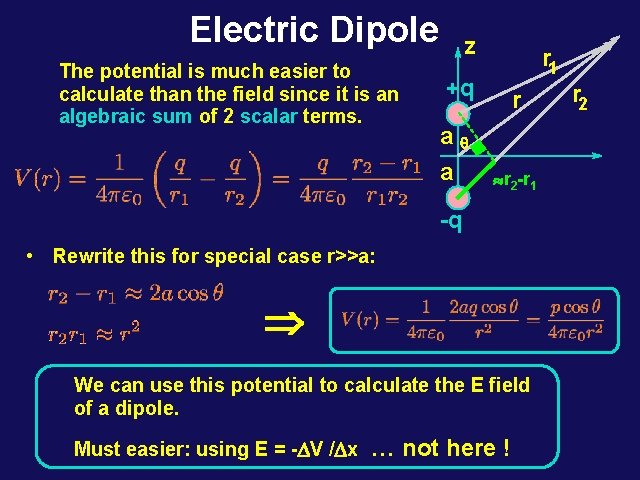
Electric Dipole The potential is much easier to calculate than the field since it is an algebraic sum of 2 scalar terms. z r 1 +q r aq a r 2 -r 1 -q • Rewrite this for special case r>>a: Þ We can use this potential to calculate the E field of a dipole. Must easier: using E = -DV /Dx … not here ! r 2
20 -4: Equipotentials ------------- • In general true for all direction F + • We found +++++++++++++ • We can obtain the electric field E from the potential V by inverting our previous relation between E and V:
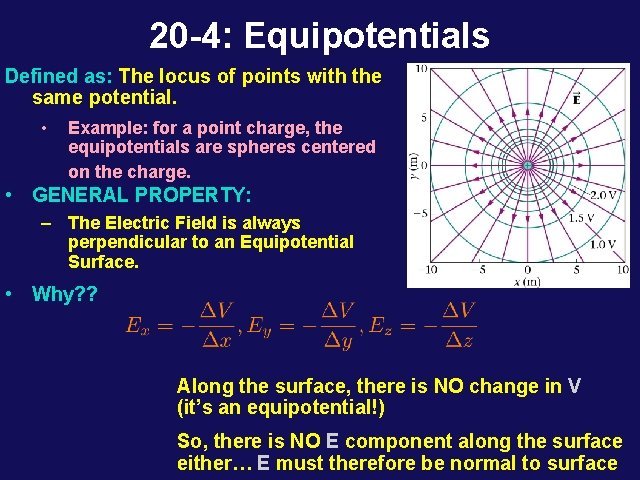
20 -4: Equipotentials Defined as: The locus of points with the same potential. • Example: for a point charge, the equipotentials are spheres centered on the charge. • GENERAL PROPERTY: – The Electric Field is always perpendicular to an Equipotential Surface. • Why? ? Along the surface, there is NO change in V (it’s an equipotential!) So, there is NO E component along the surface either… E must therefore be normal to surface
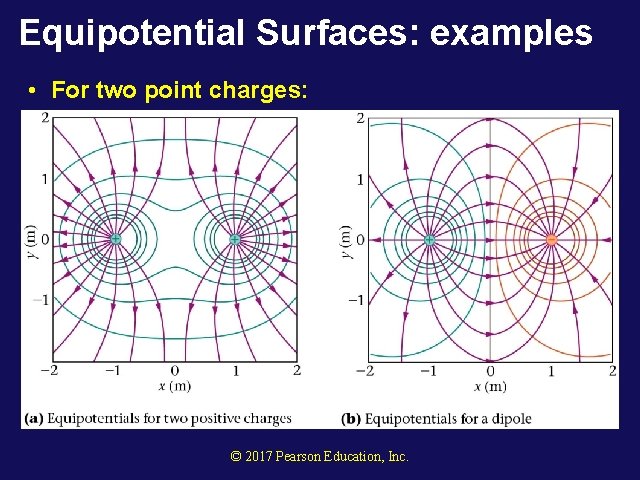
Equipotential Surfaces: examples • For two point charges: © 2017 Pearson Education, Inc.
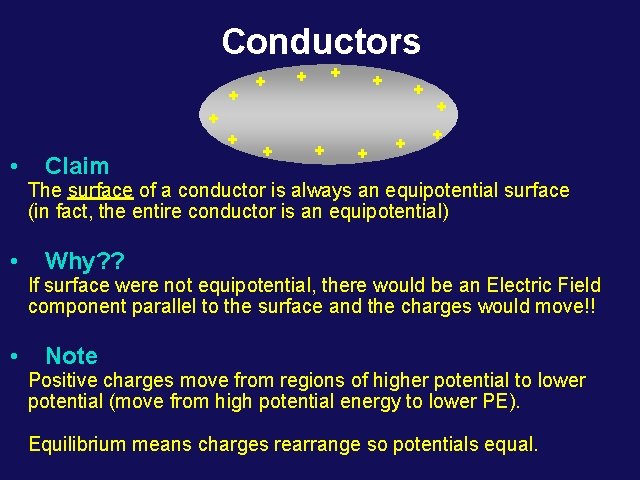
Conductors + + + + • • • Claim + + + The surface of a conductor is always an equipotential surface (in fact, the entire conductor is an equipotential) Why? ? If surface were not equipotential, there would be an Electric Field component parallel to the surface and the charges would move!! Note Positive charges move from regions of higher potential to lower potential (move from high potential energy to lower PE). Equilibrium means charges rearrange so potentials equal.
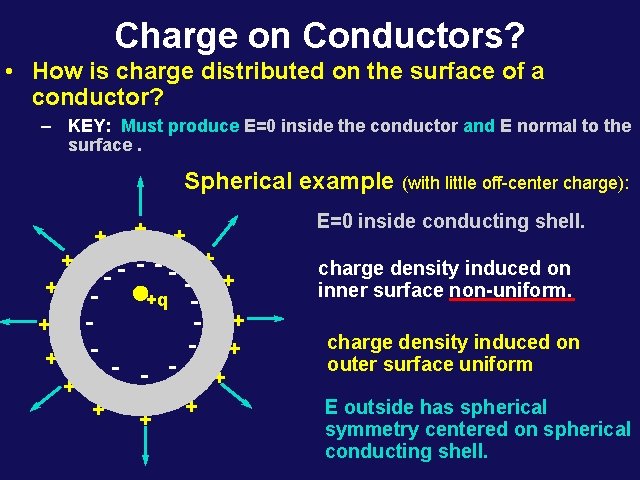
Charge on Conductors? • How is charge distributed on the surface of a conductor? – KEY: Must produce E=0 inside the conductor and E normal to the surface. Spherical example + + + - -- + +q - - + - E=0 inside conducting shell. + + + (with little off-center charge): charge density induced on inner surface non-uniform. charge density induced on outer surface uniform E outside has spherical symmetry centered on spherical conducting shell.
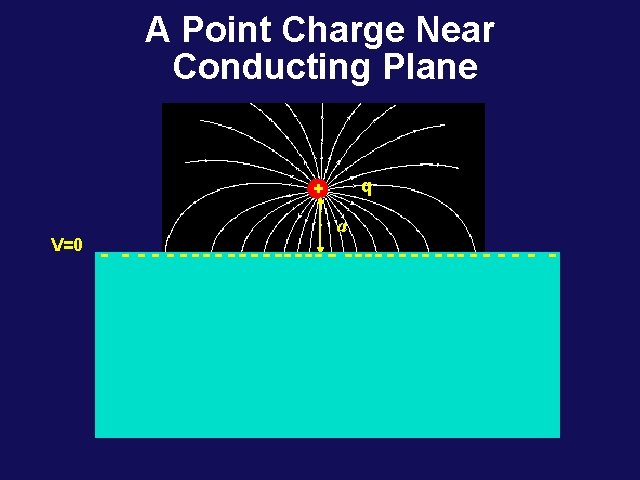
A Point Charge Near Conducting Plane q + V=0 a - - - -- - - - - -
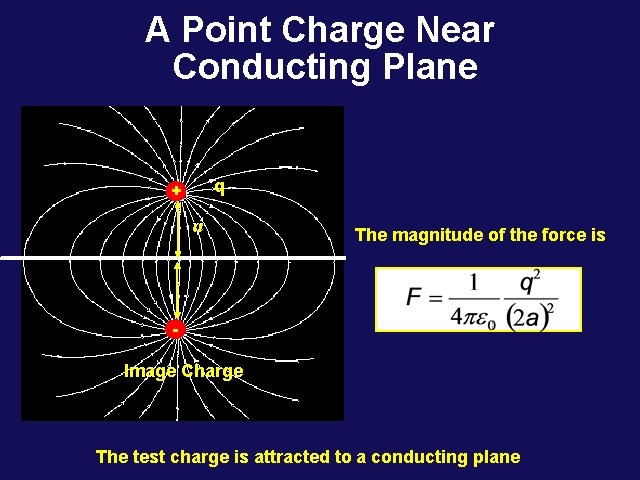
A Point Charge Near Conducting Plane q + a The magnitude of the force is Image Charge The test charge is attracted to a conducting plane
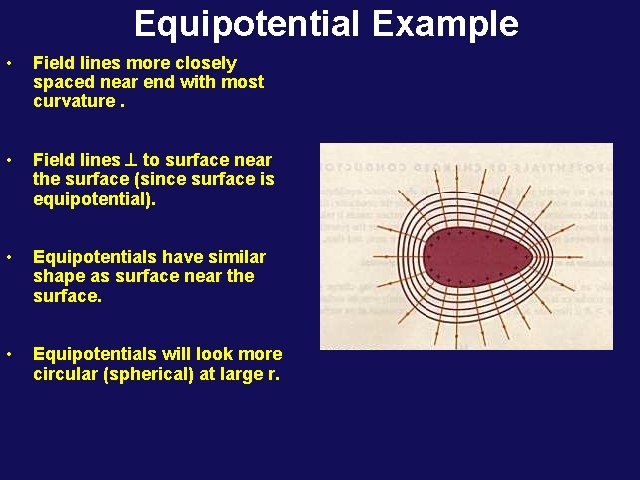
Equipotential Example • Field lines more closely spaced near end with most curvature. • Field lines ^ to surface near the surface (since surface is equipotential). • Equipotentials have similar shape as surface near the surface. • Equipotentials will look more circular (spherical) at large r.
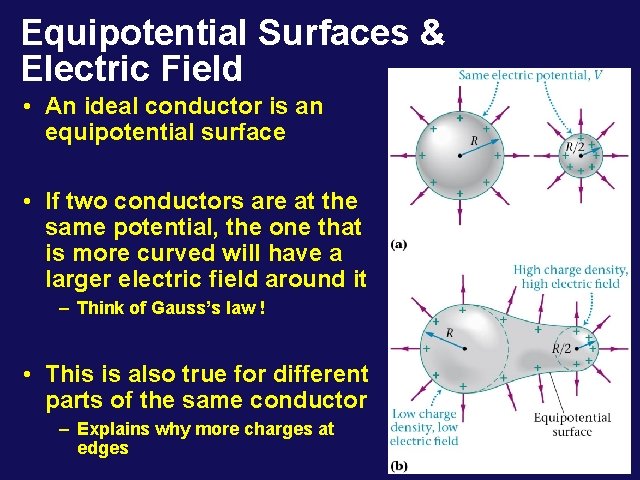
Equipotential Surfaces & Electric Field • An ideal conductor is an equipotential surface • If two conductors are at the same potential, the one that is more curved will have a larger electric field around it – Think of Gauss’s law ! • This is also true for different parts of the same conductor – Explains why more charges at edges
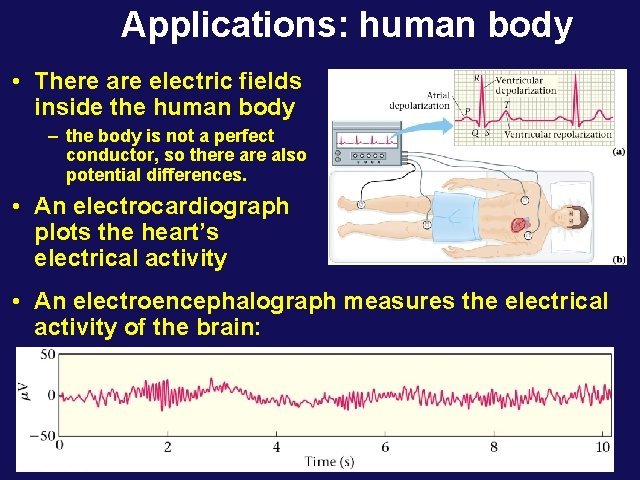
Applications: human body • There are electric fields inside the human body – the body is not a perfect conductor, so there also potential differences. • An electrocardiograph plots the heart’s electrical activity • An electroencephalograph measures the electrical activity of the brain:
Recap of today’s lecture • Chapter 19: Gauss’s law – Examples … • Chapter 20: Electric energy & potential – – Definition How to compute them Point charges Equipotentials • Homework #1 on Mastering Physics – From Chapter 19 – Due this Friday – Labs start this week