
Physics 12 UCSD Solar Energy Introduction to renewable
Physics 12 UCSD Solar Energy Introduction to renewable energy Energy from the sun 2 Q
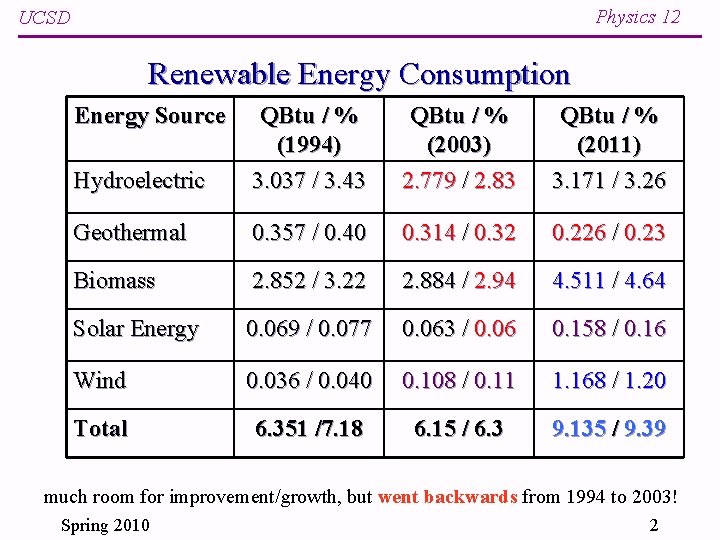
Physics 12 UCSD Renewable Energy Consumption Energy Source Hydroelectric QBtu / % (1994) 3. 037 / 3. 43 QBtu / % (2003) 2. 779 / 2. 83 QBtu / % (2011) 3. 171 / 3. 26 Geothermal 0. 357 / 0. 40 0. 314 / 0. 32 0. 226 / 0. 23 Biomass 2. 852 / 3. 22 2. 884 / 2. 94 4. 511 / 4. 64 Solar Energy 0. 069 / 0. 077 0. 063 / 0. 06 0. 158 / 0. 16 Wind 0. 036 / 0. 040 0. 108 / 0. 11 1. 168 / 1. 20 Total 6. 351 /7. 18 6. 15 / 6. 3 9. 135 / 9. 39 much room for improvement/growth, but went backwards from 1994 to 2003! Spring 2010 2
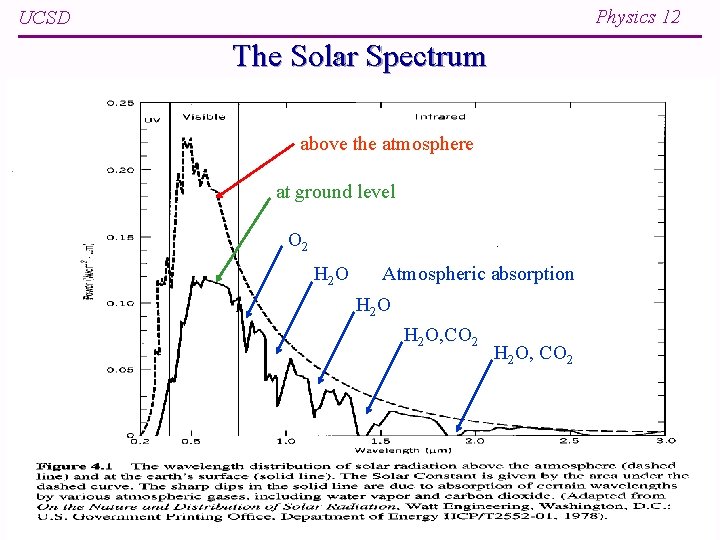
Physics 12 UCSD The Solar Spectrum above the atmosphere at ground level O 2 H 2 O Atmospheric absorption H 2 O H 2 O, CO 2 Spring 2010 H 2 O, CO 2 3
Physics 12 UCSD How much energy is available? • Above the atmosphere, we get 1368 W/m 2 of radiated power from the sun, across all wavelengths – This number varies by ± 3% as our distance to the sun increases or decreases (elliptical orbit) – The book uses 2 calories per minute per cm 2 (weird units!!) • At the ground, this number is smaller due to scattering and absorption in the atmosphere – about 63%, or ~850 W/m 2 with no clouds, perpendicular surface – probably higher in dry desert air Spring 2010 Q 4
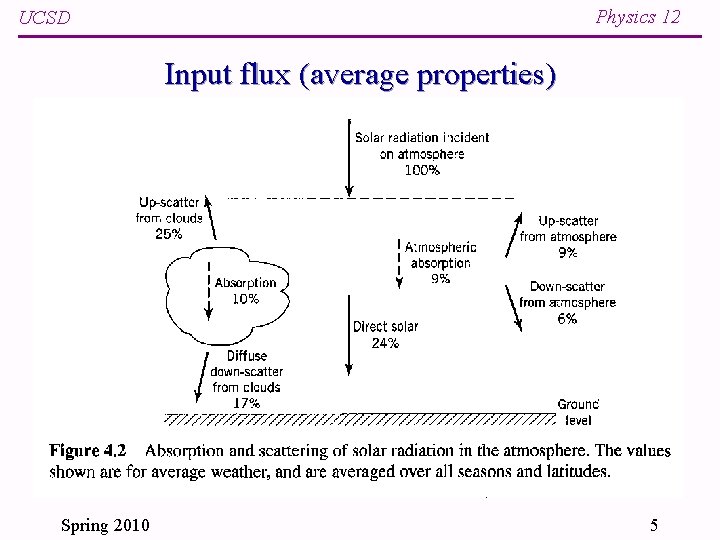
Physics 12 UCSD Input flux (average properties) Spring 2010 5
Physics 12 UCSD Making sense of the data • We can infer a number of things from the previous figure: – 52% of the incoming light hits clouds, 48% does not • 25% + 10% + 17% – in cloudless conditions, half (24/48) is direct, 63% (30/48) reaches the ground – in cloudy conditions, 17/52 = 33% reaches the ground: about half of the light of a cloudless day – averaging all conditions, about half of the sunlight incident on the earth reaches the ground – the above analysis is simplified: assumes atmospheric scattering/absorption is not relevant when cloudy Spring 2010 2 Q 6
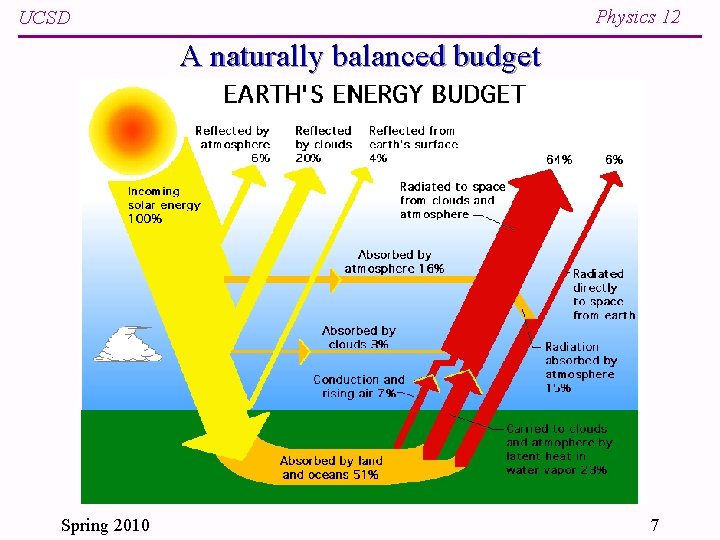
Physics 12 UCSD A naturally balanced budget Spring 2010 7
Physics 12 UCSD Comparable numbers • Both versions indicate about half the light reaching (being absorbed by) the ground – 47% vs. 51% • Both versions have about 1/3 reflected back to space – 34% vs. 30% • Both versions have about 1/5 absorbed in the atmosphere/clouds – 19% vs. 19% Spring 2010 8
Physics 12 UCSD Energy Balance • Note that every bit of the energy received by the sun is reflected or radiated back to space • If this were not true, earth’s temperature would change until the radiation out balanced the radiation in • In this way, we can compute surface temperatures of other planets (and they compare well with measurements) Spring 2010 9
Physics 12 UCSD Average Insolation • The amount of light received by a horizontal surface (in W/m 2) averaged over the year (day & night) is called the insolation • We can make a guess based on the facts that on average: – half the incident light reaches the ground – half the time it is day – the sun isn’t always overhead, so that the effective area of a horizontal surface is half it’s actual area • half the sphere (2 R 2) projects into just R 2 for the sun • twice as much area as the sun “sees” • So 1/8 of the incident sunlight is typically available at the ground – 171 W/m 2 on average Spring 2010 10
Physics 12 UCSD Insolation variation • While the average insolation is 171 W/m 2, variations in cloud cover and latitude can produce a large variation in this number – A spot in the Sahara (always sunny, near the equator) may have 270 W/m 2 on average – Alaska, often covered in clouds and at high latitude may get only 75 W/m 2 on average – Is it any wonder that one is cold while one is hot? Spring 2010 Q 11
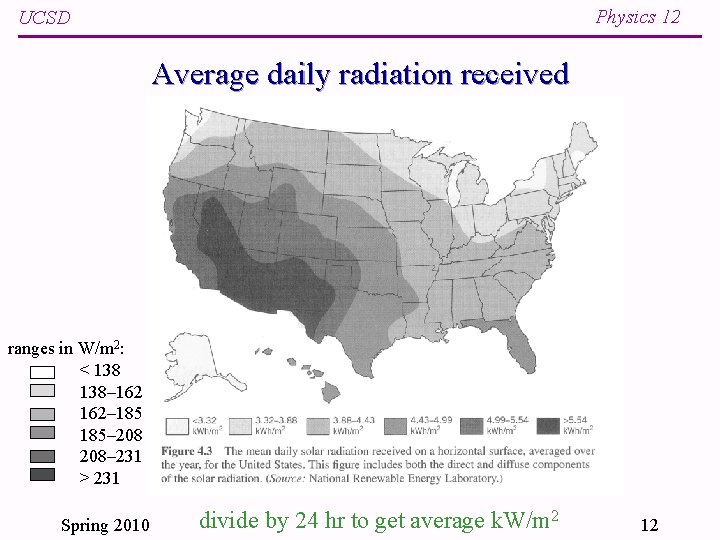
Physics 12 UCSD Average daily radiation received ranges in W/m 2: < 138– 162– 185– 208– 231 > 231 Spring 2010 divide by 24 hr to get average k. W/m 2 12
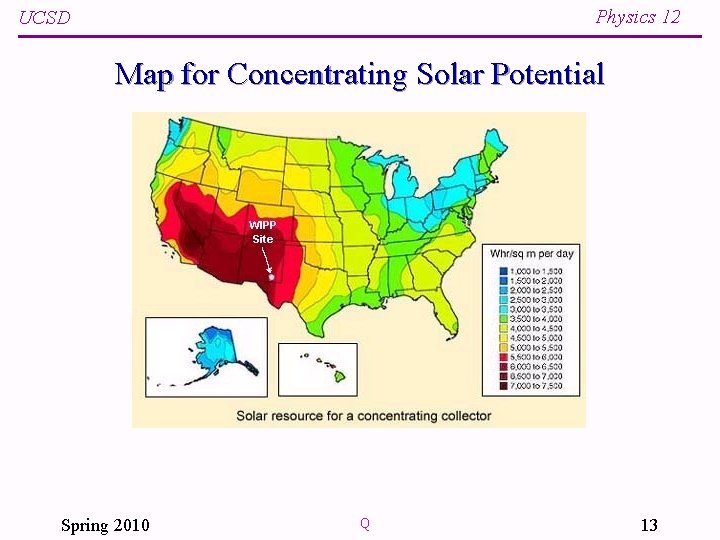
Physics 12 UCSD Map for Concentrating Solar Potential Spring 2010 Q 13
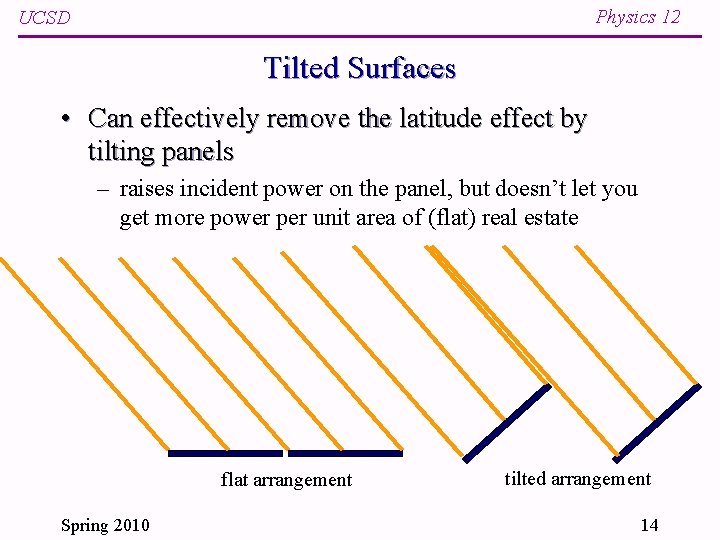
Physics 12 UCSD Tilted Surfaces • Can effectively remove the latitude effect by tilting panels – raises incident power on the panel, but doesn’t let you get more power per unit area of (flat) real estate flat arrangement Spring 2010 tilted arrangement 14
Physics 12 UCSD Which is best? • To tilt, or not to tilt? • If the materials for solar panels were cheap, then it would make little difference (on flat land) • If you have a limited number of panels (rather than limited flat space) then tilting is better • If you have a slope (hillside or roof), then you have a built-in gain • Best solution of all (though complex) is to steer and track the sun Spring 2010 15
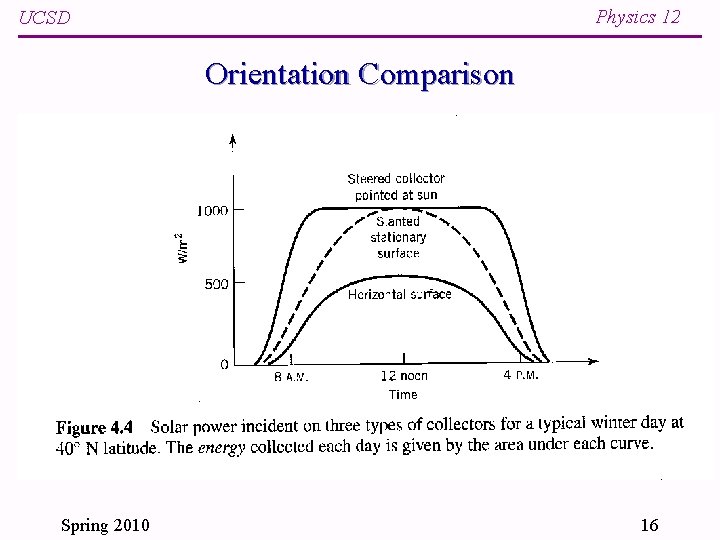
Physics 12 UCSD Orientation Comparison Spring 2010 16
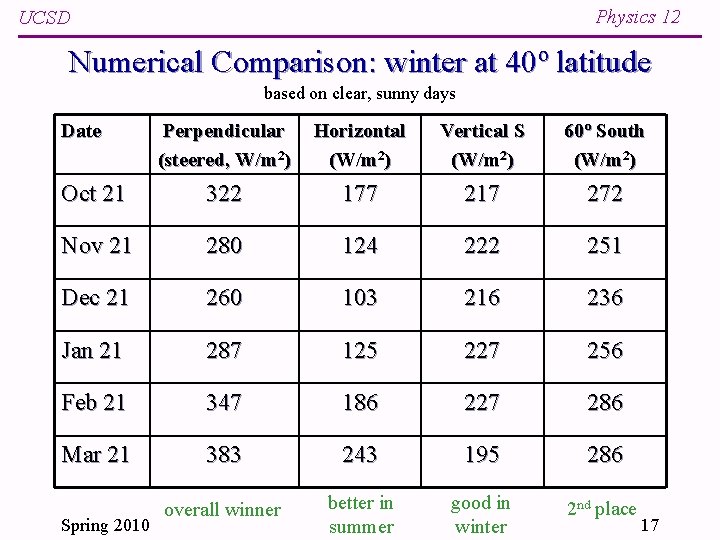
Physics 12 UCSD Numerical Comparison: winter at 40º latitude based on clear, sunny days Date Perpendicular (steered, W/m 2) Horizontal (W/m 2) Vertical S (W/m 2) 60º South (W/m 2) Oct 21 322 177 217 272 Nov 21 280 124 222 251 Dec 21 260 103 216 236 Jan 21 287 125 227 256 Feb 21 347 186 227 286 Mar 21 383 243 195 286 overall winner better in summer good in winter 2 nd place Spring 2010 17
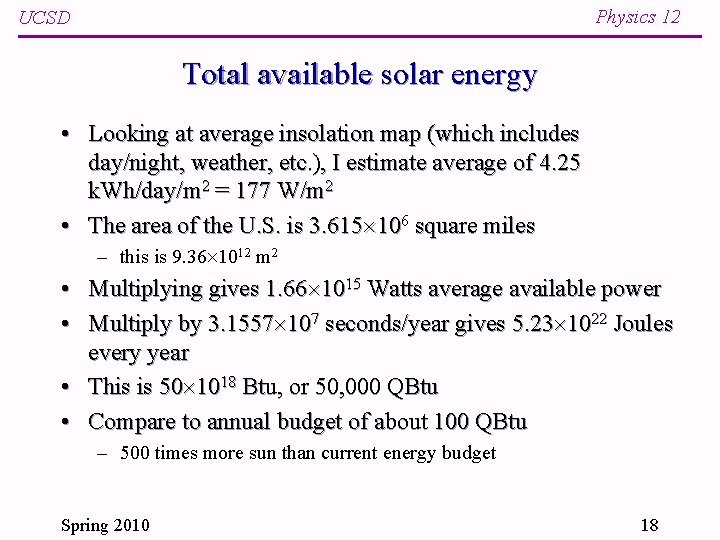
Physics 12 UCSD Total available solar energy • Looking at average insolation map (which includes day/night, weather, etc. ), I estimate average of 4. 25 k. Wh/day/m 2 = 177 W/m 2 • The area of the U. S. is 3. 615 106 square miles – this is 9. 36 1012 m 2 • Multiplying gives 1. 66 1015 Watts average available power • Multiply by 3. 1557 107 seconds/year gives 5. 23 1022 Joules every year • This is 50 1018 Btu, or 50, 000 QBtu • Compare to annual budget of about 100 QBtu – 500 times more sun than current energy budget Spring 2010 18
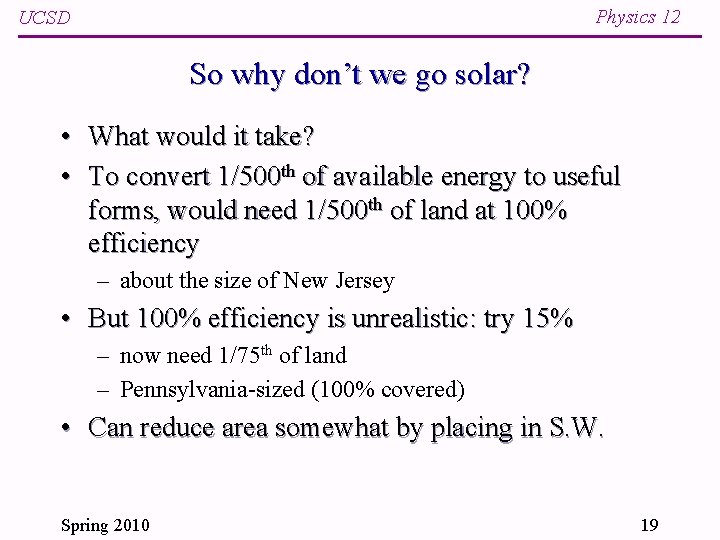
Physics 12 UCSD So why don’t we go solar? • What would it take? • To convert 1/500 th of available energy to useful forms, would need 1/500 th of land at 100% efficiency – about the size of New Jersey • But 100% efficiency is unrealistic: try 15% – now need 1/75 th of land – Pennsylvania-sized (100% covered) • Can reduce area somewhat by placing in S. W. Spring 2010 19
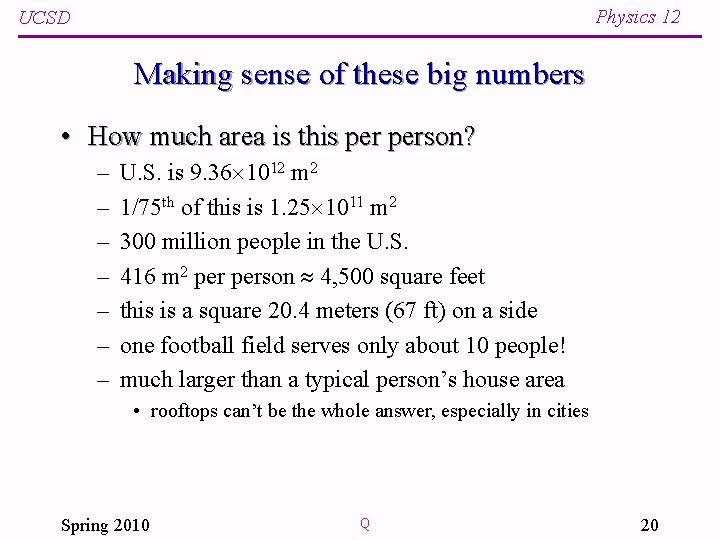
Physics 12 UCSD Making sense of these big numbers • How much area is this person? – – – – U. S. is 9. 36 1012 m 2 1/75 th of this is 1. 25 1011 m 2 300 million people in the U. S. 416 m 2 person 4, 500 square feet this is a square 20. 4 meters (67 ft) on a side one football field serves only about 10 people! much larger than a typical person’s house area • rooftops can’t be the whole answer, especially in cities Spring 2010 Q 20
Physics 12 UCSD Ways of using solar energy • Direct heating of flat panel (fluids, space heating) • Passive heating of well-designed buildings • Thermal power generation (heat engine) via concentration of sunlight • Direct conversion to electrical energy Spring 2010 21
Physics 12 UCSD Assignments / Announcements 19 • Read Chapter 4 if you haven’t already • Optional Reading from Dt. M: – http: //physics. ucsd. edu/do-the-math/2012/08/solar-datatreasure-trove/ • HW 4 available on web • Midterm will be Monday, May 6, York 2622 – will need red half-sheet scan-tron with place for Student ID (Form No. X-101864 -PAR-L) – study guide posted on web site • problems com from this study guide! – will plan review session, at a time TBD Spring 2010 22
Physics 12 UCSD My Plans for Your Brain this is your brain… real world stuff Spring 2010 stuff you learn in school …this is your brain after physics 12 phys 12 real world stuff you learn in school 23
- Slides: 23