
Physics 1161 Lecture 23 Models of the Atom
- Slides: 33
Physics 1161: Lecture 23 Models of the Atom Sections 31 -1 – 31 -6
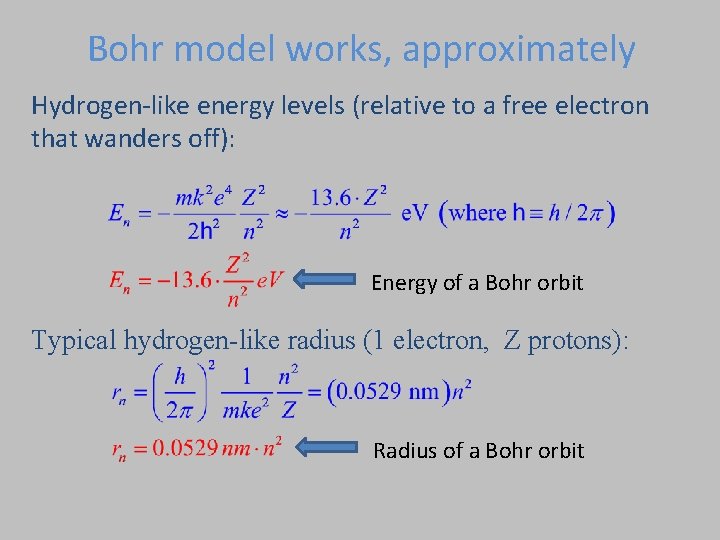
Bohr model works, approximately Hydrogen-like energy levels (relative to a free electron that wanders off): Energy of a Bohr orbit Typical hydrogen-like radius (1 electron, Z protons): Radius of a Bohr orbit
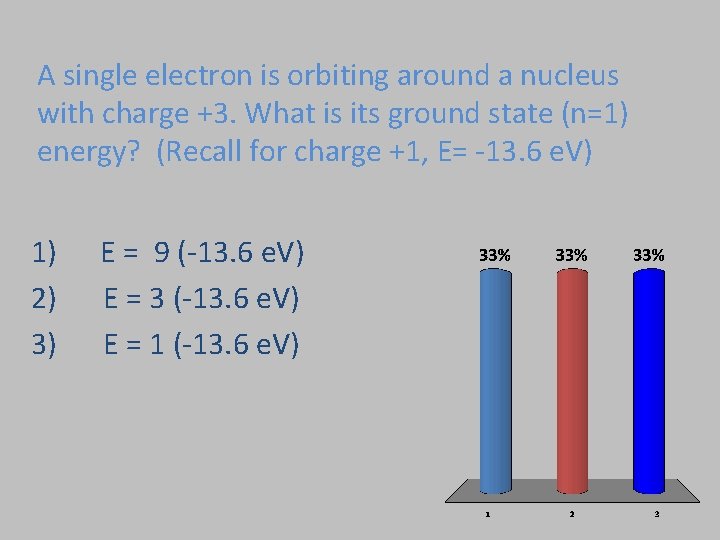
A single electron is orbiting around a nucleus with charge +3. What is its ground state (n=1) energy? (Recall for charge +1, E= -13. 6 e. V) 1) 2) 3) E = 9 (-13. 6 e. V) E = 3 (-13. 6 e. V) E = 1 (-13. 6 e. V)
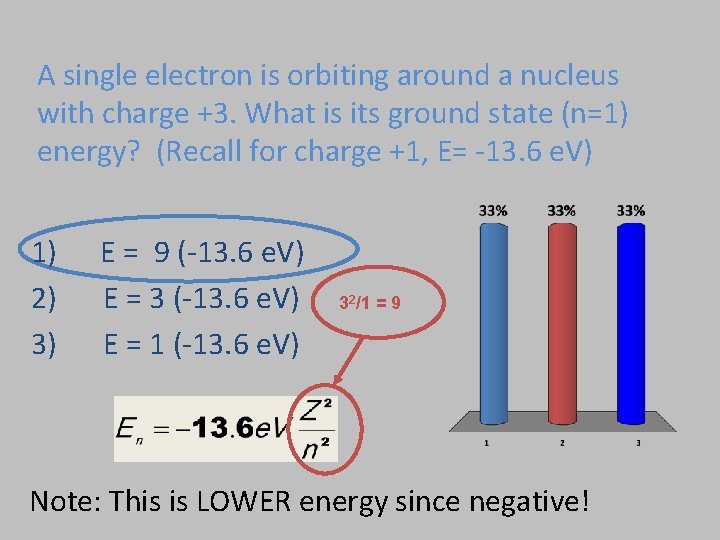
A single electron is orbiting around a nucleus with charge +3. What is its ground state (n=1) energy? (Recall for charge +1, E= -13. 6 e. V) 1) 2) 3) E = 9 (-13. 6 e. V) E = 3 (-13. 6 e. V) E = 1 (-13. 6 e. V) 32/1 = 9 Note: This is LOWER energy since negative!
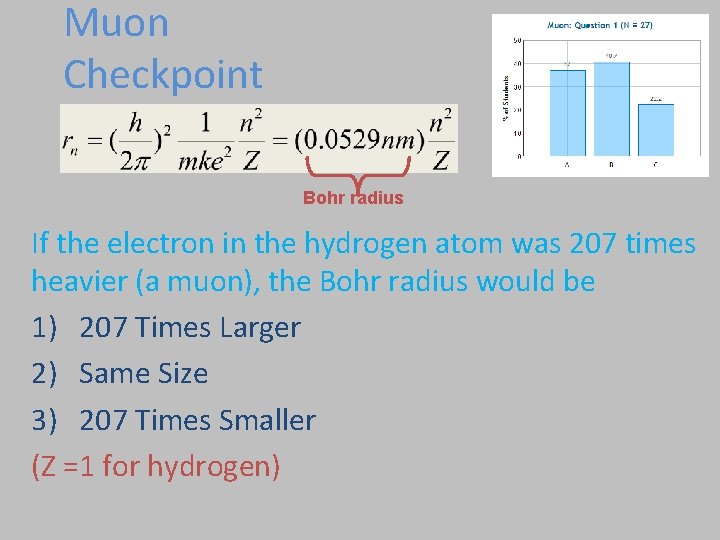
Muon Checkpoint Bohr radius If the electron in the hydrogen atom was 207 times heavier (a muon), the Bohr radius would be 1) 207 Times Larger 2) Same Size 3) 207 Times Smaller (Z =1 for hydrogen)
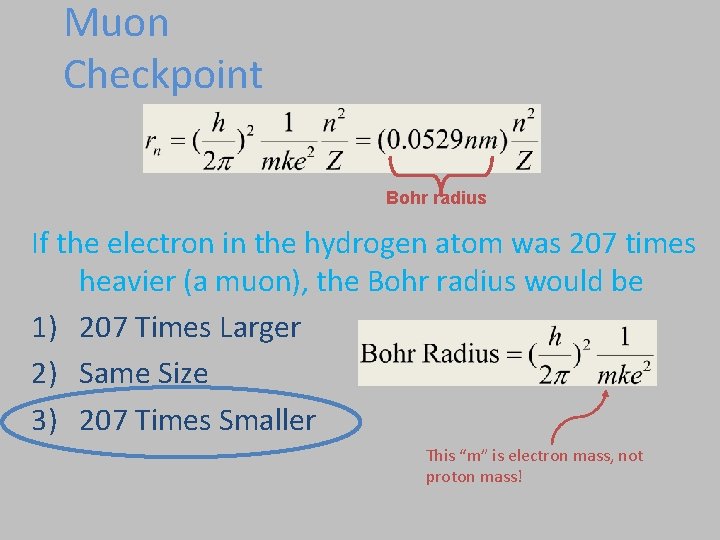
Muon Checkpoint Bohr radius If the electron in the hydrogen atom was 207 times heavier (a muon), the Bohr radius would be 1) 207 Times Larger 2) Same Size 3) 207 Times Smaller This “m” is electron mass, not proton mass!
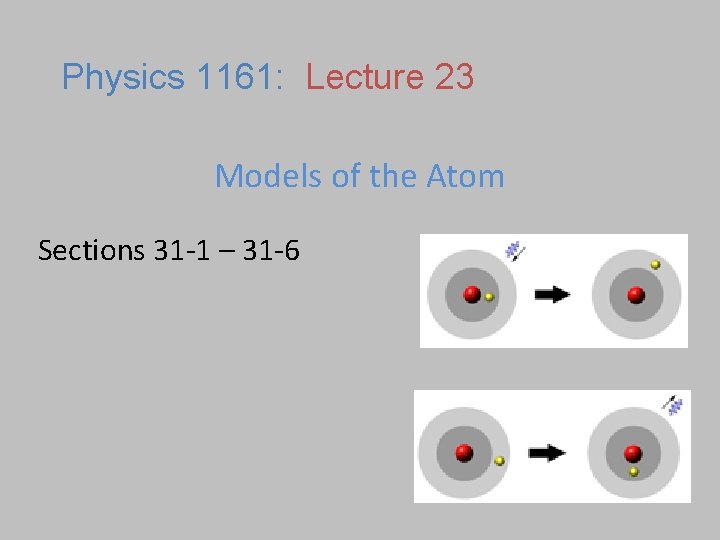
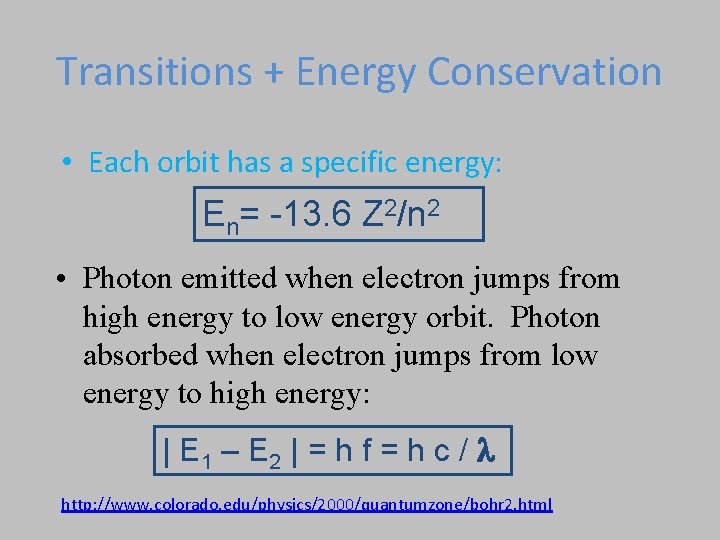
Transitions + Energy Conservation • Each orbit has a specific energy: En= -13. 6 Z 2/n 2 • Photon emitted when electron jumps from high energy to low energy orbit. Photon absorbed when electron jumps from low energy to high energy: | E 1 – E 2 | = h f = h c / l http: //www. colorado. edu/physics/2000/quantumzone/bohr 2. html
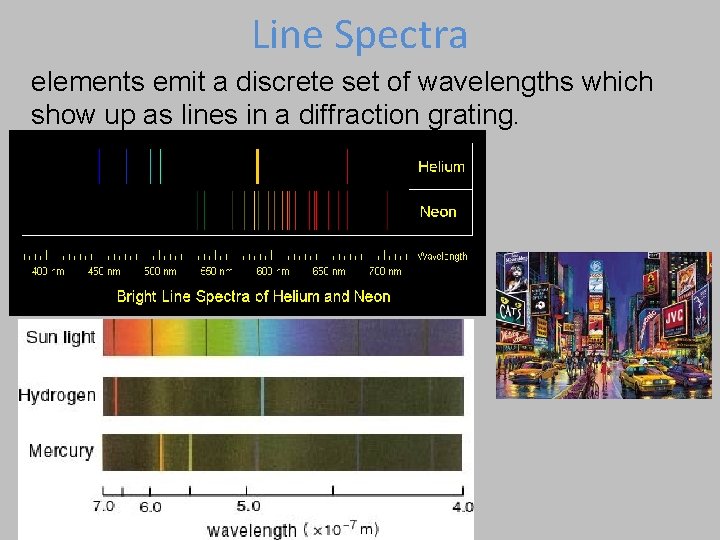
Line Spectra elements emit a discrete set of wavelengths which show up as lines in a diffraction grating.
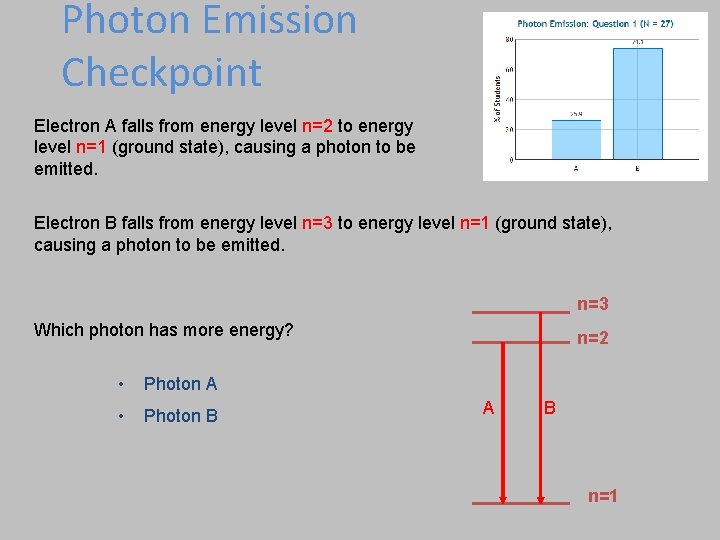
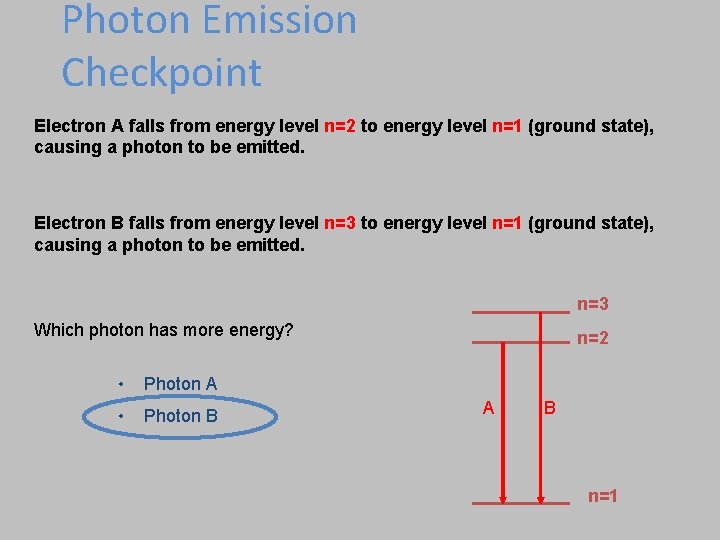
Photon Emission Checkpoint Electron A falls from energy level n=2 to energy level n=1 (ground state), causing a photon to be emitted. Electron B falls from energy level n=3 to energy level n=1 (ground state), causing a photon to be emitted. n=3 Which photon has more energy? • Photon A • Photon B n=2 A B n=1
Photon Emission Checkpoint Electron A falls from energy level n=2 to energy level n=1 (ground state), causing a photon to be emitted. Electron B falls from energy level n=3 to energy level n=1 (ground state), causing a photon to be emitted. n=3 Which photon has more energy? • Photon A • Photon B n=2 A B n=1
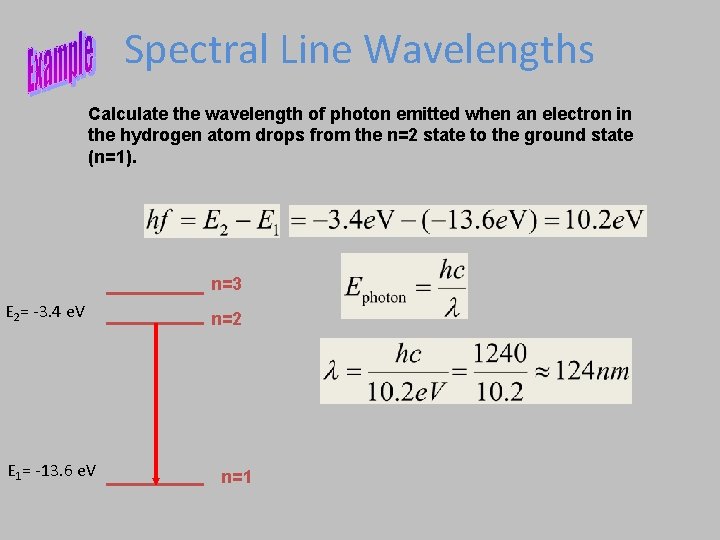
Spectral Line Wavelengths Calculate the wavelength of photon emitted when an electron in the hydrogen atom drops from the n=2 state to the ground state (n=1). n=3 E 2= -3. 4 e. V E 1= -13. 6 e. V n=2 n=1
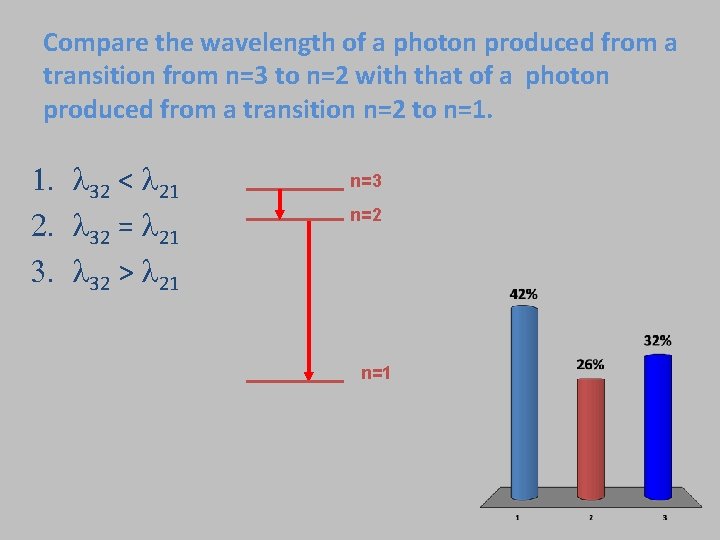
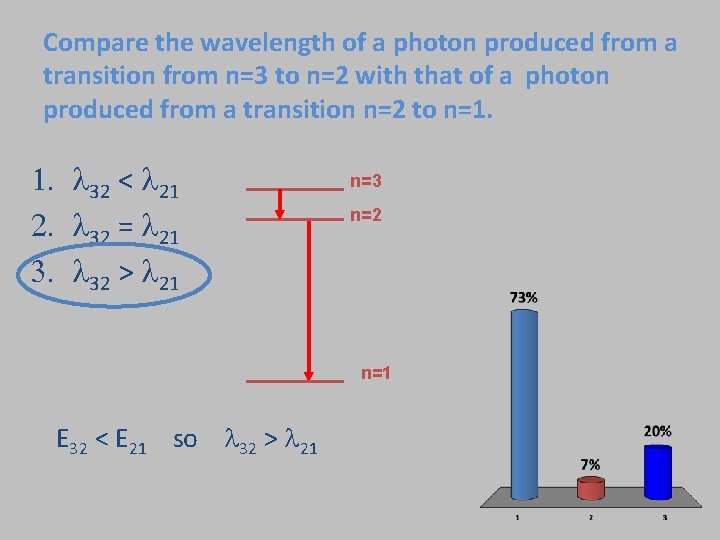
Compare the wavelength of a photon produced from a transition from n=3 to n=2 with that of a photon produced from a transition n=2 to n=1. 1. l 32 < l 21 2. l 32 = l 21 3. l 32 > l 21 n=3 n=2 n=1
Compare the wavelength of a photon produced from a transition from n=3 to n=2 with that of a photon produced from a transition n=2 to n=1. 1. l 32 < l 21 2. l 32 = l 21 3. l 32 > l 21 n=3 n=2 n=1 E 32 < E 21 so l 32 > l 21
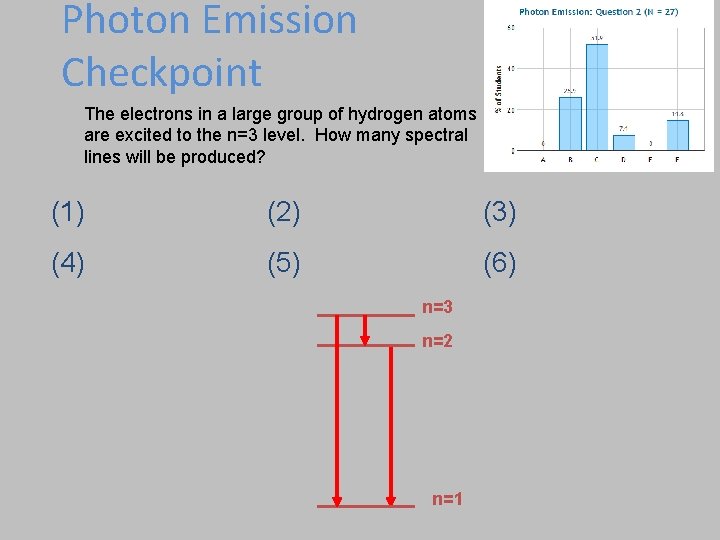
Photon Emission Checkpoint The electrons in a large group of hydrogen atoms are excited to the n=3 level. How many spectral lines will be produced? (1) (2) (3) (4) (5) (6) n=3 n=2 n=1
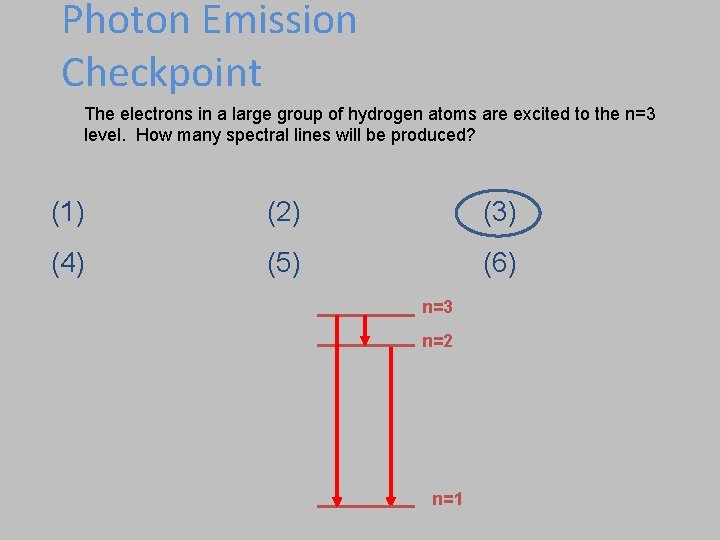
Photon Emission Checkpoint The electrons in a large group of hydrogen atoms are excited to the n=3 level. How many spectral lines will be produced? (1) (2) (3) (4) (5) (6) n=3 n=2 n=1
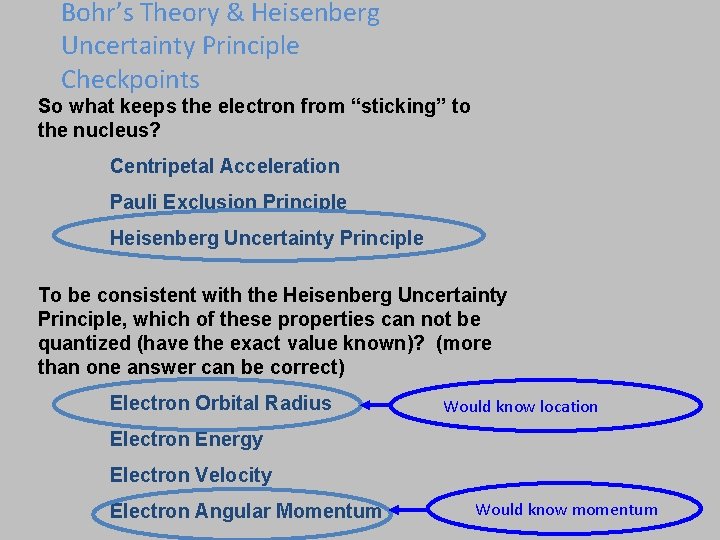
Bohr’s Theory & Heisenberg Uncertainty Principle Checkpoints So what keeps the electron from “sticking” to the nucleus? Centripetal Acceleration Pauli Exclusion Principle Heisenberg Uncertainty Principle To be consistent with the Heisenberg Uncertainty Principle, which of these properties can not be quantized (have the exact value known)? (more than one answer can be correct) Electron Orbital Radius Would know location Electron Energy Electron Velocity Electron Angular Momentum Would know momentum
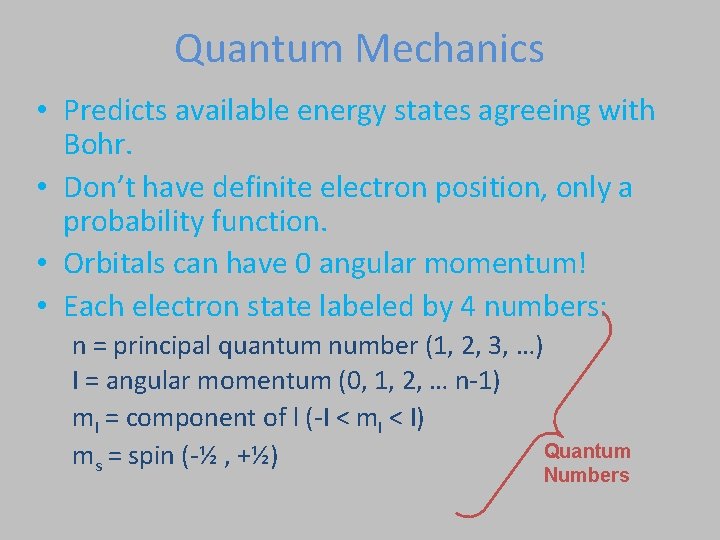
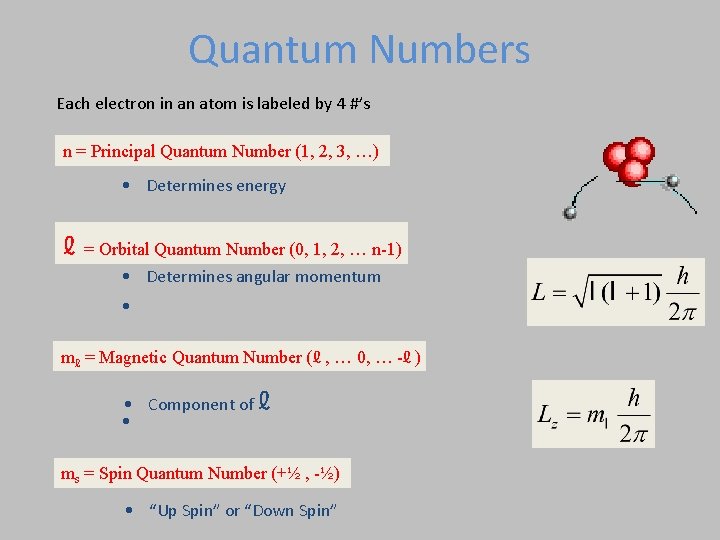
Quantum Mechanics • Predicts available energy states agreeing with Bohr. • Don’t have definite electron position, only a probability function. • Orbitals can have 0 angular momentum! • Each electron state labeled by 4 numbers: n = principal quantum number (1, 2, 3, …) l = angular momentum (0, 1, 2, … n-1) ml = component of l (-l < ml < l) Quantum ms = spin (-½ , +½) Numbers
Summary • Bohr’s Model gives accurate values for electron energy levels. . . • But Quantum Mechanics is needed to describe electrons in atom. • Electrons jump between states by emitting or absorbing photons of the appropriate energy. • Each state has specific energy and is labeled by 4 quantum numbers (next time).
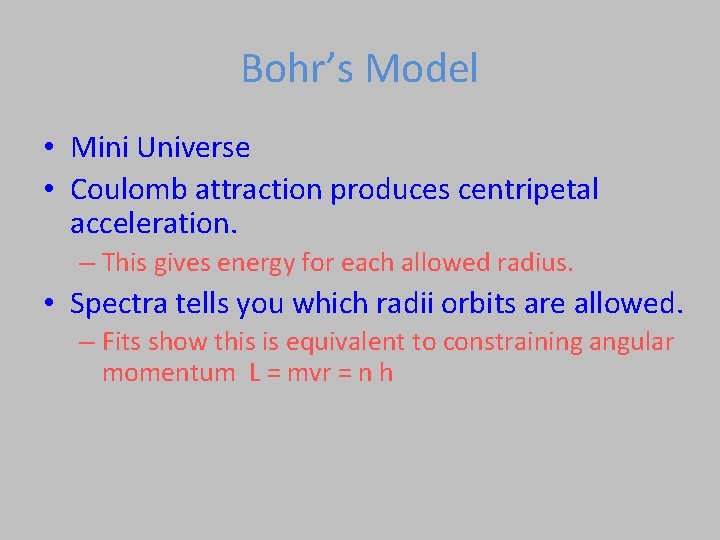
Bohr’s Model • Mini Universe • Coulomb attraction produces centripetal acceleration. – This gives energy for each allowed radius. • Spectra tells you which radii orbits are allowed. – Fits show this is equivalent to constraining angular momentum L = mvr = n h
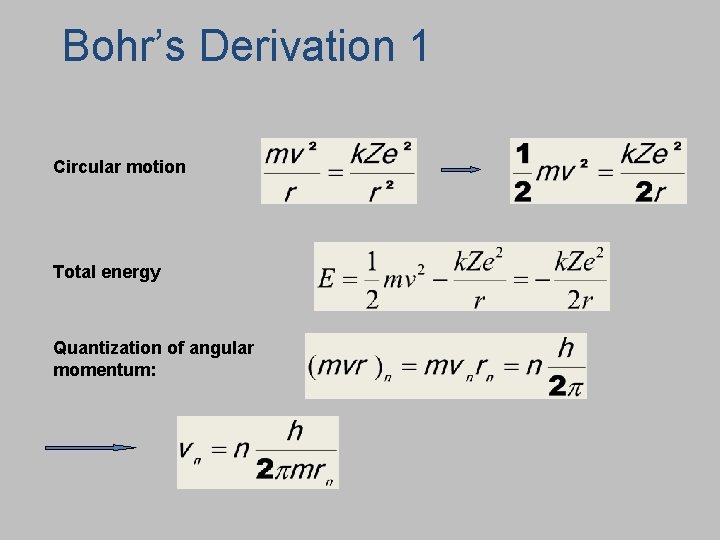
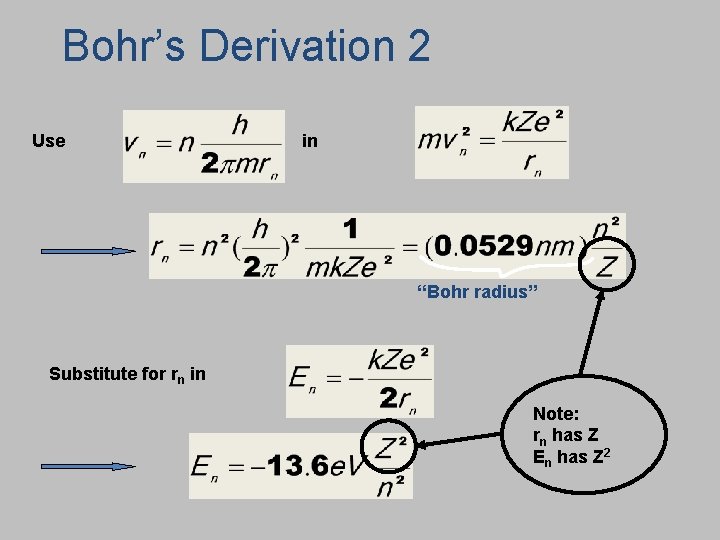
Bohr’s Derivation 1 Circular motion Total energy Quantization of angular momentum:
Bohr’s Derivation 2 Use in “Bohr radius” Substitute for rn in Note: rn has Z En has Z 2
Quantum Numbers Each electron in an atom is labeled by 4 #’s n = Principal Quantum Number (1, 2, 3, …) • Determines energy ℓ = Orbital Quantum Number (0, 1, 2, … n-1) • Determines angular momentum • mℓ = Magnetic Quantum Number (ℓ , … 0, … -ℓ ) • Component of ℓ • ms = Spin Quantum Number (+½ , -½) • “Up Spin” or “Down Spin”
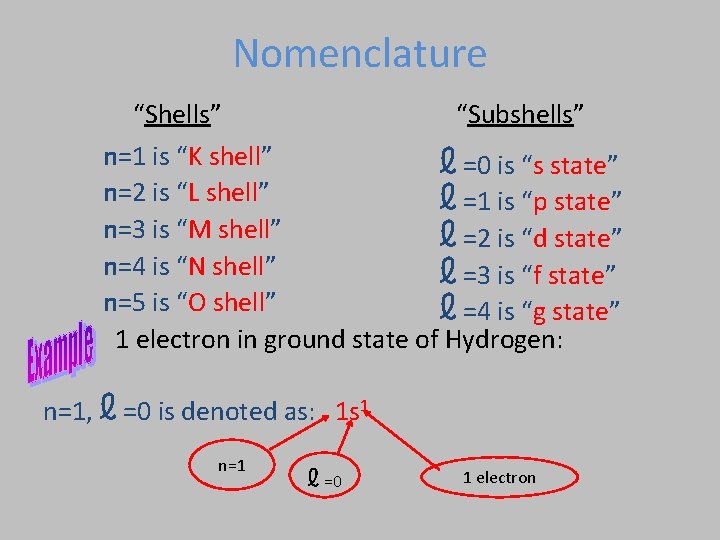
Nomenclature “Shells” “Subshells” n=1 is “K shell” ℓ =0 is “s state” n=2 is “L shell” ℓ =1 is “p state” n=3 is “M shell” ℓ =2 is “d state” n=4 is “N shell” ℓ =3 is “f state” n=5 is “O shell” ℓ =4 is “g state” 1 electron in ground state of Hydrogen: n=1, ℓ =0 is denoted as: 1 s 1 n=1 ℓ =0 1 electron
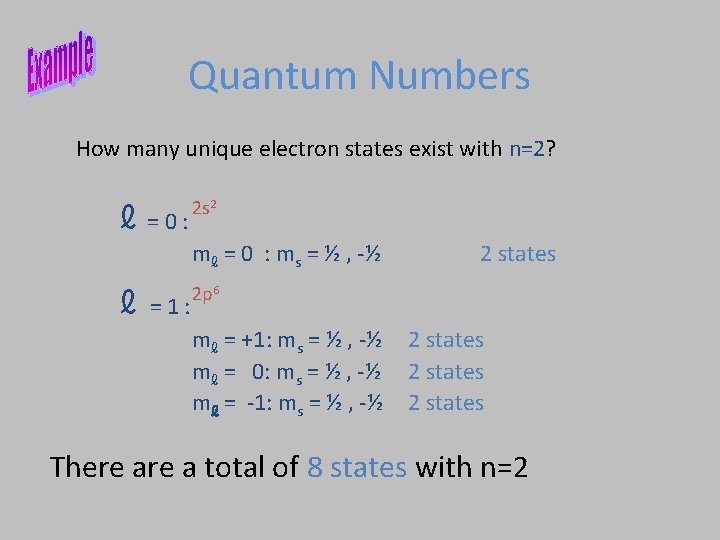
Quantum Numbers How many unique electron states exist with n=2? ℓ =0: 2 s 2 mℓ = 0 : ms = ½ , -½ ℓ =1: 2 states 2 p 6 mℓ = +1: ms = ½ , -½ mℓ = 0: ms = ½ , -½ mℓ = -1: ms = ½ , -½ 2 states There a total of 8 states with n=2
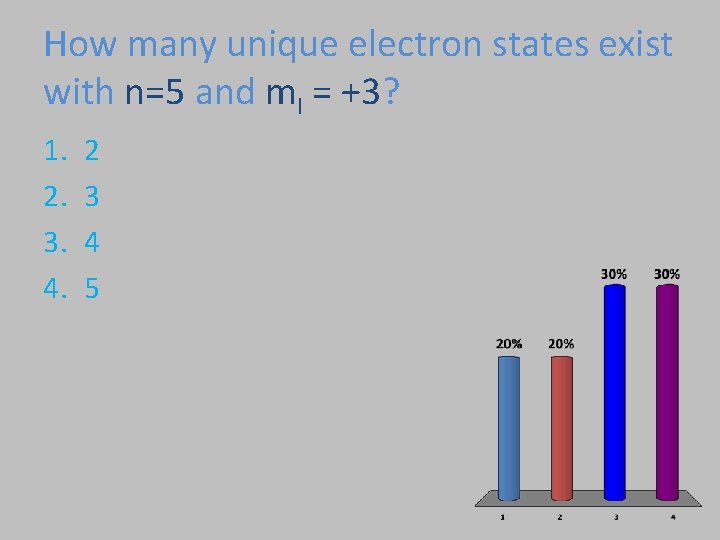
How many unique electron states exist with n=5 and ml = +3? 1. 2. 3. 4. 2 3 4 5
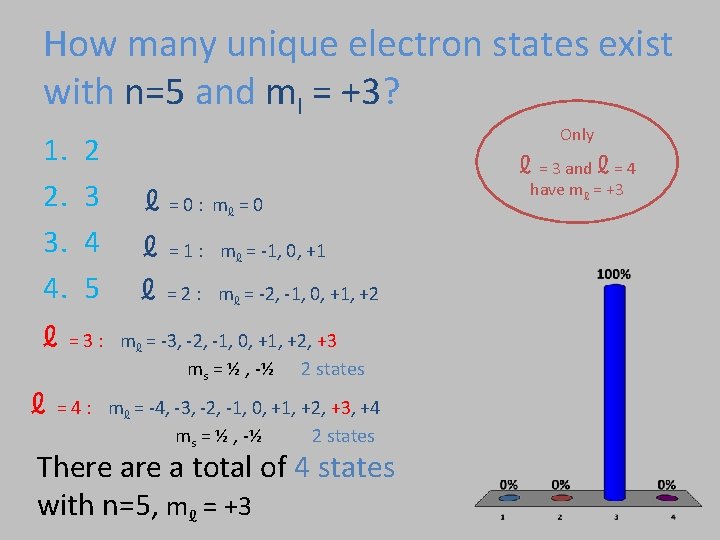
How many unique electron states exist with n=5 and ml = +3? 1. 2. 3. 4. ℓ ℓ 2 3 4 5 Only ℓ = 3 and ℓ = 4 ℓ = 0 : mℓ = 0 ℓ = 1 : mℓ = -1, 0, +1 ℓ = 2 : mℓ = -2, -1, 0, +1, +2 = 3 : mℓ = -3, -2, -1, 0, +1, +2, +3 ms = ½ , -½ 2 states = 4 : mℓ = -4, -3, -2, -1, 0, +1, +2, +3, +4 ms = ½ , -½ 2 states There a total of 4 states with n=5, mℓ = +3 have mℓ = +3
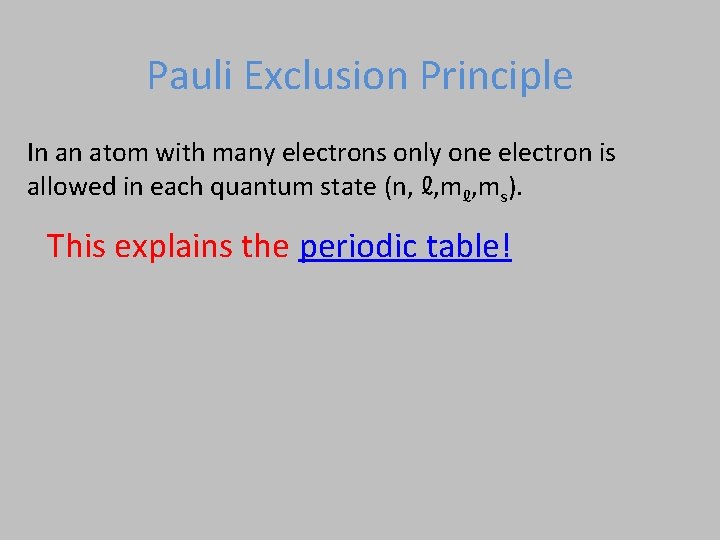
Pauli Exclusion Principle In an atom with many electrons only one electron is allowed in each quantum state (n, ℓ, ms). This explains the periodic table!
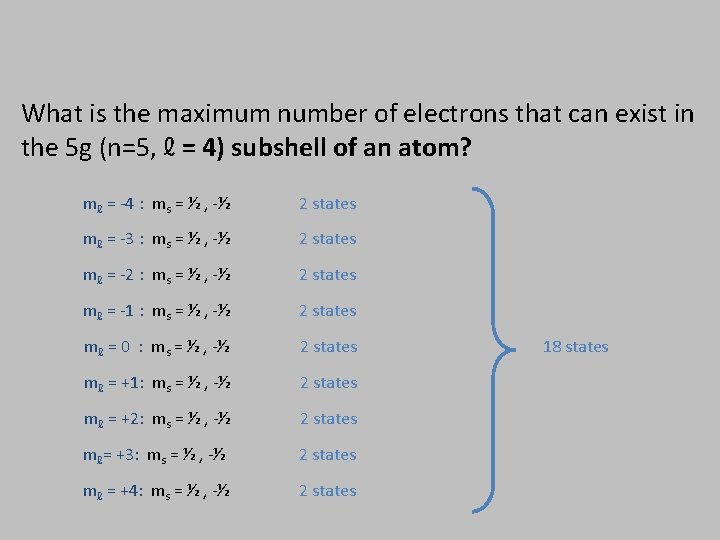
What is the maximum number of electrons that can exist in the 5 g (n=5, ℓ = 4) subshell of an atom?
What is the maximum number of electrons that can exist in the 5 g (n=5, ℓ = 4) subshell of an atom? mℓ = -4 : ms = ½ , -½ 2 states mℓ = -3 : ms = ½ , -½ 2 states mℓ = -2 : ms = ½ , -½ 2 states mℓ = -1 : ms = ½ , -½ 2 states mℓ = 0 : ms = ½ , -½ 2 states mℓ = +1: ms = ½ , -½ 2 states mℓ = +2: ms = ½ , -½ 2 states mℓ= +3: ms = ½ , -½ 2 states mℓ = +4: ms = ½ , -½ 2 states 18 states
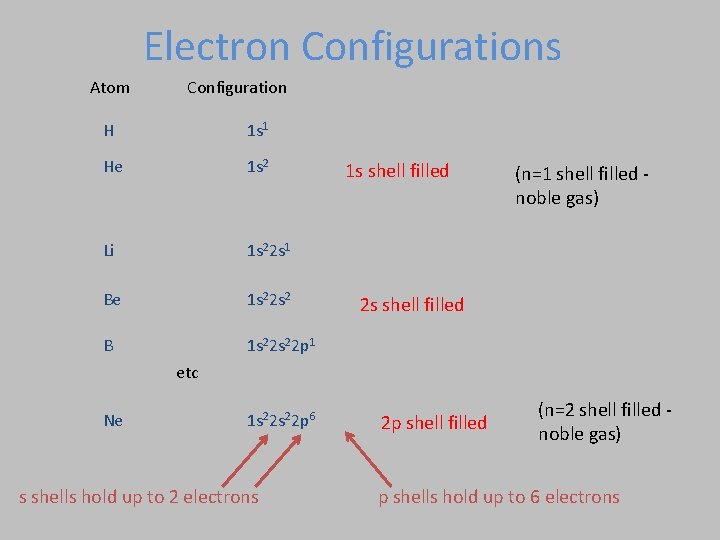
Electron Configurations Atom Configuration H 1 s 1 He 1 s 2 Li 1 s 22 s 1 Be 1 s 22 s 2 B 1 s 22 p 1 1 s shell filled (n=1 shell filled noble gas) 2 s shell filled etc Ne 1 s 22 p 6 s shells hold up to 2 electrons 2 p shell filled (n=2 shell filled noble gas) p shells hold up to 6 electrons
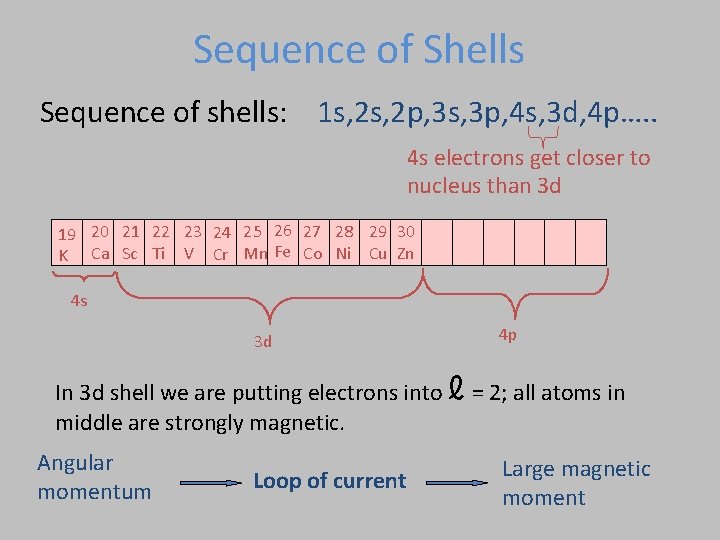
Sequence of Shells Sequence of shells: 1 s, 2 p, 3 s, 3 p, 4 s, 3 d, 4 p…. . 4 s electrons get closer to nucleus than 3 d 19 20 21 22 23 24 25 26 27 28 29 30 K Ca Sc Ti V Cr Mn Fe Co Ni Cu Zn 4 s 3 d 4 p In 3 d shell we are putting electrons into ℓ = 2; all atoms in middle are strongly magnetic. Angular momentum Loop of current Large magnetic moment
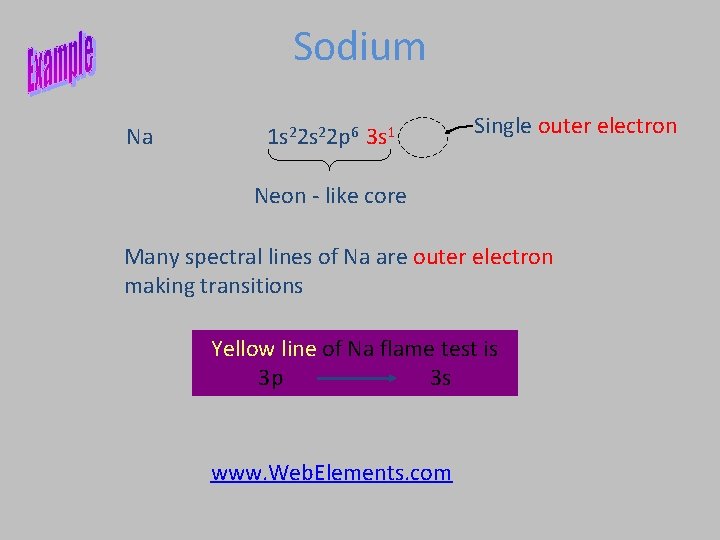
Sodium Na 1 s 22 p 6 3 s 1 Single outer electron Neon - like core Many spectral lines of Na are outer electron making transitions Yellow line of Na flame test is 3 p 3 s www. Web. Elements. com
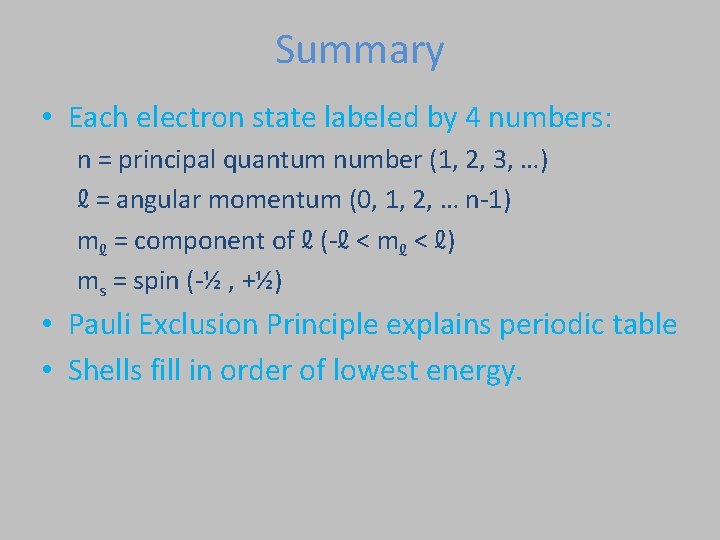
Summary • Each electron state labeled by 4 numbers: n = principal quantum number (1, 2, 3, …) ℓ = angular momentum (0, 1, 2, … n-1) mℓ = component of ℓ (-ℓ < mℓ < ℓ) ms = spin (-½ , +½) • Pauli Exclusion Principle explains periodic table • Shells fill in order of lowest energy.