
Physics 1161 Lecture 2 Vectors Electric Fields Three


- Slides: 21
Physics 1161 Lecture 2 Vectors & Electric Fields
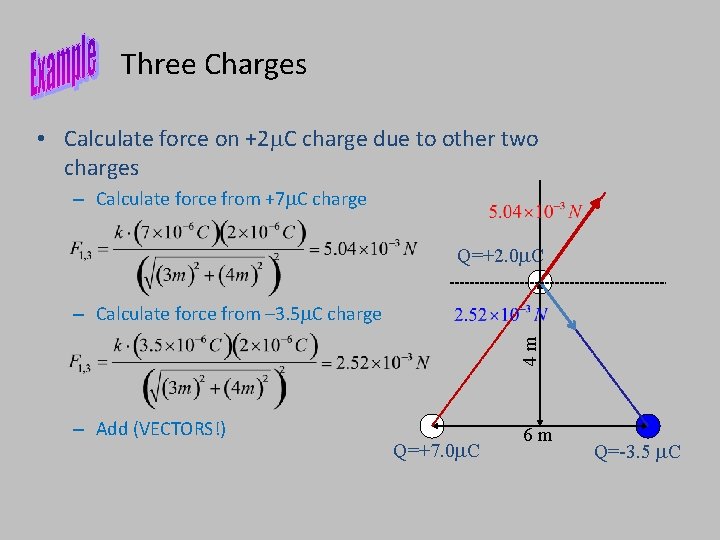
Three Charges • Calculate force on +2 m. C charge due to other two charges – Calculate force from +7 m. C charge Q=+2. 0 m. C 4 m – Calculate force from – 3. 5 m. C charge – Add (VECTORS!) Q=+7. 0 m. C 6 m Q=-3. 5 m. C
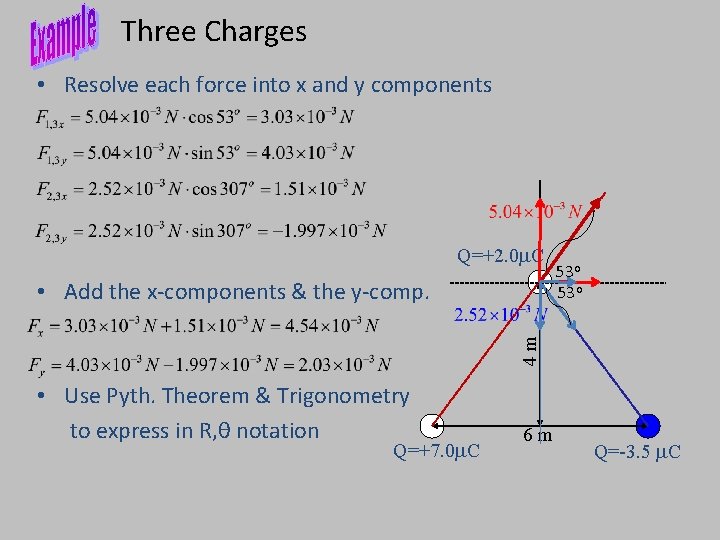
Three Charges • Resolve each force into x and y components Q=+2. 0 m. C 4 m • Add the x-components & the y-comp. 53 o • Use Pyth. Theorem & Trigonometry to express in R, θ notation Q=+7. 0 m. C 6 m Q=-3. 5 m. C
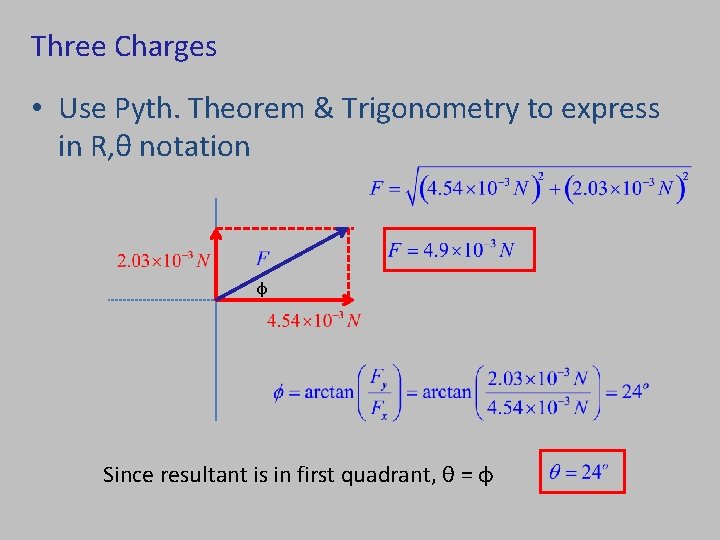
Three Charges • Use Pyth. Theorem & Trigonometry to express in R, θ notation φ Since resultant is in first quadrant, θ = φ
Electric Force on Electron by Proton • What are the magnitude and direction of the force on the electron by the proton? q=1. 6 x 10 -19 C + r = 1 x 10 -10 m Toward the left e-
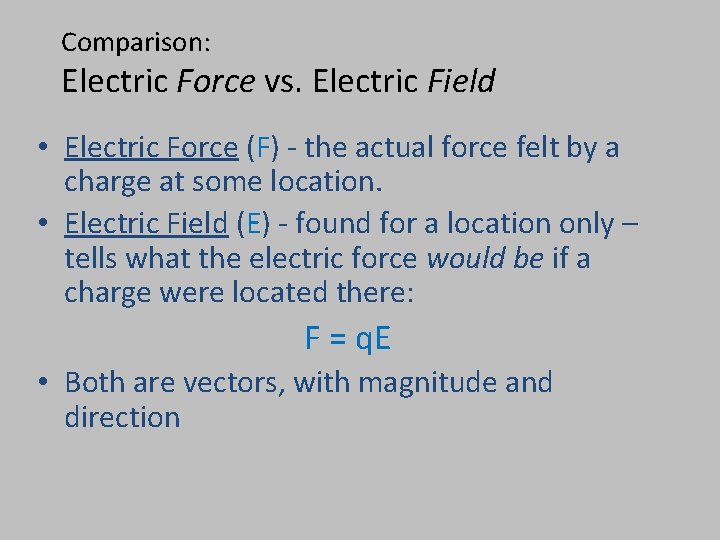
Comparison: Electric Force vs. Electric Field • Electric Force (F) - the actual force felt by a charge at some location. • Electric Field (E) - found for a location only – tells what the electric force would be if a charge were located there: F = q. E • Both are vectors, with magnitude and direction
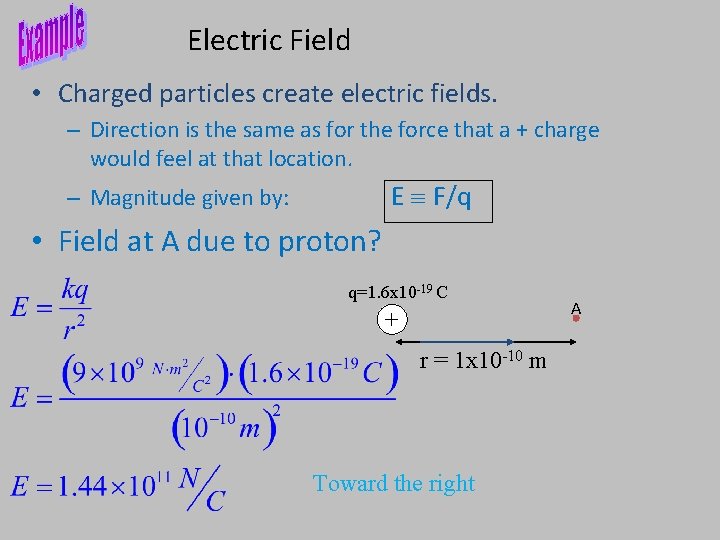
Electric Field • Charged particles create electric fields. – Direction is the same as for the force that a + charge would feel at that location. E F/q – Magnitude given by: • Field at A due to proton? q=1. 6 x 10 -19 C + r = 1 x 10 -10 m Toward the right A
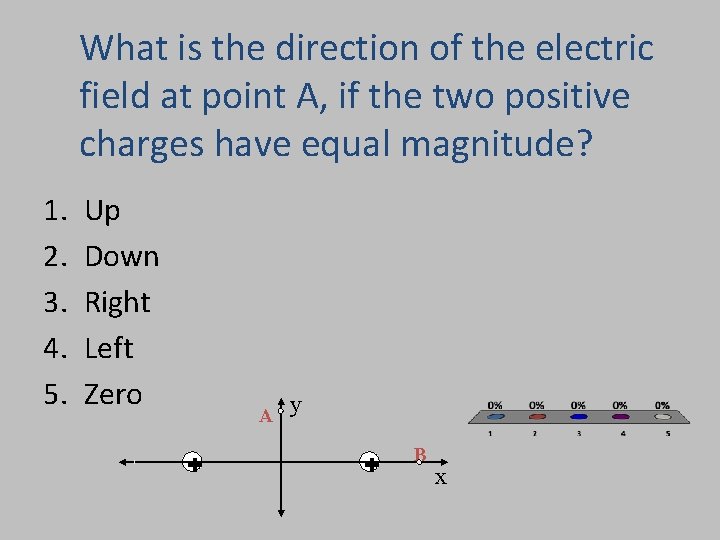
What is the direction of the electric field at point A, if the two positive charges have equal magnitude? 1. 2. 3. 4. 5. Up Down Right Left Zero A + y + B x
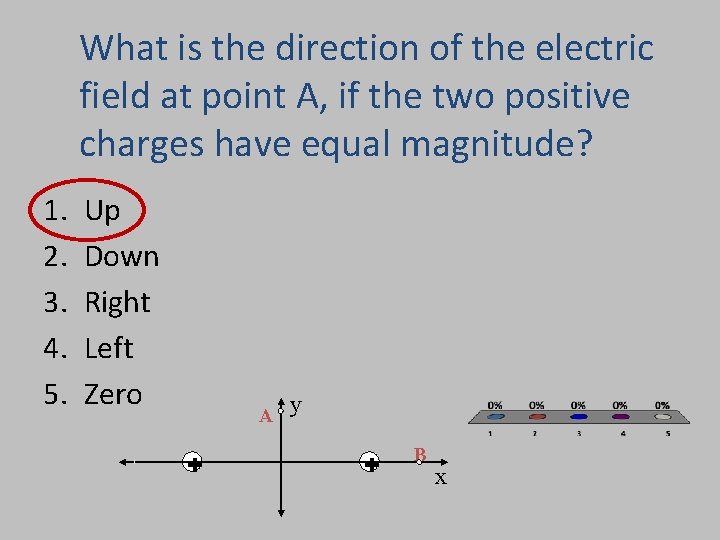
What is the direction of the electric field at point A, if the two positive charges have equal magnitude? 1. 2. 3. 4. 5. Up Down Right Left Zero A + y + B x
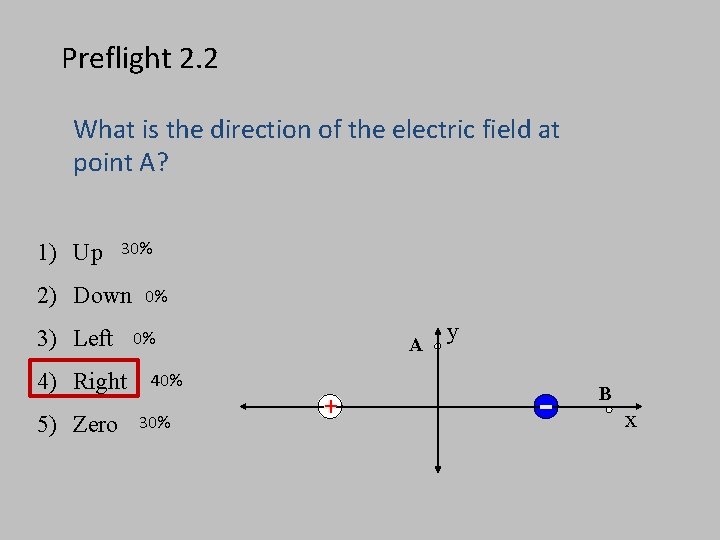
Preflight 2. 2 What is the direction of the electric field at point A? 1) Up 30% 2) Down 3) Left 4) Right 5) Zero 0% 0% 40% 30% A + y B x
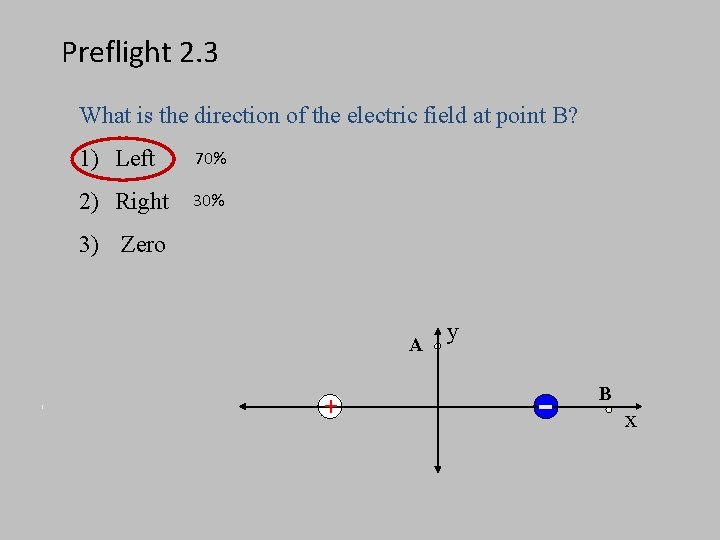
Preflight 2. 3 What is the direction of the electric field at point B? 1) Left 70% 2) Right 30% 3) Zero A + y B x
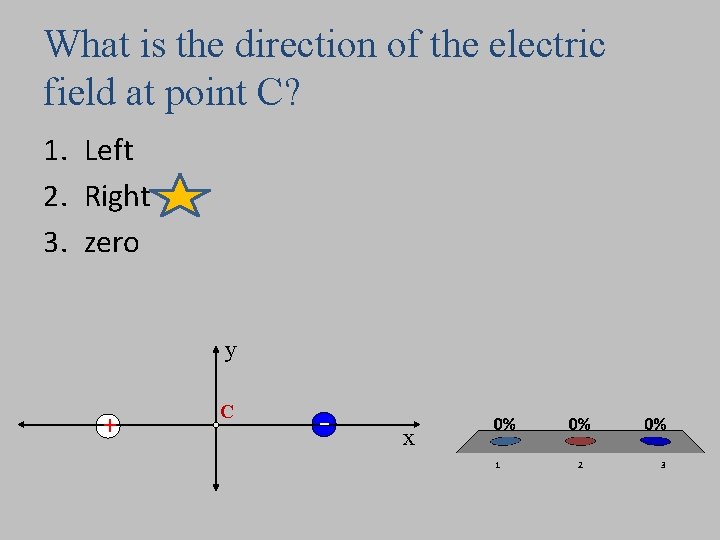
What is the direction of the electric field at point C? 1. Left 2. Right 3. zero y + C - x
Electric Field Applet • http: //www. cco. caltech. edu/~phys 1/java/phy s 1/EField. html
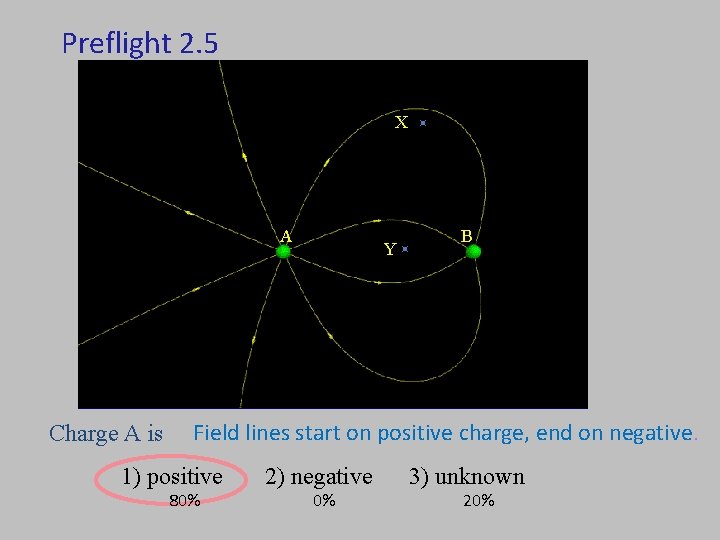
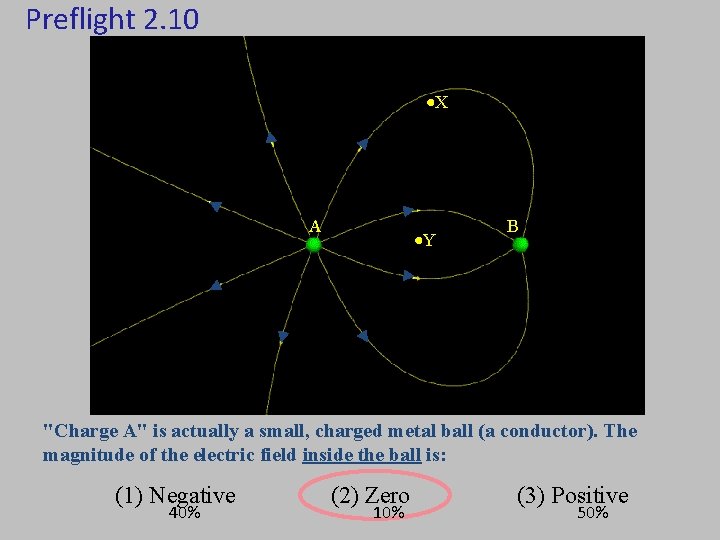
Preflight 2. 5 X A Charge A is Y B Field lines start on positive charge, end on negative. 1) positive 80% 2) negative 0% 3) unknown 20%
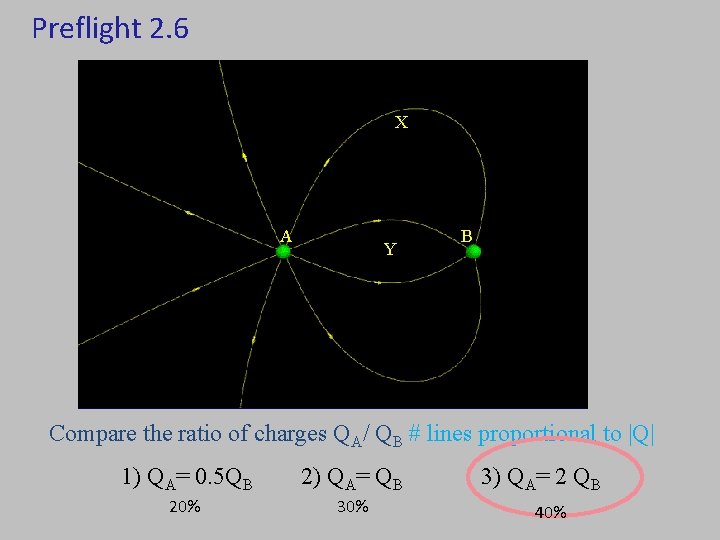
Preflight 2. 6 X A Y B Compare the ratio of charges QA/ QB # lines proportional to |Q| 1) QA= 0. 5 QB 2) QA= QB 20% 3) QA= 2 QB 40%
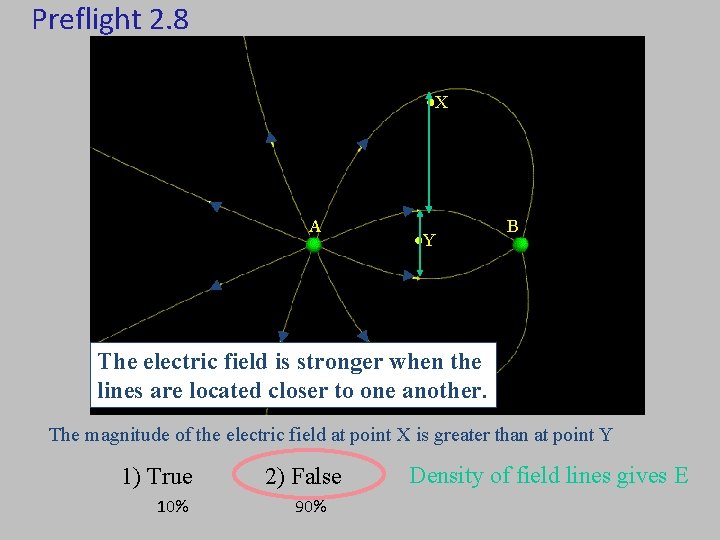
Preflight 2. 8 X A Y B The electric field is stronger when the lines are located closer to one another. The magnitude of the electric field at point X is greater than at point Y 1) True 10% 2) False 90% Density of field lines gives E
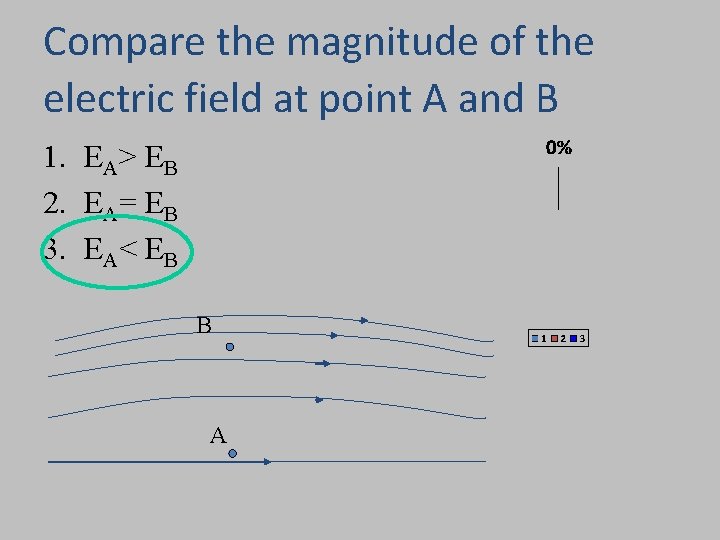
Compare the magnitude of the electric field at point A and B 1. EA> EB 2. EA= EB 3. EA< EB B A
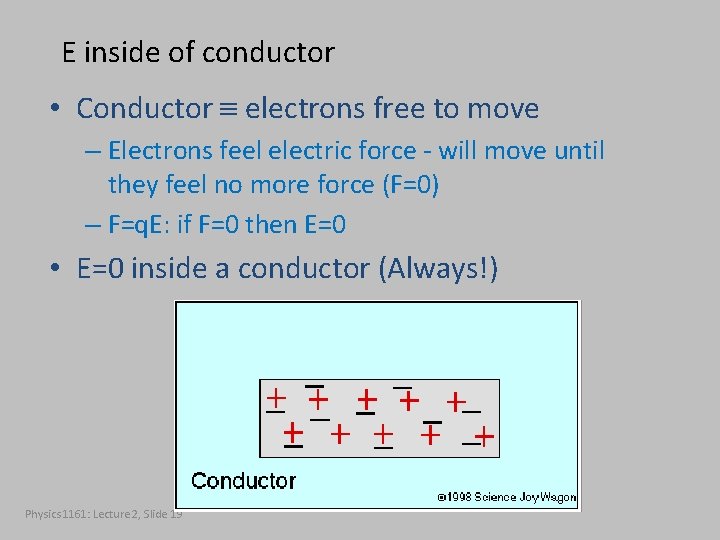
E inside of conductor • Conductor electrons free to move – Electrons feels electric force - will move until they feel no more force (F=0) – F=q. E: if F=0 then E=0 • E=0 inside a conductor (Always!) Physics 1161: Lecture 2, Slide 18
E inside of conductor • Conductor electrons free to move – Electrons feel electric force - will move until they feel no more force (F=0) – F=q. E: if F=0 then E=0 • E=0 inside a conductor (Always!) Physics 1161: Lecture 2, Slide 19
Preflight 2. 10 X A Y B "Charge A" is actually a small, charged metal ball (a conductor). The magnitude of the electric field inside the ball is: (1) Negative 40% (2) Zero 10% (3) Positive 50%
Recap • E Field has magnitude and direction: – E F/q – Calculate just like Coulomb’s law – Careful when adding vectors • Electric Field Lines – Density gives strength (# proportional to charge. ) – Arrow gives direction (Start + end on -) • Conductors – Electrons free to move E=0 Physics 1161: Lecture 2, Slide 21