
Physics 1161 Lecture 17 Reflection Refraction Textbook sections
Physics 1161: Lecture 17 Reflection & Refraction • Textbook sections 26 -3 – 26 -5, 26 -8
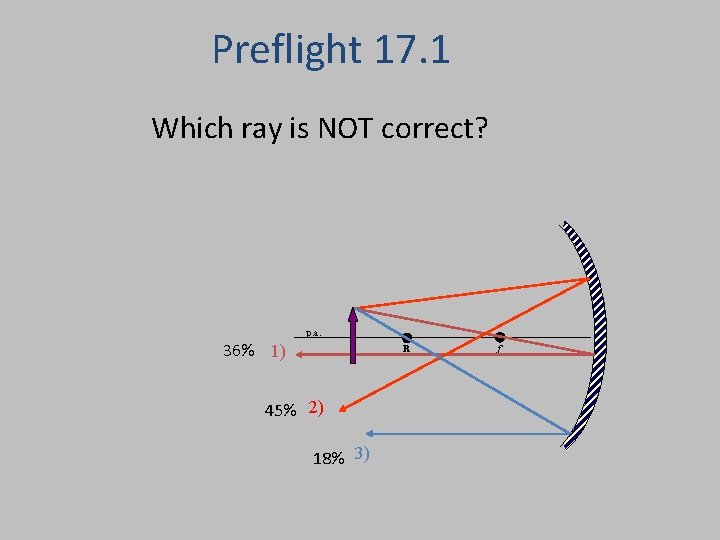
Preflight 17. 1 Which ray is NOT correct? p. a. 36% 1) R 45% 2) 18% 3) f
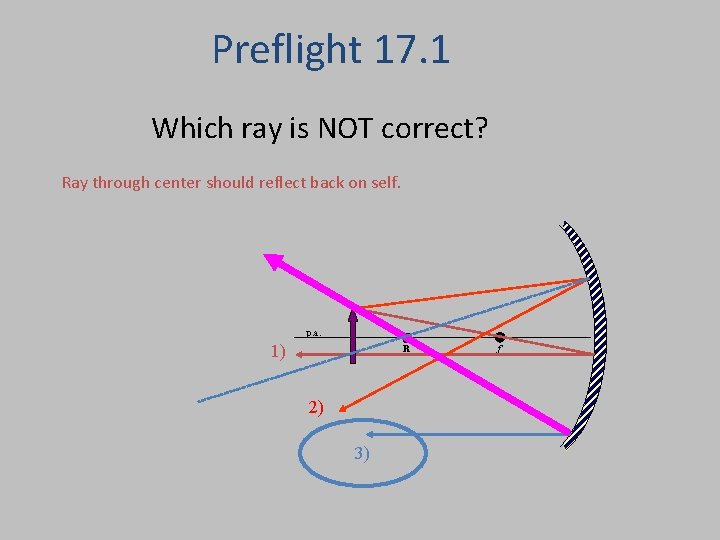
Preflight 17. 1 Which ray is NOT correct? Ray through center should reflect back on self. p. a. 1) R 2) 3) f
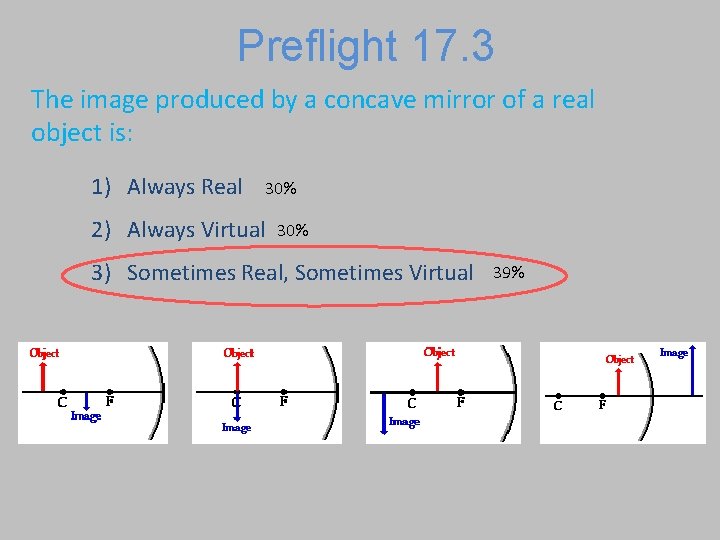
Preflight 17. 3 The image produced by a concave mirror of a real object is: 1) Always Real 30% 2) Always Virtual 30% 3) Sometimes Real, Sometimes Virtual 39%
Where in front of a concave mirror should you place an object so that the image is virtual? 1. 2. 3. 4. Close to mirror Far from mirror Either close or far Not Possible
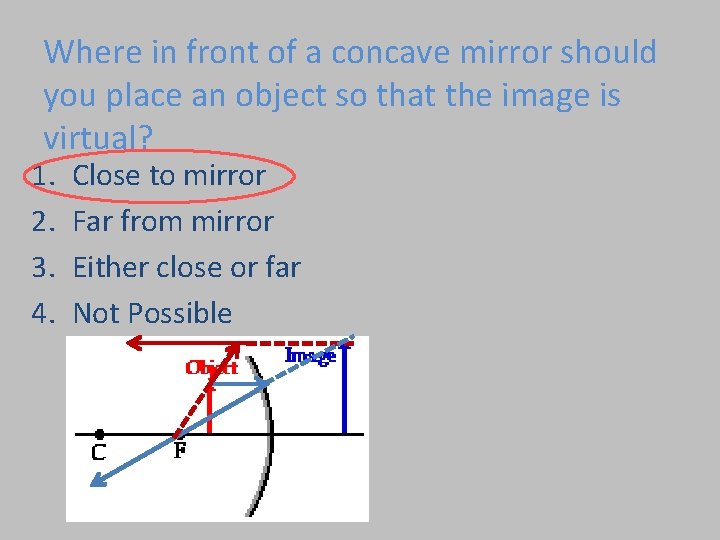
Where in front of a concave mirror should you place an object so that the image is virtual? 1. 2. 3. 4. Close to mirror Far from mirror Either close or far Not Possible
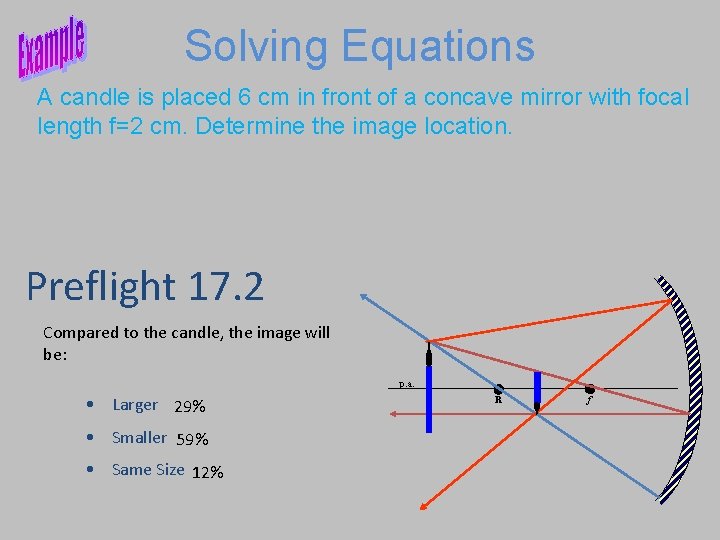
Solving Equations A candle is placed 6 cm in front of a concave mirror with focal length f=2 cm. Determine the image location. Preflight 17. 2 Compared to the candle, the image will be: p. a. • Larger 29% • Smaller 59% • Same Size 12% R f
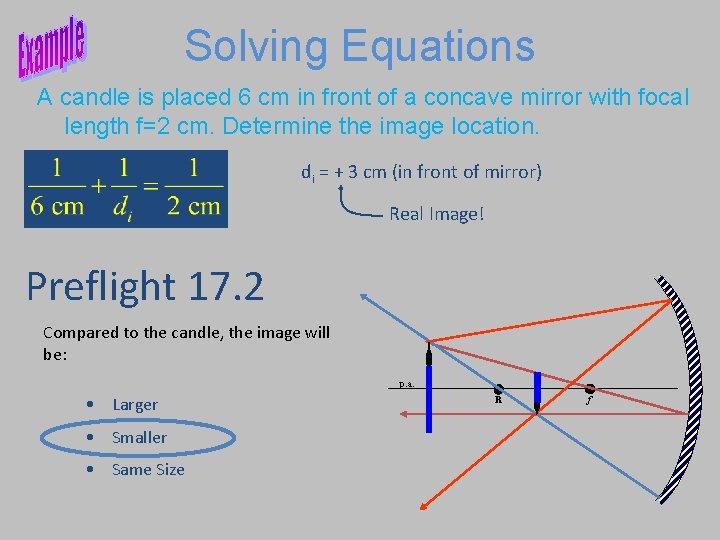
Solving Equations A candle is placed 6 cm in front of a concave mirror with focal length f=2 cm. Determine the image location. di = + 3 cm (in front of mirror) Real Image! Preflight 17. 2 Compared to the candle, the image will be: p. a. • Larger • Smaller • Same Size R f
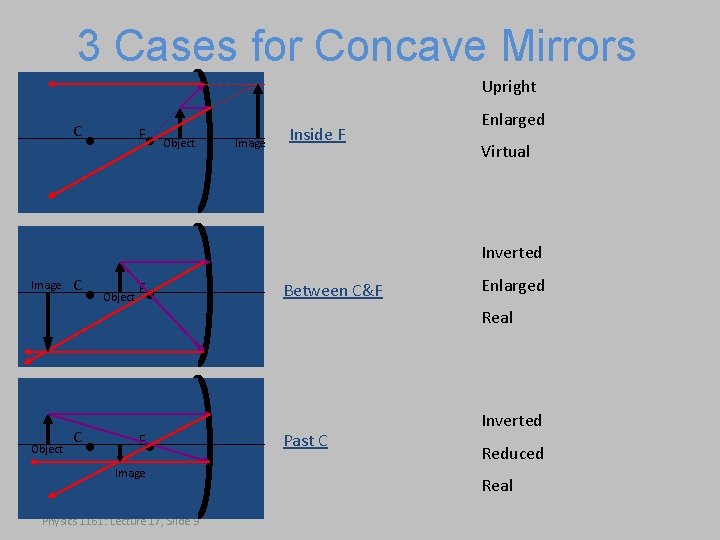
3 Cases for Concave Mirrors Upright C • • F Object Image Inside F Enlarged Virtual Inverted Image Object C C • • Object • F Image Physics 1161: Lecture 17, Slide 9 Between C&F Enlarged Real Past C Inverted Reduced Real

Solving Equations A candle is placed 6 cm in front of a convex mirror with focal length f=-3 cm. Determine the image location. Determine the magnification of the candle. If the candle is 9 cm tall, how tall does the image candle appear to be?
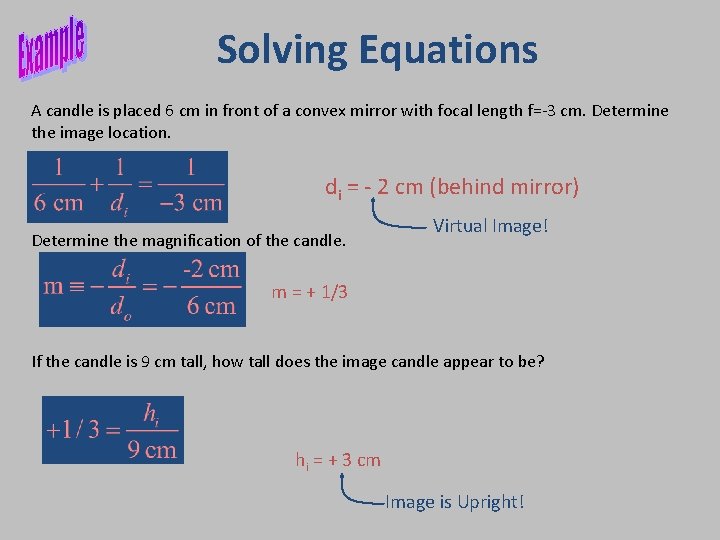
Solving Equations A candle is placed 6 cm in front of a convex mirror with focal length f=-3 cm. Determine the image location. di = - 2 cm (behind mirror) Determine the magnification of the candle. Virtual Image! m = + 1/3 If the candle is 9 cm tall, how tall does the image candle appear to be? hi = + 3 cm Image is Upright!
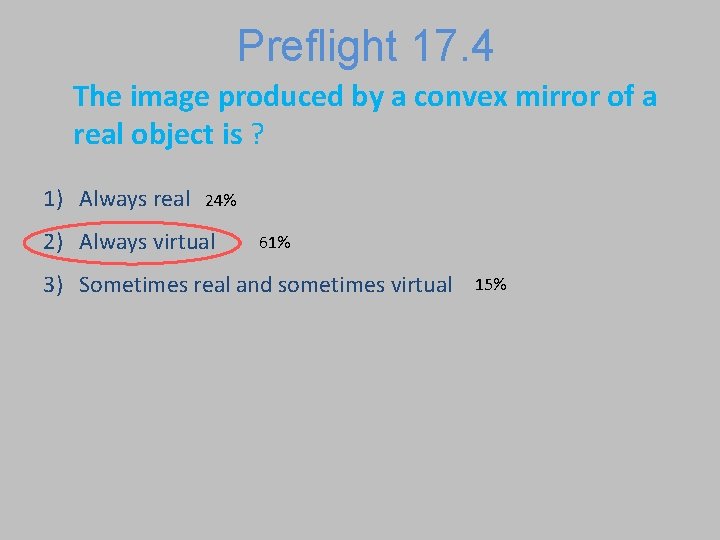
Preflight 17. 4 The image produced by a convex mirror of a real object is ? 1) Always real 24% 2) Always virtual 61% 3) Sometimes real and sometimes virtual 15%
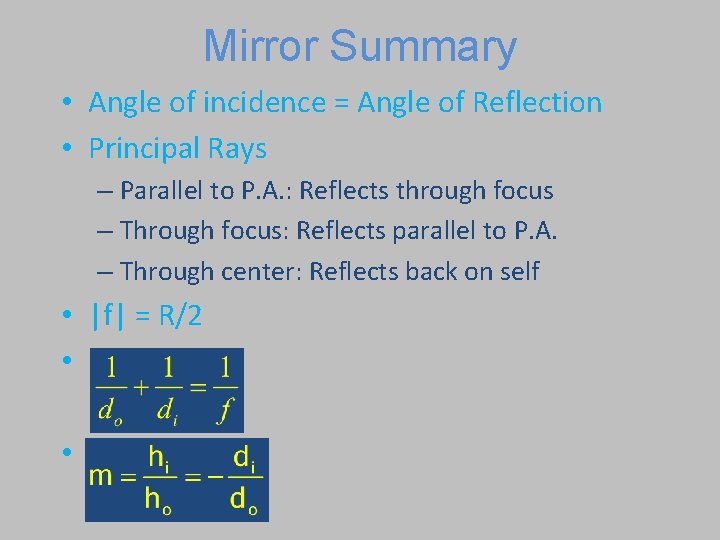
Mirror Summary • Angle of incidence = Angle of Reflection • Principal Rays – Parallel to P. A. : Reflects through focus – Through focus: Reflects parallel to P. A. – Through center: Reflects back on self • |f| = R/2 • •
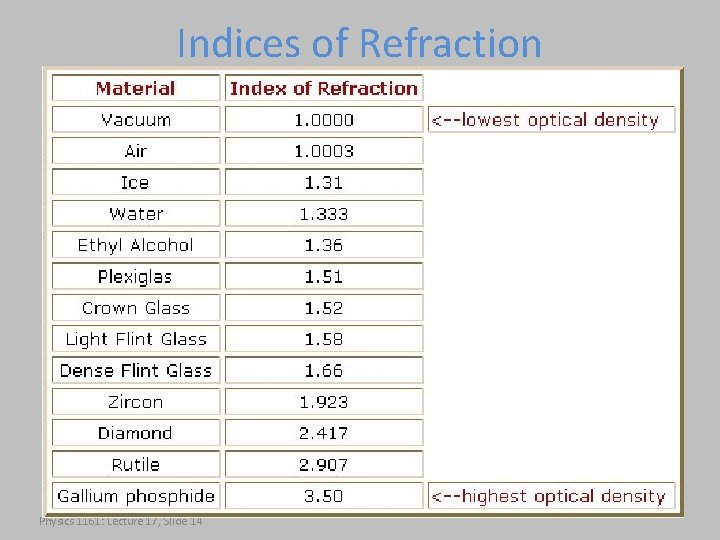
Indices of Refraction Physics 1161: Lecture 17, Slide 14
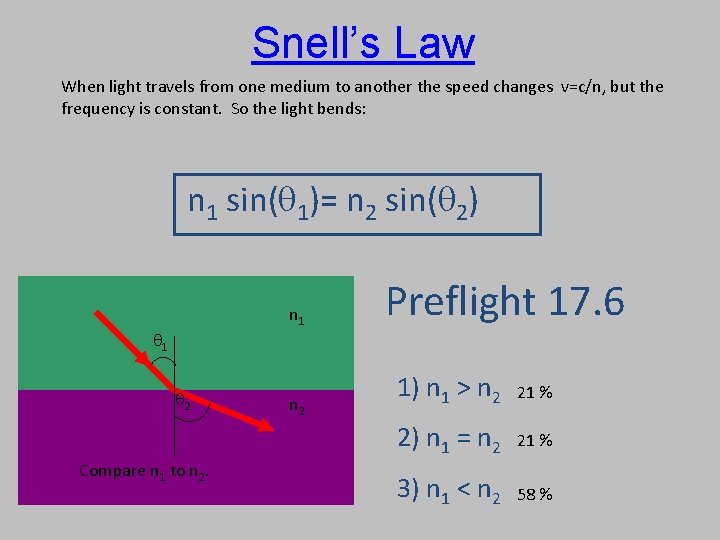
Snell’s Law When light travels from one medium to another the speed changes v=c/n, but the frequency is constant. So the light bends: n 1 sin( 1)= n 2 sin( 2) n 1 1 2 Compare n 1 to n 2 Preflight 17. 6 1) n 1 > n 2 21 % 2) n 1 = n 2 21 % 3) n 1 < n 2 58 %

Snell’s Law When light travels from one medium the speed changes. If the angle of incidence is greater than 0, the light bends. During this process, the frequency remains constant. n 1 sin( 1)= n 2 sin( 2) n 1 1 2 Compare n 1 to n 2 Preflight 17. 6 1) n 1 > n 2 1 < 2 2) n 1 = n 2 sin 1 < sin 2 3) n 1 < n 2 n 1 > n 2
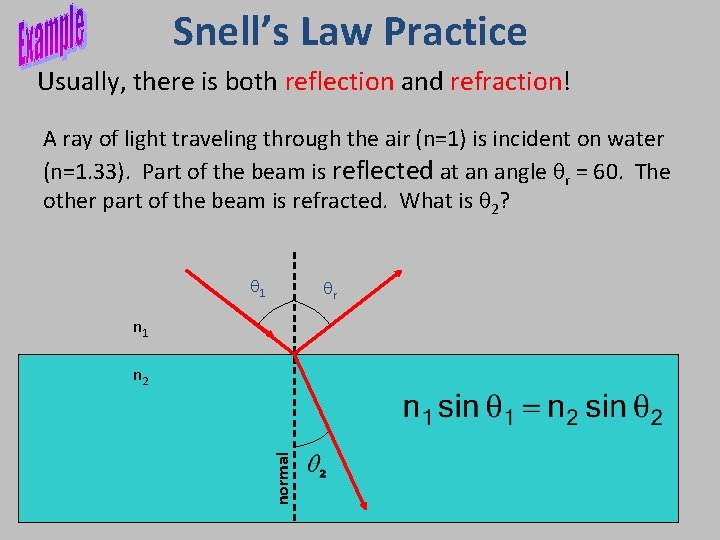
Snell’s Law Practice Usually, there is both reflection and refraction! A ray of light traveling through the air (n=1) is incident on water (n=1. 33). Part of the beam is reflected at an angle r = 60. The other part of the beam is refracted. What is 2? 1 r n 1 normal n 2
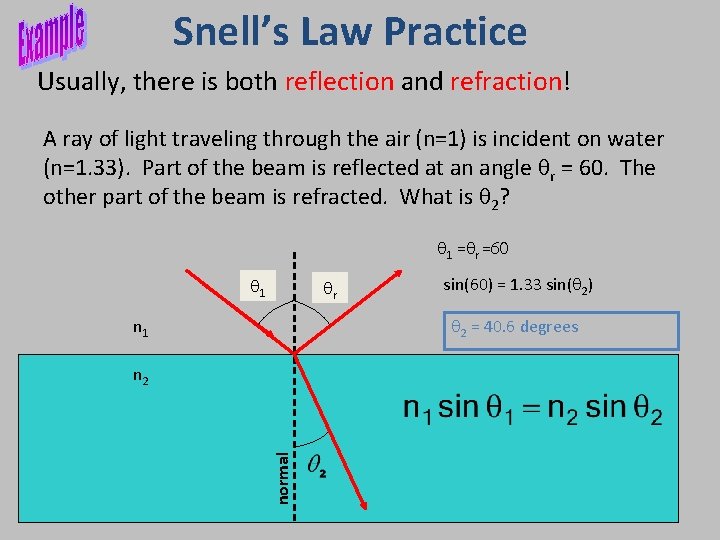
Snell’s Law Practice Usually, there is both reflection and refraction! A ray of light traveling through the air (n=1) is incident on water (n=1. 33). Part of the beam is reflected at an angle r = 60. The other part of the beam is refracted. What is 2? 1 = r =60 1 r sin(60) = 1. 33 sin( 2) 2 = 40. 6 degrees n 1 normal n 2
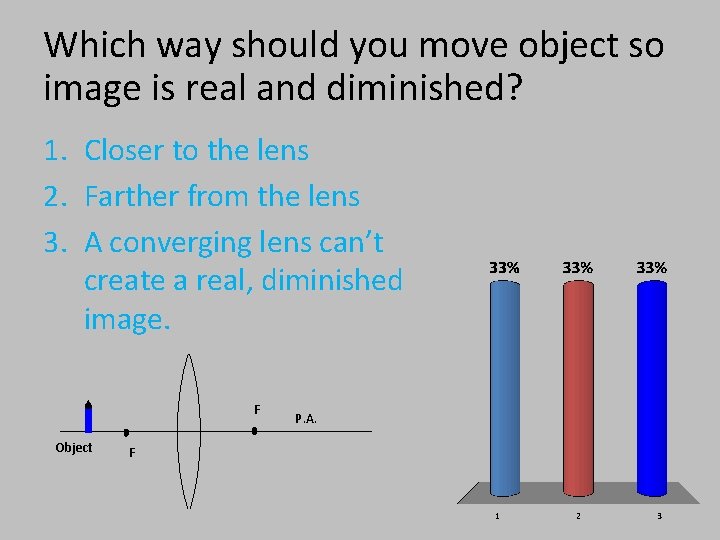
Which way should you move object so image is real and diminished? 1. Closer to the lens 2. Farther from the lens 3. A converging lens can’t create a real, diminished image. F Object F P. A.
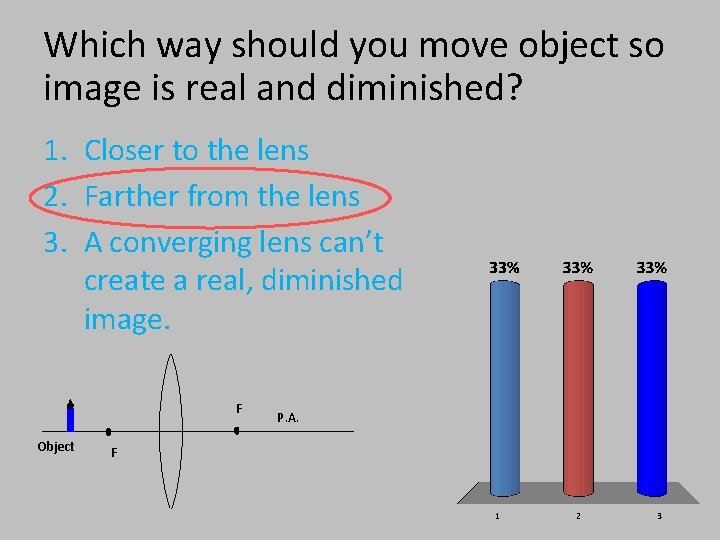
Which way should you move object so image is real and diminished? 1. Closer to the lens 2. Farther from the lens 3. A converging lens can’t create a real, diminished image. F Object F P. A.
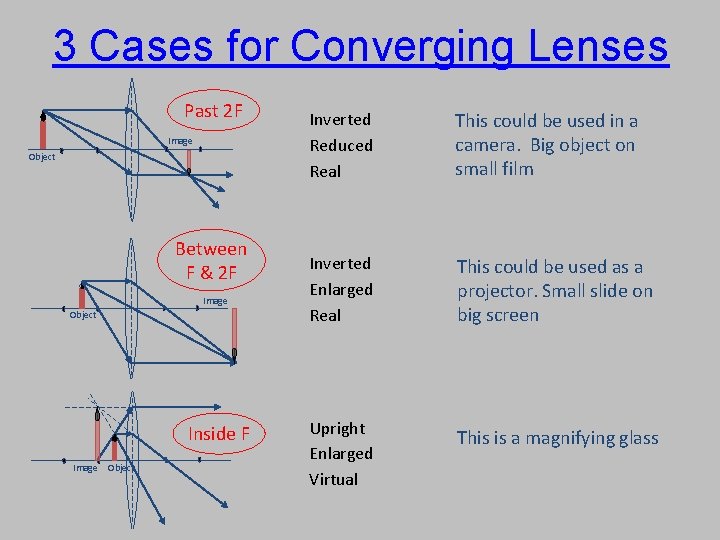
3 Cases for Converging Lenses Past 2 F Image Object Between F & 2 F Image Object Inside F Image Object Inverted Reduced Real This could be used in a camera. Big object on small film Inverted Enlarged Real This could be used as a projector. Small slide on big screen Upright Enlarged Virtual This is a magnifying glass

Diverging Lens Principal Rays F Object P. A. F 1) Rays parallel to principal axis pass through focal point. 2) Rays through center of lens are not refracted. 3) Rays toward F emerge parallel to principal axis. Image is (always true): Real or Upright or Reduced Imaginary Inverted or Enlarged
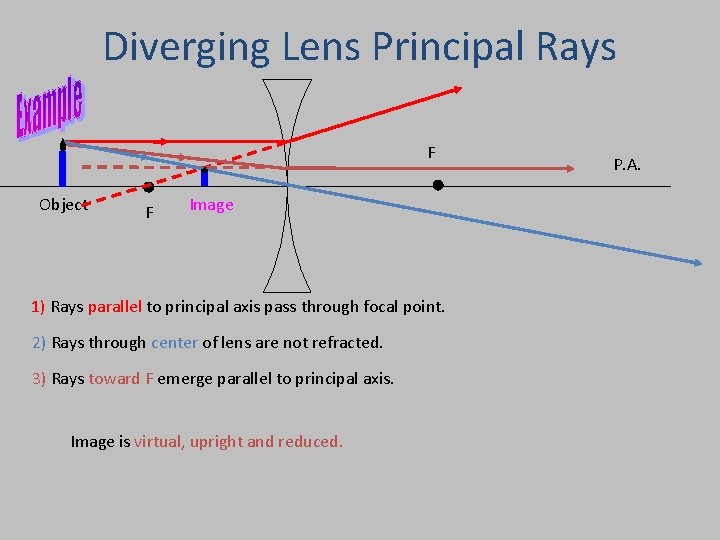
Diverging Lens Principal Rays F Object F Image 1) Rays parallel to principal axis pass through focal point. 2) Rays through center of lens are not refracted. 3) Rays toward F emerge parallel to principal axis. Image is virtual, upright and reduced. P. A.
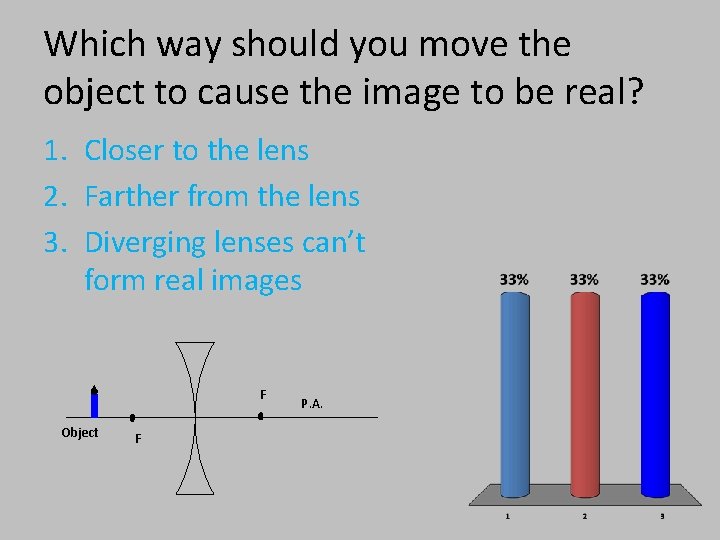
Which way should you move the object to cause the image to be real? 1. Closer to the lens 2. Farther from the lens 3. Diverging lenses can’t form real images F Object F P. A.
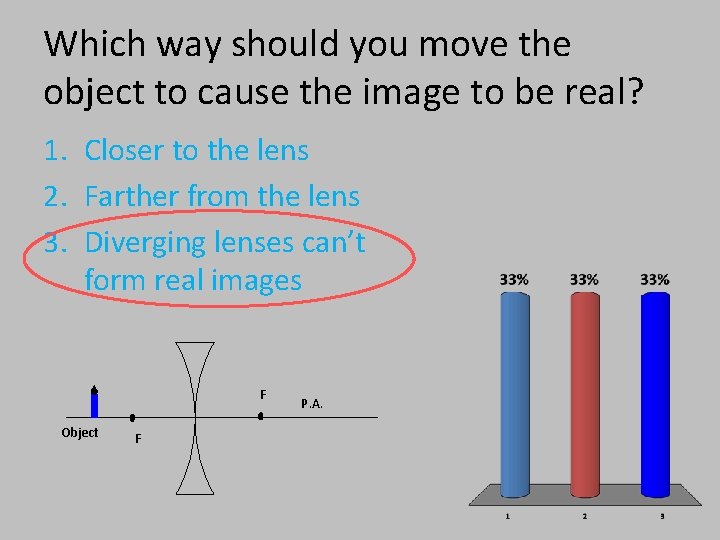
Which way should you move the object to cause the image to be real? 1. Closer to the lens 2. Farther from the lens 3. Diverging lenses can’t form real images F Object F P. A.
- Slides: 25