
Physics 1161 Lecture 06 Georg Ohm Resistance Ohms
- Slides: 18
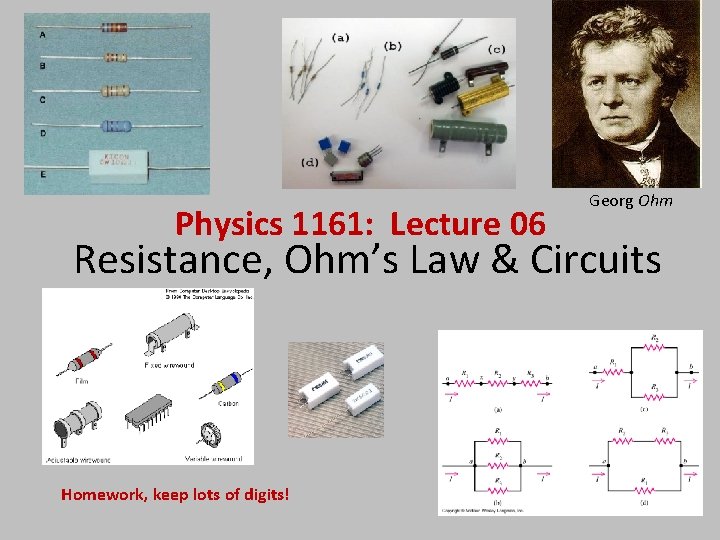
Physics 1161: Lecture 06 Georg Ohm Resistance, Ohm’s Law & Circuits Homework, keep lots of digits!
I find it interesting learning about why there are higher resistance levels due to contributing factors!. . Also, the questions were alot easier to answer, after I read pre-lecture 06. Oh my gosh, everything. Still trying to get the hang of currents. Most confusing at this point is coparing the R 1 and R 2 resistances. I tried my best on this preflight hopefully everything makes some sense. The first problem confussed me a little bit im not sure I got it right. i find it confusing that the current is not the remembering how resistors work from the class i took before on electrical circuits direction the electrons flow I find it interesting that I will probably never use this in physical therapy, but if i was an electrical engineer then it would be rad what isnt confusing? I mainly confused why and how this class applies to my major. I am still finding the concept of parallel systems and systems in series difficult to understand. Could we please go over these in class? Also, it seems like bigger objects should have more resistance than smaller objects so I must not be understanding the concept of resistance.
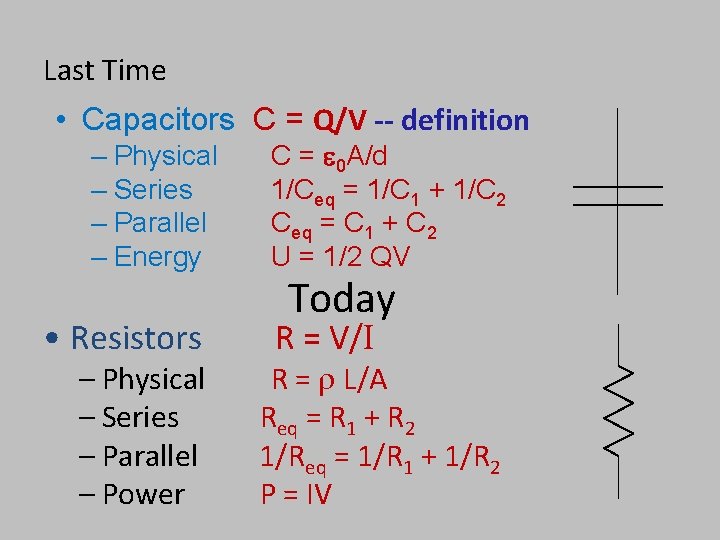
Last Time • Capacitors C = Q/V -- definition – Physical – Series – Parallel – Energy • Resistors – Physical – Series – Parallel – Power C = e 0 A/d 1/Ceq = 1/C 1 + 1/C 2 Ceq = C 1 + C 2 U = 1/2 QV Today R = V/I R = r L/A Req = R 1 + R 2 1/Req = 1/R 1 + 1/R 2 P = IV
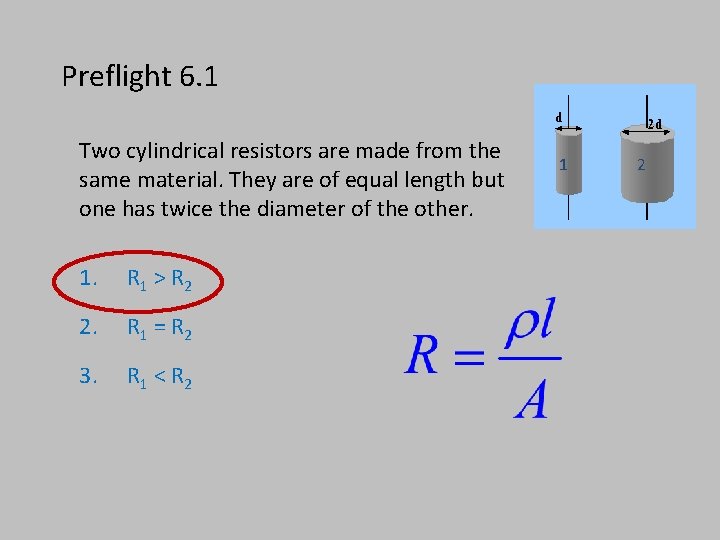
Preflight 6. 1 Two cylindrical resistors are made from the same material. They are of equal length but one has twice the diameter of the other. 1. R 1 > R 2 2. R 1 = R 2 3. R 1 < R 2 1 2
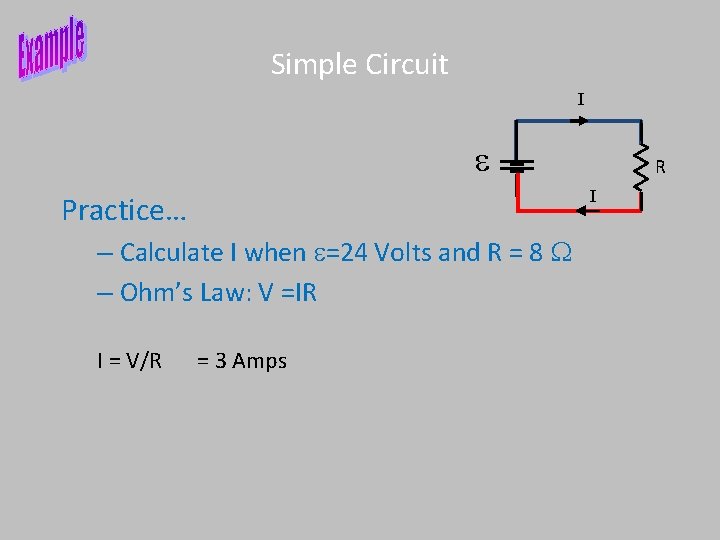
Simple Circuit I e I Practice… – Calculate I when e=24 Volts and R = 8 W – Ohm’s Law: V =IR I = V/R R = 3 Amps
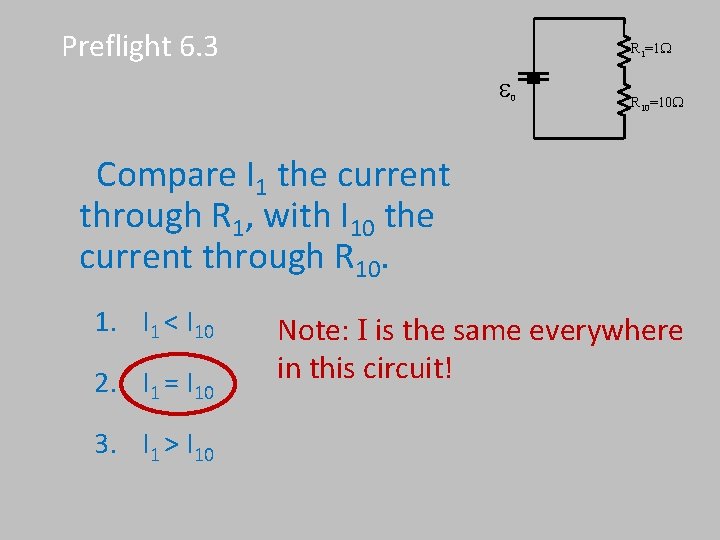
Preflight 6. 3 R 1=1 W e 0 R 10=10 W Compare I 1 the current through R 1, with I 10 the current through R 10. 1. I 1 < I 10 2. I 1 = I 10 3. I 1 > I 10 Note: I is the same everywhere in this circuit!
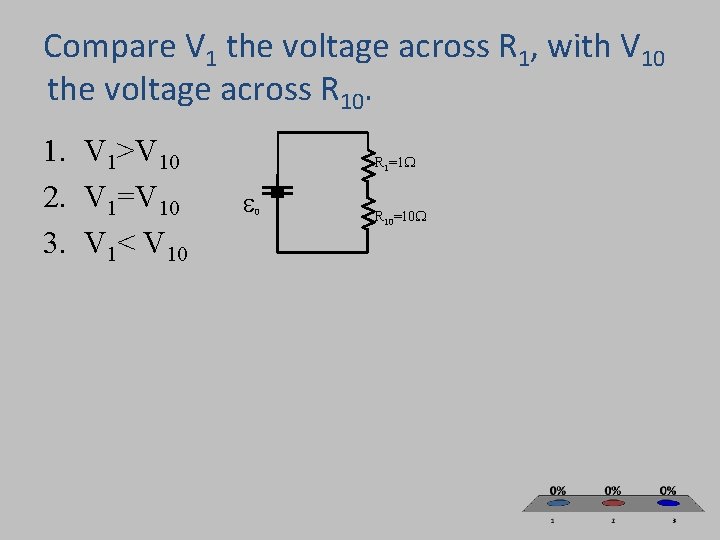
Compare V 1 the voltage across R 1, with V 10 the voltage across R 10. 1. V 1>V 10 2. V 1=V 10 3. V 1< V 10 R 1=1 W e 0 R 10=10 W
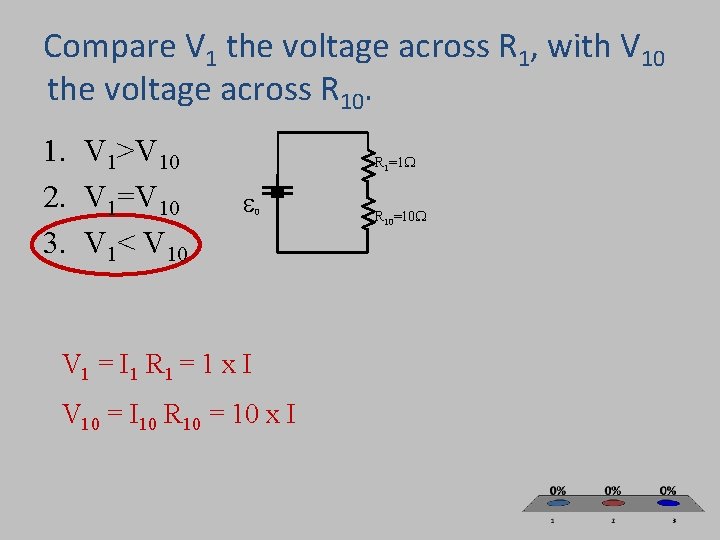
Compare V 1 the voltage across R 1, with V 10 the voltage across R 10. 1. V 1>V 10 2. V 1=V 10 3. V 1< V 10 R 1=1 W e 0 V 1 = I 1 R 1 = 1 x I V 10 = I 10 R 10 = 10 x I R 10=10 W
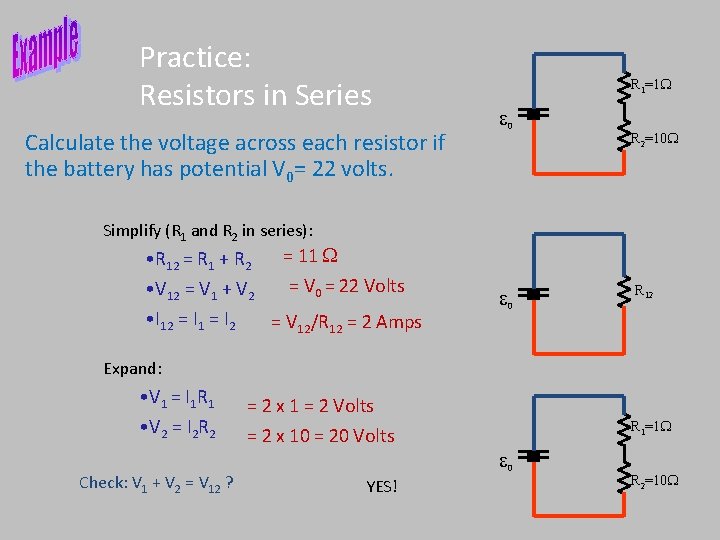
Practice: Resistors in Series Calculate the voltage across each resistor if the battery has potential V 0= 22 volts. R 1=1 W e 0 R 2=10 W Simplify (R 1 and R 2 in series): = 11 W • R 12 = R 1 + R 2 = V 0 = 22 Volts • V 12 = V 1 + V 2 • I 12 = I 1 = I 2 = V 12/R 12 = 2 Amps e 0 R 12 Expand: • V 1 = I 1 R 1 • V 2 = I 2 R 2 Check: V 1 + V 2 = V 12 ? = 2 x 1 = 2 Volts = 2 x 10 = 20 Volts YES! R 1=1 W e 0 R 2=10 W
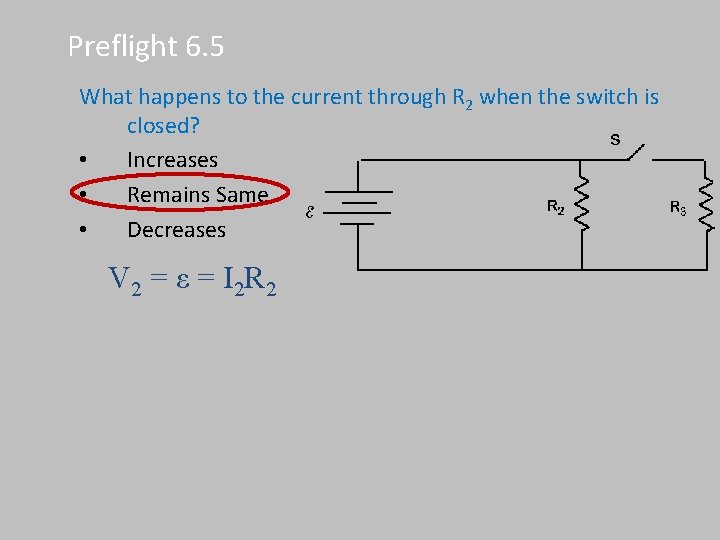
Preflight 6. 5 What happens to the current through R 2 when the switch is closed? • Increases • Remains Same • Decreases V 2 = ε = I 2 R 2
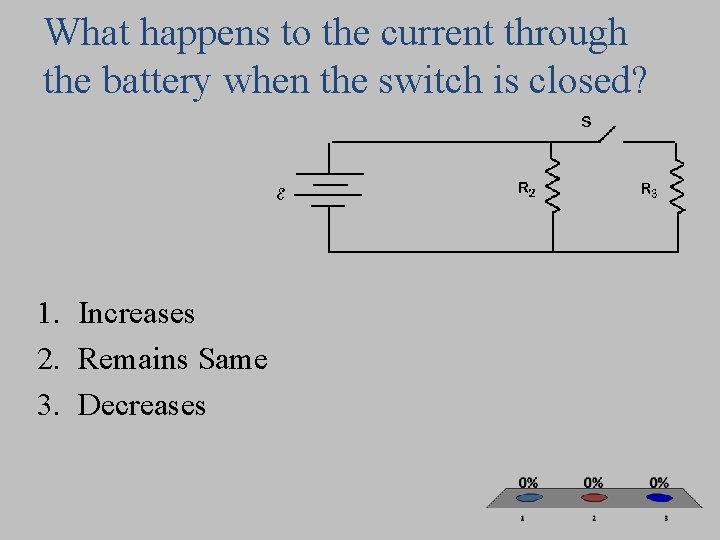
What happens to the current through the battery when the switch is closed? 1. Increases 2. Remains Same 3. Decreases
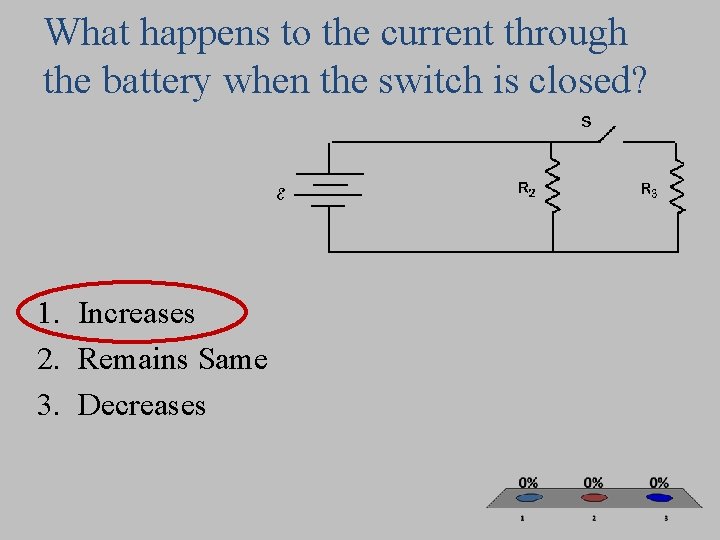
What happens to the current through the battery when the switch is closed? 1. Increases 2. Remains Same 3. Decreases
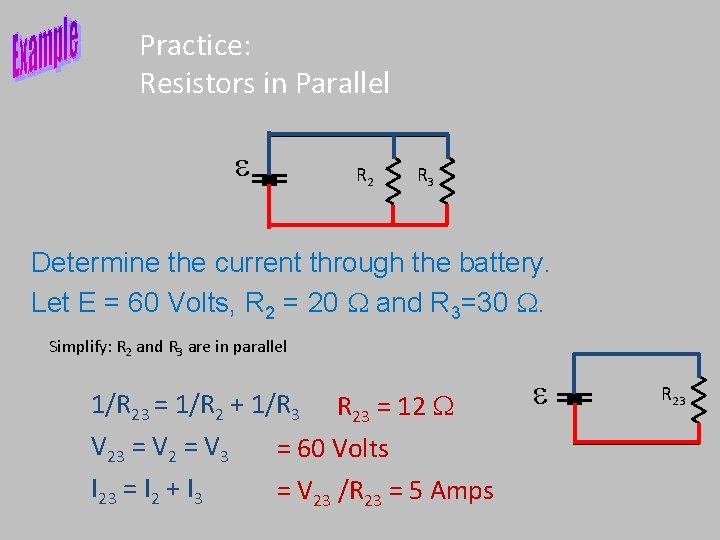
Practice: Resistors in Parallel e R 2 R 3 Determine the current through the battery. Let E = 60 Volts, R 2 = 20 W and R 3=30 W. Simplify: R 2 and R 3 are in parallel 1/R 23 = 1/R 2 + 1/R 3 V 23 = V 2 = V 3 I 23 = I 2 + I 3 R 23 = 12 W = 60 Volts = V 23 /R 23 = 5 Amps e R 23
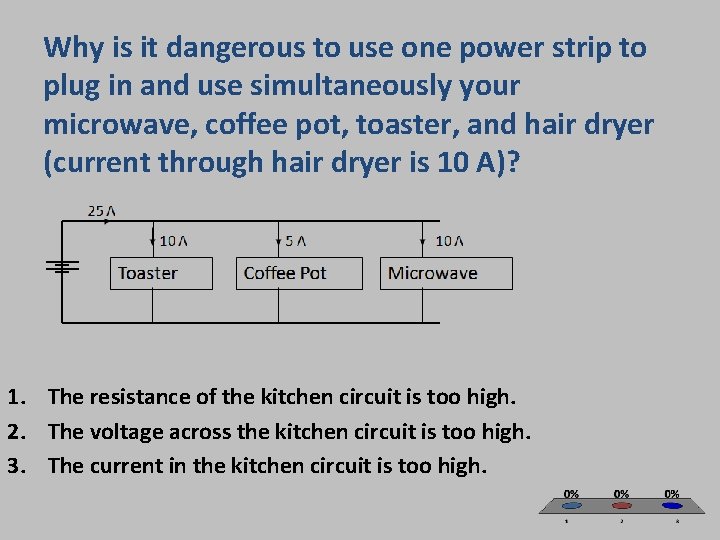
Why is it dangerous to use one power strip to plug in and use simultaneously your microwave, coffee pot, toaster, and hair dryer (current through hair dryer is 10 A)? 1. The resistance of the kitchen circuit is too high. 2. The voltage across the kitchen circuit is too high. 3. The current in the kitchen circuit is too high.
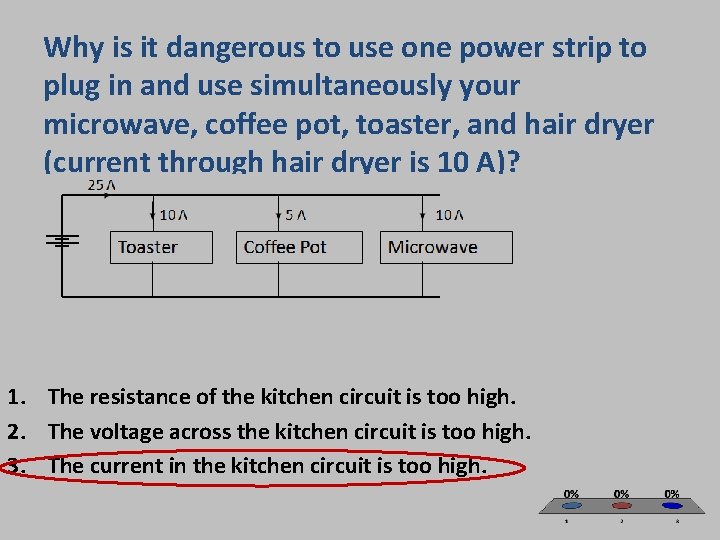
Why is it dangerous to use one power strip to plug in and use simultaneously your microwave, coffee pot, toaster, and hair dryer (current through hair dryer is 10 A)? 1. The resistance of the kitchen circuit is too high. 2. The voltage across the kitchen circuit is too high. 3. The current in the kitchen circuit is too high.
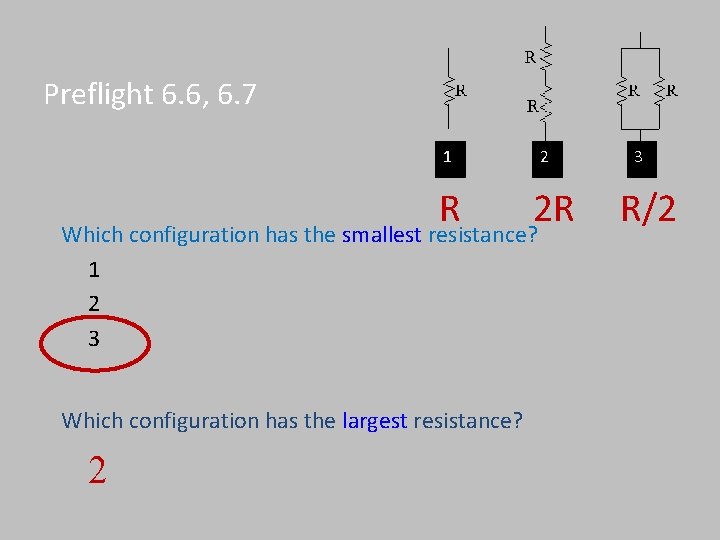
Preflight 6. 6, 6. 7 1 R 2 2 R Which configuration has the smallest resistance? 1 2 3 Which configuration has the largest resistance? 2 3 R/2
Parallel + Series Tests • Resistors R 1 and R 2 are in series if and only if every loop that contains R 1 also contains R 2 • Resistors R 1 and R 2 are in parallel if and only if you can make a loop that has ONLY R 1 and R 2 • Same rules apply to capacitors!!
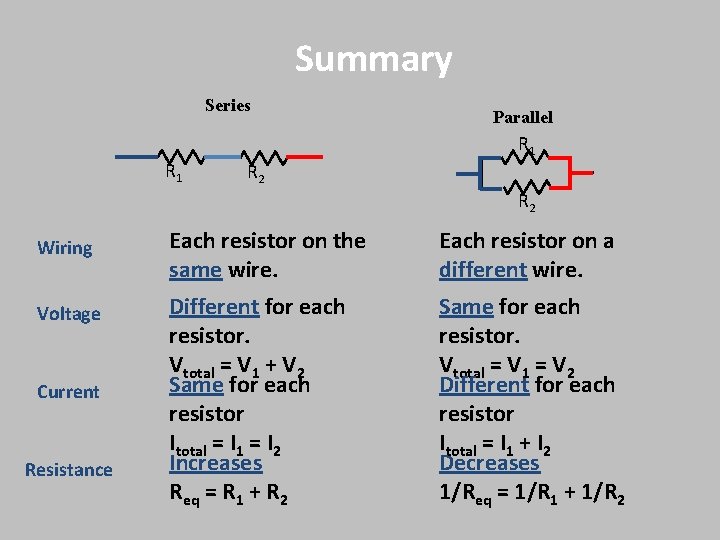
Summary Series Parallel R 1 R 2 Wiring Each resistor on the same wire. Each resistor on a different wire. Voltage Different for each resistor. Vtotal = V 1 + V 2 Same for each resistor Itotal = I 1 = I 2 Increases Req = R 1 + R 2 Same for each resistor. Vtotal = V 1 = V 2 Different for each resistor Itotal = I 1 + I 2 Decreases 1/Req = 1/R 1 + 1/R 2 Current Resistance