
Physics 111 Dynamic Fluids Concept Checker Ideal fluids


- Slides: 13
Physics 111 Dynamic Fluids
Concept Checker �Ideal fluids have three main components. What are they?
Answer: �Steady Flow: the velocity of the fluid particles at any point in time is constant �Incompressible �Nonviscous
Concept Checker 2 �Explain in your own words why tornados can pull the roof of your house.
Answer. �The wind above the roof is moving faster, meaning it has a lower pressure �Air in the house is moving slower, meaning it has a higher pressure �The high pressure wants to be where the low pressure is, so it pushes the roof up
Determine the Mass Flow Rate �Density and velocity of a fluid is given as 920 kg/m 3 and 5 m/s, this fluid is flowing through an area of 25 cm 2. Calculate the mass flow rate?
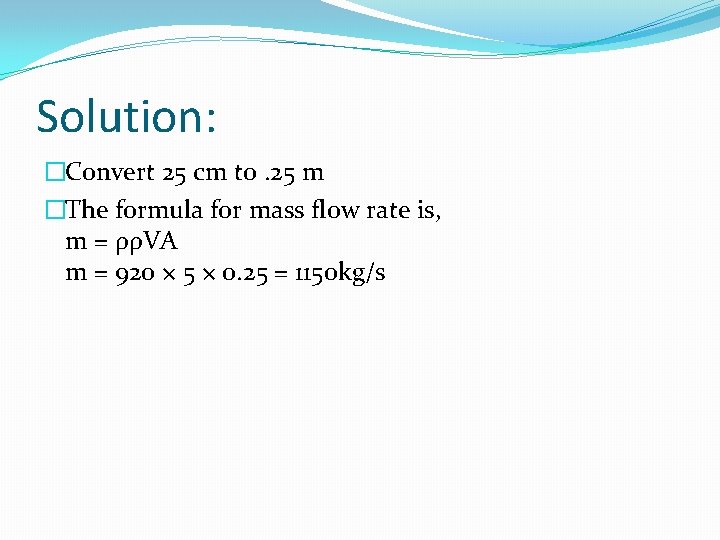
Solution: �Convert 25 cm to. 25 m �The formula for mass flow rate is, m = ρρVA m = 920 × 5 × 0. 25 = 1150 kg/s
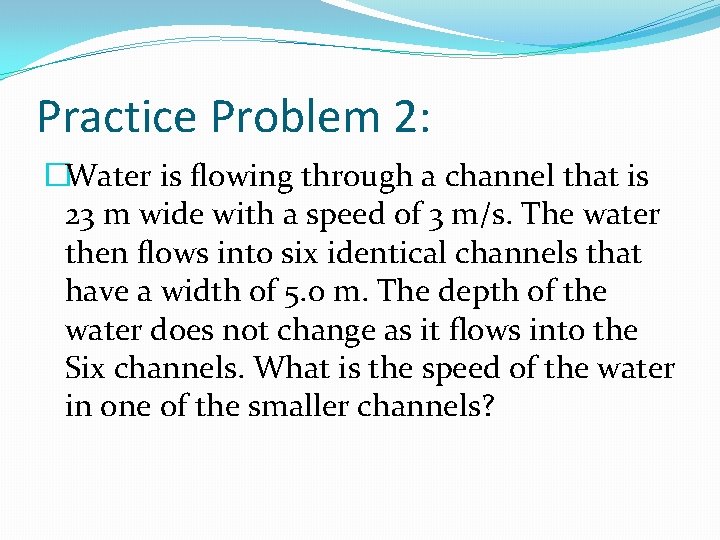
Practice Problem 2: �Water is flowing through a channel that is 23 m wide with a speed of 3 m/s. The water then flows into six identical channels that have a width of 5. 0 m. The depth of the water does not change as it flows into the Six channels. What is the speed of the water in one of the smaller channels?
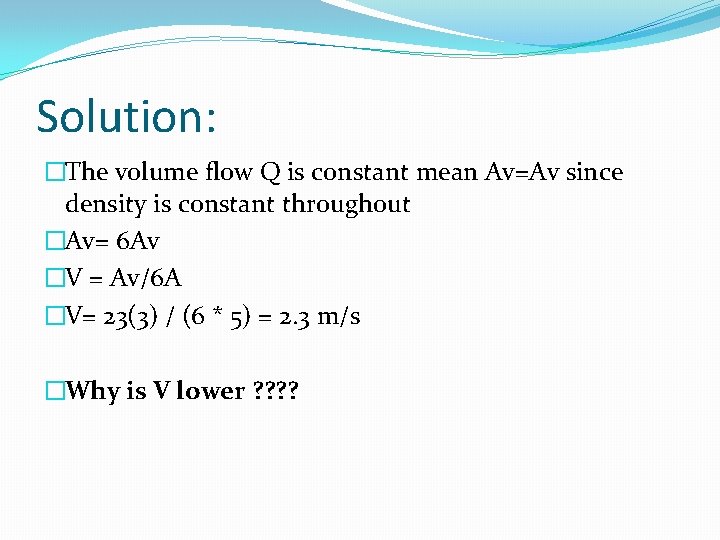
Solution: �The volume flow Q is constant mean Av=Av since density is constant throughout �Av= 6 Av �V = Av/6 A �V= 23(3) / (6 * 5) = 2. 3 m/s �Why is V lower ? ?
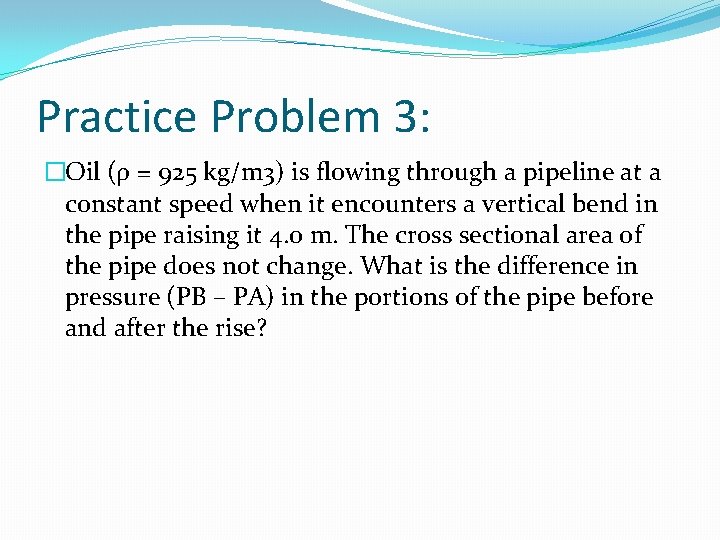
Practice Problem 3: �Oil (ρ = 925 kg/m 3) is flowing through a pipeline at a constant speed when it encounters a vertical bend in the pipe raising it 4. 0 m. The cross sectional area of the pipe does not change. What is the difference in pressure (PB – PA) in the portions of the pipe before and after the rise?
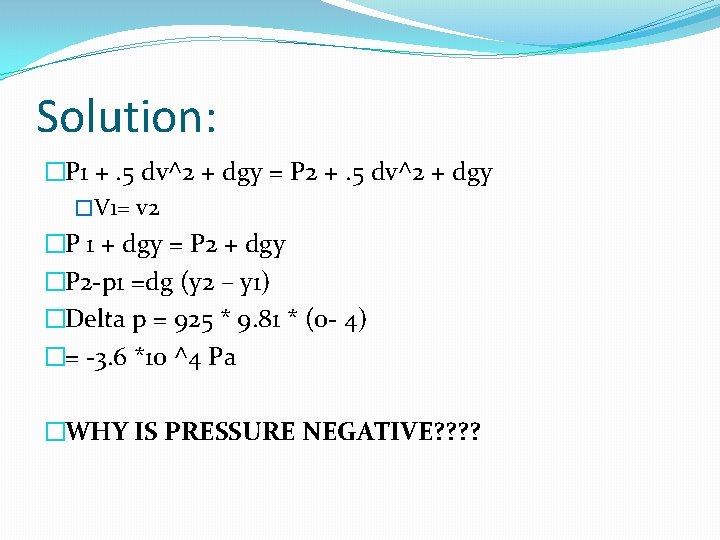
Solution: �P 1 +. 5 dv^2 + dgy = P 2 +. 5 dv^2 + dgy �V 1= v 2 �P 1 + dgy = P 2 + dgy �P 2 -p 1 =dg (y 2 – y 1) �Delta p = 925 * 9. 81 * (0 - 4) �= -3. 6 *10 ^4 Pa �WHY IS PRESSURE NEGATIVE? ?
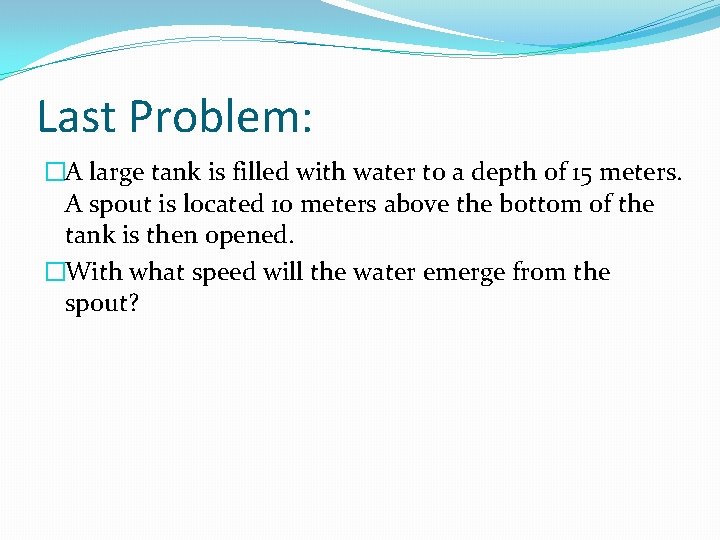
Last Problem: �A large tank is filled with water to a depth of 15 meters. A spout is located 10 meters above the bottom of the tank is then opened. �With what speed will the water emerge from the spout?
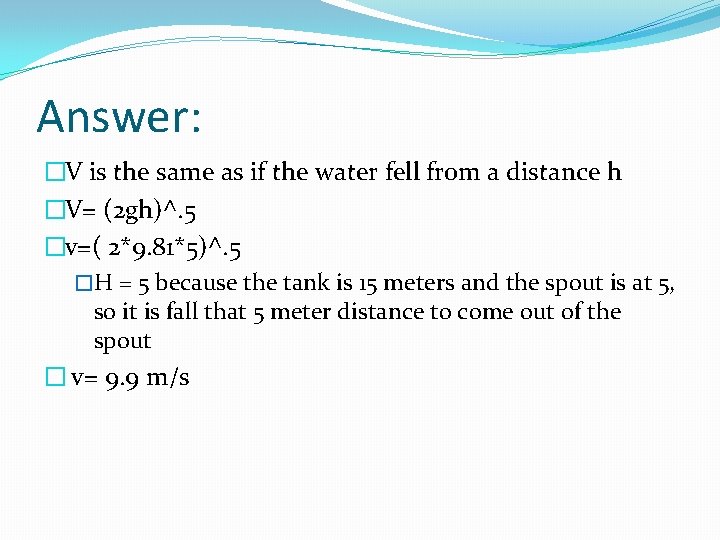
Answer: �V is the same as if the water fell from a distance h �V= (2 gh)^. 5 �v=( 2*9. 81*5)^. 5 �H = 5 because the tank is 15 meters and the spout is at 5, so it is fall that 5 meter distance to come out of the spout � v= 9. 9 m/s