
PHYSICS 11 TODAY Constant Acceleration Grading Scale for

- Slides: 38
PHYSICS 11 TODAY: • Constant Acceleration
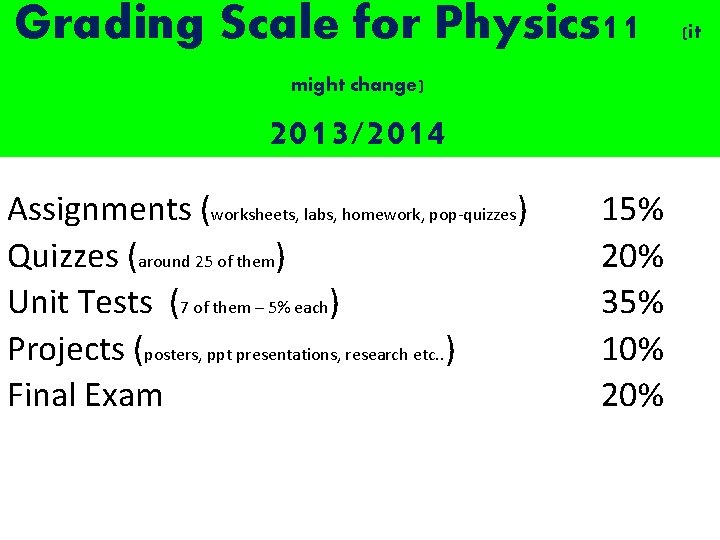
Grading Scale for Physics 11 might change) 2013/2014 Assignments (worksheets, labs, homework, pop-quizzes) Quizzes (around 25 of them) Unit Tests (7 of them – 5% each) Projects (posters, ppt presentations, research etc. . ) Final Exam 15% 20% 35% 10% 20% (it
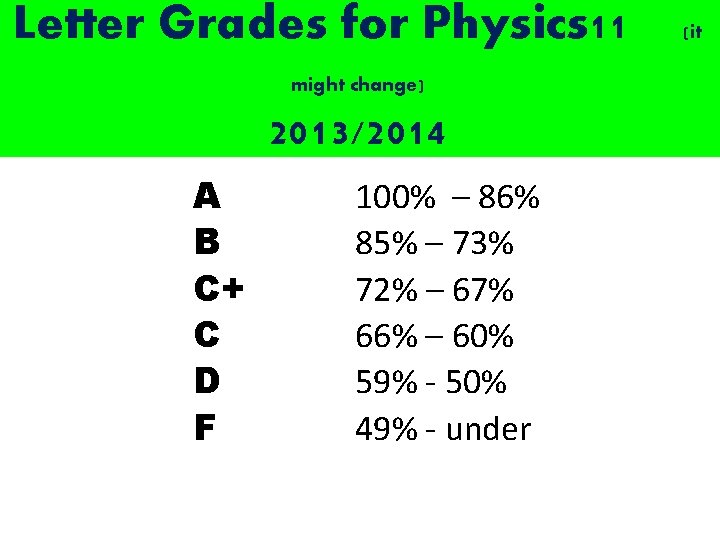
Letter Grades for Physics 11 might change) 2013/2014 A B C+ C D F 100% – 86% 85% – 73% 72% – 67% 66% – 60% 59% - 50% 49% - under (it
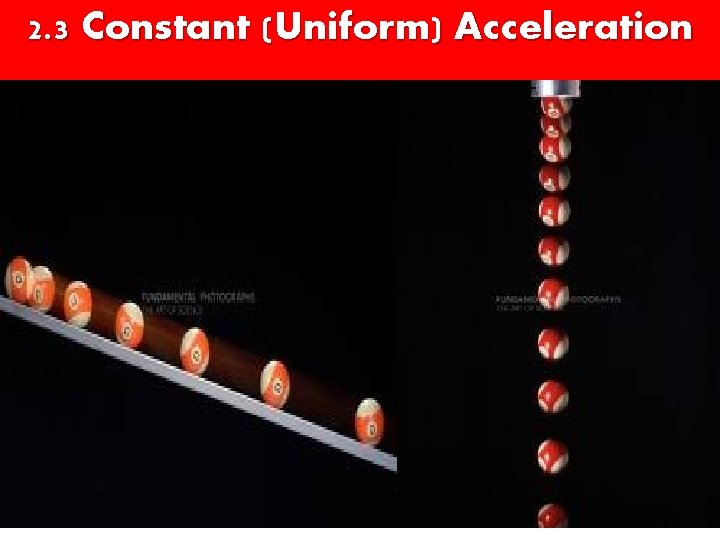
2. 3 Constant (Uniform) Acceleration
2. 3 Constant (Uniform) Acceleration
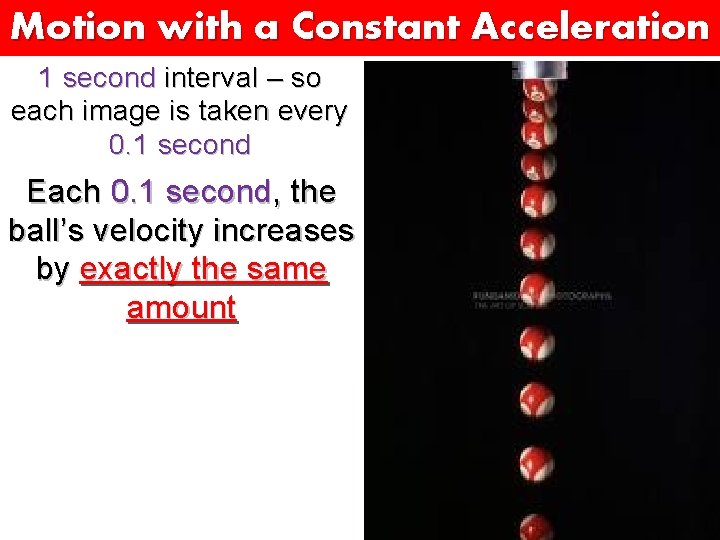
Motion with a Constant Acceleration 1 second interval – so each image is taken every 0. 1 second Each 0. 1 second, the ball’s velocity increases by exactly the same amount
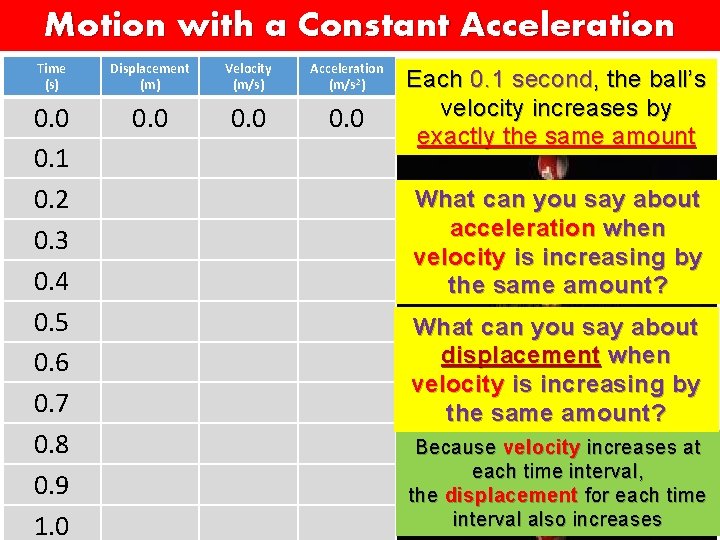
Motion with a Constant Acceleration Time (s) Displacement (m) Velocity (m/s) Acceleration (m/s 2) 0. 0 0. 1 0. 2 0. 3 0. 4 0. 5 0. 6 0. 7 0. 8 0. 9 1. 0 0. 1 0. 4 0. 9 1. 6 2. 5 3. 6 4. 9 6. 4 8. 1 10. 0 1. 0 2. 0 3. 0 4. 0 5. 0 6. 0 7. 0 8. 0 9. 0 10. 0 Each 0. 1 second, the ball’s velocity increases by exactly the same amount What can you say about acceleration when velocity is increasing by the same amount? What can you say about displacement when velocity is increasing by the same amount? Because velocity increases at each time interval, the displacement for each time interval also increases
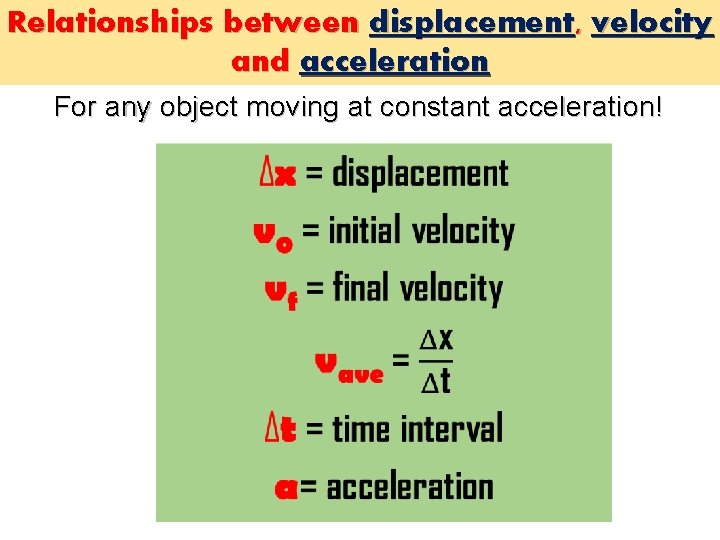
Relationships between displacement, velocity and acceleration For any object moving at constant acceleration!
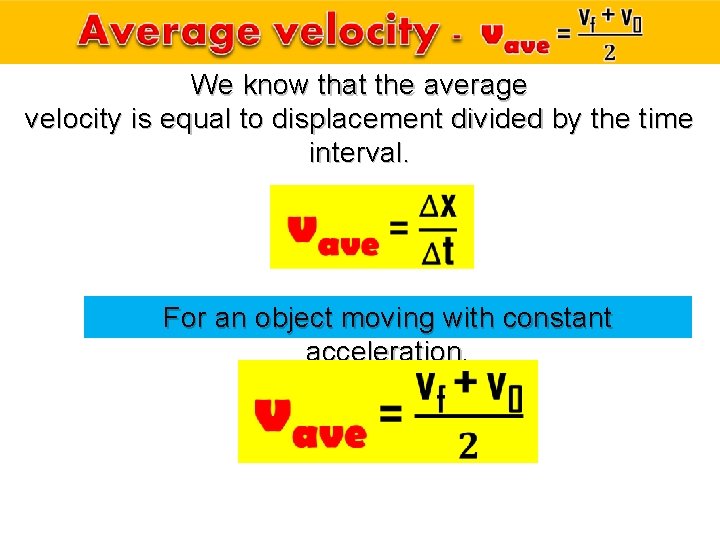
We know that the average velocity is equal to displacement divided by the time interval. For an object moving with constant acceleration,
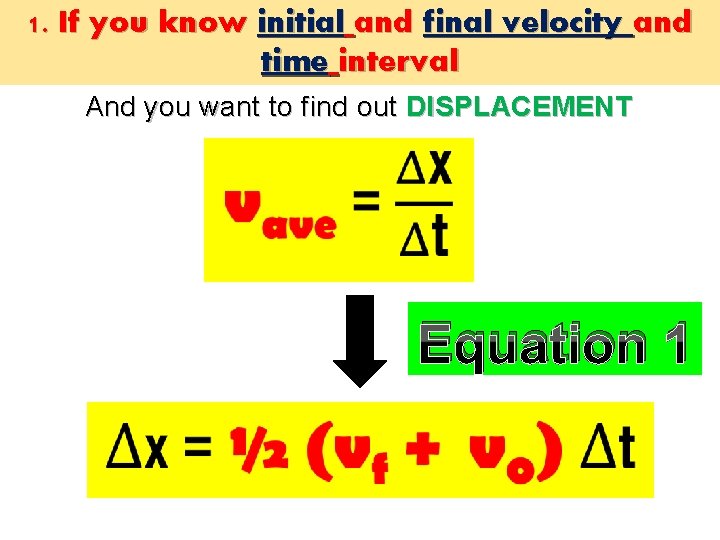
1. If you know initial and final velocity and time interval And you want to find out DISPLACEMENT Equation 1
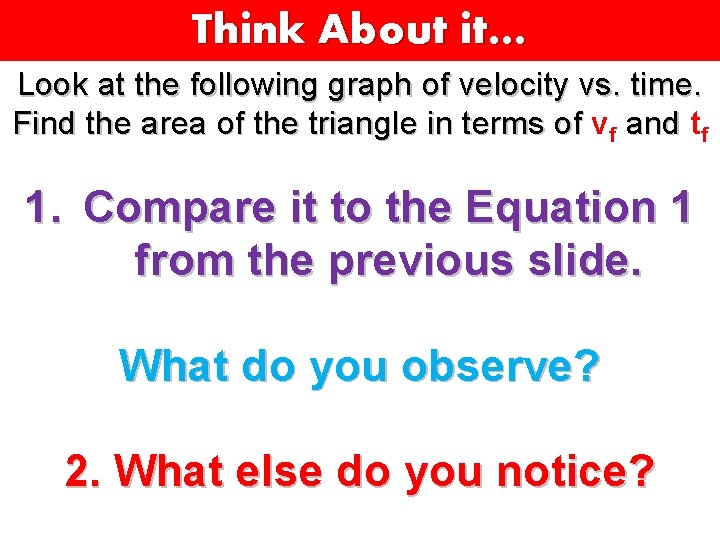
Think About it… Look at the following graph of velocity vs. time. Find the area of the triangle in terms of vf and t and f 1. Compare it to the Equation 1 from the previous slide. What do you observe? 2. What else do you notice?
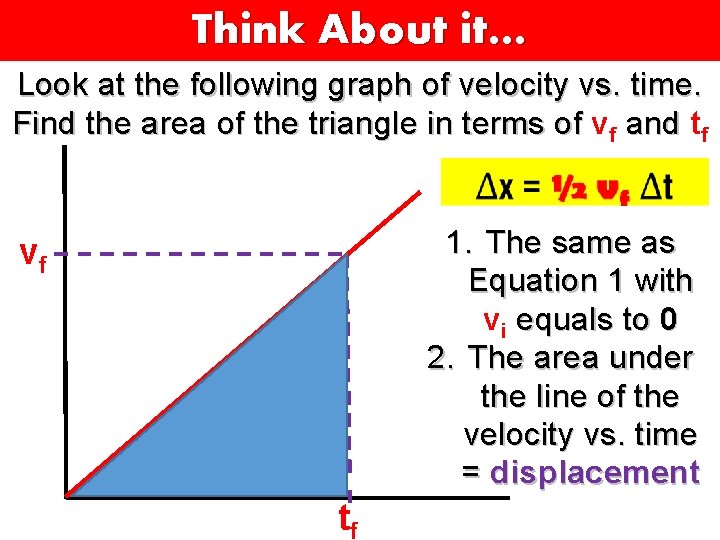
Think About it… Look at the following graph of velocity vs. time. Find the area of the triangle in terms of vf and t and f 1. The same as Equation 1 with vi equals to 0 2. The area under the line of the velocity vs. time = displacement vf tf
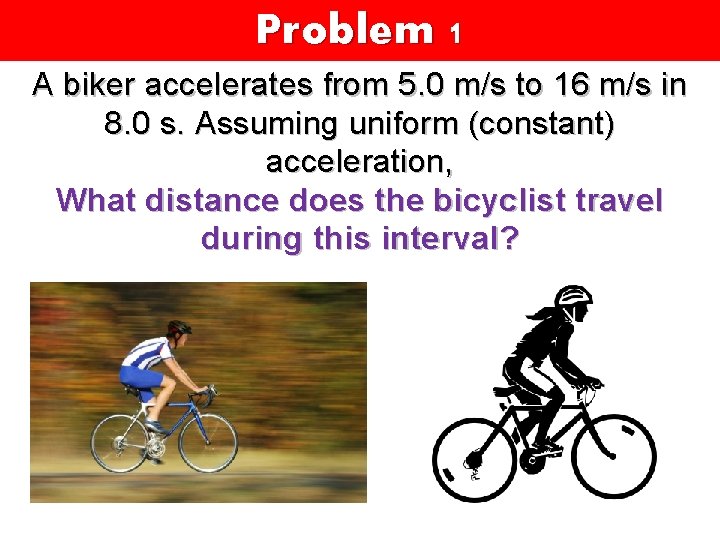
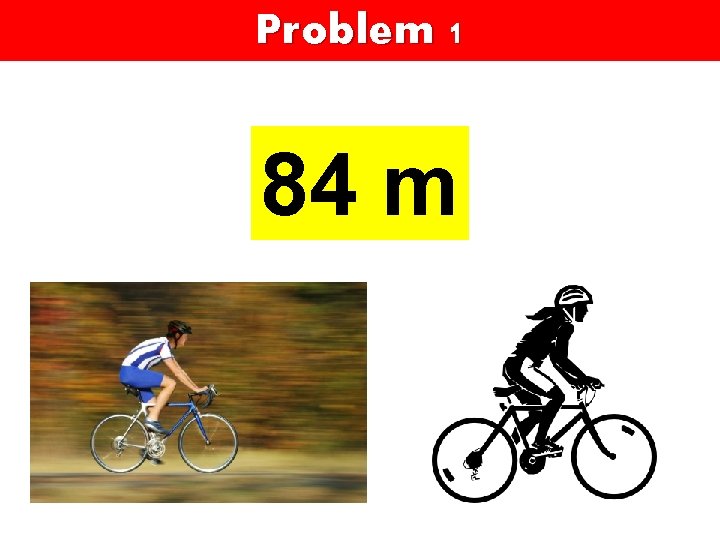
Problem 1 A biker accelerates from 5. 0 m/s to 16 m/s in 8. 0 s. Assuming uniform (constant) acceleration, What distance does the bicyclist travel during this interval?
Problem 1 84 m
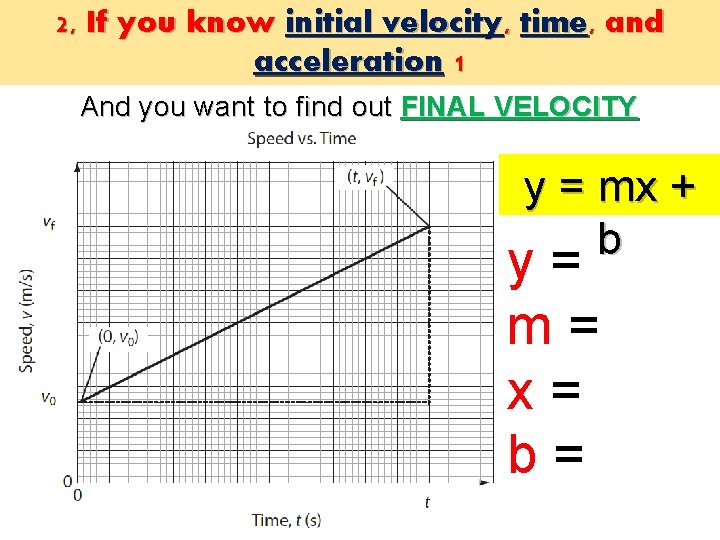
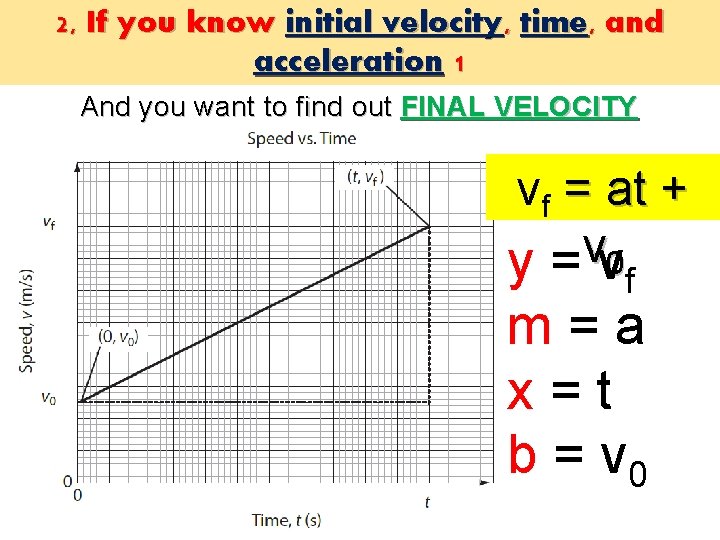
2, If you know initial velocity, time, and acceleration 1 And you want to find out FINAL VELOCITY y = mx + b y = m = x = b =
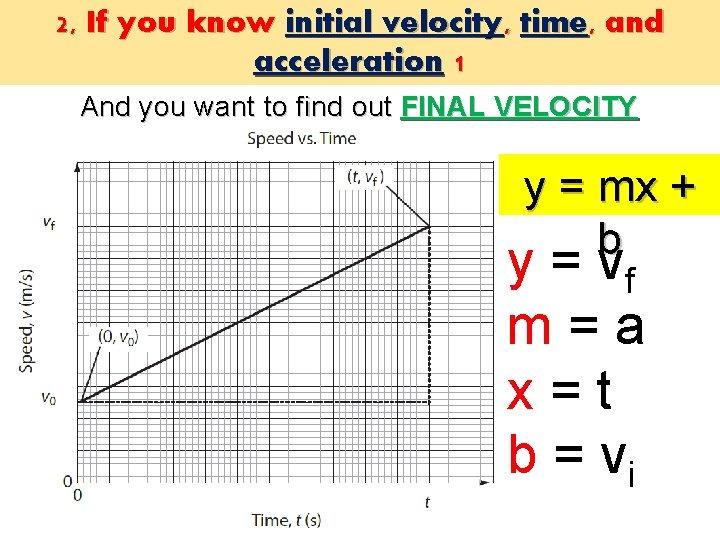
2, If you know initial velocity, time, and acceleration 1 And you want to find out FINAL VELOCITY y = mx + b y = vf m = a x = t b = vi
2, If you know initial velocity, time, and acceleration 1 And you want to find out FINAL VELOCITY vf = at + v y = v 0 f m = a x = t b = v 0
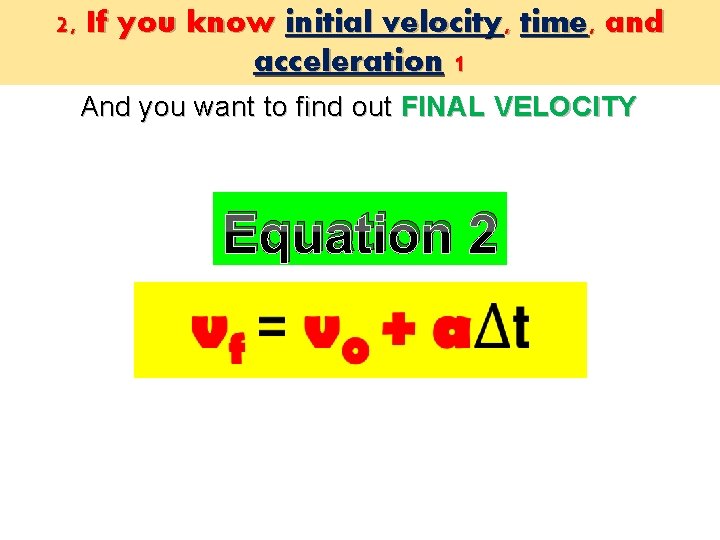
2, If you know initial velocity, time, and acceleration 1 And you want to find out FINAL VELOCITY Equation 2
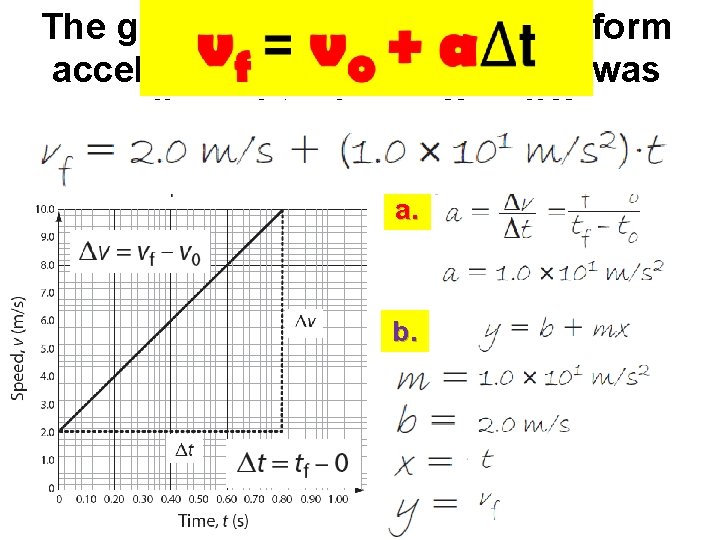
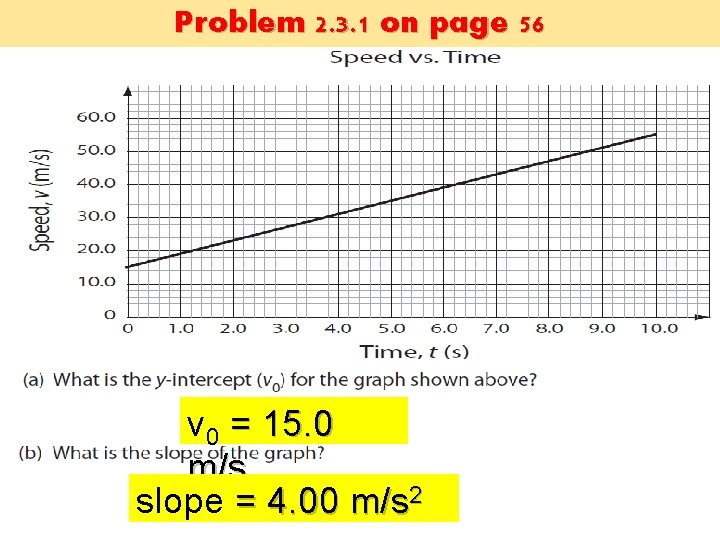
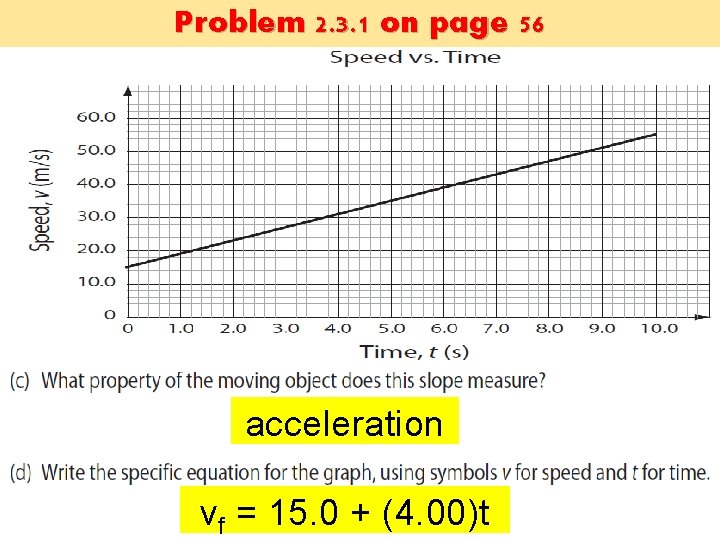
The graph below shows the uniform acceleration of an object, as it was allowed to drop off a cliff. a. What was the acceleration of the object? b. Write the equation for the graph a. b.
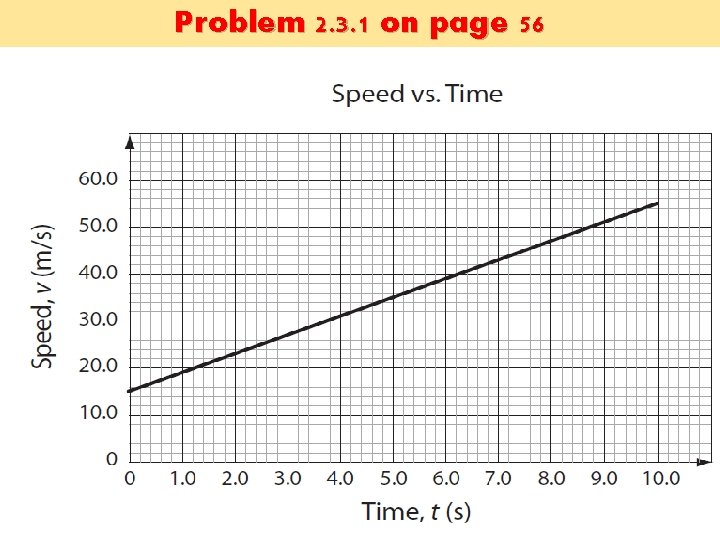
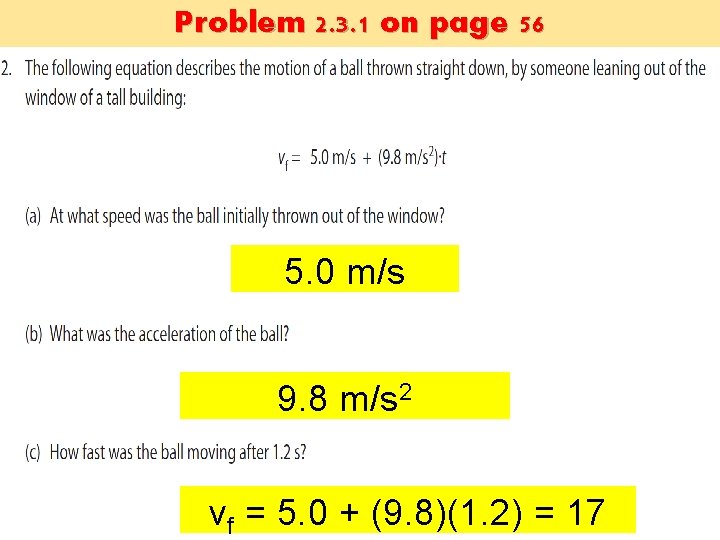
Problem 2. 3. 1 on page 56
Problem 2. 3. 1 on page 56 v 0 = 15. 0 m/s slope = 4. 00 m/s 2
Problem 2. 3. 1 on page 56 acceleration vf = 15. 0 + (4. 00)t
Problem 2. 3. 1 on page 56 5. 0 m/s 9. 8 m/s 2 vf = 5. 0 + (9. 8)(1. 2) = 17
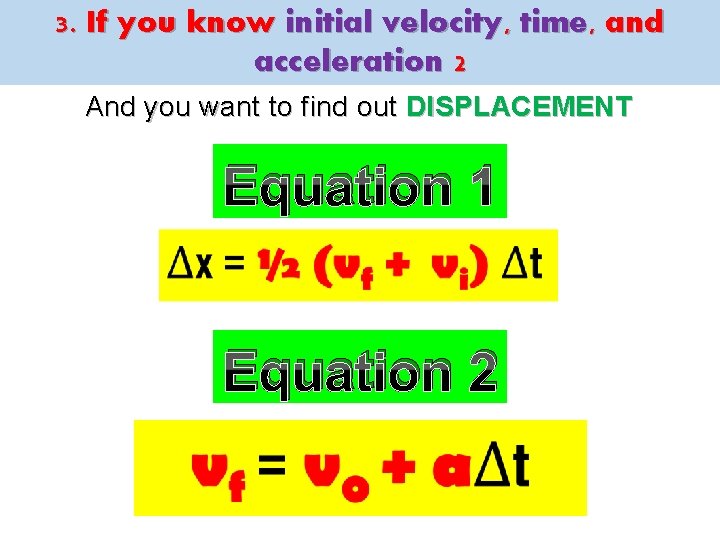
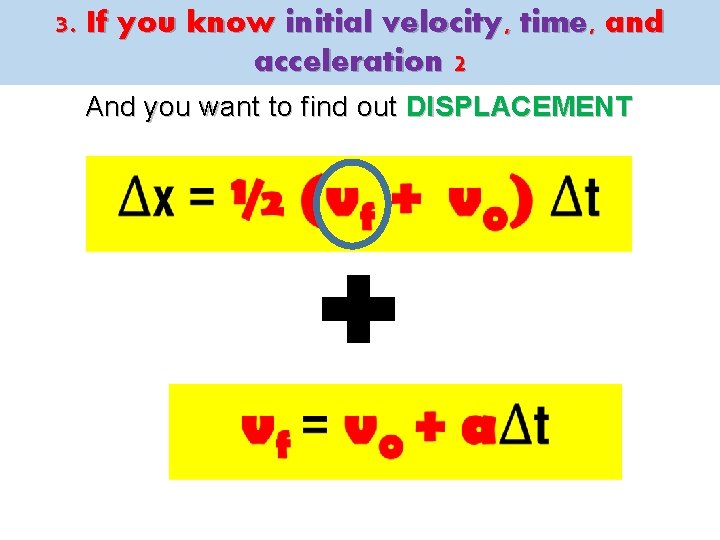
3. If you know initial velocity, time, and acceleration 2 And you want to find out DISPLACEMENT Equation 1 Equation 2
3. If you know initial velocity, time, and acceleration 2 And you want to find out DISPLACEMENT
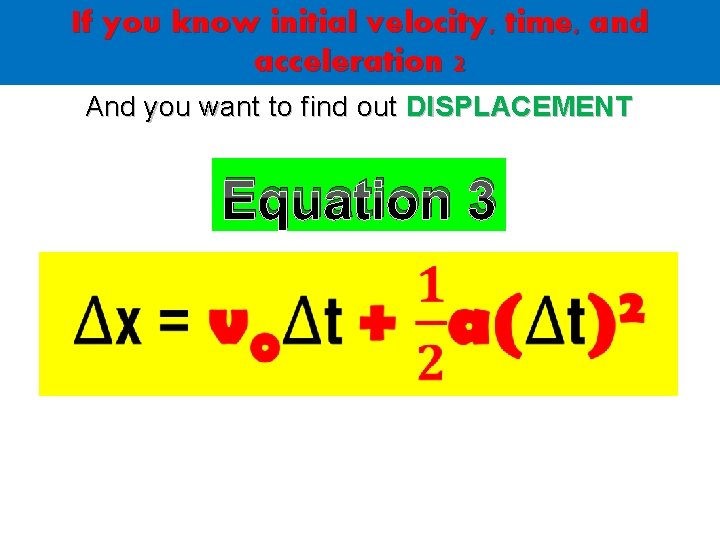
If you know initial velocity , time, and acceleration 2 And you want to find out DISPLACEMENT Equation 3
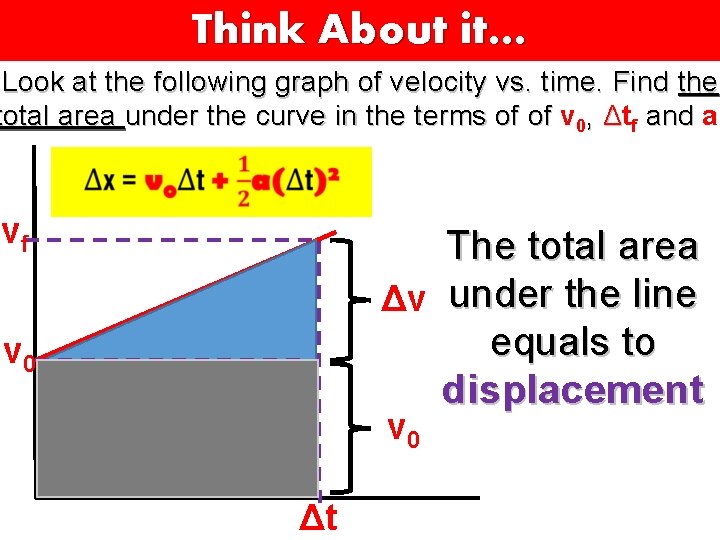
Think About it… Look at the following graph of velocity vs. time. Find the total area under the curve in the terms of of v 0, Δtf and a. and What do you observe?
Think About it… Look at the following graph of velocity vs. time. Find the total area under the curve in the terms of of v 0, Δtf and a. and vf The total area Δv under the line equals to displacement v 0 Δt
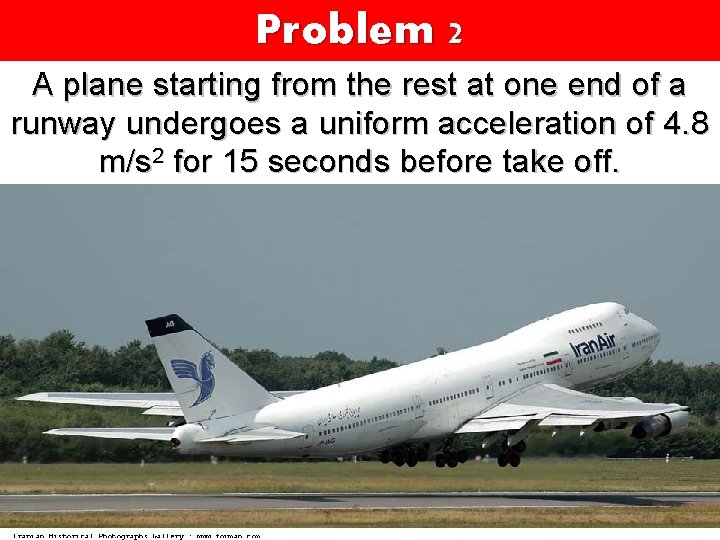
Problem 2 A plane starting from the rest at one end of a runway undergoes a uniform acceleration of 4. 8 m/s 2 for 15 seconds before take off.
Problem 2 1. What is its speed at take off? 2. How long must the runaway be for the plane to be able to take off?
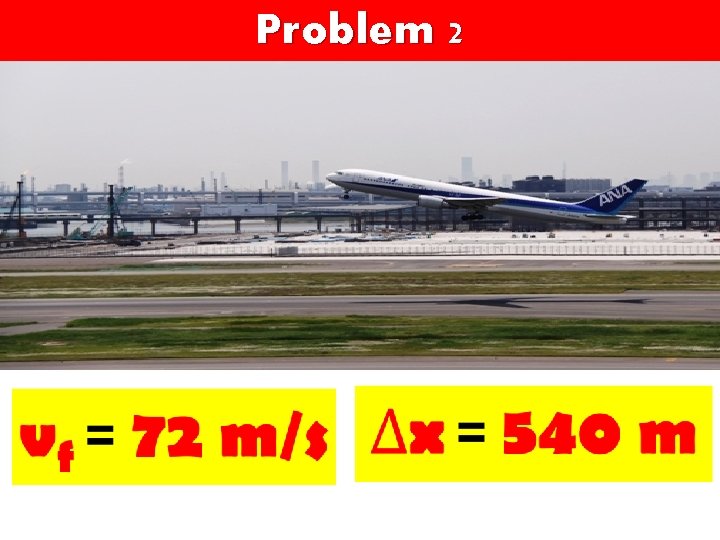
Problem 2
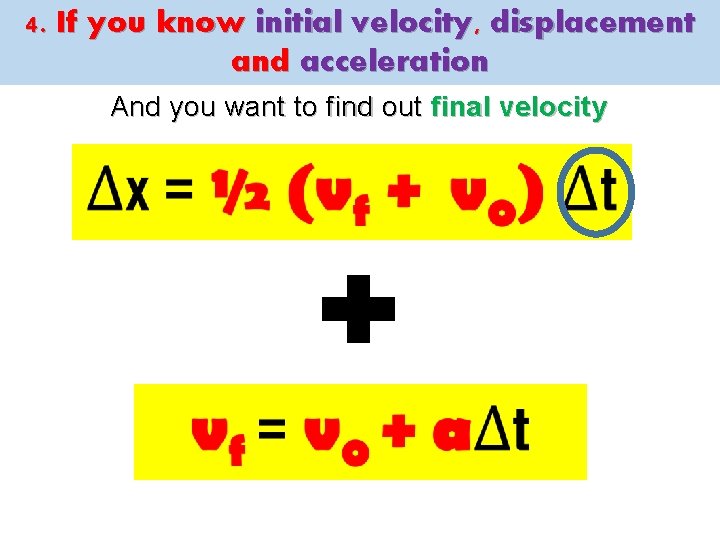
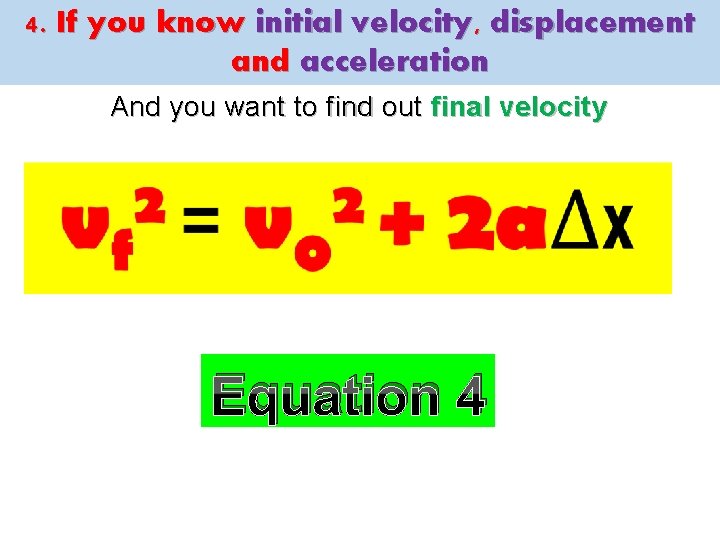
4. If you know initial velocity, displacement and acceleration And you want to find out final velocity
4. If you know initial velocity, displacement and acceleration And you want to find out final velocity Equation 4
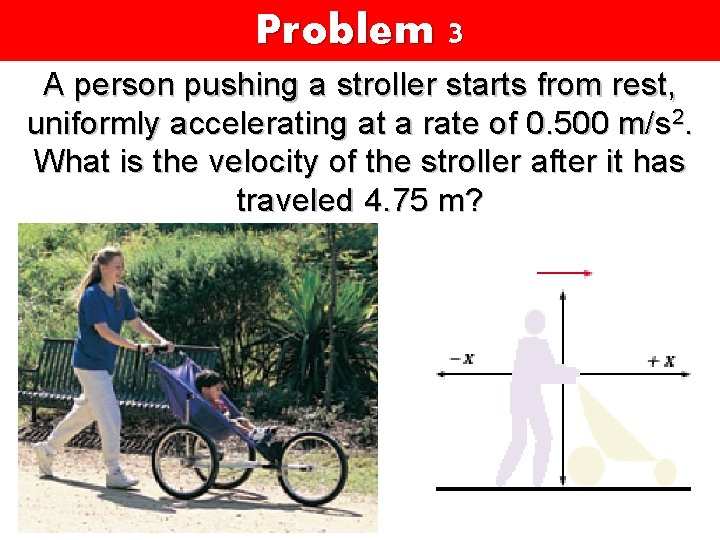
Problem 3 A person pushing a stroller starts from rest, uniformly accelerating at a rate of 0. 500 m/s 2. What is the velocity of the stroller after it has traveled 4. 75 m?
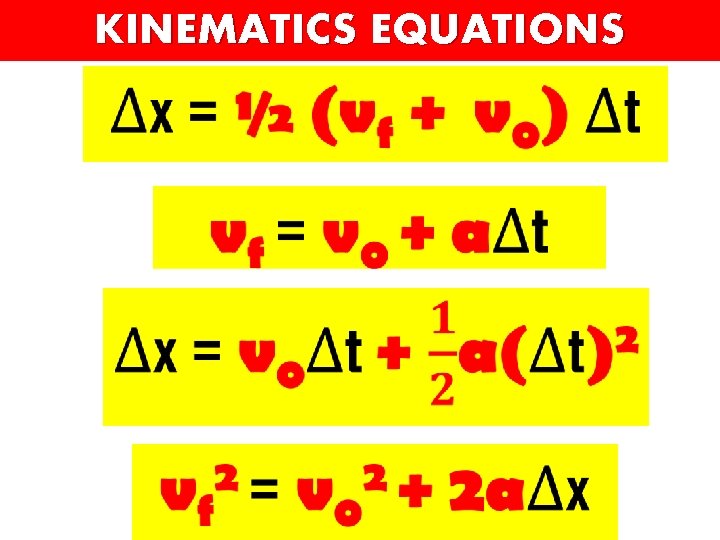
KINEMATICS EQUATIONS
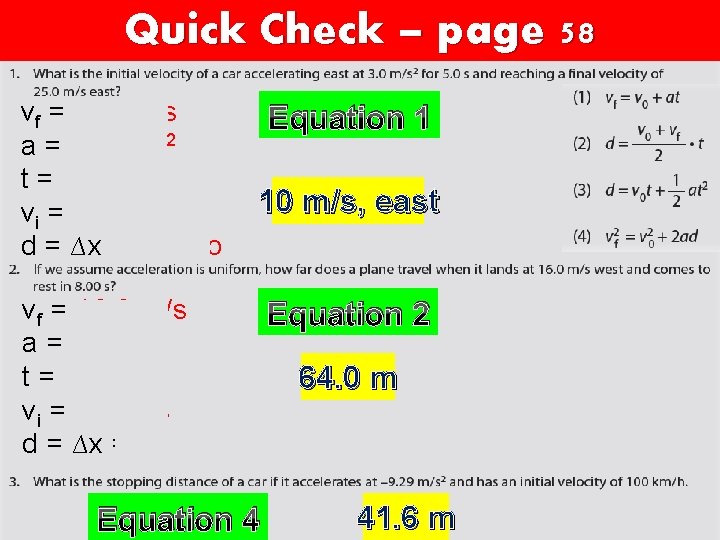
Quick Check – page 58 vf = 25. 0 m/s a = 3. 0 m/s 2 t = 5. 0 s vi = ? ? d = ∆x = no info Equation 1 10 m/s, east vf = 16. 0 m/s a = no info t = 8. 00 s vi = 0. 0 m/s d = ∆x = ? ? Equation 4 Equation 2 64. 0 m 41. 6 m
2. 3 Uniform Acceleration HOMEWORK Page: 62 – 63 Problems: 1, 3, 5, 7