
Physics 106 Lesson 4 Newtons Laws of Motion
- Slides: 18
Physics 106 Lesson #4 Newton’s Laws of Motion Dr. Andrew Tomasch 2405 Randall Lab atomasch@umich. edu
Last Time: A Puzzle • All objects near the earth are attracted with the same acceleration g = 9. 8 m/s 2 toward the Earth’s center (“downward”) irrespective of their masses • Forces cause motion • More massive objects have a larger downward force acting on them due to gravity • How can these facts be consistent? • Enter Sir Isaac Newton!
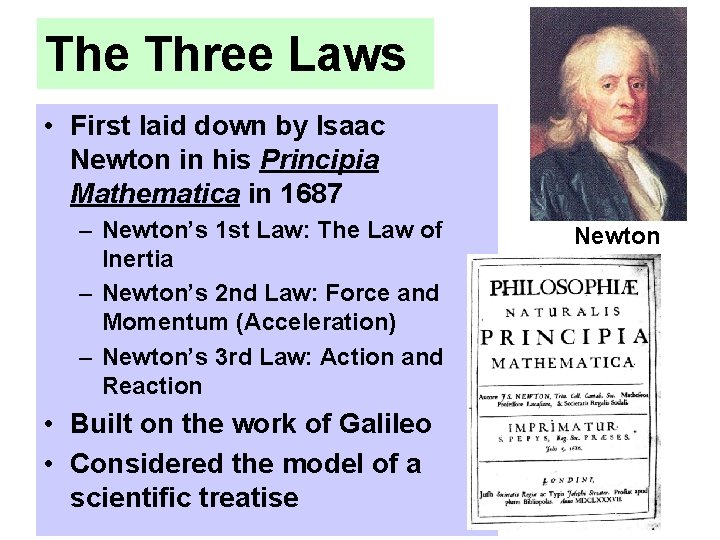
The Three Laws • First laid down by Isaac Newton in his Principia Mathematica in 1687 – Newton’s 1 st Law: The Law of Inertia – Newton’s 2 nd Law: Force and Momentum (Acceleration) – Newton’s 3 rd Law: Action and Reaction • Built on the work of Galileo • Considered the model of a scientific treatise Newton
Newton’s First Law: The Law of Inertia • “Every body continues in its state of rest, or of uniform motion in a straight line, unless it is compelled to change that state by outside forces impressed upon it. ” • Inertia (a scalar) is also called mass (m), which is measured in kilograms (SI)
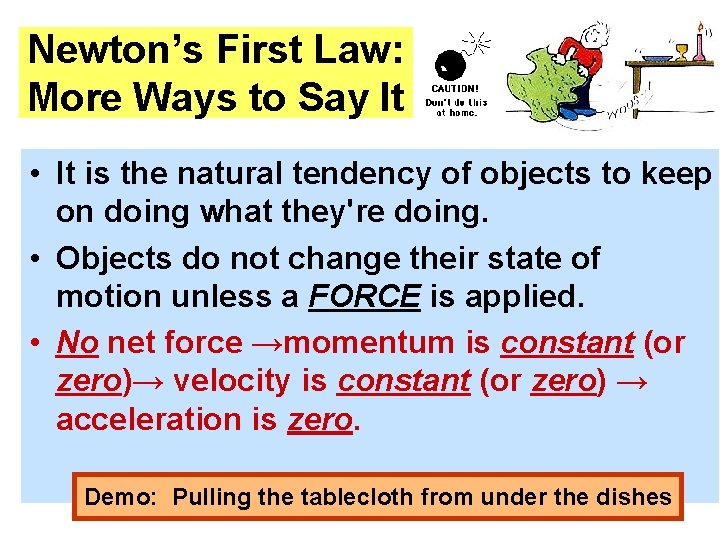
Newton’s First Law: More Ways to Say It • It is the natural tendency of objects to keep on doing what they're doing. • Objects do not change their state of motion unless a FORCE is applied. • No net force →momentum is constant (or zero)→ velocity is constant (or zero) → acceleration is zero. Demo: Pulling the tablecloth from under the dishes
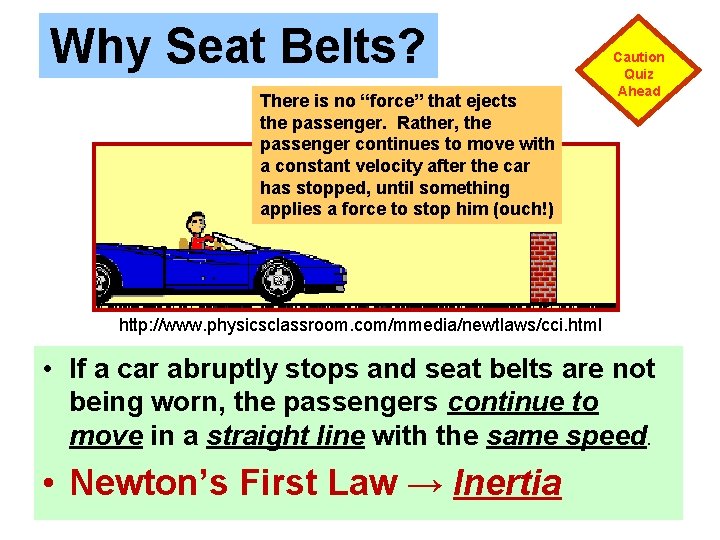
Why Seat Belts? There is no “force” that ejects the passenger. Rather, the passenger continues to move with a constant velocity after the car has stopped, until something applies a force to stop him (ouch!) Caution Quiz Ahead http: //www. physicsclassroom. com/mmedia/newtlaws/cci. html • If a car abruptly stops and seat belts are not being worn, the passengers continue to move in a straight line with the same speed. • Newton’s First Law → Inertia
Concept Test #1 Harry and Sally are arguing in a bakery. Harry says that if he throws his jelly donut at her with a greater speed it will have a greater inertia. Sally argues that inertia does not depend upon speed, but rather upon mass. With whom do you agree? A)Harry B)Sally Inertia is simply another word for mass. The more mass, the more inertia.
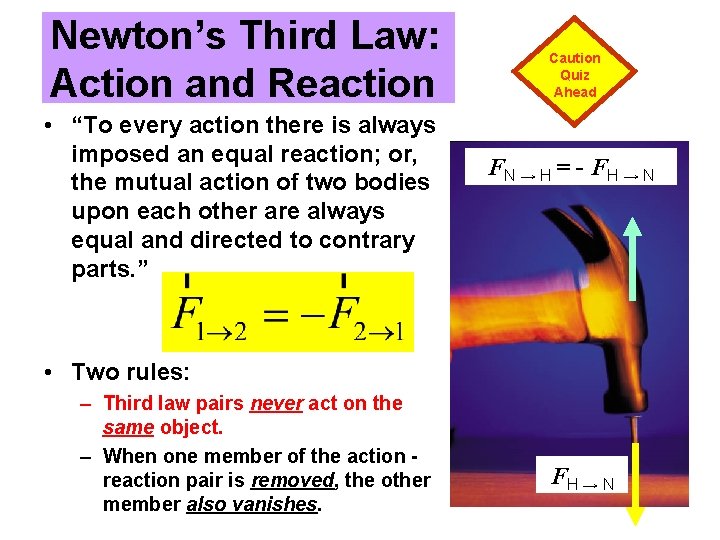
Newton’s Third Law: Action and Reaction • “To every action there is always imposed an equal reaction; or, the mutual action of two bodies upon each other are always equal and directed to contrary parts. ” Caution Quiz Ahead FN → H = - FH → N • Two rules: – Third law pairs never act on the same object. – When one member of the action reaction pair is removed, the other member also vanishes. FH → N
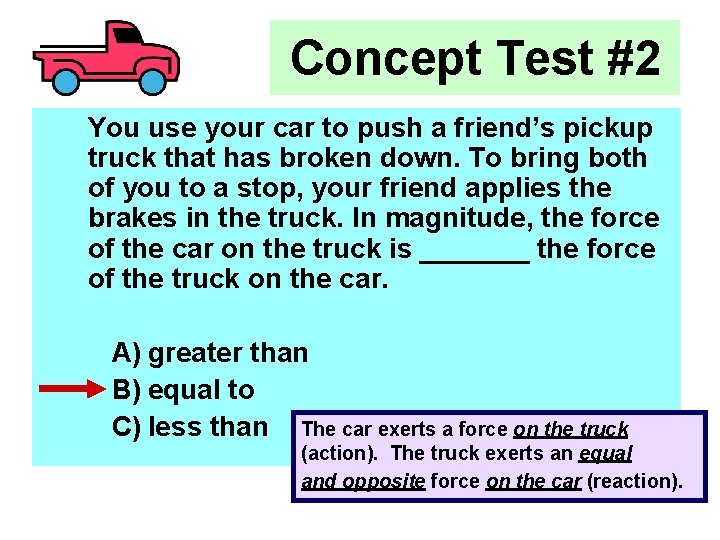
Concept Test #2 You use your car to push a friend’s pickup truck that has broken down. To bring both of you to a stop, your friend applies the brakes in the truck. In magnitude, the force of the car on the truck is _______ the force of the truck on the car. A) greater than B) equal to C) less than The car exerts a force on the truck (action). The truck exerts an equal and opposite force on the car (reaction).
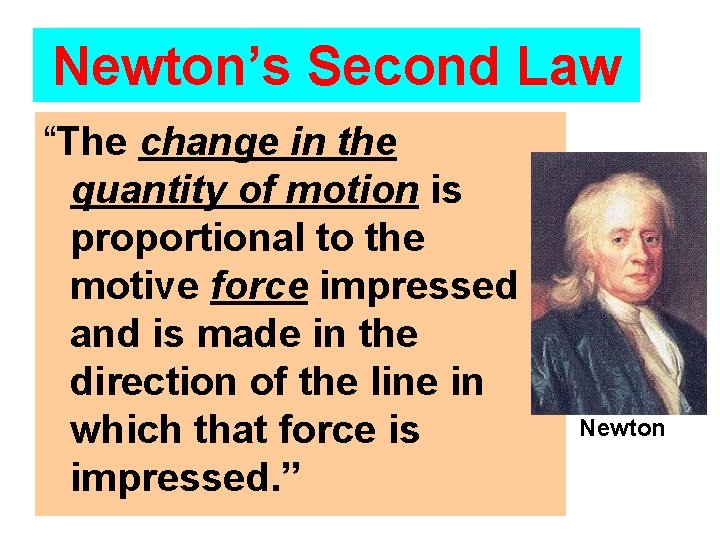
Newton’s Second Law “The change in the quantity of motion is proportional to the motive force impressed and is made in the direction of the line in which that force is impressed. ” Newton
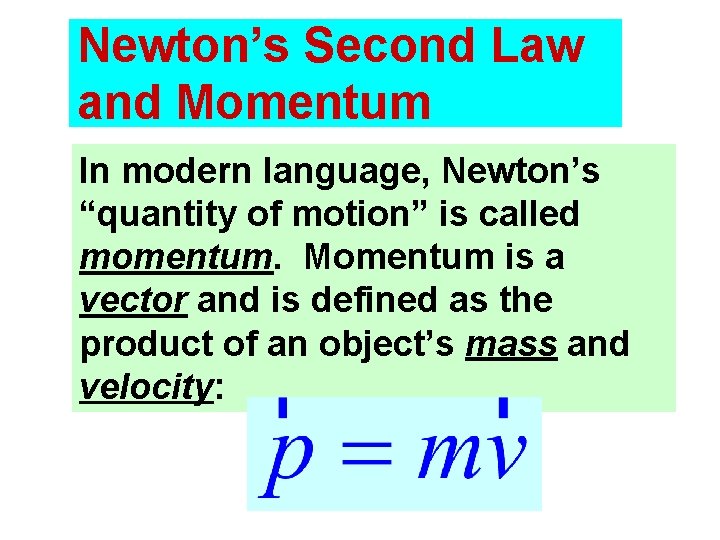
Newton’s Second Law and Momentum In modern language, Newton’s “quantity of motion” is called momentum. Momentum is a vector and is defined as the product of an object’s mass and velocity:
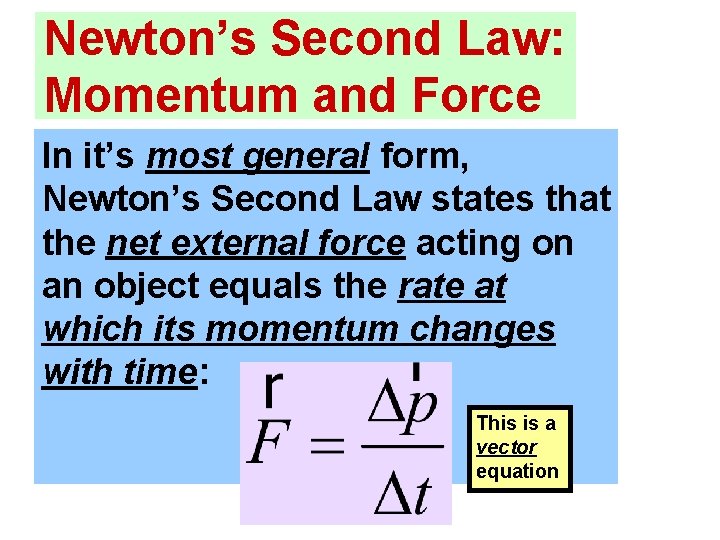
Newton’s Second Law: Momentum and Force In it’s most general form, Newton’s Second Law states that the net external force acting on an object equals the rate at which its momentum changes with time: This is a vector equation
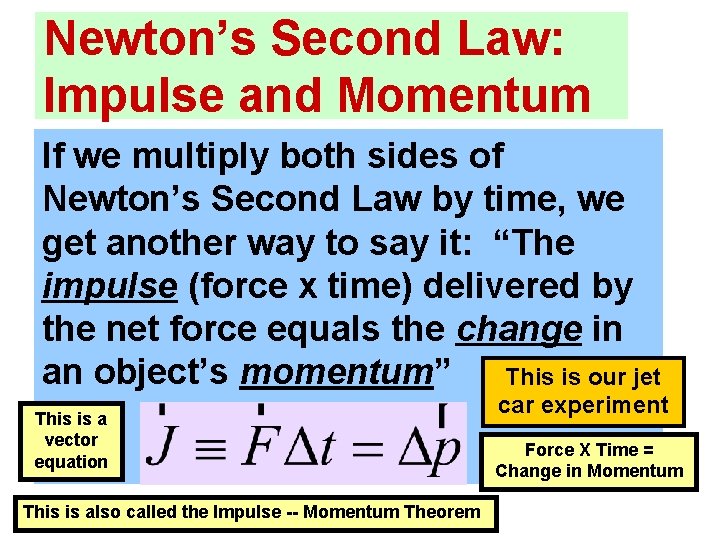
Newton’s Second Law: Impulse and Momentum If we multiply both sides of Newton’s Second Law by time, we get another way to say it: “The impulse (force x time) delivered by the net force equals the change in an object’s momentum” This is our jet This is a vector equation This is also called the Impulse -- Momentum Theorem car experiment Force X Time = Change in Momentum
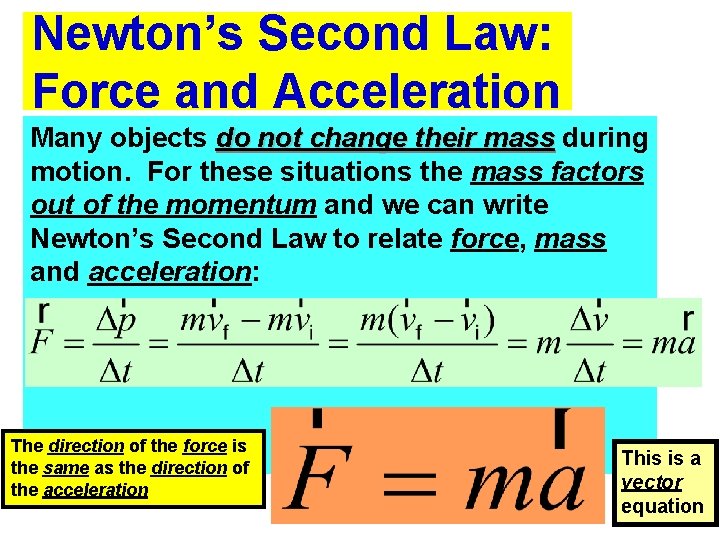
Newton’s Second Law: Force and Acceleration Many objects do not change their mass during motion. For these situations the mass factors out of the momentum and we can write Newton’s Second Law to relate force, mass and acceleration: The direction of the force is the same as the direction of the acceleration This is a vector equation
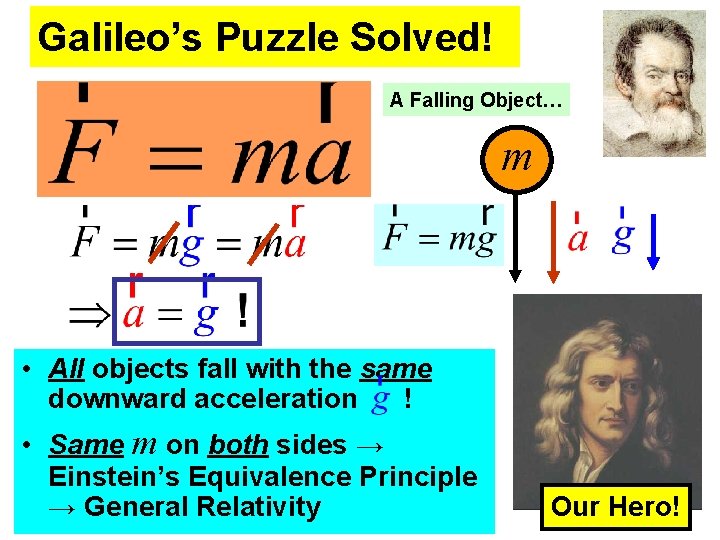
Galileo’s Puzzle Solved! A Falling Object… m • All objects fall with the same downward acceleration ! • Same m on both sides → Einstein’s Equivalence Principle → General Relativity Our Hero!
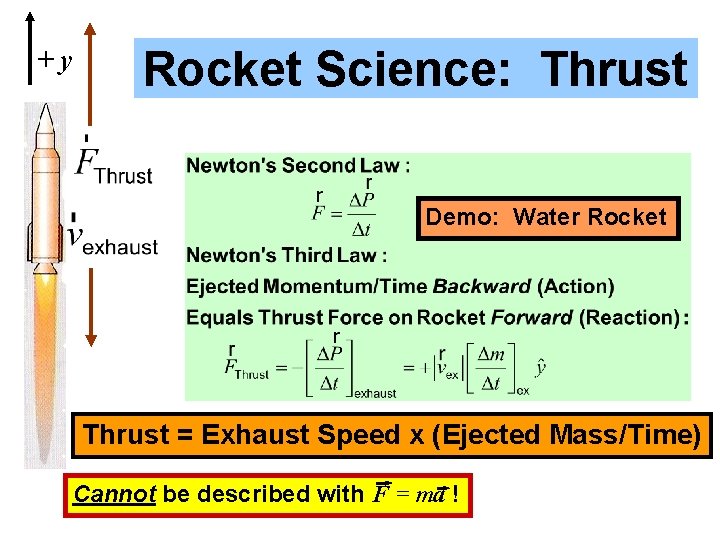
+y Rocket Science: Thrust Demo: Water Rocket Thrust = Exhaust Speed x (Ejected Mass/Time) Cannot be described with F = ma !
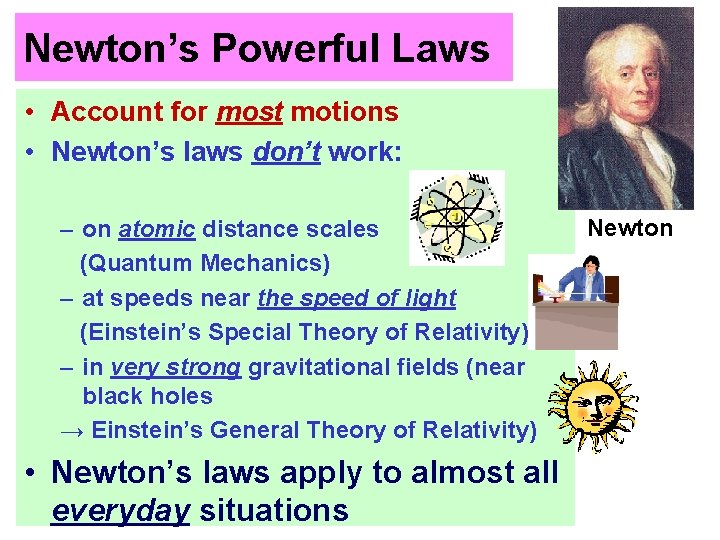
Newton’s Powerful Laws • Account for most motions • Newton’s laws don’t work: – on atomic distance scales (Quantum Mechanics) – at speeds near the speed of light (Einstein’s Special Theory of Relativity) – in very strong gravitational fields (near black holes → Einstein’s General Theory of Relativity) • Newton’s laws apply to almost all everyday situations Newton
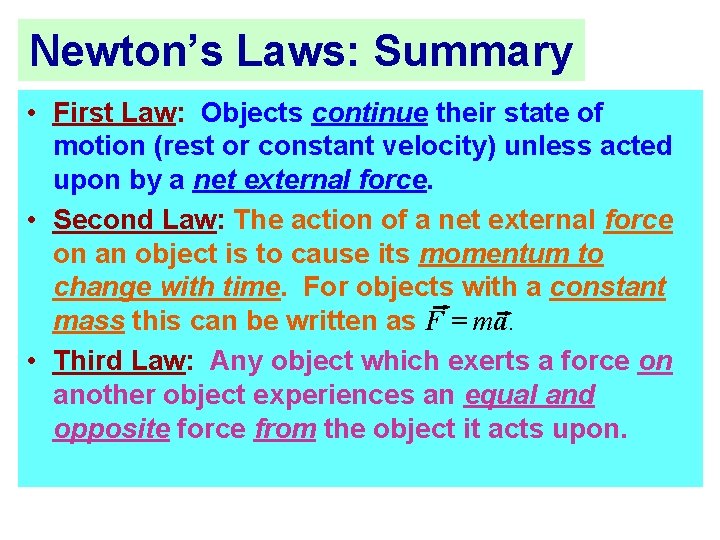
Newton’s Laws: Summary • First Law: Objects continue their state of motion (rest or constant velocity) unless acted upon by a net external force. • Second Law: The action of a net external force on an object is to cause its momentum to change with time. For objects with a constant mass this can be written as F = ma. • Third Law: Any object which exerts a force on another object experiences an equal and opposite force from the object it acts upon.