
Physics 102 Lecture 24 Bohr vs Correct Model
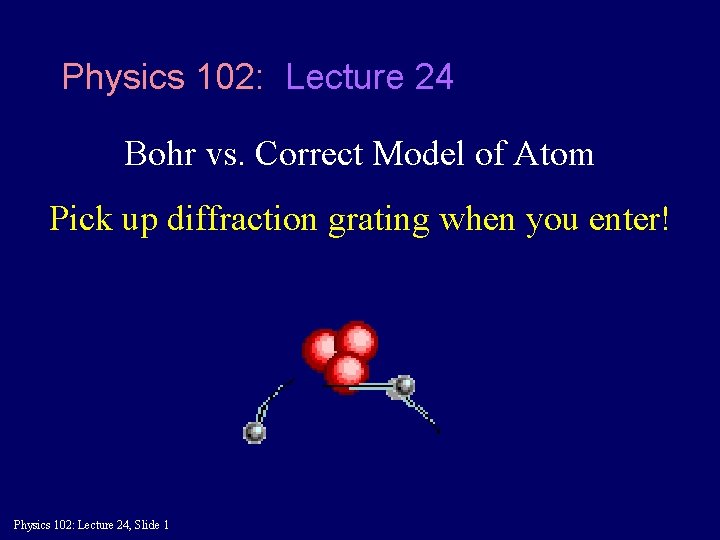
Physics 102: Lecture 24 Bohr vs. Correct Model of Atom Pick up diffraction grating when you enter! Physics 102: Lecture 24, Slide 1
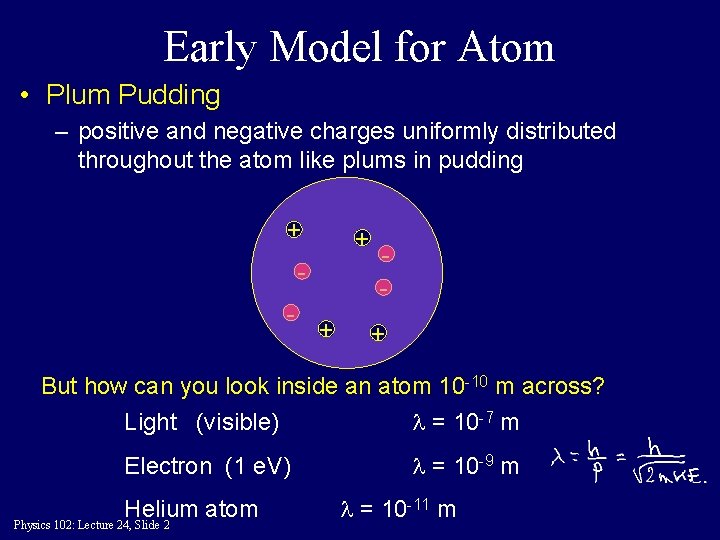
Early Model for Atom • Plum Pudding – positive and negative charges uniformly distributed throughout the atom like plums in pudding + + - + + But how can you look inside an atom 10 -10 m across? Light (visible) l = 10 -7 m Electron (1 e. V) Helium atom Physics 102: Lecture 24, Slide 2 l = 10 -9 m l = 10 -11 m
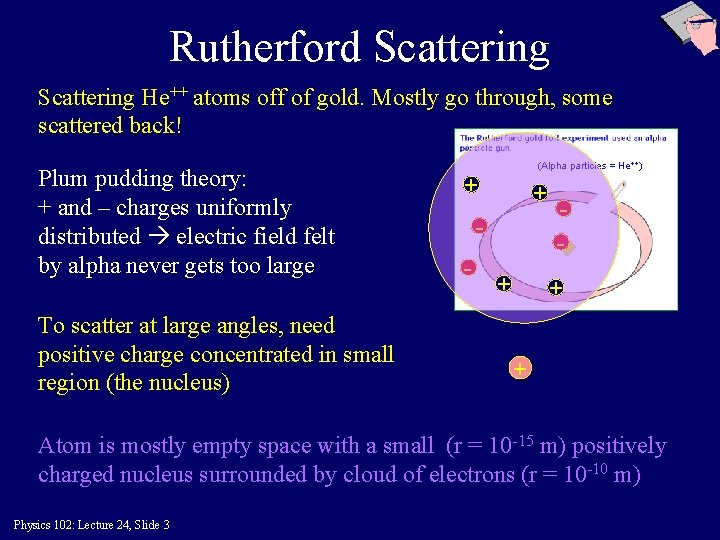
Rutherford Scattering He++ atoms off of gold. Mostly go through, some scattered back! Plum pudding theory: + and – charges uniformly distributed electric field felt by alpha never gets too large To scatter at large angles, need positive charge concentrated in small region (the nucleus) (Alpha particles = He++) + + - + + + Atom is mostly empty space with a small (r = 10 -15 m) positively charged nucleus surrounded by cloud of electrons (r = 10 -10 m) Physics 102: Lecture 24, Slide 3
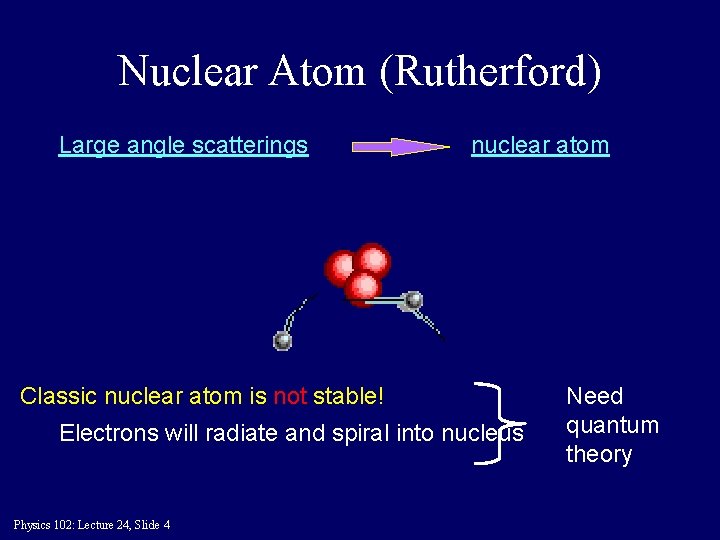
Nuclear Atom (Rutherford) Large angle scatterings nuclear atom Classic nuclear atom is not stable! Electrons will radiate and spiral into nucleus Physics 102: Lecture 24, Slide 4 Need quantum theory
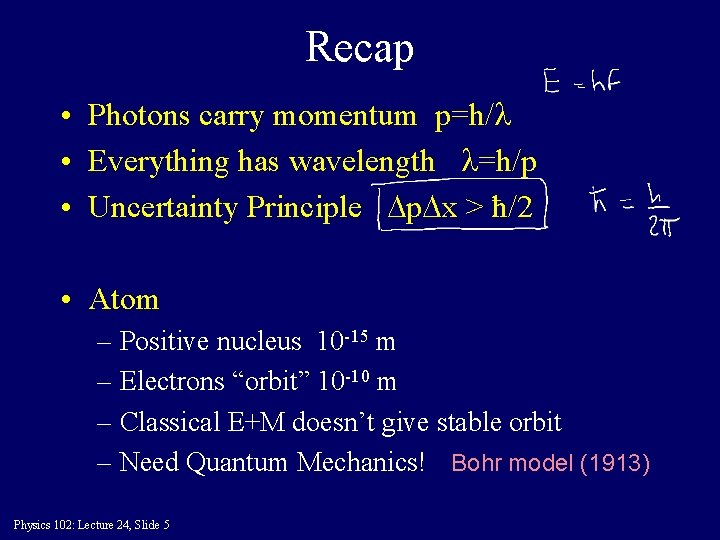
Recap • Photons carry momentum p=h/l • Everything has wavelength l=h/p • Uncertainty Principle p x > ħ/2 • Atom – Positive nucleus 10 -15 m – Electrons “orbit” 10 -10 m – Classical E+M doesn’t give stable orbit – Need Quantum Mechanics! Bohr model (1913) Physics 102: Lecture 24, Slide 5
Bohr Model is Science fiction The Bohr model is complete nonsense. Electrons do not circle the nucleus in little planetlike orbits. The assumptions injected into the Bohr model have no basis in physical reality. BUT the model does get some of the numbers right for SIMPLE atoms… Physics 102: Lecture 24, Slide 6
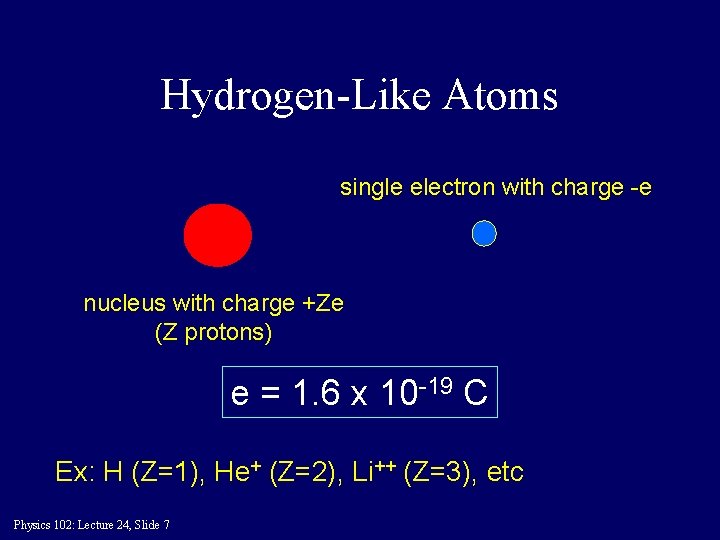
Hydrogen-Like Atoms single electron with charge -e nucleus with charge +Ze (Z protons) e = 1. 6 x 10 -19 C Ex: H (Z=1), He+ (Z=2), Li++ (Z=3), etc Physics 102: Lecture 24, Slide 7
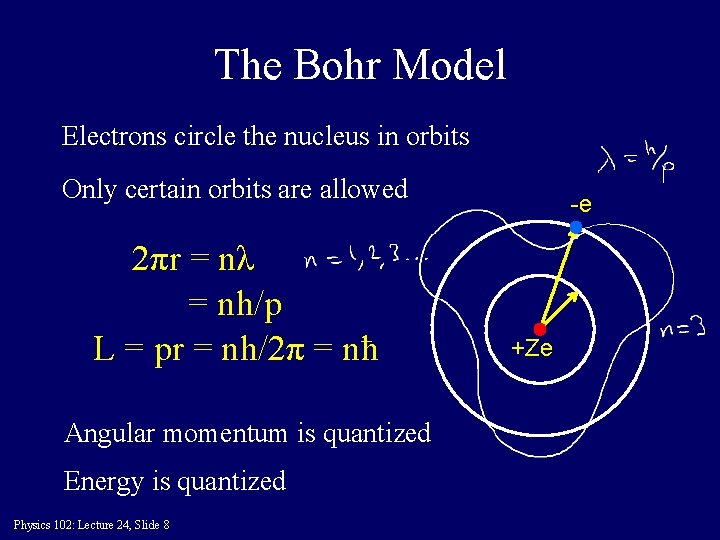
The Bohr Model Electrons circle the nucleus in orbits Only certain orbits are allowed 2πr = nλ = nh/p L = pr = nh/2π = nħ Angular momentum is quantized Energy is quantized Physics 102: Lecture 24, Slide 8 -e +Ze
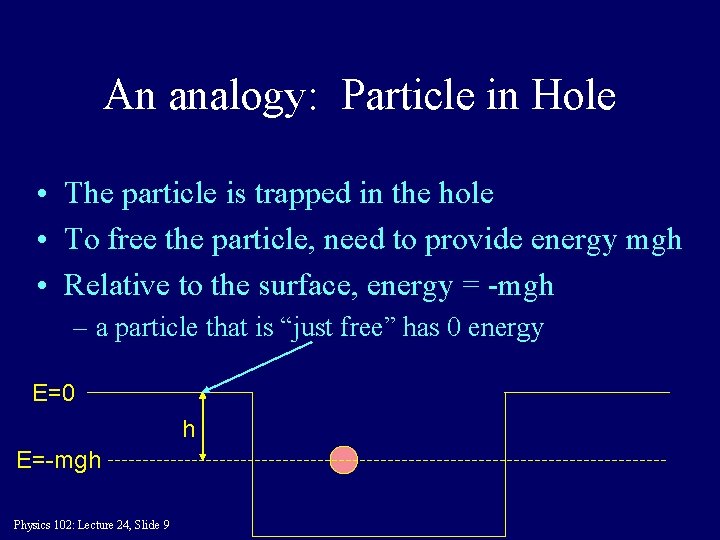
An analogy: Particle in Hole • The particle is trapped in the hole • To free the particle, need to provide energy mgh • Relative to the surface, energy = -mgh – a particle that is “just free” has 0 energy E=0 h E=-mgh Physics 102: Lecture 24, Slide 9
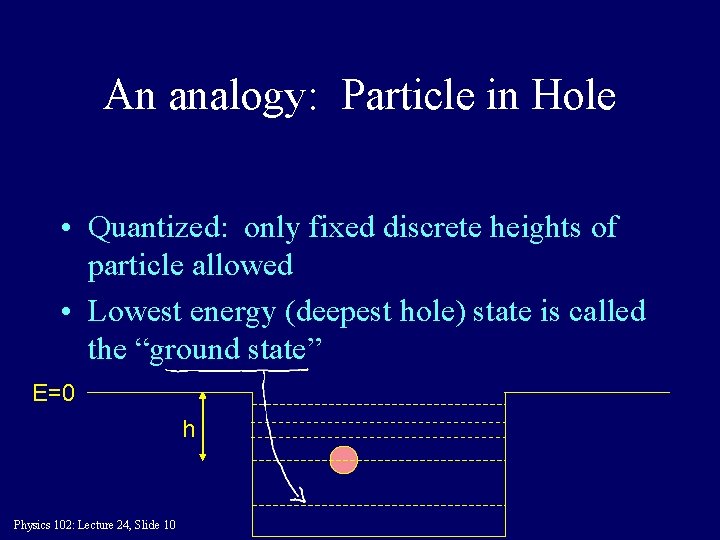
An analogy: Particle in Hole • Quantized: only fixed discrete heights of particle allowed • Lowest energy (deepest hole) state is called the “ground state” E=0 h Physics 102: Lecture 24, Slide 10
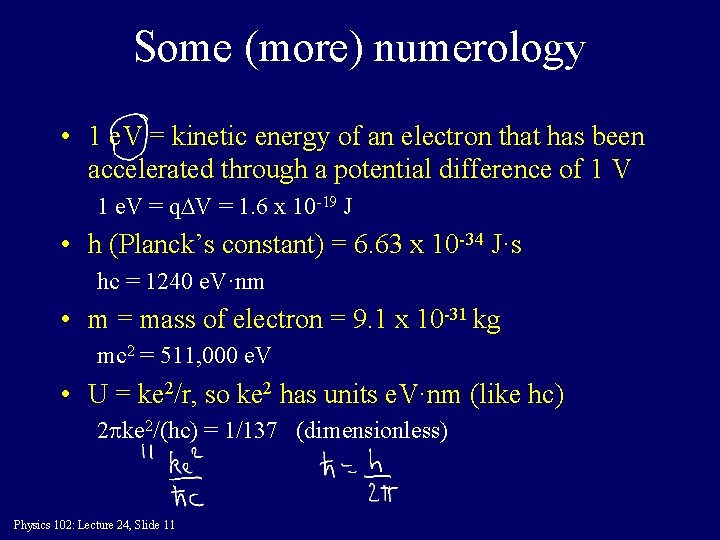
Some (more) numerology • 1 e. V = kinetic energy of an electron that has been accelerated through a potential difference of 1 V 1 e. V = q V = 1. 6 x 10 -19 J • h (Planck’s constant) = 6. 63 x 10 -34 J·s hc = 1240 e. V·nm • m = mass of electron = 9. 1 x 10 -31 kg mc 2 = 511, 000 e. V • U = ke 2/r, so ke 2 has units e. V·nm (like hc) 2 ke 2/(hc) = 1/137 (dimensionless) Physics 102: Lecture 24, Slide 11
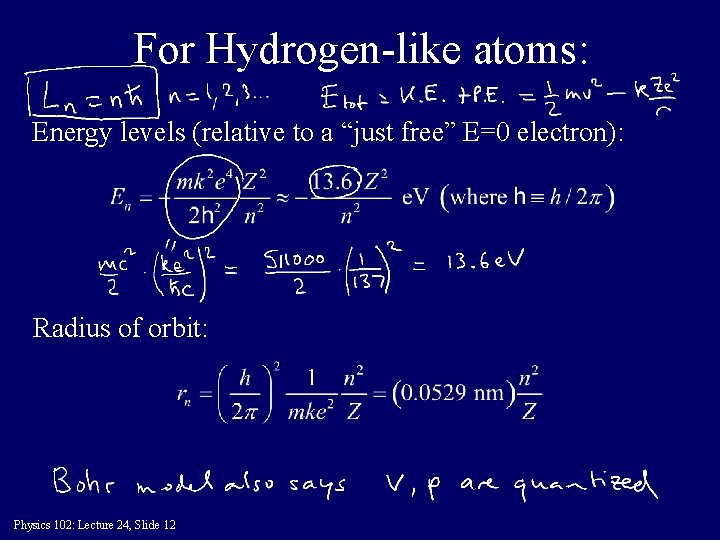
For Hydrogen-like atoms: Energy levels (relative to a “just free” E=0 electron): Radius of orbit: Physics 102: Lecture 24, Slide 12
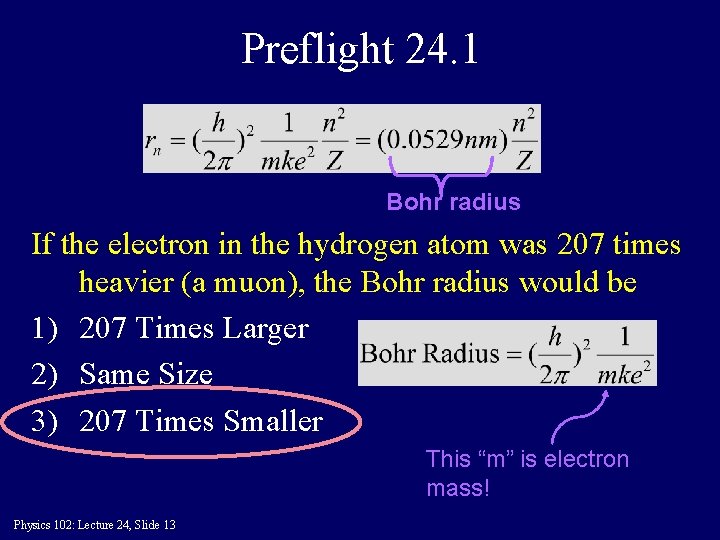
Preflight 24. 1 Bohr radius If the electron in the hydrogen atom was 207 times heavier (a muon), the Bohr radius would be 1) 207 Times Larger 2) Same Size 3) 207 Times Smaller This “m” is electron mass! Physics 102: Lecture 24, Slide 13
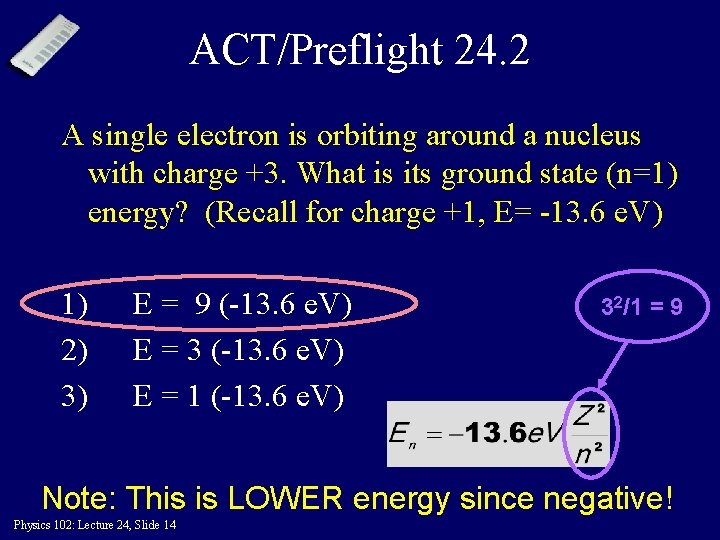
ACT/Preflight 24. 2 A single electron is orbiting around a nucleus with charge +3. What is its ground state (n=1) energy? (Recall for charge +1, E= -13. 6 e. V) 1) 2) 3) E = 9 (-13. 6 e. V) E = 3 (-13. 6 e. V) E = 1 (-13. 6 e. V) 32/1 = 9 Note: This is LOWER energy since negative! Physics 102: Lecture 24, Slide 14
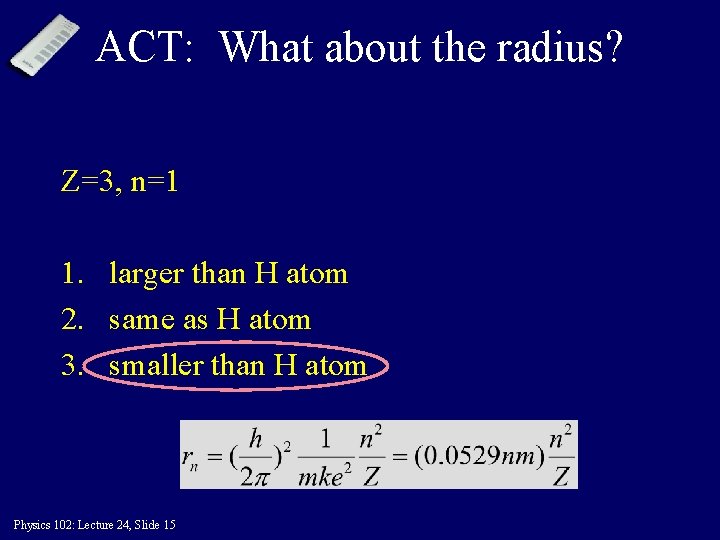
ACT: What about the radius? Z=3, n=1 1. larger than H atom 2. same as H atom 3. smaller than H atom Physics 102: Lecture 24, Slide 15
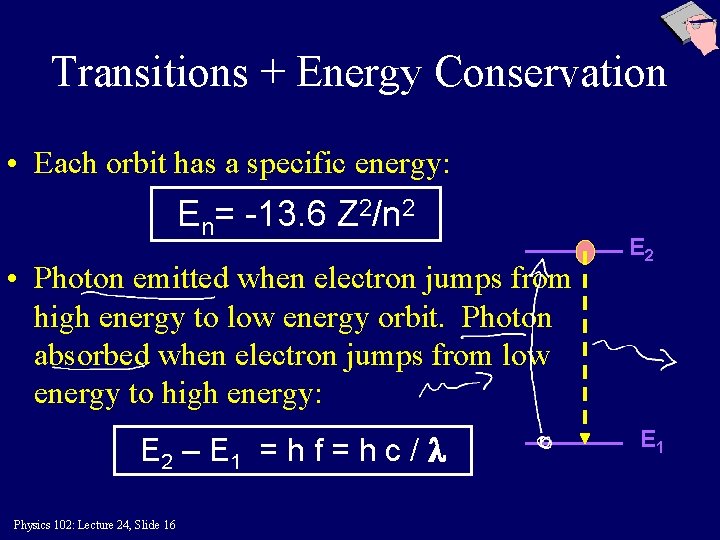
Transitions + Energy Conservation • Each orbit has a specific energy: En= -13. 6 Z 2/n 2 • Photon emitted when electron jumps from high energy to low energy orbit. Photon absorbed when electron jumps from low energy to high energy: E 2 – E 1 = h f = h c / l Physics 102: Lecture 24, Slide 16 E 2 E 1
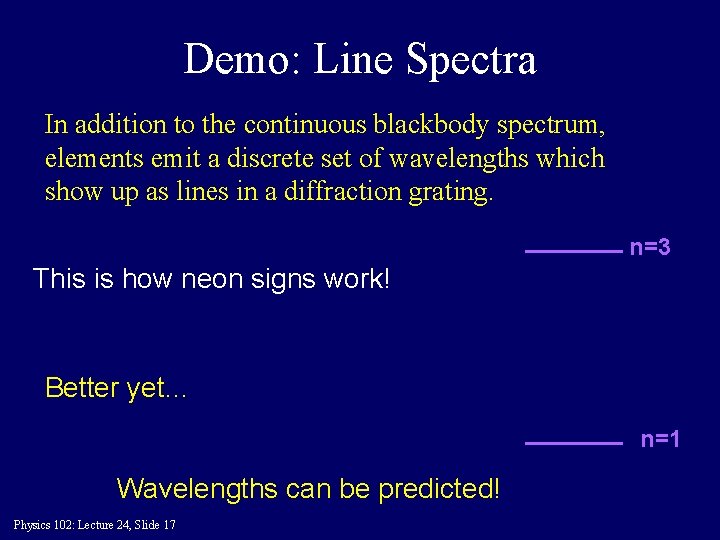
Demo: Line Spectra In addition to the continuous blackbody spectrum, elements emit a discrete set of wavelengths which show up as lines in a diffraction grating. n=3 This is how neon signs work! Better yet… n=1 Wavelengths can be predicted! Physics 102: Lecture 24, Slide 17
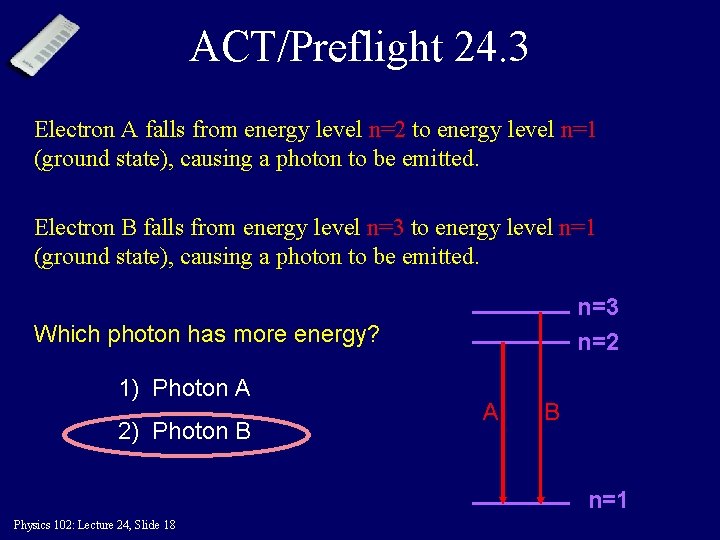
ACT/Preflight 24. 3 Electron A falls from energy level n=2 to energy level n=1 (ground state), causing a photon to be emitted. Electron B falls from energy level n=3 to energy level n=1 (ground state), causing a photon to be emitted. n=3 n=2 Which photon has more energy? 1) Photon A 2) Photon B A B n=1 Physics 102: Lecture 24, Slide 18
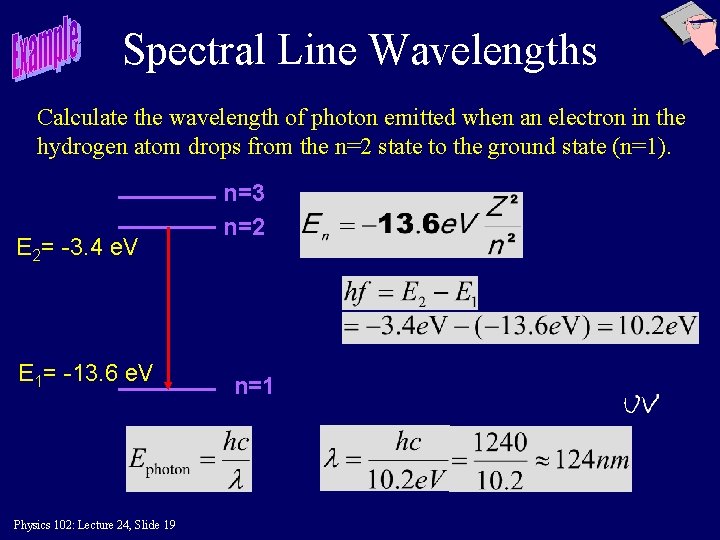
Spectral Line Wavelengths Calculate the wavelength of photon emitted when an electron in the hydrogen atom drops from the n=2 state to the ground state (n=1). E 2= -3. 4 e. V E 1= -13. 6 e. V Physics 102: Lecture 24, Slide 19 n=3 n=2 n=1
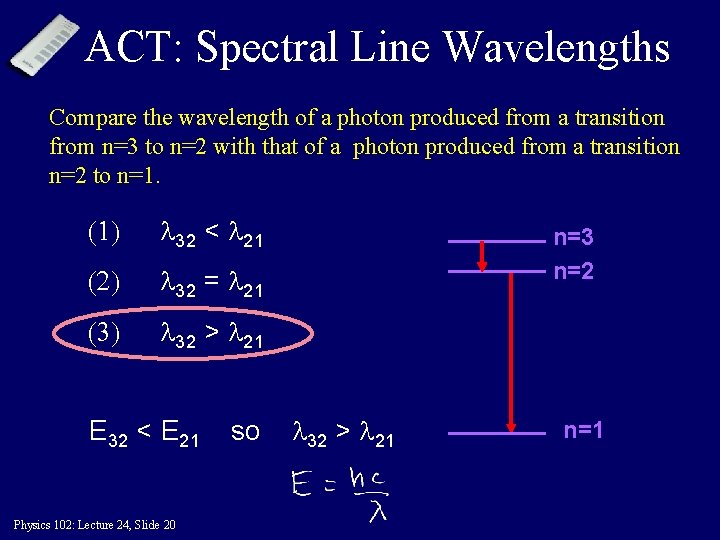
ACT: Spectral Line Wavelengths Compare the wavelength of a photon produced from a transition from n=3 to n=2 with that of a photon produced from a transition n=2 to n=1. (1) l 32 < l 21 (2) l 32 = l 21 (3) l 32 > l 21 E 32 < E 21 Physics 102: Lecture 24, Slide 20 so n=3 n=2 l 32 > l 21 n=1
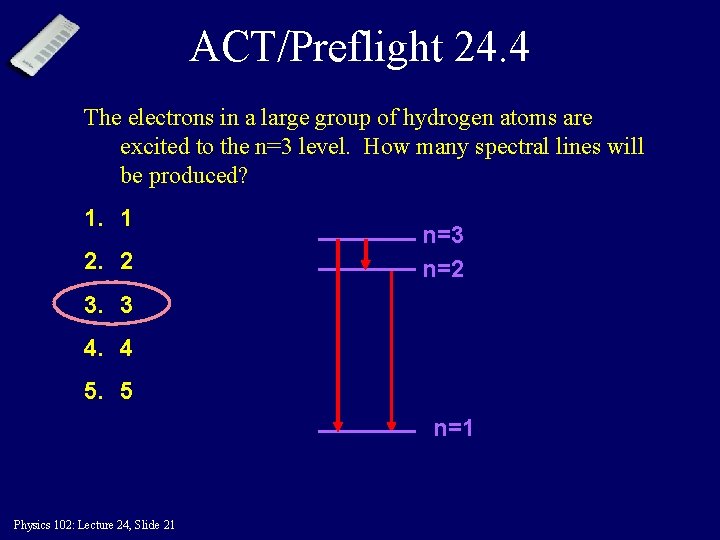
ACT/Preflight 24. 4 The electrons in a large group of hydrogen atoms are excited to the n=3 level. How many spectral lines will be produced? 1. 1 2. 2 n=3 n=2 3. 3 4. 4 5. 5 n=1 Physics 102: Lecture 24, Slide 21
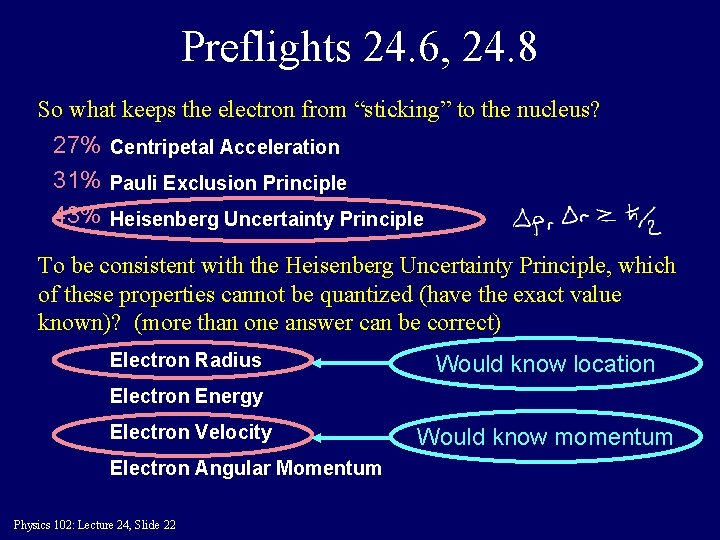
Preflights 24. 6, 24. 8 So what keeps the electron from “sticking” to the nucleus? 27% Centripetal Acceleration 31% Pauli Exclusion Principle 43% Heisenberg Uncertainty Principle To be consistent with the Heisenberg Uncertainty Principle, which of these properties cannot be quantized (have the exact value known)? (more than one answer can be correct) Electron Radius Would know location Electron Energy Electron Velocity Electron Angular Momentum Physics 102: Lecture 24, Slide 22 Would know momentum
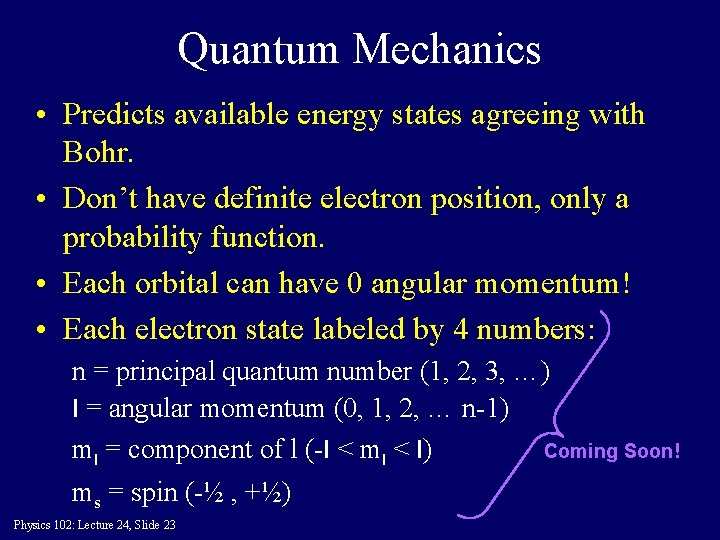
Quantum Mechanics • Predicts available energy states agreeing with Bohr. • Don’t have definite electron position, only a probability function. • Each orbital can have 0 angular momentum! • Each electron state labeled by 4 numbers: n = principal quantum number (1, 2, 3, …) l = angular momentum (0, 1, 2, … n-1) ml = component of l (-l < ml < l) Coming Soon! ms = spin (-½ , +½) Physics 102: Lecture 24, Slide 23
Summary • Bohr’s Model gives accurate values for electron energy levels. . . • But Quantum Mechanics is needed to describe electrons in atom. • Electrons jump between states by emitting or absorbing photons of the appropriate energy. • Each state has specific energy and is labeled by 4 quantum numbers (next time). Physics 102: Lecture 24, Slide 24
- Slides: 24