
Physics 102 Lecture 15 Electromagnetic Waves and Polarization
- Slides: 26
Physics 102: Lecture 15 Electromagnetic Waves and Polarization • Today’s lecture will cover Textbook Sections 22. 7 -8 Physics 102: Lecture 15, Slide 1
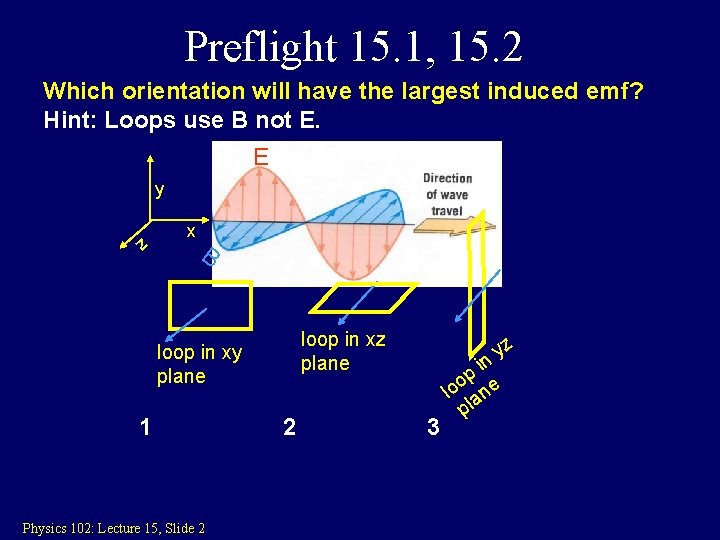
Preflight 15. 1, 15. 2 Which orientation will have the largest induced emf? Hint: Loops use B not E. E y z x B loop in xz plane loop in xy plane 1 Physics 102: Lecture 15, Slide 2 2 yz 3 in p loo ane pl
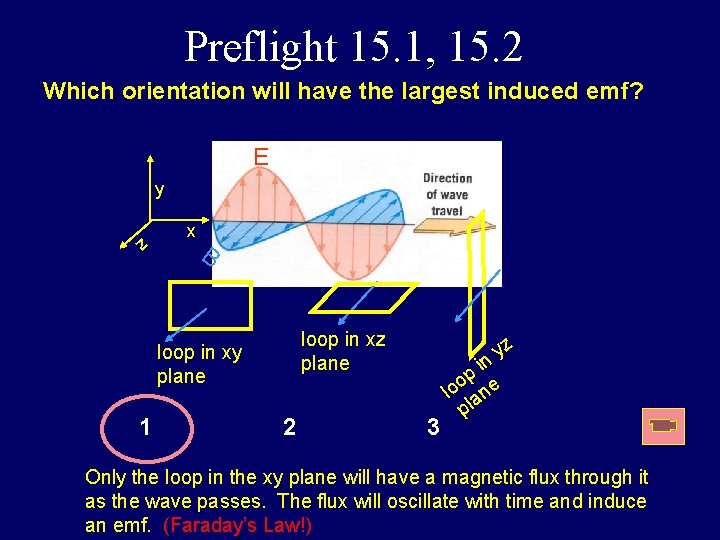
Preflight 15. 1, 15. 2 Which orientation will have the largest induced emf? E y z x B loop in xz plane loop in xy plane 1 2 yz 3 in p loo ane pl Only the loop in the xy plane will have a magnetic flux through it as the wave passes. The flux will oscillate with time and induce an emf. (Faraday’s Law!)
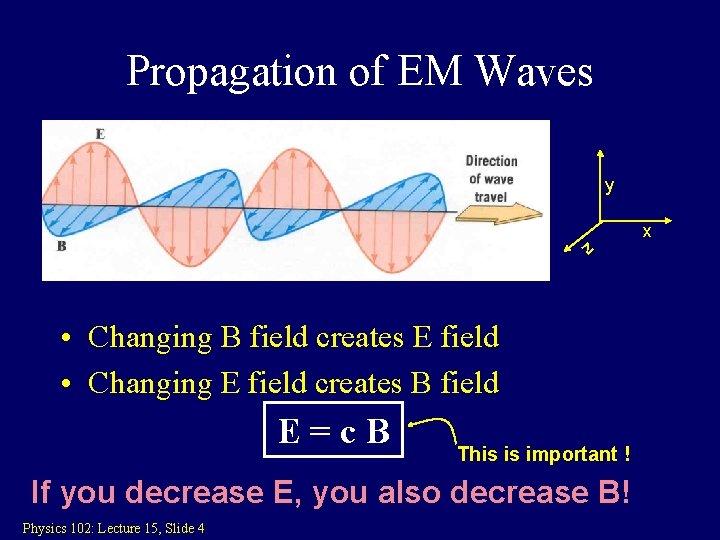
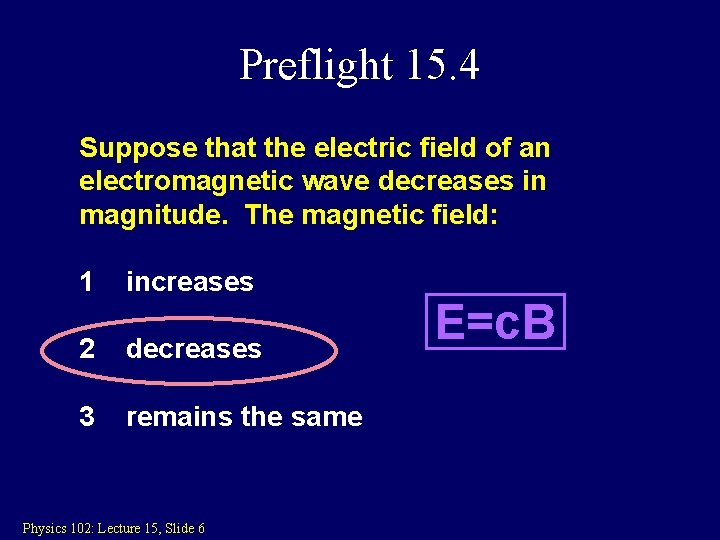
Propagation of EM Waves y z • Changing B field creates E field • Changing E field creates B field E=c. B This is important ! If you decrease E, you also decrease B! Physics 102: Lecture 15, Slide 4 x
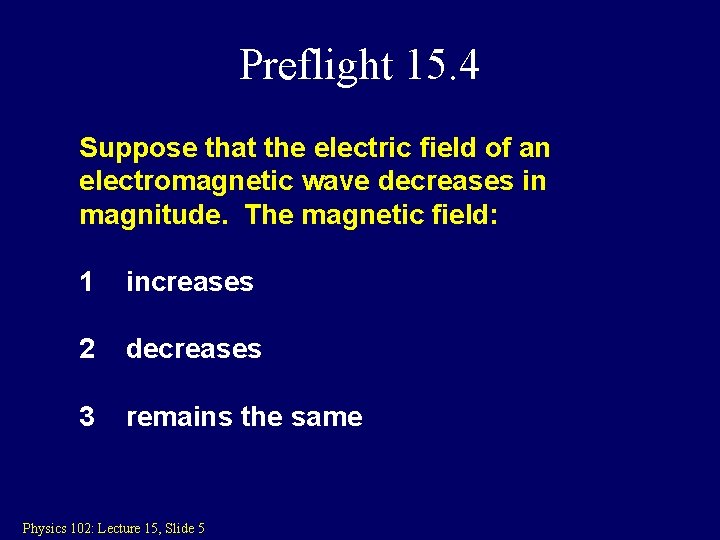
Preflight 15. 4 Suppose that the electric field of an electromagnetic wave decreases in magnitude. The magnetic field: 1 increases 2 decreases 3 remains the same Physics 102: Lecture 15, Slide 5
Preflight 15. 4 Suppose that the electric field of an electromagnetic wave decreases in magnitude. The magnetic field: 1 increases 2 decreases 3 remains the same Physics 102: Lecture 15, Slide 6 E=c. B
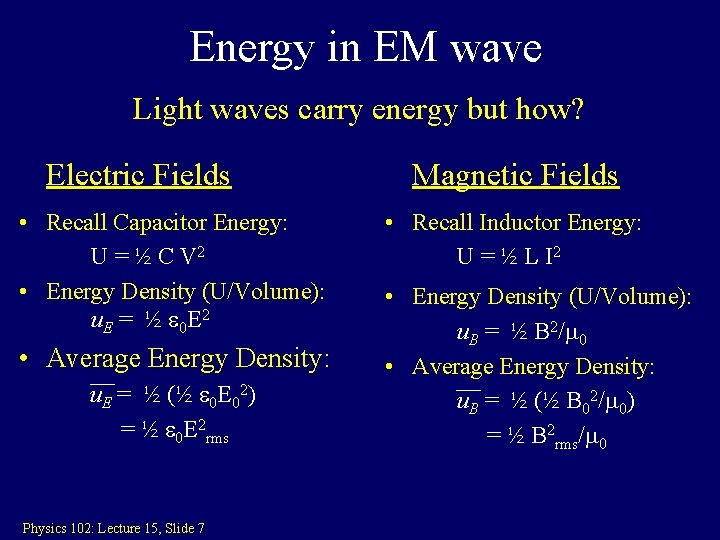
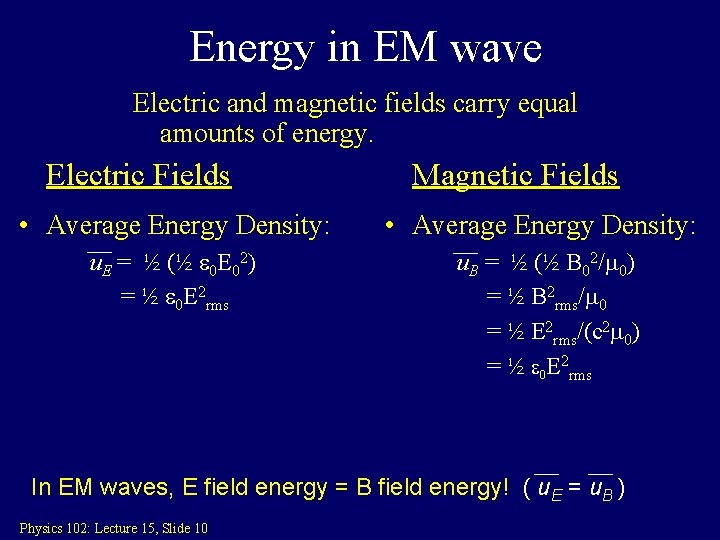
Energy in EM wave Light waves carry energy but how? Electric Fields • Recall Capacitor Energy: U = ½ C V 2 • Energy Density (U/Volume): u. E = ½ e 0 E 2 • Average Energy Density: u. E = ½ (½ e 0 E 02) = ½ e 0 E 2 rms Physics 102: Lecture 15, Slide 7 Magnetic Fields • Recall Inductor Energy: U = ½ L I 2 • Energy Density (U/Volume): u. B = ½ B 2/m 0 • Average Energy Density: u. B = ½ (½ B 02/m 0) = ½ B 2 rms/m 0
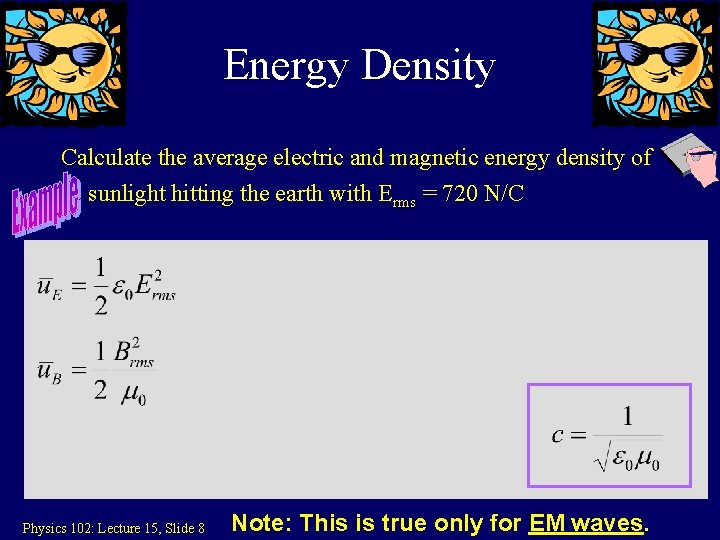
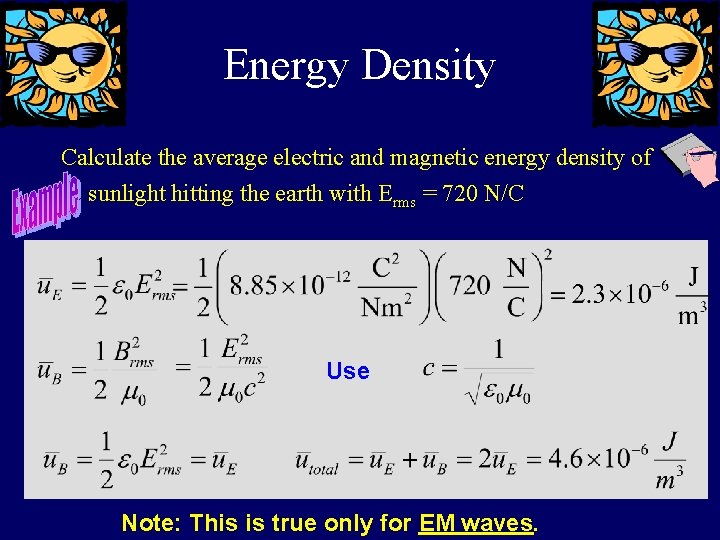
Energy Density Calculate the average electric and magnetic energy density of sunlight hitting the earth with Erms = 720 N/C Physics 102: Lecture 15, Slide 8 Note: This is true only for EM waves.
Energy Density Calculate the average electric and magnetic energy density of sunlight hitting the earth with Erms = 720 N/C Use Note: This is true only for EM waves.
Energy in EM wave Electric and magnetic fields carry equal amounts of energy. Electric Fields • Average Energy Density: u. E = ½ (½ e 0 E 02) = ½ e 0 E 2 rms Magnetic Fields • Average Energy Density: u. B = ½ (½ B 02/m 0) = ½ B 2 rms/m 0 = ½ E 2 rms/(c 2 m 0) = ½ e 0 E 2 rms In EM waves, E field energy = B field energy! ( u. E = u. B ) Physics 102: Lecture 15, Slide 10
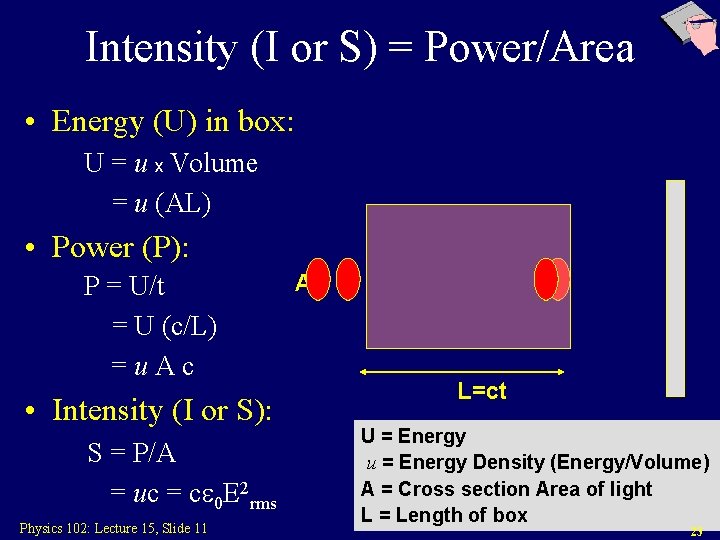
Intensity (I or S) = Power/Area • Energy (U) in box: U = u x Volume = u (AL) • Power (P): P = U/t = U (c/L) =u. Ac • Intensity (I or S): S = P/A = uc = ce 0 E 2 rms Physics 102: Lecture 15, Slide 11 A L L=ct U = Energy u = Energy Density (Energy/Volume) A = Cross section Area of light L = Length of box 23 23
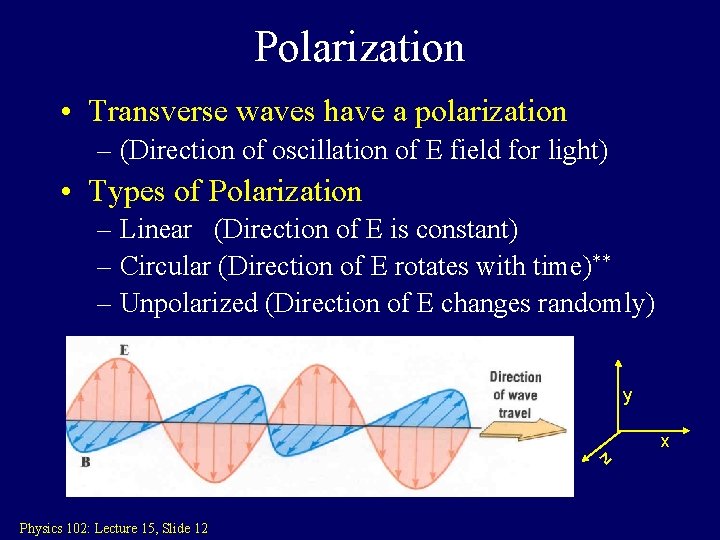
Polarization • Transverse waves have a polarization – (Direction of oscillation of E field for light) • Types of Polarization – Linear (Direction of E is constant) – Circular (Direction of E rotates with time)** – Unpolarized (Direction of E changes randomly) y z Physics 102: Lecture 15, Slide 12 x
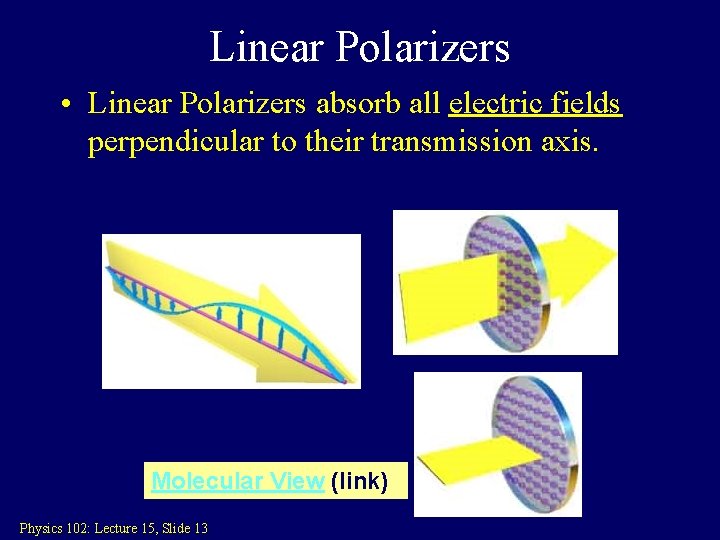
Linear Polarizers • Linear Polarizers absorb all electric fields perpendicular to their transmission axis. Molecular View (link) Physics 102: Lecture 15, Slide 13
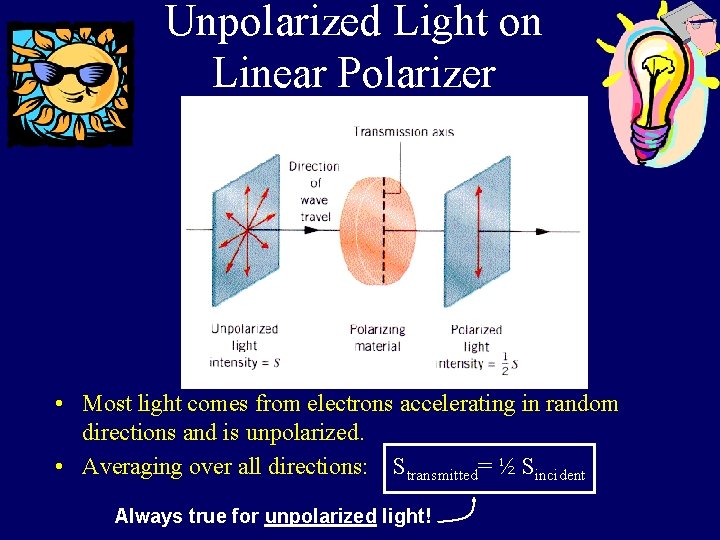
Unpolarized Light on Linear Polarizer • Most light comes from electrons accelerating in random directions and is unpolarized. • Averaging over all directions: Stransmitted= ½ Sincident Always true for unpolarized light!
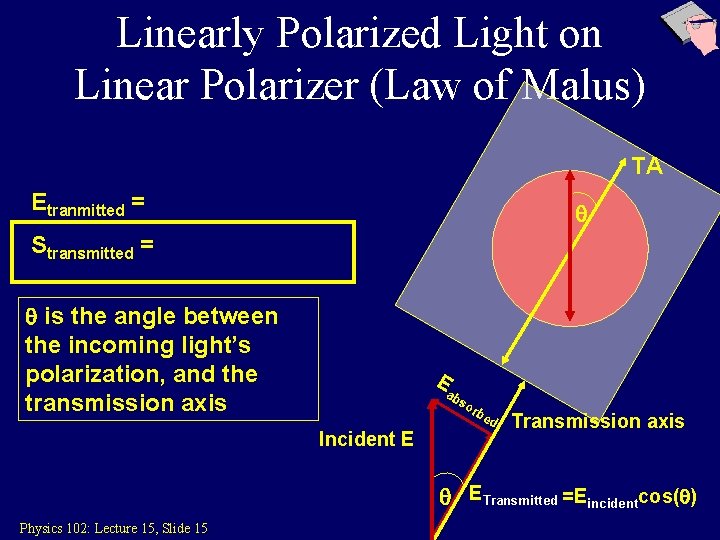
Linearly Polarized Light on Linear Polarizer (Law of Malus) TA Etranmitted = q Stransmitted = q is the angle between the incoming light’s polarization, and the transmission axis E ab so r be Incident E d Transmission axis q ETransmitted =Eincidentcos(q) Physics 102: Lecture 15, Slide 15
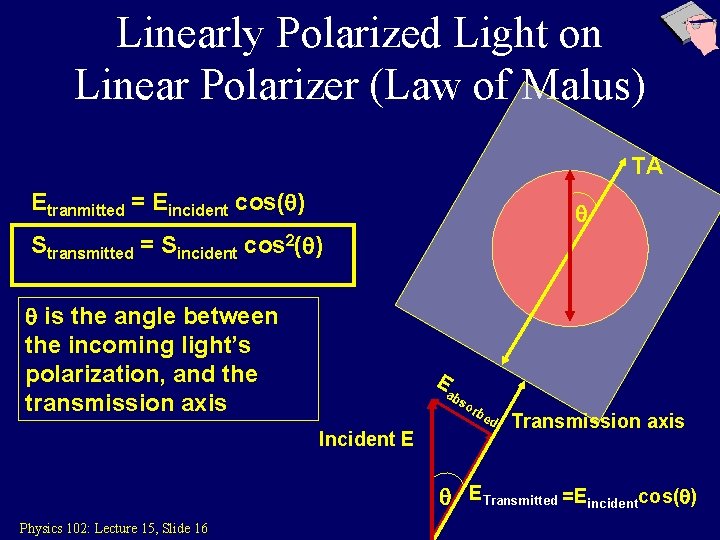
Linearly Polarized Light on Linear Polarizer (Law of Malus) TA Etranmitted = Eincident cos(q) q Stransmitted = Sincident cos 2(q) q is the angle between the incoming light’s polarization, and the transmission axis E ab so r be Incident E d Transmission axis q ETransmitted =Eincidentcos(q) Physics 102: Lecture 15, Slide 16
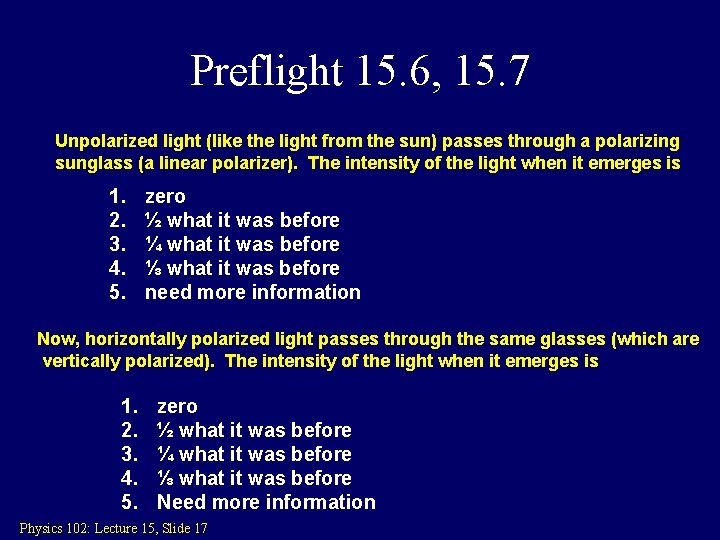
Preflight 15. 6, 15. 7 Unpolarized light (like the light from the sun) passes through a polarizing sunglass (a linear polarizer). The intensity of the light when it emerges is 1. 2. 3. 4. 5. zero ½ what it was before ¼ what it was before ⅓ what it was before need more information Now, horizontally polarized light passes through the same glasses (which are vertically polarized). The intensity of the light when it emerges is 1. 2. 3. 4. 5. zero ½ what it was before ¼ what it was before ⅓ what it was before Need more information Physics 102: Lecture 15, Slide 17
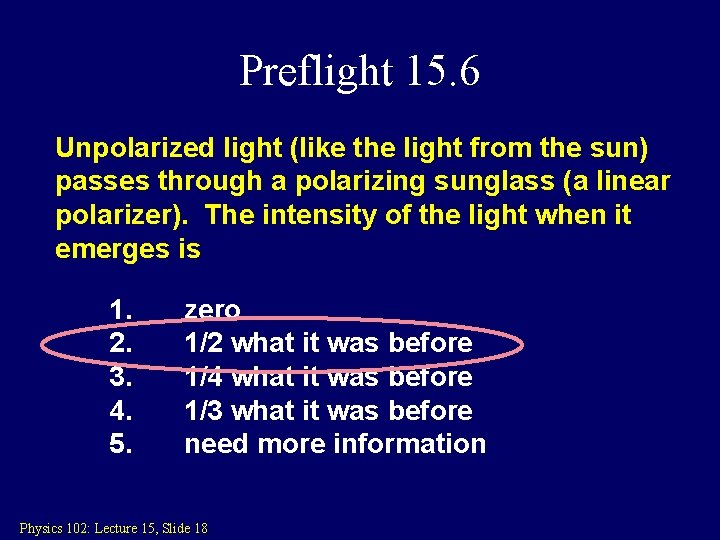
Preflight 15. 6 Unpolarized light (like the light from the sun) passes through a polarizing sunglass (a linear polarizer). The intensity of the light when it emerges is 1. 2. 3. 4. 5. zero 1/2 what it was before 1/4 what it was before 1/3 what it was before need more information Physics 102: Lecture 15, Slide 18
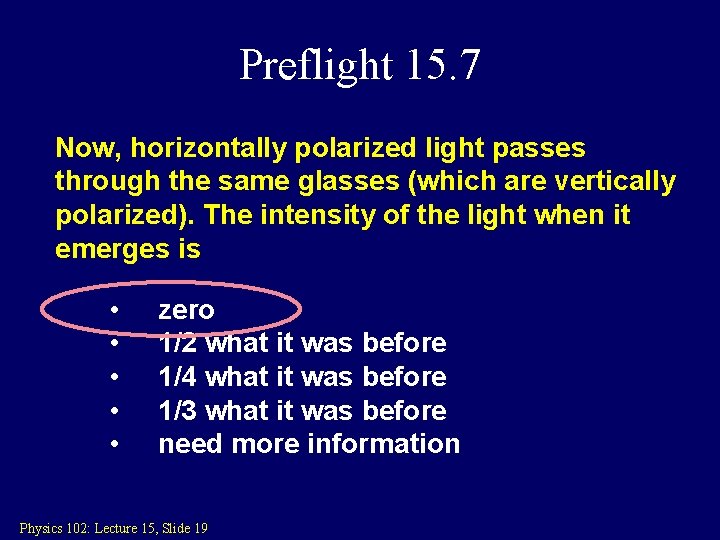
Preflight 15. 7 Now, horizontally polarized light passes through the same glasses (which are vertically polarized). The intensity of the light when it emerges is • zero • 1/2 what it was before • 1/4 what it was before • 1/3 what it was before • need more information Physics 102: Lecture 15, Slide 19
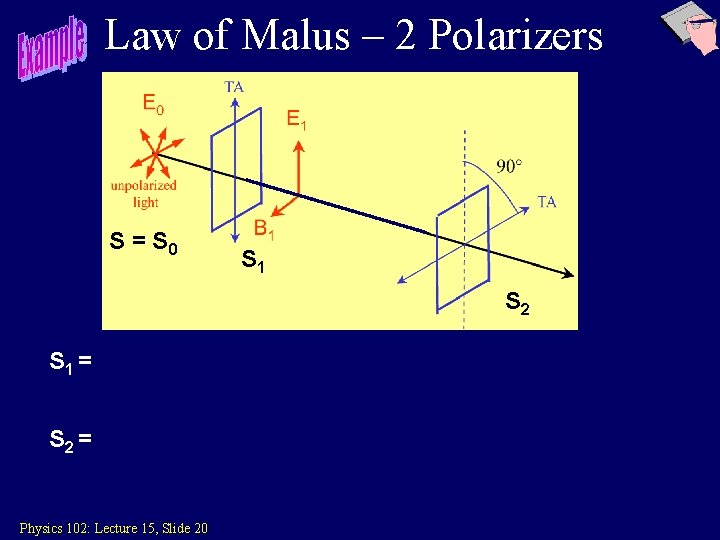
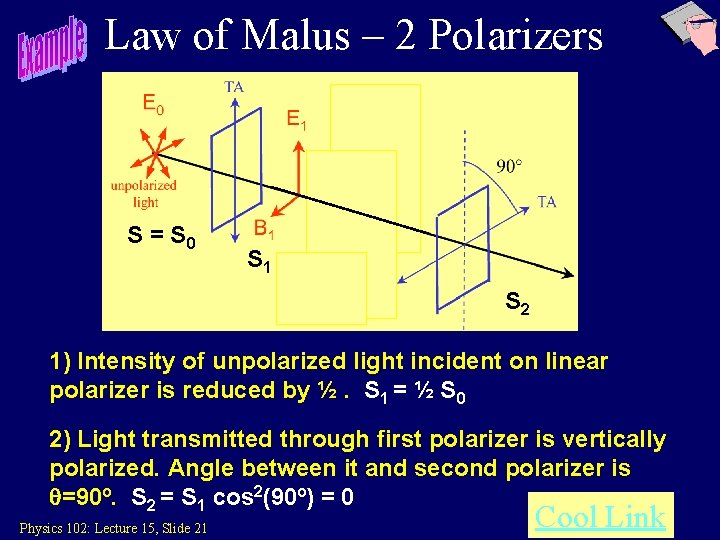
Law of Malus – 2 Polarizers S = S 0 S 1 S 2 S 1 = S 2 = Physics 102: Lecture 15, Slide 20
Law of Malus – 2 Polarizers S = S 0 S 1 S 2 1) Intensity of unpolarized light incident on linear polarizer is reduced by ½. S 1 = ½ S 0 2) Light transmitted through first polarizer is vertically polarized. Angle between it and second polarizer is q=90º. S 2 = S 1 cos 2(90º) = 0 Physics 102: Lecture 15, Slide 21 Cool Link
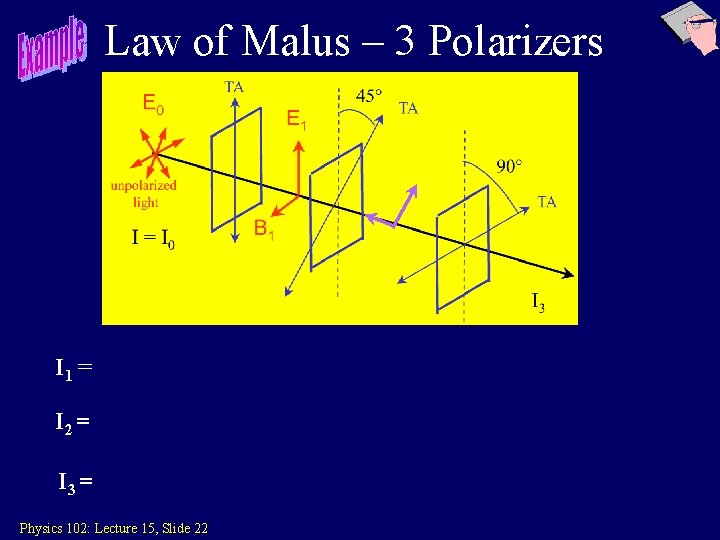
Law of Malus – 3 Polarizers I 1 = I 2 = I 3 = Physics 102: Lecture 15, Slide 22
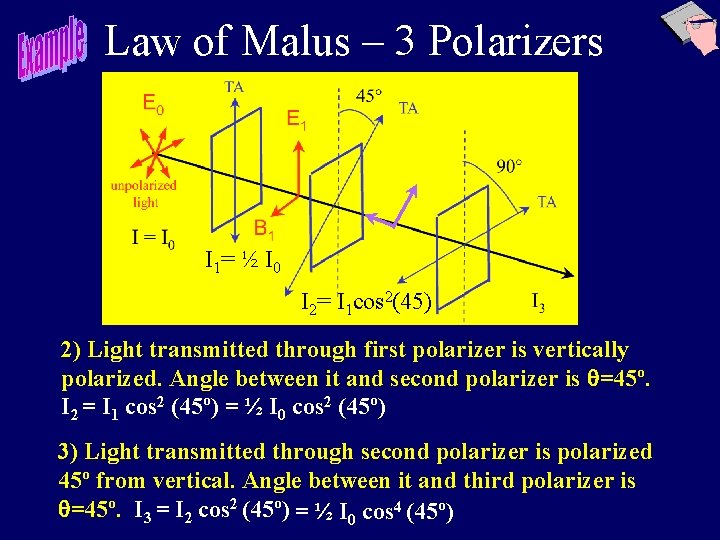
Law of Malus – 3 Polarizers I 1= ½ I 0 I 2= I 1 cos 2(45) 2) Light transmitted through first polarizer is vertically polarized. Angle between it and second polarizer is q=45º. I 2 = I 1 cos 2 (45º) = ½ I 0 cos 2 (45º) 3) Light transmitted through second polarizer is polarized 45º from vertical. Angle between it and third polarizer is q=45º. I 3 = I 2 cos 2 (45º) = ½ I 0 cos 4 (45º)
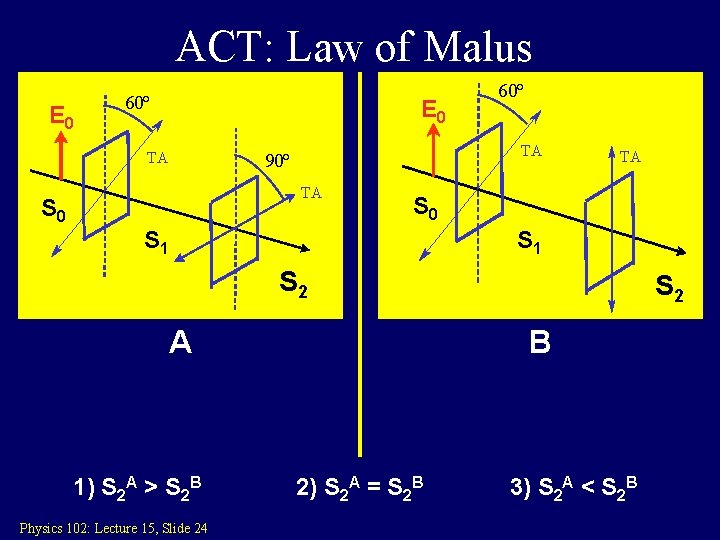
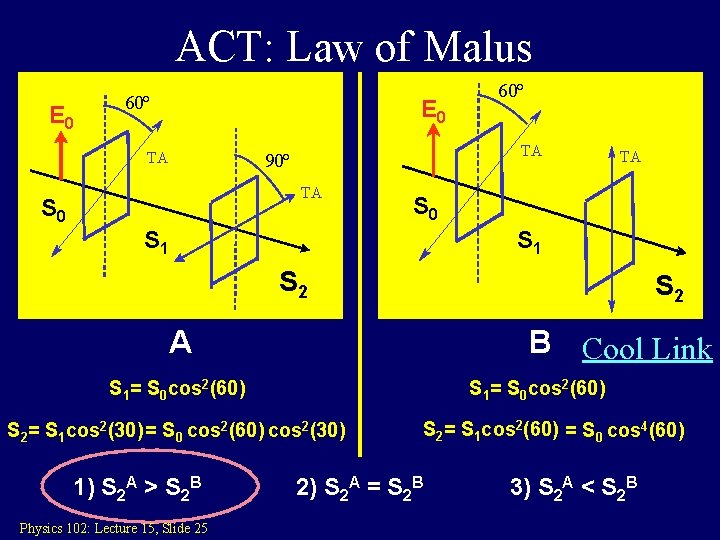
ACT: Law of Malus E 0 60°° E 0 TA 90° TA TA S 0 60°° TA S 0 S 1 S 2 A 1) S 2 A > S 2 B Physics 102: Lecture 15, Slide 24 S 2 B 2) S 2 A = S 2 B 3) S A < S B 2 2
ACT: Law of Malus E 0 60°° E 0 TA 90° TA TA S 0 60°° TA S 0 S 1 S 2 A B Cool Link S 1= S 0 cos 2(60) S 2= S 1 cos 2(30)= S 0 cos 2(60) cos 2(30) 1) S 2 A > S 2 B Physics 102: Lecture 15, Slide 25 S 2= S 1 cos 2(60) = S 0 cos 4(60) 2) S 2 A = S 2 B 3) S A < S B 2 2
See next time! • Read Sections 23. 1 -2, 7 -8 Physics 102: Lecture 15, Slide 26